
Reports
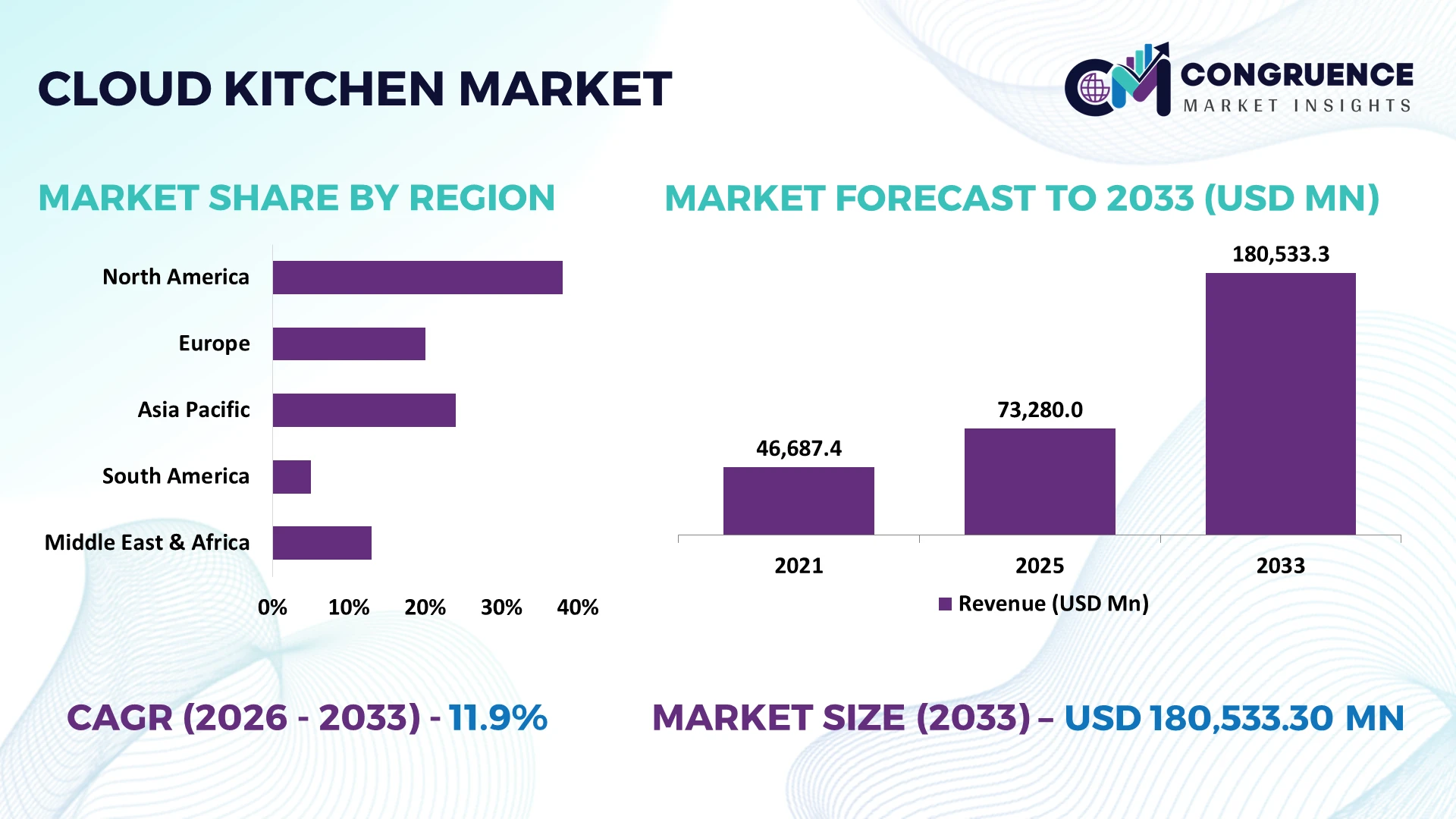
The Global Cloud Kitchen Market was valued at USD 73280 Million in 2025 and is anticipated to reach a value of USD 180533.3 Million by 2033 expanding at a CAGR of 11.93% between 2026 and 2033. Growth is being accelerated by AI-enabled kitchen operations, rapid expansion of food delivery ecosystems, multi-brand virtual kitchen models, and higher digital order penetration across urban markets.
China remains the dominant country, accounting for approximately 28% of global cloud kitchen operating capacity, supported by large-scale digital food delivery networks, smart kitchen automation, and sustained urban consumption. India follows with nearly 18% of operational capacity, driven by expanding quick-service brands and platform-based ordering. Ongoing regional supply-chain diversification across Asia after recent geopolitical trade adjustments has encouraged localized sourcing, while automated order management now supports over 65% of high-volume facilities, improving fulfillment accuracy and kitchen utilization.
Businesses expanding through technology-led multi-brand formats and region-specific fulfillment strategies are positioned to strengthen long-term operational competitiveness.
Market Size & Growth: USD 73,280 Million in 2025 to USD 180,533.3 Million by 2033 at 11.93% CAGR, driven by AI-powered kitchen management and digital food delivery expansion.
Top Growth Drivers: Online food delivery orders increased 22%, kitchen automation adoption reached 37%, and multi-brand kitchen utilization improved approximately 30%.
Short-Term Forecast: By 2028, automated workflows reduce operating costs by 18% while order fulfillment efficiency improves by 24%.
Emerging Technologies: AI forecasting, robotics, and IoT kitchen monitoring improve inventory accuracy by 20% and reduce food waste by 16%.
Regional Leaders: Asia-Pacific exceeds USD 82 Billion, North America approaches USD 46 Billion, and Europe surpasses USD 30 Billion, supported by rapid digital ordering and regional expansion.
Consumer/End-User Trends: More than 68% of urban consumers prefer app-based food ordering at least once weekly, increasing repeat purchases.
Pilot/Case Example: In 2026, an AI-enabled cloud kitchen deployment improved preparation speed by 28% and lowered delivery delays by 19%.
Competitive Landscape: Top operators collectively hold nearly 34% market share, with Rebel Foods, Kitchen United, Keatz, Kitopi, and CloudKitchens leading expansion.
Regulatory & ESG Impact: Sustainable packaging initiatives reduce single-use plastic consumption by approximately 25% while stricter food safety compliance strengthens operations across expanding markets.
Investment & Funding: More than USD 4 Billion supports automation, strategic partnerships, and regional expansion amid evolving global supply-chain localization.
Innovation & Future Outlook: Advanced predictive analytics, autonomous kitchen equipment, and hyperlocal fulfillment strengthen next-generation cloud kitchen networks and accelerate scalable growth.
Cloud Kitchen Market expansion is increasingly shaped by AI-driven demand forecasting, robotic food preparation, and smart inventory systems serving quick-service restaurants, virtual brands, and institutional food providers. Automated kitchen technologies have improved order accuracy by approximately 20%, while localized ingredient sourcing has gained momentum amid evolving food safety and supply-chain regulations. These operational advances continue to redefine competitive strategies across high-growth regional markets.
The Cloud Kitchen Market has become strategically important as restaurant operators prioritize asset-light expansion, digital-first customer engagement, and faster market entry without conventional dine-in infrastructure. Competitive differentiation increasingly depends on intelligent kitchen orchestration, delivery network optimization, and multi-brand operating models. Infrastructure modernization and stricter food safety compliance across major economies are encouraging centralized production hubs, while digital ordering now represents more than 70% of transactions for many leading virtual kitchen operators, reshaping investment priorities and operational benchmarks.
AI-enabled kitchen management platforms outperform legacy manual scheduling systems by reducing food preparation time by approximately 22% and lowering ingredient waste by nearly 18% through predictive demand forecasting and automated inventory control. China continues to lead large-scale deployment through dense urban fulfillment networks, while India records faster expansion in new virtual kitchen launches supported by mobile-first ordering ecosystems and franchise partnerships. Over the next two to three years, automated order routing and smart kitchen technologies are expected to exceed 60% deployment across high-volume facilities, strengthening operational consistency.
A practical example is the deployment of centralized production kitchens serving multiple digital restaurant brands from one location, reducing delivery radius overlap and improving kitchen utilization by nearly 25%. Companies are increasing investment in AI platforms, regional fulfillment centers, and logistics partnerships while expanding sustainable packaging initiatives where operationally viable. Organizations that combine technology integration with localized fulfillment strategies will secure stronger competitive positioning, higher operating efficiency, and greater resilience in rapidly evolving food delivery ecosystems.
The strongest growth driver is the rapid adoption of AI-enabled multi-brand cloud kitchen operations that maximize kitchen utilization while reducing operating complexity. Automated demand forecasting improves inventory accuracy by approximately 20%, while intelligent kitchen scheduling increases order throughput by nearly 24% and lowers food waste by around 16%. India continues to witness accelerated deployment as restaurant groups expand delivery-only formats into Tier-2 cities, supported by digital payment infrastructure and evolving food safety regulations. This operational shift enables companies to serve multiple restaurant concepts from a single production facility. Leading operators are responding through technology investments, strategic delivery partnerships, and centralized kitchen expansion, creating scalable operating models with stronger margin discipline and faster market penetration.
Persistent pressure from delivery commissions, labor costs, and ingredient price fluctuations continues to limit profitability across cloud kitchen networks. In several urban markets, third-party delivery expenses account for nearly 25% of order value, while food input costs have increased by approximately 12% over recent operating cycles. In the United Kingdom, tighter food labeling and compliance requirements have added operational complexity for multi-brand facilities. These structural pressures reduce pricing flexibility and slow expansion into lower-density locations. Companies are mitigating risk through localized procurement, long-term supplier contracts, proprietary ordering applications, and diversified delivery partnerships that reduce dependence on a single platform while improving operational control.
Advanced automation and hyperlocal fulfillment models are creating significant competitive opportunities beyond traditional delivery operations. AI-powered demand prediction reduces stock shortages by approximately 18%, while robotic food preparation improves production consistency by nearly 20%. Japan is accelerating smart kitchen deployment through automation investments that address workforce shortages and improve service reliability. Companies are also developing neighborhood fulfillment hubs integrated with predictive analytics, enabling faster deliveries and optimized inventory allocation. Strategic partnerships between restaurant brands, logistics providers, and technology companies are expanding digital ecosystems, allowing operators to launch new virtual brands rapidly while lowering operating costs and improving customer retention across densely populated markets.
Long-term competitiveness depends on successfully integrating multiple digital platforms, kitchen technologies, workforce management systems, and delivery networks without disrupting operational consistency. More than 40% of expanding operators report integration complexity during multi-location deployments, while cybersecurity incidents targeting digital ordering platforms have increased by approximately 15% as transaction volumes rise. In the United States, rapid expansion across metropolitan markets has intensified pressure on technology interoperability and standardized operating procedures. Companies must strengthen cloud infrastructure, invest in secure API integration, enhance workforce training, and collaborate with technology providers to maintain scalable operations, protect customer data, and sustain consistent service quality across growing cloud kitchen networks.
AI Kitchen Workflow Optimization AI-powered kitchen orchestration is transforming production efficiency, with automated order sequencing reducing preparation time by nearly 22% and improving kitchen utilization by approximately 24%. More than 45% of high-volume operators now deploy predictive inventory systems to reduce food waste and optimize staffing. Rising labor shortages in the United Kingdom and Japan have accelerated automation investments, prompting companies to scale AI platforms and integrate real-time analytics across multi-brand facilities for higher throughput and consistent service quality.
Localized Supply Network Expansion Cloud kitchen operators are restructuring procurement strategies by increasing local sourcing, with regional ingredient procurement exceeding 60% among leading networks to reduce transportation delays and improve freshness. Inventory holding periods have declined by nearly 18%, while delivery consistency has improved by around 15%. Ongoing supply-chain adjustments across Asia continue to encourage decentralized procurement models, leading enterprises to establish regional supplier partnerships and strengthen inventory visibility through digital procurement platforms.
Multi-Brand Facility Consolidation Operators are consolidating multiple digital restaurant concepts into centralized production hubs, increasing average kitchen utilization by approximately 25% while reducing facility overhead by nearly 17%. More than 40% of newly launched cloud kitchens now support four or more virtual brands from a single location. Restaurant groups are restructuring expansion strategies through shared infrastructure, standardized production systems, and unified quality management to maximize operational efficiency without increasing physical footprints.
Smart Delivery Ecosystem Integration End-to-end digital integration between cloud kitchens, logistics providers, and delivery applications has improved order tracking accuracy by approximately 21% while reducing delivery exceptions by nearly 16%. More than 55% of enterprise operators now deploy integrated dispatch platforms supported by real-time routing algorithms. Stricter food traceability requirements in several developed markets are encouraging investment in connected fulfillment technologies, enabling companies to improve customer experience while strengthening operational transparency and compliance.
Independent cloud kitchens remain the leading segment, accounting for approximately 43% of market deployment due to lower capital requirements, flexible expansion models, and rapid adaptation to local consumer demand. Their ability to launch multiple digital brands from a single facility improves kitchen utilization by nearly 23% while reducing operating overhead by around 18%. Virtual Restaurant models continue expanding through delivery platform integration, allowing established restaurant brands to enter new locations without investing in physical dining infrastructure. Companies are strengthening these formats through technology-enabled order management and localized fulfillment strategies.
Kitchen Pods represent the fastest-growing type as modular deployment reduces setup timelines by approximately 35% compared with conventional kitchens. Commissary kitchens remain strategically important for centralized food preparation and standardized quality across franchise networks, particularly in India and the United States. Operators are expanding investments in modular infrastructure, automation, and shared production ecosystems to improve scalability while supporting multi-brand operations with higher operational consistency and stronger asset utilization.
Food Delivery remains the largest application, representing approximately 64% of cloud kitchen activity because digital ordering platforms provide consistent order volume, wider customer reach, and efficient utilization of centralized production facilities. Automated order processing has improved fulfillment accuracy by nearly 20%, while optimized routing has reduced average delivery times by approximately 17%. Operators continue integrating AI-powered forecasting and dynamic menu management to improve customer retention and maximize production efficiency during peak demand periods.
Meal Subscription is the fastest-growing application as consumers increasingly seek scheduled, personalized meal solutions supported by predictive demand planning and recurring digital payments. Subscription-based operations have improved customer retention by nearly 28% for several enterprise operators. Takeaway continues serving dense urban markets with hybrid pickup models, while Catering and Corporate Food Services are expanding through enterprise partnerships, centralized production, and digital procurement platforms. Companies are scaling application-specific workflows to diversify revenue streams and reduce dependence on single-channel demand.
Restaurant Chains account for approximately 41% of end-user deployment due to established brand recognition, standardized operating procedures, and extensive digital ordering ecosystems. Centralized production improves kitchen efficiency by nearly 22%, while multi-brand fulfillment increases facility utilization by approximately 24%. Food Service Operators remain major adopters by expanding delivery-focused production capabilities for institutional and commercial customers. Companies continue investing in proprietary ordering systems, integrated kitchen technologies, and regional fulfillment hubs to improve customer experience and operational consistency.
Food Delivery Platforms represent the fastest-growing end-user group as platform operators increasingly establish dedicated cloud kitchen partnerships and exclusive virtual brands. Platform-linked facilities have improved delivery coverage by approximately 19% in high-density urban markets. Catering Companies are adopting centralized kitchens for event-based production efficiency, while Hospitality Providers are expanding delivery-only offerings to optimize underutilized kitchen assets. Businesses are strengthening ecosystem partnerships, customized pricing models, and technology integration to secure long-term competitive differentiation across evolving food service channels.
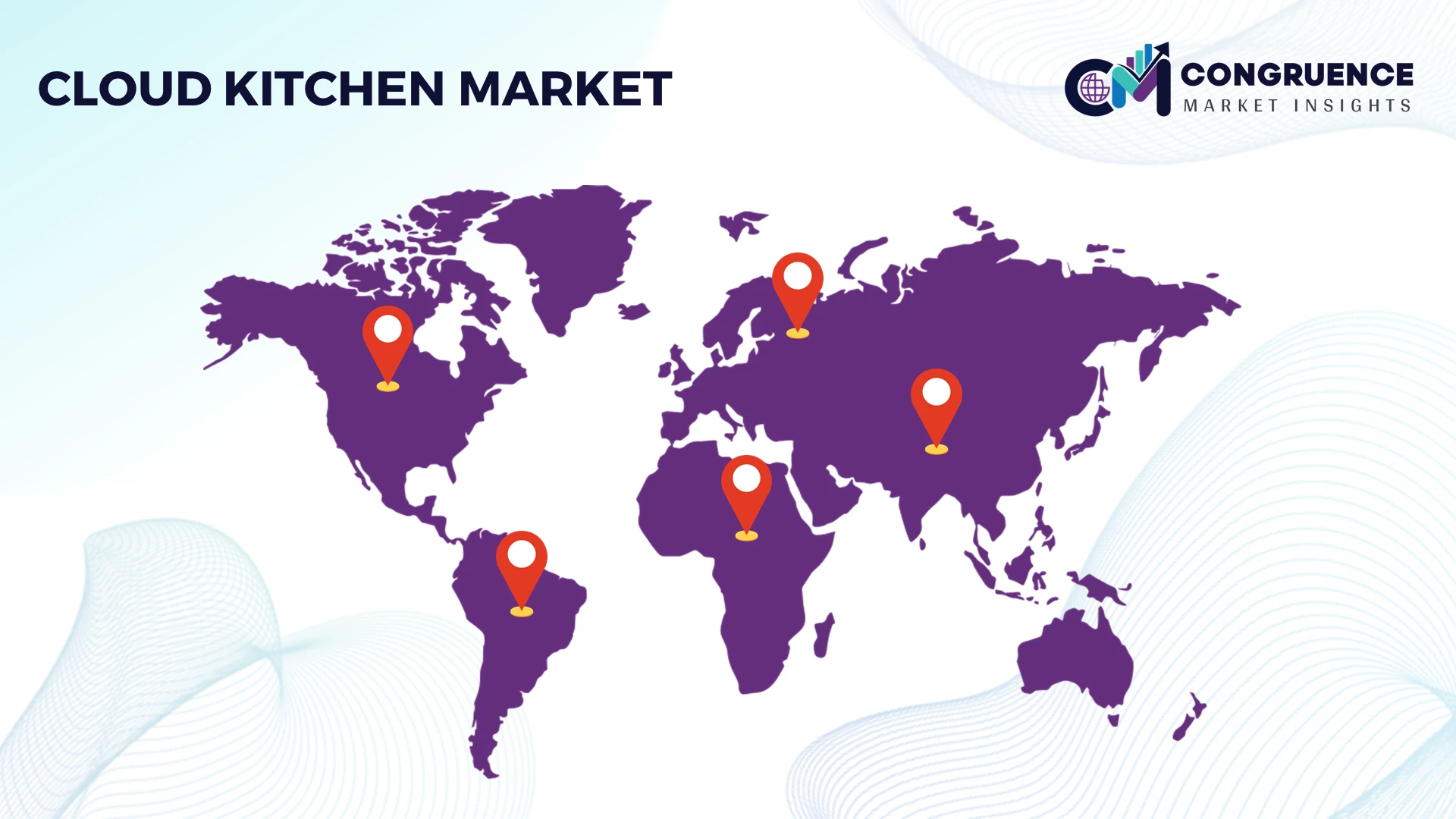
Asia-Pacific accounted for the largest market share at 45.8% in 2025 however, Middle East & Africa is expected to register the fastest growth, expanding at a 13.9% CAGR between 2026 and 2033.
Digital Fulfillment Networks Drive Enterprise Expansion
North America represents approximately 27% of the global Cloud Kitchen Market, supported by advanced food delivery infrastructure, high digital ordering penetration, and strong investment in AI-enabled kitchen operations. The United States and Canada continue expanding multi-brand production facilities to improve asset utilization and delivery efficiency. More than 62% of enterprise cloud kitchens across the region have deployed automated order management systems, reducing processing delays and improving fulfillment accuracy. Strategic partnerships between restaurant chains, logistics providers, and technology vendors are strengthening operational resilience, while localized production hubs help reduce delivery distances and optimize labor utilization. Companies are increasingly integrating predictive demand analytics and centralized kitchen management platforms to improve consistency across expanding delivery-only operations.
United States Market Outlook: The United States leads regional deployment through a mature digital food ecosystem, dense metropolitan delivery infrastructure, and strong enterprise investment in AI-enabled operations. More than 68% of urban food delivery businesses operate through integrated cloud-based order management platforms, supporting higher throughput and faster fulfillment. Major restaurant brands continue expanding virtual restaurant concepts and centralized kitchens while strengthening partnerships with delivery platforms to improve customer reach and operational scalability.
Automation and Compliance Reshape Operations
Europe accounts for nearly 21% of global cloud kitchen deployment, supported by increasing urban delivery demand, standardized food safety regulations, and investments in automated kitchen technologies. Operators are modernizing production workflows through robotics, digital inventory systems, and centralized preparation facilities that improve consistency across multiple brands. More than 48% of enterprise kitchens have adopted digital inventory management, reducing food waste and improving procurement planning. Sustainability objectives are also encouraging reusable packaging initiatives and localized ingredient sourcing. Restaurant groups continue restructuring operations by consolidating production facilities and integrating intelligent kitchen management platforms to improve productivity while maintaining regulatory compliance.
United Kingdom Market Outlook: The United Kingdom remains Europe's largest cloud kitchen hub due to advanced food delivery adoption, extensive digital payment infrastructure, and strong investment in virtual restaurant concepts. Automated kitchen scheduling has improved operational efficiency by approximately 21%, while expanding delivery-only brands continue partnering with logistics providers to strengthen urban fulfillment capabilities and maintain consistent service quality across major cities.
Scale, Urbanization, and Digital Adoption Lead Growth
Asia-Pacific dominates the global Cloud Kitchen Market with approximately 45.8% market share, supported by large urban populations, widespread smartphone adoption, and rapidly expanding food delivery ecosystems. China, India, Japan, and Southeast Asian economies continue increasing deployment of centralized production kitchens and AI-powered operational platforms. More than 65% of high-volume cloud kitchens across major metropolitan markets utilize automated order processing systems, improving production speed and reducing operational inefficiencies. Investment in localized fulfillment infrastructure and smart kitchen technologies continues accelerating expansion while strengthening multi-brand operating models and supply-chain resilience.
China Market Outlook: China maintains the strongest operational position through extensive digital ordering ecosystems, high-density urban delivery infrastructure, and advanced smart kitchen deployment. Approximately 28% of global cloud kitchen operating capacity is concentrated in China, supported by AI-enabled production management and integrated logistics networks. Leading operators continue investing in robotics, predictive inventory systems, and regional fulfillment centers to strengthen operational efficiency and support large-scale multi-brand expansion.
Urban Delivery Demand Strengthens Deployment
South America represents approximately 5% of global market activity, with expanding metropolitan food delivery services driving investment in cloud kitchen infrastructure. Brazil, Colombia, and Chile are increasing deployment of centralized production facilities to improve delivery coverage while reducing operating costs. Nearly 39% of commercial operators have adopted digital kitchen management platforms to improve workflow visibility and order coordination. Infrastructure limitations and logistics variability remain operational challenges, encouraging businesses to prioritize localized sourcing, technology integration, and strategic delivery partnerships. Enterprise operators are increasingly focusing expansion within densely populated urban corridors where delivery economics remain favorable.
Brazil Market Outlook: Brazil leads regional deployment through strong food delivery adoption, expanding restaurant digitization, and a large urban consumer base. Cloud kitchen operators continue strengthening proprietary ordering platforms and localized fulfillment centers, while automated production scheduling has improved kitchen utilization by approximately 19%. Ongoing partnerships between restaurant brands and delivery platforms are supporting more efficient expansion into high-demand metropolitan markets.
Investment-Led Digital Food Infrastructure Expansion
The Middle East & Africa market is undergoing rapid transformation through smart city development, expanding digital commerce, and growing investment in technology-enabled food service infrastructure. Enterprise operators are deploying centralized cloud kitchens across major metropolitan centers while integrating AI-based production management and real-time delivery coordination. More than 43% of newly established facilities utilize cloud-native kitchen management platforms that improve operational visibility and production planning. Strategic investment in logistics infrastructure and premium food delivery services continues strengthening deployment, particularly across Gulf economies where digital consumption patterns are evolving rapidly.
United Arab Emirates Market Outlook: The United Arab Emirates leads regional adoption through advanced logistics infrastructure, high smartphone penetration, and supportive business regulations. Multi-brand cloud kitchen facilities continue expanding across Dubai and Abu Dhabi, while automated kitchen technologies have improved production efficiency by approximately 20%. Strong collaboration between restaurant operators, technology providers, and delivery platforms continues positioning the country as a regional innovation hub for digital food service operations.
The Cloud Kitchen Market is led by Kitopi, Rebel Foods, CloudKitchens, Kitchen United, and Zuul, competing against regional virtual kitchen operators and technology-enabled food service networks. The top five players collectively control approximately 36% of organized market activity. Competition centers on fulfillment speed, AI-driven kitchen management, delivery integration, and operating cost efficiency. Advanced automation improves kitchen productivity by nearly 20%, while predictive demand planning reduces ingredient waste by approximately 18%. Global operators are expanding through centralized production hubs, technology partnerships, proprietary software platforms, and multi-brand operating models, whereas regional players compete through localized menus and faster neighborhood fulfillment. Vertical integration across logistics, kitchen technology, and digital ordering continues reshaping competitive positioning. Rising investment in modular kitchens and intelligent workflow systems increases operational barriers for new entrants, particularly where delivery infrastructure is highly developed. Sustainable competitive advantage increasingly depends on scalable technology, efficient asset utilization, strategic delivery partnerships, and consistent execution across multiple digital restaurant brands.
Rebel Foods
Kitopi
CloudKitchens
Kitchen United
Zuul
Karma Kitchen
Ghost Kitchen Brands
Franklin Junction
Keatz
Dahmakan
Taster
KitchenCo
Kitchens@
FoodStars
Cloud kitchen operators are rapidly deploying AI-powered kitchen management, IoT-enabled equipment monitoring, and cloud-native order orchestration to improve production efficiency. AI-driven demand forecasting reduces ingredient waste by approximately 18%, while intelligent kitchen scheduling improves order throughput by nearly 22%. Around 58% of enterprise cloud kitchens now operate with integrated digital order management platforms, enabling real-time coordination across delivery applications, inventory systems, and production workflows. These technologies strengthen operational consistency, shorten preparation cycles, and improve customer experience through faster, more accurate fulfillment.
Emerging technologies between 2026 and 2028 include robotic food preparation, computer vision for quality inspection, and digital twins for workflow optimization. Robotic assistance improves repetitive food preparation efficiency by approximately 20%, while computer vision reduces quality-control errors by nearly 15%. Deployment of predictive maintenance platforms is expected to exceed 45% among high-volume operators, minimizing equipment downtime and improving kitchen availability. Companies integrating AI analytics with automated procurement gain stronger inventory visibility, enabling faster response to demand fluctuations and localized supply-chain adjustments.
Compared with conventional manual kitchen operations, AI-enabled cloud kitchen ecosystems improve production efficiency by approximately 25% while lowering operating costs by nearly 17%. Global operators deploying proprietary technology platforms and automated fulfillment networks secure stronger competitive differentiation than traditional delivery-only kitchens relying on fragmented systems. Through 2028, technology leadership will increasingly determine scalability, operational resilience, and multi-brand expansion, making early digital infrastructure investment a decisive competitive advantage.
December 2024 Rebel Foods completed a strategic investment from KKR to accelerate expansion across India and the Middle East, supporting more than 450 cloud kitchens serving over 5,000 internet restaurants. The investment strengthened long-term scaling and technology deployment.
February 2025 Rebel Foods launched the QuickiES 15-minute food delivery platform, expanding ultra-fast delivery capabilities through its cloud kitchen network. The initiative targeted significantly faster order fulfillment, reinforcing competitive positioning in rapid food delivery. Source: Inc42 Media
February 2026 Kitopi secured $50 million in growth capital after achieving profitability, supporting expansion across Gulf markets while scaling its Smart Kitchen OS technology platform for managed cloud kitchen operations and enterprise customers.
March 2026 Zomato introduced the cloud kitchen protein-focused brand Ritual in collaboration with Massive Restaurants, expanding digital-first restaurant offerings through its platform and strengthening category diversification within cloud kitchen operations.
This report provides comprehensive analysis of the Cloud Kitchen Market across Independent, Commissary, Kitchen Pods, and Virtual Restaurant formats, covering applications including Food Delivery, Takeaway, Meal Subscription, Catering, and Corporate Food Services. It evaluates Restaurant Chains, Food Service Operators, Catering Companies, Hospitality Providers, and Food Delivery Platforms across North America, Europe, Asia-Pacific, South America, and the Middle East & Africa. The assessment incorporates deployment trends, digital adoption levels, automation penetration, and competitive positioning across more than 10 major industry participants.
The study examines AI-enabled kitchen management, robotics, IoT integration, predictive analytics, smart inventory systems, and digital fulfillment technologies shaping operational performance between 2026 and 2033. It highlights segment-level deployment patterns, enterprise expansion strategies, regional infrastructure readiness, and evolving business models supporting multi-brand operations. The report delivers actionable insights for investment prioritization, market entry planning, partnership evaluation, competitive benchmarking, and long-term operational strategy while identifying emerging opportunities across high-growth urban markets and technology-driven cloud kitchen ecosystems.
| Report Attribute/Metric | Report Details |
|---|---|
Market Revenue in 2025 | USD 73280 Million |
Market Revenue in 2033 | USD 180533.3 Million |
CAGR (2026 - 2033) | 11.93% |
Base Year | 2025 |
Forecast Period | 2026 - 2033 |
Historic Period | 2021 - 2025 |
Segments Covered | By Type
By Application
By End-User
|
Key Report Deliverable | Revenue Forecast, Growth Trends, Market Dynamics, Segmental Overview, Regional and Country-wise Analysis, Competition Landscape |
Region Covered | North America, Europe, Asia-Pacific, South America, Middle East, Africa |
Key Players Analyzed | Rebel Foods, Kitopi, CloudKitchens, Kitchen United, Zuul, Karma Kitchen, Ghost Kitchen Brands, Franklin Junction, Keatz, Dahmakan, Taster, KitchenCo, Kitchens@, FoodStars |
Customization & Pricing | Available on Request (10% Customization is Free) |




