
Reports
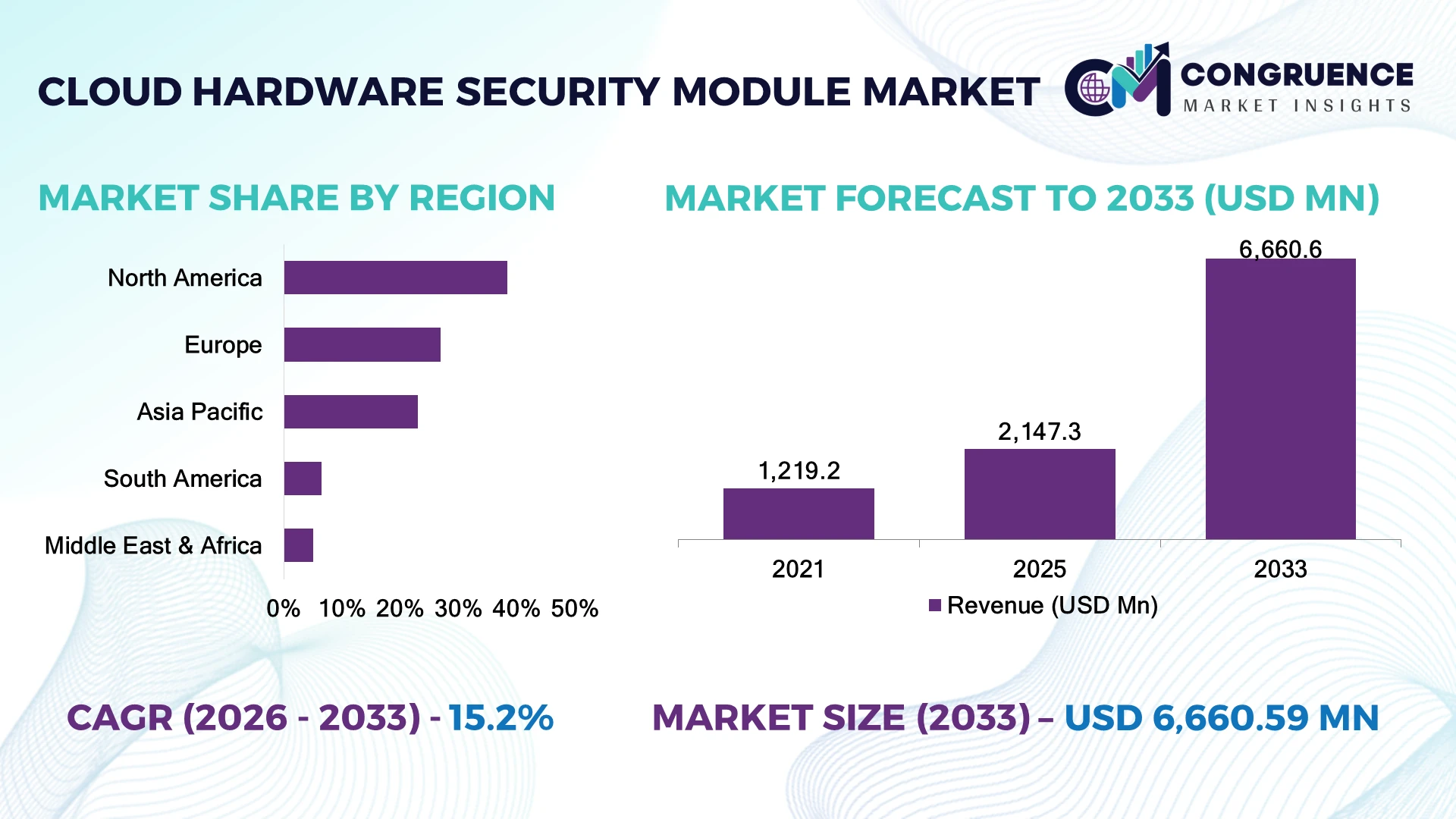
The Global Cloud Hardware Security Module Market was valued at USD 2,147.3 Million in 2025 and is anticipated to reach a value of USD 6,660.6 Million by 2033 expanding at a CAGR of 15.2% between 2026 and 2033. Growth is being driven by rapid migration of cryptographic workloads to cloud environments, tighter key-management requirements, and rising adoption of zero-trust architectures across regulated enterprises.
The United States remains the dominant country market, representing approximately 39% of global demand in 2025, supported by hyperscale cloud infrastructure, financial services, healthcare, defense, and technology enterprises. Enterprise cloud-security investment remains intensive, with more than 70% of large U.S. organizations operating multi-cloud environments. Germany and the United Kingdom show stronger regulatory-driven deployment, while India is expanding faster through digital payments and cloud-native services. The U.S. therefore retains scale leadership while Asia-based enterprises accelerate adoption.
Strategically, vendors that combine certified cryptographic protection with low-latency cloud integration and multi-cloud interoperability are best positioned to capture enterprise security budgets.
Market Size & Growth: USD 2,147.3 million in 2025 to USD 6,660.6 million by 2033 at a 15.2% CAGR, driven by cloud cryptographic workload migration and regulatory security requirements.
Top Growth Drivers: Multi-cloud adoption contributes approximately 31% of incremental demand, compliance requirements 27%, and digital identity expansion 22%.
Short-Term Forecast: By 2028, cloud HSM deployment efficiency is expected to improve 15–20% through automated provisioning, centralized key management, and API-based integration.
Emerging Technologies: Confidential computing, post-quantum cryptography, and cloud-native key orchestration are advancing, with automated cryptographic workflows reducing manual administration by approximately 25%.
Regional Leaders: North America is projected at roughly USD 2.6 billion by 2033, Europe at USD 1.7 billion, and Asia-Pacific at USD 1.5 billion, with Asia-Pacific showing the strongest cloud-security deployment acceleration.
Consumer/End-User Trends: Financial services and technology enterprises account for approximately 48% of demand, while regulated organizations increasingly integrate HSMs into identity, payment, and encryption workflows.
Pilot/Case Example: In 2026, cloud-native security architectures using centralized cryptographic services are targeting approximately 20% faster key provisioning and 15% lower administrative workload compared with fragmented legacy environments.
Competitive Landscape: Leading cloud platforms and specialist security providers compete around certification, latency, interoperability, and geographic availability, with the largest provider group estimated to control approximately 20% of market value.
Regulatory & ESG Impact: Data-sovereignty and cryptographic-control requirements are influencing approximately 30% of enterprise security architecture decisions, increasing demand for region-specific key custody and auditable controls.
Investment & Funding: Enterprise and infrastructure investment exceeding USD 1 billion annually across cloud-security modernization is shifting toward managed cryptography, hardware-backed identity, and automated compliance capabilities.
Innovation & Future Outlook: Post-quantum-ready HSMs, confidential computing integration, and policy-driven key orchestration will reshape deployment priorities through 2028, favoring vendors with certified hardware and cloud-native software ecosystems.
Cloud Hardware Security Modules are becoming operationally critical for financial transactions, digital identities, software signing, database encryption, certificate management, and regulated workloads. Approximately 60% of large enterprises now operate environments requiring centralized cryptographic controls across multiple infrastructure locations. In 2026, demand is shifting toward API-driven HSM services that reduce deployment friction while preserving hardware-backed key protection. Sovereignty requirements are also increasing demand for geographically controlled key storage, particularly in Europe and Asia-Pacific, creating opportunities for vendors with localized infrastructure and compliance-ready architectures.
Cloud HSM technology is becoming a strategic security layer because enterprises are moving encryption keys, signing operations, and identity credentials into increasingly distributed cloud architectures. The shift is particularly important as organizations combine public cloud, private infrastructure, SaaS platforms, and edge environments. Regulatory requirements around data sovereignty and cryptographic control are simultaneously increasing the need for auditable, hardware-backed key protection.
Modern cloud HSM deployment also changes the economics of cryptographic infrastructure. API-based provisioning and centralized lifecycle management can reduce manual key-administration workload by approximately 20–30% compared with fragmented on-premises implementations, while automated policy enforcement improves provisioning consistency. North American enterprises lead in large-scale cloud security integration, whereas European organizations place greater emphasis on sovereignty and compliance controls; Asia-Pacific is accelerating through digital payments, banking modernization, and cloud-native application expansion.
During 2026–2028, practical deployment priorities will center on automated key rotation, confidential-computing integration, post-quantum readiness, and multi-cloud orchestration. Financial institutions are increasingly integrating HSM services into payment and identity architectures rather than maintaining isolated cryptographic appliances. Vendors responding with interoperable APIs, regional infrastructure, and certified cryptographic modules will gain stronger enterprise positioning as cryptographic control becomes an architectural requirement rather than a standalone security purchase.
Cloud migration is shifting cryptographic key management from isolated data centers toward cloud-native HSM infrastructure, particularly as regulated workloads expand. In 2026, enterprises increasingly prioritize dedicated key custody, workload isolation, and hardware-backed encryption, with zero-trust adoption influencing more than 60% of enterprise security architectures. API-based HSM provisioning can reduce deployment cycles by roughly 40%, improving operational responsiveness. U.S. financial institutions and healthcare platforms are strengthening cryptographic controls as post-quantum readiness enters procurement planning. Cloud security providers are responding through regional HSM availability, managed key services, confidential-computing integration, and automated certificate workflows. The strategic shift is significant: cryptographic infrastructure is becoming an embedded cloud control plane rather than a standalone security appliance.
Cloud HSM adoption remains constrained by interoperability, latency, and specialized infrastructure requirements. Multi-cloud enterprises can operate across three or more major cloud environments, yet HSM APIs, key policies, and cryptographic workflows are not uniformly portable, increasing integration effort by an estimated 20–30%. Hardware-backed services also impose transaction and provisioning costs that can exceed software-based key management by 15–25% for low-volume workloads. In India and Southeast Asia, localized data-residency requirements further complicate cross-border key operations. These constraints directly affect deployment speed and security architecture standardization. Providers are reducing friction through standardized APIs, managed migration services, regional infrastructure, volume-based contracts, and hybrid HSM architectures that reserve dedicated hardware for high-value cryptographic operations.
Post-quantum cryptography creates a high-value upgrade pathway for cloud HSM providers as enterprises redesign long-lived encryption infrastructure. Organizations migrating sensitive workloads can allocate 10–20% more security-engineering capacity toward cryptographic modernization, while hybrid cryptographic deployments are expected to expand materially through 2028. U.S. government procurement requirements and financial-sector migration programs are accelerating algorithm-agility planning. Emerging opportunities include HSMs supporting dual-algorithm key management, automated crypto-agility orchestration, confidential computing, and machine-identity protection. Providers are investing in firmware upgrades, PQC-ready architectures, cloud partnerships, and developer APIs. A non-obvious opportunity lies in crypto-agility management: enterprises increasingly need centralized policy control across legacy RSA/ECC environments and newer post-quantum algorithms rather than simply replacing existing encryption hardware.
Long-term competitiveness increasingly depends on integrating HSMs across rapidly changing application estates, rather than simply increasing cryptographic capacity. Large enterprises can maintain thousands of certificates, keys, and machine identities, creating operational complexity when 20–30% of applications still depend on legacy cryptographic libraries. Post-quantum migration adds another integration layer because hybrid algorithms require coordinated application, firmware, and policy changes. Skills shortages remain material, with cybersecurity teams frequently operating below optimal staffing capacity by 15–20%. In the United States, Europe, and India, evolving digital-security requirements also increase validation workloads. Vendors must invest in orchestration, automated key lifecycle management, developer tooling, interoperability testing, and ecosystem partnerships to make crypto-agility operationally sustainable rather than an isolated compliance project.
Managed HSM Adoption Accelerates Cloud HSM deployments are increasingly shifting from customer-managed appliances toward managed cryptographic services, reducing provisioning effort by roughly 30–40%. Enterprises are integrating HSM APIs directly into DevSecOps pipelines, while providers expand automated key rotation, policy enforcement, and multi-region availability. This improves deployment speed and reduces specialist infrastructure administration.
Post-Quantum Readiness Intensifies In 2026, cryptographic migration planning is moving from assessment toward implementation, with hybrid RSA/ECC and post-quantum workflows entering enterprise testing. Approximately 20–30% of security modernization programs now include explicit crypto-agility requirements. HSM vendors are upgrading firmware and APIs to support algorithm transitions without disrupting established key-management operations.
Multi-Cloud Key Control Expands Enterprises increasingly require centralized cryptographic governance across two or more cloud environments, pushing demand for interoperable HSM interfaces and unified policy layers. Multi-cloud security programs can reduce duplicated key-management processes by 15–25% when orchestration is standardized. Providers are responding with cross-cloud integrations and consolidated management consoles.
Confidential Computing Converges HSMs are increasingly integrated with confidential-computing environments to protect keys and sensitive workloads during processing. Enterprise deployments combining hardware-backed encryption with trusted execution environments can improve workload isolation by approximately 20%. Cloud providers are therefore aligning HSM services, attestation workflows, and identity controls, making cryptographic protection increasingly embedded within cloud infrastructure.
Dedicated Cloud HSMs Lead, Shared Models Accelerate
Dedicated Cloud HSM solutions represent the leading type, accounting for approximately 64–67% of the 2025 market, supported by stronger tenant isolation, direct cryptographic control, and compliance requirements in banking, government, and healthcare. Shared Cloud HSM models capture roughly 33–36%, serving organizations prioritizing lower entry costs and faster provisioning. The mature dedicated model remains operationally critical for high-value workloads, while shared architectures are gaining traction among mid-sized enterprises and cloud-native developers. Providers are responding with flexible capacity tiers, regional availability, and automated provisioning to narrow the deployment-cost gap.
The fastest-growing shift is toward cloud-native, API-driven HSM consumption, with adoption accelerating as enterprises integrate cryptographic services into DevSecOps and multi-cloud workflows. Approximately 25–30% of new deployments increasingly emphasize automated key lifecycle management and application integration. Dedicated offerings retain the performance and isolation advantage, while shared models strengthen scalability and procurement flexibility. Investment is therefore shifting toward hybrid service architectures rather than replacing dedicated infrastructure outright.
The Cloud Security Alliance's 2025 key-management guidance identifies cloud-native, external key origination, external KMS, and multi-cloud KMS as four major architecture patterns, reinforcing the industry's shift toward integrated and policy-driven cryptographic management.
Payment Security Leads as Cloud Key Management Expands
Payment processing remains the leading application, representing approximately 37–38% of HSM demand, because transaction signing, PIN protection, tokenization, and payment-key custody require continuous hardware-backed cryptographic assurance. Financial institutions and payment processors therefore concentrate deployment around high-throughput transaction environments, while SSL/TLS encryption, PKI, code signing, and database encryption collectively address broader enterprise security workloads. Payment-focused deployments typically prioritize deterministic performance and compliance, whereas general enterprise applications emphasize API integration and centralized policy control. Companies are expanding cloud HSM capacity and integrating cryptographic functions directly into transaction and application-security workflows.
Key management and KMS represent the fastest-expanding application shift, supported by multi-cloud architectures and automated key lifecycle controls. Around 25–30% of emerging deployments increasingly prioritize centralized key governance across distributed workloads. Blockchain custody, IoT identity, document signing, and post-quantum cryptography remain smaller but strategically important applications, with usage broadening as digital identities and machine-to-machine authentication increase. Vendors are responding through API-first integrations, automated rotation, multi-region deployment, and crypto-agility capabilities.
The Cloud Security Alliance's 2025 research, based on 912 IT and security professionals, identified fragmented tools and complex hybrid and multi-cloud environments as significant data-security management challenges, strengthening the business case for centralized cloud key-management architectures.
BFSI Dominates While Cloud Providers Accelerate
Banking, financial services, and insurance remain the dominant end-user group, accounting for approximately 45% of 2025 cloud HSM demand. High transaction volumes, stringent cryptographic controls, digital-payment infrastructure, and regulatory audit requirements concentrate spending within banks, payment processors, and financial platforms. IT and telecommunications follow at roughly 22%, reflecting extensive multi-tenant infrastructure and machine-identity requirements. Government and defense, healthcare, life sciences, retail, and e-commerce maintain more selective deployment patterns, generally prioritizing sensitive-data protection and regulatory compliance. Vendors are tailoring service tiers, performance guarantees, and integration packages around workload criticality.
Cloud service providers and digitally intensive technology enterprises represent the fastest-growing buyer group as HSM capabilities become embedded into managed cloud security stacks. Their demand is shifting toward automated provisioning, multi-region resilience, and programmable cryptographic services, with cloud-oriented deployments increasingly accounting for more than 30% of new enterprise HSM implementations. Healthcare and government buyers favor sovereignty and policy controls, while retail emphasizes transaction security and scalability. Providers are consequently building ecosystem partnerships and developer-centric offerings to capture workload growth before cryptographic infrastructure becomes commoditized.
The 2025 Cloud Security Alliance survey gathered responses from 912 IT and security professionals and highlighted fragmented security tooling and hybrid/multi-cloud complexity as material operational issues, reinforcing demand for centralized cryptographic controls among enterprise buyers.
North America accounted for the largest market share at 38.4% in 2025 however, Asia-Pacific is expected to register the fastest growth, expanding at a CAGR of 17.1% between 2026 and 2033.
Cloud-Native Cryptography Reshapes Enterprise Security
North America held approximately 38.4% of the global Cloud Hardware Security Module market in 2025, supported by dense hyperscale infrastructure, mature cybersecurity procurement, and high concentration of BFSI, technology, healthcare, and government workloads. The United States represents the principal deployment hub, with cloud-native enterprises increasingly embedding HSM services into identity, payment, encryption, and DevSecOps architectures. More than 60% of large U.S. enterprises now operate multi-cloud or hybrid-cloud environments, increasing demand for centralized cryptographic governance. Financial institutions are also accelerating post-quantum readiness and hardware-backed key protection. Providers are expanding regional availability zones, automated provisioning, and API-based integration. The competitive advantage is shifting from standalone hardware performance toward service availability, interoperability, compliance support, and rapid cryptographic policy deployment.
United States Market Outlook: The United States remains the strategic center of Cloud HSM adoption because of its hyperscale cloud ecosystem, financial-services concentration, federal cybersecurity requirements, and advanced enterprise security spending. More than 60% of large enterprises operate hybrid or multi-cloud environments, creating sustained requirements for centralized key custody and cryptographic policy enforcement. U.S. providers are prioritizing multi-region resilience, post-quantum readiness, confidential computing, and automated key lifecycle management.
Regulated Cloud Adoption Drives Cryptographic Modernization
Europe accounted for approximately 27% of global Cloud HSM demand in 2025, with Germany, the United Kingdom, France, and the Netherlands forming important enterprise and cloud-infrastructure centers. Data sovereignty, financial-sector regulation, and increasing digital-resilience requirements are pushing organizations toward hardware-backed encryption and controlled key custody. Approximately 45% of large European enterprises operate workloads across multiple cloud environments, intensifying demand for interoperable cryptographic controls. Modern data centers are also increasing energy-efficiency requirements, encouraging providers to consolidate security infrastructure through managed services rather than fragmented appliances. Vendors are responding with European-region deployments, sovereign-cloud integrations, automated compliance controls, and crypto-agility capabilities. Regulatory modernization is therefore strengthening the strategic value of HSMs beyond conventional encryption use cases.
Germany Market Outlook: Germany offers strong market potential through its industrial automation base, banking infrastructure, data-sovereignty priorities, and highly regulated enterprise environment. Industrial companies increasingly require hardware-backed protection for machine identities, cloud credentials, intellectual property, and connected production systems. More than 40% of large German enterprises maintain hybrid or multi-cloud architectures, creating demand for centralized cryptographic governance. Providers are emphasizing sovereign deployment options, localized support, and integration with industrial cybersecurity platforms.
Hyperscale Expansion Accelerates Cryptographic Infrastructure
Asia-Pacific represented approximately 23% of global Cloud HSM demand in 2025 and is becoming the principal expansion zone as cloud adoption accelerates across China, India, Japan, Singapore, South Korea, and Australia. India and Southeast Asia are particularly important deployment markets because financial digitization, payment platforms, data localization, and hyperscale data-center investment are expanding simultaneously. More than 35% of large enterprises in major Asia-Pacific technology hubs increasingly operate multi-cloud environments. Providers are adding local cloud regions, API-based HSM services, and compliance-focused key management. The region's strategic advantage lies in combining rapid workload migration with expanding digital-payment infrastructure, creating demand for scalable cryptographic services rather than appliance-heavy deployments.
India Market Outlook: India is emerging as a high-priority Cloud HSM market because of rapid digital-payment adoption, expanding cloud infrastructure, financial-sector digitization, and increasingly stringent data-protection requirements. More than 40% of large Indian enterprises have adopted multi-cloud or hybrid architectures, increasing the need for centralized key management. Cloud providers and security vendors are expanding local infrastructure, API integrations, and managed cryptographic services to address data-residency and latency requirements.
Financial Digitization Strengthens Cloud Security Demand
South America accounted for approximately 6.5% of global Cloud HSM demand in 2025, with Brazil representing the dominant deployment market because of its financial-services scale, digital-payment ecosystem, telecommunications infrastructure, and expanding cloud adoption. Brazil's banking sector increasingly requires hardware-backed protection for transaction keys, payment credentials, and customer data. Approximately 30% of large enterprises in leading South American economies are moving toward hybrid or multi-cloud infrastructure, creating demand for centralized cryptographic controls. Adoption remains constrained by uneven cloud infrastructure and specialized cybersecurity skills. Providers are addressing these limitations through managed HSM services, local partnerships, regional cloud deployments, and simplified API-based provisioning, allowing enterprises to obtain hardware-backed security without maintaining dedicated cryptographic infrastructure.
Brazil Market Outlook: Brazil provides the strongest commercial base in South America through its large banking ecosystem, advanced instant-payment infrastructure, telecommunications networks, and growing enterprise cloud adoption. Financial institutions and payment processors require continuous cryptographic protection for transaction authentication and sensitive credentials. More than 30% of major enterprises increasingly use multi-cloud environments, strengthening demand for centralized key management. Providers are expanding local support and managed HSM offerings to reduce infrastructure complexity and deployment costs.
Sovereign Cloud Investment Elevates Cryptographic Controls
Middle East & Africa represented approximately 5.6% of global Cloud HSM demand in 2025, with the United Arab Emirates and Saudi Arabia emerging as important deployment centers. Sovereign-cloud initiatives, financial-services modernization, smart-city programs, and government digitization are increasing requirements for localized cryptographic infrastructure. More than 25% of large enterprises in leading Gulf markets are expanding multi-cloud or hybrid-cloud environments, increasing demand for centralized key custody. Saudi Arabia's digital transformation programs and the UAE's hyperscale data-center investments are reinforcing infrastructure requirements. Providers are responding through local availability zones, sovereign-security partnerships, managed HSM services, and compliance-oriented architectures. The region's non-obvious advantage is its ability to combine greenfield cloud infrastructure with security-by-design rather than retrofitting cryptographic controls into legacy environments.
United Arab Emirates Market Outlook: The UAE is the leading strategic market because of its hyperscale data-center development, financial-services concentration, government digitization, and cloud-first enterprise infrastructure. More than 25% of major enterprises are expanding hybrid or multi-cloud workloads, strengthening demand for programmable cryptographic controls. Investments in sovereign and localized cloud infrastructure are encouraging providers to deploy managed HSM capabilities closer to regulated workloads, reducing latency while strengthening data-residency compliance.
AWS, Microsoft Azure, and Google Cloud compete as hyperscale platform leaders, while Thales and Entrust compete as independent cryptographic specialists; IBM targets enterprises requiring hybrid-cloud key sovereignty. The top five players collectively account for 65% of the market, reflecting concentration around cloud ecosystems and HSM portfolios. Competition centers on security architecture, interoperability, deployment speed, and economics: API integration can cut provisioning effort by 30–40%, managed models reduce infrastructure administration by 20–30%, and high-performance services command premiums of 15–25% for transaction-intensive workloads. AWS and Microsoft emphasize native cloud integration, Google differentiates through single-tenant isolation, while Thales and Entrust push cloud-agnostic HSM services and multi-cloud portability. IBM competes through customer-controlled cryptography and centralized orchestration. The shift is moving from appliance performance toward cloud-native automation, sovereignty, and post-quantum readiness. High certification costs, specialized expertise, and ecosystem integration create formidable entry barriers. Winning requires hardware, cloud compatibility, rapid provisioning, compliance depth, and cryptographic innovation.
Amazon Web Services (AWS)
Microsoft Corporation
Google LLC
IBM Corporation
Thales
Entrust Corporation
Fortanix
Utimaco
Futurex
Securosys
Keyfactor
DigiCert
Hewlett Packard Enterprise
Oracle Corporation
Cloud-native HSM services are shifting cryptographic infrastructure from appliance-centered deployment toward managed, API-driven architectures. Single-tenant HSMs, FIPS 140-3 validation, confidential-computing integration, and automated key rotation are becoming capabilities. Managed provisioning can reduce administration by 20–30%, while API-based deployment can shorten implementation cycles by 30–40%. Adoption is strongest among financial, healthcare, government, and technology workloads. Cloud providers benefit from integration, while independent HSM vendors gain through multi-cloud portability.
Emerging architectures combine HSMs with confidential computing, external key management, BYOK/HYOK controls, and crypto-agility frameworks. Compared with legacy appliance deployments, automated orchestration can improve provisioning efficiency by 35% and reduce manual lifecycle activity by 25%. Post-quantum cryptography is becoming the next disruptive layer, requiring firmware and APIs capable of supporting algorithm transitions without replacing security estates. Hybrid cryptographic workflows are entering roadmaps where long-lived keys protect financial records, identities, software signing, and intellectual property.
Between 2026 and 2028, integration rather than standalone hardware performance will determine competitive advantage. Enterprises are prioritizing unified control planes, multi-region resilience, programmable policies, and machine-identity protection. Vendors combining HSM isolation with confidential computing and automated crypto-agility will gain positioning. Migration readiness is now critical: modernization reduces integration costs as post-quantum requirements, sovereignty rules, and legacy cryptographic dependencies converge.
February 2026 Google Cloud launched Single-tenant Cloud HSM, providing dedicated HSM partitions for regulated workloads across the United States and European Union. The service strengthens key isolation and expands cloud-native cryptographic control for financial, healthcare, defense, and government customers. Source: cloud.google.com (Google Cloud)
May 2026 AWS CloudHSM released client version 5.17.2, extending its current software line and supporting continued migration toward HSM2M infrastructure. The update improves operational continuity for customers, while the broader platform transition reduces exposure to aging HSM1 deployments and support constraints. Source: aws.amazon.com (AWS Documentation)
March 2026 IBM announced deprecation of Hyper Protect Crypto Services, including its CloudHSM capability, with new instance creation ending March 28, 2026 and existing premium instances supported until March 28, 2027. The shift redirects customers toward alternative IBM cloud security architectures. Source: ibm.com (IBM Cloud)
2025 Thales received #1 positioning in ABI Research’s Payment HSM Competitive Ranking, leading both innovation and implementation categories. The assessment highlighted payShield’s cloud integration, post-quantum readiness, and 390 RSA-2048 key-generation operations per second, strengthening its competitive position in high-throughput payment cryptography. Source: ABI Research. (Thales Cyber Security Solutions)
The Cloud Hardware Security Module Market Report covers the evolving cryptographic infrastructure landscape across deployment types, applications, and end-user environments. Segmentation evaluates dedicated and shared cloud HSM models, while application coverage includes payment processing, encryption, key management, PKI, digital signing, database security, and emerging post-quantum use cases. End-user analysis encompasses BFSI, IT and telecommunications, government, healthcare, retail, manufacturing, and technology enterprises.
The report evaluates North America, Europe, Asia-Pacific, South America, and Middle East & Africa, with country-level analysis emphasizing cloud infrastructure maturity, regulatory requirements, data sovereignty, and enterprise adoption. Technology coverage includes FIPS-validated HSMs, confidential computing, BYOK/HYOK, crypto-agility, API-driven orchestration, and post-quantum cryptography. The analysis supports investment planning, regional expansion, product prioritization, partnership strategy, competitive positioning, and technology decisions through 2026–2033.
| Report Attribute/Metric | Report Details |
|---|---|
|
Market Revenue in 2025 |
USD 2,147.3 Million |
|
Market Revenue in 2033 |
USD 6,660.6 Million |
|
CAGR (2026 - 2033) |
15.2% |
|
Base Year |
2025 |
|
Forecast Period |
2026 - 2033 |
|
Historic Period |
2021 - 2025 |
|
Segments Covered |
By Type
By Application
By End-User
|
|
Key Report Deliverable |
Revenue Forecast, Growth Trends, Market Dynamics, Segmental Overview, Regional and Country-wise Analysis, Competition Landscape |
|
Region Covered |
North America, Europe, Asia-Pacific, South America, Middle East, Africa |
|
Key Players Analyzed |
Amazon Web Services (AWS), Microsoft Corporation, Google LLC, IBM Corporation, Thales, Entrust Corporation, Fortanix, Utimaco, Futurex, Securosys, Keyfactor, DigiCert, Hewlett Packard Enterprise, Oracle Corporation |
|
Customization & Pricing |
Available on Request (10% Customization is Free) |




