
Reports
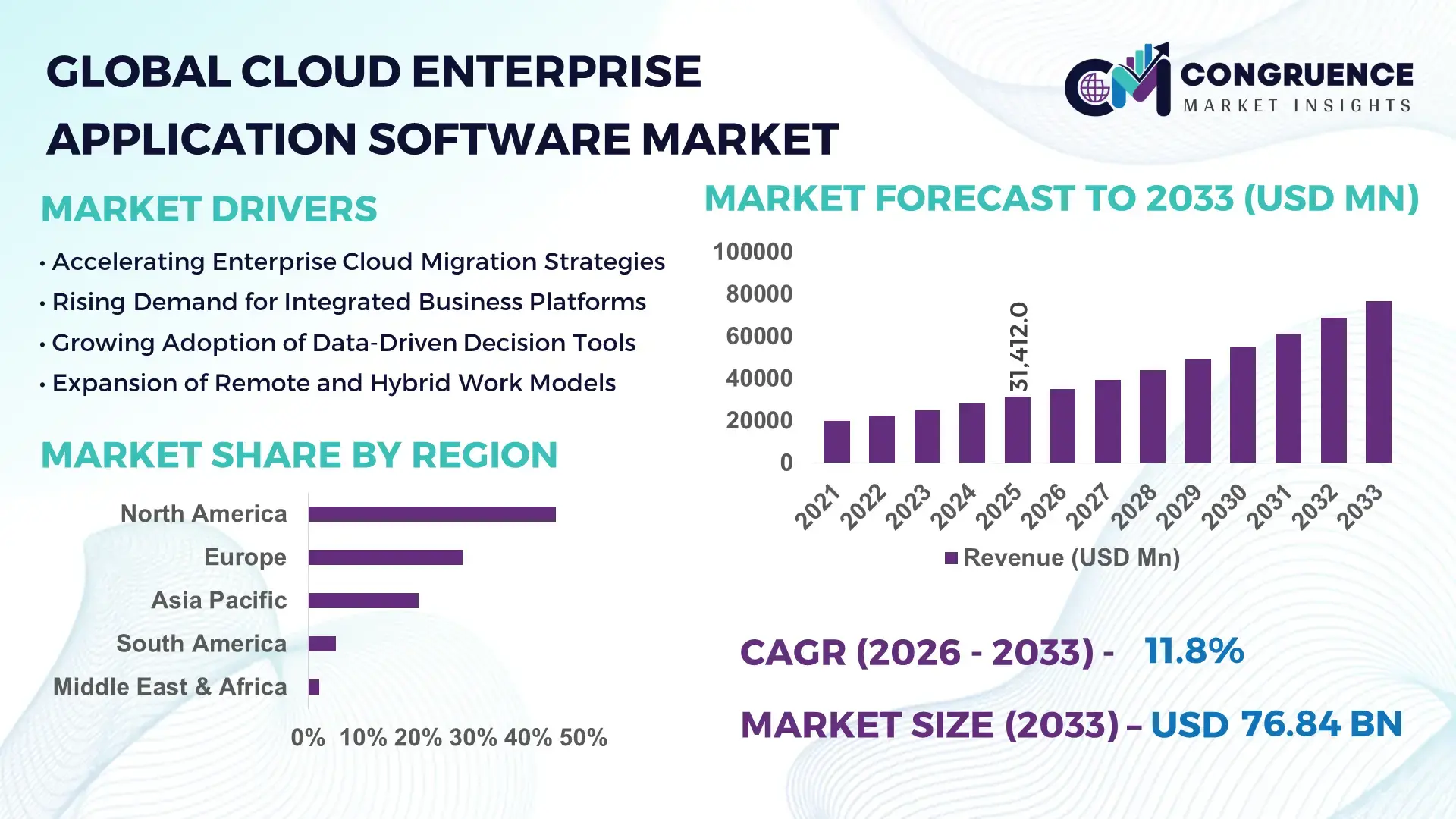
The Global Cloud Enterprise Application Software Market was valued at USD 31,412.0 Million in 2025 and is anticipated to reach a value of USD 76,835.5 Million by 2033, expanding at a CAGR of 11.83% between 2026 and 2033, according to an analysis by Congruence Market Insights driven by ongoing enterprise digital transformation and sustained demand for scalable subscription services.
In the United States, adoption of cloud enterprise application software continues to grow with significant investment and deployment in cloud ERP, CRM, and analytical platforms. By 2025, over 60% of large enterprises reported fully integrating cloud applications into core business functions, with investment in AI‑powered automation exceeding USD 12 billion and more than 40% annual growth in API‑centric integration. Technology advancements such as embedded real‑time analytics and low‑code configurations further enhance deployment capabilities and accelerate enterprise workflows.
Market Size & Growth: Valued at USD 31,412.0 Million in 2025, projected to USD 76,835.5 Million by 2033; CAGR 11.83% driven by enterprise modernization.
Top Growth Drivers: Digital transformation adoption 72%; operational efficiency improvement 58%; hybrid work enablement impact 65%.
Short‑Term Forecast: By 2028, average deployment time reduced by 50% and cross‑enterprise collaboration improvements of 35%.
Emerging Technologies: AI‑enabled ERP, low‑code platforms, and real‑time predictive analytics integration.
Regional Leaders: U.S. projected USD 28B by 2033 with advanced analytics uptake, Europe USD 18B with compliance‑centric deployment, Asia Pacific USD 15B with rapid SMB cloud adoption.
Consumer/End‑User Trends: Manufacturing, healthcare, and retail increasing cloud application usage with demand for customizable solutions.
Pilot or Case Example: In 2025, a global retailer improved order processing by 40% using integrated cloud CRM with AI insights.
Competitive Landscape: Market leader ~22% share; 3–5 major competitors range 8–15% presence each.
Regulatory & ESG Impact: Enhanced data protection and ESG reporting requirements accelerating secure cloud adoption.
Investment & Funding Patterns: Over USD 14B in strategic investments and venture funding for cloud enterprise platforms.
Innovation & Future Outlook: Predictive AI, autonomous workflows, and composable applications shaping next‑generation solutions.
Cloud enterprise application software demand is strengthening across core sectors such as manufacturing, finance, healthcare, and retail. Recent innovations include embedded AI assistants, real‑time analytics dashboards, and API‑first architectures. Regulatory and data sovereignty requirements are influencing design approaches, while economic drivers favor flexible consumption models and regional digital skills investments, especially in North America and Asia Pacific.
The Cloud Enterprise Application Software Market will remain strategically relevant as enterprises prioritize agility, resilience, and data‑driven operations. Cloud applications enable measurable performance improvements; for example, AI‑powered process automation delivers up to 45% improvement compared to legacy on‑premise systems in cycle times. In deployment volume, the United States leads with widespread adoption, while Europe shows strong penetration with more than 60% of mid‑to‑large enterprises migrating critical systems by 2025. Organizations are integrating cloud orchestration and real‑time automation to improve operational KPIs and reduce bottlenecks.
In the next 2–3 years, by 2028, integration of autonomous AI‑augmented workflows is expected to cut operational cycle times by up to 40%, improving service delivery metrics and accelerating innovation lifecycles. Compliance and ESG considerations are also shaping strategy, with firms committing to 30% reductions in carbon footprint by 2030 through optimized cloud infrastructure sharing and efficient resource utilization. A multinational manufacturing group achieved a 38% reduction in downtime in 2025 by deploying predictive cloud maintenance applications.
Going forward, the Cloud Enterprise Application Software Market will be central to digital resilience, regulatory compliance, and sustainable growth. Enterprise strategies increasingly emphasize composable architectures, extensible platforms, and continuous innovation that enable seamless process automation and future‑ready business models.
The Cloud Enterprise Application Software Market Dynamics reflect rapid enterprise digital transformation, increased need for scalable operations, and demand for integrated analytics and automation. Organizations are moving away from legacy monolithic systems toward modular, cloud‑native frameworks that support hybrid and multi‑cloud strategies. Cloud applications for ERP, CRM, SCM, and analytics are being customized for industry‑specific use cases, enabling improved process orchestration and real‑time insights. Vendor capabilities are expanding to include embedded AI, low‑code development, and enhanced security frameworks that address strict data governance requirements. Market participants are also responding to enterprise needs for rapid deployment, cost transparency, and predictable scalability, unlocking new business value.
Enterprises are investing heavily in digital transformation to achieve operational efficiency, flexibility, and customer responsiveness. Cloud enterprise applications replace legacy systems, providing scalable environments for process automation, collaboration, and analytics. Organizations have reported up to 50% improvements in workflow responsiveness and a 30% reduction in unplanned downtime after deploying integrated cloud ERP and CRM solutions. Investments in API‑first architectures and integration platforms have increased significantly year‑over‑year, enabling seamless data exchange and enterprise‑wide automation. These dynamics are particularly strong in sectors where real‑time decision‑making and digital flexibility are critical.
Despite strong adoption, data security, privacy, and compliance challenges continue to restrain broader market uptake. Many enterprises express hesitation in migrating mission‑critical workloads due to concerns about distributed cloud attack surfaces and regulatory compliance overheads. Data localization requirements in multiple regions add complexity and drive additional governance costs. Survey statistics indicate that over 45% of enterprises identify data privacy and compliance as top barriers to full cloud migration. Additionally, the demand for skilled cloud security professionals has outpaced supply, increasing operational costs and slowing deployment cycles in some organizations.
The integration of AI‑driven enterprise applications presents significant opportunities as organizations embed predictive analytics, automation, and intelligent workflow capabilities into core operations. AI‑enabled ERP and CRM modules can deliver 20–30% improvements in forecasting accuracy and customer engagement metrics. Over 50% of cloud application roadmaps now include AI enhancements by 2026, indicating strong investment momentum. The expansion of industry‑specific cloud solutions tailored for verticals such as healthcare and logistics opens additional growth avenues, enabling demand for customized, value‑added services and solutions optimized for unique operational workflows.
Integration of disparate legacy systems with modern cloud platforms remains a major challenge, requiring sophisticated middleware, technical expertise, and enterprise data alignment. Organizations report integration timelines extending beyond planned schedules by 25–30%, driven by the complexity of harmonizing data models and business rules. Real‑time operations impose performance and reliability requirements on integration frameworks, increasing implementation complexity and resource demands. These challenges are amplified in hybrid and multi‑cloud environments where interoperability, data synchronization, and cross‑platform consistency are essential for enterprise continuity.
Accelerated Adoption of AI‑Driven Capabilities: Over 55% of new cloud enterprise application deployments now include predictive analytics and machine learning features that automate decision‑making and reduce manual intervention by up to 40%, reshaping application portfolios across sectors.
Expansion of Low‑Code/No‑Code Platforms: Approximately 42% of enterprises are leveraging low‑code/no‑code tools to accelerate application customization and workflow automation, shortening development cycles by up to 60% and enabling greater business user involvement.
Hybrid and Multi‑Cloud Architectures: Around 48% of enterprises are deploying hybrid and multi‑cloud enterprise applications to enhance redundancy and performance, optimizing costs and compliance with data residency requirements across regions.
Growth of Industry‑Focused Solutions: Industry‑specific cloud enterprise applications are gaining traction, with over 35% of new contracts tailored to sector workflows in healthcare and manufacturing, addressing regulatory and operational specificity for improved outcomes.
The Cloud Enterprise Application Software Market is segmented across product types, application areas, and end‑user industries to provide a detailed view of deployment patterns, technology preferences, and adoption behavior. Segmentation helps decision‑makers understand how different offerings are utilized across business functions, how enterprises choose software based on operational needs, and where investments are focused. Types include core platforms such as ERP, CRM, SCM, and analytics suites with varying integration and customization capabilities. Applications range from finance operations and customer engagement to supply chain optimization and human capital management. End‑users reflect industry diversity, spanning manufacturing, retail, healthcare, and professional services each with distinct requirements for scalability, compliance, and data insights. Segmentation also reveals variation in adoption rates, with mid‑sized firms prioritizing modular solutions while large enterprises invest in fully integrated suites. Insights from segmentation support portfolio development, targeted marketing strategies, and technology roadmaps aligned with specific business outcomes.
The Cloud Enterprise Application Software Market by type includes ERP software, CRM solutions, supply chain management (SCM) platforms, business intelligence and analytics suites, and other enterprise tools. ERP systems currently account for the largest share at approximately 38% of total deployments, reflecting their role as foundational operational platforms that unify finance, procurement, and resource planning. CRM solutions hold a significant portion at 30%, driven by sustained demand for customer data integration and sales automation. Analytics and business intelligence platforms are rising fastest, with adoption momentum propelled by the need for real‑time insights and predictive decision support, and are estimated to grow at a high percentage compared to legacy reporting tools. Other types such as SCM and HCM tools together contribute the remaining 32%, serving niche requirements in logistics, workforce management, and compliance reporting.
In application segmentation, the market is divided into finance and accounting, sales and customer service, supply chain and logistics, human resources, and analytics and reporting. Finance and accounting applications represent the largest share at around 35%, as enterprises prioritize scalable, compliant financial systems that support global operations. Sales and customer service functions comprise roughly 28%, reflecting the ongoing importance of customer experience platforms and integrated engagement tools. Analytics and reporting are gaining traction rapidly, supported by digital transformation and demand for near‑real‑time performance dashboards, with adoption increasing faster than traditional operational modules. Other applications such as human resources and supply chain functions collectively hold about 37%, driven by workforce analytics and demand planning enhancements. Adaptation patterns show that more than 40% of enterprises globally are integrating cloud analytics into customer experience platforms, and over 50% of mid‑sized firms report prioritizing unified CRM and ERP interfaces for operational efficiency.
End‑user segmentation includes manufacturing, retail, healthcare, financial services, and professional services sectors. Manufacturing leads with approximately 32% market share, reflecting strong demand for integrated ERP and analytics to optimize production, inventory, and quality control processes. Retail follows at 27%, where cloud CRM and unified commerce platforms support omnichannel engagement and inventory visibility. Professional services and financial services are expanding adoption quickly, driven by client collaboration tools, compliance reporting, and real‑time forecasting requirements; their combined share is around 29%. Other sectors such as education and logistics contribute the remaining 12%, often focused on specialized modules for workforce scheduling and resource planning. Adoption trends show that in 2025, more than 38% of enterprises globally reported piloting advanced cloud CRM modules for enhanced customer experience, and over 60% of business leaders indicate preference for integrated analytics dashboards to support decision‑making across functions.
North America accounted for the largest market share at 45% in 2025, however, Asia-Pacific is expected to register the fastest growth, expanding at a CAGR of12% between 2026 and 2033.
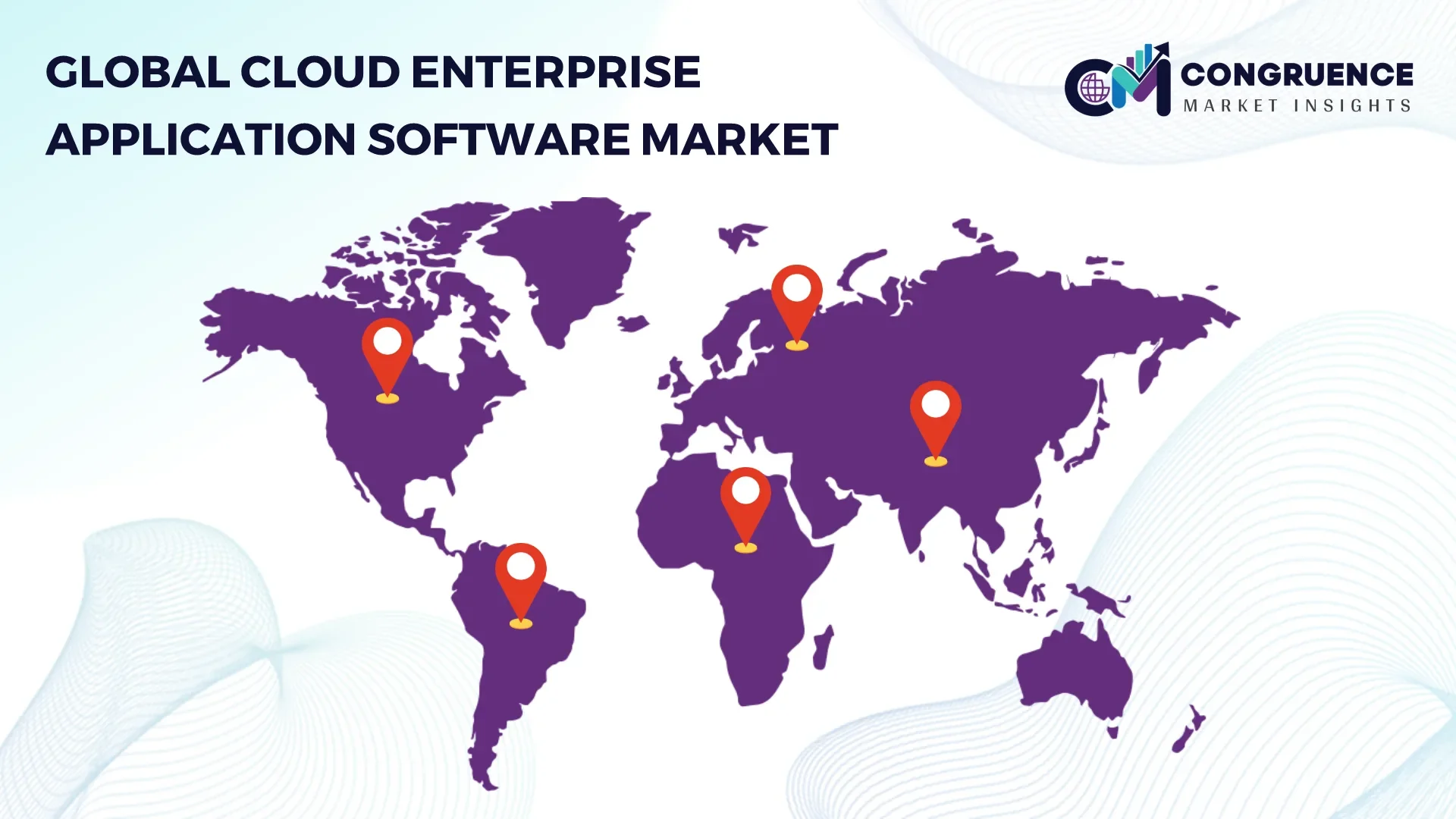
North America leads in adoption of cloud enterprise application software due to mature digital infrastructure, strong corporate IT budgets, and widespread deployment of ERP and CRM solutions across manufacturing, finance, and healthcare sectors. In 2025, more than 70% of large enterprises implemented cloud-based ERP systems, while 65% of SMEs adopted integrated CRM platforms. Cloud analytics and business intelligence solutions are increasingly integrated, with over 50% of companies using AI-powered dashboards to optimize operations. Asia-Pacific is accelerating adoption driven by digital transformation in e-commerce, manufacturing, and mobile-based applications, supported by over USD 8 billion in regional tech investments in 2025. Europe, South America, and Middle East & Africa also show growing interest, with digital compliance and sustainability trends influencing enterprise software deployments across industries.
North America accounts for approximately 45% of the global market share, reflecting high enterprise adoption in healthcare, finance, and manufacturing. Regulatory compliance initiatives, such as stricter data privacy laws, have prompted firms to adopt secure cloud-based ERP and CRM platforms. Key digital transformation trends include AI-enabled process automation, low-code workflow tools, and real-time analytics integration. Local players like Oracle and Salesforce continue to expand cloud solutions tailored for large and mid-sized enterprises. Regional consumer behavior indicates that healthcare and financial sectors prioritize integrated platforms for compliance, operational transparency, and scalability, while retail enterprises emphasize omnichannel customer engagement solutions.
Europe represents approximately 28% of the global market share, with Germany, the UK, and France as major contributors. Regulatory pressures from GDPR and sustainability initiatives drive demand for explainable and secure cloud enterprise applications. Adoption of AI, low-code platforms, and predictive analytics is accelerating across finance, manufacturing, and professional services. Local players such as SAP are implementing advanced ERP and analytics solutions to meet regional regulatory and operational needs. Enterprises in Europe increasingly seek secure, compliant solutions that enable process efficiency and cross-border operations, reflecting consumer preferences for transparency and digital trust.
Asia-Pacific accounts for approximately 20% of global market volume and is the fastest-growing region. Top-consuming countries include China, India, and Japan, driven by e-commerce expansion, manufacturing modernization, and mobile AI applications. Cloud adoption is supported by emerging innovation hubs and robust IT infrastructure investments exceeding USD 8 billion in 2025. Local players such as Alibaba Cloud are delivering AI-powered ERP and CRM solutions customized for regional SMEs. Consumer behavior trends show high demand for scalable, mobile-accessible platforms, especially in retail, logistics, and finance sectors where rapid digital adoption is critical.
South America represents about 5% of the global market share, with Brazil and Argentina leading adoption. Demand is particularly tied to the media, finance, and language localization sectors. Investments in cloud-enabled business analytics and operational platforms are supported by government incentives promoting digital infrastructure development. Local players, including regional software providers, are integrating cloud ERP and CRM for SMEs to optimize cross-border operations. Enterprises increasingly require multilingual and adaptable cloud solutions to meet diverse consumer demands, with adoption rates highest in finance and retail.
Middle East & Africa account for approximately 2% of global market share, with the UAE and South Africa as key growth countries. Demand is concentrated in oil & gas, construction, and logistics, where cloud ERP and analytics improve operational visibility and efficiency. Technological modernization includes AI-driven process optimization and integrated workflow platforms. Regional players and international vendors are deploying cloud solutions adapted to local regulatory standards. Consumer behavior in the region favors secure, scalable applications for industrial and service sectors, with high adoption in urban centers focused on digital transformation initiatives.
United States - 45% Market Share: Strong enterprise adoption in healthcare, finance, and manufacturing driving demand for integrated cloud solutions.
Germany - 12% Market Share: Advanced industrial digitalization and strict regulatory frameworks support large-scale cloud enterprise application deployments.
The Cloud Enterprise Application Software Market is characterized by a competitive and evolving landscape with a mix of established multinational giants and dynamic emerging challengers. Over 50 active competitors operate globally, offering solutions across ERP, CRM, SCM, analytics, and industry‑specific platforms. The market remains moderately fragmented, with the top 5 companies collectively accounting for roughly 48–52% of total deployment footprints in 2025, reflecting both consolidation among leaders and ample opportunity for niche innovators. Strategic initiatives include high‑profile partnerships, advanced product launches, and technology integrations. For example, Microsoft expanded its enterprise product portfolio with 80+ new AI‑enhanced offerings in 2025, while Oracle integrated generative AI capabilities into its Fusion Cloud Applications Suite to support over 50 AI‑driven use cases within enterprise workflows. Several competitors are forming alliances to bolster cloud and AI adoption, with extended partner programs and integration ecosystems aimed at increasing market entry and retention.
Innovation trends significantly influence competition, with vendors focusing on AI‑enabled automation, modular architectures, low‑code/no‑code tooling, and unified analytics platforms to differentiate offerings. The nature of competition spans end‑to‑end suites for large enterprises to agile platforms tailored for mid‑sized businesses. Regional players and specialized providers are also leveraging industry‑specific compliance, scalability, and customization capabilities to capture incremental share, especially in regulated sectors such as healthcare, finance, and manufacturing. This dynamic competitive environment underscores the importance of ongoing R&D, strategic alliances, and customer‑centric solutions to sustain leadership in the global Cloud Enterprise Application Software Market.
Salesforce
ServiceNow
Infor
Hewlett Packard Enterprise (HPE)
Zoho Corporation
OpenText Corporation
Workday
NetSuite
Sage
QAD Inc
Tibco Software Inc
The Cloud Enterprise Application Software Market is undergoing significant technological transformation, driven by the rapid integration of artificial intelligence, machine learning, and advanced analytics into enterprise platforms. These technologies are enabling real‑time decision support, predictive insights, and automated workflows, enhancing both operational efficiency and strategic capabilities for businesses. AI‑enabled modules within cloud ERP and CRM systems are now capable of interpreting complex datasets, identifying patterns, and generating actionable recommendations without manual intervention. Over 50 AI‑driven use cases are supported in leading suites, enhancing decision‑making across finance, supply chain, and customer engagement functions. Generative AI is increasingly incorporated into customer service automation and intelligent process orchestration, enabling natural language interaction and adaptive responses to enterprise events.
Low‑code and no‑code development environments are empowering business users to customize applications and workflows without deep technical expertise, reducing time‑to‑value and development costs. Composable architectures allow enterprises to integrate modular components—such as analytics engines or compliance modules—into core platforms, offering scalable and flexible solutions for evolving business needs. Hybrid and multicloud strategies are also shaping technology adoption, as organizations deploy workloads across private and public environments to optimize performance, cost, and compliance. This has led to expanded support for cross‑platform data integration and unified security frameworks capable of managing governance across heterogeneous infrastructures.
Emerging technologies including edge computing, Internet of Things (IoT) integration, and distributed ledger systems are beginning to influence enterprise application design, particularly in asset‑intensive sectors such as manufacturing and logistics. Edge data capture and analysis improve responsiveness for real‑time operations, while blockchain enhances transparency and traceability in supply chain applications. With over 75% of large organizations expected to employ hybrid cloud strategies by 2026, enterprises are prioritizing solutions that support both innovation and resilience, ensuring that technological investments extend across functional domains while maintaining security and interoperability.
• In March 2024, Oracle integrated new generative AI capabilities into its Fusion Cloud Applications Suite, supporting over 50 AI‑driven enterprise use cases to enhance decision‑making and productivity across core business functions. Source: www.investopedia.com
• In June 2025, Software‑as‑a‑Service (SaaS) consolidation intensified as enterprise AI adoption accelerated, with 48 strategic acquisition deals in the enterprise SaaS space by September 2025 and tech funding for enterprise applications reaching USD 2.43 billion despite a broader tech funding decline. Source: www.timesofindia.indiatimes.com
• In October 2025, AI startup DualEntry raised USD 90 million in Series A funding to expand its AI‑native ERP platform, focusing on rapid financial data migration and automation for mid‑sized enterprises. Source: www.reuters.com
• In September 2025, Salesforce experienced a nearly 7% drop in shares following a weaker‑than‑expected revenue forecast, even as the company continued rolling out its Agentforce AI platform and expanded acquisitions to strengthen its data management capabilities. Source: www.reuters.com
The scope of the Cloud Enterprise Application Software Market Report encompasses an expansive analysis of key segments, geographic regions, technological trends, and industry applications. The report provides detailed insights on product offerings including enterprise resource planning (ERP), customer relationship management (CRM), supply chain management (SCM), analytics and business intelligence suites, and emerging modules such as AI‑augmented workflow automation and compliance frameworks. It explores deployment modes across hybrid, multi‑cloud, and SaaS environments, showing how these influence organizational agility and integration strategies. End‑user segmentation covers major industries such as manufacturing, healthcare, retail, financial services, and professional services, each with distinct adoption characteristics and operational requirements.
Geographically, the report examines market behaviors across North America, Europe, Asia‑Pacific, South America, and Middle East & Africa, highlighting regional demand trends, infrastructure development, and regulatory environments. Technology focus areas include the integration of artificial intelligence and machine learning into enterprise applications, real‑time analytics adoption, low‑code/no‑code customization environments, and hybrid cloud interoperability. The report also addresses innovation hotspots, such as modular architectures and IoT integration for real‑time operational visibility. Emerging or niche segments, such as industry‑specific cloud applications for logistics automation or regulated data environments, are treated with specialized insights to inform strategic decision‑making. Throughout, the report targets business professionals, technology leaders, and strategic planners seeking comprehensive market understanding without reliance on narrow revenue or jargon, offering a clear and data‑driven foundation for investment, product development, and competitive strategy.
| Report Attribute / Metric | Details |
|---|---|
| Market Revenue (2025) | USD 31,412.0 Million |
| Market Revenue (2033) | USD 76,835.5 Million |
| CAGR (2026–2033) | 11.83% |
| Base Year | 2025 |
| Forecast Period | 2026–2033 |
| Historic Period | 2021–2025 |
| Segments Covered |
By Type
By Application
By End-User Insights
|
| Key Report Deliverables | Revenue Forecast; Market Trends; Growth Drivers & Restraints; Technology Insights; Segmentation Analysis; Regional Insights; Competitive Landscape; Regulatory & ESG Overview; Recent Developments |
| Regions Covered | North America; Europe; Asia-Pacific; South America; Middle East & Africa |
| Key Players Analyzed | Microsoft Corporation; SAP SE; IBM Corporation; Salesforce; ServiceNow; Infor; Hewlett Packard Enterprise (HPE); Zoho Corporation; OpenText Corporation; Workday; NetSuite; Sage; QAD Inc; Tibco Software Inc |
| Customization & Pricing | Available on Request (10% Customization Free) |




