
Reports
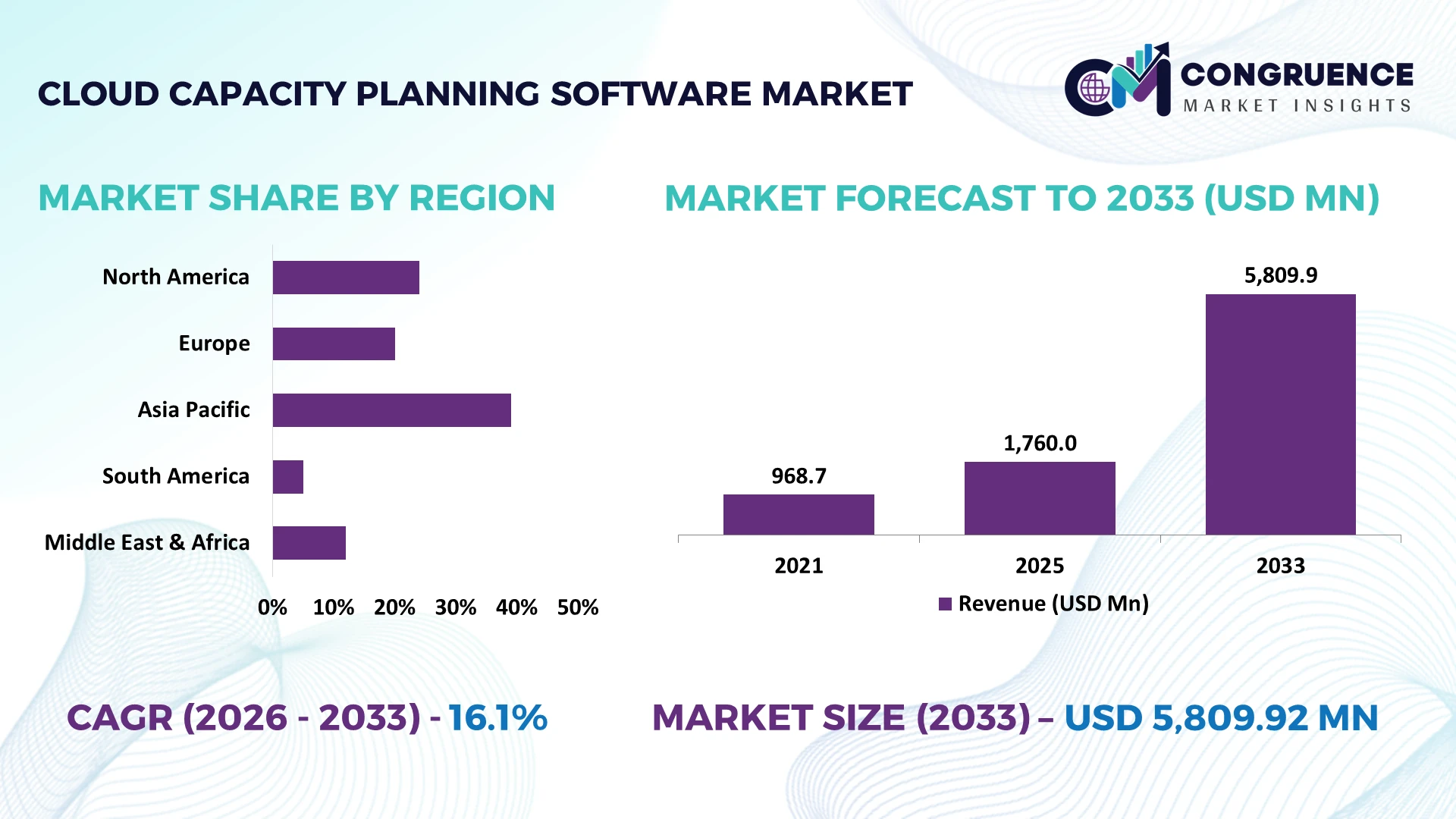
The Global Cloud Capacity Planning Software Market was valued at USD 1760 Million in 2025 and is anticipated to reach a value of USD 5809.92 Million by 2033 expanding at a CAGR of 16.1% between 2026 and 2033. Growth is driven by AI and GPU-intensive workloads, multi-cloud infrastructure complexity, automated FinOps, and rising pressure to optimize compute capacity against data-center power and grid constraints.
The United States dominates cloud infrastructure deployment with approximately 45% of global data-center capacity, supported by hyperscale AI investments exceeding USD 100 billion annually across major operators and technology companies. India is emerging rapidly, with data-center capacity approaching 2 GW in 2026 and strong expansion across BFSI, IT services, e-commerce, and telecommunications. U.S. capacity remains more than 20 times larger than India’s, while India’s faster infrastructure expansion reflects accelerating regional cloud adoption and AI localization.
Strategically, enterprises should prioritize AI-enabled capacity planning platforms that combine workload forecasting, GPU visibility, automated rightsizing, FinOps, and power-aware infrastructure allocation.
Market Size & Growth: USD 1.76 billion in 2025 is projected to reach USD 5.81 billion by 2033 at a 16.1% CAGR, supported by AI workload expansion and automated infrastructure optimization.
Top Growth Drivers: AI workload expansion accounts for approximately 30%, multi-cloud complexity 24%, and FinOps adoption 20% of identified demand drivers.
Short-Term Forecast: By 2028, advanced capacity-planning tools are positioned to reduce unnecessary cloud infrastructure costs by 20–30% while improving resource utilization by 15–25%.
Emerging Technologies: AI forecasting, machine-learning anomaly detection, GPU-aware scheduling, and autonomous rightsizing are reshaping capacity planning, with automation increasingly replacing manual infrastructure reviews.
Regional Leaders: North America is projected to reach approximately USD 2.35 billion by 2033, Europe USD 1.45 billion, and Asia Pacific USD 1.55 billion, with AI infrastructure expansion strengthening adoption.
Consumer/End-User Trends: More than 60% of large enterprises increasingly require continuous visibility across compute, storage, networking, and GPU resources to manage dynamic cloud workloads.
Pilot/Case Example: AI-assisted capacity optimization programs have demonstrated more than 20% improvement in resource utilization by combining predictive workload analysis with automated provisioning and rightsizing.
Competitive Landscape: Microsoft leads with an estimated 18% share of the cloud capacity planning software ecosystem, followed by IBM, Broadcom, VMware, Flexera, and BMC Software, with competition centered on AI forecasting and multi-cloud optimization.
Regulatory & ESG Impact: Energy-efficiency requirements are pushing data-center operators toward power-aware capacity planning, with optimized workload placement targeting 10–20% reductions in avoidable energy consumption.
Investment & Funding: More than USD 500 billion is being directed toward AI infrastructure financing and expansion in 2026, increasing enterprise demand for software that aligns compute growth with available power and capacity.
Innovation & Future Outlook: Next-generation platforms will integrate AI forecasting, autonomous workload placement, GPU optimization, carbon-aware scheduling, and real-time FinOps, shifting capacity planning toward continuous infrastructure orchestration.
The Cloud Capacity Planning Software Market is expanding across hyperscalers, enterprises, SaaS providers, financial institutions, and AI-intensive organizations seeking greater control over compute, storage, networking, and GPU resources. AI-driven forecasting and automated rightsizing can deliver 20–40% cost-optimization potential in mature cloud environments, while 2026 power constraints and regional data-center expansion are increasing the value of predictive capacity allocation. GPU-aware planning, multi-cloud visibility, and autonomous resource optimization are emerging as key technology trends, creating a strategic shift toward continuous infrastructure management.
Cloud capacity planning software is becoming strategically important because AI workloads, GPU shortages, and power-constrained data-center expansion are turning infrastructure capacity into a competitive variable. Enterprises using predictive planning can target 15–25% higher resource utilization and 10–20% lower avoidable cloud expenditure than organizations relying on spreadsheet-based or manually reviewed capacity models. This shift is particularly important as companies modernize infrastructure for AI-intensive applications.
The market is also being reshaped by data-center power availability, sovereign-cloud requirements, and supply-chain restructuring. The United States continues to concentrate hyperscale and AI infrastructure, while India is accelerating data-center deployment to support BFSI, telecommunications, digital services, and localized AI workloads. Over the next 2–3 years, enterprises are expected to increase automated capacity monitoring, GPU forecasting, and multi-cloud optimization, with continuous planning becoming operationally preferable to quarterly infrastructure reviews.
A practical deployment involves using AI-based forecasting to identify underutilized virtual machines, predict peak workloads, and automatically adjust provisioning before demand spikes. Companies are consequently directing investment toward FinOps, observability, workload orchestration, and strategic cloud partnerships rather than adding capacity uniformly. Competitive advantage will increasingly depend on how precisely organizations synchronize infrastructure investment, workload demand, energy availability, and application performance.
Rapid AI infrastructure deployment is the strongest structural driver, as GPU-intensive applications create substantially more variable capacity requirements than conventional enterprise workloads. Organizations can achieve 15–30% better infrastructure utilization through predictive provisioning, while automated rightsizing can reduce avoidable resource consumption by 10–20%. In the United States, hyperscale AI expansion is increasing pressure on constrained power and data-center capacity, making workload forecasting operationally critical. Enterprises are responding by integrating capacity planning with FinOps, observability, and automated orchestration platforms. The non-obvious advantage is that AI-driven planning enables companies to delay unnecessary hardware commitments while preserving service-level performance, improving capital efficiency and reducing exposure to volatile infrastructure procurement cycles.
Capacity planning remains constrained by volatile cloud pricing, GPU availability, and uneven infrastructure economics across deployment locations. Compute and accelerator costs can vary by 20–40% across workload configurations, while inefficiently provisioned environments frequently carry 15–25% excess capacity. In India, rapid data-center construction is simultaneously increasing capacity and intensifying requirements for power availability, cooling, and network infrastructure. These constraints directly affect optimization accuracy because software recommendations depend on actual resource availability and pricing. Companies are reducing exposure through multi-cloud contracts, reserved-capacity commitments, workload portability, and diversified infrastructure suppliers. A key restraint is that software optimization cannot fully compensate for physical power, hardware, or regional availability constraints, limiting savings where infrastructure bottlenecks remain severe.
The next opportunity is the integration of predictive analytics with autonomous workload placement, GPU scheduling, and real-time FinOps. Advanced platforms can target 20–30% improvements in resource utilization and 10–25% reductions in unnecessary provisioning by continuously matching workloads with available capacity. India, Singapore, and the Middle East are emerging as important deployment markets as enterprises build localized cloud and AI infrastructure. Carbon-aware scheduling also creates a differentiated opportunity by shifting non-critical workloads toward lower-emission or lower-cost power periods. Vendors are investing in APIs, cloud-native integrations, and ecosystem partnerships to automate capacity decisions. The strongest strategic opportunity lies in transforming capacity planning from a reporting function into an autonomous infrastructure-control layer.
Fragmented infrastructure environments create a major execution challenge because enterprises increasingly operate across public clouds, private infrastructure, edge environments, and specialized AI platforms. Organizations can manage 3 or more cloud environments, while inconsistent APIs, pricing structures, telemetry formats, and workload policies can increase capacity-analysis complexity by 20–30%. Cybersecurity and data-residency requirements further restrict automated workload movement, particularly for financial and public-sector organizations in countries such as India and Germany. Companies must invest in unified observability, policy-based orchestration, identity controls, and interoperable APIs to maintain deployment consistency. The strategic challenge is not simply forecasting demand; it is executing capacity decisions reliably across heterogeneous infrastructure without compromising security, compliance, application performance, or energy efficiency.
AI Forecasting Enters Operations: Enterprises are moving AI-based forecasting into production capacity workflows, with 58% of organizations using generative AI services and 29% reporting wasted cloud spending associated with AI workloads. Companies are integrating predictive analytics with FinOps to improve GPU provisioning, workload scheduling, and infrastructure utilization.
FinOps Drives Capacity Decisions: Cloud teams are shifting from cost reporting toward business-value management, with 63% of organizations operating established FinOps teams and 71% maintaining Cloud Centers of Excellence. This transition is increasing workload-level budgeting, unit-economics analysis, and automated capacity decisions across large enterprise environments.
Hybrid Workloads Gain Precision: Enterprises are coordinating public-cloud resources with private infrastructure as workload placement becomes increasingly selective. Approximately 45% of IT workloads remained in corporate facilities in 2025, encouraging companies to deploy unified monitoring, policy-based orchestration, and cross-environment capacity controls.
Power-Aware Planning Expands: AI rack densities and grid constraints are making electricity availability a capacity-planning variable. Data-center operators are increasingly combining compute forecasts with power and cooling requirements, while companies redesign deployment schedules and infrastructure expansion plans to avoid capacity stranded by energy constraints.
Hybrid Cloud represents the leading type with an estimated 38% market share, supported by its ability to combine public-cloud scalability with private infrastructure control, security, and regulatory flexibility. Public Cloud follows with approximately 31%, driven by SaaS providers, digital-native businesses, and enterprises requiring rapid resource provisioning. Private Cloud accounts for around 17%, retaining importance across BFSI, healthcare, and government workloads requiring tighter governance. Companies are investing in orchestration platforms that dynamically allocate workloads according to performance, security, cost, and available capacity rather than maintaining rigid infrastructure boundaries.
Multi-Cloud is the fastest-growing type, with adoption expanding approximately 20–25% among large enterprises seeking provider diversification and greater workload flexibility. U.S. technology companies and Indian IT service providers are increasingly distributing workloads across multiple providers to improve resilience and negotiate infrastructure economics. Vendors are responding with cross-cloud visibility, automated rightsizing, policy engines, and integrated FinOps capabilities, making interoperability a critical purchasing criterion.
Resource Optimization leads the application segment with an estimated 34% market share because enterprises directly associate capacity planning with utilization improvement, workload rightsizing, and infrastructure efficiency. Cost Management accounts for approximately 27%, supported by stronger FinOps adoption and executive scrutiny of cloud expenditure. Capacity Monitoring represents about 22%, remaining important for identifying saturation, performance bottlenecks, and availability constraints. Enterprises are increasingly consolidating these functions within unified platforms, improving infrastructure decision speed by approximately 15–20%.
Workload Forecasting is the fastest-growing application, with adoption expanding approximately 24–28% as AI workloads and variable application demand make historical utilization models less reliable. U.S. enterprises are deploying predictive models to anticipate GPU, compute, and storage requirements, while Indian IT companies are using forecasting to coordinate distributed customer workloads. Vendors are responding through machine-learning forecasting, anomaly detection, scenario modeling, and automated provisioning, shifting capacity management toward predictive rather than reactive operations.
IT & Telecom represents the dominant end-user segment with an estimated 36% market share, reflecting extensive cloud estates, distributed applications, high transaction volumes, and continuous infrastructure modernization. BFSI follows at approximately 24%, where capacity planning supports transaction peaks, resilience requirements, and stringent governance. Retail contributes around 16%, driven by seasonal digital-commerce workloads, while Manufacturing and Healthcare account for approximately 14% and 10%. Providers are expanding managed services and platform partnerships, while financial institutions are prioritizing policy-based automation and workload visibility.
Healthcare is the fastest-growing end-user segment, with adoption expanding approximately 22–26% as electronic health records, analytics, medical AI, and digital patient services increase infrastructure requirements. Manufacturing is also adopting predictive capacity planning as industrial IoT and edge workloads connect production environments with cloud platforms. Vendors are responding through sector-specific compliance controls, consumption-based pricing, customized deployment models, and managed-service partnerships.
North America accounted for the largest market share at 42% in 2025 however, Asia-Pacific is expected to register the fastest growth, expanding at a CAGR of 19.2% between 2026 and 2033.
AI Infrastructure Scaling Reshapes Capacity Control
North America remains the primary demand center, supported by hyperscale cloud estates, enterprise AI deployment, and concentrated data-center investment across the United States and Canada. The region represented approximately 42% of global market demand in 2025, with U.S. enterprises accounting for the majority of deployments. Data-center users in eight major North American markets absorbed 2,497.6 MW during 2025, a 38% increase from 2024, intensifying demand for predictive capacity modeling. Companies are integrating GPU forecasting, FinOps, automated rightsizing, and power-aware scheduling into infrastructure workflows. Grid constraints and local permitting pressures are also shifting investment toward capacity optimization rather than indiscriminate expansion.
United States Market Outlook: The United States remains the region's technology and infrastructure anchor, with hyperscalers, AI developers, financial institutions, and SaaS providers driving sophisticated capacity-planning deployments. U.S. data-center expansion increasingly depends on power availability, making software-based workload placement and infrastructure forecasting strategically important for maintaining utilization and deployment schedules.
Sovereign Cloud and Energy Efficiency Drive Adoption
Europe is increasingly defined by digital sovereignty, energy efficiency, and infrastructure modernization rather than pure capacity expansion. Germany, the United Kingdom, France, and the Netherlands remain key deployment markets, while regulatory requirements are pushing operators toward detailed energy and workload management. The European Union's 2026 Cloud and AI Development Act targets at least threefold growth in data-center capacity over the next 5–7 years, creating substantial demand for capacity forecasting and infrastructure optimization. Companies are integrating sustainability metrics, workload placement, cooling efficiency, and compliance controls into planning platforms. The region's emphasis on data residency also favors hybrid architectures and localized capacity management.
Germany Market Outlook: Germany provides a strong enterprise base through manufacturing, automotive, BFSI, and industrial cloud adoption. Domestic data-center power capacity is targeted at approximately 2,330 MW by 2030, while strict energy-efficiency requirements encourage operators to deploy software capable of monitoring utilization, power consumption, cooling requirements, and workload allocation.
AI Expansion Shifts Capacity Toward Power-Rich Markets
Asia-Pacific is the fastest-expanding market as China, India, Japan, Australia, Malaysia, and South Korea accelerate cloud and AI infrastructure deployment. Data-center investment across the region reached approximately USD 11.6 billion in 2025, while power availability is increasingly determining where new facilities can be commissioned. India and Malaysia are gaining strategic importance as enterprises diversify beyond established hubs. Companies are deploying capacity-planning platforms to coordinate GPU clusters, cloud workloads, storage, and energy availability while reducing infrastructure underutilization. The region's manufacturing base also creates demand from industrial enterprises integrating cloud platforms with IoT, automation, and edge computing.
India Market Outlook: India is becoming a major enterprise cloud and AI infrastructure hub, supported by IT services, BFSI, telecommunications, e-commerce, and government digitization. Data-center capacity approached 2 GW in 2026, strengthening demand for predictive planning tools that coordinate rapid workload growth with power, cooling, and network constraints.
Brazil Leads Regional Cloud Infrastructure Expansion
South America remains concentrated around Brazil, Mexico-linked infrastructure corridors, Chile, and Colombia, with Brazil providing the strongest enterprise and data-center demand base. Regional colocation inventory increased approximately 20% during 2025, while the construction pipeline was about 42% precommitted, indicating strong forward demand for infrastructure capacity. Cloud capacity-planning adoption is expanding among financial institutions, telecommunications operators, retailers, and digital-service companies seeking greater utilization visibility. Companies are prioritizing modular infrastructure, colocation partnerships, and hybrid-cloud deployments to address uneven power availability and network limitations. The non-obvious opportunity is the growing importance of secondary cities as enterprises seek lower congestion and more predictable infrastructure economics.
Brazil Market Outlook: Brazil represents the most strategically important market through its large banking, telecommunications, retail, and technology ecosystem. Data-center demand is increasingly concentrated around São Paulo, while operators are expanding capacity and improving connectivity to support AI workloads and cloud adoption. Companies are combining colocation, hybrid infrastructure, and automated capacity monitoring to manage concentrated demand.
AI Infrastructure Investment Accelerates Digital Modernization
The Middle East & Africa market is being shaped by sovereign-cloud initiatives, AI infrastructure investment, hyperscale expansion, and digital transformation programs. Saudi Arabia and the United Arab Emirates are leading deployment activity, with operators prioritizing high-density computing, localized data processing, and energy-aware infrastructure. Saudi Arabia's operational data-center capacity increased from 68 MW in 2021 to 440 MW in 2025, creating stronger demand for capacity forecasting and workload optimization. Companies are forming infrastructure partnerships and investing in automated resource management to coordinate rapid expansion with power and cooling availability. The region's strategic advantage lies in combining large-scale infrastructure investment with government-backed digital modernization.
Saudi Arabia Market Outlook: Saudi Arabia has emerged as a major digital-infrastructure investment destination, supported by Vision 2030, AI initiatives, cloud localization, and abundant energy resources. Operational data-center capacity reached approximately 440 MW in 2025, nearly six times the 2021 level. Enterprises and infrastructure providers are increasingly adopting capacity-planning systems to manage rapid deployment, workload allocation, and infrastructure utilization.
Microsoft, IBM, Broadcom, BMC Software, Flexera, and VMware compete across cloud optimization, infrastructure automation, capacity forecasting, and FinOps-enabled resource management. The top five players collectively command an estimated 45% of the market, reflecting moderate concentration with strong competition from specialized cloud-management providers. Competition centers on technology depth, with AI-driven automation improving resource utilization by approximately 15–30%, while automated rightsizing can reduce avoidable infrastructure expenditure by 10–25%. Microsoft and IBM emphasize integrated cloud ecosystems, whereas Flexera and BMC compete through governance, FinOps, and multi-cloud visibility. Broadcom strengthens its position through enterprise virtualization and infrastructure integration. Partnerships with hyperscalers, managed-service providers, and enterprise software vendors are becoming more important than standalone deployments. The competitive shift is moving toward autonomous capacity orchestration, GPU-aware planning, and power-sensitive workload allocation. High integration complexity and enterprise switching costs remain major entry barriers. Winning platforms must combine predictive accuracy, interoperability, automation, and measurable cost control.
Microsoft Corporation
IBM Corporation
Broadcom Inc.
BMC Software, Inc.
Flexera Software LLC
VMware, Inc.
Apptio, Inc.
Hewlett Packard Enterprise
Dell Technologies Inc.
Oracle Corporation
Amazon Web Services, Inc.
Google Cloud
Turbonomic
CloudBolt Software
Cloud capacity planning is shifting from static threshold monitoring to AI-assisted forecasting, automated rightsizing, and GPU-aware scheduling. Machine-learning models can improve utilization by 15–25% versus legacy rule-based planning, while automated provisioning can reduce avoidable capacity costs by 10–20%. Adoption is strongest among large multi-cloud enterprises.
Emerging platforms integrate FinOps, observability, Kubernetes telemetry, workload orchestration, and energy data into one planning layer. AI-driven optimization can improve infrastructure efficiency by 10–18%, while predictive workload placement can reduce performance bottlenecks by 8–15%. More than half of large enterprises now operate multi-cloud environments, increasing demand for interoperable capacity controls and centralized policy automation.
By 2026–2028, autonomous capacity orchestration, digital twins, GPU scheduling, and power-aware workload placement will become competitive differentiators. Hyperscalers and large enterprises benefit first because their infrastructure scale creates the largest optimization pools. Compared with spreadsheet-based planning, continuous analytics enables faster decisions and tighter resource allocation, making real-time capacity intelligence essential for AI-heavy deployments. Disruptive architectures will increasingly connect capacity software with liquid-cooling telemetry, carbon intensity, and data-center power availability, allowing workloads to shift before physical constraints affect service levels. Vendors that combine forecasting accuracy with automated execution will gain enterprise retention, while customers gain resilience, cost discipline, and faster deployment cycles.
October 2025 Microsoft deployed its first production cluster with more than 4,600 NVIDIA GB300 NVL72 GPUs, creating large-scale AI capacity for OpenAI workloads. The deployment supports faster model training and higher-throughput inference, strengthening demand for GPU-aware capacity planning. Source: Microsoft
November 2025 Microsoft secured a $9.7 billion, five-year agreement with IREN for AI cloud capacity using NVIDIA GB300 systems, with 750 MW planned at the Texas facility. The partnership locks in accelerator supply and supports predictable capacity expansion. Source: TechCrunch
July 2026 Uptime Institute reported that more than half of data-center operators struggled to recruit staff, while peak rack densities of 30 kW or higher increased. These constraints strengthen automation requirements for capacity forecasting, power planning, and infrastructure operations. Source: Uptime
November 2025 The UK government introduced AI Growth Zones to accelerate data-center development by improving power access and planning processes. The policy created five initial zones, helping unlock AI infrastructure capacity and strengthening demand for location-aware cloud capacity planning. Source: GOV.UK
The Cloud Capacity Planning Software Market Report covers Public Cloud, Private Cloud, Hybrid Cloud, and Multi-Cloud types, alongside Resource Optimization, Workload Forecasting, Cost Management, and Capacity Monitoring applications. End-user coverage includes BFSI, IT & Telecom, Healthcare, Retail, and Manufacturing, providing a structured view of demand concentration, deployment intensity, and technology adoption.
The report evaluates North America, Europe, Asia-Pacific, South America, and Middle East & Africa, with country-level analysis emphasizing infrastructure investment, enterprise cloud adoption, AI deployment, and data-center capacity. Coverage also addresses AI forecasting, automated rightsizing, GPU-aware scheduling, FinOps integration, workload orchestration, and power-aware planning. These insights support investment prioritization, geographic expansion, technology partnerships, competitive positioning, and capacity strategy through 2033, with particular attention to multi-cloud adoption and AI infrastructure requirements.
| Report Attribute/Metric | Report Details |
|---|---|
Market Revenue in 2025 | USD 4184.7 Million |
Market Revenue in 2033 | USD 7352.95 Million |
CAGR (2026 - 2033) | 7.3% |
Base Year | 2025 |
Forecast Period | 2026 - 2033 |
Historic Period | 2021 - 2025 |
Segments Covered | By Type
By Application
By End-User
|
Key Report Deliverable | Revenue Forecast, Growth Trends, Market Dynamics, Segmental Overview, Regional and Country-wise Analysis, Competition Landscape |
Region Covered | North America, Europe, Asia-Pacific, South America, Middle East, Africa |
Key Players Analyzed | Vertiv, Schneider Electric, Rittal, Eaton, Huawei Technologies, Legrand, nVent Electric, Delta Electronics, Panduit, Chatsworth Products, Black Box, Supermicro, Lenovo, Fujitsu |
Customization & Pricing | Available on Request (10% Customization is Free) |




