
Reports
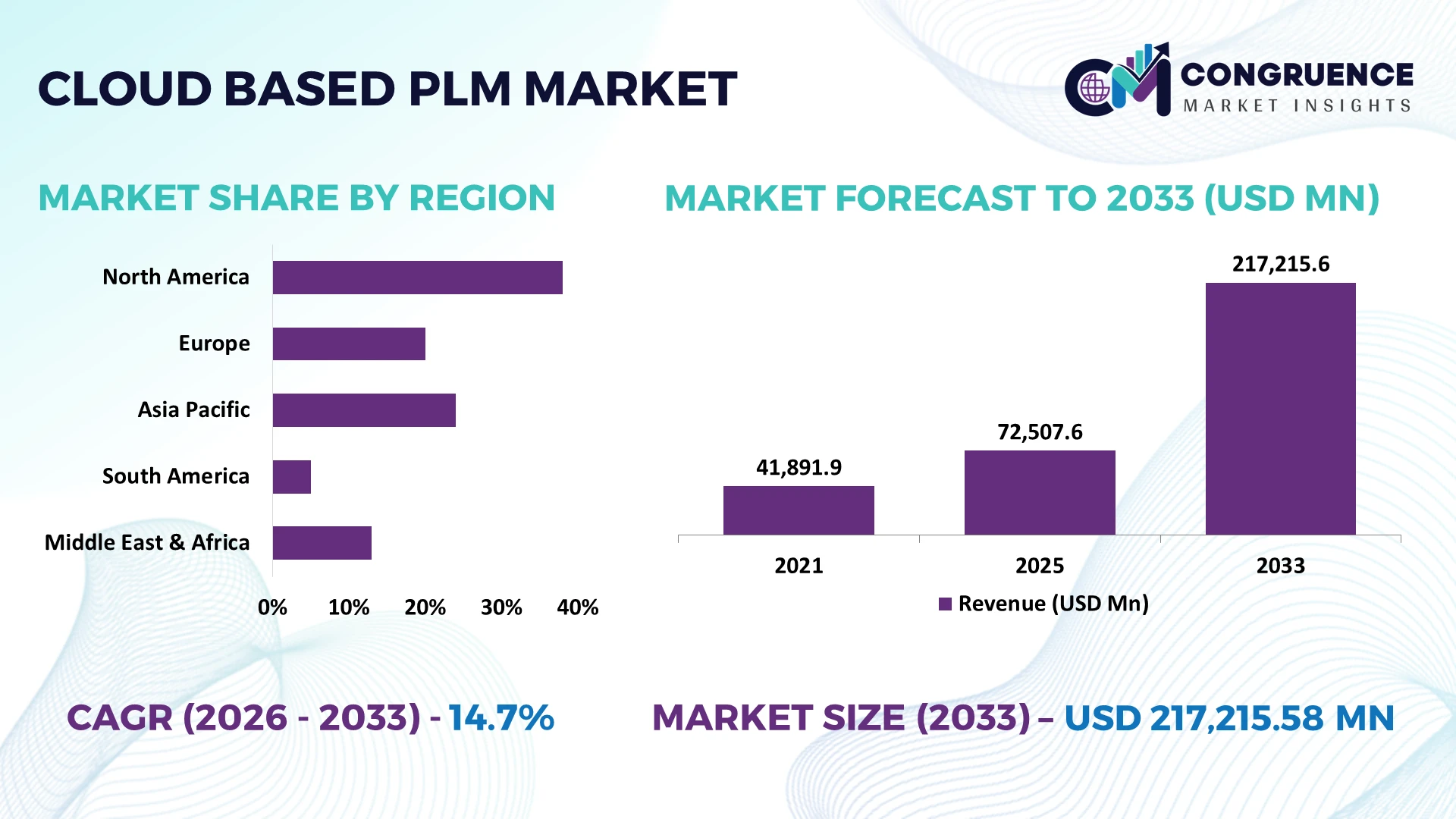
The Global Cloud-Based PLM Market was valued at USD 72507.61 Million in 2025 and is anticipated to reach a value of USD 217215.58 Million by 2033 expanding at a CAGR of 14.7% between 2026 and 2033. Growth is driven by SaaS-based engineering collaboration, digital-thread deployment, AI-assisted product development, digital twins, supplier integration, and manufacturers replacing fragmented on-premise lifecycle systems.
The United States represents approximately 35% of global cloud-based PLM deployment, supported by aerospace, automotive, electronics, medical devices, and industrial equipment manufacturers. More than 90% of enterprises use cloud services, while manufacturers increasingly connect CAD, engineering change, BOM, simulation, and supplier data through cloud platforms. U.S. semiconductor localization under the CHIPS Act strengthens digitally coordinated product development. Compared with Germany, U.S. deployments emphasize hyperscale SaaS and AI integration, while German manufacturers prioritize industrial interoperability and controlled engineering-data exchange.
Strategically, PLM vendors integrating digital threads, AI engineering tools, supplier collaboration, and cloud-native lifecycle workflows are positioned to capture manufacturing-platform consolidation.
Market Size & Growth: USD 72,507.61 million in 2025 reaches USD 217,215.58 million by 2033 at 14.7% CAGR, driven by digital-thread modernization.
Top Growth Drivers: Cloud enterprise adoption exceeds 90%, multi-cloud deployment surpasses 75%, and digital engineering penetration approaches 70% among large manufacturers.
Short-Term Forecast: By 2028, integrated cloud PLM workflows can reduce engineering change-cycle time by approximately 30% through automated approvals and collaboration.
Emerging Technologies: Generative AI, digital twins, and model-based systems engineering are reshaping PLM as approximately 78% of organizations deploy AI in business functions.
Regional Leaders: By 2033, North America approaches USD 76 billion, Europe USD 58 billion, and Asia-Pacific USD 66 billion as manufacturing digitization accelerates.
Consumer/End-User Trends: More than 70% of large manufacturers are advancing digital engineering, increasing demand for unified product, supplier, and lifecycle information.
Pilot/Case Example: Siemens’ digital-enterprise implementations have demonstrated approximately 30% reductions in selected engineering and product-development cycles through integrated digital workflows.
Competitive Landscape: Siemens holds approximately 18% market positioning, competing with Dassault Systèmes, PTC, Autodesk, and Oracle across enterprise cloud PLM ecosystems.
Regulatory & ESG Impact: EU Ecodesign for Sustainable Products Regulation introduces Digital Product Passports across prioritized categories, increasing lifecycle-data traceability requirements through 2030.
Investment & Funding: Global digital-transformation spending exceeds USD 2 trillion annually, directing substantial enterprise budgets toward cloud engineering, digital twins, and connected lifecycle platforms.
Innovation & Future Outlook: AI-assisted engineering can reduce selected documentation and design-support workloads by 20–30%, shifting PLM from record management toward intelligent product orchestration.
The Cloud-Based PLM Market is evolving from engineering-document management toward connected digital-thread platforms spanning requirements, CAD, bills of materials, simulation, manufacturing, suppliers, and service information. Automotive, aerospace, electronics, industrial machinery, and medical-device companies lead demand because complex products require synchronized engineering changes across distributed teams. With cloud adoption exceeding 90% among enterprises, SaaS PLM increasingly supports real-time collaboration and supplier participation. Semiconductor localization, automotive electrification, and European Digital Product Passport requirements further elevate lifecycle traceability, while generative AI and digital twins are transforming how product data supports engineering decisions and downstream operations.
Cloud-based PLM is becoming strategic manufacturing infrastructure as product complexity, distributed engineering, and supply-chain restructuring require one governed digital thread from requirements through service. More than 90% of enterprises use cloud services, while approximately 70% of large manufacturers are advancing digital engineering. Semiconductor localization in the United States and Europe’s Digital Product Passport requirements are further elevating traceable engineering, component, supplier, and sustainability data.
Cloud-native PLM replaces fragmented file transfers and locally administered engineering databases with shared product structures, automated workflows, and controlled supplier access. Integrated digital workflows can reduce selected engineering change cycles by approximately 30% versus sequential legacy processes. U.S. manufacturers emphasize hyperscale cloud, AI, and aerospace-semiconductor programs, while Germany prioritizes industrial interoperability and controlled engineering-data exchange. Through 2026–2028, AI-assisted engineering, digital twins, and model-based systems engineering will become increasingly embedded.
An automotive manufacturer can synchronize a battery-system BOM change across engineering, procurement, suppliers, manufacturing, and compliance teams without manually reconciling separate records. Vendors are expanding hyperscaler partnerships, AI capabilities, industry templates, and supplier portals. Competitive advantage will increasingly depend on converting lifecycle data into faster engineering decisions and coordinated product execution.
Manufacturers are replacing disconnected engineering systems with digital threads linking requirements, CAD, BOMs, simulation, manufacturing, suppliers, and service records. More than 90% of enterprises use cloud services, approximately 70% of large manufacturers are advancing digital engineering, and integrated lifecycle workflows can reduce selected engineering change cycles by roughly 30%. U.S. semiconductor localization under the CHIPS Act intensifies this requirement because new fabrication capacity depends on coordinated equipment, component, process, and supplier information. Manufacturers are consequently migrating product structures into cloud PLM and connecting engineering with ERP, MES, and supplier platforms. Vendors are expanding SaaS portfolios, hyperscaler partnerships, digital-twin capabilities, and industry templates. The strategic advantage extends beyond engineering speed: a governed product record reduces downstream reconciliation when design changes affect sourcing, production, certification, and service simultaneously.
Cloud PLM migration remains constrained by decades of engineering data distributed across legacy PDM systems, CAD repositories, ERP platforms, spreadsheets, and customized databases. More than 70% of manufacturers retain legacy applications, over 75% of large enterprises operate multi-cloud environments, and data migration can consume 30–40% of major transformation effort. Germany’s automotive and industrial machinery sectors illustrate the constraint: engineering histories, supplier specifications, and customized workflows cannot be transferred without preserving configuration relationships and intellectual-property controls. Migration complexity increases implementation cost, extends deployment schedules, and discourages enterprise-wide replacement programs. Vendors are responding with staged migration utilities, API-based interoperability, CAD connectors, hybrid deployment, and specialized implementation partnerships. The operational constraint is data context rather than storage volume; losing configuration relationships during migration can undermine the digital thread the cloud platform is intended to establish.
Generative and agentic AI create an opportunity to transform PLM repositories from passive systems of record into engineering decision platforms. Approximately 78% of organizations use AI in at least one business function, cloud penetration exceeds 90%, and AI-assisted engineering can reduce selected documentation and design-support workloads by 20–30%. India presents an expanding opportunity through automotive engineering, electronics manufacturing, industrial software, and global engineering centers supporting multinational product programs. Through 2026–2028, PLM copilots will increasingly summarize requirements, identify BOM inconsistencies, retrieve historical design knowledge, and automate change-impact analysis. Vendors are investing in domain-specific AI, knowledge graphs, digital twins, and engineering-software partnerships. A non-obvious opportunity lies in institutional knowledge retention: AI can make decades of engineering decisions searchable, reducing dependence on individual specialists as experienced manufacturing workforces retire.
The long-term challenge is maintaining one accurate product definition as cloud PLM connects engineering, suppliers, factories, software, service operations, and increasingly complex product variants. More than 75% of large enterprises operate multi-cloud estates, cybersecurity workforce shortages affect roughly 70% of organizations, and connected-product architectures can involve thousands of hardware and software configuration relationships. Aerospace and automotive manufacturers face additional pressure because engineering changes must remain synchronized across regulated documentation and geographically dispersed suppliers. Inconsistent APIs, access permissions, version control, and configuration logic can fragment the digital thread despite successful cloud migration. Vendors must strengthen model-based configuration, cybersecurity, automated validation, open APIs, and partner certification. The decisive execution issue is maintaining authoritative lifecycle context at scale; faster collaboration provides limited advantage when downstream teams cannot trust which configuration represents the released product.
Supplier Collaboration Moves Into PLM: Manufacturers are extending controlled lifecycle access beyond internal engineering teams as supplier networks handle 50–70% of component content in complex products. Cloud workspaces increasingly connect specifications, drawings, BOM changes, and approvals directly with suppliers. Automotive and aerospace companies are replacing email-based exchanges with permission-controlled portals, cutting selected change-coordination cycles by 20–30%. Vendors are scaling supplier collaboration modules, external-user licensing, and ERP integrations to reduce revision errors across geographically dispersed sourcing networks.
Digital Product Passports Reshape Traceability: Europe’s Ecodesign for Sustainable Products Regulation is pushing manufacturers toward structured lifecycle records covering materials, components, repairability, and product provenance. Digital Product Passports will progressively affect prioritized product categories through 2030, while manufacturers already manage thousands of component attributes per complex assembly. PLM providers are adding sustainability data models, material traceability, and compliance workflows, turning regulatory information management into a core product-data function rather than a separate reporting exercise.
Software Configuration Joins Hardware Lifecycle: Automotive, aerospace, electronics, and industrial products increasingly combine physical configurations with continuously updated software. Modern vehicles can contain more than 100 million lines of code, requiring PLM platforms to synchronize hardware BOMs, software versions, requirements, and validation records. Companies are integrating PLM with application lifecycle management and systems engineering tools. This convergence reduces configuration mismatches and enables engineering teams to manage product variants as integrated hardware-software systems.
Subscription Deployment Changes PLM Economics: Cloud subscriptions are replacing large infrastructure-heavy implementations as enterprise cloud usage exceeds 90% and multi-cloud adoption surpasses 75% among large organizations. Manufacturers increasingly deploy PLM incrementally by business unit, supplier group, or product program instead of executing enterprise-wide cutovers. Vendors are expanding configurable SaaS editions, industry templates, and implementation partnerships, reducing infrastructure administration while making deployment speed and user adoption stronger procurement criteria.
Product Lifecycle Management represents approximately 34% of type-level demand because manufacturers require an authoritative environment connecting product structures, engineering workflows, configurations, approvals, suppliers, and downstream operations. Product Data Management remains foundational for CAD files, revisions, and engineering records, while Product Design Management supports design-specific collaboration. Product Quality Management integrates corrective actions and compliance processes with product records. Product Portfolio Management serves investment prioritization and product-line planning, connecting commercial decisions with development capacity.
Product Quality Management is the fastest-growing type as regulated manufacturers integrate quality events directly with engineering configurations rather than operating separate systems. Quality-related processes can represent 15–20% of lifecycle workflow activity in highly regulated programs, while cloud integration can reduce selected engineering change cycles by approximately 30%. Vendors are responding with closed-loop quality workflows, automated change impact analysis, configurable SaaS modules, and ERP/MES integrations. Investment is consequently shifting toward lifecycle platforms that connect product definition with quality evidence instead of treating quality as downstream documentation.
Product Development accounts for approximately 31% of application demand because cloud PLM increasingly coordinates requirements, engineering structures, product configurations, approvals, and cross-functional development programs. Design Collaboration remains essential for geographically distributed engineering teams, while Bill of Materials Management provides configuration control across engineering and manufacturing structures. Change Management supports controlled revision propagation, and Quality Management links product definitions with nonconformance, corrective-action, and compliance processes. Integrated workflows can shorten selected product-development and engineering-change cycles by 20–30%.
Quality Management is the fastest-growing application as medical-device, aerospace, automotive, and electronics manufacturers connect quality events directly to affected configurations. U.S. manufacturers increasingly automate corrective-action routing, design-history traceability, and supplier-quality workflows through cloud platforms. Vendors are expanding closed-loop quality, digital-thread integration, automated BOM reconciliation, and role-based collaboration. Demand is therefore moving beyond document storage toward applications that maintain configuration integrity across development, engineering change, production readiness, and quality execution.
Automotive represents approximately 29% of end-user demand because vehicle programs require intensive management of mechanical, electrical, electronic, software, supplier, and regulatory configurations. Electric and software-defined vehicles are increasing lifecycle complexity, with modern vehicles containing more than 100 million lines of software code. Aerospace and Defense remains a mature buyer because long program lifecycles require strict configuration and traceability. Industrial Manufacturing emphasizes engineering reuse and variant control, while Consumer Electronics prioritizes rapid design iterations and globally distributed suppliers.
Medical Devices is the fastest-growing end-user as connected products, software functionality, quality documentation, and regulatory traceability become more tightly integrated. Quality and compliance processes can account for 15–20% of lifecycle workflow activity in regulated development environments. Vendors are targeting these companies through validated cloud environments, design-history controls, quality modules, configurable workflows, and specialized implementation partnerships. Competitive positioning increasingly depends on industry-specific data models rather than generic PLM functionality.
North America accounted for the largest market share at 35.4% in 2025 however, Asia-Pacific is expected to register the fastest growth, expanding at a CAGR of 17.6% between 2026 and 2033.
Digital Engineering Moves to Cloud Platforms
North America accounts for approximately 35.4% of global Cloud-Based PLM activity, anchored by U.S. aerospace, automotive, semiconductor, medical-device, and industrial technology companies. Enterprise cloud usage above 90% provides the infrastructure foundation for SaaS PLM, while manufacturers increasingly connect CAD, requirements, BOM, simulation, quality, and supplier information through digital threads. Semiconductor manufacturing localization is particularly important: U.S. CHIPS Act incentives support more than USD 50 billion in federal semiconductor programs, increasing requirements for coordinated product, equipment, and supplier data. Automotive electrification adds configuration complexity across batteries, electronics, embedded software, and mechanical systems. PLM providers are expanding hyperscaler integrations, AI-assisted engineering, model-based systems engineering, and supplier collaboration capabilities. Investment is moving toward platforms that connect engineering decisions directly with manufacturing readiness and sourcing execution.
United States Market Outlook: The United States combines major aerospace programs, semiconductor investment, electric-vehicle engineering, medical-device development, and a mature enterprise software ecosystem. New semiconductor fabrication projects require controlled collaboration across equipment manufacturers and component suppliers. Cloud PLM providers benefit from manufacturers seeking scalable engineering environments that integrate product structures, software configurations, compliance records, and supplier changes without maintaining dedicated infrastructure.
Product Traceability Reshapes Lifecycle Architecture
Europe represents approximately 27.2% of global Cloud-Based PLM activity, with Germany, France, the United Kingdom, Italy, and Sweden concentrating automotive, aerospace, machinery, and industrial engineering deployments. The Ecodesign for Sustainable Products Regulation is transforming lifecycle-data requirements by establishing Digital Product Passports for prioritized product categories, increasing the importance of structured material, component, repairability, and provenance information. Automotive manufacturers simultaneously require tighter synchronization between hardware, software, battery, and supplier configurations. Germany’s industrial base drives integration between PLM, ERP, manufacturing systems, and engineering applications, while France contributes substantial aerospace and defense lifecycle requirements. Vendors are adding sustainability data models, product-passport functionality, cloud sovereignty options, and systems-engineering integration. The strategic shift is clear: PLM increasingly functions as the traceability backbone connecting engineering configuration with regulatory and downstream product information.
Germany Market Outlook: Germany remains Europe’s most strategically significant Cloud-Based PLM environment because automotive, machinery, industrial automation, and electrical-equipment companies manage complex product variants and supplier networks. Manufacturing contributes roughly one-fifth of German economic output, reinforcing demand for controlled digital product structures. Cloud deployments increasingly emphasize engineering interoperability, intellectual-property protection, configuration management, and traceable supplier collaboration.
Manufacturing Scale Accelerates Digital Threads
Asia-Pacific accounts for approximately 26.1% of global Cloud-Based PLM activity, supported by China, Japan, South Korea, India, and Australia. The region combines electronics manufacturing, automotive production, industrial machinery, semiconductor fabrication, and rapidly expanding engineering-service capacity. China produces more than 30 million vehicles annually, creating substantial lifecycle-management requirements across electric powertrains, batteries, electronics, software, and supplier configurations. Japan and South Korea contribute advanced automotive, electronics, robotics, and semiconductor engineering, while India is expanding global engineering centers and electronics manufacturing. Manufacturers are adopting cloud PLM to coordinate product structures across distributed factories and supplier networks without replicating engineering infrastructure. Vendors are expanding local cloud availability, implementation partnerships, language support, digital-twin integration, and industry templates. Deployment priorities increasingly favor platforms capable of connecting design centers with high-volume manufacturing operations across national boundaries.
China Market Outlook: China’s scale in automotive, batteries, electronics, machinery, and industrial manufacturing creates extensive demand for lifecycle coordination. Electric vehicles increasingly combine mechanical engineering with software, electronics, and battery configurations, requiring synchronized BOM and change-management processes. Domestic manufacturing localization also increases pressure to integrate suppliers rapidly, strengthening the operational case for configurable cloud PLM and collaborative product-data environments.
Industrial Modernization Favors SaaS Deployment
South America represents approximately 6.1% of global Cloud-Based PLM activity, led by Brazil and supported by Argentina, Chile, and Colombia. Automotive assembly, aerospace, industrial machinery, consumer products, and process manufacturing create the strongest lifecycle-management requirements. Brazil’s manufacturing sector contributes roughly one-tenth of national economic output, while its aerospace and automotive ecosystems require coordinated engineering and supplier data across internationally distributed programs. Cloud PLM provides an alternative to infrastructure-intensive on-premise implementations, allowing manufacturers to introduce lifecycle capabilities by product line or engineering team. However, legacy ERP environments, uneven digital maturity, currency pressure, and specialized engineering-skills availability constrain large transformations. Vendors are responding through SaaS subscriptions, localized implementation partners, modular deployments, and cloud integrations designed to lower upfront infrastructure requirements while accelerating engineering collaboration.
Brazil Market Outlook: Brazil combines automotive production, aerospace engineering, industrial equipment, consumer manufacturing, and a growing cloud ecosystem. Its aerospace supply chain creates particularly demanding configuration and certification workflows, while vehicle manufacturers coordinate extensive component networks. Cloud PLM enables Brazilian engineering operations to participate in global product programs while maintaining controlled revisions, BOM structures, supplier documentation, and change approvals.
Industrial Diversification Expands Engineering Platforms
Middle East & Africa accounts for approximately 5.2% of global Cloud-Based PLM activity, concentrated in Saudi Arabia, the UAE, Israel, and South Africa. Gulf industrial diversification is expanding aerospace, defense, electric mobility, advanced manufacturing, energy equipment, and localized production capabilities, increasing requirements for structured product and engineering information. Saudi Arabia’s Vision 2030 industrial programs and UAE manufacturing initiatives are encouraging new digital infrastructure where cloud-native PLM can be deployed without decades of legacy engineering systems. Israel contributes advanced aerospace, defense, electronics, and medical-device development, while South Africa supports automotive and industrial manufacturing. Providers are building regional cloud partnerships, implementation ecosystems, industry-specific configurations, and secure collaboration capabilities. The region’s strategic advantage is greenfield deployment: manufacturers establishing new engineering operations can implement digital-thread architecture earlier in the production lifecycle.
Saudi Arabia Market Outlook: Saudi Arabia is strategically important as localization programs expand defense, automotive, industrial equipment, and advanced manufacturing capabilities. Vision 2030 targets a substantially larger domestic industrial base, requiring engineering systems capable of supporting technology transfer and supplier development. Cloud PLM provides centralized configuration control for newly established programs while connecting local manufacturers with international engineering and technology partners.
Siemens, Dassault Systèmes, PTC, Autodesk, and Oracle compete for cloud PLM programs through engineering depth, SaaS scalability, digital threads, and enterprise integration. The top five collectively represent approximately 55% of market activity, giving established platforms advantages in CAD connectivity, installed engineering workflows, and implementation ecosystems. Siemens and Dassault compete on integrated engineering breadth; PTC emphasizes SaaS and digital-thread execution, while Autodesk targets accessible cloud collaboration and Oracle leverages enterprise applications. Cloud deployment can lower infrastructure administration by 20–30%, integrated change workflows shorten selected engineering cycles by approximately 30%, and automated product-data processes reduce manual reconciliation by 20–25%. Vendors are expanding hyperscaler partnerships, AI copilots, digital twins, industry templates, and supplier portals. Competition is shifting from document-centric PLM toward intelligent lifecycle orchestration spanning software and hardware. Complex migrations, engineering-data context, integrations, and customer switching costs remain barriers. Winning requires deep engineering interoperability, scalable SaaS architecture, trusted configuration management, and measurable workflow acceleration globally.
Siemens
Dassault Systèmes
PTC
Autodesk
Oracle
SAP
Aras
Centric Software
Propel Software
Arena Solutions
Lectra
Infor
Bamboo Rose
Configit
Current cloud PLM combines SaaS product-data management, digital threads, model-based systems engineering, and digital twins across engineering environments. Cloud deployment can reduce infrastructure administration by approximately 25%, while automated change workflows cut selected engineering-cycle times by roughly 30%. With enterprise cloud usage exceeding 90%, manufacturers integrate PLM with CAD, ERP, MES, simulation, ALM, and supplier collaboration platforms.
Emerging capabilities center on generative AI, knowledge graphs, automated BOM validation, and AI-assisted parts rationalization. Compared with legacy file-based engineering processes, synchronized cloud PLM can reduce design rework by 20–25% by propagating controlled product data across teams. AI search and copilots further reduce information-retrieval effort by approximately 30%. Automotive, aerospace, electronics, and medical-device manufacturers benefit most because configuration complexity magnifies the value of trusted lifecycle context.
Disruptive development through 2026–2028 will combine agentic AI, software-hardware lifecycle convergence, and digital twins. Intelligent agents will identify configuration conflicts, summarize change impacts, recommend reusable parts, and coordinate workflows while preserving human governance. Integrated PLM-ALM architectures can reduce manual reconciliation by 20% and improve traceability across software-defined products. Vendors with deep engineering ecosystems, scalable SaaS infrastructure, and governed AI gain competitive advantage. Manufacturers should act now because lifecycle intelligence increasingly determines engineering speed, reuse, and product-complexity control.
June 2024 Dassault Systèmes announced Mahindra & Mahindra would deploy 3DEXPERIENCE cloud across all future automotive programs, connecting thousands of employees and suppliers in one virtual environment, accelerating end-to-end product development and cross-functional collaboration across engineering operations. Source: Dassault Systèmes
July 2025 ABI Research evaluated 10 PLM vendors and ranked Siemens Teamcenter overall leader for large discrete manufacturers, highlighting SaaS, digital twins, and generative AI as integral capabilities shaping faster implementation and manufacturing lifecycle modernization globally today.
April 2025 PTC expanded its Schaeffler relationship as the 75-year-old industrial supplier selected Windchill+, migrating from on-premises PLM to cloud deployment while preparing AI-driven product-development collaboration, accelerating upgrades, engineering collaboration, and time-to-market modernization across global engineering operations substantially. Source: PTC
September 2026 Autodesk previewed agentic PLM for Fusion Manage around four principles: intuitive, adaptive, connected, and intelligent workflows. The AI-driven canvas links product context, people, decisions, and actions, reducing administrative friction across lifecycle processes for manufacturing teams globally. Source: Autodesk
The report evaluates Product Data Management, Product Lifecycle Management, Product Design Management, Product Quality Management, and Product Portfolio Management across Product Development, Design Collaboration, Bill of Materials Management, Change Management, and Quality Management. End-user coverage includes Automotive, Aerospace and Defense, Industrial Manufacturing, Consumer Electronics, and Medical Devices. Regional assessment spans North America, Europe, Asia-Pacific, South America, and Middle East & Africa, with North America representing approximately 35.4% of 2025 market activity.
Technology coverage examines SaaS PLM, digital threads, digital twins, generative and agentic AI, MBSE, automated BOM validation, PLM-ALM convergence, and supplier collaboration. The report tracks cloud migration, software-defined products, lifecycle traceability, AI-assisted engineering, and emerging digital product passport requirements. Competitive and country-level analysis supports investment planning, platform selection, geographic expansion, partnership strategy, and product-development priorities between 2026 and 2033.
| Report Attribute/Metric | Report Details |
|---|---|
Market Revenue in 2025 | USD 72507.61 Million |
Market Revenue in 2033 | USD 217215.58 Million |
CAGR (2026 - 2033) | 14.7% |
Base Year | 2025 |
Forecast Period | 2026 - 2033 |
Historic Period | 2021 - 2025 |
Segments Covered | By Type
By Application
By End-User
|
Key Report Deliverable | Revenue Forecast, Growth Trends, Market Dynamics, Segmental Overview, Regional and Country-wise Analysis, Competition Landscape |
Region Covered | North America, Europe, Asia-Pacific, South America, Middle East, Africa |
Key Players Analyzed | Siemens, Dassault Systèmes, PTC, Autodesk, Oracle, SAP, Aras, Centric Software, Propel Software, Arena Solutions, Lectra, Infor, Bamboo Rose, Configit |
Customization & Pricing | Available on Request (10% Customization is Free) |




