
Reports
The Global Cloud Automation Market was valued at USD 64108.8 Million in 2025 and is anticipated to reach a value of USD 275656.1 Million by 2033 expanding at a CAGR of 20% between 2026 and 2033. AI-driven infrastructure orchestration, Infrastructure-as-Code (IaC), FinOps automation, and multi-cloud governance are accelerating enterprise replacement of manual provisioning and configuration workflows.
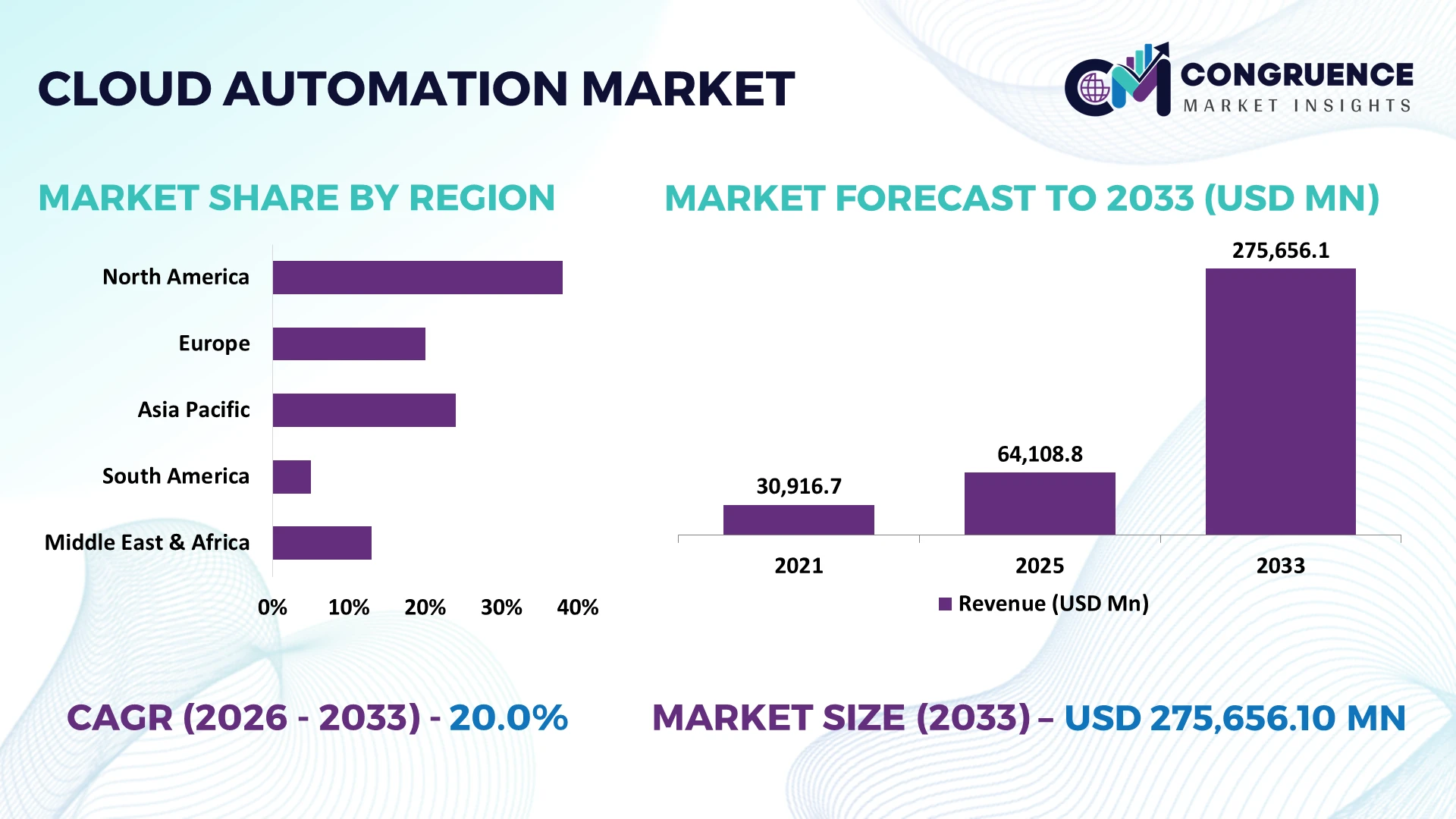
The United States dominates the global cloud automation landscape, supported by hyperscale cloud infrastructure, advanced DevOps adoption, and concentrated investment across technology, financial services, healthcare, retail, and government workloads. Enterprise automation intensity is rising as 71% of organizations operate a Cloud Center of Excellence or equivalent structure, while 63% maintain dedicated FinOps teams. GenAI usage in public cloud services reached 58% in 2026, reinforcing automated provisioning and governance requirements. Compared with European enterprises, U.S. organizations benefit from deeper hyperscaler ecosystems and earlier platform-engineering adoption, while geopolitical pressure around data sovereignty is strengthening localized automation architectures.
Strategically, enterprises and vendors should prioritize policy-driven multi-cloud orchestration, AI workload governance, and automated cost controls as cloud complexity shifts competitive advantage toward unified automation platforms.
Market Size & Growth: USD 64.11 billion in 2025 advances toward USD 275.66 billion by 2033 at 20% CAGR, driven by AI-led infrastructure orchestration and automated cloud operations.
Top Growth Drivers: 85% cite cloud-cost management challenges, 82% identify security pressure, and 68% prioritize cloud-cost optimization, strengthening demand for automated governance, remediation, and resource controls.
Short-Term Forecast: By 2027, automation-led FinOps deployments will increasingly target the 29% of IaaS/PaaS spending currently identified as wasted expenditure.
Emerging Technologies: Generative AI, AIOps, Infrastructure-as-Code, policy-as-code, and autonomous remediation are converging; GenAI already represents 58% of public-cloud service usage.
Regional Leaders: North America remains the primary advanced cloud automation hub, followed by Europe and Asia-Pacific, with multi-cloud governance, sovereignty controls, and AI infrastructure respectively shaping deployment priorities.
Consumer/End-User Trends: 71% of organizations operate a CCOE or similar structure, demonstrating institutionalized demand for standardized provisioning, governance, security, and automation workflows.
Pilot/Case Example: In 2026, enterprise FinOps maturity reached 63% adoption, while 64% measured cloud performance through value delivered to business units, up 12 percentage points.
Competitive Landscape: Hyperscaler-linked automation ecosystems remain influential, with Microsoft, AWS, Google, IBM, and Broadcom competing across orchestration, observability, configuration, governance, and DevOps automation.
Regulatory & ESG Impact: 56% prioritize cloud-cost optimization over sustainability, while 30% balance both equally, increasing requirements for automated resource utilization and carbon-aware workload management.
Investment & Funding: 76% of large enterprises now spend above USD 5 million monthly on cloud, expanding addressable budgets for FinOps, AIOps, orchestration, and automated governance platforms.
Innovation & Future Outlook: AI workload expansion is reshaping cloud operations as wasted cloud spending reaches 29%, pushing enterprises toward autonomous optimization and value-based infrastructure management.
Cloud automation demand is concentrating around infrastructure provisioning, workload orchestration, security remediation, FinOps, Kubernetes operations, and application deployment. Generative AI is becoming a major operational catalyst, reaching 58% usage across surveyed public-cloud environments in 2026 and creating heavier requirements for automated capacity and cost governance. Platform engineering, policy-as-code, event-driven remediation, and AI-assisted operations are replacing fragmented scripting with standardized control layers. Meanwhile, data-sovereignty requirements across Europe and geopolitical scrutiny of digital infrastructure are encouraging region-specific cloud architectures, making programmable governance increasingly important for enterprise cloud strategy and the strategic discussion ahead.
Cloud automation is becoming strategically essential as enterprises shift from basic cloud migration toward AI-intensive, multi-cloud operating models where infrastructure speed, cost visibility, and governance directly influence competitiveness. Approximately 78% of organizations use hybrid or multi-cloud environments, increasing demand for unified provisioning and policy enforcement. Infrastructure modernization is consequently moving investment from isolated scripts toward platform engineering, Infrastructure-as-Code, AIOps, and automated FinOps controls that standardize operations across distributed environments.
Modern Infrastructure-as-Code and policy-driven provisioning can shorten environment deployment from hours or days to minutes, delivering roughly 50–70% faster provisioning than ticket-based legacy workflows while reducing configuration drift. U.S. enterprises lead in hyperscaler-integrated automation and AI operations, whereas Germany, France, and other European markets place greater emphasis on sovereignty, regulatory controls, and workload portability. Through 2028, automation coverage will deepen across Kubernetes, security remediation, AI infrastructure, and cloud-cost management as enterprises consolidate fragmented toolchains.
A practical deployment involves financial institutions automatically provisioning compliant cloud environments with predefined identity, encryption, networking, and spending policies instead of configuring each workload manually. Vendors are consequently investing in autonomous operations, FinOps integrations, platform engineering partnerships, and cross-cloud control planes. Competitive positioning will increasingly depend on converting cloud automation from a deployment tool into an enterprise-wide operating layer linking infrastructure, security, cost, and application performance.
Enterprise AI deployment is transforming cloud automation from an IT productivity tool into critical infrastructure. Generative AI is used by approximately 58% of surveyed public-cloud organizations, while about 71% maintain Cloud Centers of Excellence or equivalent teams and 63% operate dedicated FinOps functions. GPU-intensive workloads require automated provisioning, scaling, observability, and cost controls because manual infrastructure management cannot efficiently accommodate variable compute consumption. In the United States, rapid hyperscaler expansion and AI data-center investment are reinforcing this shift toward programmable operations. Cloud providers and software vendors are responding through AIOps integration, autonomous remediation, Infrastructure-as-Code platforms, and FinOps partnerships. Strategically, vendors controlling both workload orchestration and cost optimization gain stronger enterprise relevance because AI infrastructure economics increasingly depend on utilization rather than installed capacity.
Interoperability remains a structural restraint as enterprises combine hyperscaler services, Kubernetes clusters, SaaS applications, and legacy infrastructure with incompatible policy and management frameworks. Around 78% of organizations operate hybrid or multi-cloud architectures, while approximately 85% identify cloud-cost management as a significant challenge and estimated cloud waste remains near 29%. Sovereignty requirements in Germany and other European markets further complicate workload placement by introducing jurisdiction-specific controls for sensitive data. Fragmented tooling increases integration expenditure, duplicated automation logic, configuration drift, and operational overhead, weakening returns from automation at scale. Vendors are countering this constraint through provider-neutral orchestration, OpenTelemetry integration, Kubernetes-based abstraction, and standardized policy-as-code. Enterprises increasingly consolidate automation vendors because reducing management-plane fragmentation delivers a more immediate operational benefit than adding isolated automation functions.
The strongest emerging opportunity lies in combining FinOps, AIOps, predictive analytics, and autonomous remediation into closed-loop cloud optimization. Approximately 29% of cloud expenditure is still considered wasted, while 68% of organizations identify cost optimization as a leading cloud priority and 63% maintain dedicated FinOps teams. This creates substantial demand for systems that automatically detect idle resources, resize instances, schedule non-production workloads, and redirect applications toward lower-cost infrastructure. India presents a particularly attractive deployment environment as digital-native enterprises expand cloud-native applications while maintaining strict infrastructure economics. Through 2028, agentic AI will increasingly convert recommendations into policy-controlled infrastructure actions. Vendors are investing in AI models, observability integrations, hyperscaler partnerships, and FinOps ecosystems. The non-obvious opportunity is automation tied to business-unit economics, allowing infrastructure decisions to reflect application value rather than technical utilization alone.
Scaling automation without weakening security or operational control represents the market’s critical execution challenge. Approximately 82% of organizations identify cloud security as a significant concern, while 78% operate hybrid or multi-cloud environments and 71% have established centralized cloud-governance structures. As automation expands from provisioning into autonomous remediation and AI-driven infrastructure changes, incorrect policies can propagate configuration errors across thousands of resources significantly faster than manual processes. U.S. financial institutions face particularly demanding identity, auditability, resilience, and third-party cloud requirements, making unrestricted autonomous operations impractical. Companies must therefore invest in policy validation, human-in-the-loop controls, automated rollback, identity governance, observability, and skilled platform-engineering teams. The strategic challenge is not maximizing automation coverage; it is establishing trustworthy automation boundaries that preserve deployment speed while maintaining traceability, cybersecurity, and operational consistency across increasingly autonomous cloud estates.
Platform Engineering Consolidates Automation Workflows: Enterprises are replacing fragmented DevOps toolchains with internal developer platforms that standardize infrastructure provisioning, deployment, and governance. Approximately 71% of organizations now operate cloud centers of excellence, while nearly 78% manage hybrid or multi-cloud estates. Platform teams are integrating Infrastructure-as-Code, Kubernetes, observability, and policy controls into reusable workflows, reducing developer infrastructure interactions by roughly 30–40%. U.S. software enterprises are responding by consolidating automation tooling and expanding platform-engineering teams to shorten application release cycles.
Policy-as-Code Moves Into Production: Automated policy enforcement is shifting from security testing into continuous cloud operations as regulated enterprises manage increasingly distributed workloads. Nearly 82% of organizations report cloud-security challenges, while automated compliance workflows can reduce manual control validation by approximately 40–60%. European data-sovereignty requirements are accelerating machine-readable policies covering residency, encryption, identity, and workload placement. Vendors are integrating policy engines directly into CI/CD pipelines and cloud-management platforms, reducing compliance bottlenecks without slowing deployment.
Event-Driven Operations Replace Scheduled Tasks: Cloud teams are moving from periodic scripts toward event-triggered automation that reacts immediately to infrastructure, application, and security telemetry. Automated remediation can shorten incident-response workflows by 30–50%, while observability-integrated operations eliminate multiple manual escalation steps. Enterprises are connecting telemetry platforms with serverless functions and orchestration engines, enabling automatic scaling, rollback, and configuration correction. Providers are expanding API integrations and event-driven architectures to improve infrastructure responsiveness.
Cloud Portability Gains Operational Priority: Sovereignty requirements and hyperscaler concentration are pushing enterprises toward portable automation frameworks. With roughly 78% operating multi-cloud environments and cloud waste approaching 29%, companies increasingly standardize Terraform-compatible workflows, Kubernetes configurations, and provider-neutral observability. The non-obvious shift is procurement-driven: automation portability is becoming negotiating leverage against provider lock-in. Enterprises are restructuring cloud architectures and expanding cross-cloud engineering partnerships to preserve workload mobility and purchasing flexibility.
Infrastructure Automation leads the type segmentation with an estimated 31% share, reflecting its central role in compute, storage, container, and cloud-network provisioning. Large enterprises increasingly standardize Infrastructure-as-Code to eliminate ticket-based provisioning and configuration drift across multi-cloud estates. Automated provisioning can reduce environment setup times by 50–70% compared with conventional manual processes. DevOps Automation remains an established segment as CI/CD pipelines become tightly integrated with cloud infrastructure, while Network Automation supports software-defined connectivity and dynamic configuration across distributed environments.
Security Automation is the fastest-growing type as identity controls, vulnerability remediation, and policy enforcement become embedded directly into deployment workflows. Approximately 82% of organizations identify cloud security as a significant operational concern, accelerating investment in automated detection and remediation. Application Automation is also strengthening as enterprises standardize release, scaling, and lifecycle workflows. Vendors are consequently integrating infrastructure, DevOps, security, application, and network functions into unified automation platforms, shifting investment away from isolated tools toward interoperable control planes.
Resource Provisioning represents the leading application with an estimated 29% share because automated allocation of compute, storage, networking, and container capacity remains foundational to cloud operations. Enterprises operating hybrid environments increasingly use policy-based templates and Infrastructure-as-Code to reduce provisioning from hours to minutes, with standardized workflows delivering approximately 50–70% faster deployment than ticket-driven processes. Configuration Management remains important for maintaining infrastructure consistency, while Backup and Recovery automation supports standardized resilience policies across distributed workloads.
Security Compliance is the fastest-growing application as regulatory controls become continuous rather than periodic. Approximately 82% of enterprises report cloud-security challenges, increasing adoption of automated identity validation, encryption enforcement, configuration assessment, and remediation. Workload Orchestration is simultaneously gaining strategic importance as Kubernetes and AI applications require dynamic placement and scaling across heterogeneous infrastructure. Providers are expanding policy engines, orchestration integrations, automated recovery capabilities, and compliance templates. Investment is therefore moving toward platforms capable of coordinating provisioning, configuration, orchestration, recovery, and compliance through one operational framework.
IT Enterprises lead end-user adoption with an estimated 34% share because software-intensive businesses manage high volumes of application releases, development environments, Kubernetes clusters, and distributed cloud resources. Automation reduces repetitive infrastructure work while enabling standardized DevOps and platform-engineering practices. Approximately 78% of organizations operate hybrid or multi-cloud environments, making centralized orchestration particularly valuable for large technology enterprises. Cloud Service Providers represent another mature buyer group, using automation extensively for tenant provisioning, capacity allocation, monitoring, and service lifecycle management.
Financial Institutions represent the fastest-growing end-user segment as banks automate compliant provisioning, security controls, workload orchestration, and recovery across regulated cloud estates. Healthcare Organizations are expanding automation around application modernization and protected workload governance, while Government Agencies increasingly require policy-controlled infrastructure aligned with sovereignty and cybersecurity mandates. Vendors are responding with industry-specific compliance templates, private-cloud integrations, consumption-based offerings, and partnerships with hyperscalers and systems integrators. Competitive demand is consequently shifting toward automation platforms combining operational scale with sector-specific governance rather than standardized provisioning alone.
North America accounted for the largest market share at 38% in 2025 however, Asia-Pacific is expected to register the fastest growth, expanding at a CAGR of 22.4% between 2026 and 2033.
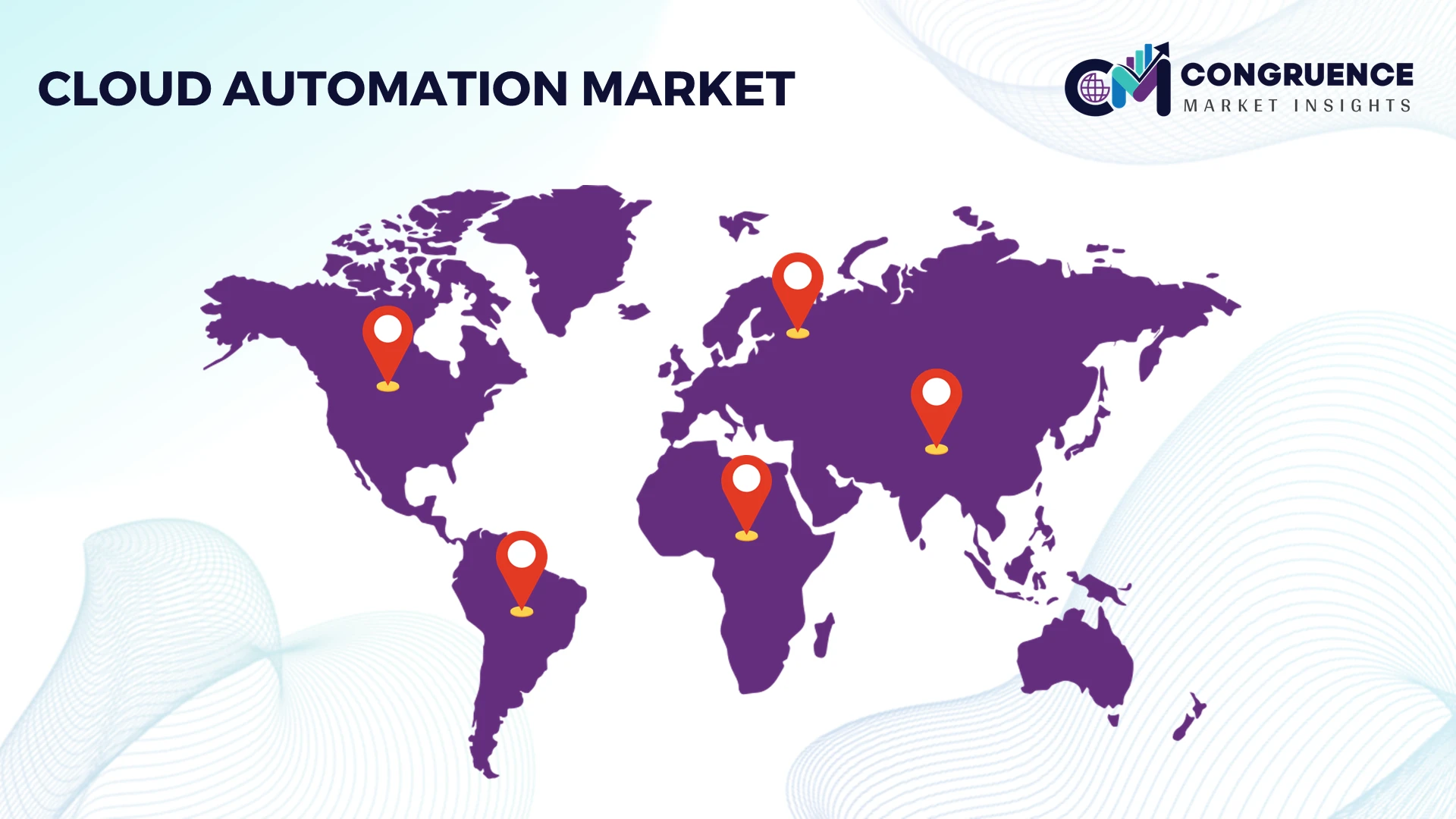
AI Infrastructure and Platform Engineering Reshape Operations
North America accounted for approximately 38% of global cloud automation demand in 2025, supported by hyperscaler concentration, mature DevOps ecosystems, and large-scale AI infrastructure deployment. U.S. enterprises are moving beyond scripted provisioning toward platform engineering, AIOps, Infrastructure-as-Code, automated FinOps, and policy-driven security. Hybrid and multi-cloud penetration exceeds 75% among large cloud users, creating demand for centralized orchestration across AWS, Azure, Google Cloud, private infrastructure, and Kubernetes environments. Financial services, technology, healthcare, and retail organizations increasingly automate workload placement and resource optimization as GPU-intensive AI deployments increase infrastructure complexity. Canadian enterprises are emphasizing regulated workload modernization and data residency. Providers are responding with integrated control planes, autonomous remediation, and cloud-cost optimization capabilities, shifting competitive differentiation toward governance depth and cross-cloud interoperability.
United States Market Outlook: The United States represents the region’s operational center, supported by hyperscale data-center capacity, extensive software ecosystems, and rapid enterprise adoption of AI workloads. More than 70% of large organizations use centralized cloud-governance or cloud-center-of-excellence structures, strengthening demand for automated provisioning, security enforcement, FinOps, and application orchestration. Investment is increasingly concentrated on platform engineering and autonomous infrastructure operations.
Digital Sovereignty Redefines Cloud Architecture
Europe represents approximately 25% of global cloud automation activity, with Germany, the United Kingdom, France, and the Netherlands forming major deployment centers. Automation requirements are increasingly shaped by sovereignty, operational resilience, cybersecurity, and regulated data handling rather than migration alone. Around 82% of surveyed European organizations have adjusted cloud strategies in response to geopolitical or regulatory considerations, while 94% plan modifications or expansion of cloud architecture. Sovereign-cloud deployment is consequently increasing demand for automated workload classification, residency enforcement, identity governance, and policy-as-code. Germany is emerging as a critical infrastructure hub as hyperscalers establish independently operated sovereign environments. Banks, public agencies, manufacturers, and healthcare organizations are integrating automation with compliance workflows, while vendors expand local infrastructure and partnerships. This creates a distinct competitive requirement: automation platforms must orchestrate infrastructure without compromising jurisdictional control.
Germany Market Outlook: Germany combines a large industrial enterprise base with stringent data-governance requirements, making it strategically important for sovereign cloud automation. The launch of dedicated European sovereign-cloud infrastructure in Brandenburg brings more than 90 cloud services into an EU-controlled operating environment. Manufacturing, government, healthcare, and financial organizations are increasingly automating workload placement, compliance validation, encryption, and infrastructure provisioning within jurisdiction-specific architectures.
Cloud Scale Accelerates Automated Operations
Asia-Pacific accounts for approximately 23% of global cloud automation demand and combines hyperscale infrastructure expansion with rapid cloud-native adoption across China, India, Japan, Australia, Singapore, and South Korea. India is strengthening its position through expanding data-center capacity, digital banking, SaaS exports, and enterprise application modernization, while Japan emphasizes automated operations to address IT workforce constraints. China maintains substantial domestic cloud infrastructure supported by locally developed platforms and sovereignty requirements. Across major markets, Kubernetes, Infrastructure-as-Code, automated security, and FinOps are moving into production environments as enterprises manage increasingly distributed applications. AI infrastructure expansion is intensifying automated GPU allocation, workload scheduling, and capacity optimization. Providers are responding by establishing additional cloud regions, expanding partner ecosystems, and localizing managed automation services, making operational scalability and integration breadth decisive purchasing criteria.
India Market Outlook: India is becoming a major cloud automation deployment center as banks, telecom operators, IT service providers, digital commerce companies, and SaaS businesses scale cloud-native infrastructure. More than 80% of large Indian enterprises now operate or plan hybrid-cloud architectures, increasing requirements for automated configuration, observability, workload orchestration, and governance. Domestic data-localization priorities further strengthen demand for programmable infrastructure controls and geographically aware workload management.
Enterprise Modernization Concentrates Around Brazil
South America represents approximately 6% of global cloud automation activity, with Brazil accounting for the majority of enterprise-scale deployment, followed by Argentina, Chile, and Colombia. Banks, digital commerce platforms, telecom operators, and government organizations are replacing manually administered infrastructure with automated provisioning, container orchestration, DevSecOps, and cloud-cost controls. Brazil’s expanding data-center ecosystem and renewable-power availability are supporting hyperscaler infrastructure development, while Chile provides an additional location for regional cloud capacity. However, enterprise modernization remains uneven because skills availability, connectivity quality, currency exposure, and legacy application estates constrain standardized deployment outside major commercial centers. Cloud providers and integrators are therefore expanding managed automation, training programs, and localized implementation partnerships. Demand increasingly favors automation platforms that reduce specialist labor requirements while supporting hybrid environments rather than cloud-only architectures.
Brazil Market Outlook: Brazil is the region’s principal automation market because of its large banking, fintech, telecommunications, retail, and government technology base. Cloud providers have trained hundreds of thousands of Brazilian technology professionals, strengthening the local implementation ecosystem. Growing emphasis on national data sovereignty is also encouraging automated workload classification, auditable infrastructure configuration, and policy-controlled placement of sensitive public-sector information.
Sovereign Infrastructure Drives Automation Investment
Middle East & Africa represents approximately 8% of global cloud automation activity, with the UAE, Saudi Arabia, South Africa, and Israel concentrating advanced deployments. Saudi Arabia and the UAE are building cloud and AI infrastructure around national digital-transformation programs, increasing requirements for automated capacity provisioning, sovereign workload governance, and AI infrastructure orchestration. Government, energy, financial services, aviation, and telecommunications organizations are prominent adopters. The region’s infrastructure strategy is also changing: geopolitical disruption affecting Gulf data-center operations in 2026 increased attention to geographic redundancy, automated failover, workload portability, and disaster recovery. African adoption remains more concentrated around South Africa and major financial centers because data-center availability and connectivity remain uneven. Vendors are responding with sovereign-cloud partnerships, local cloud regions, resilient architectures, and managed automation services designed for regulated workloads.
Saudi Arabia Market Outlook: Saudi Arabia is emerging as a strategic cloud automation center through government digitalization, AI infrastructure investment, and stronger domestic data-residency requirements. Partnerships involving national institutions and global cloud providers are advancing sovereign-cloud capabilities for regulated industries. Banks, government agencies, energy companies, and telecom operators increasingly require automated compliance, infrastructure provisioning, identity governance, and workload orchestration within locally controlled cloud environments.
Microsoft, AWS, Google Cloud, IBM, Broadcom, and ServiceNow compete across cloud orchestration, infrastructure automation, governance, observability, and DevOps workflows, while specialized platforms challenge hyperscalers through provider-neutral control. The top five vendors collectively represent approximately 48% of adjacent cloud-management and automation deployments, creating a moderately concentrated structure. Technology integration dominates competition: enterprises increasingly demand 30–50% faster provisioning, approximately 20–30% cloud-cost optimization, and policy automation capable of reducing manual compliance work by over 40%. Hyperscalers compete through native service breadth and infrastructure integration, while IBM and Broadcom emphasize hybrid-cloud control and ServiceNow targets workflow orchestration. Acquisitions, ecosystem partnerships, AI-enabled operations, and FinOps integration are accelerating platform consolidation. Provider lock-in, migration complexity, security certification, and integration depth create substantial entry barriers. Winning requires interoperable multi-cloud automation, autonomous remediation, measurable cost control, and governance capabilities that integrate directly into enterprise operating workflows.
Microsoft Corporation
Amazon Web Services
IBM Corporation
Broadcom Inc.
ServiceNow, Inc.
Cisco Systems, Inc.
BMC Software, Inc.
Oracle Corporation
Hewlett Packard Enterprise
Dynatrace, Inc.
Nutanix, Inc.
Progress Software Corporation
Puppet, Inc.
Infrastructure-as-Code, Kubernetes orchestration, policy-as-code, and automated configuration management form today’s cloud automation stack. Enterprises increasingly automate provisioning across hybrid environments, where automation can cut deployment time by 50–70% and reduce configuration errors by roughly 30%. Adoption is extending beyond DevOps teams into centralized platform engineering, enabling standardized environments, faster releases, stronger governance, and consistent resource allocation across multi-cloud estates while reducing manual infrastructure administration substantially.
Emerging AIOps, FinOps automation, event-driven remediation, and generative-AI assistants are shifting operations from scripted execution toward contextual decision-making. AI-assisted incident correlation can reduce resolution effort by 30–50%, while automated resource optimization commonly targets 20–30% cloud waste. Compared with ticket-based legacy provisioning, modern Infrastructure-as-Code workflows deliver approximately 60% faster environment deployment. Enterprises with large Kubernetes, AI, and distributed application estates benefit most because automation converts telemetry directly into infrastructure, security, and cost actions.
From 2026–2028, agentic cloud operations will become disruptive as autonomous agents diagnose incidents, generate infrastructure code, optimize capacity, and execute policy-controlled remediation. Deployment is advancing rapidly: AWS Console-to-Code supports 32 services, while agentic operations increasingly span multicloud and on-premises environments. Integration of observability, FinOps, DevSecOps, and orchestration will favor vendors offering unified control planes. Companies acting now gain faster infrastructure execution, lower operating overhead, and stronger governance as AI workloads make manual cloud management operationally unsustainable.
August 2026 – Amazon Web Services expanded Console-to-Code from 6 to 32 supported services and added cross-region recording, converting manual console actions into production-ready Infrastructure-as-Code. The expansion strengthens repeatable multi-region automation and reduces infrastructure configuration effort for DevOps teams. Source: aws.com
February 2025 – IBM advanced its HashiCorp acquisition after UK regulators cleared the USD 6.4 billion transaction without a Phase 2 investigation. The deal strengthens IBM’s hybrid-cloud automation portfolio through Terraform infrastructure provisioning and Vault-based security capabilities for enterprises. Source: reuters.com
August 2024 – Broadcom unveiled an updated VMware Cloud Foundation featuring one self-service management console instead of more than 12 consoles. IDC-backed figures cited 42% lower operating costs, strengthening Broadcom’s private-cloud automation proposition through consolidated provisioning, operations, and infrastructure management. Source: siliconangle.com
October 2025 – IBM expanded hybrid-cloud automation with agentic orchestration and intelligent infrastructure capabilities at TechXchange. The initiative addressed increasingly fragmented enterprise environments as IBM projected more than 1 billion applications by 2028, strengthening demand for scalable automated operations. Source: ibm.com.
The Cloud Automation Market Report evaluates Infrastructure Automation, Application Automation, Network Automation, Security Automation, and DevOps Automation across Resource Provisioning, Configuration Management, Workload Orchestration, Backup and Recovery, and Security Compliance. End-user coverage includes IT Enterprises, Cloud Service Providers, Financial Institutions, Healthcare Organizations, and Government Agencies. The analysis tracks North America, Europe, Asia-Pacific, South America, and Middle East & Africa, with North America representing approximately 38% of 2025 market activity.
Technology coverage extends across Infrastructure-as-Code, Kubernetes, AIOps, FinOps automation, policy-as-code, agentic operations, observability, and autonomous remediation. The report examines competitive positioning, deployment economics, regulatory influences, sovereign-cloud requirements, multi-cloud interoperability, and emerging AI infrastructure automation. With hybrid and multi-cloud adoption exceeding 75% among major enterprise users, the framework supports 2026–2033 investment planning, geographic expansion, product prioritization, partnership strategy, and identification of automation capabilities becoming operationally critical.
| Report Attribute/Metric | Report Details |
|---|---|
Market Revenue in 2025 | USD 64108.8 Million |
Market Revenue in 2033 | USD 275656.1 Million |
CAGR (2026 - 2033) | 20% |
Base Year | 2025 |
Forecast Period | 2026 - 2033 |
Historic Period | 2021 - 2025 |
Segments Covered | By Type
By Application
By End-User
|
Key Report Deliverable | Revenue Forecast, Growth Trends, Market Dynamics, Segmental Overview, Regional and Country-wise Analysis, Competition Landscape |
Region Covered | North America, Europe, Asia-Pacific, South America, Middle East, Africa |
Key Players Analyzed | Microsoft Corporation, Amazon Web Services, Google, IBM Corporation, Broadcom Inc., ServiceNow, Inc., Cisco Systems, Inc., BMC Software, Inc., Oracle Corporation, Hewlett Packard Enterprise, Dynatrace, Inc., Nutanix, Inc., Progress Software Corporation, Puppet, Inc. |
Customization & Pricing | Available on Request (10% Customization is Free) |




