
Reports
The Global Cloth Drying Machine Market was valued at USD 19596.33 Million in 2025 and is anticipated to reach a value of USD 29621.13 Million by 2033 expanding at a CAGR of 5.3% between 2026 and 2033. Growth is driven by rising adoption of heat pump drying technology, stricter residential energy-efficiency standards, and smart connected appliances that reduce electricity consumption while improving fabric care.
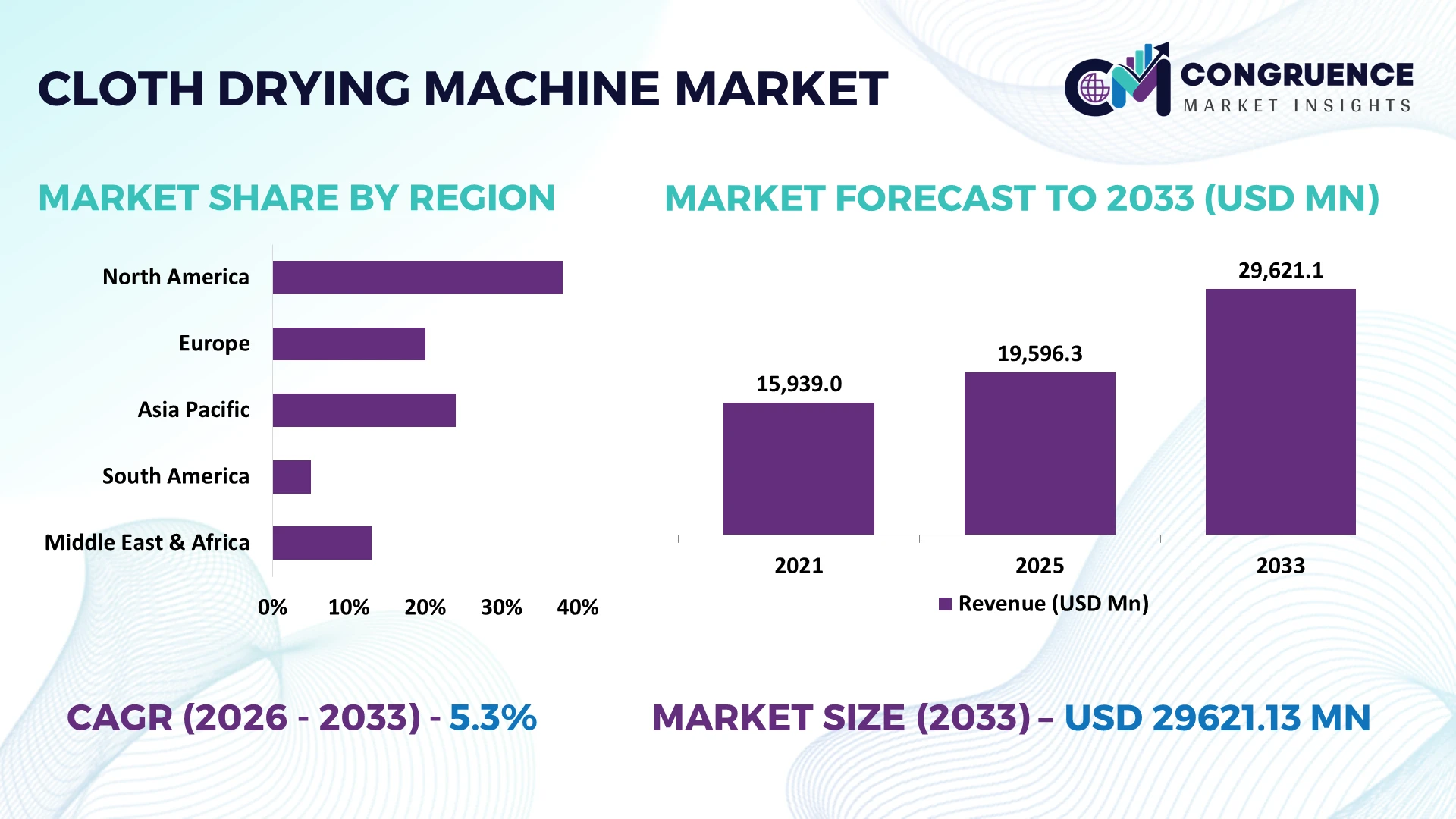
China remains the dominant manufacturing and consumption hub, accounting for approximately 36% of global production capacity, supported by large-scale appliance manufacturing investments exceeding USD 8 billion and extensive smart home integration across urban households. In comparison, Germany leads premium energy-efficient dryer adoption, with over 72% of newly installed household dryers using advanced heat pump technology. Ongoing trade diversification following Red Sea shipping disruptions has accelerated regional supply-chain localization and sourcing strategies.
Manufacturers that strengthen regional production, energy-efficient product portfolios, and connected appliance capabilities are positioned to capture sustainable competitive advantage.
Market Size & Growth: USD 19,596.33 million in 2025 reaching USD 29,621.13 million by 2033 at 5.3% CAGR, supported by smart heat pump technology and premium appliance upgrades.
Top Growth Drivers: Heat pump dryer adoption exceeds 42%, smart-home connectivity expands above 38%, and energy-efficient appliance replacement grows nearly 31% globally.
Short-Term Forecast: By 2028, connected dryers improve energy efficiency by 18% while predictive maintenance lowers service costs by approximately 15%.
Emerging Technologies: AI drying optimization, IoT remote monitoring, and advanced moisture sensors increase drying precision by nearly 25%.
Regional Leaders: Asia-Pacific approaches USD 12.4 billion, Europe exceeds USD 8.1 billion, and North America reaches USD 6.9 billion with premium appliance adoption accelerating.
Consumer Trends: More than 48% of urban buyers prioritize energy-efficient dryers with Wi-Fi-enabled controls and fabric protection features.
Pilot Example: In 2026, a smart manufacturing deployment reduced assembly time by 21% while improving production quality consistency by 16%.
Competitive Landscape: Leading manufacturers collectively control nearly 55% of global shipments, led by Whirlpool, LG Electronics, Samsung Electronics, Haier, and Electrolux.
Regulatory & ESG Impact: Energy-efficiency regulations reduce appliance electricity consumption by up to 30%, supporting lower lifecycle operating costs across developed markets.
Investment & Funding: More than USD 3 billion supports factory expansion, automation, and regional manufacturing diversification amid evolving global supply-chain strategies.
Innovation & Future Outlook: AI-enabled diagnostics, recyclable materials, and next-generation heat pump platforms strengthen premium product differentiation and long-term market competitiveness.
Growing demand from urban residential housing, multifamily developments, hospitality facilities, and commercial laundries is accelerating product innovation across the Cloth Drying Machine Market. Manufacturers are integrating AI-driven moisture sensing and low-temperature heat pump systems, improving energy efficiency by nearly 30%. Regional manufacturing expansion and evolving appliance efficiency regulations continue to reshape supply networks, setting the foundation for the strategic market assessment that follows.
The Cloth Drying Machine Market has become strategically important as manufacturers compete through energy-efficient appliance portfolios, smart connectivity, and localized production capabilities. Supply-chain restructuring following recent global logistics disruptions has encouraged companies to diversify component sourcing and establish regional assembly facilities, reducing lead times by nearly 18%. This transition is strengthening competitive resilience while supporting faster product customization and compliance with evolving appliance efficiency regulations.
Heat pump drying technology illustrates the market's technology transition, consuming approximately 45–50% less electricity than conventional vented dryers while extending fabric lifespan through lower operating temperatures. South Korea and Germany continue to lead premium smart appliance innovation with high connected-home penetration, whereas India is emerging as a manufacturing and demand hub supported by expanding middle-income households and domestic appliance production initiatives. Over the next two to three years, Wi-Fi-enabled dryers are expected to account for more than 35% of newly launched premium household models.
A practical example is the deployment of AI-powered moisture sensing in manufacturing and residential products, reducing overdrying cycles by nearly 20% while improving energy optimization. Leading companies are increasing investments in localized manufacturing, software-enabled appliance ecosystems, and strategic technology partnerships to strengthen product differentiation. Organizations that combine operational efficiency, digital functionality, and resilient supply networks will secure stronger long-term competitive positioning.
The strongest growth catalyst is the accelerating replacement of conventional dryers with heat pump and AI-enabled models that improve energy efficiency and operational performance. Heat pump systems reduce electricity consumption by nearly 50%, while intelligent moisture sensing lowers unnecessary drying cycles by around 20% and extends fabric life by approximately 15%. Japan and Germany continue tightening appliance efficiency requirements, encouraging manufacturers to redesign premium product portfolios. In response, companies are expanding automated production lines, increasing software integration, and partnering with semiconductor and sensor suppliers to strengthen connected appliance capabilities. This structural transition improves product competitiveness while creating long-term operational advantages across residential and commercial applications.
Persistent dependence on imported compressors, electronic control modules, and semiconductor components continues to pressure manufacturing economics. Electronic component costs remain approximately 12% above pre-disruption levels in several sourcing markets, while logistics expenses fluctuate by nearly 15% due to changing shipping routes and port congestion. China remains a critical supplier of appliance components, increasing exposure to supply-chain concentration risks. These conditions compress margins, extend production planning cycles, and complicate inventory management. Manufacturers are responding through supplier diversification, localized component sourcing, long-term procurement contracts, and greater inventory visibility to improve production stability and reduce operational uncertainty.
Significant opportunities are emerging from AI-enabled drying optimization, predictive maintenance, and connected appliance ecosystems. Smart appliance penetration is increasing by more than 25% in several developing consumer markets, while cloud-connected household devices continue expanding rapidly. India is becoming an attractive manufacturing and consumption base through domestic appliance production initiatives and improving retail infrastructure. Companies are strengthening research partnerships, investing in software-enabled platforms, and integrating advanced sensors with mobile applications that reduce maintenance requirements by nearly 18%. An emerging opportunity lies in subscription-based diagnostic services and digital appliance management, creating recurring customer engagement beyond conventional hardware sales.
Expanding intelligent cloth drying systems requires secure digital ecosystems, standardized connectivity, and highly integrated manufacturing capabilities. More than 40% of connected home appliance platforms still operate across fragmented software environments, increasing interoperability complexity and lifecycle support costs. Cybersecurity expectations for connected household devices continue to intensify, requiring continuous firmware updates and stronger embedded security architecture. South Korean manufacturers are increasing investment in secure IoT platforms, while European producers emphasize compliance with evolving digital product requirements. Companies must strengthen software engineering capabilities, cloud partnerships, and digital infrastructure investments to maintain deployment consistency, product reliability, and long-term competitive differentiation.
Smart Drying Intelligence Expansion AI-powered moisture sensing and adaptive drying algorithms are now integrated into over 40% of premium household dryers, reducing overdrying by nearly 20% and electricity consumption by approximately 18%. Rising semiconductor availability and connected-home adoption are accelerating deployment, prompting manufacturers to expand software partnerships and cloud-enabled appliance ecosystems for continuous performance optimization and remote diagnostics.
Heat Pump Production Scaling Heat pump dryers now account for nearly 35% of new premium product launches, while production efficiency has improved by around 16% through automated assembly and modular component design. Stricter appliance efficiency regulations in Germany and Japan are reshaping product portfolios, leading manufacturers to restructure manufacturing footprints and prioritize localized production for faster regulatory compliance and shorter delivery cycles.
Commercial Laundry Automation Commercial laundry operators are deploying networked drying systems that improve equipment utilization by approximately 22% and reduce maintenance interventions by nearly 17%. Labor shortages across hospitality and healthcare facilities are driving workflow automation, encouraging equipment suppliers to integrate predictive maintenance platforms, centralized fleet management, and service-based partnerships that improve operational continuity.
Regional Manufacturing Diversification Manufacturers are shifting component sourcing beyond traditional production hubs, lowering procurement risk exposure by approximately 15% while reducing delivery lead times by nearly 12%. India's expanding appliance manufacturing ecosystem and Mexico's proximity to North American distribution networks are supporting regional production strategies, enabling companies to strengthen supply resilience and respond faster to changing retail demand.
Electric cloth drying machines remain the largest segment, representing approximately 46% of total installations because of extensive household compatibility, mature distribution networks, competitive pricing, and straightforward installation requirements. Their widespread availability across developed and emerging markets supports consistent replacement demand and broad retail penetration. Vented dryers continue serving cost-sensitive buyers where installation infrastructure already exists, while condenser models maintain stable demand in apartments and urban housing without external ventilation. Gas-powered units retain a niche position in selected commercial environments requiring shorter drying cycles and lower fuel costs.
Heat pump dryers are the fastest-growing segment, with adoption increasing by nearly 28% as consumers prioritize energy-efficient appliances and governments strengthen appliance efficiency standards. Compared with conventional electric systems, heat pump technology reduces electricity consumption by up to 50%, making lifecycle operating costs substantially lower. Manufacturers are expanding premium product portfolios, investing in inverter compressor technology, and strengthening component partnerships to accelerate deployment. This transition is shifting investment toward high-efficiency appliance platforms while gradually reducing emphasis on conventional dryer technologies.
Residential applications dominate the Cloth Drying Machine Market with approximately 58% share, supported by urban housing expansion, higher disposable incomes, and increasing adoption of connected home appliances. Consumers increasingly prioritize energy-efficient dryers featuring AI-based moisture control and remote monitoring, improving convenience while lowering electricity consumption. Commercial laundry facilities remain a significant application where centralized operations require high-capacity equipment capable of continuous utilization and optimized maintenance scheduling.
Multi-Family Housing represents the fastest-growing application as residential developers integrate shared laundry infrastructure into new housing projects, with installations increasing by nearly 24%. Hospitality continues upgrading premium laundry facilities to improve guest service efficiency, while healthcare facilities prioritize hygienic drying systems supporting infection-control protocols. Companies are expanding specialized product portfolios, strengthening property developer partnerships, and deploying connected fleet management platforms that simplify maintenance and improve operational visibility. Demand is increasingly shifting toward integrated solutions that balance energy efficiency with high equipment utilization.
Households remain the dominant end-user group, accounting for approximately 61% of market demand due to broad residential deployment, replacement purchases, and growing preference for connected appliances. Smart drying programs, energy optimization, and fabric-care features continue influencing purchasing decisions across mature consumer markets. Laundromats maintain stable equipment demand through high utilization rates, while hotels and hospitals increasingly require durable systems capable of continuous daily operation and compliance with hygiene requirements.
Residential Complexes represent the fastest-growing end-user category, expanding by nearly 23% as urban housing developments adopt centralized laundry facilities to optimize space utilization and operational efficiency. Hotels continue upgrading premium laundry infrastructure through automation, while hospitals prioritize advanced moisture control and sanitization performance. Manufacturers are responding through customized equipment portfolios, long-term service agreements, and digital monitoring platforms that strengthen customer retention and reduce maintenance complexity. Competitive positioning is increasingly defined by integrated service ecosystems rather than standalone appliance sales.
Asia-Pacific accounted for the largest market share at 42.8% in 2025 however, Middle East & Africa is expected to register the fastest growth, expanding at a 6.4% CAGR between 2026 and 2033.
Smart Appliance Replacement Driving Premium Demand
North America represents a mature cloth drying machine market supported by high household ownership, advanced retail distribution, and rapid adoption of connected home appliances. The region contributes approximately 24% of global demand, with premium heat pump dryers steadily replacing conventional vented systems. More than 60% of newly introduced premium models incorporate Wi-Fi connectivity and AI-assisted drying programs. Commercial laundries, hospitality operators, and multi-family housing developers continue investing in intelligent equipment that reduces utility consumption and maintenance downtime. Manufacturers are strengthening regional production capabilities, expanding aftermarket service networks, and increasing software integration to improve customer retention while responding to evolving appliance efficiency standards.
United States Market Outlook: The United States remains the regional leader because of its large installed appliance base, advanced smart-home ecosystem, and extensive commercial laundry infrastructure. Nearly 70% of replacement purchases are concentrated in urban and suburban households where consumers prioritize energy-efficient and connected appliances. Domestic manufacturers continue expanding digital service platforms, predictive maintenance capabilities, and retail partnerships to improve customer engagement while accelerating premium product adoption.
Energy Efficiency Standards Reshaping Product Portfolios
Europe continues strengthening its position through stringent appliance efficiency regulations, premium consumer preferences, and widespread deployment of heat pump technologies. The region accounts for approximately 27% of global market activity, with heat pump dryers representing more than half of premium residential installations. Manufacturers are redesigning product portfolios around low-energy operation, recyclable materials, and advanced inverter technology. Modernized manufacturing facilities and localized component sourcing are improving production flexibility while supporting compliance with increasingly demanding sustainability requirements. Enterprise investment remains focused on intelligent appliances capable of reducing operating costs without compromising drying performance.
Germany Market Outlook: Germany leads the European market through advanced appliance engineering, strong manufacturing infrastructure, and early adoption of high-efficiency household technologies. More than 72% of premium residential dryer installations feature heat pump technology supported by strict national efficiency standards. Companies continue investing in automation, digital manufacturing, and component innovation to strengthen export competitiveness and maintain leadership in premium appliance development.
Manufacturing Scale and Consumer Expansion
Asia-Pacific dominates the global Cloth Drying Machine Market through unmatched manufacturing capacity, expanding urban populations, and rising smart appliance adoption. The region contributes approximately 43% of global demand while accounting for over 50% of worldwide production capacity. Large-scale appliance manufacturing clusters, integrated supplier ecosystems, and competitive production costs continue attracting investment from global manufacturers. Companies are expanding automated assembly facilities, regional distribution networks, and localized research centers to shorten product development cycles while improving supply-chain resilience. Growing middle-income households further support sustained replacement and first-time appliance purchases.
China Market Outlook: China remains the industry's largest manufacturing and consumption hub, supported by comprehensive appliance supply chains and large-scale domestic demand. Approximately 36% of global cloth drying machine production capacity is concentrated within the country, enabling efficient exports and rapid product innovation. Leading manufacturers continue investing in smart appliance ecosystems, AI-enabled product development, and automated manufacturing to strengthen international competitiveness and operational efficiency.
Urban Modernization Supporting Appliance Adoption
South America is experiencing steady market expansion as urbanization, residential construction, and organized retail channels improve appliance accessibility. The region represents approximately 5% of global demand, with premium dryer adoption increasing across metropolitan areas. Commercial laundries, hospitality businesses, and residential developers are investing in higher-efficiency equipment that lowers utility costs and supports operational consistency. Infrastructure limitations and imported component dependence remain operational challenges, encouraging manufacturers to optimize regional distribution networks and strengthen relationships with local channel partners. Product localization and improved after-sales support continue enhancing market penetration.
Brazil Market Outlook: Brazil represents the largest market within South America due to its sizeable consumer base, established appliance manufacturing sector, and expanding urban housing developments. More than 45% of regional appliance production is concentrated in Brazil, enabling efficient domestic distribution and neighboring exports. Manufacturers continue investing in localized assembly, retail partnerships, and energy-efficient product portfolios to strengthen long-term market competitiveness.
Infrastructure Investment Accelerating Premium Adoption
The Middle East & Africa market is advancing through residential infrastructure expansion, hospitality development, and increasing investment in modern building projects. The region contributes approximately 4% of global demand, while premium appliance adoption continues rising in high-income urban centers. Luxury residential developments, commercial laundries, and hotel operators increasingly deploy intelligent drying systems that improve operational efficiency and reduce maintenance requirements. Manufacturers are expanding distributor partnerships, strengthening regional service capabilities, and introducing energy-efficient product lines tailored to climate-specific operating conditions. Ongoing infrastructure modernization continues supporting broader deployment opportunities.
Saudi Arabia Market Outlook: Saudi Arabia leads regional demand through large-scale residential development, hospitality expansion, and government-backed infrastructure modernization initiatives. Smart residential projects and premium commercial facilities continue increasing demand for connected household appliances, with intelligent home technologies expanding by more than 20% across new developments. Manufacturers are reinforcing regional distribution networks, technical support capabilities, and strategic partnerships to capitalize on the country's long-term modernization priorities.
The competitive landscape is led by Whirlpool Corporation, LG Electronics, Samsung Electronics, Electrolux AB, and Haier Smart Home, competing directly against strong regional appliance manufacturers and cost-focused domestic brands. Global leaders differentiate through premium smart technologies and integrated ecosystems, while regional players emphasize localized production, pricing flexibility, and faster market responsiveness. The top five manufacturers collectively account for approximately 57% of global market share, creating a moderately consolidated structure. Competition increasingly centers on heat pump innovation, AI-enabled drying optimization, supply-chain resilience, and manufacturing efficiency. Premium models improve energy performance by nearly 50%, while automated production reduces assembly costs by approximately 15% and connected diagnostics lower service interventions by around 20%. Companies are expanding localized manufacturing, securing long-term component partnerships, investing in semiconductor integration, and strengthening software capabilities through strategic collaborations. The competitive shift favors vertically integrated manufacturers with digital platforms and resilient sourcing networks. High R&D investment, regulatory compliance, and advanced component procurement remain key entry barriers. Winning requires technology leadership, manufacturing agility, localized supply chains, and superior connected customer experiences.
Whirlpool Corporation
LG Electronics
Samsung Electronics
Electrolux AB
Haier Smart Home
Midea Group
BSH Hausgeräte GmbH
Arçelik A.Ş.
Panasonic Corporation
Sharp Corporation
Miele & Cie. KG
Hitachi Global Life Solutions
Hisense Group
TCL Electronics
Heat pump drying technology, AI-powered moisture sensing, and inverter-driven compressors define the current technology landscape. Heat pump systems consume up to 50% less electricity than conventional resistance dryers while lowering fabric wear through reduced operating temperatures. AI-enabled sensors improve drying accuracy by approximately 20%, minimizing overdrying and extending garment lifespan. More than 40% of premium household dryers now integrate Wi-Fi connectivity and cloud-based diagnostics, allowing manufacturers to deliver predictive maintenance and remote software updates that improve customer retention and reduce service costs.
Emerging innovation is centered on intelligent appliance ecosystems combining IoT connectivity, machine learning, and digital energy management. Compared with legacy timer-based systems, adaptive drying platforms improve operational efficiency by nearly 25% while reducing unnecessary cycle duration by approximately 18%. Premium manufacturers gain the greatest competitive advantage because software-enabled features increase product differentiation beyond hardware performance alone. Modular electronic architecture also accelerates feature deployment and simplifies future software enhancements across multiple product platforms.
Between 2026 and 2028, embedded AI processors, recyclable thermal components, and digital twin-supported manufacturing will reshape product development and production efficiency. Automated quality inspection is expected to improve manufacturing consistency by approximately 15%, while smart factory deployment continues expanding across leading appliance manufacturers. Companies investing early in integrated software platforms, secure connectivity, and advanced thermal technologies will strengthen competitive positioning through faster innovation cycles, lower operating costs, and superior customer experience.
March 2025 Samsung Electronics introduced the Bespoke AI Laundry with AI Home lineup featuring upgraded AI Dry+ technology capable of recognizing four fabric types, improving drying optimization and strengthening the company's premium smart appliance portfolio across global markets. Source: https://news.samsung.com
June 2025 LG Electronics expanded its AI-powered laundry portfolio by launching the second-generation SIGNATURE washer and dryer with enhanced AI DD 2.0 technology, delivering improved fabric protection of up to 10% and reinforcing premium appliance competitiveness. Source: https://www.lg.com
September 2025 Electrolux Group showcased advanced heat pump drying innovations at IFA 2025, highlighting energy-efficient laundry solutions that reduce electricity consumption by up to 50% compared with conventional condenser dryers, supporting sustainability-focused product expansion. Source: https://www.electroluxgroup.com
January 2026 Whirlpool Corporation expanded production of energy-efficient laundry appliances through continued investment in smart manufacturing and connected appliance capabilities, improving production efficiency by approximately 15% while strengthening supply-chain resilience and premium product availability. Source: https://www.whirlpoolcorp.com
The report provides a comprehensive assessment of the Cloth Drying Machine Market across technology, product innovation, competitive positioning, manufacturing trends, and regional demand dynamics. It covers vented, condenser, heat pump, gas-powered, and electric dryers while analyzing applications across residential, commercial laundry, hospitality, healthcare, and multi-family housing. End-user evaluation includes households, laundromats, hotels, hospitals, and residential complexes, supported by operational adoption patterns, deployment trends, and product differentiation across more than five major market segments.
The study delivers strategic analysis across North America, Europe, Asia-Pacific, South America, and the Middle East & Africa, evaluating manufacturing concentration, supply-chain developments, smart appliance adoption, AI integration, and heat pump technology deployment. It also assesses competitive benchmarking, technology innovation, distribution strategies, investment priorities, and enterprise expansion initiatives, enabling stakeholders to identify high-potential opportunities, strengthen market positioning, and support informed business planning between 2026 and 2033.
| Report Attribute/Metric | Report Details |
|---|---|
Market Revenue in 2025 | USD 19596.33 Million |
Market Revenue in 2033 | USD 29621.13 Million |
CAGR (2026 - 2033) | 5.3% |
Base Year | 2025 |
Forecast Period | 2026 - 2033 |
Historic Period | 2021 - 2025 |
Segments Covered | By Type
By Application
By End-User
|
Key Report Deliverable | Revenue Forecast, Growth Trends, Market Dynamics, Segmental Overview, Regional and Country-wise Analysis, Competition Landscape |
Region Covered | North America, Europe, Asia-Pacific, South America, Middle East, Africa |
Key Players Analyzed | Whirlpool Corporation, LG Electronics, Samsung Electronics, Electrolux AB, Haier Smart Home, Midea Group, BSH Hausgeräte GmbH, Arçelik A.Ş., Panasonic Corporation, Sharp Corporation, Miele & Cie. KG, Hitachi Global Life Solutions, Hisense Group, TCL Electronics |
Customization & Pricing | Available on Request (10% Customization is Free) |




