
Reports
The Global Closed Cup Flash Point Testers Market was valued at USD 30.2 Million in 2025 and is anticipated to reach a value of USD 47.4 Million by 2033 expanding at a CAGR of 5.8% between 2026 and 2033. Growth is driven by stricter petroleum safety testing standards, automation in laboratories, and rising quality-control requirements across refining, chemicals, and lubricant industries.
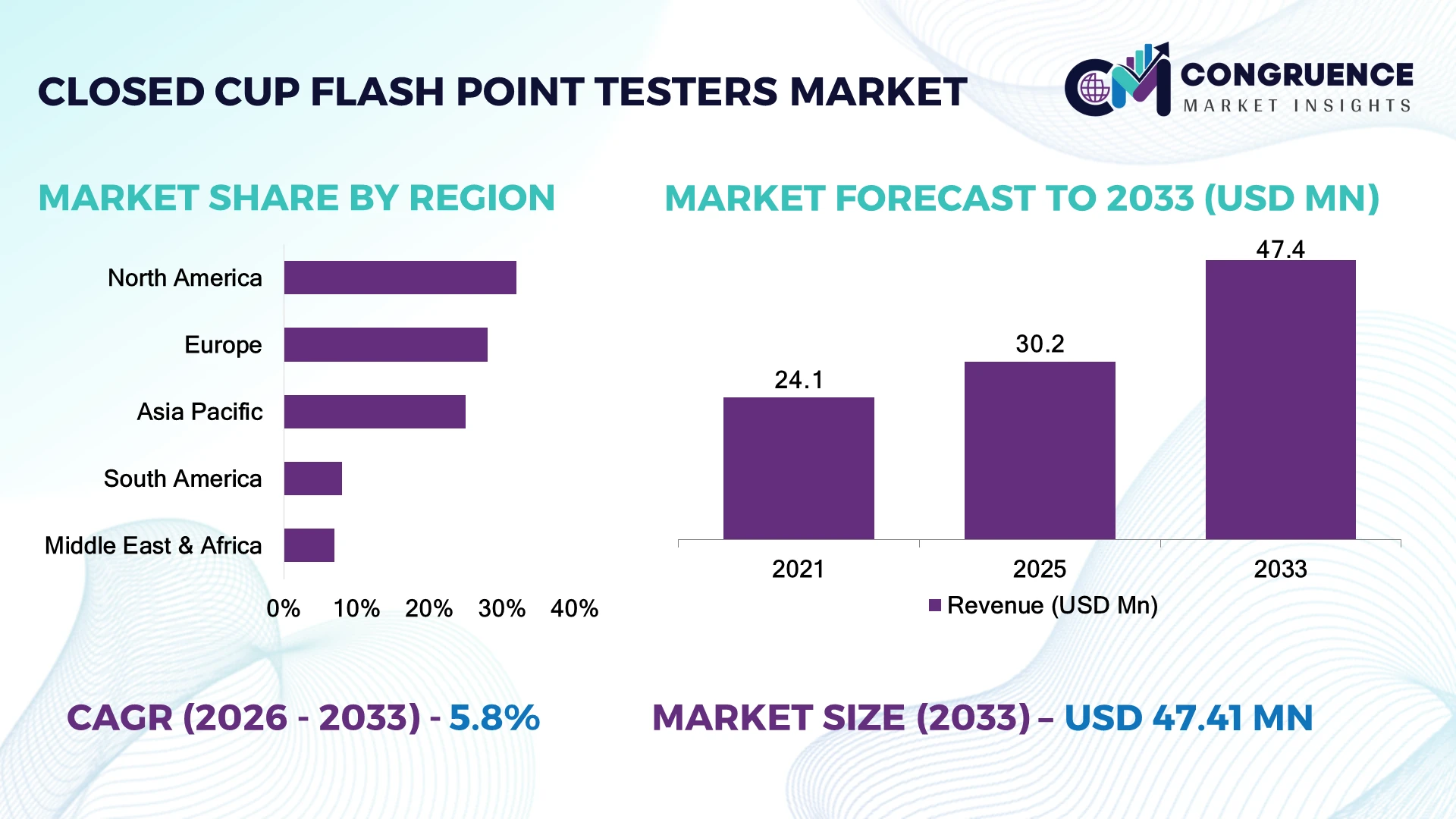
The United States dominates the market with nearly 32% share in 2025, supported by ASTM compliance testing, refinery modernization, and laboratory automation investments exceeding USD 20 billion across energy infrastructure upgrades. China follows with strong manufacturing capacity, accounting for over 20% share, driven by petrochemical expansion and domestic testing equipment adoption. The U.S. has higher automated laboratory penetration, while China records faster equipment deployment across industrial clusters.
Companies prioritizing digital testing platforms and regional service networks gain stronger competitive positioning.
Market Size & Growth: Valued at USD 30.2 Million in 2025 and projected toward USD 47.4 Million by 2033, supported by automated safety testing adoption and stricter industrial compliance requirements.
Top Growth Drivers: Laboratory automation adoption (35%), petroleum quality testing demand (28%), and chemical safety compliance upgrades (22%) are accelerating market expansion.
Short-Term Forecast: By 2028, automated closed cup testers reduce manual testing time by 40% and improve laboratory throughput by 30%.
Emerging Technologies: AI-enabled diagnostics, IoT-connected instruments, and automated ignition detection systems are reshaping advanced flash point testing workflows.
Regional Leaders: North America reaches approximately USD 15 Million, Europe USD 12 Million, and Asia-Pacific USD 14 Million by 2033, driven by regulatory modernization and industrial automation.
Consumer/End-User Trends: Petroleum laboratories represent over 45% of usage, with increasing adoption of automated instruments across chemical and lubricant testing facilities.
Pilot/Case Example: A 2024 refinery laboratory automation project achieved a 35% reduction in testing cycle time through integrated digital monitoring systems.
Competitive Landscape: Leading manufacturers hold approximately 40% combined share, with key players including Koehler Instrument, Anton Paar, Tanaka Scientific, Normalab, and PAC.
Regulatory & ESG Impact: Updated ASTM and ISO testing requirements improve safety compliance by more than 25% while supporting reduced operational risks.
Investment & Funding: Over USD 500 million in laboratory automation and industrial testing investments are supporting partnerships, equipment upgrades, and global expansion.
Innovation & Future Outlook: Next-generation testers focus on cloud connectivity, predictive maintenance, and energy-efficient laboratory operations for competitive differentiation.
Closed Cup Flash Point Testers are increasingly demanded across petroleum refining, aviation fuels, lubricants, and chemical quality-control applications where precise ignition temperature measurement is critical. Recent product innovations include automated sample handling, touchscreen interfaces, and digital compliance reporting, improving operational efficiency by around 30%. Growing laboratory modernization in emerging industrial economies and stricter safety inspections following global energy supply-chain disruptions are creating new deployment opportunities for advanced testing systems.
Closed Cup Flash Point Testers are becoming strategically important as industries prioritize safer fuel handling, regulatory compliance, and laboratory automation. Refinery upgrades, chemical manufacturing expansion, and tighter international safety frameworks are shifting companies from manual testing processes toward digitally integrated analytical platforms.
A major market shift is the transition from traditional mechanical testers to automated systems with connected monitoring capabilities. Automated models reduce operator intervention by nearly 50% and improve repeatability compared with legacy instruments requiring manual flame control. Germany and the United States lead in advanced laboratory deployment, while India and China are accelerating adoption through expanding petroleum and chemical production facilities.
Over the next 2–3 years, companies are increasing investments in smart testing infrastructure, calibration services, and regional support networks. For example, large fuel testing laboratories are integrating automated flash point systems into quality-control workflows to improve compliance consistency. Manufacturers are responding through partnerships, software upgrades, and localized production strategies. Competitive advantage will depend on delivering accurate, connected, and regulation-ready testing solutions that support industrial safety transformation.
The strongest growth driver is the shift toward automated laboratory testing across petroleum and chemical industries. Automated closed cup testers improve testing consistency by approximately 35% and reduce operator workload by nearly 40%, supporting faster quality-control cycles. The implementation of updated ASTM D93 and related safety procedures in countries such as the United States and Germany is increasing equipment replacement demand. Refiners and chemical producers are investing in digital instruments with automated ignition control, data logging, and remote monitoring capabilities. Companies are expanding service partnerships and introducing connected testing platforms to address rising compliance requirements. The strategic advantage lies in reducing human error while improving laboratory productivity.
High acquisition costs and maintenance requirements limit adoption among small laboratories and emerging-market users. Advanced closed cup testers can require 20–30% higher investment than conventional systems due to automation and sensor integration. Calibration procedures and dependence on certified reference materials create additional operational expenses, particularly in developing industrial markets. Supply-chain constraints for precision components, including sensors and electronic modules, affect delivery schedules by 15–20% in some markets. Companies are reducing these pressures through localized manufacturing, longer-term supplier agreements, and modular equipment designs. The key operational challenge remains balancing advanced functionality with affordability for smaller testing facilities.
Digital transformation creates significant opportunities through connected laboratory ecosystems and predictive analytics. IoT-enabled testers can improve equipment utilization by more than 30% through real-time monitoring and automated reporting. Emerging markets such as India, Vietnam, and Brazil are expanding petroleum and chemical infrastructure, creating demand for modern testing equipment. AI-based diagnostics and cloud-enabled compliance tracking are becoming strategic differentiators for manufacturers. Companies are investing in software integration, remote calibration services, and regional partnerships to capture new customer segments. The strongest opportunity lies in combining analytical accuracy with digital workflow management for next-generation industrial laboratories.
Long-term market expansion faces challenges from integration complexity, limited technical expertise, and evolving regulatory requirements. Around 25% of industrial laboratories still rely on semi-manual testing processes, creating barriers to full automation adoption. Skilled technician shortages in emerging manufacturing hubs increase installation and maintenance difficulties. Cybersecurity requirements for connected laboratory systems are also becoming more important as digital monitoring expands. Companies must invest in workforce training, secure software platforms, and standardized integration frameworks. The ability to provide reliable technical support and lifecycle management will determine long-term competitiveness in the evolving testing equipment landscape.
Automation-Driven Laboratory Upgrades: Industrial laboratories are replacing manual flash point testing workflows with automated systems, reducing operator intervention by 40% and improving testing repeatability by nearly 35%. Refineries in the United States and Germany are integrating robotic sample handling and digital reporting after stricter safety audits. Instrument manufacturers are scaling automated product lines and software partnerships to meet demand for faster compliance testing.
Connected Testing Ecosystems: IoT-enabled flash point testers are gaining adoption, with connected monitoring improving equipment utilization by around 30% and reducing calibration delays by 20%. Chemical producers are deploying cloud-based laboratory management systems to centralize test records and support remote diagnostics. Companies are responding through embedded sensors, cybersecurity upgrades, and subscription-based service models.
Precision Compliance Expansion: Updated ASTM and ISO testing expectations are accelerating demand for high-accuracy instruments, with compliance-focused laboratories increasing advanced tester adoption by approximately 25%. The shift is particularly visible in petroleum hubs where safety documentation requirements are becoming stricter. Manufacturers are enhancing ignition control technology and expanding regional calibration networks.
Supply Chain Localization Shift: Global component disruptions have encouraged manufacturers to localize production and diversify suppliers, reducing equipment delivery risks by 15–20%. Companies are increasing partnerships with regional electronics suppliers and developing modular designs. This trend creates a non-obvious advantage: localized servicing is becoming a competitive differentiator alongside instrument performance.
The automated closed cup flash point testers segment dominates the market, accounting for approximately 55% share in 2025 due to superior accuracy, reduced operator dependency, and integration with laboratory information systems. Automated systems are preferred by petroleum refineries and chemical laboratories because they improve testing consistency by nearly 35% compared with manual alternatives. Semi-automatic testers maintain relevance among cost-sensitive facilities, while manual systems continue serving smaller laboratories requiring basic compliance testing. The fastest-growing segment is advanced automated testers with digital connectivity, driven by rising adoption of smart laboratory infrastructure. Demand for connected instruments is increasing by around 30% as companies prioritize remote monitoring and predictive maintenance capabilities. Manufacturers are focusing investments on AI-assisted diagnostics, touchscreen interfaces, and cloud-enabled reporting platforms. The strategic shift is moving from standalone testing equipment toward integrated laboratory ecosystems that improve operational visibility.
Petroleum and fuel testing applications represent the leading segment, contributing nearly 60% market share due to extensive use in refineries, fuel storage facilities, and lubricant manufacturing. These applications require accurate flash point measurement for transportation safety, quality assurance, and regulatory compliance. Chemical testing follows as a significant application, while paints, coatings, and specialty fluids represent emerging demand areas. The fastest-growing application is chemical and specialty material testing, supported by expanding production facilities and stricter workplace safety requirements. Adoption in these laboratories is increasing by approximately 25%, driven by automated workflows and digital compliance documentation. Fuel testing facilities are upgrading existing equipment, while chemical producers are investing in compact automated systems for decentralized testing. Companies are responding by developing application-specific testers and strengthening technical support networks across industrial hubs.
Petroleum refineries and fuel processing companies lead end-user adoption with approximately 50% market share due to high testing frequency, regulatory requirements, and large-scale quality-control operations. Refineries require continuous flash point analysis to manage fuel safety standards and operational reliability. Chemical manufacturers represent another major user group, while research laboratories and testing service providers contribute through specialized analytical demand. The fastest-growing end-user segment is independent testing laboratories, expanding as industries outsource compliance verification and certification activities. Adoption among these facilities is rising by nearly 30% due to demand for faster turnaround times and advanced analytical capabilities. Refineries are prioritizing automated systems, while smaller laboratories are adopting modular testers with lower maintenance requirements. Companies are targeting these segments through service contracts, regional partnerships, and customized equipment packages to improve accessibility.
North America accounted for the largest market share at 32% in 2025 however, Asia-Pacific is expected to register the fastest growth, expanding at a CAGR of 6.7% between 2026 and 2033.
North America holds the leading position in the Closed Cup Flash Point Testers Market due to extensive petroleum refining infrastructure, advanced laboratory networks, and strict ASTM-based safety compliance practices. The region contributes approximately 32% of global demand, with the United States representing the largest deployment base across refineries, chemical plants, and independent testing facilities. More than 45% of industrial laboratories in major energy hubs are transitioning toward automated analytical instruments to improve testing accuracy and workflow efficiency. Growing investments in refinery upgrades and digital laboratory systems are accelerating adoption. Companies are expanding calibration services, software integration, and automated product portfolios to strengthen their presence in regulated industrial environments.
United States Market Outlook: The United States remains the dominant country due to its large refining capacity, advanced chemical manufacturing ecosystem, and strong laboratory automation adoption. Over 130 operational refineries support continuous demand for fuel quality testing solutions. Industrial facilities are increasingly integrating connected testers with digital quality-management platforms to improve compliance tracking and reduce manual testing dependency.
Europe maintains a strong position due to stringent industrial safety regulations, mature chemical industries, and high adoption of advanced laboratory technologies. Countries including Germany, France, and the United Kingdom are major contributors, supported by established petroleum, automotive, and specialty chemical sectors. The region accounts for approximately 28% of market demand, with laboratories increasingly adopting automated testers to meet evolving safety standards. More than 35% of European industrial testing facilities have upgraded analytical workflows toward digital documentation and automated reporting. Sustainability-focused manufacturing policies and modernization of industrial infrastructure are encouraging companies to invest in energy-efficient testing systems and advanced calibration capabilities.
Germany Market Outlook: Germany leads European adoption through its strong chemical manufacturing base, engineering expertise, and industrial automation capabilities. The country’s chemical sector includes more than 2,000 production facilities requiring accurate material safety testing. Manufacturers are prioritizing connected testing equipment and integrated laboratory solutions to support compliance, efficiency, and process optimization.
Asia-Pacific represents the fastest-expanding market due to rapid petrochemical capacity additions, manufacturing growth, and increasing laboratory modernization across China, India, Japan, and South Korea. The region contributes nearly 25% of current demand, supported by large-scale refinery construction and chemical production investments. China and India are driving equipment deployment as industries shift from manual testing toward automated systems, improving operational efficiency by approximately 30%. Expansion of domestic manufacturing capabilities and supply-chain localization is increasing availability of testing instruments. Companies are strengthening regional partnerships, establishing service centers, and developing cost-optimized automated testers to capture emerging industrial demand.
China Market Outlook: China remains the largest Asia-Pacific contributor due to its extensive petrochemical production capacity and expanding industrial testing infrastructure. The country operates more than 200 major refining facilities, creating sustained demand for quality-control equipment. Domestic manufacturers are increasing production of automated laboratory instruments to support local industries and reduce dependence on imported systems.
South America is developing steadily as petroleum, mining, and chemical industries modernize their testing infrastructure. Brazil represents the largest regional contributor due to its refining network, industrial laboratories, and energy-sector investments. The region accounts for approximately 8% of global demand, with adoption concentrated in fuel testing and industrial quality-control applications. Around 20% of laboratories in major industrial centers are upgrading from manual to semi-automated testing equipment to improve reliability. Infrastructure limitations and equipment import dependency continue affecting smaller facilities. Companies are addressing these barriers through regional distributors, service partnerships, and localized maintenance networks to improve accessibility.
Brazil Market Outlook: Brazil leads South American demand due to its large energy industry, refining operations, and expanding chemical manufacturing base. The country’s fuel sector includes more than 15 major refining facilities requiring continuous safety testing. Companies are increasing partnerships with local service providers to improve equipment availability and technical support.
Middle East & Africa demand is primarily driven by refinery expansion, petrochemical investments, and modernization of industrial safety systems. Gulf countries, particularly Saudi Arabia and the United Arab Emirates, represent major deployment centers due to large-scale energy infrastructure and export-oriented fuel industries. The region contributes approximately 7% of global demand, with adoption increasing as companies upgrade laboratory capabilities. More than 25% of new refinery and petrochemical projects include advanced quality-control laboratories equipped with automated testing technologies. Manufacturers are expanding partnerships with energy companies and regional distributors to support installation, calibration, and maintenance requirements.
Saudi Arabia Market Outlook: Saudi Arabia holds the strongest position in the region due to its globally significant petroleum industry and continuous refinery modernization programs. The country’s energy sector supports demand for advanced testing equipment across fuel processing facilities. Companies are investing in automated laboratory systems to improve operational reliability, safety compliance, and testing efficiency across industrial sites.
The Closed Cup Flash Point Testers Market features global instrument manufacturers such as Koehler Instrument, Anton Paar, PAC, and Tanaka Scientific competing against regional laboratory equipment suppliers and specialized testing solution providers. The top five players collectively account for approximately 45% market share, creating a moderately consolidated structure. Competition is centered on automation capability, measurement accuracy, pricing, service networks, and customization, with automated systems delivering nearly 30–40% workflow improvements over manual testers. Global leaders compete through digital integration, international distribution expansion, and partnerships with laboratories, while regional suppliers focus on cost advantages and faster support. The competitive shift is moving toward connected instruments, predictive diagnostics, and software-enabled compliance management. High precision requirements, certification standards, and technical service capabilities create entry barriers. Winning requires combining advanced automation, reliable supply chains, application-specific solutions, and strong after-sales support.
Anton Paar GmbH
PAC L.P.
Tanaka Scientific Limited
Normalab SAS
BARTEC GmbH
EraTech Instruments
Stanhope-Seta
Labtron Equipment Ltd.
Ayalytical Instruments, Inc.
Elvatech Ltd.
Orbis BV
Fison Instruments
Seta Analytics
Closed Cup Flash Point Testers are shifting from mechanical measurement systems toward automated, connected laboratory platforms. Modern automated testers integrate digital temperature control, electronic ignition systems, and touchscreen interfaces, improving repeatability by approximately 35% compared with traditional manual instruments. Adoption of automated workflows is increasing across petroleum laboratories as companies seek faster compliance testing and reduced operator dependency.
Artificial intelligence-assisted diagnostics and IoT connectivity are emerging technologies transforming equipment monitoring. Connected systems enable remote performance tracking and predictive maintenance, reducing downtime by nearly 20% and improving equipment utilization by around 30%. These capabilities benefit large refineries, chemical manufacturers, and third-party testing laboratories by enabling centralized quality management.
Between 2026 and 2028, cloud-based reporting, automated calibration support, and laboratory information system integration will become key competitive differentiators. New-generation testers provide approximately 40% faster workflow execution compared with older manual models. Technology leaders with strong software ecosystems and global service networks will gain advantage, while cost-focused manufacturers must improve customization and reliability to remain competitive.
April 2025 – PAC L.P. launched its updated brand identity and continued expanding its advanced analytical instrument portfolio, including digital laboratory solutions supporting petroleum testing workflows. The transition strengthens PAC’s positioning in automated analysis and connected laboratory environments, improving customer access to integrated testing technologies. Source: www.paclp.com
February 2025 – PAC L.P. introduced enhancements to its ASURANCE Auto Sampler platform for analytical instruments, improving automated sample handling reliability and laboratory workflow efficiency. The development supports petroleum laboratories seeking higher throughput and reduced manual intervention in quality-control operations. Source: www.paclp.com
2025 – Tanaka Scientific Limited expanded its automated petroleum testing portfolio with advanced closed cup flash point tester solutions, including models supporting automated operation, digital data storage, and multiple testing standards. The company’s instruments support petroleum, lubricant, and aviation testing laboratories across more than 70 countries.
2025 – Anton Paar GmbH continued strengthening its precision measurement portfolio with automated Pensky-Martens closed cup flash point testing solutions. Its PMA series provides automated high-precision testing with faster cooling performance, including approximately 20% faster sample preparation compared with comparable instruments.
The Closed Cup Flash Point Testers Market Report covers comprehensive analysis across product types, including manual, semi-automatic, and automated systems, along with applications spanning petroleum testing, chemical analysis, lubricants, and specialty fluids. The report evaluates end-users such as refineries, chemical manufacturers, research laboratories, and testing service providers across North America, Europe, Asia-Pacific, South America, and Middle East & Africa.
The study analyzes technology adoption trends, including automation, digital connectivity, predictive diagnostics, and laboratory integration solutions. With coverage of leading companies, competitive positioning, deployment patterns, and emerging application areas, the report supports strategic decisions related to investment planning, market expansion, product development, partnerships, and competitive positioning from 2026 to 2033.
| Report Attribute / Metric | Details |
|---|---|
| Market Revenue (2025) | USD 30.2 Million |
| Market Revenue (2033) | USD 47.4 Million |
| CAGR (2026–2033) | 5.8% |
| Base Year | 2025 |
| Forecast Period | 2026–2033 |
| Historic Period | 2021–2025 |
| Segments Covered |
By Type
By Application
By End-User
|
| Key Deliverables | Revenue Forecast; Market Trends; Growth Drivers & Restraints; Technology Insights; Segmentation Analysis; Regional Insights; Competitive Landscape; Regulatory & ESG Overview; Recent Developments |
| Regions Covered | North America; Europe; Asia-Pacific; South America; Middle East & Africa |
| Companies Profiled | Koehler Instrument Company, Inc.; Anton Paar GmbH; PAC L.P.; Tanaka Scientific Limited; Normalab SAS; BARTEC GmbH; EraTech Instruments; Stanhope-Seta; Labtron Equipment Ltd.; Ayalytical Instruments, Inc.; Elvatech Ltd.; Orbis BV; Fison Instruments; Seta Analytics |
| Customization & Pricing | Available on Request (10% Customization Free) |




