
Reports
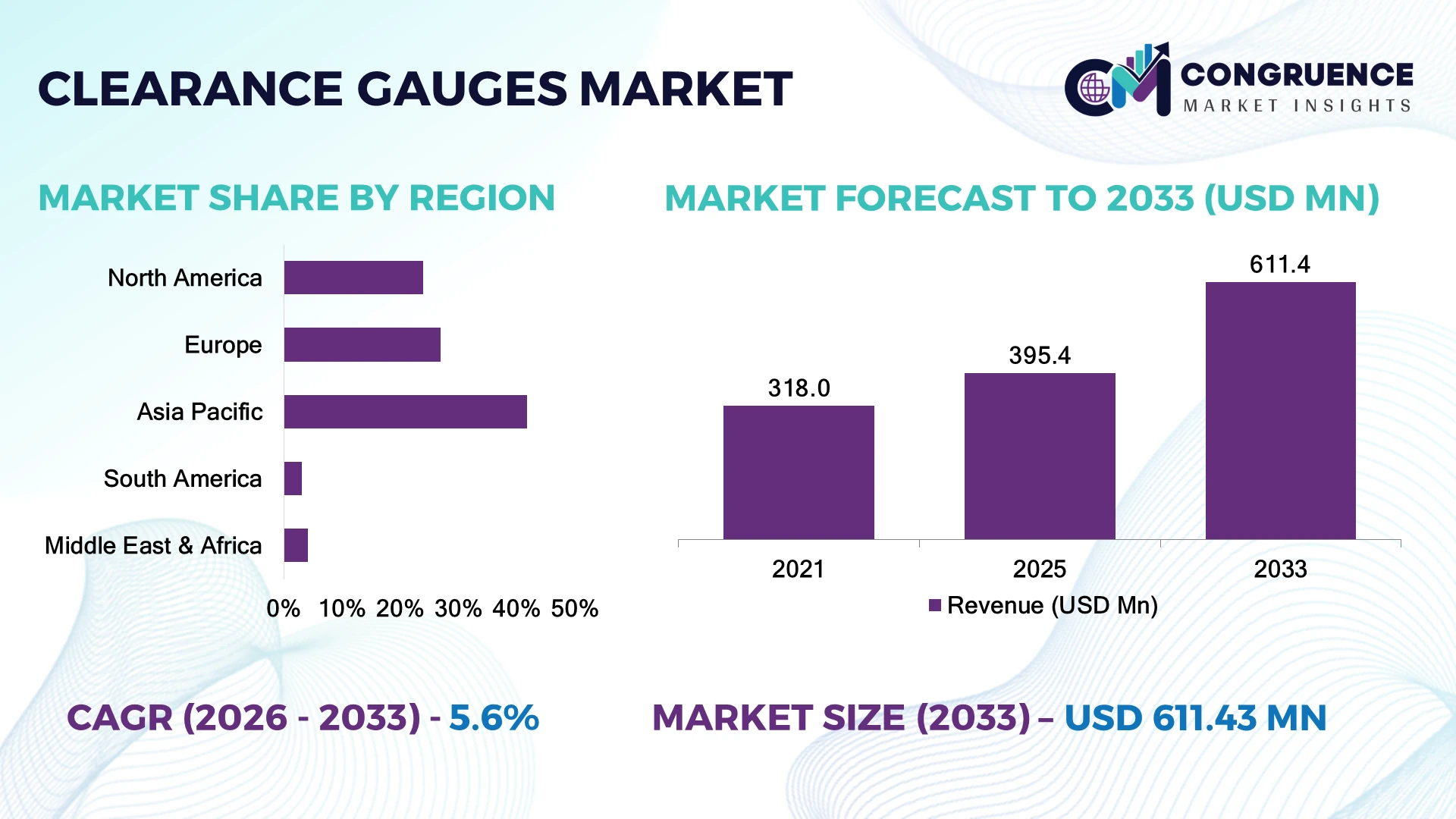
The Global Clearance Gauges Market was valued at USD 395.4 Million in 2025 and is anticipated to reach a value of USD 611.4 Million by 2033 expanding at a CAGR of 5.6% between 2026 and 2033. Growth is driven by railway infrastructure modernization, expanding high-speed rail networks, stricter track maintenance standards, and increasing adoption of precision digital clearance measurement systems.
China dominates the global clearance gauges market with approximately 36% of installed railway inspection capacity, supported by annual rail infrastructure investments exceeding USD 110 billion and one of the world's largest high-speed rail networks. Compared with Germany, China deploys significantly more automated track inspection equipment, while digital clearance measurement adoption exceeds 65% across newly commissioned railway corridors. Infrastructure priorities accelerated following global supply-chain realignment after the Russia–Ukraine conflict.
Manufacturers prioritizing digital inspection technologies and localized engineering support are strengthening competitive positioning in long-term railway infrastructure projects.
Market Size & Growth: USD 395.4 million (2025) to USD 611.4 million (2033) at 5.6% CAGR, supported by railway modernization and precision inspection technologies.
Top Growth Drivers: High-speed rail expansion (+29%), predictive maintenance (+24%), digital inspection adoption (+22%).
Short-Term Forecast: By 2028, inspection time declines by 20% while measurement accuracy improves by 18% through digital workflows.
Emerging Technologies: AI-assisted inspection, laser measurement, and IoT-enabled gauges improve operational precision by nearly 25%.
Regional Leaders: Asia-Pacific (~USD 255 million), Europe (~USD 140 million), North America (~USD 110 million), driven by rail infrastructure upgrades and automation.
Consumer/End-User Trends: More than 68% of rail infrastructure operators prioritize digital clearance measurement during maintenance planning.
Pilot/Case Example: A 2026 railway modernization program reduced manual inspection time by 27% using laser-based clearance gauges.
Competitive Landscape: Top five companies hold approximately 44% share, led by Plasser & Theurer, Goldschmidt, MER MEC, Bance, and Trimble.
Regulatory & ESG Impact: Automated inspection lowers repeat maintenance visits by nearly 16%, supporting safer and more efficient rail operations.
Investment & Funding: More than USD 4 billion supports railway inspection modernization, digital maintenance systems, and equipment expansion globally.
Innovation & Future Outlook: Smart clearance gauges integrated with predictive maintenance platforms are transforming lifecycle asset management.
Clearance gauges are becoming increasingly important across railway infrastructure, metro expansion projects, freight corridors, and industrial track maintenance. Digital laser measurement systems and connected inspection platforms improve dimensional accuracy while reducing manual verification efforts by nearly 30%. Procurement strategies increasingly favor integrated digital inspection equipment as rail operators strengthen maintenance efficiency and regulatory compliance, setting the stage for the strategic market discussion below.
The clearance gauges market has become strategically important as railway operators, metro authorities, and infrastructure managers prioritize precision inspection, network safety, and predictive asset management. Infrastructure modernization and digital maintenance programs are replacing conventional inspection practices with intelligent measurement systems capable of improving operational consistency while reducing service interruptions. Supply-chain diversification has also encouraged manufacturers to expand localized production and engineering capabilities for faster project execution.
Laser-based digital clearance gauges outperform conventional mechanical gauges by improving measurement accuracy by approximately 25% while reducing inspection time by nearly 20% through automated data capture and digital reporting. Asia-Pacific leads large-scale deployment through extensive railway construction, whereas Europe focuses on upgrading mature rail corridors with advanced inspection technologies. Over the next two to three years, digital clearance measurement systems are expected to account for more than 55% of new inspection equipment procurement across major rail infrastructure projects.
Railway infrastructure contractors are increasingly integrating clearance gauges with track geometry measurement systems and digital maintenance platforms to streamline inspection workflows. Manufacturers are expanding software capabilities, strengthening partnerships with railway engineering companies, and investing in portable smart inspection devices tailored for high-speed rail and urban transit applications. Companies combining precision hardware with digital analytics, field mobility, and lifecycle support will secure stronger competitive positioning as rail infrastructure becomes increasingly data-driven and operationally demanding.
Railway operators are accelerating the replacement of conventional mechanical inspection tools with digital clearance gauges to improve measurement precision and network safety. More than 60% of newly procured railway inspection equipment now incorporates digital measurement capability, while laser-based clearance verification improves dimensional accuracy by nearly 25% and reduces field inspection time by approximately 20%. India and China continue expanding high-speed rail and metro infrastructure, increasing demand for advanced inspection equipment that supports faster commissioning and maintenance. This shift is driving manufacturers to invest in portable digital platforms, integrated inspection software, and precision sensor technologies. Companies strengthening engineering partnerships with railway authorities are securing larger infrastructure contracts and expanding aftermarket service opportunities through lifecycle support.
Differences in railway loading gauges, track standards, and certification requirements across national rail networks continue limiting equipment standardization. Approximately 35% of railway operators require customized clearance gauge configurations, while engineering modifications increase product delivery timelines by nearly 18%. European cross-border railway projects often require compliance with multiple infrastructure specifications, adding engineering complexity and qualification costs. These structural variations reduce manufacturing scale efficiencies and increase inventory management requirements for suppliers. Companies are mitigating these constraints by developing modular product architectures, expanding regional engineering centers, localizing assembly operations, and offering configurable digital platforms that simplify compliance across multiple railway systems.
Integration of clearance gauges with digital railway asset management platforms is creating new value beyond dimensional inspection. Connected inspection systems improve maintenance scheduling efficiency by approximately 22%, while cloud-enabled reporting reduces manual documentation time by nearly 30%. Japan is expanding intelligent railway maintenance programs that combine digital inspection devices with predictive maintenance software, creating demand for interoperable measurement solutions. Manufacturers are investing in AI-enabled analytics, wireless connectivity, and software development partnerships to deliver complete inspection ecosystems rather than standalone hardware. This transition creates recurring service opportunities through software upgrades, calibration management, and digital maintenance support, strengthening long-term customer relationships.
Successful deployment increasingly depends on integrating clearance gauge data into digital railway maintenance workflows while addressing technical skill shortages. Nearly 28% of railway maintenance teams require additional training to operate advanced digital inspection systems, and inconsistent data integration delays maintenance reporting by approximately 15%. The United Kingdom and other mature rail markets continue upgrading legacy maintenance platforms that were not originally designed for connected inspection equipment. These implementation challenges affect deployment consistency and operational scalability rather than product performance. Manufacturers are investing in operator training, standardized software interfaces, cybersecurity enhancements, and strategic technology partnerships to ensure reliable adoption across complex railway maintenance environments.
Digital Inspection Platform Adoption: Railway operators are replacing standalone measuring tools with integrated digital inspection platforms, increasing digital deployment by nearly 35% while reducing manual inspection workloads by approximately 22%. Workforce shortages and stricter infrastructure verification requirements are accelerating adoption. Manufacturers are expanding software-enabled product portfolios and integrating wireless data transfer to improve maintenance productivity and reporting accuracy.
Portable Laser Gauge Expansion: Lightweight laser-based clearance gauges are gaining preference across maintenance contractors, improving field measurement accuracy by approximately 25% and reducing inspection setup time by nearly 18%. Portable equipment enables faster deployment across dispersed railway networks. Companies are redesigning product lines with ergonomic configurations, longer battery life, and ruggedized construction to improve operational flexibility in demanding field environments.
Integrated Rail Maintenance Workflows: Railway authorities increasingly connect clearance gauge data with track geometry monitoring and maintenance management platforms. Integrated workflows shorten maintenance planning cycles by around 20% while improving inspection traceability by nearly 30%. Infrastructure modernization programs in Germany and India are encouraging suppliers to strengthen software partnerships and develop interoperable inspection solutions supporting centralized asset management.
Precision Manufacturing Advancements: Manufacturers are adopting CNC machining, digital calibration, and advanced sensor technologies to improve measurement repeatability by approximately 18% while lowering product recalibration requirements by nearly 15%. Supply-chain localization is also reducing lead-time variability for critical components. Companies are expanding precision manufacturing capacity and strengthening component sourcing strategies to improve delivery performance and long-term product reliability.
Laser clearance gauges remain the leading product type, accounting for approximately 42% of the global market due to their high measurement precision, rapid inspection capability, and seamless integration with digital railway maintenance platforms. Their ability to capture accurate dimensional data with minimal manual intervention makes them the preferred choice for high-speed rail and metro infrastructure projects. Mechanical clearance gauges continue serving routine maintenance and smaller railway operators because of their lower acquisition cost and simple field operation, while optical clearance gauges retain strategic importance for specialized inspection applications requiring enhanced visual verification.
Digital electronic clearance gauges are the fastest-growing segment as railway operators modernize inspection workflows and adopt connected maintenance systems. Deployment of digital inspection equipment has increased by nearly 27% over the past two years, while portable electronic gauges reduce inspection time by approximately 22%. Manufacturers are investing in wireless connectivity, AI-enabled measurement software, and modular product platforms while expanding partnerships with railway infrastructure contractors. These developments are shifting investment toward intelligent inspection technologies capable of supporting predictive maintenance and centralized asset management.
According to industry observations published during 2026 by the International Union of Railways (UIC), digital inspection technologies are increasingly incorporated into new railway infrastructure maintenance programs, supporting greater standardization of track measurement and clearance verification.
Railway infrastructure inspection represents the largest application segment, contributing approximately 63% of global demand because of continuous requirements for track clearance verification during construction, maintenance, and network modernization. High-speed rail projects require precise dimensional inspection to maintain operational safety and infrastructure compliance, making advanced clearance gauges operationally essential. Metro rail systems continue expanding inspection requirements through urban transit development, while freight rail operators increasingly deploy digital gauges to improve maintenance efficiency. Industrial rail facilities also contribute steady demand for routine infrastructure inspection.
High-speed railway inspection is the fastest-growing application as governments continue expanding dedicated passenger rail corridors and upgrading existing transportation networks. Digital clearance verification deployment has increased by nearly 30%, while integrated inspection systems improve maintenance productivity by approximately 24%. Manufacturers are responding through automated measurement software, portable laser-based solutions, and integrated data management capabilities that reduce inspection cycles. Demand is steadily shifting toward intelligent inspection platforms that improve operational reliability while supporting data-driven maintenance planning.
A 2025 railway infrastructure assessment published by the International Union of Railways (UIC) highlighted increasing deployment of digital inspection technologies across new railway modernization programs, reinforcing demand for precision clearance verification equipment.
National railway operators remain the dominant end-user segment, accounting for approximately 58% of total market demand because of extensive responsibility for track infrastructure inspection, safety compliance, and asset lifecycle management. Large rail networks require routine clearance verification across thousands of kilometers of operational infrastructure, creating sustained procurement demand for precision inspection equipment. Metro authorities continue increasing investments in digital inspection technologies, while railway engineering contractors maintain stable demand for portable field inspection solutions supporting construction and maintenance activities.
High-speed rail infrastructure authorities are emerging as the fastest-growing end-user group as governments prioritize network expansion and digital asset management. Procurement of smart clearance gauges has increased by nearly 26%, while digital inspection adoption exceeds 45% across newly commissioned high-speed rail projects. Manufacturers are strengthening long-term service agreements, expanding localized calibration capabilities, and developing customized software platforms that improve maintenance efficiency while supporting regulatory compliance and predictive asset management strategies.
A 2026 industry review by the International Union of Railways (UIC) indicated that railway operators are increasingly integrating digital inspection equipment with centralized infrastructure management platforms to improve maintenance planning, inspection consistency, and operational safety.
Asia-Pacific accounted for the largest market share at 41.8% in 2025 however, Middle East & Africa is expected to register the fastest growth, expanding at a CAGR of 6.4% between 2026 and 2033.

Railway Digital Modernization Strengthens Inspection Standards
North America accounted for approximately 24% of the global clearance gauges market, supported by continuous investment in freight rail modernization, urban transit expansion, and digital track inspection programs. Rail operators are replacing legacy mechanical measurement equipment with laser-based and electronic clearance gauges integrated into predictive maintenance systems. More than 60% of Class I railway infrastructure maintenance projects now incorporate digital inspection technologies to improve operational efficiency and safety compliance. Equipment suppliers are expanding software-enabled inspection solutions and strengthening long-term service agreements with railway authorities, creating recurring demand for calibration, maintenance, and digital support services across the region.
United States Market Outlook: The United States leads the regional market through the world's largest freight railway network and sustained investment in rail infrastructure modernization. More than 225,000 kilometers of operational rail lines require continuous inspection and clearance verification, creating stable demand for advanced measurement equipment. Railway operators increasingly deploy digital inspection technologies integrated with asset management platforms, while equipment manufacturers continue expanding domestic engineering, calibration, and aftermarket service capabilities to improve lifecycle support and regulatory compliance.
Cross-Border Rail Standardization Accelerates Digital Inspection
Europe represents approximately 27% of the global clearance gauges market, supported by extensive railway modernization and cross-border interoperability initiatives. Infrastructure managers increasingly deploy digital clearance gauges to improve inspection consistency across mixed passenger and freight networks while complying with harmonized railway standards. Automated inspection technologies have reduced manual verification activities by nearly 20% across several modernization projects. Manufacturers continue investing in precision engineering, software integration, and modular inspection platforms that simplify deployment across multiple national railway systems while supporting predictive infrastructure maintenance.
Germany Market Outlook: Germany remains the region's leading market due to its advanced railway engineering capabilities, extensive manufacturing ecosystem, and continuous infrastructure upgrades. The country's railway modernization initiatives prioritize digital asset management and automated inspection technologies across both high-speed and conventional rail networks. Equipment suppliers collaborate closely with infrastructure operators to develop interoperable measurement solutions that improve operational reliability while supporting efficient maintenance planning.
Large-Scale Rail Expansion Drives Equipment Deployment
Asia-Pacific holds the largest global market share at approximately 41.8%, supported by continuous railway construction, metro expansion, and high-speed rail deployment across major economies. China, India, and Japan account for the majority of new railway infrastructure projects, creating sustained demand for precision clearance inspection systems. More than 65% of newly commissioned railway corridors in the region utilize digital inspection technologies during infrastructure verification and maintenance. Manufacturers are expanding regional production facilities, strengthening engineering partnerships, and increasing localized calibration capabilities to support rapidly growing deployment requirements.
China Market Outlook: China dominates the regional market through its extensive high-speed railway network exceeding 48,000 kilometers and ongoing railway expansion projects. National infrastructure programs increasingly require advanced laser-based inspection systems to improve construction quality and operational safety. Domestic manufacturers continue investing in intelligent measurement technologies, while international suppliers strengthen local partnerships to participate in large-scale railway modernization and maintenance contracts.
Freight Corridor Modernization Expands Inspection Demand
South America represents a developing but strategically important market, supported primarily by freight railway rehabilitation, mining logistics, and selective passenger rail modernization. Brazil, Argentina, and Chile are investing in rail infrastructure upgrades that require improved inspection capability and precision measurement equipment. Digital inspection deployment has increased by approximately 18% across newly upgraded freight corridors as operators prioritize operational efficiency and infrastructure reliability. Manufacturers are strengthening regional distributor networks, localized technical support, and equipment training programs to improve adoption despite infrastructure investment constraints and varying technical standards across national rail systems.
Brazil Market Outlook: Brazil leads regional demand through extensive freight rail operations supporting mining, agriculture, and industrial logistics. Railway concessionaires continue modernizing maintenance practices by adopting portable digital inspection equipment capable of improving inspection productivity across long-distance freight corridors. Equipment suppliers are expanding local service capabilities and technical partnerships to support fleet modernization while improving equipment availability and lifecycle maintenance performance.
Rail Infrastructure Investment Reshapes Inspection Practices
The Middle East & Africa is emerging as the fastest-growing regional market as governments accelerate railway expansion, metro development, and freight corridor investments. Large infrastructure projects increasingly specify digital clearance verification during construction and maintenance to improve safety and operational reliability. More than 30% of recently commissioned railway projects across the Gulf region incorporate advanced digital inspection equipment as part of integrated maintenance strategies. Manufacturers are responding through regional partnerships, engineering support centers, and localized technical services that improve deployment efficiency while supporting long-term infrastructure development.
Saudi Arabia Market Outlook: Saudi Arabia is the region's most significant market, driven by large-scale railway expansion under national infrastructure development initiatives. Projects including freight corridors, passenger rail, and metro systems continue increasing demand for advanced clearance measurement technologies that support construction quality and operational safety. Equipment suppliers are strengthening partnerships with railway contractors and engineering firms while expanding local technical support capabilities to meet growing inspection requirements across the Kingdom's expanding rail network.
The market is moderately consolidated, with the top five players accounting for approximately 48% of global demand. Goldschmidt, Plasser & Theurer, MER MEC, D/Gauge, and Trimble compete through digital inspection technologies, while regional manufacturers focus on customized mechanical gauges and lower-cost delivery. Competition is driven by measurement accuracy, software integration, calibration capability, and deployment speed rather than equipment price alone. AI-enabled and laser-based inspection systems improve measurement productivity by nearly 25%, while integrated digital workflows reduce inspection time by approximately 20% and calibration services shorten equipment downtime by around 15%. Global suppliers are expanding service centers, forming railway engineering partnerships, and integrating hardware with asset management platforms to strengthen recurring service revenue. The competitive shift favors intelligent inspection ecosystems over standalone measurement devices. High certification requirements, railway qualification procedures, and precision engineering expertise remain key entry barriers. Winning requires digital capability, localized technical support, lifecycle services, and proven measurement reliability.
Goldschmidt Group
Plasser & Theurer
MER MEC S.p.A.
D/Gauge Ltd.
Trimble Inc.
Amberg Technologies AG
GRAW Sp. z o.o.
Fugro N.V.
Bance & Co. Ltd.
Rail Vision Europe
Harsco Rail
KZV s.r.o.
Digital laser-based clearance gauges have become the benchmark for railway infrastructure inspection, replacing conventional mechanical measurement tools across modern rail networks. Laser scanning, electronic sensors, and integrated positioning technologies improve dimensional measurement accuracy by approximately 25% while reducing field inspection time by nearly 20%. More than 60% of newly deployed railway inspection systems now incorporate digital measurement capabilities, enabling real-time data capture and automated reporting. Companies offering integrated hardware and software solutions gain stronger competitive differentiation through faster inspections and lower lifecycle maintenance costs.
Emerging technologies include AI-assisted defect recognition, LiDAR-enabled clearance mapping, cloud-connected inspection platforms, and digital twin integration for railway assets. AI-supported analytics improve anomaly detection by approximately 30%, while cloud synchronization reduces inspection reporting time by nearly 35%. Nearly 45% of major railway modernization projects now specify interoperable digital inspection platforms instead of standalone measuring equipment. Technology providers combining precision instrumentation with predictive maintenance software benefit from higher-value contracts and long-term service agreements.
Between 2026 and 2028, autonomous inspection vehicles, edge computing, and digital asset management integration will redefine railway measurement workflows. Compared with conventional mechanical gauges, intelligent digital platforms improve inspection productivity by approximately 40% while reducing repeat measurements by nearly 18%. Manufacturers investing in connected inspection ecosystems, AI analytics, and interoperable software platforms will strengthen competitive positioning as railway operators increasingly prioritize condition-based maintenance and infrastructure digitalization.
August 2025 Goldschmidt's GRAW business secured a major framework contract with PKP Polish Railway Lines to supply automated track inspection vehicles equipped with advanced sensors, cameras, and software, replacing manual inspections and improving inspection efficiency across railway infrastructure. Source: Railway-News
March 2025 D/Gauge became the headline sponsor of the IMechE Railway Gauging & Clearance 2025 seminar, strengthening industry collaboration around advanced clearance assessment technologies while expanding engagement with infrastructure managers and rolling stock specialists across the United Kingdom. Source: D/Gauge
December 2025 Goldschmidt showcased AI-supported rail inspection and rolling contact fatigue detection technologies during Rail Research Week, highlighting data-driven maintenance approaches that improve early defect identification and support more efficient infrastructure management. Source: Railway-News
July 2026 Goldschmidt received German Federal Railway Authority approval for its LRB®26 road-rail vehicle, enabling deployment on Germany's rail network and expanding the company's maintenance equipment portfolio for infrastructure construction and overhead line operations. Source: Goldschmidt Group.
This report provides a comprehensive assessment of the global clearance gauges market across product types, railway applications, end-user groups, and major regional markets. It evaluates mechanical, laser-based, optical, and digital electronic clearance gauges used across railway infrastructure inspection, metro systems, freight corridors, industrial rail facilities, and high-speed rail projects. The study covers North America, Europe, Asia-Pacific, South America, and the Middle East & Africa while assessing technology adoption, deployment patterns, and competitive positioning across established and emerging railway markets.
The analysis includes segmentation trends, regional deployment dynamics, technology benchmarking, company profiling, and strategic market developments shaping the industry between 2026 and 2033. More than 60% of new railway inspection deployments now utilize digital measurement technologies, reflecting the transition toward intelligent infrastructure maintenance. The report supports investment evaluation, product development, expansion planning, partnership strategy, competitive benchmarking, and long-term positioning by identifying operational shifts, technology priorities, and evolving procurement trends across the global railway inspection ecosystem.
| Report Attribute/Metric | Report Details |
|---|---|
|
Market Revenue in 2025 |
USD 395.4 Million |
|
Market Revenue in 2033 |
USD 611.4 Million |
|
CAGR (2026 - 2033) |
5.6% |
|
Base Year |
2025 |
|
Forecast Period |
2026 - 2033 |
|
Historic Period |
2021 - 2025 |
|
Segments Covered |
By Type
By Application
By End-User
|
|
Key Report Deliverable |
Revenue Forecast, Growth Trends, Market Dynamics, Segmental Overview, Regional and Country-wise Analysis, Competition Landscape |
|
Region Covered |
North America, Europe, Asia-Pacific, South America, Middle East, Africa |
|
Key Players Analyzed |
Goldschmidt Group, Plasser & Theurer, MER MEC S.p.A., D/Gauge Ltd., Trimble Inc., Amberg Technologies AG, GRAW Sp. z o.o., Fugro N.V., Bance & Co. Ltd., Rail Vision Europe, Harsco Rail, KZV s.r.o. |
|
Customization & Pricing |
Available on Request (10% Customization is Free) |




