
Reports
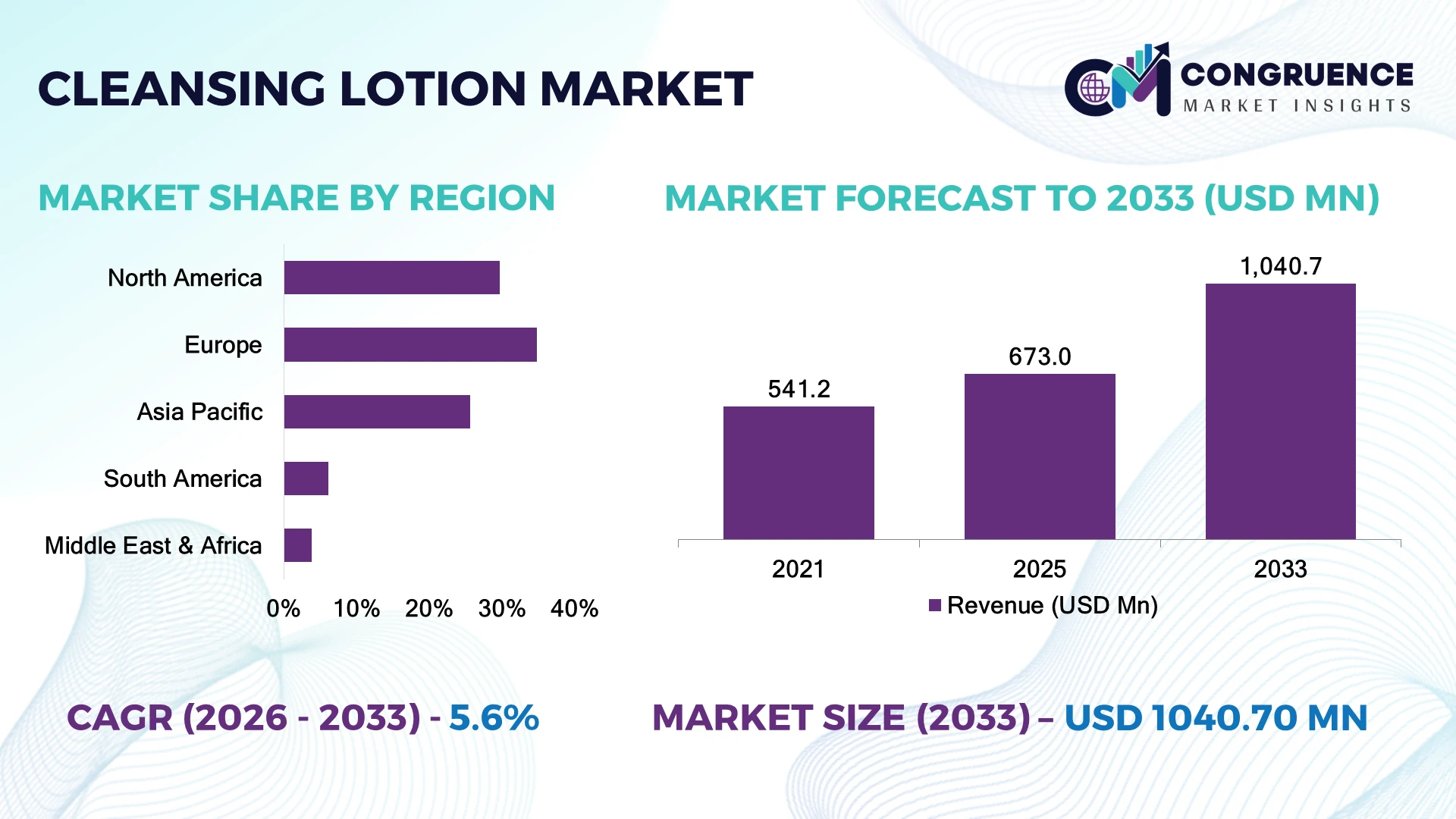
The Global Cleansing Lotion Market was valued at USD 673.0 Million in 2025 and is anticipated to reach a value of USD 1,040.7 Million by 2033 expanding at a CAGR of 5.6% between 2026 and 2033. Growth is driven by rising dermatologically tested skincare adoption, expanding sensitive-skin product portfolios, and increasing demand for microbiome-friendly cleansing formulations across premium and mass-market personal care segments.
Germany accounts for nearly 21% of the European cleansing lotion production and premium skincare exports, supported by more than 180 advanced cosmetic manufacturing facilities and strong investments in dermatological research. Compared with France, Germany records higher manufacturing automation and ingredient traceability, while over 68% of premium skincare launches incorporate skin-barrier-focused formulations. The European Green Deal continues to accelerate sustainable ingredient sourcing and recyclable packaging adoption.
Manufacturers prioritizing clinically validated formulations, regional manufacturing resilience, and sustainable packaging are strengthening long-term competitive positioning.
Market Size & Growth: USD 673.0 Million in 2025, reaching USD 1,040.7 Million by 2033 at 5.6% CAGR, supported by expanding dermatologist-recommended skincare and clean-label formulations.
Top Growth Drivers: Sensitive skincare adoption (+38%), premium personal care demand (+31%), sustainable packaging implementation (+27%).
Short-Term Forecast: By 2028, manufacturing efficiency improves by 18% through automation, reducing production waste by 12%.
Emerging Technologies: AI-assisted formulation development, microbiome-based ingredients, and automated filling systems improve product consistency and development speed.
Regional Leaders: North America approaches USD 335 Million through premium skincare adoption, Europe exceeds USD 285 Million with sustainable innovation, while Asia-Pacific nears USD 245 Million through expanding beauty retail.
Consumer/End-User Trends: Nearly 64% of consumers prefer fragrance-free and dermatologist-tested cleansing lotions for daily skincare routines.
Pilot/Case Example: In 2024, a smart cosmetic production upgrade improved batch consistency by 16% while reducing formulation time by 14%.
Competitive Landscape: The top manufacturer holds approximately 13% market share alongside Beiersdorf, L'Oréal, Unilever, Johnson & Johnson, and Kao Corporation.
Regulatory & ESG Impact: Recyclable packaging adoption exceeds 42% following stricter sustainability initiatives and ingredient transparency requirements.
Investment & Funding: More than USD 520 Million has been directed toward formulation innovation, manufacturing expansion, and strategic partnerships.
Innovation & Future Outlook: Advanced skin-barrier technologies, refillable packaging, and personalized skincare platforms continue reshaping global product strategies.
Demand continues expanding across dermatology clinics, pharmacies, premium retail, and online beauty platforms as consumers prioritize gentle daily cleansing and skin-barrier protection. Manufacturers are introducing microbiome-supporting ingredients, fragrance-free formulations, and refillable packaging solutions, while over 45% of new premium skincare launches emphasize clinically tested performance. Supply-chain diversification and stricter cosmetic ingredient compliance are accelerating innovation and regional manufacturing investments, setting the stage for broader strategic market expansion.
The cleansing lotion market has become strategically important as skincare brands compete through clinical efficacy, ingredient transparency, and sustainable manufacturing rather than product variety alone. Companies are restructuring supply chains to reduce dependence on single-source raw materials while adapting to stricter cosmetic regulations and expanding regional production capabilities. These developments are strengthening product availability and improving manufacturing resilience across global markets.
Advanced AI-assisted formulation platforms reduce product development cycles by nearly 25% compared with conventional laboratory workflows, enabling faster commercialization of dermatologist-tested formulations and improved ingredient optimization. Europe continues leading in sustainable cosmetic manufacturing and regulatory compliance, while Asia-Pacific records faster product deployment supported by expanding skincare production capacity and rapidly growing digital commerce networks.
Leading manufacturers are investing in automated production facilities, recyclable packaging systems, and strategic ingredient partnerships to improve operational flexibility and supply security. For example, integrated manufacturing lines equipped with automated quality inspection reduce formulation deviations while improving production consistency across large batches. Over the next two to three years, increasing adoption of personalized skincare, clinically validated ingredients, and digital product development will reinforce competitive positioning, operational efficiency, and long-term market relevance across the global cleansing lotion industry.
Growing consumer preference for clinically validated skincare is accelerating cleansing lotion adoption across retail, pharmacy, and dermatology channels. More than 61% of premium skincare launches now emphasize skin-barrier protection, while approximately 47% of consumers actively seek fragrance-free formulations for sensitive skin. Germany has strengthened cosmetic ingredient innovation through advanced dermatological research and sustainable formulation development, aligning with evolving European ingredient compliance requirements. This shift improves consumer confidence and expands premium product penetration. In response, leading manufacturers are investing in microbiome-friendly formulations, refillable packaging, and strategic partnerships with dermatology specialists to differentiate product portfolios. A notable operational advantage is the integration of digital skin diagnostics, enabling more targeted product recommendations and stronger customer retention across omnichannel retail networks.
Price fluctuations in botanical extracts, specialty emollients, and naturally derived surfactants continue to constrain production planning and procurement efficiency. Nearly 36% of cosmetic manufacturers report higher formulation costs due to premium ingredient sourcing, while over 42% of ingredient suppliers have implemented stricter documentation for traceability and compliance. France-based cosmetic producers face additional operational complexity as evolving ingredient regulations require frequent formulation validation and packaging updates. These pressures reduce manufacturing flexibility and extend product commercialization timelines. Companies are mitigating risks by diversifying supplier networks, increasing local ingredient sourcing, and securing long-term procurement agreements with certified suppliers. A key strategic response involves reformulating products with multifunctional ingredients that simplify supply chains without compromising product performance.
Artificial intelligence and digital skin assessment technologies are creating new opportunities for personalized cleansing lotion development. Around 54% of online skincare shoppers prefer products tailored to individual skin conditions, while AI-assisted formulation platforms reduce research cycles by nearly 24%. South Korea continues advancing smart beauty innovation through connected skincare ecosystems, integrating digital diagnostics with customized product recommendations. Cosmetic companies are expanding investment in microbiome science, refillable packaging systems, and direct-to-consumer digital platforms to strengthen customer engagement. An emerging opportunity lies in subscription-based skincare programs that combine recurring product delivery with personalized skin monitoring, improving customer lifetime value while enabling manufacturers to collect real-world product performance insights for continuous formulation refinement.
Maintaining consistent product quality while transitioning toward sustainable manufacturing remains a major execution challenge. More than 39% of cosmetic manufacturers identify recyclable packaging compatibility as a production constraint, while approximately 33% report operational delays during validation of bio-based formulations. Japan's advanced cosmetic industry faces increasing pressure to balance high-performance skincare with stricter environmental standards and resource-efficient production processes. These complexities affect manufacturing consistency, packaging integration, and product shelf-life optimization. Companies must strengthen automated quality control, invest in advanced material testing capabilities, and expand collaboration with packaging technology providers. A critical long-term priority is building flexible manufacturing systems capable of rapidly adapting to evolving sustainability requirements without disrupting production efficiency or premium product standards.
Microbiome-Focused Product Expansion: More than 46% of newly introduced premium cleansing lotions now incorporate microbiome-supporting or skin-barrier ingredients, while fragrance-free formulations have increased by nearly 34% over the past two years. Regulatory emphasis on ingredient transparency is accelerating reformulation programs, prompting manufacturers to expand dermatologically tested product portfolios. Companies are scaling biotechnology partnerships and ingredient validation programs to improve consumer trust and shorten product launch cycles.
Smart Manufacturing Integration: Automated filling, digital quality inspection, and AI-assisted formulation systems have improved production consistency by approximately 18% while reducing formulation development time by nearly 22%. Cosmetic manufacturers in South Korea and Germany are modernizing production facilities to improve batch traceability and reduce operational waste. This transition enables faster commercialization and more efficient inventory planning, encouraging investment in connected manufacturing environments.
Sustainable Packaging Transformation: Around 43% of premium skincare brands have adopted recyclable or refillable cleansing lotion packaging, while packaging material usage has declined by nearly 17% through lightweight container designs. Extended producer responsibility policies are encouraging packaging redesign and higher recycled-content utilization. Manufacturers are restructuring packaging supply chains and collaborating with material innovators to improve environmental performance while maintaining product stability and premium shelf appeal.
Digital Retail Personalization: Nearly 58% of online skincare purchases now involve personalized product recommendations generated through digital skin analysis or AI-enabled beauty platforms. Subscription-based skincare services continue expanding as customer retention improves by approximately 21% through personalized replenishment programs. Companies are strengthening omnichannel strategies, integrating digital diagnostics with loyalty platforms, and expanding direct-to-consumer operations to improve engagement and optimize long-term customer value.
Sensitive Skin Cleansing Lotion represents the largest product category, accounting for approximately 39% of the market due to increasing consumer awareness of skin-barrier protection, dermatologist recommendations, and demand for fragrance-free daily skincare. These formulations continue gaining preference because they minimize irritation while supporting long-term skin health across all age groups. Dry Skin Cleansing Lotion remains another mature category, supported by demand for hydration-focused formulations enriched with ceramides, glycerin, and botanical lipids. Oily Skin Cleansing Lotion maintains strong relevance among younger consumers seeking balanced sebum control without disrupting the skin barrier. Combination Skin Cleansing Lotion is emerging as the fastest-growing type as multifunctional skincare routines become increasingly common among urban consumers. Acne-Prone Skin Cleansing Lotion is also recording strong adoption through clinically tested formulations and ingredient innovation, while Normal Skin Cleansing Lotion continues serving the mass-market segment with broad retail availability. Manufacturers are expanding specialized product portfolios, investing in microbiome science, and introducing customized formulations to strengthen premium positioning and improve customer retention. Sensitive Skin products are expected to retain leadership as clinical validation becomes a stronger purchasing criterion.
Daily Facial Cleansing accounts for approximately 52% of overall application demand, supported by rising skincare awareness, preventive skin health routines, and increasing consumer preference for gentle cleansing products suitable for everyday use. Consistent product usage and high replacement frequency reinforce stable demand across pharmacies, supermarkets, and digital retail platforms. Makeup Removal remains a significant application as waterproof cosmetic products require specialized cleansing solutions that effectively remove impurities while preserving skin hydration. Sensitive Skin Care represents the fastest-growing application due to expanding dermatologist consultations and growing consumer awareness regarding skin sensitivity. Professional Dermatology Clinics continue increasing product recommendations for post-treatment cleansing routines, while Hospital and Medical Skincare applications remain strategically important for patients requiring gentle cleansing following dermatological procedures. Companies are expanding clinically validated formulations, strengthening partnerships with skincare professionals, and enhancing omnichannel product education to support differentiated application-specific portfolios.
Individual Consumers remain the largest end-user group with approximately 72% market share, supported by widespread daily skincare routines, increasing disposable income, and growing awareness of preventive skin health. Strong demand through pharmacies, supermarkets, specialty beauty retailers, and e-commerce platforms continues reinforcing this segment's leadership. Consumers increasingly prioritize dermatologist-tested formulations, ingredient transparency, and environmentally responsible packaging when selecting cleansing lotions, encouraging manufacturers to diversify premium and mass-market offerings. Dermatology Clinics represent the fastest-growing end-user segment as physicians increasingly recommend specialized cleansing products for patients undergoing skin treatments and long-term dermatological care. Beauty Salons and Professional Skincare Centers continue expanding premium cleansing lotion usage through customized facial treatments, while Hospitals remain an important institutional buyer for post-procedure skincare protocols. Companies are responding through professional education programs, clinic partnerships, customized product lines, and digital engagement strategies that strengthen relationships across consumer and professional distribution channels.
Europe accounted for the largest market share at 34.8% in 2025 however, Asia-Pacific is expected to register the fastest growth, expanding at a CAGR of 6.8% between 2026 and 2033.
North America accounted for approximately 29.7% of the global cleansing lotion market in 2025, supported by advanced skincare consumption, high penetration of dermatologist-recommended products, and strong enterprise investment in premium personal care innovation. Widespread omnichannel retail integration and AI-enabled consumer analytics continue improving product positioning and inventory efficiency across major brands. More than 63% of premium cleansing lotion sales are generated through pharmacies, specialty beauty retailers, and digital commerce platforms. Companies are expanding automated manufacturing capacity and investing in refillable packaging solutions to strengthen sustainability performance while improving production flexibility. Strategic collaborations between cosmetic manufacturers and dermatology networks continue accelerating clinically validated product launches and reinforcing premium market positioning.
United States Market Outlook: The United States remains the operational center of North America's cleansing lotion industry, supported by strong consumer spending, advanced cosmetic research, and a mature dermatology ecosystem. Approximately 72% of regional premium skincare product development originates from U.S.-based manufacturers, while enterprise investment in AI-assisted formulation and digital consumer engagement continues increasing. Major cosmetic companies are expanding domestic manufacturing facilities and strengthening partnerships with healthcare professionals to accelerate premium product commercialization and improve long-term customer retention.
Europe led the global cleansing lotion market with approximately 34.8% market share in 2025, supported by its strong cosmetic manufacturing base, stringent ingredient quality standards, and leadership in premium skincare innovation. Germany, France, and Italy collectively account for more than 58% of the region's cosmetic manufacturing capacity, reinforcing Europe's position as the global production hub for high-quality cleansing formulations. Increasing adoption of biodegradable ingredients, recyclable packaging, and clinically validated formulations continues strengthening operational competitiveness. Manufacturers are modernizing production facilities and integrating digital quality assurance systems, improving production efficiency by nearly 17% while enhancing product traceability and regulatory compliance.
Germany Market Outlook: Germany represents the largest country market in Europe due to its extensive cosmetic manufacturing infrastructure, advanced dermatological research, and strong export capabilities. The country contributes nearly 21% of Europe's premium skincare production and hosts more than 180 cosmetic manufacturing facilities focused on high-quality formulations. Continued investment in biotechnology, ingredient innovation, and automated production technologies enables German manufacturers to maintain product consistency while supporting expanding international demand for premium cleansing lotions.
Asia-Pacific accounted for approximately 25.6% of the global cleansing lotion market in 2025 and is expected to remain the fastest-expanding regional market through rapid urbanization, premium skincare adoption, and expanding digital beauty platforms. Large-scale manufacturing clusters and integrated supply chains continue improving production efficiency and export competitiveness. More than 55% of regional beauty purchases now involve online channels, encouraging manufacturers to strengthen direct-to-consumer operations and personalized skincare offerings. Investment in automated filling systems and advanced formulation technologies is improving manufacturing consistency while supporting faster product launches across domestic and export markets.
South Korea Market Outlook: South Korea continues leading regional innovation through advanced cosmetic research, smart manufacturing, and globally recognized beauty brands. More than 65% of newly launched premium skincare products incorporate advanced skin-barrier or microbiome-focused ingredients. Companies are investing heavily in AI-supported skin diagnostics, biotechnology research, and digital beauty platforms, reinforcing the country's position as an innovation hub serving both domestic consumers and international export markets.
South America represented approximately 6.1% of the global cleansing lotion market in 2025, supported by expanding premium skincare awareness, improving retail distribution, and increasing penetration of international cosmetic brands. Urban consumer demand continues shifting toward dermatologist-tested formulations and multifunctional skincare products. More than 48% of premium cleansing lotion sales are concentrated in metropolitan retail channels, encouraging manufacturers to strengthen local distribution partnerships and optimize inventory management. Although logistics costs and import dependency remain operational constraints, localized production initiatives are improving supply resilience and product availability across major consumer markets.
Brazil Market Outlook: Brazil remains the largest cleansing lotion market in South America due to its established cosmetics industry, extensive retail infrastructure, and high consumer engagement in personal care. The country accounts for more than half of regional premium skincare consumption, supported by domestic manufacturing capabilities and continuous product innovation. Manufacturers are expanding production capacity, investing in sustainable packaging, and increasing collaboration with pharmacy chains to improve nationwide product accessibility.
The Middle East & Africa accounted for approximately 3.8% of the global cleansing lotion market in 2025, driven by premium beauty retail expansion, rising disposable incomes, and increasing availability of international skincare brands. Modern retail infrastructure and e-commerce development continue improving product accessibility across major urban centers. Nearly 41% of premium skincare purchases are now made through organized retail and digital channels, encouraging manufacturers to strengthen regional distribution partnerships. Companies are also investing in localized packaging and climate-adapted formulations to better address regional consumer preferences while improving operational efficiency.
United Arab Emirates Market Outlook: The United Arab Emirates serves as the region's strategic commercial hub for premium skincare products through its advanced logistics infrastructure, international retail presence, and strong luxury beauty sector. More than 60% of premium cosmetic imports entering the Gulf are distributed through UAE-based trade networks. Cosmetic companies continue expanding regional headquarters, strengthening distributor partnerships, and introducing premium dermatological skincare portfolios to capitalize on increasing consumer demand for high-quality cleansing lotion products.
The cleansing lotion market is characterized by competition between global skincare leaders including Galderma, Beiersdorf, Johnson & Johnson, Unilever, and L'Oréal, and strong regional dermatological skincare specialists focused on prescription-recommended and sensitive-skin formulations. The top five players collectively account for approximately 47% of the global market, while regional brands compete through localized formulations and pricing flexibility. Competition centers on dermatological efficacy, ingredient innovation, sustainable packaging, and omnichannel distribution rather than price alone. Around 58% of premium product launches emphasize skin-barrier or microbiome science, while nearly 44% of manufacturers have adopted recyclable packaging to strengthen brand differentiation. Companies are expanding manufacturing capacity, forming dermatologist partnerships, investing in AI-assisted formulation, and integrating supply chains to improve launch speed and quality consistency. Portfolio premiumization and science-backed product development are reshaping competitive dynamics. Strict regulatory compliance, extensive clinical validation, and established retail networks remain key entry barriers. Success depends on continuous innovation, trusted clinical performance, resilient supply chains, and premium consumer engagement.
Beiersdorf AG
L'Oréal S.A.
Unilever PLC
Johnson & Johnson
Kao Corporation
Shiseido Company, Limited
The Procter & Gamble Company
Edgewell Personal Care
Amorepacific Corporation
The Estée Lauder Companies Inc.
Pierre Fabre Group
Himalaya Wellness Company
Bioderma Laboratories
Advanced dermatological formulation technologies are redefining cleansing lotion development through microbiome-friendly ingredients, ceramide complexes, and encapsulated active delivery systems. More than 52% of premium product launches now incorporate skin-barrier repair technologies, while automated formulation platforms reduce laboratory development time by nearly 24%. Digital ingredient traceability is also improving regulatory compliance and manufacturing transparency, strengthening consumer confidence and accelerating premium product commercialization.
Artificial intelligence is increasingly integrated into formulation optimization, digital skin diagnostics, and consumer personalization platforms. AI-assisted formulation reduces development cycles by approximately 25% compared with conventional laboratory processes, while automated production and vision-based quality inspection improve batch consistency by nearly 18%. Companies with integrated R&D and digital manufacturing capabilities gain stronger competitive positioning through faster product launches, lower formulation variability, and improved inventory planning. More than 46% of premium skincare manufacturers have already expanded digital production workflows.
Between 2026 and 2028, biotechnology-derived ingredients, precision fermentation, and refillable smart packaging are expected to reshape product innovation. Connected consumer platforms integrating AI skin analysis with personalized cleansing recommendations will continue expanding. Early adopters will benefit from faster commercialization, stronger customer retention, improved sustainability performance, and greater operational resilience as premium skincare competition increasingly shifts toward science-driven differentiation.
June 2024 – Galderma introduced the new Cetaphil Daily Facial Cleanser featuring ceramide-focused foam technology designed to strengthen the skin barrier. The formulation supports all 15 essential ceramides while expanding the brand's sensitive-skin portfolio and premium cleanser positioning. Source: www.prnewswire.com
January 2025 – Kao Corporation announced the launch of NIVEA Skin Polish Gel Cleanse in Japan using proprietary Skin Polish Technology. The formulation targets makeup, pore impurities, and dullness, supporting a facial cleansing segment that expanded by 114% versus 2020 levels in Japan. Business impact includes strengthening Kao's premium cleansing portfolio. Source: www.kao.com
August 2025 – Galderma launched Cetaphil Nourishing Oil to Foam Cleanser featuring dual-phase cleansing technology delivering 24-hour hydration while preserving the skin moisture barrier. The innovation strengthens the company's science-led sensitive skincare portfolio and expands its premium cleanser offerings. Source: www.galderma.com
March 2026 – Beiersdorf reported continued expansion of its science-based skincare business following portfolio rebalancing across NIVEA Face Care and Body Care, with skin care delivering 3.7% organic growth during 2025. The strategy reinforces localized innovation and improves competitive positioning across major global markets.
This report provides comprehensive analysis of the cleansing lotion market across major product types, applications, end-user categories, and key geographic regions between 2026 and 2033. It evaluates sensitive skin, dry skin, oily skin, combination skin, acne-prone, and normal skin formulations alongside applications including daily facial cleansing, makeup removal, sensitive skincare, professional dermatology, and medical skincare. The assessment covers consumer purchasing behavior, enterprise deployment strategies, manufacturing trends, and competitive positioning across more than 14 leading industry participants.
The report further examines technology adoption, sustainable packaging innovation, AI-enabled formulation development, microbiome-focused skincare, and advanced manufacturing integration. Regional analysis evaluates operational performance across Europe, North America, Asia-Pacific, South America, and the Middle East & Africa, supported by segment-level adoption indicators, deployment trends, and enterprise expansion activity. Strategic insights enable manufacturers, investors, distributors, and brand owners to identify high-value opportunities, optimize product portfolios, strengthen competitive positioning, and support long-term investment and market expansion decisions.
| Report Attribute / Metric | Details |
|---|---|
| Market Revenue (2025) | USD 673.0 Million |
| Market Revenue (2033) | USD 1,040.7 Million |
| CAGR (2026–2033) | 5.6% |
| Base Year | 2025 |
| Forecast Period | 2026–2033 |
| Historic Period | 2021–2025 |
| Segments Covered |
By Type
By Application
By End-User
|
| Key Deliverables | Revenue Forecast; Market Trends; Growth Drivers & Restraints; Technology Insights; Segmentation Analysis; Regional Insights; Competitive Landscape; Regulatory & ESG Overview; Recent Developments |
| Regions Covered | North America; Europe; Asia-Pacific; South America; Middle East & Africa |
| Companies Profiled | Galderma; Beiersdorf AG; L'Oréal S.A.; Unilever PLC; Johnson & Johnson; Kao Corporation; Shiseido Company, Limited; The Procter & Gamble Company; Edgewell Personal Care; Amorepacific Corporation; The Estée Lauder Companies Inc.; Pierre Fabre Group; Himalaya Wellness Company; Bioderma Laboratories |
| Customization & Pricing | Available on Request (10% Customization Free) |




