
Reports
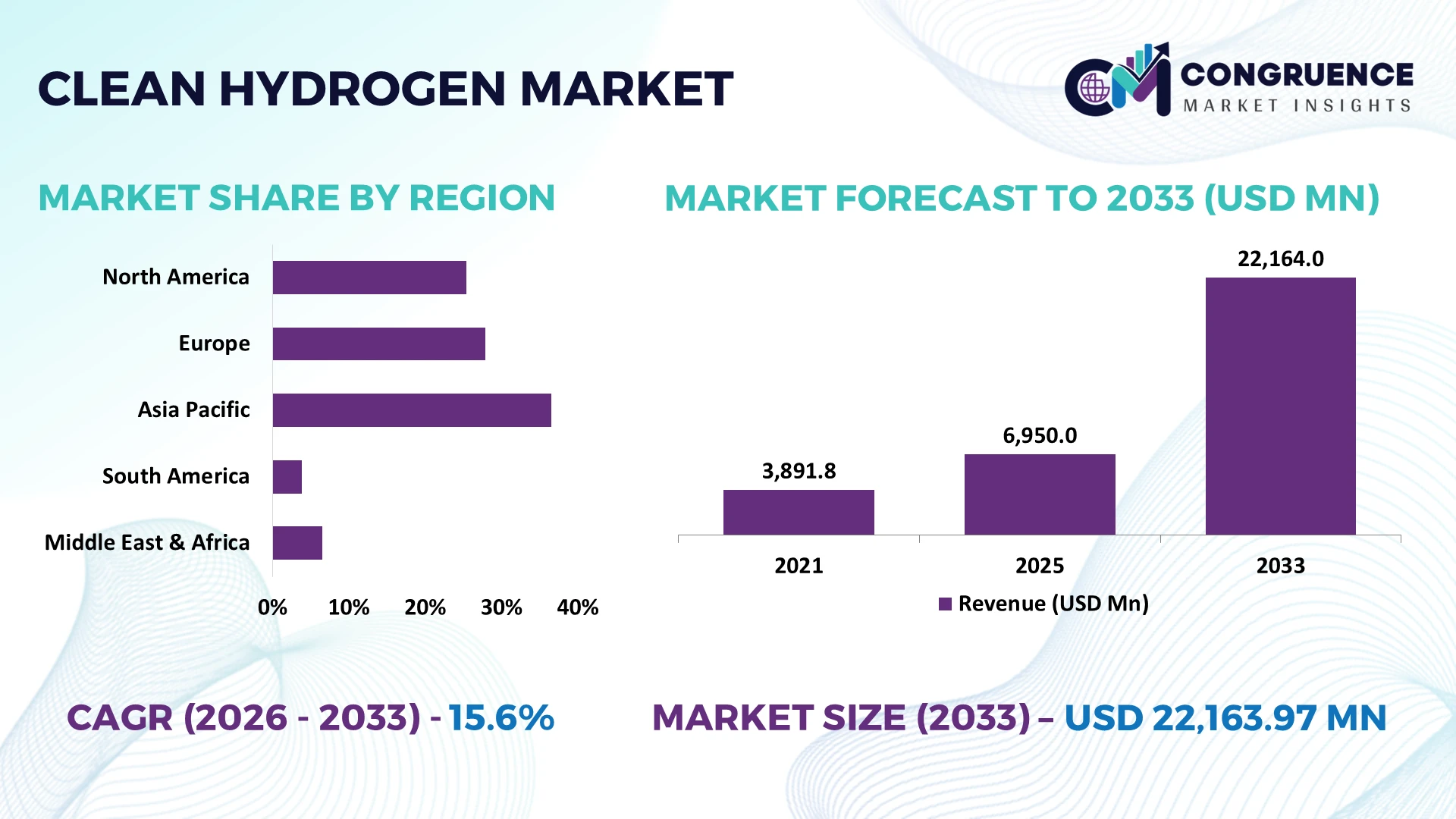
The Global Clean Hydrogen Market was valued at USD 6,950.0 Million in 2025 and is anticipated to reach a value of USD 22,164.0 Million by 2033 expanding at a CAGR of 15.6% between 2026 and 2033. Industrial decarbonization mandates, expanding renewable-powered electrolysis capacity, and the substitution of fossil fuel-derived hydrogen across ammonia production, petroleum refining, and steel manufacturing are driving market growth.
China dominates clean hydrogen infrastructure development, accounting for approximately 60% of global installed water electrolysis capacity in 2024. Its national hydrogen strategy targets renewable hydrogen production of 100,000–200,000 tonnes annually by 2025. Compared with Germany, China benefits from larger electrolyzer manufacturing capacity and lower equipment costs, while European energy security policies following the Russia–Ukraine conflict accelerate competing hydrogen infrastructure investments.
Strategic investment priorities increasingly favor localized electrolyzer manufacturing, renewable energy integration, and long-term industrial hydrogen offtake agreements.
Market Size & Growth: Valued at USD 6,950.0 million in 2025, reaching USD 22,164.0 million by 2033 at 15.6% CAGR, driven by industrial decarbonization.
Top Growth Drivers: Indicative driver weighting: industrial decarbonization (40%), renewable energy integration (35%), and policy incentives (25%).
Short-Term Forecast: Electrolyzer system costs are projected to decline by 15–20% by 2028 under favorable manufacturing and deployment conditions.
Emerging Technologies: Advanced PEM electrolysis, solid oxide electrolyzers, and AI-enabled energy optimization support three major technological shifts.
Regional Leaders: Indicative 2033 projections include Asia Pacific (USD 8,865.6 million; manufacturing), Europe (USD 6,427.6 million; industrial decarbonization), and North America (USD 4,876.1 million; hydrogen hubs).
Consumer/End-User Trends: Refining and chemical production collectively represent over 80% of conventional hydrogen consumption, creating substantial substitution opportunities.
Pilot/Case Example: In 2024, the HYBRIT initiative demonstrated hydrogen-based ironmaking technology capable of reducing production-related carbon emissions by approximately 90% or more.
Competitive Landscape: LONGi Hydrogen remains a prominent electrolyzer supplier, competing with thyssenkrupp nucera, Siemens Energy, Nel, and ITM Power; clean hydrogen market share remains unverified.
Regulatory & ESG Impact: European regulations target 42% renewable hydrogen use within eligible industrial hydrogen consumption by 2030.
Investment & Funding: Announced clean hydrogen investments exceeding USD 100 billion at committed project stages support infrastructure expansion and industrial partnerships.
Innovation & Future Outlook: Solid oxide electrolysis targets electrical efficiencies exceeding 80%, leveraging industrial waste heat integration.
The global clean hydrogen market is transforming energy-intensive industries through renewable hydrogen production, low-carbon ammonia synthesis, and hydrogen-based direct reduced iron manufacturing. Advanced electrolyzer systems and integrated renewable power infrastructure are improving production flexibility. With low-emissions hydrogen representing less than 1% of global hydrogen production in 2024, industrial substitution and geographically concentrated hydrogen clusters are becoming central to strategic infrastructure planning.
Clean hydrogen is becoming a strategic industrial feedstock as steelmakers, chemical manufacturers, and energy companies restructure production systems around low-carbon operations. European carbon pricing mechanisms and renewable hydrogen mandates are accelerating procurement decisions, while countries with abundant renewable resources are developing export-oriented production hubs to strengthen energy security and industrial competitiveness.
Conventional alkaline electrolyzers typically achieve electrical efficiencies of approximately 60–70%, whereas advanced solid oxide systems can exceed 80% when integrated with suitable external heat sources. China prioritizes manufacturing scale and equipment affordability, while Germany emphasizes industrial integration and certified renewable hydrogen procurement. Between 2026 and 2028, standardized manufacturing and larger project configurations are expected to reduce electrolyzer system costs by approximately 15–20% under favorable deployment conditions.
The HYBRIT initiative in Sweden demonstrates the operational feasibility of replacing coal-based iron reduction with hydrogen-powered processes. Companies including Siemens Energy, thyssenkrupp nucera, and Air Liquide are strengthening industrial partnerships, expanding production capabilities, and integrating hydrogen generation with downstream consumption infrastructure. Competitive advantage increasingly depends on securing affordable renewable electricity, reliable industrial offtake commitments, and integrated production assets that minimize transportation costs and exposure to energy price volatility.
Industrial decarbonization requirements are accelerating clean hydrogen adoption across ammonia manufacturing, petroleum refining, and primary steel production. Refining and chemical industries collectively account for over 80% of conventional hydrogen consumption, establishing an immediate substitution opportunity without creating entirely new end-use markets. The European Union requires renewable hydrogen to represent 42% of eligible industrial hydrogen consumption by 2030, increasing to 60% by 2035. Germany’s industrial transformation programs are encouraging steelmakers and chemical producers to secure renewable hydrogen supplies through long-term procurement agreements. Companies are responding by developing integrated electrolyzer facilities near existing industrial clusters. Co-locating production and consumption reduces transportation requirements while improving infrastructure utilization and long-term project bankability.
Clean hydrogen production remains constrained by expensive renewable electricity, electrolyzer capital expenditure, and limited access to cost-effective storage infrastructure. Electricity can represent approximately 50–70% of renewable hydrogen production costs, while conventional electrolysis systems typically achieve electrical efficiencies of 60–70%, increasing power procurement requirements. Germany faces additional competitiveness pressures from industrial electricity prices and restricted availability of low-cost renewable generation. These conditions weaken project profitability and widen the cost differential against conventional natural gas-derived hydrogen. Manufacturers and project developers are addressing these limitations through long-term renewable power purchase agreements, localized equipment sourcing, and modular electrolyzer configurations. Securing predictable electricity prices is increasingly more important than achieving incremental equipment cost reductions.
Next-generation electrolysis technologies and hydrogen-derived fuels are creating opportunities beyond conventional industrial hydrogen substitution. Solid oxide electrolyzers can achieve electrical efficiencies exceeding 80% when supported by external process heat, compared with approximately 60–70% for conventional alkaline systems. Meanwhile, the European Union’s sustainable aviation fuel framework establishes a 1.2% average synthetic aviation fuel requirement for 2030–2031, opening specialized demand for renewable hydrogen derivatives. Saudi Arabia is positioning large-scale renewable hydrogen projects around ammonia exports, enabling access to international industrial markets. Companies are investing in high-temperature electrolysis, integrated ammonia synthesis, and synthetic fuel partnerships. Monetizing industrial waste heat and hydrogen derivatives offers differentiated opportunities to improve asset utilization and production economics.
Scaling clean hydrogen production requires synchronized development of renewable electricity generation, electrolyzer installations, storage facilities, transportation networks, and industrial consumption assets. Low-emissions hydrogen represented less than 1% of global hydrogen production in 2024, while approximately 9% of announced low-emissions hydrogen production capacity for 2030 had reached final investment decisions by 2025. Australia’s hydrogen export ambitions illustrate the complexity of coordinating large renewable energy projects with ammonia conversion facilities and international procurement commitments. Project delays create mismatches between production availability and downstream industrial readiness, undermining infrastructure utilization. Companies must establish phased commissioning schedules, standardized engineering specifications, interoperable infrastructure, and binding offtake agreements. Coordinated ecosystem development remains essential for converting announced capacity into commercially sustainable production.
Electrolyzer Manufacturing Capacity Consolidation: Global electrolyzer manufacturing capacity reached approximately 41 GW annually in 2024, with China accounting for around 60% of capacity. Production capabilities increasingly exceed immediate project requirements, intensifying equipment pricing pressure. Manufacturers are restructuring production schedules, standardizing electrolyzer modules, and prioritizing confirmed industrial orders to improve factory utilization and working capital efficiency.
Hydrogen Certification Becomes Procurement Critical: European renewable hydrogen regulations require at least 70% lifecycle greenhouse gas emissions savings, while hourly renewable electricity matching becomes applicable from 2030. Industrial buyers are incorporating carbon traceability into procurement contracts. Suppliers are deploying digital monitoring platforms and partnering with certification providers to strengthen regulatory compliance and cross-border commercial eligibility.
Modular Hydrogen Infrastructure Deployment: Containerized electrolyzer configurations ranging from 1 MW to 20 MW are supporting phased industrial installations, while larger standardized modules enable incremental capacity expansion. Companies are shifting toward prefabricated systems with integrated purification, compression, and control equipment, reducing onsite engineering complexity and improving commissioning predictability across distributed industrial hydrogen facilities.
Flexible Electricity Procurement Strategies: Electrolyzers typically consume 50–55 kWh of electricity per kilogram of hydrogen, making operating schedules highly sensitive to power prices. Developers are integrating automated load management and hybrid renewable electricity procurement. Equipment manufacturers are improving dynamic operating capabilities, enabling industrial producers to balance electricity expenditure against equipment utilization and contractual delivery requirements.
Green Hydrogen leads the clean hydrogen market by type, with an indicative market share of approximately 55.0% in 2025 on a market-value basis, supported by renewable electricity integration, expanding electrolyzer installations, and industrial procurement commitments. Green hydrogen is also expected to register the fastest growth as manufacturers transition toward larger alkaline and proton exchange membrane electrolysis systems. China accounted for nearly 75% of newly installed electrolysis capacity globally in 2025, strengthening manufacturing scale and equipment availability. Renewable hydrogen developers increasingly prioritize industrial locations offering affordable electricity and established consumption infrastructure.
Blue Hydrogen maintains significant commercial relevance, particularly in the United States and the Middle East, where established natural gas infrastructure and carbon capture systems support large-volume production. Turquoise Hydrogen represents an emerging alternative, using methane pyrolysis to produce hydrogen and solid carbon while reducing direct carbon dioxide emissions. Companies are diversifying production portfolios through renewable energy partnerships, carbon capture integration, and methane pyrolysis research. Investment decisions increasingly depend on lifecycle emissions intensity, feedstock availability, and technology-specific production economics rather than production capacity alone.
Ammonia Production represents the leading application, with an indicative market share of approximately 35.0% in 2025, supported by continuous hydrogen consumption across fertilizer manufacturing and chemical processing facilities. Petroleum Refining remains another established application, benefiting from existing hydrogen distribution infrastructure and hydroprocessing requirements. Both applications offer commercially attractive substitution pathways because clean hydrogen can replace conventional hydrogen without fundamentally restructuring downstream production processes. Industrial developers increasingly locate production facilities near fertilizer plants and refineries to minimize transportation expenditure and improve operational continuity.
Steel Production is projected to register the fastest growth as manufacturers introduce hydrogen-based direct reduced iron processes capable of reducing production-related carbon emissions by approximately 90% under suitable low-carbon operating conditions. Transportation Fuels are gaining traction across heavy-duty mobility, maritime operations, and synthetic fuel production, while Power Generation & Energy Storage applications focus on industrial backup systems and long-duration electricity storage. Companies are developing application-specific hydrogen supply agreements, integrated ammonia conversion facilities, and steelmaking partnerships. Demand is gradually shifting toward applications where direct electrification remains technically challenging or commercially inefficient.
Chemical & Fertilizer Manufacturers constitute the leading end-user segment, accounting for an indicative market share of approximately 38.0% in 2025, supported by continuous feedstock requirements across ammonia and methanol production facilities. Oil & Gas Companies remain major purchasers through refinery desulfurization, hydrocracking, and industrial hydrogen network modernization. These established buyer groups benefit from predictable consumption volumes and existing processing infrastructure, enabling phased clean hydrogen procurement without extensive downstream modifications. Industrial buyers increasingly negotiate long-term contracts linking hydrogen prices with electricity costs and verified emissions performance.
Steel & Metal Manufacturers represent the fastest-growing end-user group as low-carbon steel procurement requirements encourage hydrogen-based production investments. Transportation & Logistics Companies are expanding specialized hydrogen refueling networks, particularly for commercial fleets, with China accounting for approximately 95% of global commercial fuel cell vehicle stock in 2024. Power & Utility Companies are evaluating hydrogen integration across dispatchable generation and long-duration storage. Companies are strengthening competitive positioning through customized supply contracts, captive production facilities, shared infrastructure development, and industrial partnerships that improve supply reliability while reducing buyers' exposure to production cost volatility.
Asia Pacific accounted for the largest market share at 36.5% in 2025 however, Middle East & Africa is expected to register the fastest growth, expanding at a CAGR of 19.2% between 2026 and 2033.
North America accounted for 25.4% of the global clean hydrogen market in 2025, supported by established industrial hydrogen consumption, extensive natural gas infrastructure, and expanding low-carbon production capabilities. The United States and Canada are developing integrated hydrogen ecosystems connecting production facilities with petroleum refineries, chemical manufacturers, and transportation networks. The United States' regional clean hydrogen hubs program originally allocated USD 7 billion across seven hydrogen hubs, supporting geographically concentrated production and consumption infrastructure. Canada is leveraging renewable electricity resources and carbon capture capabilities to develop competitive hydrogen production pathways. Industrial gas suppliers and energy companies are prioritizing blue hydrogen facilities alongside renewable electrolysis projects to diversify production portfolios. Regional competitiveness increasingly depends on carbon management infrastructure, long-term industrial procurement contracts, and coordinated development of hydrogen storage and distribution networks.
United States Market Outlook: The United States benefits from established Gulf Coast hydrogen pipelines, large-scale ammonia manufacturing facilities, and extensive geological carbon storage resources. The federal clean hydrogen production tax credit offers eligible producers incentives of up to USD 3 per kilogram, depending on lifecycle emissions intensity and applicable requirements. Companies are aligning production technology selection with emissions thresholds, industrial feedstock requirements, and project financing conditions.
Europe accounted for 27.8% of the global clean hydrogen market in 2025, driven by industrial decarbonization policies, renewable hydrogen procurement mandates, and cross-border infrastructure modernization. Germany, the Netherlands, Spain, and France are developing hydrogen production and distribution networks targeting steelmaking, chemical manufacturing, and petroleum refining. The European Union's REPowerEU strategy established targets of 10 million tonnes of domestic renewable hydrogen production and 10 million tonnes of imports annually by 2030. Port infrastructure operators are preparing ammonia import terminals and hydrogen distribution facilities to connect international suppliers with inland industrial consumers. Equipment manufacturers are expanding standardized electrolyzer production while energy companies establish renewable electricity procurement partnerships. Europe's competitive positioning increasingly depends on certified low-emissions hydrogen availability, interconnected transportation infrastructure, and commercially viable industrial conversion projects that reduce exposure to imported fossil fuels.
Germany Market Outlook: Germany is strengthening its hydrogen economy through industrial modernization and nationwide pipeline development. The approved hydrogen core network encompasses approximately 9,040 kilometers of pipelines, with around 60% planned through conversion of existing natural gas infrastructure. Steelmakers and chemical manufacturers are coordinating production technology upgrades with pipeline availability, creating procurement opportunities for electrolyzer manufacturers, engineering contractors, and industrial hydrogen suppliers.
Asia Pacific dominated the global clean hydrogen market with a 36.5% share in 2025, supported by extensive electrolyzer manufacturing capacity, expanding renewable energy infrastructure, and substantial industrial hydrogen requirements. China, Japan, South Korea, India, and Australia are pursuing differentiated hydrogen development strategies based on domestic manufacturing capabilities and energy security priorities. China accounted for approximately 60% of global installed water electrolysis capacity in 2024, reinforcing regional equipment supply advantages. Japan and South Korea are developing international hydrogen and ammonia procurement networks, while India is integrating renewable hydrogen production with fertilizer manufacturing and petroleum refining. Australia is targeting export-oriented hydrogen derivatives through large-scale renewable energy projects. Companies are expanding manufacturing partnerships, localizing critical components, and developing integrated production facilities to reduce procurement costs and strengthen regional hydrogen supply-chain resilience.
China Market Outlook: China benefits from vertically integrated electrolyzer manufacturing, competitive renewable electricity infrastructure, and extensive chemical processing capacity. The country's Kuqa green hydrogen project in Xinjiang has a designed annual production capacity of approximately 20,000 tonnes, supporting renewable hydrogen substitution in petroleum refining. Domestic manufacturers are advancing larger alkaline electrolyzer systems, automated production processes, and standardized equipment configurations to strengthen industrial deployment economics.
South America accounted for 3.8% of the global clean hydrogen market in 2025, supported by competitive renewable electricity resources and emerging opportunities in fertilizer manufacturing, mining, and low-carbon fuel exports. Brazil, Chile, and Uruguay are developing hydrogen production frameworks that leverage hydropower, wind energy, and solar generation capabilities. Chile's national green hydrogen strategy established an ambition to develop 25 GW of electrolysis capacity by 2030, reflecting its export-oriented industrial development priorities. Mining companies are evaluating hydrogen-powered heavy equipment, while chemical manufacturers are exploring domestic renewable ammonia production to reduce imported fertilizer dependency. However, limited hydrogen transportation infrastructure, financing constraints, and uncertain international offtake commitments restrict commercial deployment. Developers are addressing these limitations through port-centered industrial clusters, international technology partnerships, and phased project development aligned with confirmed downstream demand.
Brazil Market Outlook: Brazil possesses a structural advantage through its diversified renewable electricity portfolio, which supplied approximately 88% of national electricity generation in 2024. The Pecém Industrial and Port Complex is attracting renewable hydrogen and ammonia development initiatives targeting domestic industrial consumption and European export markets. Brazil's established agricultural sector also creates opportunities for renewable ammonia production, reducing dependency on imported nitrogen-based fertilizers.
Middle East & Africa accounted for 6.5% of the global clean hydrogen market in 2025, supported by competitive renewable energy resources, established hydrocarbon processing infrastructure, and large-scale hydrogen export ambitions. Saudi Arabia, the United Arab Emirates, Oman, Egypt, and Morocco are developing integrated production ecosystems targeting renewable ammonia, industrial feedstock substitution, and international energy markets. Oman's hydrogen development strategy targets annual renewable hydrogen production of at least 1 million tonnes by 2030, supported by dedicated land allocations and renewable electricity infrastructure. Established energy companies are leveraging engineering expertise, port facilities, and international commercial relationships to develop export-oriented hydrogen supply chains. African developers are pursuing partnerships that connect renewable generation resources with European industrial consumers. Regional competitiveness depends on securing binding international procurement agreements, efficient water management systems, and coordinated development of production and export infrastructure.
Saudi Arabia Market Outlook: Saudi Arabia is advancing large-scale renewable hydrogen commercialization through the NEOM Green Hydrogen Project, designed to produce approximately 600 tonnes of renewable hydrogen daily using around 4 GW of renewable electricity capacity. Integrated ammonia conversion and long-term offtake arrangements strengthen the project's commercial positioning. The country's established industrial infrastructure and energy project execution capabilities support expansion into international low-carbon fuel supply chains.
Air Liquide, Linde, and Air Products compete through integrated hydrogen production, industrial distribution networks, and long-term supply contracts, while thyssenkrupp nucera and LONGi Hydrogen challenge established suppliers through electrolyzer manufacturing scale and equipment innovation. The market remains moderately concentrated, with the top five players collectively representing an estimated 38.5% share. Competition centers on electricity procurement, production efficiency, infrastructure accessibility, and project execution capabilities. Electricity accounts for approximately 50–70% of renewable hydrogen production costs, while advanced electrolysis systems achieve electrical efficiencies exceeding 80% under suitable heat integration conditions. Companies are expanding manufacturing facilities, establishing renewable energy partnerships, and integrating hydrogen production with ammonia conversion infrastructure. Competitive dynamics are shifting from standalone equipment supply toward integrated production ecosystems supported by binding industrial offtake agreements. Capital-intensive infrastructure, certification requirements, and financing constraints create substantial entry barriers. Winning requires competitive production economics, dependable technology performance, secured industrial demand, and scalable infrastructure integration across strategic markets.
Air Liquide
Linde plc
Air Products and Chemicals, Inc.
thyssenkrupp nucera AG & Co. KGaA
LONGi Green Energy Technology Co., Ltd.
Siemens Energy AG
Nel ASA
ITM Power plc
Plug Power Inc.
Bloom Energy Corporation
Topsoe A/S
Enapter AG
ACWA Power
TotalEnergies SE
Alkaline water electrolysis remains commercially established, offering electrical efficiencies of approximately 60–70% and supporting large-scale industrial hydrogen production. Proton exchange membrane electrolysis provides comparable efficiency while enabling faster operational adjustments during renewable electricity fluctuations. China accounted for approximately 60% of global installed electrolysis capacity in 2024, reinforcing manufacturing advantages. Automated electrolyzer controls and modular system configurations are improving operational flexibility, equipment utilization, and industrial integration.
Solid oxide electrolysis represents an emerging technological shift, achieving electrical efficiencies exceeding 80% when suitable external process heat is available. Compared with conventional electrolysis operating at 65% efficiency, systems achieving 80% efficiency require approximately 19% less electricity for equivalent hydrogen output, excluding external heat requirements. Steelmakers, chemical manufacturers, and industrial facilities possessing recoverable process heat benefit disproportionately. Anion exchange membrane electrolysis is advancing through reduced dependence on expensive platinum-group catalysts and simplified equipment architectures.
Carbon capture integration supports blue hydrogen production, with advanced configurations targeting carbon dioxide capture rates exceeding 90% across relevant process streams. Methane pyrolysis offers an alternative pathway producing solid carbon alongside hydrogen. Between 2026 and 2028, standardized electrolyzer modules, predictive maintenance, and automated energy management will increasingly influence procurement decisions. Competitive advantage will favor suppliers delivering verified emissions performance, operational reliability, and lifecycle cost optimization.
February 2025, Air Liquide announced two electrolyzer projects in collaboration with TotalEnergies, representing a combined capacity of 450 MW. The investment strengthens European renewable hydrogen production infrastructure, supporting refinery decarbonization and expanding supply availability for industrial and heavy-duty transportation customers. Source: airliquide.com
November 2024, Air Liquide announced a EUR 50 million investment in hydrogen packaging and distribution infrastructure along France’s Seine Axis. The initiative strengthens renewable hydrogen delivery capabilities, supporting commercial vehicle refueling infrastructure and expanding low-carbon mobility services across established transportation corridors. Source: normandhy.airliquide.com
August 2024, Bloom Energy introduced a hydrogen-powered solid oxide fuel cell solution delivering approximately 60% electrical efficiency and 90% combined heat and power efficiency. The innovation strengthens hydrogen-based distributed power generation capabilities, improving energy utilization opportunities for heat-intensive industrial operations. Source: bloomenergy.com
June 2024, TotalEnergies signed a 15-year agreement with Air Products to procure 70,000 tonnes of green hydrogen annually beginning in 2030. The partnership establishes long-term industrial demand, supports European refinery decarbonization, and strengthens commercial visibility for large-scale renewable hydrogen production investments. Source: totalenergies.com
The Clean Hydrogen Market Report provides comprehensive analysis across three production types: Green Hydrogen, Blue Hydrogen, and Turquoise Hydrogen. Application coverage includes Ammonia Production, Petroleum Refining, Steel Production, Transportation Fuels, and Power Generation & Energy Storage. End-user analysis encompasses Chemical & Fertilizer Manufacturers, Oil & Gas Companies, Steel & Metal Manufacturers, Transportation & Logistics Companies, and Power & Utility Companies.
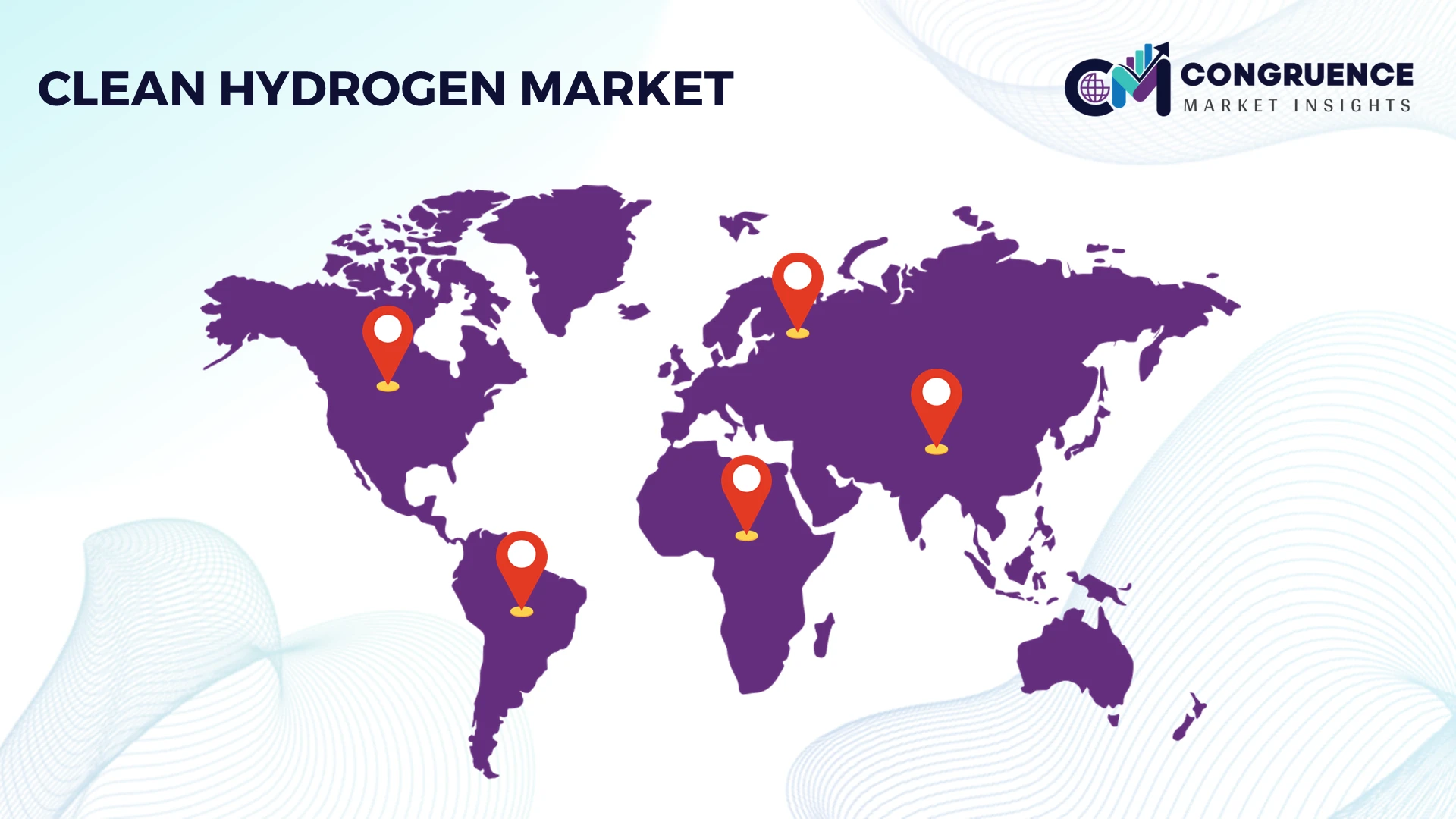
The report evaluates five major geographical regions, including North America, Europe, Asia Pacific, South America, and Middle East & Africa, examining production infrastructure, industrial adoption, regulatory frameworks, and investment opportunities. Technology coverage includes alkaline electrolysis, proton exchange membrane electrolysis, solid oxide electrolysis, carbon capture, and methane pyrolysis. Competitive assessment covers 14 major companies, supporting strategic investment planning, technology selection, geographical expansion, partnership development, and competitive positioning between 2026 and 2033.
| Report Attribute / Metric | Details |
|---|---|
| Market Revenue (2025) | USD 6,950.0 Million |
| Market Revenue (2033) | USD 22,164.0 Million |
| CAGR (2026–2033) | 15.6% |
| Base Year | 2025 |
| Forecast Period | 2026–2033 |
| Historic Period | 2021–2025 |
| Segments Covered |
By Type
By Application
By End-User
|
| Key Report Deliverables | Revenue Forecast; Market Trends; Growth Drivers & Restraints; Technology Insights; Segmentation Analysis; Regional Insights; Competitive Landscape; Regulatory & ESG Overview; Recent Developments |
| Regions Covered | North America; Europe; Asia-Pacific; South America; Middle East & Africa |
| Key Players Analyzed | Air Liquide; Linde plc; Air Products and Chemicals, Inc.; thyssenkrupp nucera AG & Co. KGaA; LONGi Green Energy Technology Co., Ltd.; Siemens Energy AG; Nel ASA; ITM Power plc; Plug Power Inc.; Bloom Energy Corporation; Topsoe A/S; Enapter AG; ACWA Power; TotalEnergies SE |
| Customization & Pricing | Available on Request (10% Customization Free) |




