
Reports
The Global Clean Coal Technology Market was valued at USD 4,360.5 Million in 2025 and is anticipated to reach a value of USD 6,929.0 Million by 2033 expanding at a CAGR of 5.96% between 2026 and 2033. Retrofit-driven efficiency upgrades at existing coal-fired units, particularly co-firing and carbon capture integration, anchor near-term deployment activity across China and the United States.
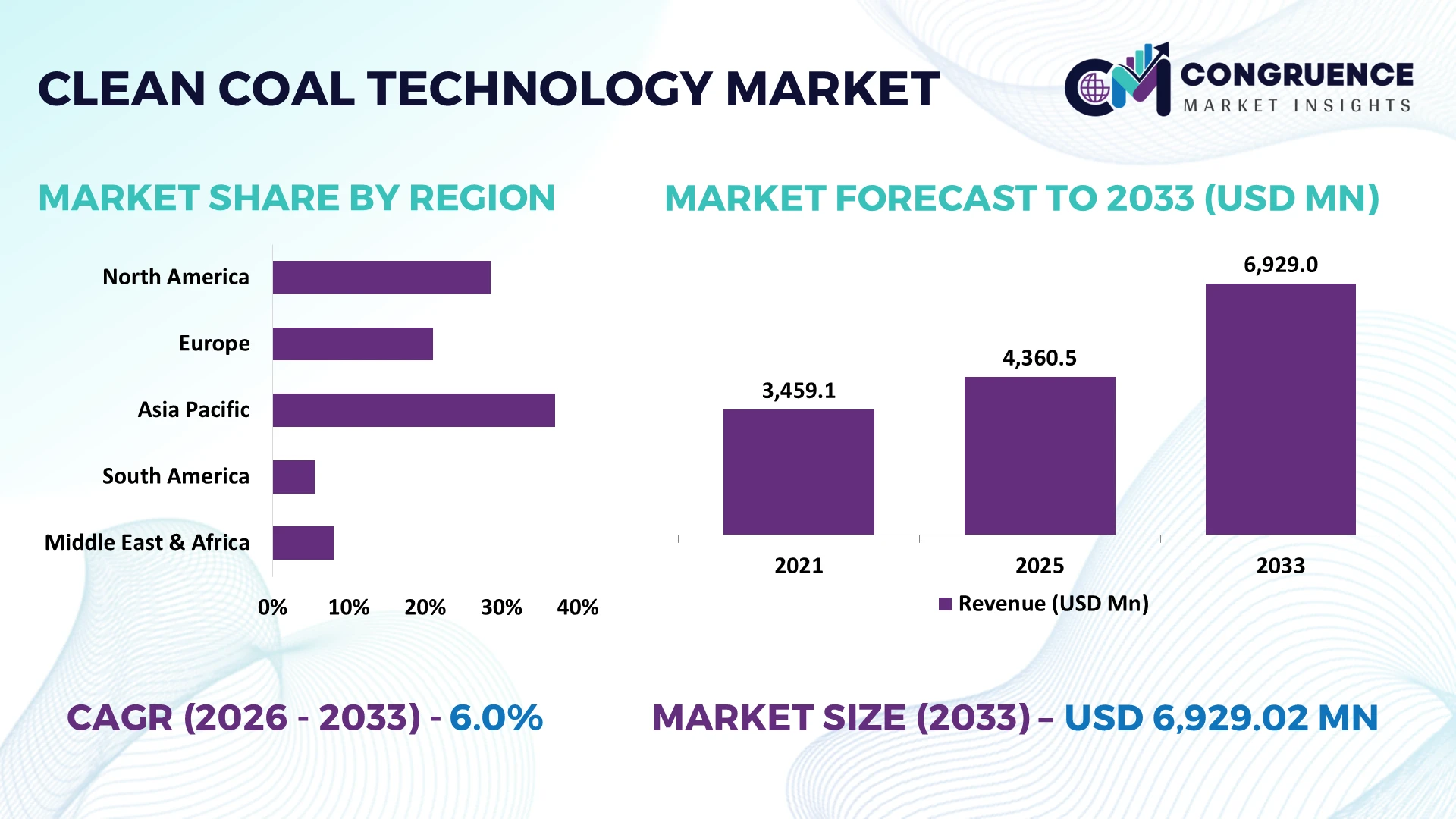
China dominates with 39.5% of global market value, supported by CHN Energy's full ultra-low emission compliance across conventional coal units and pilot projects including ammonia co-firing trials and large-scale carbon capture at Taizhou. India advances through a gasification incentive program targeting 100 million tonnes by 2030, contrasting with China's scale-driven retrofit model.
Strategic priority for suppliers: align offerings with state-owned retrofit pipelines in China and CCUS-linked gasification schemes in India rather than greenfield capacity.
Market Size & Growth: Valued at USD 4,360.5 Million in 2025, projected to reach USD 6,929.0 Million by 2033 at 5.96% CAGR; retrofit economics for existing coal fleets drive adoption.
Top Growth Drivers: Coal gasification incentives (₹8,500 crore India scheme), ammonia co-firing pilots (10% blend at CHN Energy), and U.S. federal retrofit funding ($625 million DOE allocation).
Short-Term Forecast: By 2027, wastewater retrofit systems target reduced operational costs and extended plant service life across U.S. coal units receiving DOE funding.
Emerging Technologies: AI-driven plant optimization, chemical looping combustion (20 MWth demonstration in Jiangxi), and biomass/ammonia co-firing systems.
Regional Leaders: Asia Pacific (USD 1.65 billion), North America (USD 1.2 billion), Western Europe (USD 0.9 billion); China leads adoption via state-owned retrofit mandates.
Consumer/End-User Trends: Chemical industry accounts for 36.4% of end-user demand, driven by coal-to-chemicals integration in China.
Pilot/Case Example: CHN Energy Taishan 10% ammonia co-firing trial (2025) demonstrates viable alternative fuel blending without major boiler redesign.
Competitive Landscape: CHN Energy leads with 65% of China's coal-to-oil output; key players include Clean Coal Technologies Inc., Honeywell, and ExxonMobil.
Regulatory & ESG Impact: U.S. Executive Orders mandate coal plant life extension; 100% of CHN Energy conventional units meet ultra-low emission standards.
Investment & Funding: U.S. DOE committed $625 million for coal recommissioning and retrofit; India allocated ₹8,500 crore for gasification.
Innovation & Future Outlook: Coal-to-methanol (6,000 MT/year at NTPC Vindhyachal) and CCUS-integrated gasification hubs signal diversification beyond power generation.
Clean coal technology demand concentrates in coal-to-chemicals and co-firing retrofits, with China's CHN Energy achieving full ultra-low emission compliance across conventional units. India's NTPC commissioned a 10 TPD CO₂-to-methanol plant, signaling CCUS commercialization momentum. Regulatory pressure in the U.S. under Executive Orders prioritizes plant life extension, creating retrofit-led procurement cycles. These dynamics position the market for strategic capital allocation toward modular retrofit solutions and industrial symbiosis.
Clean coal technology has shifted from environmental compliance tool to strategic asset for energy security and industrial competitiveness. Supply-chain restructuring in the U.S., driven by Executive Orders mandating coal plant reliability for AI infrastructure, redirects capital toward retrofit-ready systems rather than new builds. Regulatory change in India integrates CCUS into gasification hubs, creating a dual-track pathway for coal's industrial role.
Technology comparison shows ammonia co-firing at 10% blend achieves measurable emissions reduction without major boiler replacement, while chemical looping combustion captures 35,000 tons CO₂ annually at demonstration scale. China's state-driven retrofit model deploys 500,000 tons/year carbon capture at Taizhou, contrasting with India's pilot-stage CCUS-to-methanol approach at 6,000 MT/year capacity.
Operationally, CHN Energy's full ultra-low emission compliance across conventional units demonstrates that retrofit standardization reduces deployment friction. Over the next two to three years, adoption indicators will center on co-firing blend rates exceeding 15% and CCUS integration into gasification hubs. Companies that secure retrofit partnerships with state-owned generators in China and India position themselves for recurring service and technology upgrade contracts, while U.S.-focused suppliers benefit from federally backed recommissioning pipelines.
China's CHN Energy operates all conventional coal units under ultra-low emission standards and is advancing 10% ammonia co-firing at Taishan, creating a replicable retrofit template for its coal fleet. India's ₹8,500 crore gasification incentive targets 100 million tonnes by 2030, with seven projects under implementation. These state-directed programs generate procurement pipelines for co-firing burners, carbon capture modules, and gasification equipment. Suppliers that localize engineering and service capacity near Chinese and Indian coal clusters reduce lead times and capture recurring maintenance contracts. The strategic insight: retrofit standardization, not technology novelty, determines deployment velocity.
U.S. coal plant recommissioning requires $625 million in federal funding to offset capital barriers, signaling that private capital alone cannot justify retrofit economics at current utilization rates. India's CCUS pilots remain at 500 kg CO₂/day scale, limiting commercial viability without sustained subsidy. The constraint manifests as delayed final investment decisions for full-scale carbon capture retrofits, particularly in markets without carbon pricing. Companies mitigate through phased deployment, starting with co-firing modifications that require lower capital outlay, and through cost-sharing partnerships with national laboratories and state-owned utilities.
China's coal-to-oil output from CHN Energy represents 65% of national capacity, with coal-to-olefins at 20% and coal-to-methanol at 10%. India's NTPC Vindhyachal 10 TPD CO₂-to-methanol plant demonstrates industrial symbiosis potential. The non-obvious opportunity lies in integrating captured CO₂ with adjacent chemical facilities, converting a waste stream into revenue-generating feedstock. Companies positioning at the intersection of gasification and CCUS—rather than treating them as separate verticals—capture margin from both emissions compliance and chemical product sales.
India's coal sector faces reskilling requirements as CCUS and gasification replace conventional combustion pathways, with no established certification pipeline at the 100 million tonne gasification target scale. U.S. coal plant retrofits for dual-fuel capability introduce operational complexity requiring new control systems and specialized training. Integration of AI-driven plant optimization with legacy distributed control systems creates cybersecurity and interoperability gaps. Long-term competitiveness depends on utilities investing in human capital alongside hardware; retrofit programs that neglect workforce readiness face extended commissioning timelines and degraded performance guarantees.
Modular Retrofit Packages Accelerate Deployment Operators in the United States and Europe are shifting toward modular post-combustion capture retrofits that fit within narrow boiler refurbishment windows, reducing plant downtime by up to 30% compared to stick-built amine systems. The EU Innovation Fund's EUR 220 million allocation to cement-sector capture initiatives signals technology spillover beyond power generation, prompting EPC firms to standardize skid-mounted capture units for cross-industry deployment. Companies are restructuring engineering teams around repeatable retrofit designs rather than bespoke configurations.
Ultra-Supercritical Conversions Dominate Fleet Upgrades Ultra-supercritical systems are capturing 17.26% uptake growth through 2031 as operators in China and India pursue efficiency thresholds above 45%, cutting fuel consumption per kilowatt-hour by measurable margins. Supercritical platforms retain 44.02% market share, but the incremental efficiency gap is pushing state-owned generators toward USC conversions in new retrofit cycles. Suppliers are responding by localizing high-temperature material supply chains near Chinese industrial hubs to shorten lead times.
Digital-Twin Predictive Models Extend Plant Life Digital-twin modeling for boiler and turbine performance is being integrated into retrofit workflows, enabling operators to simulate co-firing blends and capture integration before physical deployment. This reduces commissioning risk for ammonia co-firing pilots and supports life-extension decisions without compromising grid reliability. Engineering firms are embedding digital-twin capabilities into O&M contracts, converting one-time retrofit projects into recurring service revenue.
Policy-Driven Capital Redirects Toward Capture-Ready Design The U.S. 45Q credit and $1.3 billion in federal funding are reshaping investment priorities, with developers favoring capture-ready designs over conventional pollution-control-only retrofits. Louisiana's $4.5 billion clean-energy complex illustrates private capital co-investment under supportive policy frameworks. Non-obvious insight: capture-ready engineering adds marginal upfront cost but preserves optionality for future mandates, making it a hedge against regulatory tightening rather than a pure compliance expense.
Supercritical technology holds 44.02% of the clean coal technology market in 2025, sustained by proven supply chains and lower integration risk for operators retrofitting existing subcritical units. Its dominance reflects scalability across China and India, where state-owned generators prioritize deployment speed over maximum efficiency gains. Ultra-supercritical systems represent the fastest-growing type, with efficiencies surpassing 45% and measurable fuel consumption reductions per kilowatt-hour driving adoption in new-build and conversion projects. Circulating fluidized bed units retain relevance in markets handling variable coal grades, offering intrinsic sulfur capture that eases compliance for Indian and Southeast Asian operators. Subcritical technology, constrained by efficiencies around 35%, continues ceding ground but persists in units under 300 MW where low-complexity builds remain acceptable. Companies are prioritizing USC localization and CFB partnerships, with investment shifting toward high-temperature materials and modular retrofit packages that shorten deployment windows.
Desulfurization applications commanded 55% of the clean coal technology market in 2025, driven by stringent environmental regulations mandating sulfur content reduction across industrial facilities in China and India. This concentration reflects the maturity of flue gas desulfurization installations and the operational necessity of continuous compliance for coal-fired utilities. Denitrification represents the fastest-growing application segment, as operators pursue selective catalytic reduction and low-NOx burner upgrades to minimize nitrogen oxide emissions. Pulverized coal combustion remains the dominant combustion platform with 51% share, but IGCC configurations are accelerating as carbon capture mandates create demand for syngas-based pathways. Companies are adapting by bundling desulfurization and denitrification into integrated pollution-control packages, reducing installation complexity and capturing broader retrofit budgets from Chinese and Indian utilities.
The chemical industry accounts for 36.4% of clean coal technology end-user demand, valued at approximately $1.51 billion in 2025, driven by coal-to-chemicals integration in China where CHN Energy dominates coal-to-oil and coal-to-olefins output. This concentration reflects the chemical sector's operational intensity and its reliance on gasification-based syngas for feedstock production. The pharmaceutical industry represents the fastest-growing end-user segment, as clean coal-derived intermediates and process heat applications expand in India and China. Power utilities remain the largest volume buyer of emission-control retrofits, but their share is stabilizing as developed markets phase down coal generation. Companies are targeting chemical and pharmaceutical buyers through application-specific gasification configurations and long-term supply partnerships, shifting commercial focus from utility retrofit cycles to industrial symbiosis models.
Asia-Pacific accounted for the largest market share at 36.8% in 2025 however, North America is expected to register the fastest growth, expanding at a CAGR of 6.74% between 2026 and 2033.
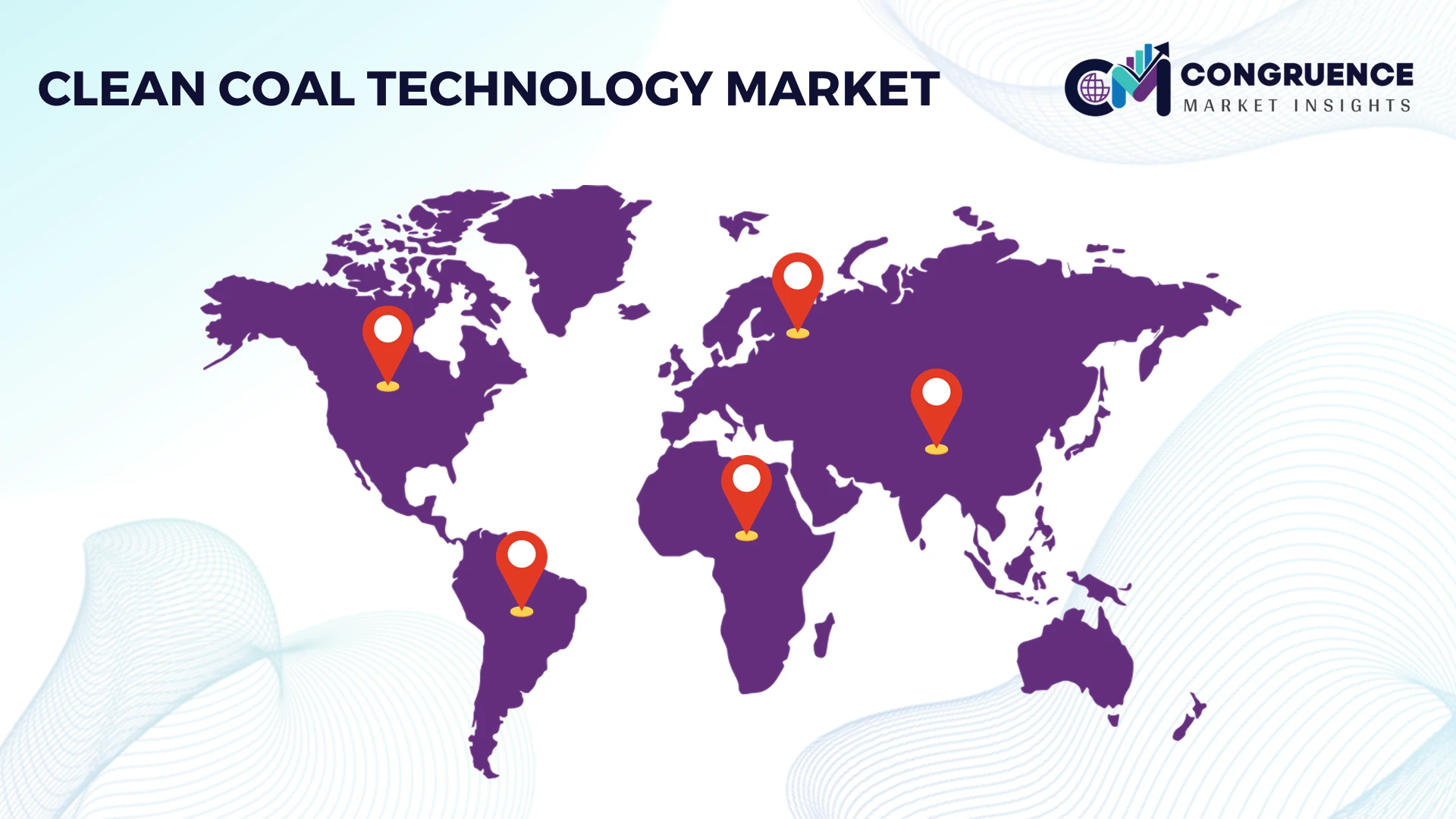
North America commands 28.5% of global market value, supported by concentrated deployment activity across U.S. coal-fired capacity and a structured federal funding pipeline. The U.S. Department of Energy has allocated $425 million to 13 coal plants covering more than 14 GW of capacity, alongside $350 million for four coal modernization projects, creating a near-term procurement cycle for efficiency upgrades and emissions-control retrofits. Canada's emissions-performance standard of 420 tonnes of CO₂ per GWh by 2030 adds regulatory pressure for capture and combustion efficiency technologies at eligible facilities. The region's dominance reflects both installed base scale and the availability of policy-backed capital for retrofit execution.
U.S. Market Outlook: The U.S. accounts for approximately $1.44 billion in 2025, representing the overwhelming majority of North American market value. Federal recommissioning funding and Executive Order-driven plant life extension mandates prioritize retrofit-ready engineering over greenfield construction, sustaining demand for boiler modifications, emission controls, and co-firing-capable combustion systems.
Europe holds 21.0% of global market share, with activity increasingly shaped by carbon capture and storage targets rather than coal generation expansion. The European Union's goal of at least 50 million tonnes of annual CO₂ injection capacity by 2030 creates downstream demand for capture integration at remaining coal and industrial facilities. Germany's planned reduction to 17 GW of coal capacity by 2030 and France's 2027 coal exit phase-out timeline compress the retrofit window, pushing operators toward efficiency-maximizing upgrades and capture-ready configurations before closure deadlines. The region's market character is transitional: compliance-driven, infrastructure-linked, and increasingly oriented toward carbon management rather than combustion technology alone.
Germany Market Outlook: Germany represents approximately $300 million in 2025, the largest single European market despite its declining coal base. The country's dual pressure of near-term capacity reduction and 2030 energy-sector emissions targets forces operators to prioritize high-efficiency combustion retrofits and carbon capture readiness as closure timelines accelerate.
Asia-Pacific represents 37.0% of global market value, with China, India, and Japan anchoring deployment at a scale unmatched in other regions. China's policy target to raise the share of coal power capacity meeting energy-efficiency benchmarks by 15 percentage points by 2028 sustains demand for ultra-supercritical conversions and emissions controls. India's biomass co-firing mandate of 5–10% at coal-fired plants creates a distinct retrofit category for combustion system modifications. Japan's 20% ammonia co-firing target for 2030 positions the country as a technology leader in alternative fuel integration. The region's export capability further distinguishes it: China's clean coal technology equipment exports reached $8.7 billion in 2025, extending regional manufacturing capacity into Southeast Asian and Latin American markets.
China Market Outlook: China accounts for approximately $760 million in 2025, the largest single country market within Asia-Pacific. The country's efficiency benchmark expansion target, combined with CHN Energy's full ultra-low emission compliance across conventional units, creates a standardized retrofit pipeline that rewards localized engineering capacity and service proximity over imported solutions.
South America represents approximately 5.5% of global market value, with deployment concentrated in industrial applications rather than utility-scale power generation. Brazil and Argentina account for the majority of regional activity, driven by coal-based industrial processes and the adoption of combustion efficiency technologies at facilities serving domestic manufacturing supply chains. The region's market is structurally constrained by limited coal-fired generation capacity and infrastructure gaps, but the spillover of Chinese clean coal equipment exports into Latin American markets introduces cost-competitive retrofit options for industrial operators. Growth potential exists in emissions-control upgrades at existing facilities, though deployment velocity depends on industrial investment cycles rather than power-sector mandates.
Brazil Market Outlook: Brazil represents the largest single South American market, with activity concentrated in industrial combustion efficiency and emissions-control applications at facilities supporting the country's manufacturing and mining sectors. The absence of utility-scale coal retrofit mandates means demand is driven by operational cost reduction and export-oriented industrial compliance requirements rather than regulatory deadlines.
The Middle East and Africa region holds 8.0% of global market value, with South Africa accounting for 52.3% of regional revenue. Eskom's Medupi and Kusile supercritical stations, totaling 9.6 GW in capacity, are undergoing fleet recovery and optimization programs, with partial funding from an $8.5 billion Just Energy Transition partnership. The UAE's 2.4 GW Hassyan plant demonstrates that Gulf economies view efficient coal generation as a baseload diversification tool, though at a smaller scale. The region's market is defined by fleet rehabilitation rather than new technology deployment, with operational restoration and efficiency recovery taking priority over advanced capture integration.
South Africa Market Outlook: South Africa anchors regional demand through Eskom's rehabilitation programs at Medupi and Kusile, where operational recovery and efficiency restoration represent the primary procurement drivers. The Just Energy Transition partnership funding structure ties retrofit activity to broader decarbonization commitments, creating a dual mandate of performance restoration and emissions reduction at the country's flagship coal stations.
General Electric (GE Vernova), Siemens Energy, Mitsubishi Heavy Industries, Shanghai Electric, and China Shenhua lead a fragmented field, with the top ten competitors holding just 18.49% combined share in 2024 and GE Vernova the largest at 2.26% . Competition splits between Western OEMs competing on carbon capture integration and Chinese state-linked equipment suppliers competing on retrofit cost and deployment speed. Technology differentiation drives roughly 34% of purchasing decisions around carbon capture and storage capabilities, while price pressure dominates in price-sensitive Indian and Southeast Asian tenders . Players pursue partnerships and government contracts rather than acquisition-led consolidation. The decisive barrier is utility-scale CCUS integration experience—suppliers without reference plants face exclusion from federally funded U.S. and EU-backed retrofits. Winning requires localized engineering near coal clusters and proven capture-ready retrofit designs.
General Electric (GE Vernova)
Siemens Energy
Mitsubishi Heavy Industries
Shanghai Electric Group
China Shenhua Energy
Dongfang Electric
Doosan Enerbility
KBR Inc.
Bharat Heavy Electricals Limited (BHEL)
Fluor Corporation
Alstom Power
Shell
Clean Coal Technologies Inc.
Supercritical and ultra-supercritical pulverized coal combustion remains the operational backbone, delivering thermal efficiency gains that reduce fuel consumption per megawatt-hour compared with subcritical baselines . Carbon capture integration now defines competitive positioning: post-combustion capture offers near-term retrofit viability, while chemical looping and calcium looping configurations demonstrate measurable greenhouse-gas reductions of over 50% relative to uncontrolled plants .
Gasification is accelerating as the fastest-growing technology pathway because it converts coal into syngas for both power and chemical feedstock applications, extending clean coal's relevance beyond electricity generation . Japan's 20% ammonia co-firing target and India's biomass co-firing mandates are pushing combustion-system modifications into commercial procurement cycles .
Between 2026 and 2028, suppliers with validated capture-ready retrofit designs will capture federally backed U.S. and EU-funded projects, while Chinese OEMs compete on deployment speed and cost in Asian and African markets. The operational advantage belongs to firms integrating digital-twin simulation into retrofit engineering, reducing commissioning risk and extending service contracts.
July 2025 – JSW SA Launched the METH2GEN R&D project with EUR 25.6 million total budget, targeting 70% methane capture efficiency through directional drilling and waste-methane-to-hydrogen conversion at the Budryk mine, advancing mine-safety and emissions-reduction integration. Source: biznes.pap.pl
November 2025 – Warrior Met Coal Reported third-quarter adjusted EBITDA of $70.6 million at a 21.5% margin, reflecting sustained operational performance and capital discipline across its metallurgical coal portfolio amid volatile pricing conditions. Source: investors.warriormetcoal.com
December 2025 – Active Energy Group Completed strategic review of CoalSwitch® and strengthened collaboration with Indigenous Canadian Energy to develop an industrial-scale validation plant for steam-enhanced biofuel pellets, establishing technical benchmarks required for commercial guarantees and project funding. Source: investegate.co.uk
April 2026 – SNS Insider (industry analysis) Reported that Asia Pacific held nearly 43% of global clean coal technology revenue share in 2025, driven by coal reserve scale and power demand modernization in China and India, confirming regional dominance in deployment activity. Source: miningweekly.com
The report covers the full clean coal technology value chain across combustion platforms (supercritical, ultra-supercritical, fluidized bed), capture methods (post-combustion, pre-combustion, oxy-fuel), and gasification pathways. Segmentation spans applications including desulfurization, denitrification, and carbon capture, with end-user coverage across chemical, power, pharmaceutical, and commercial sectors. Regional analysis addresses Asia-Pacific's 39.5% deployment concentration, North America's policy-backed retrofit pipeline, Europe's carbon-management transition, and emerging activity in South Africa, Brazil, and Gulf economies .
Quantitative indicators include segment distribution—supercritical pulverized coal at 51% combustion share, desulfurization at 55% application share, and chemical industry at 36.4% end-user share—alongside adoption signals such as Japan's 20% ammonia co-firing target and India's 5–10% biomass co-firing mandate . The report supports investment planning through competitive positioning analysis of the fragmented supplier landscape, expansion strategy guidance by region and segment, and forward-looking assessment of capture-ready retrofit demand between 2026 and 2033.
| Report Attribute / Metric | Details |
|---|---|
| Market Revenue (2025) | USD 4,360.5 Million |
| Market Revenue (2033) | USD 6,929.0 Million |
| CAGR (2026–2033) | 5.96% |
| Base Year | 2025 |
| Forecast Period | 2026–2033 |
| Historic Period | 2021–2025 |
| Segments Covered |
By Type
By Application
By End-User
|
| Key Deliverables | Revenue Forecast; Market Trends; Growth Drivers & Restraints; Technology Insights; Segmentation Analysis; Regional Insights; Competitive Landscape; Regulatory & ESG Overview; Recent Developments |
| Regions Covered | North America; Europe; Asia-Pacific; South America; Middle East & Africa |
| Companies Profiled | General Electric (GE Vernova); Siemens Energy; Mitsubishi Heavy Industries; Shanghai Electric Group; China Shenhua Energy; Dongfang Electric; Doosan Enerbility; KBR Inc.; Bharat Heavy Electricals Limited (BHEL); Fluor Corporation; Alstom Power; Shell; Clean Coal Technologies Inc. |
| Customization & Pricing | Available on Request (10% Customization Free) |




