
Reports
The Global Civil Helicopter MRO Market was valued at USD 3,850.2 Million in 2025 and is anticipated to reach a value of USD 6,420.1 Million by 2033 expanding at a CAGR of 6.6% between 2026 and 2033. Growth is driven by ageing helicopter fleets, engine and dynamic-component overhauls, mandatory airworthiness inspections, avionics modernization, and operators extending aircraft service lives instead of replacing expensive platforms.
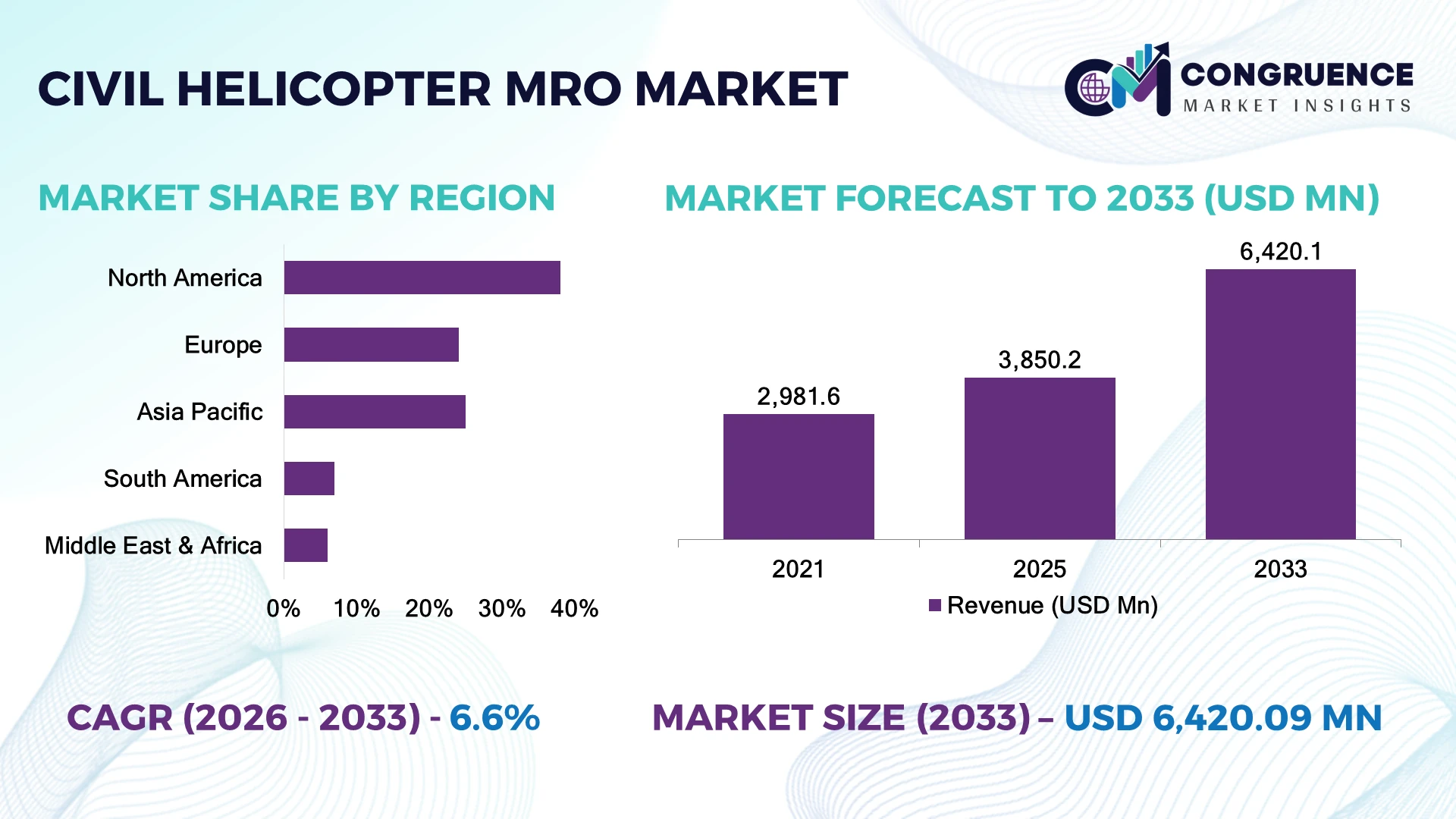
The United States remains a strategically important civil helicopter maintenance market because of its extensive emergency medical services, offshore operations, law-enforcement, tourism, and private aviation activities. Globally, the in-service civil helicopter fleet reached approximately 24,700 aircraft at the end of 2025, with an average aircraft age of 33.5 years. North America has an established maintenance infrastructure, while Asia-Pacific is developing additional regional support capacity. These conditions strengthen demand for component repair, scheduled inspections, engine servicing, and life-extension programs.
For investors and MRO providers, the strategic priority is to expand high-value technical capabilities and parts availability while reducing turnaround time for ageing aircraft.
Market Size & Growth: The market is valued at USD 3,850.2 million in 2025 and is projected to reach USD 6,420.1 million by 2033, supported by ageing fleets, overhaul requirements, and avionics upgrades.
Top Growth Drivers: Approximately 90% of helicopters delivered over the previous 30 years remain in existence, creating a substantial installed base requiring maintenance, component replacement, and upgrades.
Short-Term Forecast: Through 2028, MRO providers should target 5–10% shorter turnaround times through improved parts planning and workflow scheduling; this is an operational target, not a market-wide measured outcome.
Emerging Technologies: Predictive maintenance, digital maintenance records, health monitoring, and advanced diagnostic tools help identify component deterioration and prioritize inspections.
Regional Leaders: North America remains an established MRO center; Europe benefits from OEM engineering and service networks; Asia-Pacific offers opportunities to expand local repair capacity and reduce ferrying downtime.
Operator Trends: Emergency medical services, offshore operators, utility fleets, and private aviation customers prioritize aircraft availability, predictable maintenance costs, and rapid access to approved parts.
Operational Improvement: A 5% reduction in avoidable maintenance delays is a practical target for facilities improving parts availability, technician scheduling, and work-package readiness.
Competitive Landscape: Airbus Helicopters, Leonardo, Bell, Safran Helicopter Engines, StandardAero, and independent repair stations compete through technical approvals, OEM access, turnaround time, and component capabilities.
Regulatory & Safety Impact: Airworthiness directives can require revised inspection procedures or maintenance programs, making traceable records and prompt technical compliance essential to continued operations.
Investment Priorities: Capital spending is directed toward component workshops, engine support, diagnostic equipment, technician training, and regional parts inventories; no consistent global civil-helicopter MRO investment total is available.
Innovation & Future Outlook: With the global civil helicopter fleet reaching about 24,700 aircraft in 2025, providers that combine maintenance expertise with digital diagnostics and reliable parts access are positioned to capture recurring service demand.
The civil helicopter MRO market supports emergency medical services, offshore energy, law enforcement, tourism, utility operations, and private aviation. The ageing installed base is increasing the importance of engine overhauls, dynamic-component inspections, avionics retrofits, and life-extension work. As operators balance replacement costs against continued airworthiness, maintenance providers are strengthening technical capabilities, parts planning, and digital records to protect aircraft availability and manage lifecycle expenditure.
Civil helicopter MRO is becoming strategically important because operators increasingly rely on maintenance, repair, overhaul, and upgrades to preserve aircraft availability without incurring the capital cost of fleet replacement. With approximately 90% of helicopters delivered over the past three decades still in existence, the installed base creates recurring requirements for scheduled inspections, engine work, rotor-system maintenance, component repair, and avionics modernization. The average in-service aircraft age of 33.5 years reinforces the importance of life-extension expertise.
Technology is changing how maintenance organizations prioritize work. Traditional calendar- and flight-hour-based schedules remain essential, while condition monitoring and digital maintenance records improve visibility into component status and maintenance history. Predictive tools can help identify developing faults earlier, although savings depend on data quality, aircraft configuration, and the maintenance task involved. North America benefits from mature service infrastructure, while selected Asia-Pacific markets are developing local capabilities to reduce dependence on overseas workshops.
During 2026–2028, operators and MRO providers should prioritize component traceability, technician capability, parts availability, and digital workflow integration. For example, a workshop can target a 5% reduction in avoidable turnaround delays by improving work-package readiness and inventory coordination. Providers that combine approved technical capability with responsive parts support and reliable maintenance scheduling will strengthen customer retention and compete more effectively for long-term service agreements.
The ageing civil helicopter fleet is a structural driver of MRO demand. The global in-service fleet reached approximately 24,700 aircraft at the end of 2025, and around 90% of helicopters delivered over the previous 30 years remain in existence. Older aircraft require continued inspections, component replacements, structural checks, and engine maintenance, even when operators defer new purchases. This creates recurring demand for approved repair capabilities and overhaul services. MRO providers are expanding component expertise, improving spare-parts planning, and offering maintenance packages tailored to aircraft utilization. A 5% reduction in avoidable turnaround delays is a reasonable operational target for facilities improving scheduling and parts readiness, rather than an established industry-wide result.
Civil helicopter maintenance depends on qualified technicians, approved technical data, certified parts, and specialized equipment. Delays in engine components, rotor-system parts, or model-specific materials can keep aircraft grounded even when workshop capacity is available. Ageing fleets intensify the challenge because some legacy parts have limited production availability and require repair, replacement, or engineering assessment. MRO providers must also comply with model-specific airworthiness instructions and maintain traceable records. A 5–10% reduction in parts-related delays can serve as a facility-level improvement target, but results depend on inventory conditions and supplier lead times. Providers are reducing exposure through alternate approved suppliers, exchange-pool arrangements, critical-spares planning, and stronger coordination with OEMs.
Digital health monitoring and regional MRO expansion create opportunities to improve aircraft availability and capture work closer to operators. Engine data, vibration monitoring, maintenance histories, and component-life records can help teams identify abnormal trends and plan inspections before they disrupt operations. A 5% reduction in unplanned maintenance events is a potential target for selected fleets using validated monitoring programs, not a universal technology outcome. Asia-Pacific and other underserved markets can benefit from approved regional workshops that reduce ferrying time and simplify access to parts. Providers are investing in diagnostics, technician training, and OEM partnerships. The strongest opportunity lies in combining digital insight with certified repair capability and dependable component supply, rather than selling software independently of maintenance execution.
Modern civil helicopters integrate advanced avionics, flight-control systems, engine monitoring, composite structures, and model-specific maintenance requirements. Integrating these systems into existing maintenance processes requires specialized tooling, current technical documentation, and continuous technician training. Regulatory updates can also require changes to inspection intervals, maintenance manuals, or approved maintenance programs. In 2025 and 2026, airworthiness directives affecting specific helicopter models reinforced the need for prompt technical review and documented compliance. MRO organizations can target 2–3% fewer documentation-related rework events through improved digital records and independent quality checks, subject to baseline validation. Long-term competitiveness depends on maintaining approvals, securing qualified personnel, protecting maintenance data, and consistently delivering airworthy aircraft without unnecessary downtime.
Digital Maintenance and Health Monitoring: Operators are using aircraft health data, electronic records, and diagnostic tools to improve visibility into component condition. A 5% reduction in avoidable maintenance delays is a target for fleets improving parts readiness and work planning, not a verified industry average. MRO providers are integrating maintenance records with scheduling and inventory workflows to reduce last-minute disruptions and strengthen customer reporting.
Ageing Fleet Overhaul Demand: The global civil helicopter fleet reached approximately 24,700 aircraft at the end of 2025, while the average in-service aircraft age reached 33.5 years. With around 90% of helicopters delivered over the previous 30 years still in existence, operators are extending service lives through inspections, component overhaul, and avionics upgrades. MRO providers are prioritizing legacy-platform expertise and critical-spares access.
Regional Service Network Expansion: Operators seek maintenance closer to their bases to limit ferrying requirements and reduce aircraft downtime. Airbus Helicopters reports a network of approximately 93 MRO service centres, illustrating the scale of OEM-supported maintenance coverage. Regional providers are competing through approved repair capabilities, local inventory, and mobile technical assistance. A 5–10% reduction in logistics-related downtime is a potential target requiring route- and fleet-specific validation.
Regulatory Compliance and Technical Upgrades: Airworthiness directives and updated maintenance limitations require operators to revise inspection practices, records, or approved programs for affected models. These obligations create demand for engineering support, inspections, component replacement, and documented compliance. MRO organizations are strengthening digital work cards and technical-review processes. During 2026–2028, providers that rapidly interpret approved instructions and maintain traceable work records will be better positioned to protect fleet availability and avoid repeat maintenance.
Engine maintenance is estimated to account for approximately 40% of civil helicopter MRO demand, reflecting the specialized labor, precision components, and recurring inspections required for turboshaft engines. Airframe heavy maintenance represents an estimated 35%, driven by structural inspections, corrosion control, major checks, and ageing-aircraft life-extension requirements. Component maintenance contributes approximately 25%, covering transmissions, gearboxes, rotor assemblies, hydraulics, landing gear, and repairable avionics. These directional estimates distinguish engine work from airframe and non-engine component services.
Component maintenance is positioned for faster operational development as digital diagnostics, repair capabilities, and exchange-pool arrangements help operators reduce aircraft downtime. Engine work retains a high-value position because overhaul requires specialist tooling, approved technical data, and access to life-limited parts. Airframe providers remain important for older aircraft and helicopters exposed to demanding offshore or utility environments. MRO companies are investing in component repair, engine capacity, and predictive diagnostics. A 5% reduction in avoidable turnaround delays is a practical facility-level target, while actual results depend on parts availability and workflow maturity. Investment decisions increasingly favor capabilities that combine technical approvals with reliable parts access and measurable aircraft-availability improvements.
Commercial transport and utility operations are estimated to account for approximately 35% of civil helicopter MRO demand, reflecting recurring flight activity, passenger and crew transport, and operational availability requirements. Emergency medical services and search-and-rescue operations contribute an estimated 25%, while offshore energy transport represents approximately 20%. Tourism, private transport, law enforcement, and other aerial-work missions collectively account for the remaining 20%. These directional shares classify maintenance demand by principal mission and avoid treating the same flight activity as multiple applications.
Emergency medical services and search-and-rescue missions are positioned for stronger maintenance demand where operators prioritize dispatch readiness and rapid response. Offshore operators also require disciplined inspections because high utilization and demanding environments intensify maintenance planning. Tourism and private transport fleets generally place greater emphasis on seasonal scheduling, cabin condition, and predictable service costs. MRO providers are tailoring inspection planning, component availability, and support agreements to mission intensity. A 5% reduction in avoidable aircraft downtime is a potential operational target, not a measured industry average. Providers that align maintenance windows with mission schedules can protect fleet availability and strengthen long-term service relationships.
Commercial helicopter operators are estimated to account for approximately 70% of civil helicopter MRO demand, supported by offshore transport, emergency medical services, charter operations, tourism, and utility missions. Private and corporate operators represent an estimated 30%, with maintenance requirements shaped by aircraft value, utilization, configuration, and owner preferences. These shares are directional estimates consistent with the distinction between commercial and private end-user groups. Commercial fleets typically require structured maintenance planning, predictable turnaround times, and dependable access to approved parts, while private operators often prioritize scheduling flexibility and cost transparency.
Commercial operators are positioned to generate the strongest recurring service demand because aircraft availability directly affects contracted missions and service commitments. Private and corporate buyers remain strategically valuable for refurbishment, avionics upgrades, and scheduled maintenance, although work timing can be more flexible. MRO providers are differentiating through support-by-the-hour arrangements, fixed-scope overhaul packages, component exchange programs, and tailored maintenance planning. A 5–10% improvement in parts readiness is a reasonable target for operators seeking to reduce maintenance delays, subject to baseline validation. Future competitive positioning will favor providers able to combine certified technical coverage with transparent pricing, responsive scheduling, and dependable parts supply.
North America accounted for the largest market share at an estimated 38% in 2025; however, Asia-Pacific is expected to register the fastest growth at a CAGR of 7.0% between 2026 and 2033.

North America maintains a leading position in civil helicopter MRO through its extensive operator base, established repair infrastructure, and mature regulatory framework. The United States anchors regional demand through emergency medical services, offshore energy support, law enforcement, corporate transport, and utility operations. A substantial installed fleet generates recurring requirements for engine overhauls, component repairs, scheduled inspections, and avionics upgrades. Operators increasingly prioritize predictive maintenance, digital maintenance records, and parts availability to reduce aircraft downtime. The region also benefits from established OEM support networks and independent repair stations operating under stringent airworthiness requirements. However, technician shortages, specialized-component lead times, and the cost of maintaining ageing aircraft can constrain turnaround performance. Competitive advantage increasingly depends on repair depth, inventory access, and the ability to support mixed fleets across geographically dispersed operating bases.
United States Market Outlook: The United States benefits from a large civil aviation ecosystem, extensive FAA-regulated repair capabilities, and strong demand from medical, utility, offshore, and private operators. Its established helicopter manufacturers, component specialists, and independent MRO providers support engine, transmission, rotor, avionics, and airframe maintenance. FAA certification requirements create a structured environment for approved maintenance and repair activities. Operators also have access to advanced diagnostic systems and established parts-distribution networks, supporting complex repairs and fleet modernization. The scale and technical depth of the US aerospace supply chain position the country as a key center for high-value helicopter maintenance.
Europe benefits from a concentrated aerospace manufacturing base, established helicopter OEMs, and a network of specialized maintenance providers. France, Germany, Italy, and the United Kingdom contribute through engineering, component support, emergency medical services, offshore operations, and corporate aviation. The region's maintenance environment is shaped by European Union Aviation Safety Agency requirements, which emphasize airworthiness, approved maintenance procedures, and traceable technical records. Operators are upgrading avionics, improving component reliability, and planning maintenance around tighter fleet-availability requirements. Airbus Helicopters reported 544 gross orders in 2025 and delivered 392 helicopters worldwide, reinforcing the scale of the regional OEM ecosystem, although these figures include military as well as civil aircraft. Skilled-labor availability, repair capacity, and access to replacement parts remain important determinants of service performance.
France Market Outlook: France holds strategic importance through Airbus Helicopters' industrial base in Marignane and its wider engineering and support ecosystem. The country combines OEM-linked maintenance expertise with specialized suppliers, technical training, and established civil helicopter operations. Airbus Helicopters' 2025 order intake included customers across 50 countries, demonstrating the international reach of the manufacturer headquartered in France. This global installed base supports continuing demand for approved component repair, technical documentation, upgrades, and spare-parts management. French maintenance providers can benefit from close integration with OEM engineering and supply-chain functions, particularly for complex repairs and lifecycle support.
Asia-Pacific is positioned for comparatively strong MRO expansion as helicopter deployment supports offshore energy, emergency medical services, tourism, utility work, and remote-area connectivity. Australia, mainland China, Japan, and New Zealand represent major fleet centers, while India is developing additional operational capacity. Asian Sky Group recorded 4,167 civil turbine helicopters in the region at the end of 2025, with 50 commercial helicopter operators. Australia remained the largest national market, with 1,051 helicopters. The regional fleet's diversity creates demand for scheduled inspections, engine and transmission work, component repairs, and mission-specific upgrades. However, maintenance capability is unevenly distributed, and some operators depend on overseas facilities for specialized repairs. Investments in local technical skills, parts inventories, and approved repair infrastructure can improve aircraft availability and reduce logistics-related downtime.
Australia Market Outlook: Australia is the region's largest civil turbine helicopter market, with 1,051 helicopters at the end of 2025 following a 2.4% annual increase. Its extensive geography and remote operating environments sustain demand for utility aviation, emergency response, tourism, and resource-sector support. Operators require maintenance arrangements capable of serving aircraft across dispersed bases, including locations far from major aviation centers. Australia's established aviation safety framework and experienced helicopter service providers support scheduled maintenance, component replacement, and fleet refurbishment. Continued fleet additions create opportunities for repair networks that can combine regional coverage with reliable access to OEM-approved parts and specialist engineering.
South America's civil helicopter MRO demand is concentrated around Brazil's offshore energy sector, utility operations, executive transport, and public-service missions. Offshore deployments generate recurring requirements for engine inspections, drivetrain maintenance, corrosion control, and reliability-focused component replacement. Brazil also provides an important industrial foundation through Helibras, which supports helicopter production and maintenance within the country. Regional demand is supported by remote geography and the need to connect offshore installations, industrial sites, and communities with limited ground access. Nevertheless, currency volatility, imported-part costs, uneven maintenance infrastructure, and long logistics routes can extend turnaround times. Providers with domestic repair capabilities and dependable component supply are better positioned to reduce aircraft downtime and limit dependence on overseas maintenance facilities.
Brazil Market Outlook: Brazil is the region's principal strategic market because of its offshore oil and gas activity, large domestic operating environment, and established helicopter industrial base. Helibras reports more than 850 helicopters delivered in Brazil across civil, government, and military segments, with approximately 700 still operating across those categories. Its maintenance workshop and local supplier network provide a foundation for technical support, parts availability, and aircraft lifecycle services. Offshore operators require rigorous maintenance planning and rapid component support, creating opportunities for qualified providers with experience in demanding operating environments. Domestic capability remains valuable where imported parts and international repair logistics can delay aircraft return to service.
Middle East and Africa demand is shaped by offshore energy, executive transport, emergency services, tourism, and major infrastructure projects. Gulf markets benefit from investment in commercial helicopter operations and aviation services, while parts of Africa rely on helicopters for remote-site access, medical missions, and resource-sector logistics. The United Arab Emirates is strengthening local component support through partnerships that reduce reliance on overseas repair movements. In November 2025, Honeywell and Abu Dhabi Aviation announced a multiyear agreement covering avionics repair and overhaul support for AW139 helicopters, including integrated repair logistics. Such arrangements can improve repair coordination and reduce avoidable downtime. However, capability remains uneven across the region, with specialist labor, approved facilities, parts availability, and cross-border logistics influencing maintenance costs and service responsiveness.
United Arab Emirates Market Outlook: The UAE benefits from its aviation-services ecosystem, international logistics links, and established helicopter operators. The Honeywell–Abu Dhabi Aviation agreement announced in 2025 provides AW139 operators with a local option for managing avionics repair logistics, from repair-facility selection through shipment and tracking. This arrangement illustrates how regional partnerships can shorten coordination chains even when specialized repairs are performed at different facilities. The country's commercial aviation infrastructure and access to international suppliers support opportunities in component maintenance, avionics support, and fleet-service coordination. Continued development of local technical capabilities can strengthen the UAE's role as a maintenance-support hub for nearby markets.
Competition is led by OEM-backed networks Airbus Helicopters, Leonardo and Bell, which compete with independent specialists StandardAero and Heli-One; Safran Helicopter Engines and Pratt & Whitney Canada dominate engine-specific work. The structure remains fragmented across airframes, engines and components. Public estimates indicate the five leading providers hold roughly 40–55% of civil MRO activity, although audited shares are unavailable. Buyers compare approved-platform coverage, turnaround time, parts access, technical depth and contract certainty. Providers target 5–10% shorter repair cycles through exchange pools, digital diagnostics and regional inventory; these are operational targets, not universal measured results. OEMs defend installed fleets through authorized networks, while independents win multi-platform contracts and price-sensitive component work. Partnerships are bringing repair logistics closer to operators, including Honeywell–Abu Dhabi Aviation support for AW139 avionics. Certification, technical data, tooling and specialist labor restrict entry. Winning requires trusted approvals, reliable parts and demonstrably faster return-to-service—not price discounting alone, consistently.
Civil helicopter MRO is shifting from calendar-based inspection toward condition-informed maintenance, combining health monitoring, vibration analysis, oil-debris monitoring and engine trend data. These tools identify deterioration earlier; a 5–10% reduction in avoidable downtime is a target for well-instrumented fleets, not a universal measured outcome. Adoption is strongest among offshore and emergency-service operators, while legacy aircraft face sensor and training constraints. Digital work cards and connected parts platforms improve traceability across bases.
Predictive analytics complement mandatory inspections. Compared with reactive troubleshooting, condition-based workflows can reduce repeat fault isolation and unnecessary component removal; a 3–8% labor-efficiency improvement is a planning benchmark where processes are mature. OEM-backed providers benefit from proprietary fleet data, while independent MROs gain from interoperable tools. Exchange pools, approved additive manufacturing, advanced coatings and automated inspection are emerging selectively; certification limits adoption for flight-critical components.
During 2026–2028, competitive gains will favor providers linking monitoring alerts with inventory planning, scheduling and repair authorization. Adoption remains uneven, with no reliable percentage covering all civil helicopter fleets. Operators should prioritize validated use cases, cybersecurity, technician training and baselines. Facilities connecting monitoring to parts readiness can target fewer aircraft-on-ground events and predictable turnaround; providers lacking data access or repair approvals risk losing contracts.
The report examines the global civil helicopter MRO market across engine maintenance, airframe heavy maintenance, and component maintenance. Application coverage includes commercial transport, emergency medical services, search and rescue, offshore energy, tourism, private transport, and utility operations. End-user analysis distinguishes commercial fleet operators from private and corporate owners. Geographic coverage spans North America, Europe, Asia-Pacific, South America, and the Middle East and Africa, with country-level analysis of key operating and maintenance centers.
The study assesses scheduled inspections, unscheduled repairs, predictive diagnostics, avionics upgrades, component exchange, digital maintenance records, health and usage monitoring, and emerging repair technologies. Competitive analysis compares OEM-backed service networks, engine specialists, independent MRO providers, and regional maintenance organizations. The report also evaluates technician availability, certification requirements, parts logistics, turnaround performance, and fleet-age-related service needs. These findings support investment planning, facility expansion, partnership selection, competitive positioning, and maintenance-capability prioritization across the 2026–2033 planning horizon.
| Report Attribute/Metric | Report Details |
|---|---|
|
Market Revenue in 2025 |
USD 3,850.2 Million |
|
Market Revenue in 2033 |
USD 6,420.1 Million |
|
CAGR (2026 - 2033) |
6.6% |
|
Base Year |
2025 |
|
Forecast Period |
2026 - 2033 |
|
Historic Period |
2021 - 2025 |
|
Segments Covered |
By Type
By Application
By End-User
|
|
Key Report Deliverable |
Revenue Forecast, Growth Trends, Market Dynamics, Segmental Overview, Regional and Country-wise Analysis, Competition Landscape |
|
Region Covered |
North America, Europe, Asia-Pacific, South America, Middle East, Africa |
|
Key Players Analyzed |
Airbus Helicopters, Leonardo S.p.A., Bell Textron Inc., Sikorsky, Safran Helicopter Engines, Pratt & Whitney Canada, Rolls-Royce, StandardAero, Heli-One, Honeywell Aerospace, Abu Dhabi Aviation, Indamer Aviation |
|
Customization & Pricing |
Available on Request (10% Customization is Free) |




