
Reports
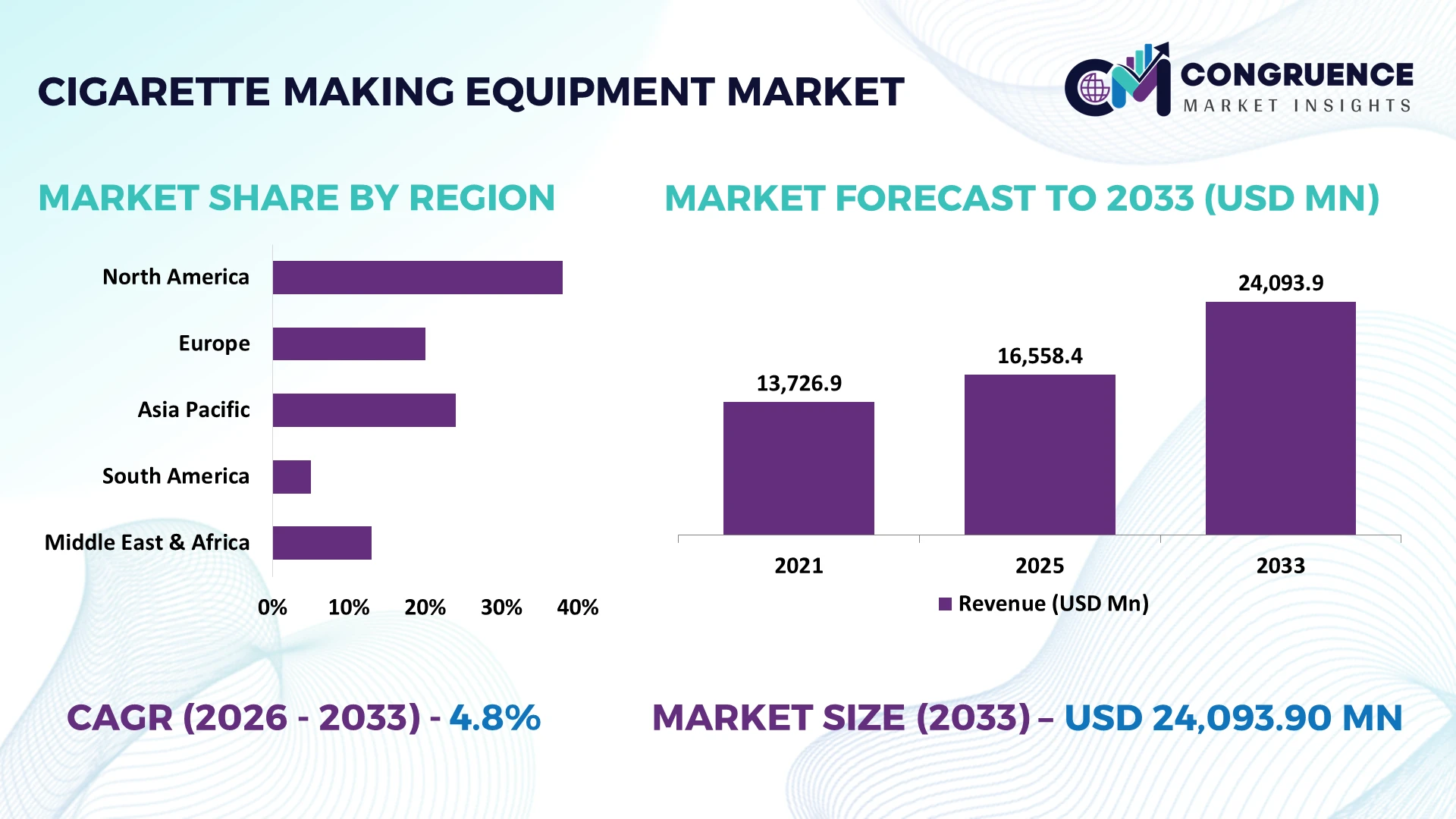
The Global Cigarette Making Equipment Market was valued at USD 16558.4 Million in 2025 and is anticipated to reach a value of USD 24093.9 Million by 2033 expanding at a CAGR of 4.8% between 2026 and 2033. Growth is driven by automated production-line modernization, high-speed filter assembly, machine-vision inspection, and regulatory requirements for manufacturing traceability.
China dominates global cigarette manufacturing, producing approximately 2.4 trillion cigarettes annually and accounting for more than 40% of worldwide cigarette output. Its state-controlled tobacco industry operates extensive manufacturing facilities supported by automated cigarette makers, filter attachment systems, and high-speed packaging equipment. China's production volume exceeds India's estimated annual cigarette output by more than tenfold, creating substantial differences in equipment requirements. In 2026, China's industrial automation capabilities and centralized tobacco manufacturing structure support machinery modernization, while international trade restrictions and tobacco regulations influence equipment procurement decisions.
Strategically, equipment manufacturers should prioritize production-line retrofits, regulatory compliance capabilities, and long-term maintenance contracts rather than relying exclusively on new manufacturing capacity.
Market Size & Growth: USD 16,558.4 million in 2025, reaching USD 24,093.9 million by 2033 at 4.8% CAGR, supported by production-line modernization.
Top Growth Drivers: China's over 40% production contribution, 100% pack-level traceability requirements in covered EU markets, and automated quality inspection.
Short-Term Forecast: By 2028, the supplied market trajectory implies approximately 15.1% cumulative expansion from 2025, emphasizing equipment replacement and upgrades.
Emerging Technologies: Three priorities include AI-enabled defect detection, servo-driven cigarette assembly, and connected production-line diagnostics.
Regional Leaders: Asia-Pacific dominates production infrastructure, while Europe emphasizes traceability and North America prioritizes established manufacturing-line modernization.
Consumer/End-User Trends: China produces approximately 2.4 trillion cigarettes annually, supporting demand for high-throughput machinery and maintenance services.
Pilot/Case Example: EU tobacco traceability requirements expanded to all tobacco products in May 2024, extending unit-level identification beyond cigarettes.
Competitive Landscape: Körber Technologies, G.D, Molins, and Hauni-associated equipment portfolios compete through machinery precision and service support.
Regulatory & ESG Impact: EU traceability rules require unique identifiers on covered tobacco product packs, strengthening machine-level coding and verification requirements.
Investment & Funding: Capital expenditure concentrates on 3 areas: production automation, packaging traceability, and predictive maintenance infrastructure.
Innovation & Future Outlook: By 2033, connected inspection, modular retrofits, and digitally synchronized production systems will shape equipment replacement decisions.
The cigarette making equipment market is increasingly shaped by factory modernization rather than unrestricted manufacturing capacity expansion. High-speed cigarette makers, filter attachment units, inspection systems, and packaging machinery require coordinated performance management to reduce production interruptions. China's annual cigarette output of approximately 2.4 trillion units demonstrates the operating scale supporting specialized equipment maintenance and replacement. European tobacco traceability requirements, extended across tobacco product categories in May 2024, have reinforced demand for machine-readable identifiers and production verification systems. In 2026, manufacturers are emphasizing servo-controlled equipment, automated defect inspection, and predictive maintenance, positioning integrated machinery services as an important competitive differentiator.
The cigarette making equipment market is strategically important as tobacco manufacturers shift investment from production capacity expansion toward equipment modernization, regulatory compliance, and manufacturing efficiency. China's tobacco industry accounts for more than 40% of global cigarette production, creating concentrated demand for high-speed machinery, automated inspection, and specialized maintenance. Meanwhile, European Union tobacco traceability requirements, extended to all tobacco products in May 2024, have increased the importance of serialized packaging and production data integration.
Servo-controlled cigarette makers and automated inspection systems provide greater process consistency than conventional mechanically synchronized machinery. In an illustrative production line operating at 90% efficiency, improving performance to 95% increases effective output by approximately 5.6% without additional installed capacity. China's manufacturing ecosystem emphasizes high-volume equipment reliability, while European producers prioritize regulatory traceability, machine modernization, and production flexibility. These differences influence equipment specifications, supplier relationships, and aftermarket service requirements.
Between 2026 and 2028, investment will increasingly target predictive maintenance, automated quality verification, and modular production-line upgrades. A factory operating ten cigarette making lines can prioritize equipment retrofits according to downtime, rejection rates, and maintenance costs. Manufacturers including Körber and G.D are positioned within specialized tobacco machinery ecosystems. Competitive advantage will depend on integration expertise, equipment availability, and measurable improvements in manufacturing performance.
Manufacturing modernization is driving cigarette making equipment replacement as producers seek higher operating consistency and stronger production traceability. China's tobacco industry accounts for more than 40% of global cigarette output, supporting substantial demand for automated machinery and maintenance services. European Union traceability rules require identification of covered tobacco product packs, increasing the importance of coding and verification systems. A production line improving operating efficiency from 90% to 95% achieves approximately 5.6% higher effective output at unchanged nominal speed. This illustrative calculation demonstrates the economic value of automation without additional installed capacity. Equipment suppliers are responding through servo-driven machinery, machine-vision inspection, and modular control upgrades that integrate production monitoring with packaging verification.
Cigarette making equipment suppliers face structural constraints from tobacco control policies, concentrated purchasing arrangements, and specialized machinery procurement requirements. The World Health Organization's Framework Convention on Tobacco Control has 183 Parties, representing more than 90% of the global population, reflecting extensive international policy coverage. China contributes more than 40% of worldwide cigarette production, concentrating significant machinery demand within a state-controlled manufacturing structure. These conditions restrict unrestricted capacity expansion and increase dependence on approved suppliers and long-term customer relationships. European Union traceability requirements also impose equipment integration and verification obligations. Manufacturers are reducing commercial exposure through aftermarket services, modular equipment upgrades, diversified industrial capabilities, and maintenance contracts rather than relying exclusively on complete production-line installations.
Digital modernization creates opportunities for cigarette machinery suppliers to expand predictive maintenance, equipment retrofitting, and automated production diagnostics. A manufacturing line operating at 92% equipment availability loses 8% of scheduled operating time to interruptions. Improving availability to 96% reduces that lost-time proportion by 50%, demonstrating the potential value of condition monitoring in an illustrative operating scenario. Between 2026 and 2028, vibration monitoring, servo diagnostics, and connected machine controllers will support more targeted maintenance scheduling. Germany and Italy maintain specialized machinery engineering capabilities relevant to high-precision production equipment. Manufacturers are strengthening technical service offerings and modular automation portfolios to capture replacement demand. The strategic opportunity lies in extending equipment service life while improving measurable operating performance.
Long-term cigarette making equipment competitiveness depends on integrating advanced automation with established machinery architectures while maintaining production reliability and data integrity. A factory operating ten production lines with 95% individual availability faces approximately 5% scheduled downtime per line, requiring coordinated maintenance and spare-parts planning. Raising availability to 98% reduces the unavailable operating proportion by 60%, illustrating the operational importance of reliability improvements. These percentages represent an illustrative engineering scenario rather than reported industry averages. Manufacturers must address proprietary control interfaces, aging electrical components, cybersecurity vulnerabilities, and shortages of specialized automation technicians. Germany's advanced machinery sector provides relevant engineering capabilities, but retrofitting older equipment requires installation-specific validation. Suppliers must invest in interoperable controls, technical training, and dependable lifecycle support to maintain competitive manufacturing performance.
Machine Vision Strengthens Quality Inspection: Cigarette equipment manufacturers are integrating camera-based inspection into rod formation, filter alignment, and packaging verification. A modeled reduction in defective units from 2% to 1% cuts rejection volume by 50%. Körber and G.D are emphasizing automated quality control and precision handling, allowing manufacturers to identify defects earlier and reduce downstream rework.
Serialized Packaging Reshapes Production Workflows: European Union tobacco traceability requirements expanded to additional tobacco products in May 2024, increasing demand for synchronized coding, inspection, and data capture. In an illustrative operation, improving code verification from 98% to 99.5% reduces verification failures by 75%. Equipment suppliers are integrating packaging controls with serialization software to limit compliance-related production interruptions.
Servo Synchronization Improves Line Changeovers: Manufacturers are replacing selected mechanical adjustments with electronically synchronized drives and programmable machine settings. Reducing a 60-minute format changeover to 45 minutes represents a 25% time saving in a modeled production scenario. Specialized machinery suppliers are refining modular assemblies and electronic controls, improving scheduling flexibility without requiring complete factory replacement.
Component Localization Changes Supplier Economics: Concentrated cigarette manufacturing in China and international equipment trade restrictions are increasing attention to spare-parts availability and domestic engineering support. A modeled reduction in replacement-component lead time from 20 to 15 days represents 25% faster replenishment. Machinery suppliers are strengthening regional service partnerships and component sourcing arrangements, making maintenance responsiveness an increasingly important purchasing criterion.
Cigarette Making Machines represent the leading equipment type, accounting for an estimated 38% of the Cigarette Making Equipment Market in 2025. Their position reflects their central role in tobacco feeding, cigarette rod formation, paper wrapping, and cutting operations. These machines determine production throughput and influence downstream equipment utilization. Cigarette Filter Assembly Machines account for approximately 22%, supporting filter preparation and attachment requirements. Cigarette Packing Machines represent an estimated 24%, benefiting from automated wrapping, coding, and packaging verification. Manufacturers prioritize precise material handling, stable operating speeds, and compatibility with established production configurations.
Integrated Cigarette Production Lines represent the fastest-growing type, with an indicative 16% market share in 2025. Their adoption reflects demand for synchronized manufacturing operations that combine multiple production stages under coordinated controls. Unlike standalone equipment, integrated systems support centralized performance monitoring and coordinated maintenance scheduling. Körber and G.D compete through specialized machinery engineering, production integration, and technical services. Equipment investment is shifting toward adaptable line architectures, particularly where manufacturers seek modernization without extensive production interruptions.
Cigarette Rod Manufacturing accounts for the largest application share, estimated at 35% in 2025, because rod formation establishes the operating capacity of cigarette production systems. Tobacco feeding accuracy, paper handling, rod density, and cutting precision directly affect product consistency and downstream rejection rates. Filter Attachment represents approximately 20% of application demand, supported by specialized assembly equipment and precision alignment requirements. Cigarette Packaging contributes an estimated 25%, reflecting the importance of pack formation, identification, and automated inspection. Equipment suppliers are improving machine synchronization and process controls to maintain consistent performance across connected manufacturing stages.
High-Speed Mass Production represents the fastest-growing application, with an indicative 20% share. Its expansion is associated with integrated manufacturing lines that coordinate material movement, equipment controls, and production scheduling. Compared with independently operated machinery, synchronized systems reduce intermediate handling and improve visibility across manufacturing operations. Cigarette equipment manufacturers are emphasizing modular integration, automated quality verification, and production monitoring. Purchasing decisions increasingly depend on complete-line performance rather than the nominal speed of individual machines.
Tobacco Manufacturers represent the leading end-user segment, accounting for an estimated 48% of cigarette making equipment demand in 2025. Their purchasing position reflects direct control over manufacturing specifications, production capacity, quality requirements, and equipment replacement schedules. Large tobacco companies typically require standardized machinery configurations, technical servicing, and reliable access to replacement components. Cigarette Production Facilities account for approximately 25%, representing plant-level equipment procurement and modernization requirements. Tobacco Processing Companies contribute an estimated 12%, reflecting their more specialized involvement in upstream material preparation and associated production integration.
Contract Cigarette Manufacturers represent the fastest-growing end-user category, with an indicative 15% share. Their equipment requirements emphasize flexible manufacturing configurations, efficient changeovers, and compatibility with different customer specifications. Unlike vertically integrated manufacturers, contract producers must balance equipment utilization against varying production schedules and commercial commitments. Machinery suppliers are responding through modular equipment packages, technical service agreements, and adaptable control systems. Competitive differentiation increasingly depends on equipment flexibility, maintenance responsiveness, and demonstrated manufacturing consistency.
Asia-Pacific accounted for the largest market share at an estimated 48% in 2025 however, Middle East & Africa is expected to register the fastest growth, expanding at a CAGR of an estimated 6.2% between 2026 and 2033.

Manufacturing Consolidation and Precision Equipment Modernization
North America accounted for an estimated 16% of the global Cigarette Making Equipment Market in 2025, supported by established tobacco manufacturing infrastructure in the United States and specialized production operations in Canada and Mexico. Equipment procurement centers on replacement machinery, automated inspection, filter assembly, and packaging-line modernization rather than extensive new manufacturing capacity. Major cigarette producers operate established production networks requiring reliable equipment servicing and consistent product specifications. The United States maintains substantial tobacco manufacturing capabilities, while Mexico contributes industrial engineering and component supply opportunities. Cigarette manufacturers increasingly emphasize machine uptime, product consistency, and maintenance efficiency. Regulatory oversight also influences equipment specifications, particularly manufacturing documentation and quality controls. Suppliers compete through specialized technical support, replacement-component availability, and production-line integration services, strengthening the importance of long-term industrial relationships.
United States Market Outlook: The United States remains the region's principal cigarette manufacturing equipment market, supported by major production facilities in Virginia and North Carolina. Philip Morris USA operates its Richmond manufacturing complex, while Reynolds American maintains significant operations in North Carolina. The federal minimum age for tobacco product sales is 21, reflecting the regulated operating environment. Equipment investment emphasizes dependable production systems, packaging accuracy, and specialized maintenance capabilities.
Advanced Machinery Engineering and Regulatory Production Integration
Europe represented an estimated 24% of global cigarette making equipment demand in 2025, supported by specialized machinery engineering, established tobacco manufacturing operations, and sophisticated packaging technologies. Germany and Italy are important equipment development centers, while Poland and Romania maintain substantial cigarette production facilities. European equipment manufacturers compete through high-speed mechanical engineering, automated material handling, and precision quality control. Tobacco traceability requirements expanded to all tobacco products in May 2024, increasing the operational importance of machine-readable identification and synchronized packaging verification. Equipment modernization consequently involves closer integration between manufacturing machinery, inspection equipment, and production records. Manufacturers also face stricter tobacco control policies and changing consumption patterns, reinforcing the commercial importance of aftermarket services. Suppliers are emphasizing adaptable machinery configurations, lifecycle support, and dependable technical integration across existing production infrastructure.
Germany Market Outlook: Germany is strategically important through its specialized machinery engineering capabilities and established tobacco equipment manufacturing expertise. Körber's tobacco-related technology heritage reflects the country's longstanding role in precision cigarette production systems. German manufacturers benefit from advanced automation engineering, industrial controls, and technical service infrastructure. The country's manufacturing sector also supports specialized component development, enabling machinery suppliers to compete through equipment reliability, engineering quality, and integration expertise.
High-Volume Manufacturing and Domestic Equipment Supply Networks
Asia-Pacific dominated the global Cigarette Making Equipment Market with an estimated 48% share in 2025, reflecting concentrated cigarette manufacturing capacity in China, Indonesia, India, and Japan. China accounts for more than 40% of worldwide cigarette production, creating substantial requirements for high-speed manufacturing equipment, filter attachment machinery, and industrial maintenance services. Indonesia contributes significant demand through its established cigarette manufacturing industry, including distinctive kretek production requirements. Japan maintains technologically advanced manufacturing operations, while India's regulated cigarette industry supports specialized equipment procurement. Regional machinery suppliers benefit from proximity to production facilities and established component supply networks. However, procurement structures vary considerably between countries, influencing supplier access and equipment specifications. Manufacturers are prioritizing localized servicing, precise material handling, and compatibility with established production systems to maintain competitiveness across different manufacturing environments.
China Market Outlook: China represents the most influential national market because of its extensive cigarette production infrastructure and centralized tobacco industry structure. Annual cigarette output is approximately 2.4 trillion units, creating substantial equipment servicing and replacement requirements. Domestic machinery manufacturers benefit from established industrial automation capabilities and proximity to major tobacco production facilities. Procurement decisions emphasize operating reliability, equipment standardization, and compatibility with centralized manufacturing requirements.
Established Tobacco Manufacturing and Selective Equipment Replacement
South America represented an estimated 7% of global cigarette making equipment demand in 2025, with Brazil accounting for the region's most significant manufacturing concentration. Brazil maintains an established tobacco production and processing industry, supported by agricultural supply chains, industrial facilities, and specialized manufacturing operations. Cigarette equipment investment focuses on maintaining established production capacity, improving quality consistency, and replacing aging mechanical systems. Argentina and Paraguay contribute additional manufacturing activity, although procurement scale and industrial capabilities vary. Regulatory restrictions, taxation, and illicit tobacco trade influence legitimate manufacturers' operating conditions and capital expenditure decisions. Equipment suppliers face pressure to demonstrate reliable maintenance support and competitive lifecycle costs. Regional distributors and specialized engineering contractors play important roles in replacement-component availability, installation services, and equipment modernization projects across existing factories.
Brazil Market Outlook: Brazil is a major global tobacco producer and exporter, with substantial agricultural activity concentrated in its southern states. Rio Grande do Sul, Santa Catarina, and Paraná form an important tobacco production corridor supporting associated industrial infrastructure. The country's cigarette manufacturing sector includes established domestic production facilities and international tobacco companies. Machinery procurement is influenced by taxation, regulatory oversight, and the need for reliable maintenance services.
Manufacturing Localization and Industrial Capacity Modernization
The Middle East & Africa accounted for an estimated 5% of global cigarette making equipment demand in 2025, supported by tobacco manufacturing operations in Egypt, Türkiye, South Africa, and selected Gulf markets. Regional equipment requirements vary according to domestic manufacturing capacity, industrial policy, and the availability of specialized engineering services. Egypt represents an important production center, while Türkiye maintains established cigarette manufacturing infrastructure and significant tobacco industry investment. Industrial modernization programs create opportunities for equipment replacement and production efficiency improvements. However, currency volatility, imported machinery costs, and regulatory restrictions influence purchasing decisions. Equipment suppliers compete through regional distribution partnerships, technical training, and maintenance support. Local service capabilities are particularly important because specialized machinery components often require international procurement, increasing the operational value of dependable aftermarket arrangements.
Egypt Market Outlook: Egypt maintains an established cigarette manufacturing industry supported by domestic production infrastructure and international tobacco sector participation. Eastern Company remains an important participant in the country's cigarette manufacturing ecosystem. Egypt's population exceeds 110 million, creating a substantial domestic market subject to tobacco taxation and regulatory oversight. Equipment suppliers focus on production-line reliability, technical servicing, and machinery modernization within established manufacturing facilities.
The Cigarette Making Equipment Market is characterized by competition between specialized European machinery manufacturers, Chinese equipment suppliers, and integrated production technology providers. Körber, G.D, Molins, and regional engineering companies compete through equipment precision, production integration, technical servicing, and replacement-component availability. An illustrative market model assigns approximately 58% combined share to the leading five supplier groups, although verified company-level shares are unavailable. Cigarette Making Machines represent an estimated 38% of equipment demand, while integrated production lines account for 16%, highlighting different procurement priorities. European suppliers emphasize precision engineering and advanced controls; Chinese manufacturers leverage proximity to high-volume production facilities. Competition increasingly centers on automated inspection, modular modernization, and dependable lifecycle support. Regulatory compliance strengthens demand for packaging verification and production documentation. Specialized engineering expertise, proprietary machinery interfaces, and customer qualification requirements restrict entry. Competitive success depends on reliable equipment performance, responsive servicing, and integration capabilities across established tobacco manufacturing operations.
Körber Technologies GmbH
G.D S.p.A. (Coesia Group)
Molins PLC
ITM Group
Shanghai Tobacco Machinery Co., Ltd.
Qinhuangdao Tobacco Machinery Co., Ltd.
Changde Tobacco Machinery Co., Ltd.
Hauni Maschinenbau GmbH
Focke & Co. (GmbH & Co. KG)
Sasib S.p.A.
Arenco AB
Makepak International
Current cigarette manufacturing technology combines servo controlled rod makers, automated filter attachment, machine vision inspection, and synchronized packaging systems. Programmable drives replace mechanically coupled adjustments, improving format flexibility and production consistency. In an illustrative operating comparison, reducing changeover time from 50 to 40 minutes delivers a 20% improvement. Automated inspection also identifies dimensional defects before downstream packaging. Equipment adoption is concentrated in established manufacturing facilities undertaking selective modernization rather than unrestricted capacity expansion, particularly where proprietary machinery interfaces complicate complete line replacement.
Emerging technologies include artificial intelligence defect classification, digital production records, and condition based maintenance. Camera systems distinguish wrapping irregularities, filter misalignment, and packaging faults using automated image analysis. A modeled reduction in rejection rates from 1.5% to 1.0% represents 33.3% fewer defective units. Integrated manufacturing execution systems connect equipment status with quality records, improving traceability and maintenance scheduling. Suppliers offering compatible retrofit modules benefit from established customer relationships and lower installation disruption.
Between 2026 and 2028, manufacturers will prioritize interoperable controls, edge analytics, and digitally verified production workflows. Ten connected machines can share operating information through one supervisory platform, supporting coordinated maintenance decisions. European engineering specialists compete through precision integration, while Chinese suppliers emphasize localized servicing. Reliable automation upgrades will determine competitive advantage.
November 2024: Körber Technologies highlighted its 20-year partnership with Focke & Co., integrating cigarette making and packaging machinery into coordinated production solutions. The collaboration strengthens equipment compatibility, manufacturing flexibility, and supplier coordination for established tobacco producers. Source: koerber-technologies.com
May 2025: Focke & Co. partnered with Lorenz Snack World to develop the Phoenix Universe modular packaging line, integrating artificial intelligence and automated guided vehicles. The project demonstrates technology diversification and adaptable automation capabilities beyond tobacco packaging. Source: packaging-journal.de
September 2025: Doyas Tobacco Technology presented its dry-ice-expanded tobacco processing system at InterSupply, offering 300 kilograms of hourly processing capacity. The modular approach targets smaller manufacturers seeking lower equipment acquisition barriers and greater production flexibility. Source: tobaccoasia.com
May 2025: Japan Tobacco International discussed potential United States assembly of Ploom devices as proposed Indonesian import tariffs reached 32%. The supply-chain review reflects localization pressure and potential changes in equipment procurement for emerging tobacco manufacturing formats. Source: reuters.com
The Cigarette Making Equipment Market Report evaluates manufacturing technologies, equipment procurement, and competitive developments between 2026 and 2033. Type coverage includes Cigarette Making Machines, Cigarette Filter Assembly Machines, Cigarette Packing Machines, and Integrated Cigarette Production Lines. Application analysis examines Cigarette Rod Manufacturing, Filter Attachment, Cigarette Packaging, and High-Speed Mass Production. End-user coverage includes Tobacco Manufacturers, Contract Cigarette Manufacturers, Tobacco Processing Companies, and Cigarette Production Facilities. An indicative market model assigns Cigarette Making Machines approximately 38% of equipment demand.
Regional analysis covers North America, Europe, Asia-Pacific, South America, and the Middle East & Africa. Technology assessment examines servo controls, automated inspection, digital traceability, predictive maintenance, and modular production integration. The report supports equipment investment planning, supplier evaluation, manufacturing modernization, geographic expansion, and competitive positioning through operational performance and regulatory analysis.
| Report Attribute/Metric | Report Details |
|---|---|
Market Revenue in 2025 | USD 16558.4 Million |
Market Revenue in 2033 | USD 24093.9 Million |
CAGR (2026 - 2033) | 4.8% |
Base Year | 2025 |
Forecast Period | 2026 - 2033 |
Historic Period | 2021 - 2025 |
Segments Covered | By Type
By Application
By End-User
|
Key Report Deliverable | Revenue Forecast, Growth Trends, Market Dynamics, Segmental Overview, Regional and Country-wise Analysis, Competition Landscape |
Region Covered | North America, Europe, Asia-Pacific, South America, Middle East, Africa |
Key Players Analyzed |
|
Customization & Pricing | Available on Request (10% Customization is Free) |