
Reports
The Global Chlorinated Paraffins Market was valued at USD 1,908.2 Million in 2025 and is anticipated to reach a value of USD 2,571.6 Million by 2033 expanding at a CAGR of 3.8% between 2026 and 2033. Growth is driven by rising use of medium- and long-chain chlorinated paraffins in metalworking fluids, PVC processing, rubber, paints, sealants, and flame-retardant formulations as manufacturers shift toward higher-performance additive packages.
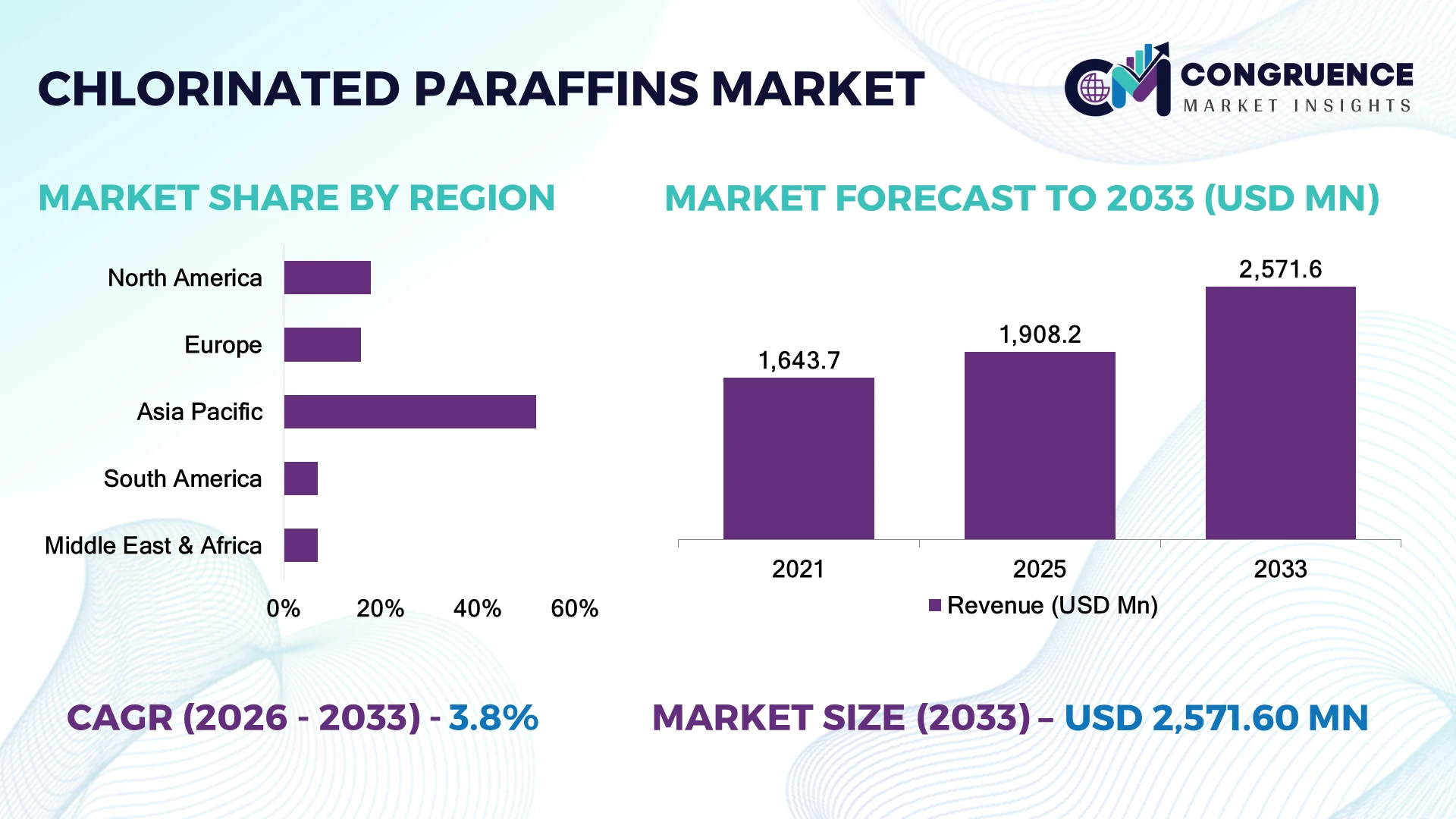
China remains the dominant production and consumption hub, accounting for approximately 45% of global chlorinated paraffin manufacturing capacity, supported by PVC, rubber, coatings, and metalworking industries. China’s installed capacity is substantially larger than India’s, while India is expanding downstream formulation demand. EU regulatory restrictions on short-chain chlorinated paraffins are accelerating substitution toward compliant medium- and long-chain grades by more than 20% in selected applications.
Strategic priority is shifting toward compliant formulations, regional supply diversification, and higher-value chlorinated paraffin grades.
Market Size & Growth: USD 1,908.2 Million in 2025 to USD 2,571.6 Million by 2033 at 3.8% CAGR, supported by specialty formulations and downstream PVC modernization.
Top Growth Drivers: Metalworking fluids 31%, PVC processing 26%, rubber and coatings 18% are the leading demand drivers shaping global consumption.
Short-Term Forecast: By 2028, reformulated chlorinated paraffin products are expected to reduce restricted-grade exposure by 20–25% across regulated applications.
Emerging Technologies: Continuous chlorination, automated process control, and advanced additive formulation are improving chlorine-content consistency by approximately 10–15%.
Regional Leaders: Asia Pacific is projected near USD 1,050 Million by 2033, North America around USD 590 Million, and Europe approximately USD 520 Million, with compliance-led product upgrading strongest in Europe.
Consumer/End-User Trends: Metalworking and PVC processors represent more than 55% of global consumption, while demand for specification-controlled grades is increasing by approximately 8–10% annually.
Pilot/Case Example: By 2027, automated chlorination and closed-loop process controls are targeting 10–15% reductions in batch variability, improving formulation consistency for industrial lubricant and polymer applications.
Competitive Landscape: Chinese producers collectively hold approximately 45% of manufacturing capacity, competing with Dover Chemical, INOVYN-linked suppliers, Caffaro Industrie, KLJ Group, and regional specialty chemical manufacturers.
Regulatory & ESG Impact: Stockholm Convention and EU restrictions are accelerating substitution away from SCCPs, with regulated applications targeting more than 20% reduction in restricted-grade usage through reformulation.
Investment & Funding: More than USD 250 Million in cumulative capacity, modernization, and downstream formulation investment is being directed toward Asia-based chemical production and compliance-oriented upgrades.
Innovation & Future Outlook: The market is shifting toward medium- and long-chain grades, lower-emission processing, automated quality control, and application-specific formulations, making regulatory compliance and supply reliability key competitive differentiators.
The Chlorinated Paraffins Market is increasingly concentrated around PVC processing, metalworking fluids, rubber, coatings, and sealants, where controlled chlorine content supports flame resistance, lubrication, and durability. Approximately 55% of consumption is tied to PVC and metalworking applications. Regulatory pressure on SCCPs is accelerating grade substitution, while Asian producers strengthen regional supply resilience and formulation capabilities, setting up the strategic discussion around compliance and competitive positioning.
Chlorinated paraffins are becoming strategically important because manufacturers must balance additive performance, regulatory compliance, and dependable chemical supply. The market is restructuring around medium- and long-chain grades as restrictions on SCCPs intensify, particularly under European chemical-policy frameworks. Producers with flexible chlorination systems and broader feedstock access are gaining an advantage in serving reformulation programs.
Technology is also improving production economics. Automated chlorine dosing and continuous process monitoring can reduce batch variability by roughly 10–15% versus conventional batch-controlled systems, while closed-loop processing lowers material losses and improves operator safety. Asia Pacific retains the largest manufacturing footprint, led by China, whereas Europe is moving faster toward compliant specialty formulations and substitution.
Over the next 2–3 years, manufacturers are expected to prioritize compliant grade expansion, process automation, and regional inventory buffers. A PVC compounder, for example, can shift from restricted grades toward specification-controlled medium-chain alternatives without redesigning its entire formulation platform. Suppliers are therefore directing investment toward flexible plants, application laboratories, and downstream partnerships. Competitive advantage will increasingly depend on regulatory readiness, consistent product quality, and supply-chain resilience rather than volume alone.
Rising PVC compounding and metalworking-fluid output is strengthening demand for chlorinated paraffins, with PVC-related applications accounting for approximately 26% of consumption and metalworking fluids about 31%. China’s large PVC manufacturing base is driving higher utilization of medium-chain grades as formulators replace restricted SCCPs. Automated chlorination and tighter process controls are improving chlorine-content consistency by 10–15%, reducing off-specification batches. Chinese producers are investing in continuous processing, while downstream compounders are qualifying multiple grades to maintain formulation stability. A non-obvious advantage is that higher consistency reduces additive over-dosing, improving formulation economics even when raw-material prices remain volatile.
Restrictions on SCCPs remain a structural constraint, particularly for suppliers serving European customers. Reformulation can increase additive-development and qualification costs by 8–15%, while compliance testing can extend product approval cycles by 10–20%. European processors are increasingly demanding documentation on chlorine-chain distribution, creating additional quality-control requirements for exporters. China-based manufacturers face higher compliance exposure when serving regulated markets because product portfolios must distinguish restricted and compliant grades throughout logistics and documentation systems. Companies are mitigating this pressure through medium- and long-chain product diversification, customer-specific specifications, and longer supply contracts. The key operational constraint is not chemical availability but maintaining consistent regulatory classification across manufacturing, export, and downstream formulation stages.
Application-specific chlorinated paraffin grades create opportunities beyond conventional bulk additives, particularly in high-performance metalworking fluids, specialty sealants, and engineered PVC formulations. Premium formulations can command 10–18% higher pricing where tighter chlorine-content specifications and impurity control are required. India is becoming an attractive downstream formulation base as automotive, cable, construction, and polymer processing capacity expands. Digital batch monitoring can improve production consistency by 10–15%, supporting tighter customer specifications without proportional labor increases. Companies are responding through application laboratories, localized formulation partnerships, and flexible production lines. The less obvious opportunity lies in converting commodity-grade capacity into specification-controlled products, allowing producers to defend margins without relying exclusively on volume expansion.
Long-term competitiveness increasingly depends on controlling process emissions, energy intensity, and chlorine-handling complexity while maintaining product consistency. Advanced plants can reduce process variability by 10–15%, but modernization requires significant instrumentation and operator training. In China, experienced chemical-process personnel remain concentrated around established industrial clusters, increasing workforce dependence for specialized production operations. Energy-intensive chlorination also exposes producers to industrial electricity-price fluctuations that can shift operating costs by 5–10% between production cycles. Companies are therefore investing in closed-loop systems, automated dosing, predictive maintenance, and workforce upskilling. The strategic challenge is integrating environmental controls with production economics; plants that treat compliance and process efficiency as separate programs risk higher operating costs and slower customer qualification.
Compliant Grades Gain Priority: European buyers are accelerating substitution from restricted SCCPs, with compliant medium- and long-chain grades gaining an estimated 15–20% increase in qualification activity. Suppliers are restructuring portfolios, expanding documentation systems, and reserving production capacity for export-compliant formulations. This shift is turning regulatory compliance into a product-selection criterion rather than a downstream administrative requirement.
Process Automation Improves Consistency: Chinese chlorinated paraffin producers are adopting automated chlorine dosing, temperature control, and online quality monitoring, reducing batch variability by approximately 10–15%. Automated control also lowers manual intervention requirements by 8–12%. Producers are prioritizing retrofits at established chemical hubs instead of constructing entirely new facilities, improving utilization while shortening modernization timelines.
India Builds Downstream Capability: Indian PVC, cable, rubber, and lubricant manufacturers are increasing demand for specification-controlled additives as domestic polymer processing capacity expands. Local formulation activity is estimated to be rising 8–10% annually in relevant downstream applications. Suppliers are responding through distributor partnerships, localized technical support, and inventory positioning closer to industrial clusters.
Supply Chains Become More Selective: Buyers are increasingly qualifying two or more chlorinated paraffin suppliers, with multi-source procurement rising roughly 10–15% among larger industrial formulators following chemical-feedstock disruptions. Companies are maintaining higher safety stocks and negotiating longer contracts for critical grades. The non-obvious shift is toward supplier qualification based on regulatory documentation and batch consistency, not simply delivered price.
Medium-chain chlorinated paraffins (MCCPs) represent the leading type, accounting for approximately 48% of global demand, supported by their use in metalworking fluids, PVC, rubber, sealants, coatings, and flame-retardant formulations. Their balance of chlorine content, thermal stability, and plasticizing performance makes them more commercially versatile than short-chain grades. Long-chain chlorinated paraffins account for roughly 29% and are gaining traction in applications requiring higher thermal and chemical resistance. Short-chain grades, at approximately 11%, are declining as regulatory restrictions accelerate substitution, particularly in Europe. Companies are expanding MCCP and LCCP capacity, upgrading chlorination controls, and reformulating legacy products to maintain customer qualification. The strategic shift is toward application-specific grades with controlled chain-length distribution rather than standardized commodity formulations.
Metalworking fluids led the Chlorinated Paraffins Market with approximately 35.2% share in 2025, reflecting intensive use in cutting, grinding, forming, and deep-drawing operations where extreme-pressure lubrication is operationally critical. Lubricating additive applications are the fastest-changing segment, supported by expanding machining capacity in India, Vietnam, and Indonesia, with adoption increasing roughly 8–10% annually in selected industrial applications. Mature PVC plasticizer applications remain substantial, particularly for cables, flooring, and flexible profiles, while rubber, flame retardants, paints, adhesives, and sealants provide diversified secondary demand. Companies are scaling application-specific formulations and automated dosing to improve additive consistency by approximately 10–15%. The key shift is from commodity-volume purchasing toward specification-controlled grades that protect machining performance while meeting evolving chemical restrictions.
PVC and plastics represent the leading end-user group at approximately 42% of Chlorinated Paraffins consumption, driven by large-volume use in cable insulation, flooring, flexible sheeting, profiles, and automotive components. Metalworking and engineering follows at around 28%, with substantially higher formulation intensity because additive performance directly affects machining quality, tool wear, and surface finish. The fastest-changing demand is emerging from metalworking and engineering users, where expanding machining capacity in India and Southeast Asia is increasing preference for specification-controlled extreme-pressure additives. Construction and automotive buyers remain established volume channels, while rubber processing, electrical and electronics, and marine applications are becoming more selective. Companies are responding with customized grades, technical partnerships, localized inventories, and dual-source procurement; premium specification demand is increasingly shifting purchasing decisions away from lowest-cost supply.
Asia-Pacific accounted for the largest market share at 52% in 2025 however, South America is expected to register the fastest growth, expanding at a CAGR of 4.5% between 2026 and 2033.
Automotive manufacturing and specialty lubricant demand favor higher-specification grades
North America represents approximately 18% of the global Chlorinated Paraffins Market, supported by established metalworking, automotive, construction, electrical, and polymer-processing industries. The United States concentrates most regional demand, with industrial lubricant and PVC applications accounting for more than 60% of consumption. Buyers increasingly favor specification-controlled medium- and long-chain grades as regulatory scrutiny tightens around legacy chlorinated paraffins. Metalworking-fluid formulators are upgrading additive packages to improve extreme-pressure performance while maintaining compliance, and automated blending systems are reducing formulation variability by approximately 10–15%. Suppliers are strengthening technical-sales capabilities and maintaining regional inventories to shorten delivery cycles for industrial customers.
United States Market Outlook:
The United States remains the region’s principal demand center because of its large automotive, aerospace, machinery, cable, and specialty chemical manufacturing base. More than 20% of regional consumption is linked to metalworking-fluid applications, where chlorinated paraffins support extreme-pressure performance. Established specialty-chemical distribution networks also enable faster qualification of alternative grades as regulatory requirements evolve.
Regulatory substitution accelerates specification-controlled formulations
Europe accounts for approximately 16% of global chlorinated paraffin demand, but its market structure is increasingly defined by regulatory compliance rather than volume expansion. Germany, Italy, France, and the United Kingdom remain important downstream processing centers, particularly for automotive components, industrial lubricants, PVC, rubber, and specialty coatings. Restrictions affecting SCCPs and tighter controls on MCCPs are encouraging manufacturers to reformulate products and improve chemical traceability. Compliant-grade qualification activity is estimated to have increased 15–20% across selected industrial applications. Producers are responding with application-specific formulations, regulatory documentation, and customer testing programs, while European buyers increasingly prioritize supply continuity and compliance assurance over lowest-cost procurement.
Germany Market Outlook: Germany is the region’s most strategically important industrial market, supported by its automotive, machinery, plastics, and chemical-processing ecosystems. Its large machining and engineering base creates sustained demand for high-performance metalworking formulations. Manufacturers are increasingly integrating additive suppliers into formulation-development programs, enabling faster qualification of compliant grades and reducing disruption when legacy chemistries require replacement.
China’s manufacturing scale reinforces supply-chain leadership
Asia-Pacific commands approximately 52% of the global Chlorinated Paraffins Market, with China representing more than 70% of regional production capacity. Large PVC, rubber, metalworking, cable, and chemical-processing industries create both domestic consumption and export demand. Chinese producers benefit from integrated access to chlorinated chemical feedstocks and established industrial clusters, supporting competitive manufacturing economics. India, Japan, South Korea, and Southeast Asian economies are expanding downstream consumption through automotive, construction, plastics, and engineering activity. Producers are investing in automated chlorination, quality monitoring, and flexible product lines, with process automation capable of reducing batch variability by approximately 10–15%.
China Market Outlook: China is the decisive manufacturing hub, with extensive chlorinated chemical infrastructure and a large network of downstream PVC and industrial lubricant processors. Its production ecosystem supports shorter feedstock-to-product cycles and competitive export economics. Producers are increasingly differentiating output by chlorine content, chain length, and application specification rather than relying exclusively on bulk-grade volumes.
Industrial diversification broadens specialty-additive consumption
South America accounts for approximately 7% of global Chlorinated Paraffins demand, with Brazil generating more than 55% of regional consumption. PVC processing, automotive components, metalworking, construction materials, rubber, and cable manufacturing form the principal demand base. Brazil’s sizeable industrial economy supports recurring demand for specialty additives, although import dependence for selected chemical intermediates creates longer replenishment cycles than in China or the United States. Local distributors are increasing safety inventories by approximately 10–15% for critical grades, while manufacturers are developing dual-source procurement arrangements. The strategic opportunity is strongest in application-specific formulations where technical support can offset logistics and import-cost disadvantages.
Brazil Market Outlook: Brazil remains the dominant South American market because of its diversified plastics, automotive, machinery, construction, and chemical industries. Its large domestic manufacturing base supports steady consumption of chlorinated paraffins in PVC and metalworking applications. Local formulation and distribution partnerships are becoming increasingly important, particularly for customers requiring shorter lead times and consistent technical specifications.
Industrial diversification strengthens specialty-chemical demand
Middle East & Africa represents approximately 7% of global Chlorinated Paraffins consumption, with demand concentrated in Saudi Arabia, the United Arab Emirates, South Africa, Egypt, and Türkiye-linked trade channels. Construction materials, PVC products, cables, industrial lubricants, and coatings provide the principal consumption base. Saudi Arabia and the UAE are expanding downstream chemical and manufacturing infrastructure, supporting greater local conversion of imported specialty chemicals. Demand for specification-controlled additives is increasing by approximately 6–8% annually in selected industrial applications. Suppliers are responding through regional distribution hubs, larger inventories, and partnerships with PVC compounders and lubricant formulators to reduce import-cycle volatility.
Saudi Arabia Market Outlook: Saudi Arabia is the region’s most strategically significant market, supported by large petrochemical infrastructure, expanding downstream manufacturing, and industrial diversification initiatives. Growing domestic production of plastics, cables, construction materials, and industrial products is strengthening demand for performance additives. Chemical producers and distributors are increasingly positioning inventory near major industrial clusters to reduce delivery times and improve supply reliability for downstream processors.
The market pits integrated chemical producers such as INEOS, Aditya Birla Chemicals, and KLJ Group against specialty suppliers including Dover Chemical and Caffaro Industrie. The top five players are estimated to control about 40% of global sales, while Chinese producers compete aggressively through scale and pricing. Competition centers on feedstock integration, product consistency, regulatory capability, and delivery reliability; integrated producers can hold 8–12% cost advantages, while specification-controlled grades command 5–10% premiums. Companies are expanding CPW capacity, adding application-specific MCCP/LCCP grades, and integrating chlorine and paraffin feedstocks to stabilize margins. Caffaro and European suppliers emphasize compliant specialty grades, while Asian manufacturers prioritize capacity, logistics, and export reach. The competitive shift is moving from commodity pricing toward supply security and regulatory readiness as MCCP restrictions intensify. High capital requirements, chlorine-handling infrastructure, customer qualification, and environmental compliance raise entry barriers. Winning requires integrated feedstock economics, consistent quality, regulatory agility, and dependable multi-market supply.
Chlorinated paraffin production is moving from conventional batch chlorination toward automated dosing, closed-loop HCl recovery, and online chlorine-content monitoring. Automated controls can reduce batch variability by 10–15%, while optimized HCl recovery lowers process losses by 5–8%. Adoption is strongest among larger Chinese and Indian plants, where integrated chlor-alkali operations improve feedstock utilization and supply consistency.
Product technology is also shifting toward application-specific MCCP and LCCP grades as SCCP restrictions intensify. Modern specification-controlled formulations can improve performance consistency by 8–12% versus less-controlled legacy blends. Analytical methods such as high-resolution mass spectrometry strengthen congener profiling and regulatory traceability, particularly for European customers. Producers with stronger laboratories and documented chain-length control gain an advantage in customer qualification and export compliance.
Between 2026 and 2028, digital process monitoring, predictive maintenance, energy-efficient chlorination, and integrated chlorine management will become increasingly important. Plants combining real-time controls with downstream formulation testing can shorten batch-release cycles by roughly 10% and reduce rework by 5–10%. The competitive advantage favors vertically integrated producers such as INEOS and Aditya Birla, alongside specialized Asian manufacturers investing in automation. Companies acting now can convert compliance-driven technology upgrades into higher consistency, lower operating losses, and faster customer qualification and protect margins in export markets.
May 2024 UNID completed a 90,000-ton annual CPW expansion at UNID Jiangsu Chemical, improving chlorine utilization through integration with its potassium hydroxide operations. The project strengthens Chinese supply reliability and reduces exposure to liquid-chlorine logistics disruptions globally across markets. Source: mk.co.kr매일경제
June 2025 Lords Chloro Alkali announced doubling CPW capacity from 50 TPD to 100 TPD with approximately INR 30 crore investment. The Rajasthan expansion targets stronger availability, scale economies, and higher chlorine utilization for downstream customers regionally. Source: Business Standard
April 2025 Shivtek Spechemi committed INR 650 crore to new Gujarat and Rajasthan plants, lifting planned manufacturing capacity from 150,000 to 650,000 MTPA. The expansion includes chlorinated paraffin derivatives and strengthens domestic production, logistics, and export capability. Source: Economic Times
July 2025 Caffaro Industrie secured a €5 million investment from Friulia to support development of its Torviscosa chemical operations, including its dedicated chlorinated paraffin unit. The funding strengthens European specialty-chemical capacity, modernization, and customer supply resilience globally. Source: Caffaro Industrie
The Chlorinated Paraffins Market Report covers SCCP, MCCP, and LCCP types, with analysis across metalworking fluids, PVC and plastics, rubber, paints and coatings, sealants, adhesives, flame-retardant formulations, and other industrial applications. End-user coverage includes plastics processors, automotive manufacturers, engineering and metalworking companies, construction-material producers, electrical manufacturers, and specialty chemical formulators.
Regional analysis spans North America, Europe, Asia Pacific, South America, and Middle East & Africa, with country-level assessment of manufacturing concentration, trade flows, regulatory exposure, and downstream demand. Technology coverage includes automated chlorination, online quality monitoring, HCl recovery, application-specific formulation, and analytical congener profiling. The report supports capacity planning, localization, supplier selection, regulatory strategy, investment prioritization, competitive positioning, and expansion decisions through 2026–2033.
| Report Attribute/Metric | Report Details |
|---|---|
|
Market Revenue in 2025 |
USD 1,908.2 Million |
|
Market Revenue in 2033 |
USD 2,571.6 Million |
|
CAGR (2026 - 2033) |
3.8% |
|
Base Year |
2025 |
|
Forecast Period |
2026 - 2033 |
|
Historic Period |
2021 - 2025 |
|
Segments Covered |
By Type
By Application
By End-User
|
|
Key Report Deliverable |
Revenue Forecast, Growth Trends, Market Dynamics, Segmental Overview, Regional and Country-wise Analysis, Competition Landscape |
|
Region Covered |
North America, Europe, Asia-Pacific, South America, Middle East, Africa |
|
Key Players Analyzed |
INEOS, Dover Chemical Corporation, Aditya Birla Chemicals, KLJ Group, Caffaro Industrie S.p.A., NCP Chlorchem (Pty) Ltd, Química del Cinca S.L., Altair Chimica S.p.A., JSC Kaustik, Ajinomoto Fine-Techno Co., Inc., Flow Tech Group of Industries, LEUNA-Tenside GmbH |
|
Customization & Pricing |
Available on Request (10% Customization is Free) |




