
Reports
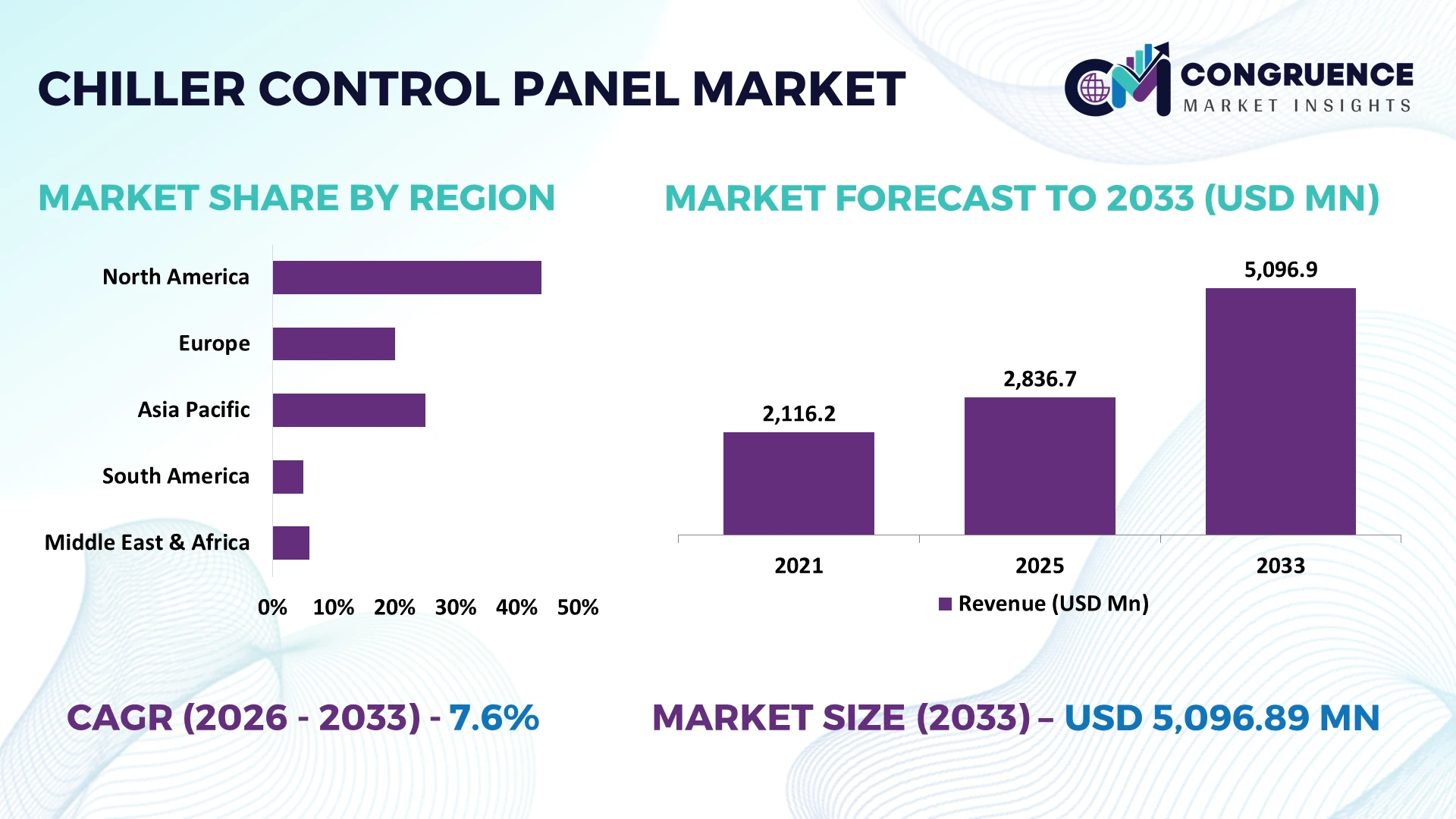
The Global Chiller Control Panel Market was valued at USD 2836.65 Million in 2025 and is anticipated to reach a value of USD 5096.89 Million by 2033 expanding at a CAGR of 7.6% between 2026 and 2033. Market growth is driven by expanding data center cooling infrastructure, increasing adoption of intelligent HVAC automation, stricter building energy efficiency requirements, and demand for centralized industrial cooling management.
The United States represents a significant market for advanced chiller control panels, supported by data center construction, commercial building modernization, and industrial cooling requirements. The country's position is reinforced by investment in artificial intelligence infrastructure and the modernization of existing HVAC installations. Compared with India, where expanding commercial construction and industrial infrastructure create demand for new installations, the United States offers substantial opportunities in control system upgrades. Variable speed control, intelligent monitoring, and predictive maintenance are increasingly important purchasing considerations across both markets.
Manufacturers that integrate intelligent automation, energy optimization, and compatibility with existing building management systems are positioned to address increasingly sophisticated commercial and industrial cooling requirements.
Market Size & Growth: The global market reached USD 2836.65 Million in 2025 and is projected to attain USD 5096.89 Million by 2033, registering a CAGR of 7.6%, supported by intelligent HVAC automation and expanding cooling infrastructure.
Top Growth Drivers: Three principal growth drivers are data center cooling expansion, commercial HVAC modernization, and industrial energy optimization. Their individual percentage contributions have not been established.
Short Term Forecast: By 2028, integration with building management systems, remote diagnostics, and automated energy optimization will remain important procurement considerations. A verified marketwide efficiency improvement percentage is unavailable.
Emerging Technologies: Three important technologies are artificial intelligence, industrial Internet of Things connectivity, and predictive maintenance. Their integration enables automated temperature regulation, equipment condition monitoring, and improved operational visibility.
Regional Leaders: North America, Europe, and Asia Pacific represent important regional markets. North America emphasizes data center automation, Europe prioritizes energy efficiency compliance, and Asia Pacific benefits from industrial infrastructure expansion. Separate regional revenue projections remain unverified.
Consumer and End User Trends: Three major application categories are commercial buildings, industrial facilities, and data centers. Buyers increasingly prioritize centralized monitoring, automated fault detection, and compatibility with existing cooling infrastructure.
Pilot and Case Example: In 2024, intelligent chiller optimization remained relevant to commercial HVAC modernization projects. Automated control strategies support improved equipment scheduling and cooling efficiency, although no specific project outcome is established here.
Competitive Landscape: Johnson Controls, Siemens, Schneider Electric, Honeywell, and Trane Technologies participate in cooling equipment, automation, and building controls. Their combined share of the specifically defined chiller control panel market is not established.
Regulatory & ESG Impact: The European Union's revised Energy Performance of Buildings Directive, adopted in 2024, strengthens the regulatory framework for building energy performance, supporting demand for efficient HVAC control and monitoring.
Investment & Funding: Investment opportunities concentrate on data center infrastructure, industrial automation, and intelligent building modernization. Dedicated global investment totals for chiller control panels are not publicly established.
Innovation & Future Outlook: Three important development priorities are predictive maintenance, connected control architectures, and intelligent energy management. Manufacturers are increasingly integrating digital monitoring capabilities with conventional temperature and compressor control functions.
The Chiller Control Panel Market serves commercial HVAC installations, industrial refrigeration facilities, hospitals, pharmaceutical manufacturing plants, and data centers. Demand increasingly emphasizes intelligent compressor sequencing, automated fault detection, variable speed integration, and centralized equipment monitoring. Modern controllers incorporate connected sensors and digital communication protocols to improve cooling system visibility and operational management. The European Union's 2024 building energy performance legislation reinforces the importance of efficient building systems. Meanwhile, expanding artificial intelligence infrastructure is increasing the strategic importance of reliable cooling automation, creating opportunities for manufacturers offering integrated control hardware and intelligent energy management software.
The Chiller Control Panel Market is becoming strategically important as industrial facilities, commercial buildings, and data centers prioritize cooling efficiency, operational reliability, and intelligent automation. Buildings account for 30% of global energy demand, creating substantial opportunities for advanced cooling management. Infrastructure modernization is shifting procurement toward integrated control platforms that combine compressor sequencing, automated diagnostics, and centralized monitoring. Manufacturers are responding by expanding digital control capabilities and strengthening partnerships with building automation providers.
Technological advancement is changing equipment economics. Research demonstrates that optimized chiller plant control can reduce energy consumption by 10.5% during hot weather and 13.6% during moderate conditions compared with conventional operating strategies. North American demand emphasizes data center reliability and commercial building retrofits, while India and China present opportunities through industrial expansion and new cooling installations. These differences influence product localization, engineering investments, and distribution strategies.
Between 2026 and 2028, predictive maintenance, intelligent load balancing, and connected equipment management will shape purchasing decisions. A practical deployment involves integrating chillers, cooling towers, and circulation pumps through centralized optimization software. Manufacturers combining interoperable hardware with intelligent software will strengthen competitive positioning through improved operational efficiency and differentiated service capabilities.
Increasing investment in data centers, industrial cooling infrastructure, and commercial HVAC modernization is accelerating demand for advanced chiller control panels. Buildings represent 30% of global energy consumption, while commercial and public buildings account for 30% of building energy demand. Research on industrial chillers demonstrates energy savings of up to 25% when variable speed technology replaces conventional switching controls under suitable operating conditions. These efficiency advantages encourage facility operators to adopt intelligent compressor sequencing, automated load management, and continuous performance monitoring. In the United States, expanding artificial intelligence infrastructure reinforces demand for reliable cooling automation. Manufacturers are investing in connected controllers, predictive diagnostics, and integrated building management capabilities to address increasingly demanding operating environments.
Installation expenses, legacy equipment compatibility, and specialized engineering requirements restrict advanced chiller control panel deployment. Modernization frequently requires additional sensors, variable frequency drives, communication interfaces, and electrical infrastructure modifications. Published equipment comparisons illustrate the investment challenge: an efficient 175 ton air cooled chiller carries a calculated acceptable initial cost premium of up to 17.4% of its estimated lifetime baseline energy expenditure. Actual project economics depend on operating hours, electricity tariffs, and existing equipment conditions. In India, facilities operating mixed equipment generations face additional integration complexity. Manufacturers are addressing these constraints through modular controllers, standardized communication protocols, phased modernization programs, and partnerships with local system integrators to reduce installation expenses.
Intelligent chiller optimization creates opportunities beyond conventional control panel replacement, particularly in commercial buildings, pharmaceutical manufacturing, and data center infrastructure. Evaluations of integrated chiller plant optimization have demonstrated energy savings of 35% and a five year investment payback under specified operating conditions. Separate research indicates that optimized variable speed configurations can reduce annual electricity consumption by 19.7% and water consumption by 15.9% compared with conventional constant speed systems. These findings establish attractive opportunities for software enabled retrofit solutions. In Singapore, stringent building efficiency requirements reinforce demand for intelligent cooling management. Manufacturers can expand through predictive analytics, digital commissioning services, equipment connectivity, and partnerships with energy management specialists.
Connected chiller control architectures introduce execution challenges involving cybersecurity, software compatibility, commissioning accuracy, and workforce capabilities. Modern installations coordinate five interconnected equipment categories: chillers, cooling towers, condenser pumps, chilled water pumps, and air handling units. Maintaining reliable communication across these systems requires consistent data exchange and coordinated control algorithms. Industrial cybersecurity frameworks emphasize access management, continuous monitoring, and software integrity as essential safeguards. In the United States, expanding connected building infrastructure increases the importance of protecting operational technology networks. Manufacturers must invest in secure firmware, authenticated remote access, automated fault detection, and specialized technical training. Long term competitiveness increasingly depends on delivering reliable system integration alongside advanced automation capabilities.
Increasing Adoption of Connected Cooling Systems: Connected cooling infrastructure is transforming commercial and industrial equipment management. A 2025 data center survey involving 1,033 respondents found that 75% of surveyed operators used perimeter air cooling, while 32% reported close coupled cooling. These diverse configurations increase demand for centralized monitoring and coordinated equipment operation. Manufacturers are expanding controller connectivity, remote diagnostics, and standardized communication capabilities to simplify facility management and improve operational visibility.
Expansion of Advanced Thermal Management: Rising computing densities are changing cooling equipment specifications. In 2025, 69% of surveyed data center operators identified higher rack densities as a primary driver of direct liquid cooling adoption, while 48% identified powerful individual servers. Manufacturers are adapting chiller control architectures to coordinate conventional cooling equipment with emerging liquid cooling infrastructure. This transition increases demand for configurable controllers capable of managing multiple operating conditions and maintaining thermal stability.
Growing Preference for Standardized Automation: Digital engineering is replacing manually configured control sequences in complex commercial installations. Research published in 2025 demonstrated 98% heat savings and 62% electricity savings following redesigned air handling unit controls in a specific building application. Manufacturers are strengthening programmable controller capabilities and digital engineering workflows. Standardized control libraries reduce commissioning complexity and improve consistency across commercial HVAC installations.
Greater Emphasis on Cooling Reliability: Operational continuity is becoming central to equipment procurement. A 2025 industry survey reported that 46% of respondents prioritized retrofit compatibility when evaluating liquid cooling, while 39% identified lower operating costs. Manufacturers are responding with modular architectures, equipment interoperability, and improved diagnostic capabilities. This transition strengthens demand for flexible control panels that accommodate infrastructure modernization without requiring complete cooling system replacement.
Standalone Controllers, PLC Based Controllers, Microcontroller Based Controllers, Touchscreen Controllers, and Smart Controllers represent the principal product categories within the Chiller Control Panel Market. PLC Based Controllers have an established position in industrial cooling applications because they support programmable logic, equipment sequencing, and integration with industrial automation networks. However, their precise global market share has not been independently established. Standalone Controllers remain relevant for conventional installations where straightforward temperature regulation and equipment protection take priority over extensive connectivity.
Smart Controllers represent an important emerging product category as commercial facilities increasingly adopt intelligent monitoring and predictive maintenance. Microcontroller Based Controllers support compact equipment designs and cost sensitive applications, while Touchscreen Controllers improve operator interaction and simplify equipment diagnostics. Manufacturers are expanding connected control portfolios and integrating communication interfaces that support centralized equipment management. Investment priorities increasingly emphasize software compatibility, modular hardware, and intelligent operating algorithms rather than conventional control functionality alone.
HVAC Systems represent an established application category within the Chiller Control Panel Market, supported by extensive deployment across commercial infrastructure and institutional facilities. Their precise global market share remains unverified. HVAC installations require coordinated compressor operation, temperature regulation, equipment protection, and compatibility with building automation systems. Building Cooling represents another important application, particularly where centralized chilled water distribution serves multiple building zones. Manufacturers address these requirements through integrated control platforms and standardized equipment communication.
Data Centers represent a rapidly evolving application as increasing computing densities introduce more demanding thermal management requirements. Process Cooling remains essential for manufacturing operations requiring precise temperature control, while Industrial Cooling supports equipment protection and continuous production. Manufacturers are developing configurable control architectures that accommodate application specific operating conditions. Investment priorities increasingly distinguish conventional building temperature management from mission critical cooling infrastructure, where redundancy, continuous monitoring, and equipment coordination influence purchasing decisions.
Commercial Buildings represent an established purchasing category within the Chiller Control Panel Market because centralized cooling installations support offices, shopping complexes, and other large properties. Their exact global market share has not been independently verified. Equipment purchasing decisions emphasize energy management, maintenance requirements, and compatibility with existing building automation infrastructure. Hospitals represent another important customer category because reliable cooling supports patient environments and temperature sensitive medical operations. Hotels prioritize occupant comfort and efficient management of variable cooling demand.
Data Centers represent an increasingly important customer group as artificial intelligence infrastructure increases computing density and thermal management requirements. Manufacturing Plants require durable control equipment supporting continuous production, while Food Processing Plants prioritize precise temperature regulation and operational consistency. Manufacturers are differentiating their offerings through application specific control software, equipment redundancy, and remote monitoring capabilities. Commercial partnerships with engineering contractors and specialized cooling equipment providers support access to these distinct purchasing environments.
North America accounted for the largest market share at 37% in 2025 however, Asia Pacific is expected to register the fastest growth, expanding at a published CAGR of 7.5% between 2025 and 2033.

Advanced Cooling Automation and Data Center Modernization
North America accounted for approximately 37% of the global Chiller Control Panel Market in 2025, with a published regional CAGR of 3.3% through 2033. The region's established position reflects extensive commercial HVAC infrastructure, advanced industrial automation, and growing investment in data center cooling. The United States represents the principal demand center, supported by commercial building modernization and increasing requirements for reliable thermal management. Canada contributes through institutional infrastructure development and energy efficiency initiatives. Manufacturers are expanding intelligent controller portfolios, integrating predictive maintenance capabilities, and strengthening partnerships with building automation providers. Increasing adoption of connected cooling infrastructure creates opportunities for programmable control systems that improve equipment coordination, operational visibility, and maintenance efficiency. Retrofit compatibility remains an important purchasing consideration across established commercial and industrial installations.
United States Market Outlook: The United States represents a substantial share of North American demand, supported by extensive commercial infrastructure and advanced manufacturing capabilities. Its published regional market contribution exceeds 78%. Data center expansion and intelligent building modernization encourage investment in advanced cooling automation. Manufacturers are developing integrated control platforms that combine compressor sequencing, equipment diagnostics, and centralized monitoring.
Regulatory Modernization and Intelligent Building Automation
Europe accounted for approximately 29% of the global Chiller Control Panel Market in 2025, with a published regional CAGR of 3.8% through 2033. Demand is supported by commercial building modernization, industrial automation, and stringent energy efficiency requirements. Germany, France, Italy, and the United Kingdom represent important markets for programmable cooling controllers and integrated building management technologies. European energy performance regulations are encouraging improvements in equipment efficiency and operational monitoring. Manufacturers are responding by developing connected control architectures, improving communication compatibility, and expanding intelligent monitoring capabilities. Commercial building renovation creates opportunities for advanced control panels that integrate with existing cooling infrastructure. Industrial customers increasingly prioritize precise temperature regulation, automated equipment diagnostics, and coordinated energy management. These requirements strengthen demand for sophisticated control solutions across manufacturing facilities and institutional buildings.
Germany Market Outlook: Germany represents an important European market, supported by established industrial engineering capabilities and extensive manufacturing infrastructure. Its published contribution to the European market approaches 20%. Industrial automation, commercial building renovation, and stringent energy efficiency requirements support demand for advanced controllers. Manufacturers emphasize programmable automation, intelligent monitoring, and integration with industrial communication networks.
Manufacturing Expansion and Digital Cooling Infrastructure
Asia Pacific accounted for approximately 24% of the global Chiller Control Panel Market in 2025, with a published regional CAGR of 7.5% through 2033. Industrial development, commercial construction, and expanding digital infrastructure are strengthening demand for advanced cooling automation. China maintains extensive HVAC manufacturing capabilities, while India presents opportunities through commercial infrastructure expansion and industrial modernization. Japan and South Korea contribute advanced electronics manufacturing and sophisticated automation technologies. Increasing data center investment encourages adoption of intelligent cooling management systems capable of maintaining operational reliability. Manufacturers are strengthening regional production networks, developing application specific controllers, and expanding distribution partnerships. Local component availability and established electronics manufacturing capabilities support product development and equipment integration. Investment priorities increasingly emphasize connected controllers, automated diagnostics, and compatibility with modern building management systems.
China Market Outlook: China represents a major manufacturing and deployment center for chiller control systems, supported by extensive electronics production and established HVAC equipment manufacturing capabilities. Industrial modernization and commercial infrastructure development strengthen domestic demand. Manufacturers are expanding programmable automation, connected monitoring, and intelligent equipment management capabilities while leveraging established component supply chains.
Industrial Refrigeration and Commercial Infrastructure Development
South America accounted for approximately 3.8% of the global Chiller Control Panel Market in 2025, with a published regional CAGR of 4.5% through 2033. Brazil represents an important demand center because of its established manufacturing industry, commercial property infrastructure, and extensive food processing operations. Chile and Colombia contribute through commercial construction and digital infrastructure development. Industrial refrigeration requirements support demand for reliable temperature regulation and automated equipment monitoring. However, dependence on imported electronic components and uneven availability of specialized engineering services influence equipment purchasing decisions. Manufacturers are addressing these constraints through local distribution partnerships, modular controller development, and expanded technical support capabilities. Commercial cooling modernization creates opportunities for programmable controllers that improve equipment management while maintaining compatibility with existing installations.
Brazil Market Outlook: Brazil represents an important South American market, supported by extensive industrial manufacturing, food processing, and commercial infrastructure. Industrial refrigeration installations require dependable temperature control and continuous equipment monitoring. Manufacturers are strengthening partnerships with local HVAC distributors and engineering contractors to improve equipment availability, installation capabilities, and maintenance support.
District Cooling Investment and Infrastructure Transformation
The Middle East and Africa collectively represented approximately 6.2% of the global Chiller Control Panel Market in 2025. Published forecasts indicate respective CAGRs of 4.8% for the Middle East and 5.2% for Africa through 2033. Saudi Arabia and the United Arab Emirates represent important deployment markets because of substantial cooling requirements and major infrastructure investment. District cooling installations require coordinated operation of chillers, circulation pumps, and cooling towers, increasing demand for sophisticated automation. African demand is supported by commercial infrastructure development and industrial cooling requirements. Manufacturers are expanding partnerships with engineering contractors and equipment suppliers while developing controllers suitable for demanding climatic conditions. Intelligent monitoring, automated equipment sequencing, and centralized cooling management remain important purchasing considerations across large commercial and industrial installations.
Saudi Arabia Market Outlook: Saudi Arabia represents an important Middle Eastern market, supported by infrastructure development, industrial diversification, and expanding digital infrastructure. Large commercial developments require integrated cooling systems capable of maintaining reliable operations under demanding climatic conditions. Manufacturers are strengthening local engineering partnerships and developing advanced control platforms compatible with district cooling networks and intelligent building management systems.
The Chiller Control Panel Market features competition among Johnson Controls, Siemens, Schneider Electric, Honeywell, and Trane Technologies, alongside specialized automation suppliers. The combined market share of these five companies remains unverified. Global manufacturers compete through integrated automation platforms, while regional suppliers emphasize pricing, customization, and installation flexibility. Research demonstrating 10.5% energy savings during hot weather and 13.6% during moderate conditions illustrates the performance differentiation available through optimized chiller control. Manufacturers are expanding connected controller portfolios, developing intelligent monitoring software, and strengthening partnerships with HVAC equipment suppliers. Competition increasingly centers on predictive maintenance, communication compatibility, and integrated energy management rather than conventional temperature regulation. Component availability, specialized engineering expertise, and compatibility with existing equipment remain significant entry barriers. The transition toward software driven cooling management benefits manufacturers combining established distribution networks with advanced automation capabilities. Competitive success requires dependable hardware, interoperable software, efficient commissioning, and specialized technical support.
Johnson Controls
Siemens
Schneider Electric
Honeywell
Trane Technologies
Carrier Global Corporation
Daikin Industries
Mitsubishi Electric
Danfoss
ABB
Emerson Electric
Delta Electronics
Carel Industries
Sensata Technologies
Programmable logic controllers, intelligent sensors, and variable frequency drives are transforming chiller control architectures. Advanced controllers coordinate compressor sequencing, chilled water circulation, and cooling tower operation through centralized automation. Research demonstrates that optimized chiller plant controls can reduce energy consumption by 10.5% during hot weather and 13.6% during moderate conditions compared with conventional operating strategies. These measurable improvements strengthen investment justification for commercial buildings and industrial cooling installations. Manufacturers increasingly integrate programmable controllers with building management systems to improve operational visibility and equipment coordination.
Artificial intelligence, predictive maintenance, and connected equipment monitoring represent emerging technological priorities. Smart controllers process operating data to identify abnormal equipment behavior and optimize cooling capacity. Research examining integrated optimization strategies has demonstrated energy savings of 35% under specific operating conditions. Compared with conventional control architectures, intelligent systems provide greater operational flexibility and support automated performance adjustments. Manufacturers combining control hardware with proprietary optimization software gain opportunities to differentiate their equipment and expand maintenance services.
Between 2026 and 2028, digital twins, secure remote diagnostics, and intelligent load balancing will influence controller development. Data center operators benefit from coordinated cooling management, while manufacturers prioritize modular hardware, interoperable communication protocols, and cybersecurity capabilities. These investments strengthen equipment reliability and support increasingly complex cooling infrastructure.
February 2026: Johnson Controls launched its next generation Smart Ready YORK Chillers with factory installed connectivity and advanced analytics. Connected chiller customers experienced 32% fewer unplanned service calls, demonstrating improved maintenance efficiency, equipment reliability, and operational continuity.
February 2025: Carrier introduced QuantumLeap, integrating intelligent cooling controls, predictive monitoring, and advanced thermal management technologies. Its new cooling solutions offer 30% greater efficiency than previous product generations, strengthening integrated cooling capabilities for artificial intelligence infrastructure and data centers.
February 2024: Danfoss introduced its Alsmart Universal Controller platform, featuring programmable automation, modular expansion, and advanced communication capabilities. Supporting IEC 61131 programming standards and IEC 62443 cybersecurity requirements, the platform improves integration flexibility for chiller manufacturers and building automation applications.
December 2025: Schneider Electric introduced 2 new Motivair coolant distribution units, expanding its liquid cooling portfolio for artificial intelligence infrastructure. The MCDU45 and MCDU55 support integration with chiller plants, improving deployment flexibility, thermal management, and infrastructure scalability.
The Chiller Control Panel Market Report provides comprehensive analysis of industry developments, competitive dynamics, technology adoption, and investment opportunities between 2026 and 2033. Product segmentation covers five categories: Standalone Controllers, PLC Based Controllers, Microcontroller Based Controllers, Touchscreen Controllers, and Smart Controllers. Application analysis examines HVAC Systems, Process Cooling, Data Centers, Industrial Cooling, and Building Cooling. End user coverage includes Commercial Buildings, Manufacturing Plants, Data Centers, Hospitals, Hotels, and Food Processing Plants.
Geographic analysis examines North America, Europe, Asia Pacific, South America, and the Middle East and Africa. Technology coverage includes artificial intelligence, predictive maintenance, programmable automation, intelligent sensors, and connected cooling infrastructure. The report evaluates manufacturing capabilities, regulatory developments, infrastructure investment, competitive positioning, and emerging deployment opportunities to support strategic expansion, product development, and investment planning.
| Report Attribute/Metric | Report Details |
|---|---|
Market Revenue in 2025 | USD 2836.65 Million |
Market Revenue in 2033 | USD 5096.89 Million |
CAGR (2026 - 2033) | 7.6% |
Base Year | 2025 |
Forecast Period | 2026 - 2033 |
Historic Period | 2021 - 2025 |
Segments Covered | By Type
By Application
By End-User
|
Key Report Deliverable | Revenue Forecast, Growth Trends, Market Dynamics, Segmental Overview, Regional and Country-wise Analysis, Competition Landscape |
Region Covered | North America, Europe, Asia-Pacific, South America, Middle East, Africa |
Key Players Analyzed | Johnson Controls, Siemens, Schneider Electric, Honeywell, Trane Technologies, Carrier Global Corporation, Daikin Industries, Mitsubishi Electric, Danfoss, ABB, Emerson Electric, Delta Electronics, Carel Industries, Sensata Technologies |
Customization & Pricing | Available on Request (10% Customization is Free) |




