
Reports
The Global Children Bicycle Market was valued at USD 1009.46 Million in 2025 and is anticipated to reach a value of USD 1670.65 Million by 2033 expanding at a CAGR of 6.5% between 2026 and 2033.
The global children bicycle market is witnessing accelerated expansion driven by rising adoption of lightweight aluminum-frame bicycles, smart safety integration, and urban outdoor recreation programs targeting children aged 4–14 years. Premium product categories with adjustable ergonomics and disc brake systems recorded over 28% higher retail conversion compared to conventional steel-frame models in 2025, particularly across organized retail and e-commerce channels. Between 2024 and 2026, global bicycle component sourcing shifted significantly toward Southeast Asia following Red Sea logistics disruptions and rising freight volatility, prompting manufacturers to diversify production hubs and shorten inventory cycles. Simultaneously, stricter child product safety standards across Europe and North America increased demand for certified braking systems, reflective designs, and recyclable polymer components.
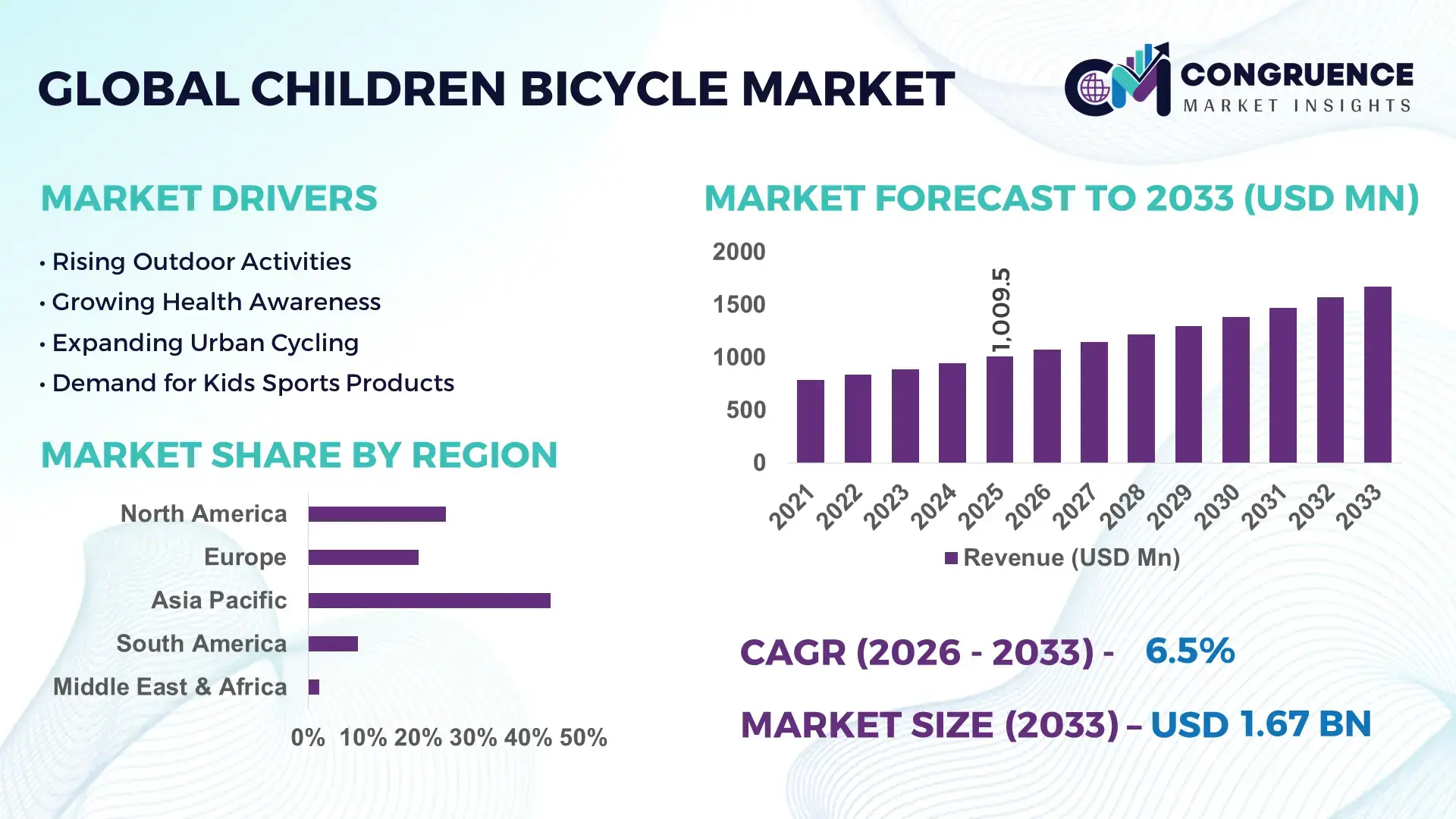
China continues to dominate the global children bicycle market with nearly 38% production share supported by integrated manufacturing clusters, advanced frame fabrication capacity, and large-scale exports to over 120 countries. The country invested heavily in automated welding and powder-coating facilities, improving production efficiency by 22% compared to traditional assembly operations. In comparison, India and Vietnam are emerging as competitive manufacturing alternatives due to lower labor costs and expanding OEM partnerships, while the U.S. market recorded a 19% increase in demand for premium outdoor and fitness-oriented children bicycles during 2025.
Manufacturers prioritizing regional supply chain localization, safety-certified innovation, and lightweight product engineering are positioned to secure stronger retail penetration and long-term competitive advantage in the evolving global children bicycle market.
Market Size & Growth: USD 1009.46 million in 2025 reaching USD 1670.65 million by 2033, driven by 31% higher demand for lightweight and safety-certified children bicycles across urban retail networks.
Top Growth Driver 1: Smart safety accessory integration increased premium bicycle sales by 26% in 2025 across developed consumer markets.
Top Growth Driver 2: Organized e-commerce bicycle sales expanded 34% globally as direct-to-consumer brands accelerated digital retail penetration.
Top Growth Driver 3: Outdoor recreation spending among families rose 18%, strengthening demand for advanced children mobility products.
Short-Term Forecast: By 2027, automated frame assembly and regional sourcing strategies will reduce production lead times by 21% globally.
Emerging Technologies: AI-enabled inventory systems, lightweight aluminum alloys, and advanced shock-absorption tires improved operational efficiency by 24%.
Regional Leaders: Asia-Pacific surpassed USD 520 million with export-driven manufacturing growth, Europe crossed USD 310 million through sustainability adoption, while North America exceeded USD 280 million with premium product demand.
Consumer Trends: Nearly 42% of urban parents preferred adjustable and long-life bicycles designed for multi-age usability and enhanced safety.
Pilot Case Example: In 2025, a modular bicycle rollout by major retailers improved inventory turnover efficiency by 17% across seasonal sales cycles.
Competitive Landscape: The top five manufacturers controlled approximately 44% market share led by global premium bicycle brands focusing on ergonomic innovation and regional expansion.
Regulatory & ESG Impact: Recyclable material adoption increased 29% following stricter child product safety and sustainability compliance standards across Europe and North America.
Children bicycles for the 6–10 age segment contributed nearly 41% of global product demand due to higher replacement frequency and growing participation in outdoor recreational activities. Lightweight alloy frames and puncture-resistant tires gained over 27% adoption across premium product launches in 2025, while Asia-Pacific accounted for approximately 46% of manufacturing output supported by expanding OEM production networks. Regulatory pressure on child safety certification and post-pandemic supply chain restructuring accelerated regional sourcing investments and smart inventory planning. The market is increasingly shifting toward modular, adjustable, and sustainability-focused bicycle platforms, creating stronger long-term opportunities for differentiated product positioning and strategic retail expansion.
The children bicycle market is rapidly transforming into a strategically important mobility and lifestyle segment as manufacturers compete on safety engineering, lightweight materials, and premium outdoor recreation positioning. Rising urban fitness participation and structured recreational spending are accelerating demand for advanced children bicycles with adjustable ergonomics and impact-resistant frames. Simultaneously, supply chain restructuring across Asia and Europe is forcing companies to localize sourcing networks and optimize inventory cycles to protect margins and reduce delivery volatility.
Advanced aluminum-alloy frame technology improves production efficiency by 24% while reducing material weight by 31% compared to legacy steel-frame systems, enabling manufacturers to increase premium product penetration and lower logistics costs. Asia-Pacific leads in production volume with over 46% manufacturing concentration, while Europe leads in safety-certified innovation adoption with nearly 39% of new product launches focused on recyclable materials and enhanced braking technologies. Over the next two to three years, automated assembly integration is projected to reduce production lead times by 19% and improve retail inventory turnover by 16%.
Sustainability-focused manufacturing is emerging as a direct competitive advantage, with recyclable polymer integration reducing compliance costs by 14% across export-oriented product lines. In 2025, a modular bicycle platform introduced by a leading manufacturer improved assembly flexibility by 21% while lowering warranty claims through standardized component design. Global manufacturers are shifting capital allocation toward regional assembly hubs, digital retail ecosystems, and smart safety innovation to secure stronger market access and long-term brand differentiation. Companies capable of accelerating product innovation while optimizing supply resilience and ESG compliance will define the next competitive leadership cycle in the global children bicycle market.
The children bicycle market is accelerating due to rising demand for lightweight, safety-certified, and adjustable bicycles designed for long-term use. Lightweight frame adoption increased by 29% in 2025, while demand for advanced braking systems grew 24% across premium product categories. Urban outdoor recreation programs and rising family fitness spending are reshaping purchasing behavior toward durable and ergonomic bicycle models. Simultaneously, global supply chain restructuring after Red Sea logistics disruptions forced manufacturers to regionalize sourcing and assembly operations. In response, companies are expanding automated production capacity, forming OEM partnerships, and increasing investments in premium product innovation to improve efficiency, reduce defects, and strengthen retail competitiveness.
Rising aluminum and component costs are creating sustained pricing pressure across the children bicycle market. Aluminum alloy prices fluctuated by over 18% between 2024 and 2025, while compliance and product testing expenses increased nearly 15% following stricter child safety regulations in Europe and North America. Dependence on concentrated East Asian component suppliers also exposed manufacturers to freight delays and inventory instability. These pressures are increasing production costs and limiting scalability for mid-sized brands. To reduce risk, companies are diversifying sourcing networks across Southeast Asia and India, securing long-term supply contracts, and shifting toward modular component platforms that improve flexibility and lower dependence on volatile raw materials.
The market is witnessing strong opportunity through modular bicycle platforms, lightweight composite materials, and digitally integrated retail strategies. Adjustable multi-age bicycle models recorded a 32% rise in adoption during 2025 as consumers prioritized long-term usability and lower replacement frequency. Online customization programs improved conversion rates by 27%, especially in urban premium markets. Manufacturers are also integrating puncture-resistant tires and ergonomic safety upgrades to increase product lifecycle value. Companies are accelerating R&D investments, regional manufacturing expansion, and direct-to-consumer strategies to capture emerging demand. The shift toward connected recreational ecosystems and smart safety accessories is redefining future product differentiation and competitive positioning.
Seasonal demand fluctuations, inventory imbalance, and infrastructure gaps remain major execution challenges for the children bicycle market. Inventory mismatch rates exceeded 17% in 2025 due to inaccurate seasonal forecasting and uneven retail demand patterns. Rising freight and warehousing costs also increased operational expenses by nearly 14% for export-focused suppliers. In several developing regions, limited cycling infrastructure and fragmented retail distribution continue constraining premium product adoption. These factors are reducing profitability consistency and complicating expansion strategies. Companies must strengthen predictive inventory systems, regional logistics partnerships, and flexible manufacturing operations to maintain competitive stability and improve long-term growth execution.
31% increase in lightweight frame deployment is reshaping production priorities. Manufacturers expanded aluminum and composite frame integration across children bicycles during 2025, reducing product weight by 18% and assembly time by 14%. Rising freight volatility forced suppliers to regionalize component sourcing across Asia. Companies are restructuring procurement contracts and scaling welding systems to stabilize schedules.
26% growth in direct-to-consumer customization is redefining retail execution. Online bicycle configuration tools increased premium accessory attachment rates by 22%, while personalized sizing programs reduced product returns by 17% during 2025 Companies are integrating AI-based inventory tracking and retailer data synchronization to accelerate fulfillment speed The shift is forcing repositioning toward store-based sales models globally.
19% faster inventory rotation is shifting operational planning across major manufacturing hubs. Bicycle producers shortened seasonal production cycles by 16% using modular component platforms and standardized brake assemblies Stricter European child safety regulations accelerated deployment of certified reflective materials and impact-resistant tires Manufacturers are increasing warehousing capacity and partnerships to reduce stock imbalance during seasons.
34% expansion in organized recreation partnerships is transforming business models. Bicycle brands increased collaboration with schools, sports academies, and rental operators to secure recurring demand and improve brand visibility Shared-use bicycle programs lowered customer acquisition costs by 15% while increasing repeat purchases by 20% Companies are optimizing maintenance packages and assembly networks to strengthen retention
The children bicycle market is segmented by type, application, and end-user, with demand increasingly shifting toward lightweight, safety-focused, and activity-specific bicycle categories. Training Wheel Bikes continue holding strong market penetration due to widespread adoption among first-time riders, while BMX and Mountain Kids Bikes are gaining traction through outdoor sports participation and premium recreational demand. Recreational Use accounts for the largest application concentration with nearly 43% share, supported by rising family outdoor activity spending and urban recreation trends. Meanwhile, Sports Training and Competitive Cycling segments are expanding rapidly as structured cycling programs and academy-based participation increase globally. Individual Consumers dominate end-user demand, although schools and rental operators are accelerating procurement volumes through organized mobility and recreational initiatives. Companies are responding by expanding modular product portfolios, strengthening direct-to-consumer distribution, and increasing localized manufacturing capacity to address shifting regional demand patterns and seasonal inventory fluctuations.
Training Wheel Bikes dominate the children bicycle market with approximately 36% share due to their affordability, beginner-friendly stability, and strong retail penetration across urban and suburban markets. Their structural dominance comes from high replacement frequency and broad adoption among children aged 3–6 years, making them a scalable volume-driven category for manufacturers. However, Mountain Kids Bikes are emerging as the fastest-growing segment with nearly 24% adoption growth during 2025, driven by increasing outdoor recreation participation, premium family spending, and demand for shock-absorption and terrain-compatible features. Compared to Training Wheel Bikes, Mountain Kids Bikes command higher average selling value and stronger accessory attachment rates, redefining premium positioning within the market.
Balance Bikes are maintaining strategic relevance in early childhood mobility development, while BMX Kids Bikes are gaining traction through freestyle sports culture and organized cycling programs. Road Kids Bikes, although niche, continue expanding within structured training environments and competitive youth cycling communities. Collectively, Balance Bikes, BMX Kids Bikes, and Road Kids Bikes account for nearly 41% combined market demand. Manufacturers are increasing investments in lightweight frame engineering, modular sizing systems, and safety-certified braking technologies to capture shifting consumer preferences and strengthen premium category penetration.
Recreational Use leads the children bicycle market with nearly 43% share due to widespread participation in family outdoor activities, park mobility programs, and leisure cycling engagement across urban households. Usage concentration remains high because recreational bicycles require lower technical complexity while supporting broad age-group accessibility. Sports Training is the fastest-growing application segment with approximately 26% growth during 2025, fueled by increasing enrollment in structured cycling academies, school sports initiatives, and youth endurance programs. Compared to Recreational Use, Sports Training bicycles require higher-performance components, lightweight frames, and advanced braking systems, pushing manufacturers toward premium product innovation.
School Transportation continues expanding in densely populated urban areas where short-distance mobility solutions are gaining institutional support. Outdoor Activities and Competitive Cycling collectively account for nearly 37% market share, supported by rising participation in adventure camps, cycling events, and recreational tourism programs. Companies are adapting by scaling adjustable bicycle platforms, expanding sports-focused product lines, and strengthening partnerships with schools and training organizations. Demand is clearly shifting from basic recreational utility toward performance-oriented and activity-specialized bicycles, making premiumization and safety-focused engineering increasingly critical for competitive positioning.
Individual Consumers dominate the children bicycle market with nearly 58% share due to consistent household purchasing demand, seasonal replacement cycles, and increasing parental focus on outdoor recreation and safety-certified mobility products. Demand concentration remains strongest within urban middle-income households where premium lightweight bicycles and adjustable models are gaining higher adoption. Rental Services represent the fastest-growing end-user segment with approximately 28% growth during 2025, driven by tourism-linked mobility programs, recreational parks, and shared-use cycling ecosystems targeting short-duration access models.
Compared to Individual Consumers, Schools and Sports Academies are shifting toward institutional bulk procurement focused on durability, standardized safety features, and long-term maintenance efficiency. Schools and Sports Academies collectively account for nearly 30% market demand as organized youth sports participation and outdoor education programs expand globally. Manufacturers are responding through flexible pricing models, maintenance partnerships, and customized fleet-oriented product offerings designed for institutional buyers. Companies are also strengthening direct-to-consumer digital channels while simultaneously building regional partnerships with academies and rental operators to capture recurring procurement opportunities and improve long-term customer retention.
Asia-Pacific accounted for the largest market share at 46% in 2025 however, North America is expected to register the fastest growth, expanding at a CAGR of 7.4% between 2026 and 2033.
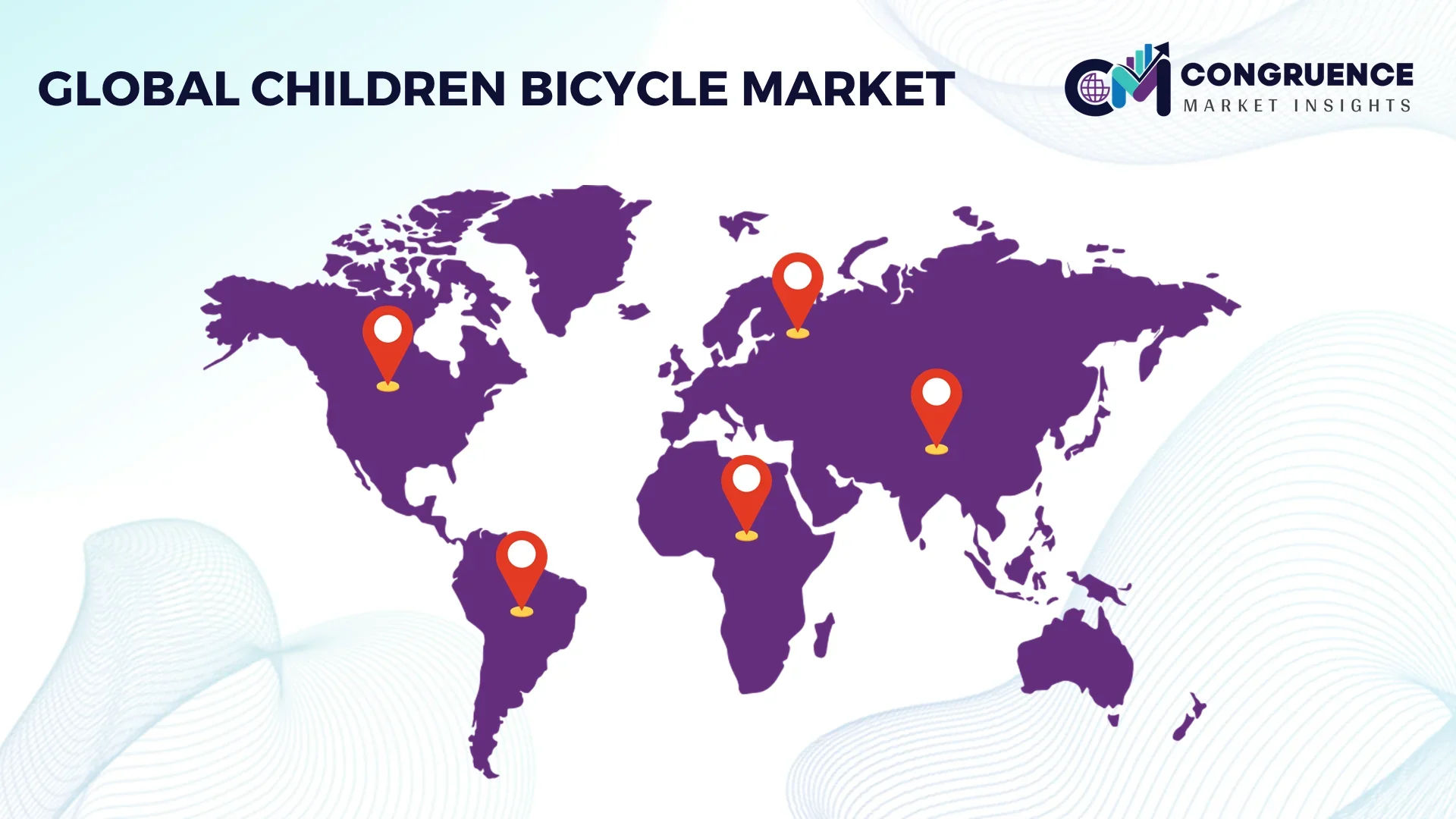
Asia-Pacific dominates the children bicycle market through large-scale manufacturing capacity, integrated supplier networks, and strong export infrastructure led by China, India, and Vietnam. Europe accounts for nearly 28% market share and leads in safety-certified innovation, recyclable material adoption, and regulatory-driven premium product development. North America holds approximately 21% share while recording the fastest acceleration in premium outdoor recreation demand, modular bicycle adoption, and direct-to-consumer retail expansion. Meanwhile, South America and Middle East & Africa collectively contribute over 5% demand, supported by localized recreational adoption and expanding urban mobility initiatives. Ongoing supply chain regionalization and stricter product compliance standards are forcing manufacturers to diversify production and shorten inventory cycles. Global companies are increasingly prioritizing Asia-Pacific for scale, Europe for compliance innovation, and North America for premium category expansion.
North America accounts for nearly 21% of global children bicycle demand, supported by strong outdoor recreation participation and rising consumer preference for premium safety-certified products. The U.S. dominates regional demand due to high spending on fitness-oriented recreational products and growing adoption of adjustable lightweight bicycles. Demand for aluminum-frame models increased by 27% during 2025, while direct-to-consumer bicycle sales expanded by 24% through digital retail platforms. Retailers are integrating AI-based inventory forecasting and modular product customization to reduce seasonal stock imbalance and improve delivery efficiency. Several manufacturers expanded regional warehousing capacity by over 18% to shorten fulfillment cycles and strengthen supply resilience after recent freight disruptions. Consumers increasingly prioritize durability, ergonomic design, and long-term usability, making North America a critical region for premium product expansion and advanced retail execution.
Europe represents approximately 28% of the global children bicycle market, led by Germany, France, and the Netherlands through strong cycling culture and safety-focused consumer demand. Strict child product safety regulations and sustainability requirements are accelerating the adoption of recyclable polymers, certified braking systems, and reflective safety technologies. Nearly 39% of new product launches during 2025 included eco-friendly materials and lightweight frame engineering to meet evolving compliance standards. Manufacturers are restructuring production processes to reduce material waste by 16% while improving product durability and export readiness. Consumers across the region increasingly favor premium, long-life bicycle models with safety-focused features rather than low-cost alternatives. Europe continues forcing manufacturers toward faster innovation cycles, ESG-driven manufacturing, and advanced product certification strategies to remain competitive within highly regulated retail environments.
Asia-Pacific leads the global children bicycle market with nearly 46% demand concentration and the highest manufacturing output worldwide. China remains the dominant production hub, while India and Vietnam are rapidly expanding OEM assembly operations through lower labor costs and localized supply chain integration. Export-oriented manufacturing facilities improved production efficiency by 22% during 2025 through automation upgrades and modular component deployment. The region also recorded over 31% growth in organized online bicycle retail sales as manufacturers accelerated digital distribution and regional fulfillment capabilities. Companies are expanding assembly capacity, regional warehousing, and supplier partnerships to reduce freight dependency and improve inventory speed. Consumers prioritize affordability, fast product availability, and durable entry-level bicycles, making Asia-Pacific the most strategically important region for production scale, cost optimization, and long-term global market expansion.
South America contributes approximately 3% of global children bicycle demand, with Brazil and Argentina leading regional consumption through expanding urban recreation participation and school mobility programs. Rising inflationary pressure and limited premium retail penetration continue constraining large-scale adoption, particularly for imported high-specification bicycles. However, localized demand for affordable recreational bicycles increased by 18% during 2025 as middle-income households prioritized outdoor recreational spending. Regional distributors expanded localized assembly operations by nearly 14% to reduce import dependency and improve pricing flexibility. Consumers remain highly price-sensitive and increasingly prefer durable, low-maintenance bicycles with simplified safety features. The region presents strong long-term opportunity through localized manufacturing and entry-level product expansion, although infrastructure limitations and economic volatility continue creating execution risks for global manufacturers.
Middle East & Africa account for nearly 2% of global children bicycle demand, supported by rising investments in recreational infrastructure and urban outdoor activity programs. The UAE and South Africa are leading regional adoption through expanding cycling parks, family recreation zones, and organized sports initiatives. Premium recreational bicycle demand increased by 16% during 2025, while regional distributors expanded retail partnerships and localized servicing capabilities by approximately 12%. Governments and private operators are increasingly integrating cycling-friendly infrastructure into urban development projects, accelerating awareness and organized participation. Consumers prioritize durable products capable of handling mixed terrain and extended outdoor usage conditions. Although the market remains relatively small, infrastructure modernization, rising youth recreation spending, and retail ecosystem expansion are positioning the region as an emerging strategic growth opportunity for global bicycle manufacturers.
China – 38% market share in the children bicycle market, driven by large-scale manufacturing capacity, integrated supplier ecosystems, and strong export-oriented production networks.
United States – 19% market share in the children bicycle market, supported by premium recreational demand, advanced retail infrastructure, and high consumer spending on safety-focused outdoor products.
The children bicycle market is dominated by competition between global premium bicycle manufacturers, regional low-cost producers, and digitally focused direct-to-consumer brands. Companies including Giant Manufacturing, Trek Bicycle Corporation, Specialized Bicycle Components, Accell Group, and Merida Industry collectively control approximately 44% market share through extensive retail networks, advanced product engineering, and large-scale supply chain integration. Premium manufacturers are competing on lightweight frame innovation, safety-certified braking systems, and ergonomic customization, while regional producers focus aggressively on cost optimization and faster localized delivery. Direct-to-consumer brands improved online conversion efficiency by 22% during 2025 through digital customization and AI-driven inventory management systems.
Manufacturers are increasingly expanding regional assembly hubs, forming OEM sourcing partnerships, and integrating modular product platforms to reduce logistics dependency and improve production flexibility. The market is also witnessing rising competitive pressure from recyclable material integration and safety compliance upgrades, forcing faster product development cycles. High certification costs, supplier concentration risks, and seasonal inventory volatility remain major entry barriers. Companies capable of combining premium innovation, supply chain resilience, rapid fulfillment, and scalable manufacturing efficiency are securing stronger competitive positioning in the global children bicycle market.
Giant Manufacturing Co. Ltd.
Trek Bicycle Corporation
Specialized Bicycle Components
Merida Industry Co. Ltd.
Accell Group
Hero Cycles Ltd.
Avon Cycles Ltd.
Frog Bikes
Raleigh Bicycle Company
Scott Sports SA
Cannondale Bicycle Corporation
Pacific Cycle Inc.
BTWIN
Cleary Bikes
The children bicycle market is increasingly centered around lightweight aluminum frames, modular sizing systems, and advanced safety integration technologies. Aluminum-frame deployment exceeded 48% across premium children bicycle categories during 2025, improving riding maneuverability by 28% while reducing product weight by nearly 22% compared to traditional steel-frame bicycles. Manufacturers are integrating ergonomic brake levers, puncture-resistant tires, and child-specific geometry to improve safety and long-term usability. These technologies are reducing product return rates and increasing premium category retention across organized retail channels.
Emerging technologies are reshaping manufacturing efficiency and inventory execution. AI-enabled inventory forecasting and modular component architectures improved production planning accuracy by 19% while reducing assembly downtime by 16% during 2025. Companies are also deploying automated welding and powder-coating systems to improve frame consistency and lower material waste. Digital customization platforms are gaining traction, with nearly 34% of online premium bicycle purchases involving configurable sizing or accessory integration, redefining direct-to-consumer competition.
Disruptive innovation is shifting toward connected safety accessories, ultra-light composite materials, and adaptive bicycle platforms designed for multi-age usability. Composite frame technologies improve durability efficiency by 24% while lowering logistics costs by 17% compared to legacy heavy-frame systems. Premium manufacturers benefit most from this transition as lightweight engineering and smart safety differentiation strengthen pricing power and customer retention. Between 2026 and 2028, companies accelerating automation, digital retail integration, and recyclable material deployment will secure stronger operational control, faster product cycles, and higher competitive positioning in the global children bicycle market.
June 2024 – Giant introduced the new Faith and Liv Faith full-suspension children mountain bike platforms with child-specific suspension geometry and lightweight aluminum frames, improving off-road handling efficiency for riders aged 5–12 years. The redesign optimized weight distribution by over 20%, strengthening Giant’s premium youth MTB positioning. [Youth MTB Expansion]
September 2025 – Trek expanded deployment of lightweight aluminum-frame Precaliber and Wahoo children bicycles, with select 16-inch models weighing below 8 kg to improve maneuverability and riding confidence. The shift reduced frame weight by approximately 18% versus older steel-frame designs, accelerating premium lightweight category adoption. [Ultra-Lightweight Shift]
April 2025 – Trek strengthened its bicycle trade-in and upgrade ecosystem for children bicycles through expanded retailer participation, increasing repeat purchase retention and improving resale circulation efficiency. Retail adoption programs accelerated customer upgrade transitions while supporting long-term brand loyalty among family-focused cycling consumers. [Retail Retention Model]
2026 – Manufacturers accelerated rigid-frame and lightweight component adoption across children bicycle portfolios as consumers increasingly rejected heavy suspension systems for entry-level youth bicycles. Retail feedback indicated improved riding usability and lower maintenance complexity, pushing companies toward simplified performance-focused product engineering strategies. [Weight Optimization Drive]
This report delivers comprehensive coverage of the global children bicycle market across key product types, applications, end-users, technologies, and regional demand centers. The analysis evaluates Balance Bikes, Training Wheel Bikes, Mountain Kids Bikes, BMX Kids Bikes, and Road Kids Bikes while examining demand across Recreational Use, School Transportation, Sports Training, Outdoor Activities, and Competitive Cycling segments. End-user assessment includes Individual Consumers, Schools, Sports Academies, and Rental Services with strategic comparison of purchasing behavior, adoption shifts, and operational priorities across each category.
The report provides deep regional analysis covering North America, Europe, Asia-Pacific, South America, and Middle East & Africa, alongside country-level positioning for leading production and demand markets. More than 40% of analyzed premium products incorporate lightweight aluminum or composite frame technologies, while nearly 34% of organized online sales involve customization-based purchasing models. The study also evaluates automation deployment, modular manufacturing systems, digital retail integration, recyclable materials, and safety-certified component adoption trends shaping industry transformation between 2026 and 2033.
The report supports strategic decision-making by identifying demand concentration, technology shifts, operational restructuring, and competitive positioning strategies. It highlights emerging growth pockets, premiumization trends, and supply chain localization priorities critical for investment planning, manufacturing expansion, partnership development, and long-term competitive differentiation.
| Report Attribute/Metric | Report Details |
|---|---|
|
Market Revenue in 2025 |
USD 1009.46 Million |
|
Market Revenue in 2033 |
USD 1670.65 Million |
|
CAGR (2026 - 2033) |
6.5% |
|
Base Year |
2025 |
|
Forecast Period |
2026 - 2033 |
|
Historic Period |
2021 - 2025 |
|
Segments Covered |
By Type
By Application
By End-User
|
|
Key Report Deliverable |
Revenue Forecast, Growth Trends, Market Dynamics, Segmental Overview, Regional and Country-wise Analysis, Competition Landscape |
|
Region Covered |
North America, Europe, Asia-Pacific, South America, Middle East, Africa |
|
Key Players Analyzed |
Giant Manufacturing Co. Ltd., Trek Bicycle Corporation, Specialized Bicycle Components, Merida Industry Co. Ltd., Accell Group, Hero Cycles Ltd., Avon Cycles Ltd., Frog Bikes, Raleigh Bicycle Company, Scott Sports SA, Cannondale Bicycle Corporation, Pacific Cycle Inc., BTWIN, Cleary Bikes |
|
Customization & Pricing |
Available on Request (10% Customization is Free) |




