
Reports
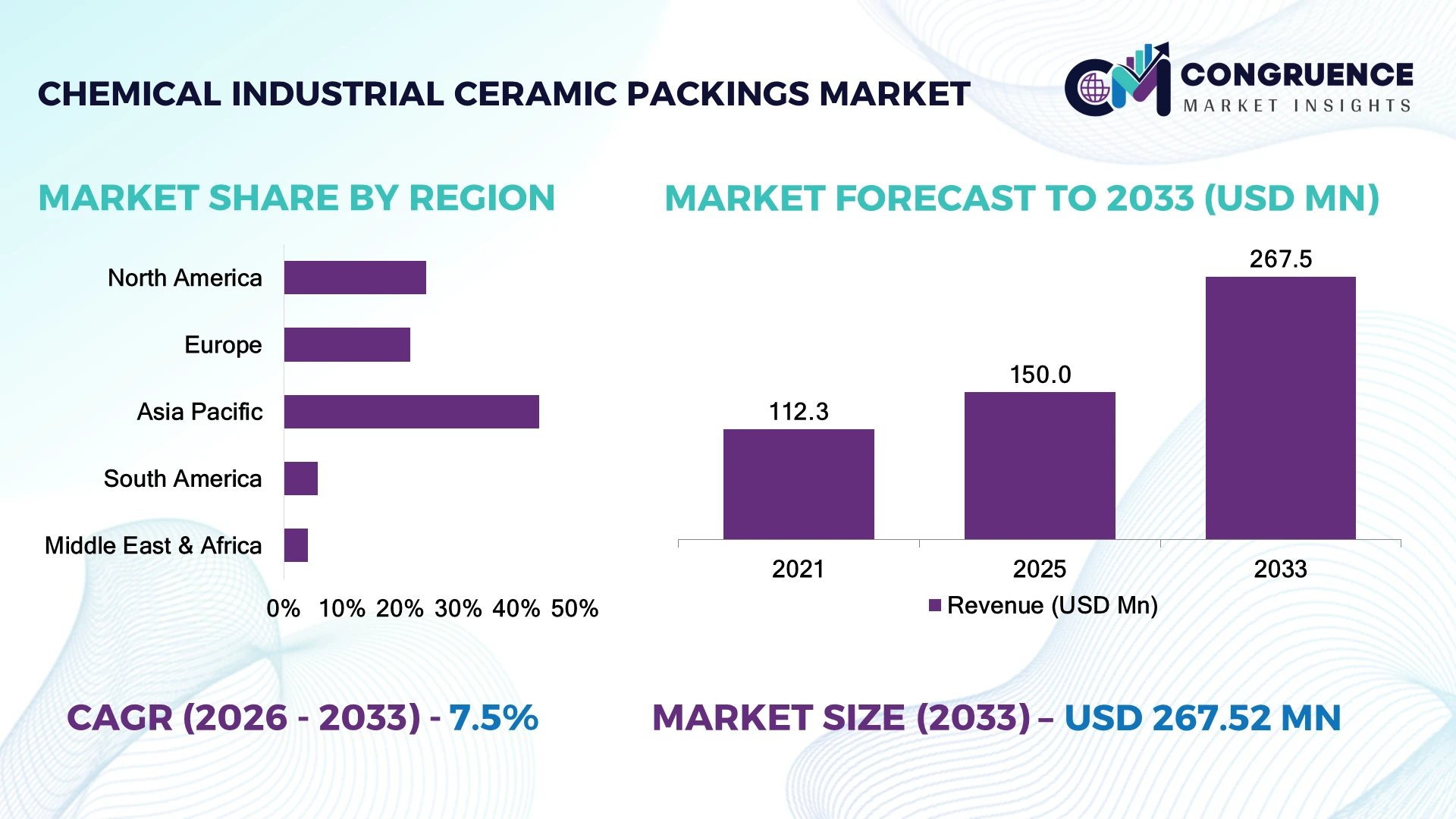
The Global Chemical Industrial Ceramic Packings Market was valued at USD 150.0 Million in 2025 and is anticipated to reach a value of USD 267.5 Million by 2033 expanding at a CAGR of 7.5% between 2026 and 2033. Growth is driven by rising deployment of high-efficiency mass transfer systems in chemical processing, refinery modernization projects, and stricter emissions control requirements across industrial separation operations.
China dominates the market with approximately 34% of global ceramic packing production capacity, supported by over 25 large-scale chemical industrial clusters and continuous investments in petrochemical and specialty chemical facilities. The country processes nearly 18% more industrial chemicals than the U.S., while Germany leads Europe in advanced tower internals adoption, with over 60% of new chemical plant upgrades incorporating high-performance ceramic packing technologies. Growing integration across refining, fertilizer, and environmental treatment applications further strengthens China's leadership.
Strategically, manufacturers prioritizing high-durability, low-pressure-drop ceramic solutions are best positioned to capture industrial modernization and process-efficiency opportunities.
Market Size & Growth: USD 150.0 Million in 2025, reaching USD 267.5 Million by 2033, supported by advanced process-intensification initiatives and refinery upgrades.
Top Growth Drivers: Chemical capacity expansion (+18%), industrial emission-control adoption (+22%), and high-temperature process upgrades (+15%).
Short-Term Forecast: By 2028, column efficiency improves by 12% while energy consumption declines by approximately 9% in optimized installations.
Emerging Technologies: AI-enabled process monitoring, advanced alumina ceramics, and automated plant optimization improve operational consistency.
Regional Leaders: Asia Pacific (~USD 98 Million), North America (~USD 61 Million), and Europe (~USD 54 Million); adoption is accelerating through industrial modernization programs.
Consumer/End-User Trends: More than 58% of new petrochemical separation units specify high-performance structured or random ceramic packing designs.
Pilot/Case Example: A 2024 chemical processing upgrade achieved 14% higher mass-transfer efficiency and reduced maintenance downtime by 11%.
Competitive Landscape: Top suppliers control nearly 38% market share; leading participants include Raschig, Koch-Glitsch, Saint-Gobain, CeramTec, and Jiangxi Xintao.
Regulatory & ESG Impact: Emission-reduction initiatives contribute to approximately 10% lower energy intensity across upgraded process units.
Investment & Funding: Over USD 450 Million allocated toward plant expansion, localization, and advanced materials manufacturing initiatives.
Innovation & Future Outlook: High-purity ceramics, digital process optimization, and supply-chain diversification are reshaping competitive positioning globally.
Chemical Industrial Ceramic Packings remain essential for petrochemicals, fertilizers, environmental treatment, and specialty chemical processing where high thermal stability and corrosion resistance are critical. Manufacturers are introducing advanced alumina and engineered structured packing designs that improve separation efficiency by over 12%. A notable trend is the localization of industrial supply chains following geopolitical trade realignments, encouraging domestic production capacity and faster project execution, creating a strong foundation for strategic market development.
Chemical industrial ceramic packings are becoming strategically important as chemical producers, refiners, and environmental treatment operators focus on process efficiency, emissions reduction, and operational reliability. The market is benefiting from global infrastructure modernization and supply-chain restructuring, particularly as manufacturers seek durable materials capable of operating under extreme temperatures and corrosive conditions. This shift is strengthening investment in advanced separation technologies across large-scale industrial facilities.
Modern high-performance ceramic packings deliver up to 15% lower pressure drop and approximately 12% higher mass-transfer efficiency compared with conventional packing systems, enabling measurable energy savings and throughput improvements. China continues to scale deployment through petrochemical capacity additions, while Germany and Japan emphasize innovation-led upgrades focused on precision manufacturing and environmental compliance. These differences highlight contrasting strategies between volume-driven expansion and technology-centric optimization.
Over the next two to three years, adoption of digital process monitoring and advanced tower retrofitting is expected to accelerate across chemical production hubs. A recent refinery modernization project demonstrated double-digit efficiency gains through ceramic packing replacement and process optimization. In response, leading companies are expanding production footprints, strengthening distributor partnerships, and increasing investment in engineered ceramic solutions. Organizations that align product innovation with industrial efficiency requirements will secure stronger competitive positioning and long-term operational advantage.
Chemical producers are increasingly replacing conventional internals with advanced ceramic packing systems to improve separation efficiency and reduce energy consumption. More than 60% of new large-scale petrochemical projects in China and the Middle East incorporate enhanced mass-transfer technologies, while process optimization programs have delivered energy savings of 8–15% across distillation applications. Stricter environmental regulations and growing demand for specialty chemicals are accelerating equipment modernization. This structural shift improves operational productivity while reducing maintenance frequency. In response, manufacturers are expanding production facilities, developing higher-purity ceramic formulations, and forming partnerships with engineering contractors. A notable strategic insight is that ceramic packing adoption is increasingly linked to plant debottlenecking initiatives, allowing operators to increase throughput without major capital-intensive facility expansion.
Production of high-performance ceramic packings depends on specialized alumina, kaolin, and refractory materials, creating exposure to raw-material price fluctuations. Manufacturing costs have increased by approximately 10–14% in recent years, while energy-intensive firing processes account for nearly 30% of total production expenses. Supply-chain disruptions affecting industrial minerals and shipping logistics have created procurement challenges for manufacturers in Europe and North America. These factors directly impact profitability and pricing competitiveness, particularly for small and mid-sized suppliers. Companies are responding through localized sourcing strategies, long-term supply agreements, and investment in energy-efficient kiln technologies. A critical operational insight is that suppliers with vertically integrated raw-material access maintain stronger pricing stability and contract competitiveness during volatile procurement cycles.
Growing investment in specialty chemicals, hydrogen processing, and industrial emissions treatment is creating new opportunities for ceramic packing suppliers. Advanced structured ceramic designs can improve separation performance by over 15% while reducing maintenance intervals by nearly 10%. India's expanding chemical manufacturing base and Southeast Asia's industrialization programs are accelerating demand for high-temperature and corrosion-resistant process equipment. In parallel, digital process analytics and predictive maintenance technologies are enabling more efficient deployment of advanced packing systems. Companies are strengthening R&D capabilities, expanding local manufacturing footprints, and collaborating with process engineering firms. A unique opportunity lies in retrofitting aging industrial columns, where performance improvements can be achieved without constructing entirely new processing infrastructure.
A major long-term challenge involves integrating advanced ceramic packing systems into older processing facilities designed around legacy equipment configurations. Retrofitting projects can increase engineering complexity by 20–25%, while plant shutdown requirements often raise implementation costs by more than 12%. Many industrial operators in mature manufacturing economies face workforce shortages in specialized process engineering disciplines, slowing deployment timelines. Additionally, increasingly stringent environmental and operational performance standards require continuous technology upgrades. These factors affect scalability, deployment consistency, and long-term competitiveness. Companies must invest in engineering support capabilities, digital simulation tools, and technical training partnerships to address these issues. A key strategic insight is that service-led deployment models are becoming as important as product performance in securing large industrial modernization contracts.
Structured Packing Adoption Accelerates Industrial operators are replacing conventional random packing with advanced structured ceramic designs that improve mass-transfer efficiency by 12–18% and reduce pressure drop by nearly 15%. More than 55% of newly commissioned petrochemical separation columns in China now specify structured configurations. Rising energy optimization targets and tighter process-performance requirements are driving deployment. Suppliers are expanding engineered-product portfolios and increasing technical collaboration with EPC contractors to secure long-term project specifications.
Localization Reshapes Supply Networks Supply-chain diversification has become a major operational priority as procurement lead times for specialty industrial components have declined by nearly 20% through localized sourcing strategies. India and Saudi Arabia have increased domestic chemical infrastructure investments, while over 35% of large buyers now prioritize regional supply resilience during vendor selection. Companies are establishing local inventories, expanding manufacturing footprints, and restructuring distribution networks to improve project execution speed and reduce procurement volatility.
Digital Monitoring Gains Traction Integration of digital process analytics with packed-column operations is increasing rapidly, with predictive maintenance deployments reducing unplanned shutdowns by approximately 14% and improving asset utilization by nearly 10%. Large chemical producers are embedding real-time monitoring systems into separation units to optimize operating conditions. This technology transition is encouraging partnerships between ceramic packing manufacturers, automation providers, and industrial software firms to deliver performance-focused service offerings.
High-Purity Materials Move Mainstream Demand for advanced alumina-based ceramic packing materials has increased by roughly 16% as specialty chemicals and electronic materials production expand. Facilities using high-purity ceramic media report contamination reductions exceeding 20% compared with conventional alternatives. A less obvious shift is the growing use of premium ceramic internals in precision processing applications previously dominated by metallic solutions. Manufacturers are investing in material engineering, application-specific customization, and higher-performance production technologies.
Random ceramic packing accounts for approximately 58% of market demand and remains the leading segment due to its cost efficiency, installation flexibility, and suitability across petrochemical, fertilizer, and environmental treatment facilities. Industrial operators favor random packing for retrofit projects because installation costs are typically 15–20% lower than highly engineered alternatives while maintaining reliable mass-transfer performance. The segment continues to benefit from broad deployment across mature processing infrastructure where operational continuity and maintenance simplicity remain key priorities.
Structured ceramic packing is the fastest-growing type, supported by increasing emphasis on energy optimization and process intensification. Adoption has expanded by nearly 14% in newly commissioned chemical plants as operators pursue lower pressure drop and higher separation efficiency. While random packing dominates large-volume applications, structured designs are gaining preference in high-value specialty chemical processes. Manufacturers are expanding structured product portfolios, investing in advanced ceramic geometries, and strengthening engineering partnerships. This shift is directing capital toward premium performance solutions while preserving demand for established random packing technologies in large-scale industrial operations.
Chemical processing represents the leading application segment with approximately 46% market share, supported by extensive use in distillation, absorption, stripping, and solvent recovery operations. Demand remains concentrated within petrochemical complexes, specialty chemical facilities, and industrial manufacturing hubs where process reliability directly influences production economics. Increasing plant modernization activity has resulted in more than 50% of major capacity upgrades incorporating advanced ceramic packing solutions to improve throughput and operational stability.
Environmental treatment is the fastest-growing application as industrial facilities strengthen emissions control and wastewater treatment capabilities. Adoption rates have increased by roughly 13% across large industrial sites implementing stricter process-efficiency targets. Meanwhile, oil refining continues to represent a stable demand base, while fertilizer production supports consistent replacement cycles due to corrosive operating environments. Suppliers are responding through customized designs, process-specific engineering services, and expanded technical support. Demand is increasingly shifting toward applications where energy efficiency, environmental performance, and operational resilience deliver measurable competitive advantages.
Petrochemical companies account for approximately 42% of total demand and remain the dominant end-user group due to extensive deployment across refining, chemical conversion, and separation operations. Large integrated facilities operate hundreds of process columns requiring durable, corrosion-resistant internals capable of maintaining performance under demanding operating conditions. More than 65% of large-scale petrochemical modernization projects now include upgrades to tower internals and mass-transfer systems, reinforcing this segment’s leadership position.
Environmental services providers represent the fastest-growing end-user category, supported by increasing investment in industrial wastewater treatment and emissions management infrastructure. Adoption within this group has expanded by nearly 15% as facilities prioritize process efficiency and regulatory compliance. Chemical manufacturers continue to represent a substantial customer base, while fertilizer producers maintain consistent replacement demand due to aggressive operating environments. Suppliers are targeting these segments through customized engineering support, lifecycle-service agreements, and application-focused product development. Future demand is steadily shifting toward operators seeking measurable efficiency gains and long-term operational reliability rather than simple component replacement.
Asia-Pacific accounted for the largest market share at 43.8% in 2025 however, Middle East & Africa is expected to register the fastest growth, expanding at a CAGR of 8.6% between 2026 and 2033.
North America accounted for approximately 24.5% of global market activity in 2025, supported by a mature petrochemical industry, extensive refining infrastructure, and ongoing process-efficiency upgrades. The region is experiencing increased replacement demand as operators modernize aging distillation and absorption systems to improve throughput and reduce operating costs. High adoption of digital process monitoring and predictive maintenance technologies is influencing specification decisions for advanced ceramic packing systems. More than 55% of major process-equipment modernization projects across the U.S. Gulf Coast now incorporate upgraded mass-transfer internals. Strategic partnerships between engineering contractors and industrial equipment suppliers are accelerating deployment timelines. The market also benefits from strong specialty chemical production, where corrosion resistance and operational reliability remain critical procurement factors.
United States Market Outlook: The United States remains the region’s most influential market due to its extensive refining, petrochemical, and specialty chemical manufacturing base. Large industrial clusters along the Gulf Coast continue investing in process optimization and capacity upgrades. More than 50 large-scale chemical facilities have undertaken operational modernization initiatives in recent years, strengthening demand for advanced ceramic packing technologies. Domestic manufacturers are prioritizing engineered solutions that improve separation efficiency while reducing maintenance frequency, supporting long-term competitiveness across industrial processing sectors.
Europe represented approximately 21.7% of global market activity in 2025, driven by environmental compliance initiatives, energy-efficiency targets, and industrial modernization programs. Chemical manufacturers are increasingly replacing legacy internals with high-performance ceramic packing solutions to improve process economics and reduce energy intensity. The region maintains strong demand from specialty chemicals, pharmaceuticals, and advanced materials production. More than 40% of recent process optimization projects across major industrial facilities have included separation-system enhancements. Enterprise investment is increasingly directed toward operational efficiency rather than large-scale capacity expansion. The market benefits from strong engineering capabilities and high adoption of precision manufacturing technologies that support advanced ceramic component development and deployment.
Germany Market Outlook: Germany serves as the strategic center of the European market due to its advanced chemical manufacturing ecosystem and strong industrial engineering expertise. The country hosts some of the world's most sophisticated processing facilities, creating consistent demand for high-performance separation technologies. Approximately 60% of newly upgraded specialty chemical production units incorporate advanced process-efficiency components. German manufacturers continue investing in automation, sustainability-focused production methods, and precision-engineered ceramic solutions that support stringent operational and environmental requirements.
Asia-Pacific held the largest share of the global market at approximately 43.8% in 2025, supported by extensive petrochemical production, rapid industrialization, and continuous investment in chemical processing infrastructure. The region benefits from large-scale deployment across refining, fertilizer, specialty chemical, and environmental treatment facilities. Industrial operators increasingly prioritize process optimization technologies capable of supporting high-volume production environments. More than 65% of newly commissioned chemical processing capacity globally is concentrated within major Asia-Pacific manufacturing hubs. Significant investment in industrial parks, export-oriented production facilities, and downstream chemical projects continues strengthening demand. Suppliers are expanding regional manufacturing footprints and technical service capabilities to support growing project pipelines.
China Market Outlook: China remains the dominant country market due to its unmatched chemical manufacturing scale and integrated industrial ecosystem. The country accounts for roughly one-third of global ceramic packing production capacity and continues investing heavily in petrochemical and specialty chemical infrastructure. Large industrial clusters support rapid deployment of advanced separation technologies across hundreds of process facilities. Domestic manufacturers are increasing automation levels and material-engineering capabilities to improve product performance, while strong local supply chains provide significant cost and delivery advantages for large industrial projects.
South America accounted for approximately 5.8% of global market activity in 2025, supported primarily by refining, fertilizer production, mining-related processing, and expanding chemical manufacturing operations. Demand is concentrated around industrial modernization initiatives designed to improve operational efficiency and reduce process downtime. Investment activity remains selective but increasingly focused on upgrading critical processing infrastructure. Nearly 30% of major industrial processing projects launched in recent years have included equipment modernization components. While logistics constraints and uneven infrastructure development create execution challenges, the region continues to attract industrial investment aimed at improving production competitiveness. Suppliers are strengthening local distribution capabilities and technical support networks to improve market access.
Brazil Market Outlook: Brazil leads the regional market through its extensive refining network, agricultural chemical production, and growing industrial processing sector. Large fertilizer and petrochemical facilities continue investing in process optimization technologies to improve reliability and productivity. Industrial operators increasingly prioritize durable separation components capable of handling demanding operating conditions. Ongoing modernization across major processing complexes is creating sustained demand for advanced ceramic packing systems, while local engineering expertise supports broader deployment across strategic industrial sectors.
Middle East & Africa represented approximately 4.2% of global market activity in 2025 but remains the fastest-evolving regional landscape due to large-scale industrial diversification and petrochemical investment programs. National infrastructure strategies are driving construction of advanced processing facilities requiring high-performance separation technologies. More than 20 major petrochemical and downstream industrial projects are currently progressing across key Gulf industrial zones. Demand is increasingly linked to new facility construction rather than replacement cycles. Strategic investments in refining, chemicals, and industrial manufacturing are strengthening long-term deployment opportunities. Market participants are expanding regional partnerships and localized technical support capabilities to secure participation in major industrial development programs.
Saudi Arabia Market Outlook: Saudi Arabia is the most strategically important market within the region due to its substantial petrochemical investment pipeline and industrial diversification agenda. The country continues expanding downstream chemical production capacity while developing new industrial clusters designed to attract manufacturing investment. Advanced process technologies are being integrated into newly constructed facilities to maximize efficiency and operational reliability. Large-scale industrial projects and strong state-backed infrastructure development provide a favorable environment for sustained adoption of high-performance ceramic packing solutions across multiple process industries.
The competitive landscape is led by Raschig, Koch-Glitsch, Saint-Gobain NorPro, CeramTec, and Jiangxi Xintao, with global engineering specialists competing directly against regional cost-focused manufacturers. The top five players collectively control approximately 42% of market activity, creating a moderately consolidated structure where technology leadership and industrial relationships determine market positioning. Competition increasingly centers on separation efficiency, durability, customization, and delivery reliability rather than product pricing alone. High-performance ceramic designs deliver 10–15% efficiency improvements, while localized manufacturing reduces lead times by nearly 20%. Global leaders leverage engineering expertise and integrated project support, whereas regional suppliers compete through lower production costs and faster procurement cycles. Companies are expanding manufacturing capacity, strengthening EPC partnerships, investing in advanced structured packing technologies, and improving raw-material integration. Competitive momentum is shifting toward application-specific solutions and supply-chain control. Technical certification requirements, process-validation demands, and customer switching costs remain significant entry barriers. Winning requires proven performance, dependable supply networks, engineering support, and continuous product innovation.
Koch-Glitsch
Saint-Gobain NorPro
CeramTec GmbH
Jiangxi Xintao Technology Co., Ltd.
Pingxiang Chemshun Ceramics Co., Ltd.
Pingxiang Zhongtai Environmental Chemical Packing Co., Ltd.
Lantec Products Inc.
MultiTower Co., Ltd.
MTE Environmental Group
Pingxiang Naike Chemical Industry Equipment Packing Co., Ltd.
Jaeger Products Inc.
Huihai Chemical Packing Co., Ltd.
Kexing Special Ceramic Co., Ltd.
Advanced structured ceramic packing technology has become the primary performance differentiator across modern separation systems. Compared with conventional random packing, engineered structured designs improve mass-transfer efficiency by 12–18% while reducing pressure drop by approximately 15%. Adoption now exceeds 55% in newly commissioned high-performance chemical processing units. These improvements enable higher throughput, lower energy consumption, and improved operational consistency, giving technology-focused suppliers a measurable competitive advantage in refinery and specialty chemical applications.
Material innovation is accelerating through high-purity alumina ceramics, optimized surface geometries, and precision manufacturing techniques. Advanced alumina formulations improve chemical resistance by nearly 20% and extend operational life by more than 15% in corrosive processing environments. Around 40% of large industrial operators now prioritize lifecycle performance over initial procurement cost. Digital process monitoring is increasingly integrated with packed-column operations, enabling real-time optimization and reducing unplanned downtime by approximately 14%.
Between 2026 and 2028, AI-assisted process control, predictive maintenance platforms, and digitally modeled tower optimization are expected to reshape deployment decisions. Suppliers with strong engineering capabilities, advanced material science expertise, and digital integration partnerships will capture disproportionate value. Early adopters benefit through lower operating costs, faster process optimization, and stronger long-term asset performance across increasingly complex industrial applications.
February 2025 – Saint-Gobain NorPro announced construction of a new manufacturing facility in Wheatfield, New York, supported by an investment exceeding USD 40 million and nearly 125,000 square feet of production space. The expansion strengthens catalyst carrier and process ceramics supply capacity for chemical processing industries. Source: saint-gobain-northamerica.com
April 2025 – Saint-Gobain Ceramic Materials Zhengzhou launched a new ceramic grains production line while marking its twentieth operational year. The additional production capability supports growing demand for advanced ceramic materials and strengthens manufacturing resilience within strategic industrial supply chains. Source: saint-gobain.com.cn
November 2025 – CeramTec expanded industrial technology engagement through advanced ceramic solutions showcased for semiconductor manufacturing applications. The initiative emphasized ultra-precise ceramic components engineered for critical production environments, reinforcing the company’s position in high-performance industrial ceramics and precision processing markets. Source: ceramtec-group.com
November 2025 – EMG Saltcores by CeramTec installed a second automated production line at its India facility, enabling output of a high six-figure volume of sintered salt cores per month. The capacity increase strengthens regional manufacturing capability and supports rising industrial demand. Source: ceramtec-industrial.com
This report provides comprehensive analysis of the Chemical Industrial Ceramic Packings Market across key product types, applications, end-users, and major geographic regions. Coverage includes random ceramic packing, structured ceramic packing, chemical processing, environmental treatment, refining operations, and other industrial separation applications. The assessment evaluates deployment patterns, operational performance trends, technology adoption rates, and competitive positioning across established and emerging industrial markets. More than 40% of industry demand remains concentrated within large-scale petrochemical and chemical processing facilities, highlighting the importance of infrastructure-driven purchasing behavior.
The study further examines regional manufacturing concentration, industrial modernization programs, advanced ceramic technologies, digital process optimization trends, and evolving procurement strategies. Strategic insights cover supplier positioning, investment priorities, operational efficiency improvements, and emerging application opportunities through 2033. The report supports decision-making related to capacity expansion, market entry, product development, partnership evaluation, supply-chain planning, and competitive benchmarking while identifying high-potential growth pockets across industrial processing ecosystems.
| Report Attribute / Metric | Details |
|---|---|
| Market Revenue (2025) | USD 150.0 Million |
| Market Revenue (2033) | USD 267.5 Million |
| CAGR (2026–2033) | 7.5% |
| Base Year | 2025 |
| Forecast Period | 2026–2033 |
| Historic Period | 2021–2025 |
| Segments Covered |
By Type
By Application
By End-User
|
| Key Deliverables | Revenue Forecast; Market Trends; Growth Drivers & Restraints; Technology Insights; Segmentation Analysis; Regional Insights; Competitive Landscape; Regulatory & ESG Overview; Recent Developments |
| Regions Covered | North America; Europe; Asia-Pacific; South America; Middle East & Africa |
| Companies Profiled | Raschig GmbH; Koch-Glitsch; Saint-Gobain NorPro; CeramTec GmbH; Jiangxi Xintao Technology Co., Ltd.; Pingxiang Chemshun Ceramics Co., Ltd.; Pingxiang Zhongtai Environmental Chemical Packing Co., Ltd.; Lantec Products Inc.; MultiTower Co., Ltd.; MTE Environmental Group; Pingxiang Naike Chemical Industry Equipment Packing Co., Ltd.; Jaeger Products Inc.; Huihai Chemical Packing Co., Ltd.; Kexing Special Ceramic Co., Ltd. |
| Customization & Pricing | Available on Request (10% Customization Free) |




