
Reports
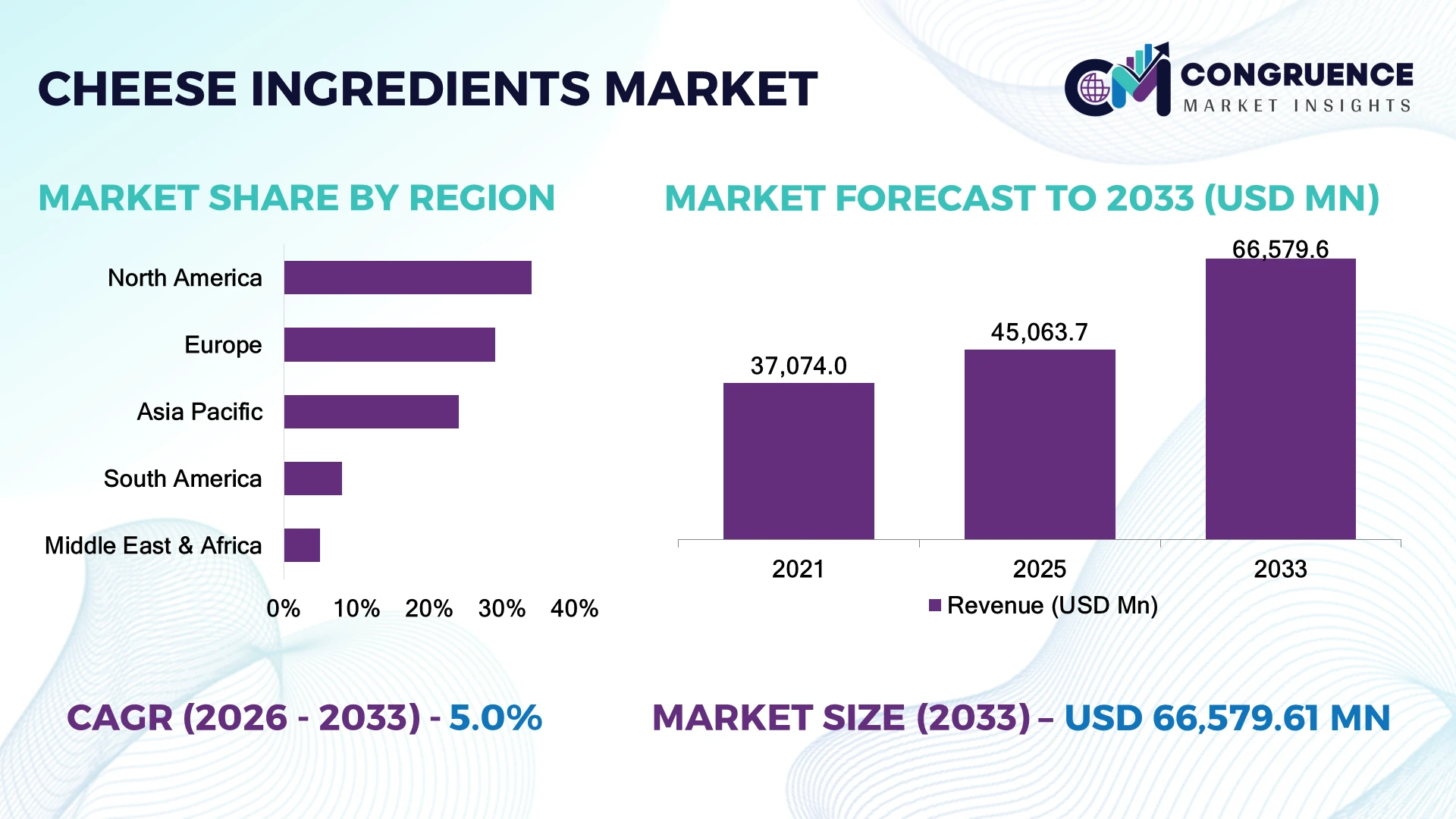
The Global Cheese Ingredients Market was valued at USD 45,063.7 Million in 2025 and is anticipated to reach a value of USD 66,579.6 Million by 2033 expanding at a CAGR of 5.0% between 2026 and 2033. Growth is driven by clean-label cheese reformulation, demand for concentrated dairy solids, specialty cultures and enzymes, and automation that improves yield consistency while reducing ingredient losses.
The United States accounts for an estimated 21% of global cheese ingredients consumption, supported by large-scale processed cheese, foodservice, and convenience-food production. China follows with approximately 10%, while U.S. cheese manufacturing capacity remains substantially higher. In 2026, processors are increasing investments in precision cultures, enzyme systems, and automated dosing; advanced ingredient systems can reduce formulation losses by 5–8%. Geopolitical supply-chain diversification following Red Sea shipping disruptions is reinforcing regional sourcing strategies.
Strategic implication: Suppliers that combine formulation performance, reliable dairy-ingredient supply, and application-specific technical support are best positioned to capture premium cheese-processing contracts.
Market Size & Growth: USD 45.1 billion in 2025 to USD 66.6 billion by 2033 at 5.0% CAGR, driven by specialty cultures, enzymes, and formulation optimization.
Top Growth Drivers: Clean-label reformulation 32%; processed-cheese demand 27%; convenience foods 21%.
Short-Term Forecast: By 2028, automated dosing can reduce ingredient waste 6–9% while improving batch consistency 10–14%.
Emerging Technologies: AI formulation, precision fermentation, automated dosing, and next-generation starter cultures are reshaping cheese production.
Regional Leaders: North America reaches approximately USD 15.0 billion; Europe USD 13.8 billion; Asia-Pacific USD 11.9 billion, with Asia-Pacific showing the strongest specialty-culture adoption.
Consumer/End-User Trends: Approximately 38% of cheese manufacturers prioritize clean-label or simplified ingredient systems in new product development.
Pilot/Case Example: 2025 precision-culture trials delivered approximately 8–12% faster acidification control, improving production scheduling and batch consistency.
Competitive Landscape: Leading suppliers hold approximately 9% individually, competing with Chr. Hansen, DSM-Firmenich, IFF, Kerry, and Lactina on cultures, enzymes, stabilizers, and formulation support.
Regulatory & ESG Impact: Clean-label reformulation and food-waste reduction programs are pushing manufacturers toward systems capable of reducing ingredient-related losses by 5–8%.
Investment & Funding: More than USD 500 million is being directed across dairy-ingredient capacity, precision fermentation, processing automation, and strategic partnerships.
Innovation & Future Outlook: Next-generation cultures, enzyme optimization, digital formulation, and low-waste processing are shifting investment toward higher-performance ingredient platforms.
Cheese Ingredients demand is concentrated across processed cheese, mozzarella, cheddar, cream cheese, cheese sauces, and foodservice formulations, with specialty cultures and enzymes gaining traction. Approximately 30% of new formulation activity increasingly emphasizes clean-label functionality and processing consistency. In 2026, manufacturers are also strengthening regional ingredient inventories to reduce exposure to dairy-input volatility and logistics disruptions, creating a stronger foundation for strategic formulation and sourcing decisions.
Cheese ingredients are becoming strategically important because processors increasingly compete on yield, texture consistency, shelf life, label simplicity, and formulation economics rather than cheese volume alone. Starter cultures, enzymes, emulsifying systems, milk proteins, and specialty dairy powders directly influence production efficiency and finished-product differentiation. Supply-chain restructuring is also encouraging manufacturers to qualify multiple ingredient suppliers and regionalize critical inputs.
Technology is accelerating this transition. Automated ingredient dosing can improve formulation accuracy by roughly 10–15% compared with manual batching, while precision culture systems provide tighter acidification control and reduce batch variability. North American processors emphasize high-throughput automation and processed-cheese applications, whereas European manufacturers place greater emphasis on clean-label formulations, specialty cultures, and sustainability performance. Asia-Pacific is expanding adoption as modern dairy-processing infrastructure develops.
During 2026–2028, processors are expected to prioritize digital formulation, predictive process control, precision fermentation-derived ingredients, and lower-waste production systems. A practical deployment involves automated dosing linked to recipe-management software, enabling real-time ingredient verification across multiple cheese lines. Suppliers are responding through technical partnerships, application laboratories, localized inventories, and expanded culture portfolios. Competitive advantage will increasingly depend on combining ingredient functionality with measurable processing efficiency, supply resilience, and formulation expertise.
Cheese processors are accelerating adoption of precision cultures, enzyme systems, and automated dosing as formulation consistency becomes a margin lever. Advanced dosing systems can improve ingredient accuracy by 10–15%, while optimized cultures can shorten acidification cycles by 8–12%. U.S. and German manufacturers are increasingly integrating recipe-management software with dosing equipment to control variability across multi-line operations. Rising demand for reduced-sodium, clean-label, and high-protein formulations is reinforcing this shift, with reformulation activity estimated to represent 25–30% of new product development. Suppliers are responding by expanding application laboratories, co-developing cultures with processors, and investing in digital formulation platforms. The non-obvious advantage is tighter process repeatability, allowing manufacturers to reduce costly batch rework while supporting more complex cheese specifications.
Volatility in milk solids, whey derivatives, cultures, and specialty dairy powders remains a structural constraint, particularly for processors dependent on imported inputs. Ingredient costs can fluctuate 8–15% across procurement cycles, while imported specialty cultures and enzymes can carry 10–20% higher landed costs than locally qualified alternatives. India and Southeast Asian processors remain exposed to logistics and cold-chain interruptions when sourcing specialized inputs from Europe. These pressures complicate long-term formulation economics and discourage rapid adoption of premium ingredient systems. Manufacturers are mitigating exposure through dual sourcing, regional warehousing, indexed supply contracts, and qualification of alternative stabilizer and enzyme systems. A critical operational insight is that supplier redundancy increasingly protects formulation continuity, not simply purchasing leverage.
Precision fermentation is creating opportunities for functional dairy proteins, specialty enzymes, and culture components that improve cheese performance without relying entirely on conventional agricultural inputs. Fermentation-derived ingredients can reduce selected processing-resource requirements by approximately 15–25%, while targeted enzyme systems can improve curd-processing efficiency by 8–12%. U.S. food-ingredient developers and European dairy processors are increasing pilot activity around alternative proteins and fermentation-enabled functionality. Digital process control further supports consistent dosing and traceability. Companies are positioning through fermentation partnerships, application trials, and modular ingredient portfolios tailored to mozzarella, processed cheese, and cheese sauces. The less obvious opportunity is premium formulation customization: suppliers can monetize performance-specific ingredient systems rather than competing solely on commodity dairy-input pricing.
Increasing formulation complexity is creating execution pressure as processors combine cultures, enzymes, stabilizers, proteins, and flavor systems across multiple cheese formats. Automated lines can require 10–20% more integration work when new dosing modules and recipe controls are added, while poorly synchronized systems can increase changeover time by 5–10%. U.S. and European plants with legacy processing equipment face greater interoperability constraints than newly designed facilities. Workforce shortages in food-process engineering further complicate commissioning and validation. Companies are addressing the challenge through modular automation, standardized interfaces, digital batch records, and equipment partnerships. The strategic pressure is shifting toward integration capability: ingredient innovation delivers limited value when plants cannot reproduce the formulation accurately at commercial scale.
Automated Dosing Becomes Standardized: Automated ingredient dosing is moving deeper into cheese plants, with adoption estimated at 30–40% among larger processors and accuracy improvements of 10–15%. Recipe-controlled systems reduce manual weighing and batch discrepancies, while U.S. manufacturers are integrating dosing with MES platforms. Suppliers are responding with modular equipment interfaces and digital formulation support.
Clean-Label Systems Gain Precision: European processors are replacing complex additive combinations with optimized cultures, enzymes, and functional dairy ingredients, reducing selected ingredient counts by 10–20%. Reformulation teams increasingly use controlled acidification and texture systems to preserve sensory performance. Companies are expanding application testing because simplified labels now require tighter process control rather than simply fewer ingredients.
Cold-Chain Resilience Reshapes Procurement: Specialty cultures and enzymes increasingly require localized inventories as shipping disruptions expose temperature-sensitive supply chains. Manufacturers are targeting 15–25% higher safety-stock coverage for critical inputs and qualifying secondary suppliers. U.S. and Indian processors are strengthening regional warehousing, revealing a non-obvious shift: inventory reliability is becoming part of ingredient value.
Digital Traceability Enters Quality Control: Batch-level ingredient traceability is expanding as processors connect supplier certificates, lot records, and production data. Digital systems can reduce manual documentation time by approximately 20–30% and accelerate recall investigations. Larger European and North American plants are integrating traceability with quality-management platforms, while suppliers increasingly provide standardized electronic documentation.
Cheese cultures represent the leading type, accounting for approximately 31% of global Cheese Ingredients demand, because controlled acidification, flavor development, and texture consistency make cultures integral to industrial cheesemaking. Enzymes follow at around 24%, while emulsifiers and stabilizers account for approximately 21%; milk powders, proteins, and other functional ingredients comprise the remainder. Enzymes are the fastest-growing type, supported by increased use of coagulants and specialty enzyme systems that improve yield and shorten processing cycles. Adoption of advanced enzyme solutions is estimated to have increased 10–14% among large processors.
Mature culture systems retain volume leadership, but precision enzymes and functional proteins are attracting greater investment because they directly influence yield and formulation economics. U.S. and European suppliers are expanding application laboratories and co-development programs, while Asian manufacturers are adding localized ingredient capacity. The strategic priority is shifting toward multifunctional systems that deliver 6–10% better processing efficiency while simplifying formulations and reducing batch variability.
USDA reported that U.S. cheese production reached 14.8 billion pounds in 2025, 4.0% above 2024, creating a larger industrial base for culture, enzyme, and functional-ingredient consumption.
Processed cheese represents the leading application at approximately 29% of global Cheese Ingredients consumption, supported by intensive use of emulsifying salts, stabilizers, dairy proteins, and flavor systems for consistent meltability and shelf life. Mozzarella follows at roughly 24%, while cheddar contributes about 19%. Mozzarella is the fastest-growing application, with ingredient adoption increasing approximately 12–15% as pizza, foodservice, and convenience-food production expands and manufacturers prioritize stretch, melt, and moisture control.
Traditional cheddar and processed-cheese formulations remain comparatively mature, but mozzarella processors are increasing investment in cultures, enzymes, and functional proteins that improve curd consistency and reduce production variability. Suppliers are responding with application-specific blends, automated dosing support, and technical partnerships with large cheese manufacturers. The business implication is stronger demand for performance-based ingredient packages rather than individual commodities, particularly where processors need 5–8% higher yield or tighter texture specifications.
USDA reported that Italian-type cheese accounted for 42.8% of U.S. cheese production in 2025, with mozzarella representing 79.1% of Italian production, reinforcing the scale of ingredient demand linked to mozzarella processing.
Industrial cheese manufacturers are the dominant end-user, representing approximately 48% of global Cheese Ingredients demand because high-throughput plants require consistent cultures, enzymes, stabilizers, proteins, and processing aids across standardized formulations. Foodservice and prepared-food manufacturers account for about 27%, while dairy processors and specialty cheese producers contribute approximately 17% and 8%, respectively. Prepared-food manufacturers are the fastest-growing group, with ingredient adoption rising an estimated 13–16% as pizza, ready meals, sauces, and convenience products demand predictable melting and portion performance.
Large industrial producers prioritize cost, batch consistency, and automated dosing, whereas specialty cheese manufacturers place greater value on flavor development, clean-label positioning, and formulation flexibility. Companies are responding with tiered ingredient portfolios, co-manufacturing partnerships, technical support programs, and volume-based contracts. Approximately 25–30% of new industrial formulation activity is increasingly focused on multifunctional ingredient systems that combine texture, yield, and shelf-life benefits. Future competitive advantage will favor suppliers capable of serving both high-volume standardized production and specialized formulation requirements.
USDA reported that U.S. cheese production excluding cottage cheese increased 4.0% in 2025 to 14.8 billion pounds, highlighting the expanding production base requiring industrial-scale ingredient systems.
North America accounted for the largest market share at 34% in 2025 however, Asia-Pacific is expected to register the fastest growth, expanding at a CAGR of 6.4% between 2026 and 2033.

Processed-cheese scale is accelerating precision ingredient adoption
North America represented approximately 34% of global Cheese Ingredients demand in 2025, supported by large-scale cheddar, mozzarella, processed-cheese, foodservice, and prepared-food manufacturing. The United States accounts for most regional consumption, with industrial processors increasingly deploying automated dosing, enzyme systems, and functional dairy proteins. Advanced formulation systems are estimated to improve ingredient-use efficiency by 8–12% in high-volume plants. U.S. manufacturers are also expanding application-specific cheese platforms as clean-label and reduced-sodium formulations gain traction. Ingredient suppliers are responding through co-development programs, technical laboratories, and localized inventories. The region's competitive advantage rests on mature processing infrastructure and rapid commercialization of formulation technologies, while Canada strengthens demand through foodservice and specialty dairy production.
United States Market Outlook: The United States remains the region's strategic center because of its extensive cheese-processing base and highly automated manufacturing infrastructure. U.S. cheese production reached approximately 14.8 billion pounds in 2025, creating substantial recurring requirements for cultures, enzymes, stabilizers, proteins, and processing aids. Large processors increasingly connect ingredient dosing with digital recipe controls, improving batch reproducibility and reducing manual intervention.
Clean-label reformulation is reshaping premium ingredient demand
Europe accounted for approximately 29% of global Cheese Ingredients demand in 2025, supported by established cheese production in Germany, France, Italy, the Netherlands, and Ireland. Regulatory emphasis on ingredient transparency and sustainability is accelerating demand for cultures, enzymes, and functional dairy systems that replace more complex formulations. Clean-label systems represent an estimated 30–35% of new premium cheese-development activity. European processors are also investing in automation and energy-efficient processing, with advanced dosing systems reducing formulation waste by approximately 6–10%. Suppliers are strengthening application partnerships and expanding specialty culture portfolios to meet differentiated texture, flavor, and maturation requirements.
Germany Market Outlook: Germany is strategically important because of its advanced dairy-processing infrastructure, engineering capabilities, and large industrial food-manufacturing base. Cheese production exceeded 2.6 million tonnes in 2025, supporting sustained demand for cultures, enzymes, proteins, and functional systems. Manufacturers increasingly prioritize traceability and formulation precision, creating opportunities for suppliers offering technically validated, clean-label ingredient solutions.
Modern dairy processing is expanding ingredient sophistication
Asia-Pacific represented approximately 24% of global Cheese Ingredients demand in 2025, with China, Japan, Australia, South Korea, and India driving industrial adoption. China is strengthening processed-cheese and foodservice production, while India is developing modern dairy-processing capacity and broader cheese consumption. Specialty culture and enzyme adoption is increasing approximately 12–16% among larger processors as manufacturers move from basic formulations toward standardized texture and melt performance. Suppliers are responding through local technical centers, regional partnerships, and application-specific blends. Expansion of cold-chain infrastructure is also improving distribution reliability for temperature-sensitive cultures. The strategic opportunity lies in serving emerging processors that require industrial-grade formulation support without adopting the higher-cost operating models common in mature markets.
China Market Outlook: China offers the strongest Asia-Pacific opportunity through its expanding processed-food manufacturing base, sophisticated foodservice supply chain, and growing modern dairy sector. Industrial cheese production is increasingly concentrated in larger automated facilities, creating demand for standardized cultures, emulsifiers, and functional proteins. Suppliers with localized technical support and shorter ingredient lead times are gaining an advantage as processors prioritize consistency and scalable formulations.
Industrial dairy modernization is widening specialty-ingredient adoption
South America accounted for approximately 8% of global Cheese Ingredients demand in 2025, led by Brazil and Argentina. Brazil's large dairy-processing and foodservice industries sustain demand for cultures, emulsifiers, milk proteins, stabilizers, and flavor systems, while Argentina contributes through established cheese manufacturing. Specialty ingredient adoption is increasing approximately 8–11% as larger processors modernize formulation and quality-control systems. Imported cultures and enzymes remain exposed to currency and logistics volatility, encouraging distributors to increase local inventories and establish regional supply agreements. Manufacturers are increasingly prioritizing standardized formulations that can be reproduced across multiple facilities, strengthening demand for technical ingredient packages rather than isolated commodities.
Brazil Market Outlook: Brazil is the region's most strategically significant market because of its extensive dairy-processing network, food manufacturing base, and large domestic consumer market. The country produced more than 35 billion liters of milk in 2025, supporting a substantial raw-material ecosystem for cheese manufacturing. Larger processors are investing in automation, quality control, and differentiated cheese formulations, creating opportunities for ingredient suppliers with local technical support and dependable distribution.
Food-processing investment is accelerating localized formulation capacity
Middle East & Africa represented approximately 5% of global Cheese Ingredients demand in 2025, with Saudi Arabia, the United Arab Emirates, South Africa, and Egypt serving as major processing centers. Dairy modernization, hospitality expansion, and food-security strategies are increasing demand for cultures, stabilizers, emulsifiers, and concentrated dairy proteins. Saudi Arabia's food-processing investments are encouraging localized production and shorter ingredient supply chains, while Gulf manufacturers increasingly deploy automated filling and formulation systems. Specialty ingredient adoption is estimated to have risen 9–12% among larger processors. Suppliers are responding through local distribution agreements, technical partnerships, and customized formulations suited to processed cheese, sauces, and foodservice applications.
Saudi Arabia Market Outlook: Saudi Arabia holds the strongest strategic position because national food-security and industrial-localization initiatives are expanding domestic dairy and food-processing capacity. The country has targeted substantial investment in food manufacturing and dairy infrastructure, supporting demand for consistent ingredient supply and formulation technology. Suppliers that establish local technical partnerships and inventory hubs can improve responsiveness while supporting manufacturers seeking greater domestic sourcing resilience.
The Cheese Ingredients Market pits Novonesis, IFF, and dsm-firmenich as global bioscience leaders against Kerry and Ingredion in formulation, taste, texture, and functional systems. The top five players are estimated to control 41% of supply, creating a concentrated premium segment alongside regional culture and dairy-ingredient specialists. Competition centers on technology, price, application support, and supply reliability: advanced cultures can improve process efficiency 8–12%, while customized systems command 10–20% premiums. Novonesis and dsm-firmenich compete through cultures, enzymes, and integrated technical services; IFF differentiates through bioscience platforms, while Kerry and Ingredion emphasize formulation breadth and cost optimization. Companies are expanding application centers, launching precision cultures, co-developing formulations, and integrating ingredient portfolios. The competitive shift is toward multifunctional, clean-label solutions that combine yield, texture, shelf life, and sustainability. Entry barriers include strain libraries, validation data, customer qualification, and technical infrastructure. Winners will combine proven functionality, localized supply, rapid co-development, and measurable processing economics.
Novonesis
International Flavors & Fragrances Inc. (IFF)
dsm-firmenich
Kerry Group plc
Ingredion Incorporated
Palsgaard A/S
AAK AB
Fonterra Co-operative Group Limited
Glanbia plc
Sacco System
Kemin Industries
Chr. Hansen Holding A/S
Precision fermentation and advanced microbial cultures are becoming core technologies for cheese ingredients, enabling tighter acidification, phage robustness, and yield control. Direct-vat cultures can remove intermediate starter preparation, while optimized enzymes improve coagulation and texture. Adoption among large processors is estimated at 35–45%, with automated culture dosing improving formulation consistency 10–15%. These systems also support clean-label reformulation by replacing selected additives with biological functionality.
Digital process integration is moving ingredient management beyond manual batching. Automated dosing, recipe execution, inline pH monitoring, and digital batch records can reduce dosing errors 20–30% and shorten changeovers 5–10%. Compared with conventional manual weighing, automated systems improve ingredient accuracy roughly 10–15%. Integrated platforms benefit large U.S. and European plants first because standardized production magnifies savings. Connected quality controls strengthen traceability and reduce rework.
From 2026–2028, bioscience will converge with clean-label formulation, bioprotection, and resource-efficient processing. Next-generation cultures can eliminate selected water-intensive steps, while enzyme platforms improve milk utilization and whey management by approximately 5–10%. Precision fermentation, AI-assisted formulation, and application laboratories will accelerate customization. Suppliers combining proprietary strains, technical service, and regional manufacturing will gain advantage as processors demand measurable yield, shelf-life, and sustainability improvements. This favors integrated suppliers serving multiple cheese formats with speed.
June 2025 IFF launched CHOOZIT LIFT, a culture eliminating curd washing in semi-hard cheese production. Trials showed 3 liters of water saved per kilogram of cheese, cutting resource use and whey-treatment costs while improving efficiency and water resilience. Source: iff.com
September 2025 dsm-firmenich launched four Dairy Safe culture rotations for semi-hard, hard, and continental cheeses, adding stronger phage robustness and temperature resistance. The portfolio strengthens label-friendly preservation, reduces spoilage risk, and improves acidification control for global cheese processors. Source: dsm-firmenich.com
May 2025 Novonesis opened a 900-square-meter Dairy Application Technology Center in Denmark, enabling commercial-scale co-development and scale-up trials. The facility strengthens formulation testing, yield optimization, cheese-functionality development, and customer collaboration, accelerating commercialization of specialized dairy biosolutions across markets. Source: novonesis.com
July 2025 Kerry launched a cheddar-flavoured sauce in Brazil replacing refrigerated cheddar, reaching 20 tonnes average monthly volume and 42% margin. The shelf-stable format reduced waste and logistics complexity while creating a scalable alternative ingredient platform for customers. Source: kerry.com
The Cheese Ingredients Market Report covers cultures, enzymes, emulsifiers, stabilizers, dairy proteins, milk powders, flavors, and specialty functional ingredients across processed cheese, mozzarella, cheddar, cream cheese, cheese sauces, specialty cheese, and emerging analogue formulations. End-user coverage includes industrial cheese manufacturers, dairy processors, foodservice suppliers, prepared-food producers, and specialty cheese makers.
Regional analysis spans North America, Europe, Asia-Pacific, South America, and Middle East & Africa, with emphasis on the United States, China, Germany, India, Brazil, Saudi Arabia, and other priority markets. Approximately 48% of demand is concentrated among industrial cheese producers, while precision cultures, enzymes, clean-label systems, and plant-based cheese ingredients represent key technology niches. Competitive assessment covers major suppliers, formulation capabilities, application laboratories, localization strategies, partnerships, and technology differentiation. The report supports investment planning, capacity expansion, supplier qualification, competitive positioning, product development, and strategic market direction from 2026 to 2033.
| Report Attribute/Metric | Report Details |
|---|---|
|
Market Revenue in 2025 |
USD 45,063.7 Million |
|
Market Revenue in 2033 |
USD 66,579.6 Million |
|
CAGR (2026 - 2033) |
5% |
|
Base Year |
2025 |
|
Forecast Period |
2026 - 2033 |
|
Historic Period |
2021 - 2025 |
|
Segments Covered |
By Type
By Application
By End-User
|
|
Key Report Deliverable |
Revenue Forecast, Growth Trends, Market Dynamics, Segmental Overview, Regional and Country-wise Analysis, Competition Landscape |
|
Region Covered |
North America, Europe, Asia-Pacific, South America, Middle East, Africa |
|
Key Players Analyzed |
Novonesis, International Flavors & Fragrances Inc. (IFF), dsm-firmenich, Kerry Group plc, Ingredion Incorporated, Palsgaard A/S, AAK AB, Fonterra Co-operative Group Limited, Glanbia plc, Sacco System, Kemin Industries, Chr. Hansen Holding A/S |
|
Customization & Pricing |
Available on Request (10% Customization is Free) |




