
Reports
The Global Charcoal Market was valued at USD 810.0 Million in 2025 and is anticipated to reach a value of USD 1,160.7 Million by 2033 expanding at a CAGR of 4.6% between 2026 and 2033. Growth is driven by premium barbecue charcoal, metallurgical applications, coconut-shell charcoal, and higher-efficiency retort kilns that improve biomass conversion and reduce production losses.
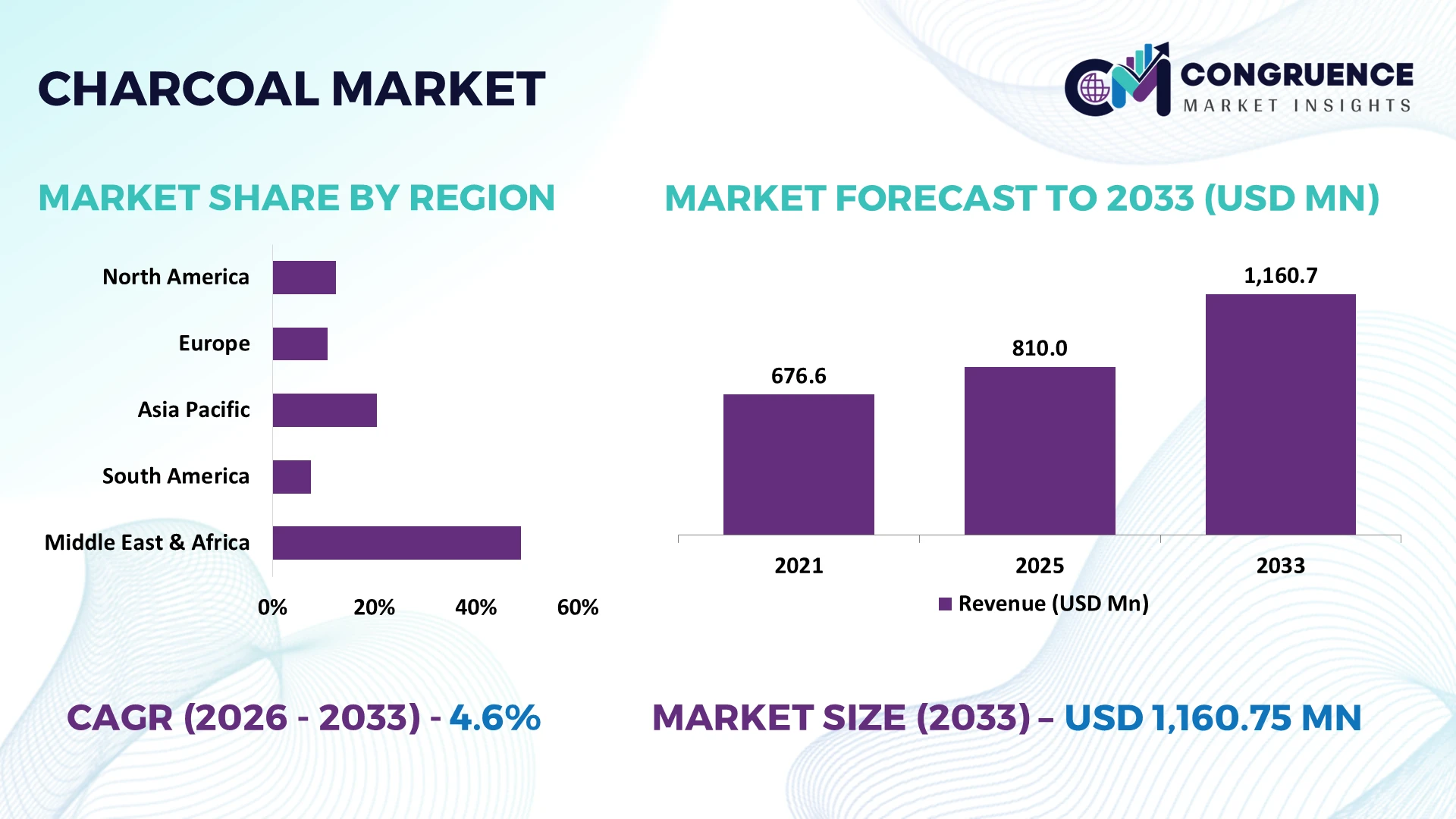
Middle East & Africa accounted for approximately 48.8% of the market in 2025, supported by household cooking, heating, hospitality, and charcoal exports. China remains a major Asia Pacific consumer, while the U.S. maintains strong premium grilling demand. Improved retort kilns achieve approximately 30–42% conversion efficiency versus 10–22% for traditional kilns, creating a substantial production advantage. The EU’s deforestation regulation is tightening traceability requirements for charcoal linked to wood-based feedstocks from December 2026, making certified sourcing increasingly important for exporters.
Strategically, producers should prioritize efficient carbonization, traceable feedstock, premium product grades, and export-compliant supply chains.
Market Size & Growth: USD 810.0 Million in 2025 to USD 1,160.7 Million by 2033 at a 4.6% CAGR, supported by efficient carbonization and premium charcoal grades.
Top Growth Drivers: Premium grilling at 20%, metallurgical applications at 18%, and sustainable charcoal adoption at 15% strengthen demand.
Short-Term Forecast: By 2028, improved kiln systems can achieve 30–42% conversion efficiency compared with 10–22% from traditional systems.
Emerging Technologies: Retort kilns, heat-recovery systems, and automated airflow controls are improving production efficiency and quality consistency.
Regional Leaders: Middle East & Africa holds 48.8% share, Asia Pacific benefits from industrial consumption, and North America expands premium barbecue adoption.
Consumer/End-User Trends: Cooking and heating represent 41.9% of application demand, maintaining charcoal's importance in household and commercial fuel use.
Pilot/Case Example: Improved kiln projects have achieved 30–42% conversion efficiency and emissions reductions of up to 75% compared with traditional production.
Competitive Landscape: Leading suppliers compete across hardwood lump, briquettes, coconut-shell charcoal, and premium grades, with quality and traceability becoming key differentiators.
Regulatory & ESG Impact: EU deforestation rules from December 2026 are increasing traceability requirements and strengthening demand for documented, lower-risk biomass sourcing.
Investment & Funding: Producers are directing investment toward retort capacity, biomass preprocessing, heat recovery, and export-grade packaging.
Innovation & Future Outlook: Coconut-shell grades, cleaner carbonization, heat recovery, and digitally monitored kilns are shifting competition toward yield, certification, and product consistency.
Charcoal remains important across household energy, foodservice, metallurgy, filtration, and specialty fuel applications. Coconut-shell charcoal is expanding at approximately 5.0%, while cooking and heating represent 41.9% of application demand. Producers are increasingly adopting standardized briquettes, premium lump charcoal, and cleaner carbonization technologies as traceability requirements reshape international biomass supply chains.
Charcoal is becoming strategically important as producers transition from informal carbonization toward controlled processing, standardized grades, and traceable biomass sourcing. This shift affects production economics, export eligibility, and access to premium retail and foodservice customers. Competitive advantage is increasingly created through feedstock control, production efficiency, and consistent product specifications.
Traditional earth-mound kilns typically achieve 10–22% conversion efficiency, whereas improved retort systems can reach approximately 30–42%. This difference enables producers to extract substantially more usable charcoal from comparable biomass inputs. Middle East & Africa represents the largest consumption base at 48.8%, while Asia Pacific combines industrial charcoal consumption with increasing adoption of modern production technologies.
Over the next two to three years, producers will prioritize higher-yield kilns, biomass preprocessing, automated temperature monitoring, and documented sourcing. EU deforestation-control requirements will accelerate traceability investments among exporters. Producers in India and East Africa are strengthening improved-kiln deployment, while international suppliers are developing partnerships around certified feedstock and premium packaging. Competitive positioning will increasingly depend on production efficiency, regulatory readiness, and consistent product quality.
Improved carbonization technology is strengthening charcoal production economics, with modern retort systems achieving approximately 30–42% conversion efficiency compared with 10–22% for traditional kilns. Heat recovery and controlled airflow further improve biomass utilization and reduce production losses. In India and East Africa, improved kiln deployment is shifting producers toward standardized commercial production rather than informal batch processing. Companies are investing in retort capacity, biomass preprocessing, and temperature-control systems to improve output consistency. The non-obvious advantage is feedstock productivity: higher conversion efficiency reduces the volume of wood or agricultural residue required per unit of charcoal, improving operating margins while supporting increasingly stringent sustainability expectations.
Feedstock availability remains a structural constraint because charcoal production depends heavily on consistent wood, agricultural residues, and coconut-shell supplies. Seasonal availability can create 10–20% fluctuations in input costs in fragmented production markets, while transport expenses can account for a significant portion of delivered charcoal costs. Kenya, Nigeria, and parts of Southeast Asia face additional pressure from informal sourcing and fragmented logistics. EU traceability requirements from December 2026 increase documentation costs for exporters handling wood-based feedstocks. Producers are responding through multi-source procurement, long-term supplier contracts, local preprocessing facilities, and greater use of agricultural residues to reduce dependence on a single biomass stream.
Coconut-shell charcoal and engineered briquettes create attractive opportunities because standardized feedstocks support consistent burn performance and premium positioning. Coconut-shell charcoal is projected to expand at approximately 5.0%, while improved kiln systems can reach 30–42% conversion efficiency. Producers in Indonesia, India, and Southeast Asia are positioned to integrate coconut-processing residues into higher-value charcoal production. Automated carbonization, heat recovery, and digital temperature monitoring provide additional efficiency gains. Companies are expanding through partnerships with coconut processors, foodservice distributors, and specialty-fuel retailers. The strategic opportunity lies in converting low-value agricultural residues into traceable premium products rather than competing primarily on commodity charcoal volume.
Long-term competitiveness increasingly depends on standardized quality, documented feedstock origins, and consistent production performance. Traditional charcoal operations can experience conversion efficiencies as low as 10–22%, while modern facilities target 30–42%, creating a significant execution gap. Smaller producers also face workforce and infrastructure limitations when adopting automated monitoring, emissions-control equipment, and digital production records. EU deforestation requirements intensify this pressure by requiring stronger supply-chain documentation for affected products. Companies must invest in digital traceability, operator training, quality-control systems, and supplier verification. The critical challenge is integrating fragmented small-scale production into auditable commercial networks without eliminating cost competitiveness.
Premium Briquettes Gain Ground: Charcoal briquettes captured 40.3% of the global market in 2025, supported by uniform burn performance, easier storage, and consistent heat output. Manufacturers are increasing automated pressing and packaging capacity as residential and commercial buyers prioritize standardized fuel. The shift is particularly visible in North American retail, where branded products are replacing fragmented loose-charcoal purchasing.
Coconut Shell Adoption Accelerates: Coconut-shell charcoal is expanding at approximately 5.0%, outpacing mature product categories as filtration, premium grilling, and shisha applications diversify demand. Producers in Indonesia and India are converting coconut-processing residues into higher-value charcoal, reducing dependence on conventional hardwood feedstock. The non-obvious shift is that waste-stream availability is increasingly determining production-location decisions.
Traceability Reshapes Export Workflows: EU deforestation-control requirements are pushing exporters toward documented feedstock origins, supplier verification, and digital chain-of-custody records. Companies supplying European buyers are restructuring procurement workflows ahead of December 2026 implementation, while certified and traceable material commands stronger commercial positioning. This regulatory transition is turning documentation capability into an operational differentiator rather than a compliance afterthought.
Product Innovation Targets Grilling: Premium grilling is moving toward differentiated formats, flavor-enhancing products, and application-specific burn profiles. Kingsford revived its Beercoal partnership in May 2025, demonstrating how established producers are using product innovation to create premium positioning rather than competing only on volume. Companies are simultaneously expanding specialty briquette formats and higher-performance lump charcoal to capture higher-value barbecue consumption.
Charcoal briquettes represented approximately 40.3% of the global charcoal market in 2025, making them the leading product type because standardized dimensions, predictable combustion, easier storage, and consistent heat output support large-scale residential and commercial distribution. Hardwood lump remains strategically important for premium grilling because of its high-temperature performance and lower ash profile, while binchotan serves specialized high-end culinary applications. Companies are prioritizing automated pressing, controlled density, and improved packaging to strengthen product consistency and reduce handling losses.
Coconut-shell charcoal is the fastest-growing type, expanding at approximately 5.0%, driven by its low ash characteristics, high carbon content, longer burn profile, and growing filtration applications. Its feedstock advantage is particularly strong in coconut-producing markets such as India and Indonesia, where processors can convert agricultural residues into higher-value fuel. Briquettes remain the volume-oriented product, while coconut-shell and binchotan products provide premium-margin opportunities. This is shifting investment toward specialized feedstock processing, cleaner carbonization, and differentiated product grades.
Cooking and heating fuel accounted for approximately 41.9% of global charcoal applications in 2025, supported by household energy consumption and commercial food preparation. Metallurgical fuel remains strategically important because charcoal provides a carbon-rich reducing and carburizing input for iron, steel, ferroalloy, and foundry operations. Water and air purification is developing as a higher-value application, particularly through charcoal and activated-carbon products used in filtration systems. Companies are therefore maintaining high-volume cooking products while expanding specification-grade material for industrial customers.
Barbecue and outdoor grilling represents an increasingly important specialized application, supported by premium charcoal adoption in North America and Europe. Water and air purification is gaining additional traction as municipalities and industrial facilities increase filtration requirements; India has introduced activated-charcoal filtration systems within urban infrastructure projects. The application mix is consequently shifting from predominantly fuel-oriented consumption toward a more diversified structure combining household energy, hospitality, metallurgy, and purification. Producers are responding through application-specific grades, higher-purity charcoal, and partnerships with industrial filtration and foodservice customers.
Households represent the largest end-user group, accounting for approximately 42.7% of machine-made charcoal demand in 2025, supported by cooking, grilling, outdoor recreation, and supplemental heating. Commercial users, including restaurants, hotels, catering operations, and foodservice businesses, represented approximately 30.8%, with demand increasingly tied to premium grilling and culinary differentiation. Companies are responding with smaller standardized packs for residential customers and bulk, specification-controlled products for commercial procurement.
Industrial users represented approximately 26.5% and are expanding their role through steelmaking, foundry operations, activated-carbon production, and water treatment. Industrial demand is more specification-driven than household consumption, creating opportunities for suppliers able to provide consistent carbon content, particle size, ash levels, and documented feedstock. Commercial and industrial buyers therefore generate stronger incentives for long-term contracts and customized supply, while household demand remains more sensitive to retail pricing and product convenience. Producers are increasingly segmenting packaging, quality grades, and distribution partnerships around these distinct procurement behaviors.
Middle East & Africa accounted for the largest market share at 48.8% in 2025 however, Asia Pacific is expected to register the fastest growth, expanding at a CAGR of 5.0% between 2026 and 2033.

North America represents a mature charcoal market anchored by household grilling, foodservice, and organized retail distribution. The U.S. accounted for approximately 12.4% of the North American charcoal market in 2024, supported by strong outdoor cooking participation and established distribution through supermarkets, hardware chains, and specialty retailers. Charcoal briquettes remain the dominant product format because standardized dimensions and predictable burn characteristics suit high-volume retail procurement. Premium lump charcoal is gaining traction among artisanal and gourmet grilling customers, creating greater product segmentation. Manufacturers are responding through premium product launches, retail partnerships, sustainable sourcing programs, and expanded packaging formats. The region's strategic advantage lies less in basic production capacity and more in sophisticated downstream distribution, branding, and premiumization.
U.S. Market Outlook: The U.S. is the principal North American market, with outdoor grilling, foodservice, and premium charcoal consumption supporting sustained commercial activity. Major suppliers operate through extensive retail and distribution networks, while demand is shifting toward natural lump charcoal, premium briquettes, and differentiated grilling products. The established consumer-packaged-goods infrastructure enables rapid product rollout and nationwide availability, giving U.S. producers a strong advantage in brand-led charcoal commercialization.
Europe with a market share of approximately 10.8% is shifting toward traceable, sustainability-oriented charcoal procurement as retailers and importers strengthen documentation requirements for wood-based products. Germany, the UK, France, Italy, and Spain form the principal commercial markets, supported by organized retail, hospitality, and outdoor grilling. European buyers increasingly prioritize certified feedstock, consistent product specifications, and documented origin rather than commodity pricing alone. The EU Deforestation Regulation is reinforcing this transition by requiring stronger due-diligence and traceability processes for covered commodities and derived products. Producers targeting Europe are therefore restructuring supplier verification, documentation, and logistics workflows. The region remains commercially important for premium charcoal despite tighter compliance requirements, creating a clear premium for exporters capable of providing auditable supply chains and consistent product quality.
Germany Market Outlook: Germany represents a strategically significant European market because of its large organized retail base, established foodservice sector, and strong consumer focus on product quality and sustainability. Importers and distributors increasingly emphasize certified sourcing and supply-chain documentation, while premium grilling supports demand for higher-quality briquettes and lump charcoal. Suppliers with robust documentation systems and consistent specifications are better positioned to maintain access to German retail and hospitality channels as environmental compliance requirements intensify.
Asia Pacific is the fastest-growing charcoal market, with growth projected at approximately 20.5% through 2033. China dominates regional consumption through its extensive industrial base, while India, Indonesia, Japan, and South Korea contribute through household fuel, metallurgy, filtration, foodservice, and premium grilling applications. The region benefits from abundant biomass resources and established coconut-processing industries, creating an important feedstock advantage for coconut-shell charcoal. China combines large-scale manufacturing capacity with demand from metallurgy, purification, and industrial applications. Indonesia and India are strengthening value-added charcoal production by converting agricultural residues into higher-grade products. Companies are investing in modern carbonization, activated-carbon capacity, export packaging, and supplier partnerships. The strategic shift is toward integrated feedstock-to-product operations that capture more value from agricultural residues.
China Market Outlook: China is the leading Asia Pacific charcoal market, supported by its large manufacturing base and extensive industrial consumption. Charcoal is utilized across metallurgy, purification, manufacturing, and foodservice applications, while strong domestic production capabilities support supply availability. China's established industrial infrastructure also facilitates investment in activated-carbon and filtration applications, allowing producers to move beyond conventional fuel markets into higher-value industrial products.
South America has a particularly strong charcoal position with a market shared of 7.5% in metallurgy because Brazil integrates plantation forestry with charcoal-based pig-iron and steel production. Brazil produced approximately 6.6 million tons of charcoal in 2024, representing the world's largest national production volume in the referenced industry data. Around 100% of Brazil's annual production was absorbed domestically, demonstrating the importance of industrial consumption rather than export demand. Charcoal is used as both an energy source and reducing agent in pig-iron production, creating a specialized industrial ecosystem. Producers are increasingly focused on plantation-grown eucalyptus, kiln modernization, and lower-carbon steel pathways. The region's main constraint is concentration around Brazil, but this concentration also provides a strong platform for technology investment and industrial partnerships.
Brazil Market Outlook: Brazil is the strategic center of South America's charcoal industry, with approximately 6.6 million tons of production recorded in 2024. Its eucalyptus plantation system, established charcoal-processing infrastructure, and integrated pig-iron industry provide a distinctive supply chain. Modern metallurgical operations can use charcoal as a renewable reducing agent, strengthening its relevance to lower-carbon steel production. Companies are investing in plantation management, kiln efficiency, and process integration to improve consistency and environmental performance.
Middle East & Africa accounted for 48.8% of the global charcoal market in 2025, the largest regional share, supported particularly by household cooking and heating across African economies. Abundant biomass availability, established informal production networks, export-oriented suppliers, and hospitality demand reinforce regional consumption. South Africa has an established barbecue culture and growing demand for premium hardwood charcoal, while countries such as Ethiopia and Nigeria remain major production centers for domestic use. The region faces a distinct transition as urban consumers gradually adopt LPG and other modern fuels, increasing pressure on traditional charcoal supply chains. Producers are responding through cleaner kilns, standardized packaging, export-grade products, and improved feedstock management. The strategic opportunity is to move from fragmented commodity production toward traceable, higher-efficiency commercial operations.
South Africa Market Outlook: South Africa is the most strategically developed charcoal market within the region for premium grilling, supported by its established braai culture, retail infrastructure, and demand for hardwood products. Premium charcoal suppliers are differentiating products through wood species, burn duration, packaging, and sustainability positioning. This creates a more sophisticated commercial segment than basic household-fuel consumption, allowing companies to expand through specialty retail, hospitality partnerships, and higher-value grilling products.
Global brands such as Kingsford, Royal Oak, and Duraflame compete in North American retail and foodservice, while regional specialists including Jumbo Charcoal, Namchar, and Mesjaya compete through feedstock access, export logistics, and supply. The market remains fragmented, with the top five players estimated to control roughly 25% of sales, leaving volume to regional producers and informal channels. Competition centers on price, burn consistency, sourcing reliability, and product differentiation: lump charcoal can command 15%–35% higher prices than commodity alternatives, while modern kiln systems can raise conversion efficiency by 20%–43% versus traditional earth-mound kilns. Players expand through distribution, sustainability certifications, product innovation, and partnerships; Kingsford’s 2025 Beercoal relaunch demonstrates flavor-led differentiation, while Duraflame’s Char·Logs introduces airflow. The competitive shift favors controlled feedstock, traceability, efficient carbonization, and branded formats. Entry pressure comes from feedstock contracts, certification, quality control, and distribution scale. Winning requires dependable supply, measurable performance, and differentiated positioning.
Duraflame Inc.
E & C Charcoal
Etosha
Fire & Flavor
Jumbo Charcoal (Pty) Ltd.
Kingsford Products Company
Mesjaya Sdn Bhd
Namchar
NamCo Charcoal and Timber Products
Rancher Charcoal
Royal Oak Enterprises LLC
Sagar Charcoal and Firewood Depot
Retort and improved brick-kiln systems are becoming the production upgrade, replacing uncontrolled earth-mound carbonization with insulated chambers, airflow regulation, and pyrolysis-gas reuse. Improved designs can cut production time 58.8% and firewood consumption 58.3%, while retort systems achieve roughly 30%–42% efficiency versus 10%–22% traditionally. Adoption remains concentrated in industrial and community production, but deployment is expanding where feedstock costs and emissions controls justify investment.
Sensor-based temperature monitoring, automated airflow control, and mobile pyrolysis units are the emerging layer. Automated mobile systems can regulate temperature, fuel flow, and air supply, while tested units deliver 15.6%–22.2% conversion efficiency. Digital controls can improve process consistency by 1%–2% and reduce operator intervention by a similar margin in optimized operations. Integration with biomass drying, heat recovery, and emissions monitoring creates advantages in yield control, quality grading, and compliance.
Disruptive development is the conversion of charcoal fines and agricultural residues into standardized briquettes, specialty charcoal, and activated-carbon feedstocks. Newer engineered formats can deliver 1%–2% better burn consistency and reduce waste versus irregular lump products. From 2026–2028, producers combining automation, traceable feedstocks, and value-added carbon products will gain margins and supply resilience. Large integrated producers benefit most because they can fund equipment, quality laboratories, and closed-loop processing.
May 2025 Kingsford and Miller Lite relaunched Beercoal, expanding the beer-infused briquet collaboration into nationwide retail after prior sellouts. The release converted a limited online concept into broader distribution, reinforcing flavor-led differentiation and retail visibility across channels.
2025 Duraflame introduced Char·Logs, a U.S.-made oak-and-hickory charcoal product using THERMACORE airflow technology. Each 14-pound bag provides up to four grilling occasions, extending the portfolio into engineered charcoal formats and targeting faster lighting and longer burns. Source: duraflame.com
August 2025 Kingsford launched Pass The Tongs with HBCU partners, extending its community strategy. The initiative cited more than $355,000 invested since 2021 through Preserve the Pit, strengthening brand engagement with barbecue entrepreneurs and segments. Source: thecloroxcompany.com
February 2026 Fire & Flavor featured Homegating with its Lump Charcoal, reinforcing premium charcoal positioning for event-based grilling. Its HERO system uses charcoal pods delivering over 60 minutes of cooking time, supporting portable convenience and differentiated outdoor-use experiences. Source: fireandflavor.com
The Charcoal Market Report covers product types including charcoal briquettes, hardwood lump, coconut-shell charcoal, binchotan, and other products, with applications spanning cooking and heating fuel, metallurgical fuel, barbecue/outdoor grilling, water and air purification, healthcare, personal care and cosmetics, filtration, and other uses. Regional coverage includes North America, Europe, Asia Pacific, Latin America, and Middle East & Africa, with country-level analysis across major consuming and producing markets.
The report evaluates feedstock sourcing, carbonization systems, retort and improved-kiln technologies, quality control, sustainable production, and emerging value-added applications. It also examines regional supply structures, premium versus commodity positioning, and competitive participation across global brands and regional producers. These insights support investment planning, capacity expansion, sourcing strategy, market-entry decisions, competitive positioning, and technology upgrades, while identifying niche opportunities in coconut-shell charcoal, specialty grilling formats, filtration, and industrial carbon applications through 2026–2033.
| Report Attribute / Metric | Details |
|---|---|
| Market Revenue (2025) | USD 810.0 Million |
| Market Revenue (2033) | USD 1,160.7 Million |
| CAGR (2026–2033) | 4.6% |
| Base Year | 2025 |
| Forecast Period | 2026–2033 |
| Historic Period | 2021–2025 |
| Segments Covered |
By Type
By Application
By End-User
|
| Key Deliverables | Revenue Forecast; Market Trends; Growth Drivers & Restraints; Technology Insights; Segmentation Analysis; Regional Insights; Competitive Landscape; Regulatory & ESG Overview; Recent Developments |
| Regions Covered | North America; Europe; Asia Pacific; South America; Middle East & Africa |
| Companies Profiled | Duraflame Inc.; E & C Charcoal; Etosha; Fire & Flavor; Jumbo Charcoal (Pty) Ltd.; Kingsford Products Company; Mesjaya Sdn Bhd; Namchar; NamCo Charcoal and Timber Products; Rancher Charcoal; Royal Oak Enterprises LLC.; Sagar Charcoal and Firewood Depot |
| Customization & Pricing | Available on Request (10% Customization Free) |




