
Reports
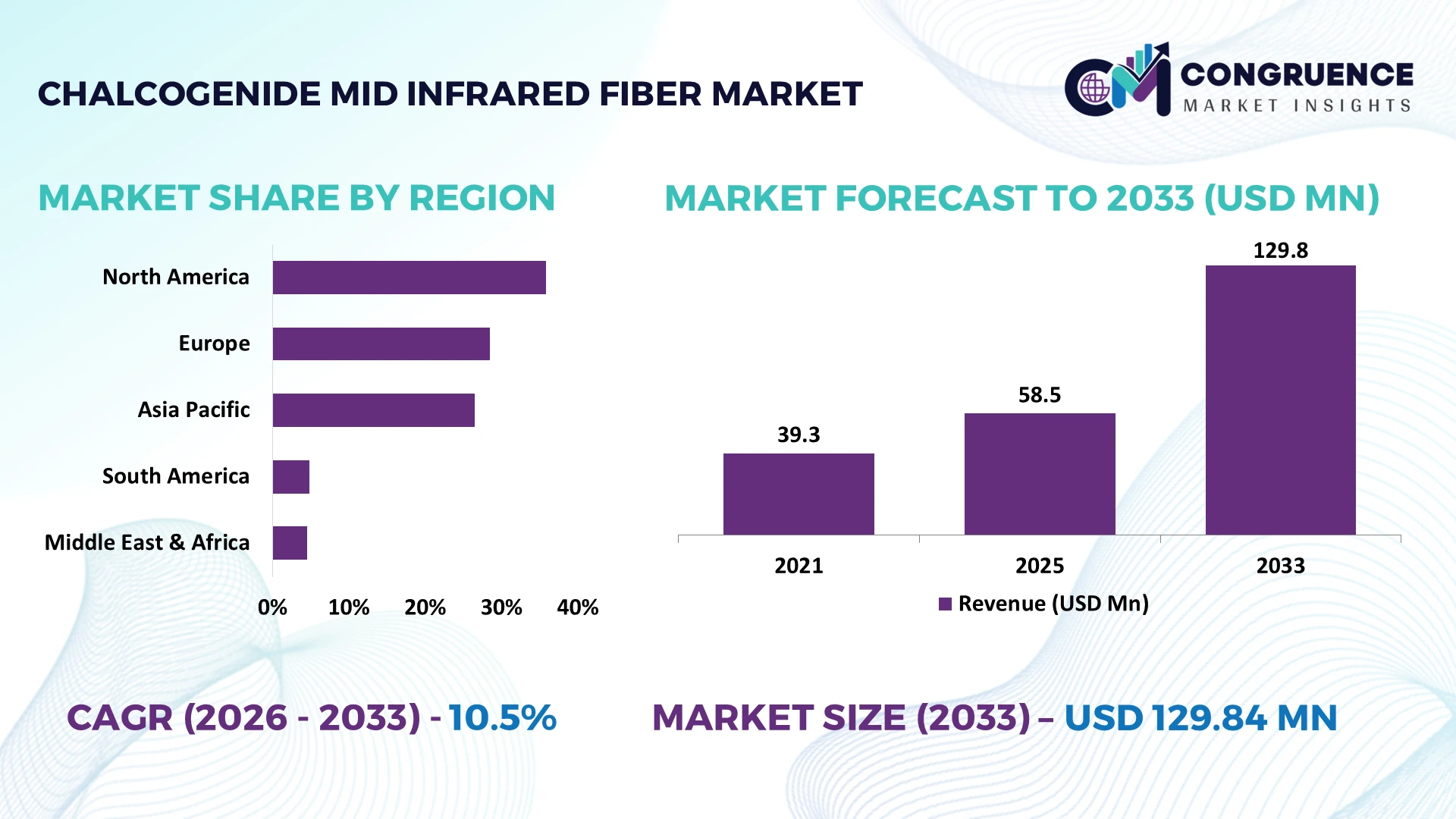
The Global Chalcogenide Mid-infrared Fiber Market was valued at USD 58.5 Million in 2025 and is anticipated to reach a value of USD 129.8 Million by 2033 expanding at a CAGR of 10.48% between 2026 and 2033. Increasing deployment of mid-infrared spectroscopy, military infrared countermeasure systems, minimally invasive medical instruments, and advanced chemical sensing technologies is accelerating market expansion.
The United States represents an estimated 29.5% of global demand, supported by substantial defense research investments, semiconductor manufacturing expansion, and advanced photonics infrastructure. Compared with Germany, the United States benefits from broader aerospace and military infrared system deployment. The USD 52.7 billion CHIPS Act funding framework and chalcogenide glass transmission capabilities extending beyond 10 µm reinforce its technological leadership across specialized sensing applications.
Competitive advantage increasingly depends on low-loss fiber manufacturing, high-purity glass processing, and application-specific integration partnerships with defense, healthcare, and industrial equipment manufacturers.
Market Size & Growth: USD 58.5 million in 2025 to USD 129.8 million by 2033, at 10.48% CAGR, driven by infrared sensing applications.
Top Growth Drivers: Industrial spectroscopy (35%), defense and aerospace modernization (30%), and medical diagnostics (20%) represent major estimated growth contributions.
Short-Term Forecast: By 2028, manufacturers target 15–20% lower optical transmission losses through improved glass purification.
Emerging Technologies: Hollow-core fibers, supercontinuum laser sources, and advanced microstructured fibers enable broadband operation across 2–12 µm wavelengths.
Regional Leaders: Projected 2033 values include North America (USD 46.7 million; defense), Europe (USD 36.3 million; spectroscopy), and Asia Pacific (USD 35.0 million; semiconductor inspection).
Consumer/End-User Trends: Industrial and research organizations collectively represent an estimated 45% of specialized fiber consumption.
Pilot/Case Example: The 2025 infrared sensing development benchmark targets 20% lower signal losses through optimized fiber geometry.
Competitive Landscape: art photonics holds an indicative 18% share, competing with Le Verre Fluoré, IRflex Corporation, and CorActive.
Regulatory & ESG Impact: EU methane regulations strengthen opportunities for infrared detection of methane around the 3.3 µm absorption band.
Investment & Funding: An illustrative USD 25 million investment scenario prioritizes specialty photonics manufacturing, purification infrastructure, and research partnerships.
Innovation & Future Outlook: Next-generation fibers targeting transmission beyond 12 µm support expanded molecular fingerprinting and advanced infrared imaging.
The Chalcogenide Mid-infrared Fiber Market is experiencing technological transformation through advanced molecular spectroscopy, distributed chemical sensing, and fiber-coupled infrared laser systems. Industrial monitoring and analytical instrumentation account for an estimated 35% of demand. Innovations in microstructured glass fibers and broadband supercontinuum generation, alongside semiconductor supply-chain localization, are strengthening application diversification and reshaping strategic investment priorities across the specialty photonics ecosystem.
Chalcogenide mid-infrared fibers are becoming strategically important as manufacturers transition toward compact, high-sensitivity optical systems for chemical identification, defense surveillance, and industrial process monitoring. Semiconductor supply-chain restructuring and domestic photonics manufacturing initiatives in the United States, Japan, and Germany are strengthening demand for specialized optical materials capable of operating beyond conventional silica fiber transmission limits.
Unlike conventional silica fibers, which experience substantial transmission limitations beyond approximately 2.2 µm, selected chalcogenide fibers operate across wavelengths extending to 12 µm, expanding the accessible upper wavelength limit by over 400%. The United States emphasizes defense-oriented infrared technologies, while Germany prioritizes industrial spectroscopy and Japan advances precision optical manufacturing. By 2028–2029, manufacturers are targeting 15–20% improvements in transmission efficiency through enhanced purification and fiber-drawing processes.
Practical deployment includes fiber-coupled infrared probes that identify hydrocarbon contamination directly within industrial processing equipment, reducing dependence on laboratory-based sampling. Companies are prioritizing partnerships with spectroscopy equipment manufacturers, specialized glass research institutions, and laser developers. Long-term competitive positioning depends on converting advanced optical performance into repeatable manufacturing quality, reliable system integration, and application-specific commercial solutions.
Growing adoption of real-time molecular spectroscopy is accelerating demand for chalcogenide mid-infrared fibers across chemical processing, pharmaceutical manufacturing, and environmental monitoring. Industrial spectroscopy represents an estimated 35% of market demand, while defense and aerospace applications contribute approximately 30%. Selected chalcogenide compositions provide upper transmission wavelength limits exceeding those of conventional silica fibers by over 400%. The European Union’s methane emissions regulation strengthens opportunities for infrared-based leak detection across energy infrastructure. Manufacturers are responding through advanced fiber-drawing investments, spectroscopy equipment partnerships, and customized optical probe development. Direct integration into processing equipment enables continuous molecular identification, creating recurring demand for application-specific fiber assemblies rather than standalone optical components.
Chalcogenide fiber manufacturing faces structural limitations arising from expensive high-purity raw materials, specialized glass synthesis, and controlled-atmosphere processing requirements. Under indicative manufacturing cost assumptions, material purification and glass preparation account for approximately 30–35% of production expenditure, while specialized fiber drawing contributes another 20–25%. China's dominant position in germanium production and its export licensing restrictions increase procurement uncertainty for manufacturers utilizing germanium-based glass compositions. These constraints compress operating margins and limit price competitiveness against alternative infrared transmission technologies. Manufacturers are addressing supply exposure through diversified sourcing agreements, alternative arsenic-selenium glass formulations, and improved material recovery processes. Composition flexibility is becoming essential for maintaining optical performance without excessive dependence on geographically concentrated feedstocks.
Emerging applications in minimally invasive medical diagnostics, tissue characterization, and broadband infrared laser delivery create opportunities for specialized chalcogenide fiber manufacturers. Healthcare applications represent an estimated 15% of current demand, while next-generation medical sensing systems target 20–25% improvements in diagnostic signal quality through optimized optical configurations. Japan and the United States are advancing fiber-coupled spectroscopy research for biochemical identification and endoscopic tissue analysis. Broadband supercontinuum generation also enables multiple molecular absorption bands to be examined through a single optical platform. Companies are positioning through microstructured fiber research, medical device partnerships, and customized probe development. The strongest commercial opportunity lies in integrated diagnostic assemblies that generate higher value than conventional bulk fiber sales.
Maintaining consistent optical transmission, mechanical durability, and dimensional accuracy during commercial-scale manufacturing remains a critical execution challenge. Uncoated arsenic-selenium glass interfaces with a refractive index near 2.8 experience approximately 22% Fresnel reflection per surface, while combined interface transmission losses approach 40% across two surfaces. Manufacturers must target production yields exceeding 90% to support economically viable high-volume deployment. Germany’s precision photonics sector and Japan’s optical component industry increasingly require application-specific qualification, stable connector performance, and repeatable environmental resistance. Companies must invest in automated optical inspection, antireflection coatings, hermetic packaging, and standardized coupling architectures. Competitive scalability depends on delivering consistent system-level performance rather than achieving exceptional laboratory transmission characteristics alone.
Automated Fiber Drawing Process Controls: Manufacturers are integrating closed-loop temperature regulation, laser-based diameter measurement, and automated tension control into specialty fiber production. Process optimization targets diameter deviations below 2% and manufacturing yield improvements of 10–15%. Companies are upgrading drawing towers and inspection systems to reduce batch variability, minimize material wastage, and improve production economics.
Transition Toward Connectorized Fiber Assemblies: Equipment manufacturers are increasingly replacing bare optical fibers with application-ready assemblies incorporating protective jackets, precision connectors, and antireflection coatings. Optimized interfaces target coupling losses below 10% and installation time reductions of 20–25%. Suppliers are expanding customized assembly capabilities, shifting competitive differentiation toward system compatibility and installation efficiency rather than fiber specifications alone.
Regionalized Specialty Glass Supply Networks: Chinese export controls on germanium are encouraging American, Japanese, and European manufacturers to diversify specialty material procurement. Companies are targeting dual-source coverage for 70–80% of critical inputs and inventory buffers of three to six months. Procurement restructuring and long-term supplier agreements are improving production continuity while reducing exposure to concentrated material supply chains.
Expansion of Application-Specific Fiber Geometries: Manufacturers are developing tapered fibers, customized core diameters, and specialized numerical apertures to improve equipment compatibility. Commercial designs increasingly accommodate core diameters ranging from 100 to 1,000 µm and numerical apertures around 0.2–0.5. Suppliers are strengthening collaborative engineering programs with equipment manufacturers to shorten qualification cycles and improve optical coupling performance.
Selenide-based Fibers accounted for the largest market share at approximately 49.4% in 2025, supported by broad infrared transparency, high refractive indices, and compatibility with advanced optical sensing systems. Their extended transmission capabilities make them particularly suitable for defense instrumentation, molecular spectroscopy, and broadband infrared light delivery. Sulphide-based Fibers represented approximately 35.4% of the market, benefiting from established manufacturing processes, comparatively stable glass formulations, and suitability for shorter mid-infrared wavelengths. German and American manufacturers are prioritizing selenide-based fiber optimization to address increasingly demanding optical performance specifications.
Telluride-based Fibers, accounting for approximately 15.2% of the market, are projected to emerge as the fastest-growing segment under the anticipated shift toward longer-wavelength infrared applications. Their extended spectral coverage supports specialized thermal sensing and molecular fingerprinting requirements that conventional sulphide compositions cannot adequately address. While sulphide-based fibers retain advantages in established spectroscopy applications, telluride-based compositions attract investment in advanced material purification and thermal stabilization. Manufacturers are diversifying glass formulations, improving fiber-drawing parameters, and collaborating with infrared equipment developers to strengthen application-specific product portfolios.
Military and Defense accounted for the largest market share at approximately 38.0% in 2025, supported by integration into infrared countermeasure systems, specialized detection equipment, and advanced optical instrumentation. Defense contractors prioritize broadband transmission, environmental stability, and reliable optical performance under demanding operating conditions. The United States remains a prominent deployment market due to sustained investment in advanced defense photonics. Medical Surgery and Diagnostics represented approximately 33.2% of demand, reflecting the increasing utilization of fiber-coupled infrared systems in tissue characterization, precision diagnostics, and specialized laser delivery.
Medical Surgery and Diagnostics are projected to register the fastest growth as equipment manufacturers prioritize compact optical assemblies and minimally invasive treatment technologies. Chemical Sensing and Spectroscopy accounted for approximately 19.9% of demand, supported by molecular analysis, material identification, and industrial process monitoring. Other Industrial Applications contribute through specialized inspection, environmental measurement, and manufacturing quality control. Unlike defense procurement, medical and analytical applications require standardized integration and repeatable operating performance across larger equipment portfolios. Manufacturers are responding through customized fiber assemblies, equipment development partnerships, and application-specific qualification programs.
Defense and Aerospace Organizations are estimated to account for the largest market share at 36.5% in 2025, supported by specialized infrared equipment procurement, stringent optical performance requirements, and long-term system development programs. American defense contractors and aerospace equipment manufacturers prioritize qualified fiber assemblies capable of maintaining transmission reliability across demanding operating environments. Medical Device Manufacturers represent an estimated 29.5% of demand, driven by the integration of infrared optical components into diagnostic instruments and specialized medical equipment. Established defense procurement emphasizes qualification and operational durability, whereas medical equipment buyers prioritize compactness, reproducibility, and regulatory compatibility.
Medical Device Manufacturers are projected to register the fastest growth as equipment developers expand minimally invasive diagnostic platforms and fiber-integrated optical technologies. Industrial and Chemical Manufacturing Companies represent an estimated 21.0% of demand, supported by process monitoring and material characterization requirements. Research and Academic Institutions contribute through experimental photonics, advanced glass development, and prototype validation. Suppliers are targeting these buyer groups through customized connectors, application-specific optical specifications, collaborative development agreements, and tiered product portfolios that accommodate differing procurement volumes and qualification requirements.
North America accounted for the largest market share at 35.8% in 2025 however, Asia-Pacific is expected to register the fastest growth, expanding at a CAGR of 12.4% between 2026 and 2033.
North America accounted for approximately 35.8% of the global market in 2025, supported by advanced defense infrastructure, established specialty photonics manufacturers, and extensive research capabilities. Demand remains concentrated across infrared countermeasure systems, chemical spectroscopy, aerospace instrumentation, and specialized medical equipment. The United States and Canada maintain strong research ecosystems focused on low-loss optical fibers, broadband infrared sources, and advanced glass compositions. The American AIM Photonics initiative, established with approximately USD 600 million in public and private commitments, strengthens the broader photonics development and commercialization ecosystem. Regional manufacturers are prioritizing customized fiber assemblies, precision optical coupling, and application-specific qualification to meet stringent equipment requirements. Established relationships between defense contractors, research institutions, and optical component suppliers reinforce regional leadership while creating substantial qualification barriers for emerging international manufacturers.
United States Market Outlook: The United States leads regional demand, accounting for an estimated 29.5% of the global market in 2025. Organizations such as the Naval Research Laboratory support advanced infrared materials research, including chalcogenide glass development. The country's extensive defense procurement infrastructure and specialized medical technology manufacturing capabilities encourage suppliers to develop ruggedized optical assemblies and high-performance infrared transmission solutions.
Europe accounted for approximately 28.4% of the global market in 2025, driven by established optical component manufacturing, industrial spectroscopy deployment, and advanced materials research. Germany, France, and the United Kingdom maintain specialized capabilities in infrared fiber development, analytical instrumentation, and precision optical engineering. The European Union’s Horizon Europe research framework, with an original budget of EUR 95.5 billion for 2021–2027, supports the broader scientific and technological ecosystem underpinning advanced photonics innovation. Environmental monitoring requirements and industrial emissions regulations are strengthening interest in wavelength-specific chemical detection technologies. European manufacturers are emphasizing low-loss fiber configurations, customized spectroscopy probes, and protective packaging solutions for demanding industrial environments. Competitive positioning increasingly depends on integrating specialty optical fibers into complete analytical systems, enabling manufacturers to differentiate through measurement accuracy, equipment compatibility, and long-term operational reliability.
Germany Market Outlook: Germany maintains a leading regional position through its established precision optics industry, chemical manufacturing infrastructure, and specialized spectroscopy equipment suppliers. Organizations such as art photonics offer chalcogenide fiber solutions covering wavelengths of approximately 1.1–6.5 µm in selected configurations. Domestic manufacturers benefit from close collaboration with analytical instrument developers, supporting customized optical assemblies for industrial process monitoring and laboratory applications.
Asia-Pacific accounted for approximately 26.5% of the global market in 2025, supported by expanding precision optical manufacturing, semiconductor infrastructure, and advanced materials research. China, Japan, and South Korea are strengthening domestic capabilities in infrared instrumentation, specialty glass processing, and optical component integration. Japan’s government announced a support framework exceeding JPY 10 trillion for artificial intelligence and semiconductor industries through fiscal 2030, strengthening the broader ecosystem for advanced optical inspection technologies. China’s established germanium production capabilities provide strategic advantages in sourcing selected chalcogenide glass constituents. Regional manufacturers are increasingly investing in automated fiber drawing, optical characterization, and application-specific component development. Competitive expansion is shifting toward localized specialty fiber manufacturing and closer collaboration with analytical equipment producers, reducing dependence on imported optical assemblies while improving customization capabilities and procurement efficiency.
China Market Outlook: China is strategically positioned through its extensive industrial manufacturing base, specialty materials supply chains, and expanding photonics research infrastructure. The country accounted for approximately 60% of estimated global primary germanium production in recent industry assessments. Domestic optical component manufacturers benefit from proximity to critical material suppliers, while expanding semiconductor inspection and infrared sensing capabilities support localized specialty fiber development.
South America accounted for approximately 4.8% of the global market in 2025, with demand concentrated across industrial spectroscopy, mining operations, petrochemical processing, and academic research. Brazil, Chile, and Argentina represent important adoption markets due to their established resource extraction industries and expanding analytical instrumentation requirements. Brazil’s New Industry Brazil initiative initially allocated BRL 300 billion in financing through 2026 to support industrial modernization and technological development. This broader modernization framework creates opportunities for advanced optical measurement technologies within manufacturing and processing facilities. However, limited domestic specialty fiber production and dependence on imported photonics components increase procurement costs and equipment servicing requirements. International manufacturers are addressing these limitations through regional distribution partnerships, technical training, and customized instrumentation packages. Commercial expansion remains closely linked to industrial automation investments and the availability of specialized optical engineering expertise.
Brazil Market Outlook: Brazil leads regional demand through its extensive petrochemical, mining, and industrial research infrastructure. The Brazilian Synchrotron Light Laboratory operates Sirius, a 3 GeV fourth-generation synchrotron light source supporting advanced materials characterization and scientific research. This infrastructure strengthens the domestic photonics research ecosystem, creating opportunities for specialized infrared optical components, laboratory instrumentation, and collaborative technology development with international suppliers.
Middle East & Africa accounted for approximately 4.5% of the global market in 2025, supported by energy infrastructure modernization, petrochemical processing, defense investments, and emerging scientific research capabilities. Saudi Arabia, the United Arab Emirates, Israel, and South Africa represent strategically important markets for specialized infrared instrumentation. Demand primarily originates from chemical analysis, hydrocarbon identification, environmental monitoring, and advanced security systems. Qatar’s North Field expansion targets an increase in annual liquefied natural gas production capacity from 77 million tonnes to 142 million tonnes by 2030, strengthening the broader industrial monitoring equipment ecosystem. Regional buyers remain dependent on imported specialty optical fibers and integrated analytical instruments. Manufacturers are targeting opportunities through equipment distributor partnerships, application-specific sensing solutions, and localized technical support, with operational reliability and environmental durability becoming important procurement considerations.
Saudi Arabia Market Outlook: Saudi Arabia maintains a prominent regional position through extensive hydrocarbon processing infrastructure and industrial diversification initiatives under Vision 2030. Saudi Aramco’s capital investment reached USD 53.3 billion in 2024, reflecting substantial expenditure across energy and industrial infrastructure. Expanding process automation and chemical monitoring requirements create opportunities for specialized infrared spectroscopy equipment and fiber-integrated analytical systems.
The Chalcogenide Mid-infrared Fiber Market exhibits a moderately concentrated structure, with the five leading suppliers collectively accounting for an estimated 57.5% of global demand. art photonics, IRflex Corporation, and Le Verre Fluoré compete through specialty glass expertise, while Thorlabs and FiberLabs emphasize optical component integration and application-specific customization. Competition centers on transmission efficiency, spectral coverage, material purity, and manufacturing consistency. Advanced antireflection coatings target interface loss reductions exceeding 50%, while automated drawing processes target manufacturing yield improvements of 15–20%. Suppliers are strengthening equipment manufacturer partnerships, expanding customized fiber portfolios, and integrating precision connectorization capabilities. Competitive differentiation is shifting from standalone fiber production toward application-ready infrared optical assemblies supporting spectroscopy, defense instrumentation, and medical equipment. High-purity material procurement, specialized glass processing, and stringent equipment qualification create substantial entry barriers. Winning suppliers must combine reproducible optical performance, flexible manufacturing, dependable material sourcing, and collaborative engineering capabilities to secure long-term equipment integration contracts.
IRflex Corporation
art photonics GmbH
CorActive High-Tech Inc.
Le Verre Fluoré
Thorlabs, Inc.
FiberLabs Inc.
Amorphous Materials, Inc.
SCHOTT AG
NKT Photonics A/S
Guiding Photonics
Conventional step-index chalcogenide fibers remain commercially established across infrared spectroscopy, optical sensing, and specialized beam delivery. Advanced purification techniques reduce impurity-related absorption, enabling attenuation levels approaching 0.05 dB/m at selected wavelengths. Optimized antireflection coatings target reductions exceeding 50% in interface reflection losses. Manufacturers adopting precision connectorization and protective polymer coatings benefit from improved integration reliability, lower maintenance requirements, and stronger equipment compatibility.
Emerging antiresonant hollow-core chalcogenide fibers are transforming laser delivery by reducing optical interaction with absorbing glass materials. Compared with a conventional fiber exhibiting 1.3 dB/m attenuation, an optimized configuration achieving 0.3 dB/m delivers approximately 77% lower attenuation under comparable measurement conditions. Experimental demonstrations remain concentrated within advanced research environments. Microstructured fiber architectures also enable dispersion management, broadband supercontinuum generation, and wavelength-specific optical confinement.
Between 2026 and 2028, integrated infrared photonic platforms combining specialty fibers, quantum cascade lasers, and compact spectroscopic detectors will increasingly influence equipment development. Advanced fiber combiners targeting optical efficiency above 80% support consolidated infrared light delivery architectures. Suppliers possessing proprietary glass formulations, automated fabrication capabilities, and collaborative equipment development partnerships benefit from stronger commercialization prospects. Investment priorities increasingly favor repeatable optical performance, scalable manufacturing, standardized interfaces, and integrated solutions that reduce qualification complexity across demanding industrial and scientific applications.
August 2025, IRflex Corporation secured a USD 1.8 million Phase II government contract to develop an infrared optical fiber combiner targeting over 80% combining efficiency, advancing integrated infrared laser architectures and strengthening its position in specialized photonics development. Source: sbir.gov
June 2025, art photonics GmbH published updated technical specifications for chalcogenide mid-infrared fibers, documenting attenuation of 0.2–0.4 dB/m across selected wavelengths. The specifications support equipment manufacturers in evaluating optical transmission performance and selecting suitable fibers for spectroscopy integration. Source: artphotonics.com
August 2024, IRflex Corporation issued revised technical documentation for its IRF-S chalcogenide fiber series, specifying typical attenuation of 0.05 dB/m at 2.8 µm. The documented performance supports low-loss infrared transmission requirements across specialized sensing and optical equipment applications. Source: irflex.com
May 2024, CorActive published a technical article highlighting chalcogenide optical fibers with typical transmission coverage between 2 and 12 µm. The publication outlined medical diagnostics, infrared imaging, and chemical sensing applications, supporting customer understanding of specialty fiber capabilities. Source: coractive.com
The Chalcogenide Mid-infrared Fiber Market Report provides comprehensive analysis across Selenide-based Fibers, Sulphide-based Fibers, and Telluride-based Fibers, covering applications in Military and Defense, Medical Surgery and Diagnostics, Chemical Sensing and Spectroscopy, and Other Industrial Applications. End-user coverage includes Defense and Aerospace Organizations, Medical Device Manufacturers, Industrial and Chemical Manufacturing Companies, and Research and Academic Institutions. The report evaluates market dynamics across North America, Europe, Asia-Pacific, South America, and Middle East & Africa.
The study examines advanced glass purification, microstructured optical fibers, antiresonant hollow-core technologies, broadband supercontinuum generation, and precision fiber manufacturing processes. Covering three fiber types, four application categories, four end-user groups, and five geographical regions, the report supports investment planning, product portfolio diversification, competitive benchmarking, manufacturing expansion, and strategic partnership development between 2026 and 2033.
| Report Attribute / Metric | Details |
|---|---|
| Market Revenue (2025) | USD 58.5 Million |
| Market Revenue (2033) | USD 129.8 Million |
| CAGR (2026–2033) | 10.48% |
| Base Year | 2025 |
| Forecast Period | 2026–2033 |
| Historic Period | 2021–2025 |
| Segments Covered |
By Type
By Application
By End-User
|
| Key Report Deliverables | Revenue Forecast; Market Trends; Growth Drivers & Restraints; Technology Insights; Segmentation Analysis; Regional Insights; Competitive Landscape; Regulatory & ESG Overview; Recent Developments |
| Regions Covered | North America; Europe; Asia-Pacific; South America; Middle East & Africa |
| Key Players Analyzed | IRflex Corporation; art photonics GmbH; CorActive High-Tech Inc.; Le Verre Fluoré; Thorlabs, Inc.; FiberLabs Inc.; Amorphous Materials, Inc.; SCHOTT AG; NKT Photonics A/S; Guiding Photonics |
| Customization & Pricing | Available on Request (10% Customization Free) |




