
Reports
The Global Chafing Fuel Market was valued at USD 1,173.4 Million in 2025 and is anticipated to reach a value of USD 1,630.8 Million by 2033 expanding at a CAGR of 4.2% between 2026 and 2033. Growth is being driven by sustained demand from catering, hospitality, banquet operations, and foodservice venues requiring portable, consistent-temperature food warming.
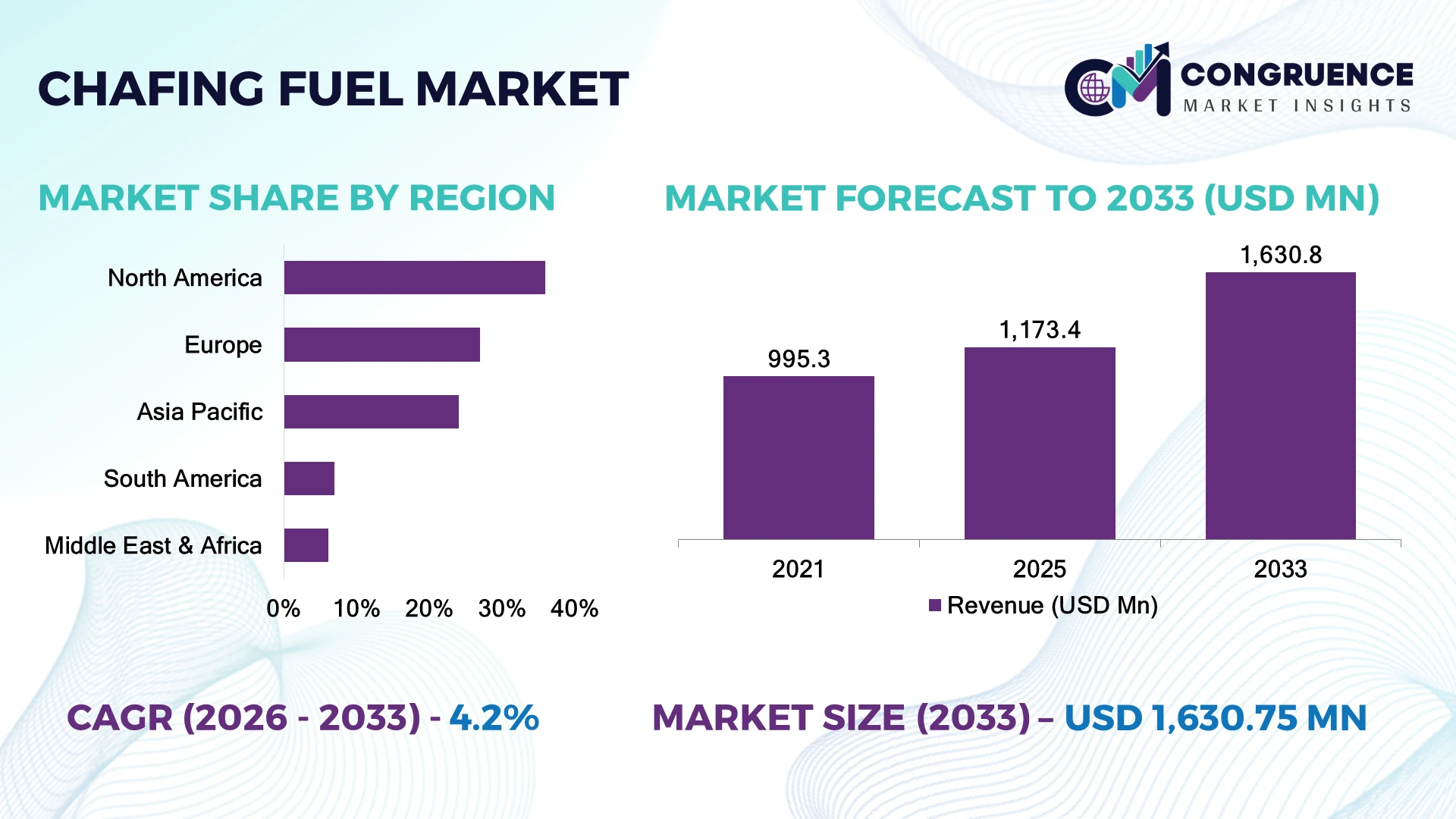
The United States leads the market with approximately 29% share, supported by extensive hotel, catering, buffet, and institutional foodservice infrastructure. Europe follows at roughly 25%, while Asia-Pacific is expanding adoption through hospitality development and large-scale events. In 2026, ethanol- and gel-based fuels increasingly replace higher-soot alternatives, with cleaner-burning formulations gaining approximately 15% greater preference among premium foodservice operators. U.S. catering networks remain more standardized than fragmented Asian operators.
Strategically, suppliers should prioritize clean-burning formulations, longer burn times, and packaging formats aligned with commercial foodservice procurement.
Market Size & Growth: USD 1,173.4M in 2025 to USD 1,630.8M by 2033 at 4.2% CAGR, driven by hospitality expansion and cleaner portable-heating formats.
Top Growth Drivers: Hospitality 32%; catering 27%; institutional foodservice 19%.
Short-Term Forecast: By 2028, improved wick and gel formulations are positioned to deliver 8–12% longer burn duration and reduce fuel replacement frequency.
Emerging Technologies: Bioethanol gels, smokeless formulations, improved wick systems, and spill-resistant containers are strengthening safety and operating consistency.
Regional Leaders: North America reaches approximately USD 528M, Europe USD 407M, and Asia-Pacific USD 366M by 2033; Asia-Pacific adoption is accelerating through hotel and banquet expansion.
Consumer/End-User Trends: Hotels and professional caterers represent approximately 55% of commercial consumption, with bulk procurement increasingly favoring standardized burn-time specifications.
Pilot/Case Example: 2026 commercial catering deployments using high-efficiency gel fuel formats demonstrate approximately 10% lower replacement frequency during extended buffet service.
Competitive Landscape: Sterno leads premium branded demand at approximately 20% share, competing with Hollowick, Candlewood, Caldo, and local private-label suppliers.
Regulatory & ESG Impact: Cleaner ethanol-based products can reduce soot and indoor particulate exposure by approximately 20–30% versus conventional petroleum-heavy formulations.
Investment & Funding: Suppliers are directing approximately USD 40M across production expansion, packaging automation, and cleaner-fuel formulation partnerships, reflecting a shift toward operational efficiency.
Innovation & Future Outlook: Through 2028, bio-based fuels, longer-duration formats, spill-resistant packaging, and automated production will shift competition toward safety, burn consistency, sustainability, and total operating cost.
The Chafing Fuel Market is increasingly concentrated around hospitality, catering, banquet, and institutional foodservice operations requiring dependable heat without permanent kitchen infrastructure. Ethanol and gel formulations are gaining preference, with cleaner-burning products capturing approximately 15% stronger interest among premium operators. Supply-chain standardization and tighter workplace-safety expectations are also encouraging commercial buyers to prioritize predictable burn duration, packaging integrity, and lower residue.
Chafing fuel has strategic relevance because commercial foodservice operators depend on portable heat for buffets, catered events, hotels, institutional dining, and temporary service environments. Product selection increasingly affects labor frequency, food-holding consistency, safety, and operating cost, making burn duration and packaging performance procurement priorities rather than secondary specifications.
The market is shifting from conventional petroleum-derived fuels toward ethanol gels, bio-based formulations, and improved wick systems. Advanced formulations can extend burn duration by approximately 8–12% versus standard formats, reducing replacement interventions during long service periods. North America favors standardized commercial procurement, while Asian markets increasingly combine bulk catering demand with rapidly expanding hospitality infrastructure.
From 2026–2028, manufacturers are investing in cleaner combustion, spill-resistant containers, automated filling, and recyclable packaging. Large caterers are increasingly using standardized fuel formats across venues to simplify inventory management and reduce SKU complexity. Suppliers responding through formulation partnerships, regional production, and contract manufacturing will strengthen margins and supply reliability. Competitive advantage will increasingly depend on consistent heat output, safety performance, cleaner combustion, and dependable high-volume fulfillment rather than fuel price alone.
Catering services account for approximately 41.3% of chafing fuel demand, while gel formats hold about 48.7% share, reflecting strong preference for controlled, spill-resistant heating. U.S. hotels, banquet operators, and institutional caterers increasingly standardize 2-, 4-, and 6-hour formats to reduce service interruptions. Ethanol-based formulations already represent about 44.3% of the market, supported by cleaner combustion and lower odor. Manufacturers are responding with higher-duration gels, bio-based formulations, and contract supply programs. The strategic shift is toward standardized fuel specifications: longer burn formats reduce mid-event replacement labor, making burn consistency a procurement metric alongside unit price.
Fuel formulation remains exposed to alcohol and glycol input costs, while international chemical and packaging logistics can create procurement volatility. Ethanol-based products account for approximately 44.3% of the market, increasing sensitivity to biofuel feedstock availability and regional blending policies. Metal containers and lids typically represent a meaningful portion of unit manufacturing cost, while shipping weight constrains long-distance distribution economics. India’s ethanol blending reached 17.98% in ESY 2024–25, demonstrating how national fuel-policy priorities can influence ethanol availability and pricing. Manufacturers are reducing exposure through regional sourcing, multi-feedstock formulations, localized filling, and longer-term supplier contracts. Operationally, production proximity increasingly matters more than nominal raw-material price.
Liquid chafing fuel is emerging as a higher-growth format, with projected growth of approximately 6.9%, compared with established gel products holding 48.7% share. Its longer-duration positioning suits hotels, institutional dining, outdoor catering, and extended buffet operations. India represents an attractive expansion market, accounting for approximately 7.13% of global demand in 2025, supported by expanding hospitality and banquet infrastructure. Manufacturers are developing cleaner ethanol liquids, improved wick systems, and higher-capacity containers. The non-obvious opportunity lies in duration-based product segmentation: 4- and 6-hour formats can reduce fuel-change frequency and service labor, allowing suppliers to compete on total operating cost rather than can-level pricing.
Chafing fuel suppliers face persistent execution pressure around flammability management, labeling, storage, transportation, and consistent combustion across different formulations. Commercial products commonly span 2-, 4-, and 6-hour burn formats, while fuel chemistry varies across ethanol, methanol, and glycol-based systems. This diversity increases training and inventory complexity for multinational hospitality operators. Product differentiation is also constrained when buyers prioritize familiar container formats and predictable heat output. Manufacturers are investing in standardized closures, spill-resistant packaging, safety testing, and formulation controls to improve consistency. The strategic challenge is balancing cleaner chemistry with stable flame performance and acceptable cost, particularly when operators require identical fuel behavior across multiple venues and catering environments.
Longer Burn Formats Gain Preference: Commercial operators are increasingly standardizing 4- and 6-hour cans for extended buffet and banquet service, reducing fuel-change interventions compared with shorter-duration formats. Available products span roughly 2–6 hours, allowing suppliers to segment offerings by service duration. Manufacturers are expanding high-duration SKUs and bulk cartons to simplify catering inventory.
Ethanol Formulations Strengthen Position: Ethanol-based products represent approximately 44.3% of market demand, supported by lower odor and cleaner combustion characteristics. India’s ethanol blending reached 17.98% in ESY 2024–25, strengthening domestic ethanol infrastructure. Fuel manufacturers are increasingly developing ethanol gels and liquid formulations while securing regional supply arrangements to manage feedstock availability.
Liquid Fuel Gains Commercial Traction: Liquid chafing fuel is projected to expand at approximately 6.9%, faster than mature gel formats. Its positioning around extended burn duration is attracting hotels and institutional caterers requiring uninterrupted heating. Suppliers are responding with improved wick designs, larger containers, and differentiated 4- and 6-hour products, shifting competition toward service-duration economics.
Packaging Becomes Operational Differentiator: Manufacturers are improving resealable lids, spill resistance, and container handling as safety and labor requirements become more important in professional catering. Products increasingly combine recyclable metal containers with controlled-burning formulations. The shift is particularly relevant to large operators managing multiple venues, where standardized packaging can reduce storage complexity, handling errors, and staff training requirements.
Gel chafing fuel leads the product-type segmentation with approximately 48.7% share, supported by controlled flame characteristics, spill resistance, predictable burn performance, and straightforward handling in hotels, banquet facilities, and professional catering. Liquid chafing fuel is the fastest-growing type, supported by longer burn duration, rapid ignition, and suitability for extended buffet operations. Solid fuel formats remain relevant for compact, portable applications but occupy a smaller commercial position. The competitive distinction is shifting from basic heating performance toward burn-time economics and safety, particularly where operators manage large event volumes. Companies are expanding liquid portfolios while improving gel formulations, packaging integrity, and combustion consistency.
The shift toward liquid formats is particularly relevant in India and Southeast Asia, where outdoor catering and banquet activity require portable heating without dependable electrical infrastructure. India represented approximately 7.13% of global demand in 2025, creating an attractive expansion market. Manufacturers are responding through localized distribution, larger-capacity formats, and differentiated 4–6-hour products.
Industry research published in 2026 identifies gel fuel as the leading product type at approximately 48.7% share, while liquid fuel is gaining commercial adoption because longer burn periods can reduce replacement frequency during extended foodservice operations.
Hotels, restaurants, and catering operations represent the leading application, accounting for approximately 55% of chafing fuel consumption. Demand concentrates around buffets, banquets, conferences, weddings, and high-volume foodservice because portable heating supports food holding without additional kitchen infrastructure. Catering services alone account for approximately 41.3% of end-use demand, while commercial restaurants are emerging as a faster-growing application as buffet and group-dining formats expand. Institutional foodservice and household use remain smaller applications, with institutional buyers emphasizing predictable heat output and household users prioritizing convenience. Companies are responding with longer-duration fuels, bulk packaging, and standardized cartons, while distributors are expanding regional inventories to support seasonal catering peaks. Longer-burn formats can reduce replacement interventions during extended events, strengthening demand for premium formulations where labor availability is constrained.
Commercial restaurants are becoming increasingly important as operators optimize labor and service consistency. In the United States, the National Restaurant Association projected restaurant and foodservice sales of approximately USD 1.5 trillion in 2025, with more than 15.9 million workers, demonstrating the scale of the commercial foodservice base supporting recurring demand for operational consumables.
The National Restaurant Association reported in 2025 that U.S. restaurant and foodservice sales were projected at approximately USD 1.5 trillion, while more than 8 in 10 operators expected sales to be higher or comparable with 2024, reinforcing sustained commercial foodservice activity.
Catering services form the dominant end-user group, representing approximately 41.3% of market demand because wedding, conference, corporate-event, and outdoor catering operations require portable food warming at temporary venues. Commercial restaurants are the fastest-shifting buyer group, supported by approximately 6.7% growth expectations as buffet formats and large-group dining expand. Hotels and hospitality remain a major established buyer, emphasizing standardized specifications, predictable replenishment, and consistent burn duration. Their procurement behavior differs from caterers, which prioritize portability, spill resistance, and carton-level economics.
Institutional foodservice remains strategically relevant for schools, healthcare facilities, and corporate dining, where dependable food holding supports scheduled meal service. Household and recreational users remain comparatively niche. Manufacturers are segmenting products by burn duration and venue type, while distributors are increasing regional inventory and bulk-contract programs. The strongest competitive opportunity is among professional caterers, where longer-duration formats can reduce fuel-change frequency and service interruptions. Suppliers with dependable seasonal fulfillment, customized packaging, and differentiated burn-time options are therefore gaining purchasing leverage.
The National Restaurant Association reported in 2026 that U.S. restaurant and foodservice sales are projected to reach approximately USD 1.55 trillion, while operators plan to add about 100,000 jobs, highlighting continued operating scale and the need for productivity-focused procurement.
North America accounted for the largest market share at approximately 35.9% in 2025 however, Asia-Pacific is expected to register the fastest growth, expanding at a CAGR of 7.4% between 2026 and 2033.

North America holds the largest market position, supported by dense hotel networks, banquet operations, restaurants, institutional catering, and established foodservice distribution. The U.S. represents the principal demand center, with commercial operators increasingly standardizing 2-, 4-, and 6-hour fuel formats to align consumption with service schedules. Demand is also strengthening among outdoor caterers and event venues where electrical warming equipment is impractical. Manufacturers are expanding bulk-case offerings, spill-resistant containers, and ethanol-based formulations, while distributors are improving regional inventory coverage to reduce seasonal stockouts. Operationally, larger catering groups are shifting procurement toward predictable burn performance and reduced replacement labor rather than lowest unit cost.
U.S. Market Outlook: The U.S. remains the region's most strategically important country because of its extensive hospitality infrastructure and high-volume foodservice ecosystem. The country's large hotel, restaurant, convention, and catering base supports recurring fuel consumption, while established commercial distribution enables rapid deployment of standardized formats. Supplier competition is increasingly centered on reliable fulfillment, formulation consistency, and institutional contracts.
Europe represents a mature demand center anchored by hotels, restaurants, catering companies, tourism venues, and event infrastructure. In 2025, EU tourist accommodation recorded approximately 3.1 billion overnight stays, with Spain, Italy, France, and Germany collectively accounting for 61.7% of activity, concentrating potential commercial demand across major hospitality markets. Hotels and similar accommodation represented about 63% of EU tourism nights, reinforcing the importance of professional foodservice applications. Suppliers are increasingly emphasizing controlled combustion, spill resistance, recyclable packaging, and consistent burn duration as operators integrate safety and sustainability into procurement.
Germany Market Outlook: Germany provides a strong industrial and hospitality base, combining extensive accommodation infrastructure with large-scale corporate catering and event activity. The country recorded approximately 442 million tourism nights in 2025, placing it among Europe's four largest tourism markets. Its comparatively diversified, year-round demand supports steady procurement rather than purely seasonal consumption.
Asia-Pacific is the fastest-expanding regional market, supported by expanding hotels, banquet facilities, organized catering, tourism infrastructure, and outdoor foodservice across India, China, Southeast Asia, and Australia. India alone represented approximately 7.13% of global chafing fuel demand in 2025, demonstrating its increasing commercial relevance. China adds substantial scale through its hospitality and catering ecosystem, with hotels and catering services expanding alongside broader services activity. Suppliers are responding with localized warehousing, lower-unit-cost packs, longer-duration formats, and ethanol-based products suited to high-frequency catering. The strongest operational shift is from fragmented purchasing toward distributor-led supply programs serving hotel groups and event caterers. China's hotels and catering services increased 4.9% in 2025, reinforcing the region's expanding consumption base.
India Market Outlook: India is emerging as a strategically important market because of its rapidly expanding banquet, wedding, hotel, and organized catering ecosystem. Increasing adoption of standardized chafing equipment is supporting demand for dependable 2–6-hour fuel formats. Suppliers are strengthening local distribution and packaging capabilities to serve fragmented caterers while positioning ethanol and gel formulations for higher-volume commercial applications.
South America remains a developing market where demand is concentrated in Brazil, Argentina, Chile, Colombia, and major tourism corridors. Brazil is the principal commercial opportunity because its large hospitality, catering, events, and restaurant ecosystem supports recurring consumption. Tourism activity in Brazil increased 4.6% in 2025, driven partly by accommodation-related services and catering businesses, creating additional demand for portable food-warming solutions. Suppliers are increasingly using regional distributors and hospitality-equipment channels rather than relying solely on direct sales. Adoption remains constrained by currency volatility, fragmented catering businesses, and uneven distribution infrastructure, making inventory localization and affordable multipacks important competitive tools.
Brazil Market Outlook: Brazil offers the strongest country-level opportunity through its scale of tourism, accommodation, catering, and event activity. Tourism-related services expanded 4.6% during 2025, with São Paulo, Rio de Janeiro, Paraná, and Bahia among the stronger-performing markets. This concentration supports targeted distribution hubs near major hospitality clusters and creates opportunities for suppliers offering reliable bulk replenishment.
Middle East & Africa demand is increasingly shaped by hospitality construction, tourism diversification, major events, premium hotels, and large-scale catering infrastructure. Saudi Arabia is the leading investment-driven market, with tourism becoming a larger contributor to economic activity as new destinations, accommodation capacity, and international events expand. The country's 2025 Vision 2030 reporting indicates tourism's GDP contribution reached approximately 5%, while more than 1 million people were employed in tourism, demonstrating the scale of the developing hospitality ecosystem. Suppliers are positioning longer-burn fuels, premium ethanol formulations, and high-volume supply contracts for hotels, venues, and event caterers.
Saudi Arabia Market Outlook: Saudi Arabia combines substantial tourism investment with rapid hospitality infrastructure development, making it the region's strongest future demand center. Visitor numbers reached approximately 115 million in 2025, including domestic and inbound tourists, creating a broad base for hotels, restaurants, banquets, and event venues. Suppliers are increasingly targeting large hospitality projects through distributor partnerships and contract-based procurement.
Sterno, Hollowick, Lumea, G.S. Industries, and Scientific Utility compete across chafing-fuel supply, with Sterno leading on brand, manufacturing scale, and distribution while specialists challenge through price, duration, and customization. The top five collectively account for approximately 35% of market sales, leaving room for suppliers and private-label producers.
Competition centers on landed cost, burn performance, packaging safety, and fulfillment. Price-led suppliers can gain 2–3% advantage through bulk formats, while wick and liquid products can reduce replacement requirements by roughly 20%. Ethanol and bio-based formulations increasingly differentiate portfolios where sustainability requirements influence hotel and catering procurement.
Players are expanding distribution, bundling fuel with catering equipment, and strengthening private-label manufacturing. The 2026 acquisition of Sterno’s foodservice business by Archer marks a shift toward consolidation and consumables integration. Entry barriers include formulation know-how, flammable-material compliance, manufacturing consistency, and distributor relationships. Winning requires supply, burn economics, and scale to customize products without sacrificing cost competitiveness.
Sterno Products
Hollowick Inc.
Lumea Ltd.
G.S. Industries
Scientific Utility Brands International
BLAZE Company
Dine-Aglow Diablo Food Service
Zodiac Stainless Products
Chef-Link Industries
OMEGA Engineering
CandleLand Inc.
Flamos International
Winco
Current chafing-fuel technology is shifting from basic gel containers toward controlled wick, ethanol, and bio-based formulations. Ethanol and wick systems can improve burn consistency by roughly 2–4% and reduce service interruptions through longer-duration output. About 44% of demand is already associated with ethanol-based fuel, giving suppliers an adoption base for formulations and standardized 4–6-hour service formats.
Emerging systems emphasize spill-resistant containers, resealable designs, recyclable aluminum, and improved flame-control mechanisms. These packaging and dispensing improvements can reduce handling-related losses by approximately 1–3% and improve operator safety during catering. Compared with conventional short-duration gel cans, six-hour wick formats can provide roughly 2.5 times longer operating duration, reducing replacement frequency and labor intervention. Integration with catering-equipment bundles is increasing, allowing suppliers to sell fuel alongside chafing dishes, wind guards, and buffet systems.
By 2026–2028, the disruptive advantage will come from bio-based fuels, cleaner combustion, standardized duration, and supply-chain integration rather than heating hardware. Suppliers combining fuel manufacturing with equipment distribution can capture procurement share through bundled contracts, while regional specialists can compete through customization and rapid fulfillment. Automated production, quality controls, and inventory planning should improve consistency by 1–2%, making operational reliability a stronger differentiator as hotels and caterers standardize fuel specifications.
March 2026 Archer Foodservice Partners agreed to acquire Sterno’s foodservice business for $292.5 million, expanding portfolio integration. The transaction places chafing fuel within a broader consumables platform, strengthening distribution leverage, cross-selling, and customer access across commercial foodservice channels. Source: wynnchurch.com
May 2026 Compass Diversified completed Sterno’s foodservice sale, receiving approximately $280 million after adjustments. The transaction transferred the established portable-warming platform to Archer, creating focused ownership and reinforcing consolidation across foodservice consumables while broadening Archer’s commercial distribution capabilities. Source: Nasdaq.com
April 2025 Sterno reported a portfolio spanning 3,800 SKUs and manufacturing or distribution facilities across five U.S. locations. This supply-chain scale supports faster replenishment, private-label production, and broader foodservice coverage, strengthening Sterno’s ability to serve catering accounts consistently. Source: sec.gov
March 2024 Sterno products appeared in U.S. export shipments to Costa Rica, including 440-unit fuel-lighter consignments and canned-heat shipments. The documented trade activity demonstrates continued cross-border deployment of Sterno’s warming ecosystem and supports distributor-led expansion across catering markets. Source: volza.com (Volza)
The Chafing Fuel Market Report covers product segmentation by gel, liquid, and wick-based formats, alongside fuel composition including ethanol, methanol, diethylene glycol, and other formulations. Application coverage includes hotels, restaurants, catering services, institutional foodservice, outdoor events, and household uses, while end-user analysis distinguishes commercial catering, hospitality, restaurants, institutions, and recreational buyers. Duration-based demand across 2-, 4-, and 6-hour formats is also evaluated.
Geographic coverage spans North America, Europe, Asia-Pacific, South America, and Middle East & Africa, with country-level analysis focused on major demand and production centers. The report assesses cleaner fuels, bio-based formulations, spill-resistant packaging, wick technology, recyclable containers, and supply-chain integration. Quantitative indicators include the approximately 48.7% share of gel formats, 44.3% positioning of ethanol-based fuels, and 41.3% contribution from catering services. These insights support investment screening, expansion planning, supplier selection, competitive positioning, and product strategy through 2026–2033.
| Report Attribute/Metric | Report Details |
|---|---|
|
Market Revenue in 2025 |
USD 1,173.4 Million |
|
Market Revenue in 2033 |
USD 1,630.8 Million |
|
CAGR (2026 - 2033) |
4.2% |
|
Base Year |
2025 |
|
Forecast Period |
2026 - 2033 |
|
Historic Period |
2021 - 2025 |
|
Segments Covered |
By Type
By Application
By End-User
|
|
Key Report Deliverable |
Revenue Forecast, Growth Trends, Market Dynamics, Segmental Overview, Regional and Country-wise Analysis, Competition Landscape |
|
Region Covered |
North America, Europe, Asia-Pacific, South America, Middle East, Africa |
|
Key Players Analyzed |
Sterno Products, Hollowick Inc., Lumea Ltd., G.S. Industries, Scientific Utility Brands International, BLAZE Company, Dine-Aglow Diablo Food Service, Zodiac Stainless Products, Chef-Link Industries, OMEGA Engineering, CandleLand Inc., Flamos International, Winco |
|
Customization & Pricing |
Available on Request (10% Customization is Free) |




