
Reports
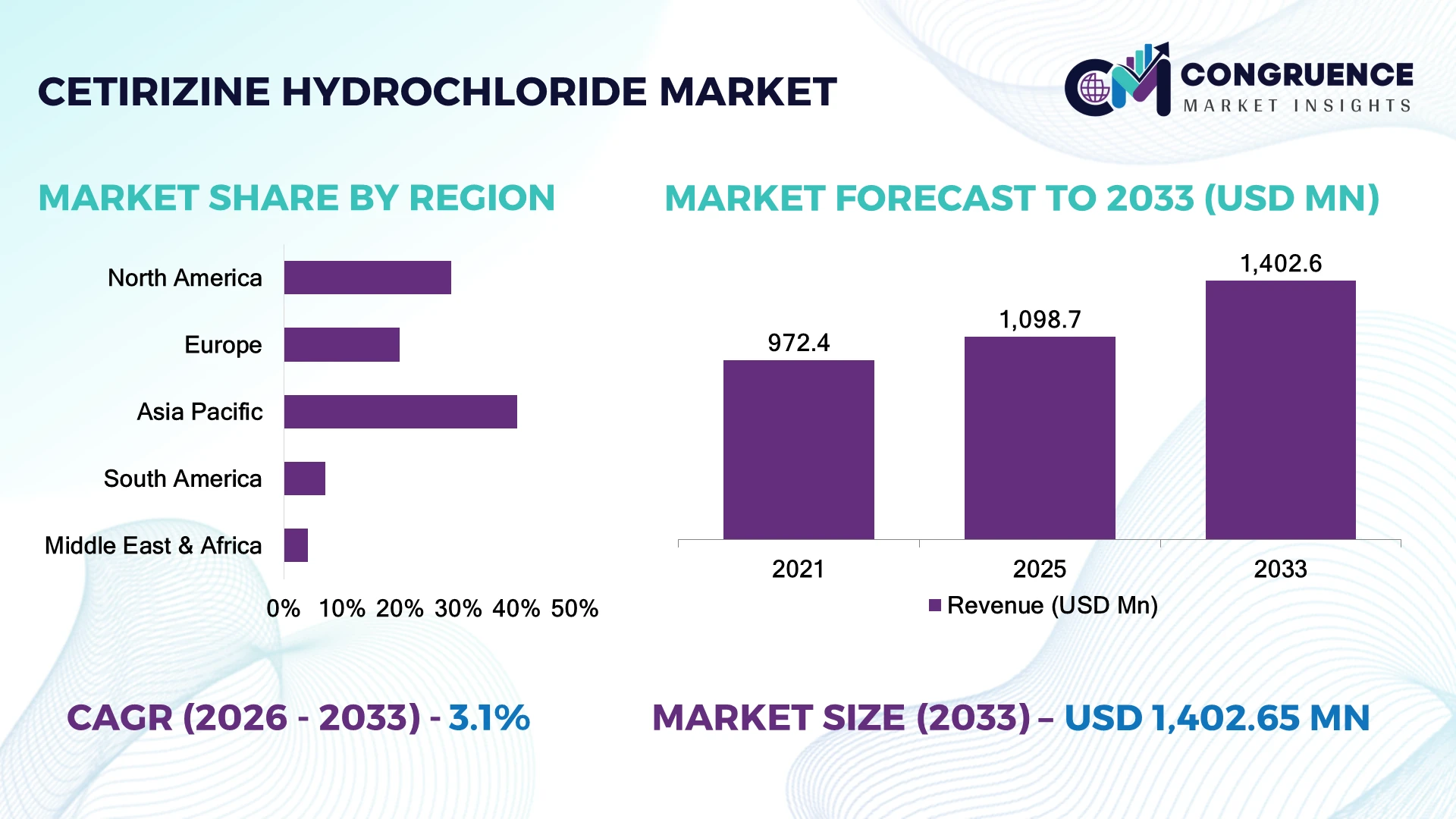
The Global Cetirizine Hydrochloride Market was valued at USD 1,098.7 Million in 2025 and is anticipated to reach a value of USD 1,402.6 Million by 2033 expanding at a CAGR of 3.1% between 2026 and 2033. Growth is supported by persistent allergic rhinitis and urticaria treatment requirements, expanding generic antihistamine availability, and pharmaceutical manufacturers' focus on affordable oral allergy medications.
India and China are strategically important to cetirizine hydrochloride supply because of their established pharmaceutical ingredient and generic-drug manufacturing ecosystems. India accounts for approximately 20% of global generic medicine supply by volume, supporting downstream formulation and export capabilities, while China remains a major source of pharmaceutical starting materials and active ingredients. Supply-chain diversification following pandemic-era disruptions and heightened scrutiny of pharmaceutical quality have increased the importance of qualified suppliers, impurity control, and regulatory compliance. Established markets such as the United States and Germany emphasize product quality, distribution reliability, and regulatory documentation.
Manufacturers should prioritize dependable API sourcing, cost-efficient generic formulations, validated impurity controls, and regulatory-ready production to protect margins in a mature antihistamine market.
Market Size & Growth: The market is valued at USD 1,098.7 million in 2025 and is projected to reach USD 1,402.6 million by 2033, supported by generic allergy-treatment consumption.
Top Growth Drivers: Allergic rhinitis, chronic urticaria, and affordable generic medicines support demand; allergic rhinitis affects an estimated 10%–30% of adults worldwide.
Short-Term Forecast: By 2028, manufacturers will prioritize yield optimization, batch consistency, and reduced rejection rates to improve API production economics.
Emerging Technologies: Continuous manufacturing, process analytical technology, and automated impurity monitoring strengthen process control and pharmaceutical quality assurance.
Regional Leaders: Asia-Pacific benefits from pharmaceutical manufacturing scale, North America from established drug distribution, and Europe from regulated generic medicine markets.
Consumer/End-User Trends: Oral tablets remain a convenient treatment format, while liquid formulations support pediatric dosing and patients requiring alternatives to conventional tablets.
Production Efficiency: Even a 2% reduction in API rejection or reprocessing can improve usable output and reduce manufacturing costs in high-volume facilities.
Competitive Landscape: Competition spans generic drug manufacturers, API producers, contract development and manufacturing organizations, and branded antihistamine suppliers.
Regulatory & Quality Impact: GMP compliance, impurity profiling, and validated analytical methods remain essential for supplying regulated pharmaceutical markets.
Investment & Manufacturing: API producers are prioritizing process optimization, quality systems, and supply continuity over capacity expansion unsupported by contracted demand.
Innovation & Future Outlook: Competitive advantage increasingly depends on reliable quality, cost-efficient synthesis, formulation flexibility, and multi-market regulatory readiness.
The cetirizine hydrochloride market serves oral allergy medications used for allergic rhinitis and urticaria, with demand spanning tablets, oral solutions, and generic formulations. Manufacturers compete through API quality, cost control, formulation consistency, and distribution reliability rather than radical changes in the established molecule. As pharmaceutical buyers strengthen supplier qualification and traceability requirements, production efficiency must be balanced with impurity management and batch reproducibility. These priorities are shaping procurement strategies and investment decisions across API manufacturing and finished-dose production.
Cetirizine hydrochloride remains commercially relevant because it is an established second-generation antihistamine used in widely prescribed allergy treatments. Its market is shaped less by molecular novelty than by reliable manufacturing, generic competition, formulation availability, and access to regulated distribution channels. Pharmaceutical companies must protect product quality while managing pricing pressure from established generic suppliers and alternative antihistamines.
Manufacturing technology provides a practical differentiation opportunity. Conventional batch synthesis offers established process control, while continuous manufacturing and process analytical technology can improve monitoring and reduce variability when appropriately validated. A 2%–5% improvement in usable yield is a potential internal process-improvement target, not a verified market-wide result. India benefits from large-scale generic formulation capabilities, while China remains important in chemical intermediates and API production. Buyers increasingly assess supplier qualification, impurity profiles, documentation, and production continuity alongside quoted price.
During 2026–2028, manufacturers are positioned to prioritize process optimization, diversified sourcing, analytical automation, and formulation development. For example, a producer can use tighter in-process controls to identify deviations earlier and reduce avoidable reprocessing before final release. Generic drug companies can also differentiate through dependable tablet and oral-solution supply rather than relying exclusively on price reductions. The strongest competitive position combines validated manufacturing, consistent quality, regulatory compliance, and resilient supply arrangements.
Allergic rhinitis and chronic urticaria sustain recurring demand for antihistamine medicines, supporting cetirizine hydrochloride use across prescription and nonprescription formulations where permitted. Allergic rhinitis affects an estimated 10%–30% of adults globally, while treatment demand varies with climate, allergen exposure, diagnosis rates, and access to healthcare. Seasonal pollen fluctuations can increase short-term purchasing requirements, whereas perennial allergies create more consistent demand. Generic manufacturers respond through reliable API procurement, high-volume tablet production, and distribution agreements with pharmaceutical companies. The strategic opportunity lies in maintaining consistent supply during seasonal demand peaks without carrying excessive inventory. Manufacturers with validated processes and flexible production scheduling can serve customers more reliably while limiting avoidable working-capital pressure.
Cetirizine hydrochloride is an established molecule with substantial generic competition, limiting the pricing power of manufacturers that offer no meaningful differentiation. Pharmaceutical buyers can compare qualified suppliers on price, impurity profile, batch consistency, documentation, and delivery reliability. Even a 2% increase in rejected or reprocessed production can erode margins when selling prices are under pressure. Regulatory inspections, analytical testing, and change-control requirements also increase the cost of maintaining market access. Manufacturers are mitigating these pressures through process-yield optimization, supplier qualification, long-term procurement agreements, and tighter quality management. The commercial priority is to reduce total cost per released batch rather than minimize raw-material cost at the expense of quality or regulatory compliance.
Manufacturers can strengthen competitiveness through improved synthesis yields, more efficient crystallization, tighter impurity control, and optimized drying and milling processes. A targeted 2%–5% improvement in usable yield provides a practical internal optimization objective, although achievable gains depend on the existing process and should be validated experimentally. Formulation opportunities include tablets, oral solutions, and differentiated packaging for specific patient groups and markets. India offers opportunities for generic formulation development and export-oriented manufacturing, while established markets require robust documentation and dependable quality systems. Companies are investing in analytical automation, process validation, and contract manufacturing relationships. The strongest opportunity is to combine low-cost production with consistent specifications, enabling buyers to reduce supply risk without compromising regulatory standards.
Scaling cetirizine hydrochloride production requires consistent control of starting materials, reaction conditions, residual impurities, crystallization, particle characteristics, and finished API specifications. Small process deviations can affect downstream formulation performance or trigger additional testing and batch delays. Pharmaceutical manufacturers must maintain traceability and validated analytical methods across production sites and suppliers. For export-oriented companies, differences in customer specifications and regulatory documentation increase coordination requirements. An internal target of reducing batch reprocessing by 2% can improve operational efficiency, but it requires reliable process data and root-cause analysis rather than a blanket production target. Companies must invest in quality-by-design practices, analytical capability, trained personnel, and supplier oversight to maintain reproducibility as production volumes change.
Analytical Process Control: API manufacturers are strengthening in-process testing and impurity monitoring to detect deviations before final batch release. Process analytical technology and automated data capture support more consistent reaction and crystallization control. A 2% reduction in reprocessing is a practical site-level improvement target, although results depend on the starting process. Manufacturers are prioritizing validated methods and traceable production records to improve quality and reduce avoidable manufacturing losses.
Generic Supply Diversification: Pharmaceutical buyers are qualifying additional API suppliers to reduce exposure to production interruptions, logistics delays, and concentrated sourcing. India and China remain important manufacturing hubs, while buyers assess alternative suppliers against documentation, impurity profiles, and batch consistency. Multi-sourcing can improve continuity but increases audit and qualification workload. Manufacturers are responding with stronger quality documentation, predictable lead times, and longer-term supply arrangements.
Flexible Finished-Dose Production: Drug manufacturers continue to serve different patient and distribution needs through tablets and oral liquid formulations. Tablets support efficient high-volume production, while liquid dosage forms offer dosing flexibility for pediatric and other appropriate patient groups. Production planning must account for different packaging, stability, and quality-control requirements. Manufacturers are aligning formulation portfolios with market demand rather than assuming that a single dosage form serves every customer segment.
Quality-Led Procurement Decisions: Pharmaceutical purchasing is placing sustained emphasis on GMP compliance, validated analytical methods, traceability, and reliable batch release. Regulatory scrutiny and customer audits increase the importance of complete manufacturing records and change control. Suppliers are strengthening quality systems and investing in laboratory capability to retain qualified-customer relationships. For buyers, supplier selection increasingly balances price against the cost of failed batches, delayed releases, and supply interruptions.
Conventional tablets are estimated to account for approximately 65% of the cetirizine hydrochloride market by dosage-form demand, supported by standardized dosing, broad generic availability, convenient storage, and comparatively economical high-volume manufacturing. Their established position across over-the-counter and prescription channels makes them the primary volume driver for generic manufacturers and private-label suppliers. Oral solutions and syrups represent an estimated 25% of demand and remain important for children and patients who have difficulty swallowing solid dosage forms. Chewable tablets and other specialized oral formats account for the remaining share, serving narrower preferences around administration convenience and product differentiation.
Oral solutions are expected to be the fastest-expanding dosage-form category, with an illustrative annual demand increase of around 5–7% in markets where pediatric allergy treatment and caregiver convenience support liquid formulations. This compares with estimated growth of 2–4% for conventional tablets, where competition increasingly centers on price, distribution reach, and brand loyalty. Manufacturers are prioritizing flavor consistency, accurate dosing, child-friendly packaging, and efficient production runs; tablet suppliers continue to compete through cost optimization and broader pack-size options. Investment is therefore likely to favor reliable generic tablet capacity while selectively expanding liquid formulations and differentiated formats in underserved patient groups.
Allergic rhinitis is estimated to represent approximately 60% of cetirizine hydrochloride demand by therapeutic application, reflecting its use for nasal and ocular allergy symptoms associated with seasonal and perennial triggers. Broad consumer familiarity, recurring symptom management, and availability through nonprescription channels support sustained volume. Chronic urticaria is estimated to account for around 25%, providing a complementary demand base that is less dependent on seasonal pollen cycles. Other allergy-related uses contribute the remaining 15%, although prescribing and labeling conditions differ across countries and formulations. These estimates are directional market allocations rather than published audited shares.
Chronic urticaria is an important growth opportunity, with illustrative demand expansion of approximately 4–6% annually in selected markets as diagnosis and continuing symptom management support repeat treatment. This compares with an estimated 2–4% increase for the more mature allergic-rhinitis application. Manufacturers can respond by maintaining dependable supply of established strengths, strengthening pharmacist and clinician education, and aligning product information with local approved indications. Seasonal inventory planning remains relevant for rhinitis, while year-round availability and refill access are more important for recurring urticaria treatment. Commercial priorities should therefore combine high-volume allergy-relief products with consistent supply and evidence-aligned positioning for longer-duration treatment needs.
Retail pharmacies are estimated to account for approximately 55% of finished-dose cetirizine hydrochloride sales, reflecting their broad geographic reach, role in nonprescription medicine purchases, and ability to serve consumers seeking immediate relief. Hospital and clinic pharmacies represent an estimated 25%, supported by clinician-directed treatment, institutional dispensing, and access to patients with more complex allergy-management needs. Online pharmacies and digital medicine retailers account for approximately 20%, with their importance varying according to local regulation, consumer purchasing habits, and delivery infrastructure. These figures represent an indicative channel split, not a verified global sales audit.
Online pharmacies are the fastest-expanding channel, with illustrative annual sales growth of around 8–12% in digitally mature markets, compared with approximately 2–4% for established retail pharmacy sales. Digital ordering, repeat-purchase convenience, price comparison, and home delivery support this shift, although seasonal demand and regulatory requirements influence adoption. Manufacturers are responding through stronger e-commerce product information, retailer partnerships, reliable pack availability, and competitive private-label offerings. Retail remains strategically essential for immediate purchases and pharmacist guidance, while hospital channels require dependable supply and compliance with procurement standards. Future investment should combine traditional pharmacy coverage with digital distribution capabilities, without weakening quality controls or local labeling compliance.
Asia-Pacific accounted for the largest market share at approximately 40.1% in 2025, while Asia-Pacific is also expected to register the fastest growth between 2026 and 2033. North America followed with an estimated 28.7% share, supported by established over-the-counter allergy-treatment channels, while Europe represented approximately 19.9%. South America and the Middle East & Africa accounted for smaller shares of around 7.1% and 4.3%, respectively. Regional demand is shaped by generic medicine availability, allergy-treatment access, local regulatory requirements, and pharmaceutical distribution infrastructure.

Established OTC Distribution and Generic Competition Sustain Market Scale
North America represented approximately 28.7% of the global cetirizine hydrochloride market in 2025, supported by extensive retail-pharmacy coverage, established allergy-treatment practices, and strong availability of branded and generic formulations. The United States drives regional demand through established nonprescription purchasing and broad access to conventional tablets, liquid formulations, and multiple pack sizes. Competition increasingly depends on product availability, retailer relationships, private-label supply, and manufacturing consistency rather than substantial differentiation in the active ingredient. Seasonal allergy demand also requires distributors to coordinate inventory ahead of peak purchasing periods. Manufacturers that combine cost-efficient production with dependable pharmacy replenishment and clear product labeling are better positioned to protect volume in this mature market.
United States Market Outlook: The United States offers the region's strongest commercial platform through its large retail-pharmacy network, established generic-drug distribution, and mature nonprescription medicine market. Generic medicines account for approximately 90% of prescriptions dispensed nationally, illustrating the importance of affordability and supply efficiency in pharmaceutical purchasing. For cetirizine suppliers, competitive positioning depends on maintaining consistent product quality, meeting FDA requirements, and securing distribution across pharmacy chains and digital retailers. Manufacturers with flexible packaging, reliable inventory, and competitive private-label offerings can defend market access as buyers prioritize value and supply continuity.
Regulatory Consistency and Cross-Border Pharmaceutical Supply Shape Competition
Europe accounted for an estimated 19.9% of the global cetirizine hydrochloride market in 2025. Demand is supported by established healthcare systems, pharmacy-led access to allergy treatments, and mature generic-drug markets across Germany, France, Italy, and the United Kingdom. Regulatory compliance, product documentation, packaging standards, and dependable distribution remain central to supplier selection. The European Union's pharmaceutical trade infrastructure reinforces its role as both a major medicines market and a manufacturing and distribution base. Eurostat reported that EU exports of medicinal and pharmaceutical products reached €366.2 billion in 2025, demonstrating the scale of the broader pharmaceutical supply ecosystem, although this figure is not specific to cetirizine. Suppliers benefit from qualified manufacturing and reliable cross-border logistics.
Germany Market Outlook: Germany is strategically important because of its established pharmaceutical manufacturing base, structured healthcare procurement, and extensive pharmacy distribution network. Its position within Europe's medicines supply chain supports access to formulation expertise, quality-control capabilities, and established generic-drug channels. For cetirizine manufacturers, success depends on meeting applicable European quality and product-information requirements while maintaining competitive pricing for pharmacies and distributors. Companies that provide dependable supply, consistent batch quality, and packaging suited to local requirements can compete effectively in a market where established generics and cost-conscious purchasing shape demand.
Manufacturing Scale and Expanding Access Support Regional Leadership
Asia-Pacific held an estimated 40.1% of the global cetirizine hydrochloride market in 2025, making it the largest regional market. China and India contribute through pharmaceutical ingredient production, formulation capacity, and extensive generic-medicine supply, while Japan, South Korea, and Australia provide established pharmaceutical distribution and regulated healthcare channels. Growing access to allergy treatments, urban pharmacy expansion, and broader availability of affordable medicines support demand across the region. India and China are particularly relevant to supply-chain planning because manufacturers can serve domestic markets while supplying international customers, subject to applicable quality and regulatory requirements. Companies are prioritizing scalable production, dependable raw-material sourcing, and market-specific registrations to balance cost competitiveness with quality assurance.
India Market Outlook: India offers a significant manufacturing and generic-medicine platform, supported by a large pharmaceutical production base, established formulation expertise, and export-oriented suppliers. The country supplies approximately 20% of global generic medicines by volume, underscoring its importance in international pharmaceutical supply chains. For cetirizine hydrochloride, Indian manufacturers can leverage established tablet and oral-liquid production capabilities to serve domestic pharmacies and overseas distributors. Competitive advantage depends on consistent manufacturing quality, regulatory compliance in destination markets, and the ability to manage pricing pressures without compromising product standards. Firms with diversified export registrations and reliable ingredient sourcing are better positioned to expand their customer base.
Generic-Medicine Access and Pharmacy Distribution Drive Market Development
South America represented approximately 7.1% of the global cetirizine hydrochloride market in 2025, with Brazil serving as the region's principal pharmaceutical market. Demand is supported by established community pharmacies, domestic formulation capabilities, and continued purchasing of affordable medicines. However, currency fluctuations, differences in purchasing power, and regulatory requirements across countries can complicate pricing and distribution. Brazil's pharmaceutical sector provides a substantial commercial base: the national medicines market recorded approximately 6.3 billion medicine packages sold in 2025, according to data reported by its pharmaceutical market regulator. This broad distribution infrastructure creates opportunities for established generic suppliers, although cetirizine-specific demand is only one part of the wider market. Companies benefit from local registration expertise and dependable distributor relationships.
Brazil Market Outlook: Brazil offers the strongest country-level opportunity in South America through its large consumer base, developed pharmaceutical distribution network, and formal market-monitoring framework administered by ANVISA and the medicines pricing authority. The country's 2025 pharmaceutical market included 14,371 medicine presentations, reflecting the breadth of its product landscape. Cetirizine suppliers must account for local registration, pricing rules where applicable, labeling requirements, and competition among domestic and multinational generic brands. Companies that align product portfolios with local purchasing power and maintain consistent supply to pharmacy distributors can strengthen their position. Local partnerships can also help reduce execution risks linked to logistics and market access.
Pharmaceutical Localization and Import-Supply Resilience Shape Market Access
The Middle East & Africa region accounted for an estimated 4.3% of the global cetirizine hydrochloride market in 2025. Demand is concentrated in markets with stronger healthcare infrastructure, pharmacy access, and pharmaceutical procurement capabilities, including Saudi Arabia, the United Arab Emirates, and South Africa. Many markets remain reliant on imported finished medicines or pharmaceutical ingredients, making supplier reliability, registration timelines, and distribution partnerships important competitive factors. Saudi Arabia is promoting local pharmaceutical manufacturing and generic-drug production as part of its industrial diversification agenda. Across the region, companies need to balance opportunities in expanding urban healthcare markets with differences in reimbursement, affordability, logistics, and regulatory capacity. Distributors with established local networks remain important for consistent availability.
Saudi Arabia Market Outlook: Saudi Arabia is strategically significant because of its healthcare investment, centralized regulatory oversight, and policies encouraging domestic pharmaceutical manufacturing. Under its industrial development and localization agenda, the country has pursued an ambition to localize 40% of pharmaceutical market value, creating a policy framework that may support local production and partnerships. For cetirizine suppliers, this environment favors companies able to meet Saudi Food and Drug Authority requirements, establish reliable distribution, and assess opportunities for local manufacturing or contract production. Importers continue to play a role, but suppliers that build relationships with domestic pharmaceutical companies and procurement stakeholders can improve market access and supply resilience.
The market pits branded allergy franchises such as Kenvue’s Zyrtec against generic manufacturers including Dr. Reddy’s, Glenmark, Teva, and Perrigo; API suppliers compete upstream on validated quality, documentation, and dependable delivery. Retail and private-label buyers pressure generic producers on unit cost, pack flexibility, and service levels, while branded players defend recognition and shelf access. The top five players’ combined global share is not publicly disclosed; a directional planning assumption is 30–35%, reflecting fragmented generic supply rather than audited concentration. Price remains decisive: procurement tenders can favor suppliers able to sustain 5–10% lower delivered costs without quality concessions. Manufacturers compete through regulatory filings, tablet and liquid portfolios, and distributor reach. Glenmark’s U.S. OTC entry illustrates regional producers challenging established brands, while Kenvue retains brand-led positioning. Quality systems, cross-contamination prevention, and traceability increasingly shape buyer confidence after recent safety actions. Barriers include GMP compliance, registration costs, validated processes, and retailer qualification. Winners combine reliable supply, competitive pricing, compliant labels, and fast corrective action.
Cetirizine hydrochloride production remains centered on established synthetic API chemistry, conventional batch processing, and standardized oral dosage manufacturing. The most relevant near-term technology gains come from process analytical technology (PAT), automated in-process controls, and electronic batch records. As planning estimates rather than verified cetirizine-specific results, integrated monitoring could reduce avoidable batch deviations by 5–10% at suitable facilities. Adoption is likely to be uneven: regulated manufacturers and export-oriented plants have stronger incentives to invest than smaller producers serving limited domestic markets. Better process visibility supports faster investigations, more consistent batches, and stronger audit readiness.
Automated tablet inspection, weight control, and packaging verification can improve defect detection compared with manual sampling alone. A potential 10–20% improvement in inspection throughput is a directional engineering target, not a published industry-wide cetirizine benchmark. Serialization, barcode verification, and digital lot genealogy also strengthen traceability across contract manufacturing and distribution. These capabilities particularly benefit suppliers serving tightly regulated markets, where documentation gaps or mix-ups can trigger costly recalls. Liquid formulations require additional controls around concentration, microbial quality, filling accuracy, and packaging integrity, creating opportunities for specialized equipment and formulation expertise.
Between 2026 and 2028, competitive advantage is likely to come from selective automation and data integration rather than disruptive changes to cetirizine’s established chemistry. Continuous processing may offer tighter control for suitable upstream steps, but broad adoption should not be assumed without product-specific validation. Manufacturers combining validated processes, efficient changeovers, electronic quality records, and robust contamination controls can target 3–5% reductions in avoidable operating costs as an illustrative improvement objective. Generic suppliers competing primarily on price should prioritize proven upgrades with measurable returns; premium brands and export-focused producers benefit most from investments that strengthen consistency, compliance, and supply resilience.
The report examines cetirizine hydrochloride across conventional tablets, oral solutions and syrups, chewable tablets, and other relevant oral formats. Application coverage includes allergic rhinitis, chronic urticaria, and other allergy-related uses, while end-user analysis evaluates retail pharmacies, hospital and clinic pharmacies, and online pharmacies. Regional assessment covers North America, Europe, Asia-Pacific, South America, and the Middle East & Africa, with country-level perspectives on the United States, Germany, India, Brazil, and Saudi Arabia.
Additional coverage evaluates generic API and formulation supply, manufacturing controls, process monitoring, automated inspection, packaging traceability, regulatory compliance, and contamination risk. The report compares established branded products with cost-focused generics and considers niche opportunities in liquid formulations, specialized dosage formats, and digital pharmacy distribution. Competitive profiling includes 14 pharmaceutical companies. These insights support supplier assessment, market-entry decisions, manufacturing investment, distribution partnerships, pricing strategy, and competitive positioning through 2033, while helping decision-makers identify where operational efficiency, quality assurance, and regional access are most commercially relevant.
| Report Attribute/Metric | Report Details |
|---|---|
|
Market Revenue in 2025 |
USD 1,098.7 Million |
|
Market Revenue in 2033 |
USD 1,402.6 Million |
|
CAGR (2026 - 2033) |
3.1% |
|
Base Year |
2025 |
|
Forecast Period |
2026 - 2033 |
|
Historic Period |
2021 - 2025 |
|
Segments Covered |
By Type
By Application
By End-User
|
|
Key Report Deliverable |
Revenue Forecast, Growth Trends, Market Dynamics, Segmental Overview, Regional and Country-wise Analysis, Competition Landscape |
|
Region Covered |
North America, Europe, Asia-Pacific, South America, Middle East, Africa |
|
Key Players Analyzed |
Kenvue Inc., Dr. Reddy’s Laboratories Ltd., Glenmark Pharmaceuticals Ltd., Teva Pharmaceutical Industries Ltd., Perrigo Company plc, Haleon plc, UCB S.A., Sun Pharmaceutical Industries Ltd., Cipla Ltd., Aurobindo Pharma Ltd., Zydus Lifesciences Ltd., Lupin Ltd., J. B. Chemicals & Pharmaceuticals Ltd., Sandoz Group AG |
|
Customization & Pricing |
Available on Request (10% Customization is Free) |




