
Reports
The Global Cereal Ingredients Market was valued at USD 575.3 Million in 2025 and is anticipated to reach a value of USD 830.7 Million by 2033 expanding at a CAGR of 4.7% between 2026 and 2033. Growth is being driven by greater use of functional starches, whole-grain fibers, oat-based ingredients, and fortified cereal systems as food manufacturers prioritize nutrition, texture, clean-label positioning, and processing efficiency.
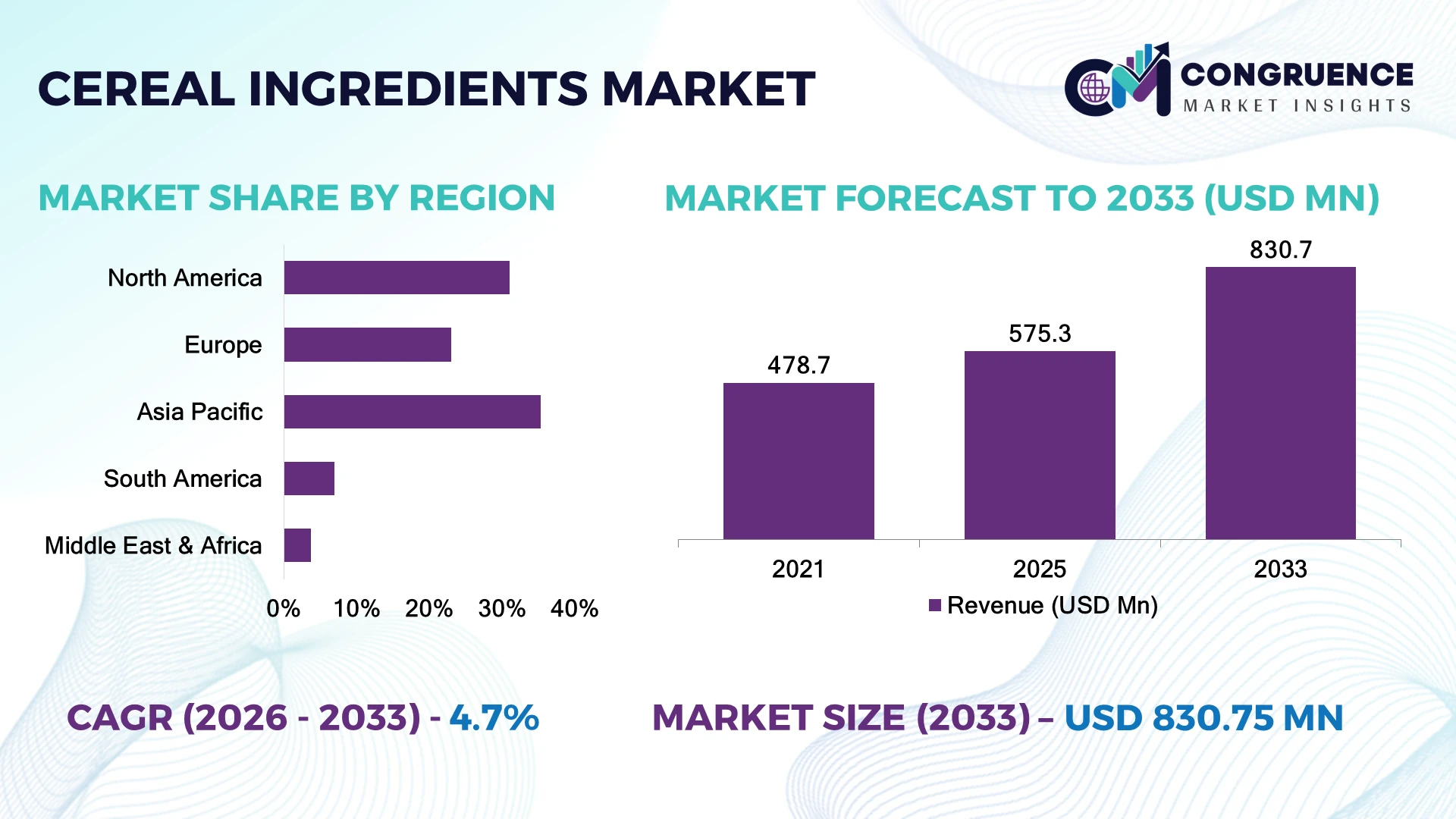
China represents the largest individual cereal-ingredient consumption base in Asia, accounting for approximately 12.5% of global market value, while India represents about 5.7%; China produces roughly 22.6% of global maize compared with about 4.1% for India, providing a substantially deeper domestic feedstock base. India’s 2025 wheat production reached approximately 117.9 million tonnes, strengthening its cereal-processing capacity and ingredient supply ecosystem. The Russia-Ukraine conflict and continuing Black Sea trade disruptions have further encouraged manufacturers to diversify grain procurement and establish regional sourcing networks.
Strategically, manufacturers with secure grain access, advanced fractionation capabilities, and flexible specialty-ingredient capacity are positioned to capture higher-value applications rather than compete primarily on commodity pricing.
Market Size & Growth: USD 575.3 million in 2025 to USD 830.7 million by 2033 at a 4.7% CAGR, supported by functional starches, fibers, oat ingredients, and fortified formulations.
Top Growth Drivers: 35.3% Asia Pacific market share, approximately 17% higher Indian maize production growth in favorable production cycles, and 39% share of UK plant-based milk attributed to oat-based products highlight three major demand accelerators.
Short-Term Forecast: By 2028, AI-enabled sorting and process automation are positioned to reduce yield losses by up to 50% in selected applications, improving usable-output economics for advanced processors.
Emerging Technologies: Deep-learning optical sorting, connected milling lines, and automated grain-quality monitoring are shifting cereal processing toward real-time quality control, with more than 100 connected digital processing lines operating within advanced processing ecosystems.
Regional Leaders: Asia Pacific is projected to reach approximately USD 293 million, Europe USD 204 million, and North America USD 158 million by 2033, with functional-ingredient adoption expanding across bakery, snacks, cereals, and plant-based foods.
Consumer/End-User Trends: Demand is shifting toward whole-grain, high-fiber, gluten-free, and protein-fortified formulations, increasing the use of multifunctional cereal ingredients across major processed-food categories.
Pilot/Case Example: In 2025, AI-based deep-learning sorting for gluten-free oats targeted improved reject concentration and quality control, with 5–10% improvements in reject concentration capable of generating substantial annual revenue benefits for large processors.
Competitive Landscape: Cargill, ADM, Ingredion, Tate & Lyle, and Kerry remain prominent global participants, competing across starches, flours, fibers, texturizers, and formulation services in a fragmented supplier environment.
Regulatory & ESG Impact: Tighter European controls on furan and alkylfurans in cereal-based foods are increasing requirements for process control and traceability, with amended requirements scheduled to affect applicable products from 2028.
Investment & Funding: More than USD 150 million in publicly announced 2025 investments across major ingredient-processing facilities reflects increasing expenditure on modernization, specialty-starch capacity, energy efficiency, and regional supply resilience.
Innovation & Future Outlook: Next-generation cereal ingredients are moving toward precision functionality, clean-label texturization, allergen-controlled oats, fortified fibers, and lower-footprint processing, shifting competition from bulk grain availability toward formulation performance.
The Cereal Ingredients Market is increasingly shaped by functionalization rather than basic grain consumption, with starches, fibers, oat flour, protein-rich fractions, and specialty blends gaining traction across bakery, snacks, breakfast cereals, and plant-based formulations. Asia Pacific accounted for about 35.3% of the market in 2025, while supply-chain diversification and tighter contaminant controls are encouraging processors to secure traceable, specification-controlled grain inputs.
The Cereal Ingredients Market is becoming strategically important because ingredient suppliers increasingly influence finished-product nutrition, texture, processing yield, labeling claims, and manufacturing economics. Food producers are shifting from basic flour and grain inputs toward customized starches, fibers, oat fractions, protein systems, and premixes that enable faster reformulation across breakfast cereals, bakery, snacks, and plant-based products. Global cereal production is forecast at approximately 2.98 billion tonnes in 2026, keeping feedstock availability central to procurement strategy.
Technology is widening the efficiency gap between conventional and digitally controlled processing. AI-enabled optical sorting can reduce yield losses by up to 50% in selected applications, while connected milling systems improve monitoring of throughput, temperature, vibration, and product quality. Europe is placing greater emphasis on traceability and contaminant control, whereas Asia Pacific combines large-scale grain availability with rapid expansion of processed cereal applications and specialty ingredient consumption.
Over the next 2–3 years, investment priorities will increasingly center on specialty processing, automation, energy efficiency, and regional sourcing. Ingredion’s USD 100 million Indianapolis modernization demonstrates the shift toward combining additional processing capability with operational resilience and energy infrastructure upgrades. Regional partnerships are also expanding specialty-starch capacity, including a EUR 35 million starch joint venture in Romania. Competitive advantage will increasingly depend on converting cereal feedstocks into differentiated, specification-driven ingredients with higher processing value.
The shift from commodity grains toward functional cereal fractions is strengthening demand for specialty starches, fibers, proteins, and oat-based ingredients. Asia Pacific represented 35.3% of the global cereal ingredients market in 2025, while China alone accounted for approximately 12.5%, creating a large manufacturing base for differentiated formulations. India’s 2025 wheat output reached 117.9 million tonnes, while maize production was forecast at 43 million tonnes, about 17% above its five-year average. This feedstock depth is enabling processors to expand fractionation and premix capabilities. Companies are responding with localized processing capacity, formulation partnerships, and higher-value ingredient portfolios rather than relying solely on bulk flour sales.
Cereal ingredient processors remain exposed to fluctuations in grain availability, energy costs, and logistics, particularly for specialized inputs such as oats. Conventional cereal ingredients still dominate purchasing, while specialty formats require tighter specifications and more expensive processing controls. In oat ingredients, conventional products represented 82.74% of the market in 2025, illustrating the substantial cost sensitivity of mainstream applications. Canada’s constrained oat supply and a 25% U.S. tariff have added pressure to procurement economics. Companies are reducing exposure through multi-origin sourcing, longer-term supplier contracts, localized inventories, and substitution between wheat, corn, rice, barley, and oats. The strategic priority is increasingly supply flexibility rather than simply securing the lowest raw-material price.
AI-enabled sorting and digital quality control are creating an underutilized efficiency opportunity for cereal processors, particularly where contamination and specification losses reduce usable output. Advanced AI sorting has demonstrated yield improvements of more than 50% in specific processing applications, while optical systems increasingly identify foreign material, aflatoxin, discoloration, and other grain defects. Specialty oat protein is also projected to expand at 12.05% annually through 2031, indicating stronger opportunities beyond conventional flakes and flour. Companies are investing in intelligent sorting, automated quality monitoring, protein fractionation, and specialty formulations. The non-obvious opportunity is monetizing the same grain input more effectively: higher usable yield can improve margins without requiring equivalent increases in acreage or raw-material procurement.
Cereal ingredient manufacturers face increasing execution complexity as customers demand consistent particle size, moisture, functionality, allergen control, and contaminant performance across multiple production batches. The European Union’s 2026 regulation establishes maximum levels of 40 μg/kg for furan and methylfurans in processed cereal-based foods for infants and young children, with application beginning January 2028. This forces processors to integrate tighter thermal-process monitoring with laboratory verification and traceability. Companies serving European infant-food customers therefore need greater process-control investment, while smaller processors face higher compliance costs per production line. The strategic challenge is maintaining specification consistency across decentralized facilities without creating excessive testing and production downtime.
AI Sorting Moves Into Production: AI-based optical sorting is moving beyond defect removal toward yield optimization, with advanced systems reporting more than 50% yield improvement in specific applications. Processors are integrating real-time monitoring with sorting workflows to increase usable output, reduce manual inspection dependence, and improve consistency where labor availability remains constrained.
Oat Supply Chains Are Rebalancing: Oat processors are restructuring sourcing as Canadian supply constraints and a 25% U.S. tariff increase procurement pressure. At the same time, oat flakes held 33.98% of the oat-ingredient segment in 2025, while oat protein is advancing faster, pushing companies toward diversified sourcing, fractionation, and higher-value protein applications rather than dependence on conventional oat formats.
Contaminant Control Enters Formulation: European food manufacturers are preparing for mandatory furan and methylfuran limits from January 2028, including a 40 μg/kg ceiling for processed cereal-based foods for infants and young children. This is shifting quality workflows toward tighter thermal-process controls, batch-level testing, and traceability, making compliance capability an increasingly important supplier-selection criterion.
Digital Mills Improve Process Visibility: Connected cereal-processing equipment is increasingly linking sorting, milling, quality measurement, and performance monitoring. The operational shift is significant because processors can respond to raw-material variability earlier rather than correcting quality deviations after production. Companies are therefore prioritizing integrated monitoring and automated controls alongside physical capacity expansion, improving consistency without relying exclusively on additional processing lines.
Wheat remains the leading cereal ingredient type, accounting for approximately 36.3% of the market in 2025, supported by established milling infrastructure, broad availability, and compatibility with bakery, breakfast cereal, snack, and fortified-food formulations. Corn ranks behind wheat because of its extensive use in starches, flours, sweeteners, and extruded products, while rice and barley retain strategic importance in gluten-free, texture-focused, and specialty formulations. Oats are the fastest-growing major type, with adoption increasingly tied to high-fiber, protein-rich, and plant-based formulations. Companies are consequently expanding oat processing, fractionation, and blended-ingredient portfolios rather than relying solely on conventional wheat volumes.
The investment shift is particularly visible in functional cereal systems: oats are gaining share in premium formulations while wheat continues to anchor high-volume applications. Approximately 84.9% of cereal ingredients remain conventional, indicating that organic and specialty formats are still smaller but increasingly relevant for premium positioning. For manufacturers, the implication is a two-speed portfolio strategy: protect wheat and corn scale while increasing R&D and processing capacity for higher-value oat, rice, and barley applications.
CEEREAL reported in 2026 that whole-grain content in European breakfast cereals increased 23% between 2015 and 2025, while fiber content increased 21.1%, demonstrating measurable reformulation toward higher-value cereal fractions.
Cold cereals accounted for approximately 67.9% of cereal ingredient demand in 2025, reflecting their established ready-to-eat manufacturing infrastructure, broad retail distribution, and compatibility with flakes, puffs, fortification systems, and multigrain formulations. Hot cereals represent the smaller application but are expanding faster as oatmeal, porridge, and minimally processed grain formats gain traction among consumers seeking higher fiber and whole-grain content. Companies are responding by extending product portfolios beyond conventional ready-to-eat formats and investing in instantization, texture control, portion formats, and functional fortification.
The distinction is increasingly operational rather than simply consumer-driven. Cold cereal manufacturers prioritize high-throughput flaking, extrusion, coating, and packaging systems, while hot cereal producers emphasize rapid hydration, particle-size consistency, and preparation convenience. Approximately 60% of cereals sold in Europe in 2025 contained added vitamins and minerals, reinforcing the importance of ingredient functionality across both applications. This favors suppliers capable of providing integrated fortification, fiber, protein, and texture solutions rather than standalone grain ingredients.
CEEREAL data reported in 2026 showed that European cereal manufacturers increased average fiber content by 21.1% and reduced sugar content by 18.2% between 2015 and 2025, indicating that reformulation is materially changing ingredient requirements.
Breakfast cereal manufacturers represent the leading end-user group, supported by the high ingredient intensity of flaked, puffed, extruded, and fortified cereal products. Bakery and snack manufacturers form the next major demand pool because wheat, corn, oats, rice, and barley ingredients provide structure, crunch, binding, fiber, and texture across a broad product range. Infant and nutritional food manufacturers represent a smaller but specification-intensive segment, while animal-feed producers create a distinct volume channel for lower-grade grains, bran, and cereal co-products. Companies are increasingly segmenting ingredient portfolios according to functionality rather than simply grain origin.
The fastest strategic shift is occurring among bakery, snack, and nutritional-food producers, where protein, fiber, whole-grain, and gluten-free formulations are expanding the addressable ingredient mix. Infant-food buyers face particularly strict contaminant and composition requirements, while feed buyers remain highly price-sensitive. Approximately 13.45 million tonnes of cereals were forecast for UK animal-feed use in 2025/26, showing the scale of feed-linked cereal demand. Suppliers are therefore developing differentiated contracts, customized blends, quality assurance programs, and application-specific technical support to serve materially different purchasing priorities.
The UK Agriculture and Horticulture Development Board estimated 13.45 million tonnes of cereals would be used for animal feed in 2025/26, approximately 1% above the previous marketing year, underscoring the continuing scale of cereal demand outside direct human-food applications.
Asia Pacific accounted for the largest market share at 35.3% in 2025 however, Asia Pacific is expected to register the fastest growth, expanding at a CAGR of 5.9% between 2026 and 2033.

Advanced processing and functional reformulation strengthen U.S. ingredient demand
North America remains a major cereal ingredients market, supported by highly developed milling, extrusion, fortification, and food-manufacturing infrastructure. The United States accounts for the majority of regional demand, with approximately 36% of the global cereal ingredients market attributed to North America in some industry estimates. Demand is increasingly shifting from conventional flour and grain inputs toward high-fiber, protein-enriched, gluten-free, and clean-label ingredients. Large processors are integrating automated sorting, precision milling, and application-specific formulation capabilities to improve yield and consistency. The region's mature supply infrastructure also enables faster commercialization of specialty ingredients for snacks, bakery, breakfast products, and alternative-protein formulations. Strategic investment is increasingly directed toward functional ingredient development rather than additional commodity processing capacity.
United States Market Outlook: The United States remains the principal manufacturing and innovation hub, supported by extensive corn, wheat, and oat processing infrastructure. U.S. cereal production includes approximately 30.1 million tonnes of maize in 2025, providing substantial feedstock for starches, flours, sweeteners, and extruded ingredients. Manufacturers are prioritizing higher-value fractions, automated quality control, and functional formulations to defend margins as conventional breakfast-cereal volumes mature.
Reformulation and traceability reshape ingredient specifications
Europe combines mature cereal-processing infrastructure with increasingly demanding nutritional and traceability requirements. The market is being reshaped by whole-grain reformulation, fiber enrichment, sugar reduction, and fortified product development rather than volume expansion alone. Approximately 60% of breakfast cereals sold in Europe in 2025 were fortified with vitamins and minerals, creating sustained demand for precisely standardized ingredient systems. Manufacturers are also adapting milling and formulation processes to accommodate higher whole-grain inclusion without compromising texture or shelf life. Germany, the United Kingdom, France, and the Netherlands remain important processing and product-development centers. Companies are responding through incremental recipe reformulation, supplier qualification, and investment in process controls that support consistent nutritional and sensory specifications.
Germany Market Outlook: Germany is a strategically important European manufacturing base, with its cereal ingredients market estimated at roughly 4.9% of global demand in 2025. German manufacturers are emphasizing whole-grain substitution and nutritional reformulation while maintaining established retail-scale production. One major German cereal producer reported average whole-grain content of approximately 45% across its retail breakfast-cereal portfolio in 2024, demonstrating how ingredient specifications are changing at industrial scale.
Scale advantages and localized processing accelerate adoption
Asia-Pacific held approximately 35.3% of the global cereal ingredients market in 2025, making it the largest regional market and the principal volume center for wheat, rice, maize, and other grain-based ingredients. China produced approximately 660.2 million tonnes of cereals in 2025, while its maize output reached about 301.2 million tonnes, reinforcing the region's exceptional feedstock and processing depth. India, Japan, South Korea, and Southeast Asian economies are simultaneously expanding demand for fortified cereals, grain-based snacks, bakery ingredients, and convenience foods. Multinational suppliers are responding by localizing milling, blending, extrusion, and application-development facilities to shorten supply chains and tailor formulations to country-specific diets.
China Market Outlook: China represents the most significant country-level production hub, supported by large-scale grain cultivation, extensive milling capacity, and a sophisticated packaged-food manufacturing base. National cereal production increased 1.2% in 2025 to approximately 660.2 million tonnes, while maize production reached about 301.2 million tonnes. This scale gives ingredient manufacturers strong access to domestic feedstock and supports expansion into starches, flours, fibers, breakfast products, snacks, and functional cereal formulations.
Brazilian grain scale strengthens regional ingredient processing
South America is developing as an important cereal ingredient supply and processing base, with Brazil providing the region's strongest combination of agricultural scale, grain availability, food manufacturing, and export infrastructure. The regional market was valued at approximately USD 120 million in 2025 in industry estimates, with Brazil, Colombia, and Peru supporting demand for instant cereals, bakery mixes, cereal beverages, and processed grain products. Brazil's extensive corn and wheat-processing ecosystem provides a cost advantage for ingredient manufacturers, while logistics and storage capacity remain important determinants of delivered ingredient economics. Companies are expanding local processing and developing applications around corn, quinoa, amaranth, and other locally available grains rather than relying exclusively on imported specialty ingredients.
Brazil Market Outlook: Brazil offers the region's strongest feedstock advantage, with national grain production expected to reach approximately 361.7 million tonnes in the 2025/26 crop, 2.6% above the previous season. Corn acreage increased 3.5%, reinforcing the country's position as a major source of cereal-based raw materials. Ingredient companies are using this agricultural scale to expand milling, starch, flour, extrusion, and value-added food-processing capabilities.
Food-processing modernization drives localized ingredient demand
Middle East & Africa remains a smaller cereal ingredients market, but demand is becoming more strategically relevant as food-processing capacity expands and countries seek greater domestic food-security resilience. Saudi Arabia, the United Arab Emirates, South Africa, Egypt, and Turkey are important processing and distribution centers, with demand concentrated around wheat, maize, rice, breakfast products, bakery ingredients, and fortified foods. Import dependence remains significant for several cereal categories, encouraging manufacturers to develop localized milling, blending, storage, and packaging capabilities. Companies are increasingly combining regional sourcing contracts with modern food-processing infrastructure to reduce exposure to international freight and commodity-price volatility. The region's approximately 3% share of the broader breakfast-cereal economy highlights the substantial scale gap with mature markets but also the scope for localized processing expansion.
Saudi Arabia Market Outlook: Saudi Arabia is emerging as a strategically important cereal-processing hub because of its investment in food security, storage infrastructure, milling capacity, and domestic food manufacturing. The country's food-security strategy emphasizes stronger supply resilience and local processing, encouraging manufacturers to develop higher-value flour, fortified cereal, bakery, and breakfast-product capabilities. Companies with regional blending and formulation capacity are positioned to reduce import dependence while serving rapidly modernizing retail and food-service channels.
Cargill, ADM, Ingredion, Tate & Lyle, Kerry, and regional millers compete across overlapping cereal-ingredient categories, with global ingredient houses contesting functional starches, fibers, flours, and texturizers while regional processors compete on feedstock access and price. The top five global players collectively account for approximately 18% of market value, leaving meaningful room for specialized suppliers. Competition centers on price, formulation performance, supply reliability, and customization; specialty formulations command roughly 15–25% higher pricing than commodity-grade inputs, while localized sourcing can reduce delivered logistics costs by 8–12%. Players are expanding specialty capacity, integrating application laboratories, forming formulation partnerships, and securing grain-processing assets. The competitive shift is moving from bulk-volume scale toward integrated ingredient solutions, traceability, and faster customer co-development. High capital requirements, food-safety qualification, and established customer validation create entry barriers for entrants. Winning requires reliable feedstock, differentiated functionality, application support, and the ability to commercialize customized ingredients faster than regional cost leaders.
Cargill, Incorporated
Archer Daniels Midland Company (ADM)
Ingredion Incorporated
Tate & Lyle PLC
Kerry Group plc
Bunge Global SA
The J. M. Smucker Company
Associated British Foods plc
Kellogg Company
PepsiCo, Inc.
Olam Group Limited
Roquette Frères
Raisio plc
The Hain Celestial Group, Inc.
Digital sorting is becoming an immediate productivity upgrade in cereal processing. AI-enabled optical sorters detect defects, foreign material, and quality deviations faster than conventional inspection; advanced systems can deliver yield improvements exceeding 50% in selected applications. Connected sensors add continuous moisture, temperature, and throughput monitoring, reducing manual intervention and improving batch consistency. Bühler’s AI700 deployment across oat and cereal applications signals increasing commercialization through 2026–2028.
Automation is also moving deeper into milling, blending, extrusion, and quality assurance. Modern automated lines can improve process consistency by 10–15% versus manually controlled workflows, while predictive monitoring reduces unplanned intervention by approximately 5–10% in suitably instrumented facilities. Large processors benefit first because they can integrate data platforms across multiple plants, creating a competitive advantage in yield optimization, traceability, and specification control.
Next-generation ingredient processing is shifting toward precision fractionation, digital formulation, and lower-energy processing. Specialty processors using automated fractionation can improve usable ingredient recovery by roughly 8–12% compared with less controlled separation. By 2028, competitive differentiation will increasingly depend on combining AI inspection, process automation, and application analytics rather than adopting isolated equipment. Companies that integrate these technologies now gain faster quality decisions, stronger supply-chain visibility, and greater ability to commercialize customized cereal ingredients.
May 2026 ADM announced a multimillion-dollar Clinton, Iowa corn-processing upgrade, adding two receiving pits rated at 25,000 bushels per hour each. The project improves harvest throughput, reduces farmer waiting times, and strengthens feedstock reliability for downstream cereal-ingredient production. Source: adm.com
February 2025 Ingredion committed $100 million to modernize its Indianapolis facility, adding energy cogeneration and upgraded equipment. The project, scheduled for completion in 2026, expands specialty starch capabilities while improving efficiency and strengthening supply of texture-focused cereal ingredients. Source: foodbusinessnews.net
July 2026 PepsiCo launched Quaker Oat Shake & Go in U.S. retail, using 100% whole-grain oats and delivering 16 grams of whole grains per serving. The format expands oat ingredients into convenient drinkable nutrition, supporting higher-value product applications. Source: pepsico.com
December 2025 Raisio commercialized its FiprOat portfolio, using fine milling and air classification to concentrate oat fiber, beta-glucan, and protein. The innovation shifts ingredients toward high-value functional fractions and supports health-focused food formulations beyond oat flour and flakes. Source: foodingredientsfirst.com
The Cereal Ingredients Market Report evaluates the global ingredient ecosystem across wheat, corn, rice, oats, barley, and other cereal-derived inputs, with segmentation by type, application, and end-user. Coverage spans cold cereals, hot cereals, breakfast products, bakery, snacks, nutritional foods, infant foods, and animal feed, with emphasis on functional starches, fibers, proteins, flours, extracts, and specialty fractions.
The report analyzes North America, Europe, Asia-Pacific, South America, and the Middle East & Africa, supported by country-level assessment of production, processing capacity, supply-chain positioning, and adoption patterns. Technology coverage includes AI sorting, automated milling, precision fractionation, extrusion, digital quality monitoring, and clean-label processing. Competitive analysis profiles 10–14 influential participants and evaluates expansion, partnerships, product innovation, sourcing strategies, and investment priorities. The 2026–2033 outlook supports capacity planning, market entry, portfolio optimization, procurement decisions, competitive positioning, and identification of emerging high-value ingredient opportunities.
| Report Attribute/Metric | Report Details |
|---|---|
|
Market Revenue in 2025 |
USD 575.3 Million |
|
Market Revenue in 2033 |
USD 830.7 Million |
|
CAGR (2026 - 2033) |
4.7% |
|
Base Year |
2025 |
|
Forecast Period |
2026 - 2033 |
|
Historic Period |
2021 - 2025 |
|
Segments Covered |
By Type
By Application
By End-User
|
|
Key Report Deliverable |
Revenue Forecast, Growth Trends, Market Dynamics, Segmental Overview, Regional and Country-wise Analysis, Competition Landscape |
|
Region Covered |
North America, Europe, Asia-Pacific, South America, Middle East, Africa |
|
Key Players Analyzed |
Cargill, Incorporated, Archer Daniels Midland Company (ADM), Ingredion Incorporated, Tate & Lyle PLC, Kerry Group plc, Bunge Global SA, The J. M. Smucker Company, Associated British Foods plc, Kellogg Company, PepsiCo, Inc., Olam Group Limited, Roquette Frères, Raisio plc, The Hain Celestial Group, Inc. |
|
Customization & Pricing |
Available on Request (10% Customization is Free) |




