
Reports
The Global Ceramic Proppant Market was valued at USD 1,610.4 Million in 2025 and is anticipated to reach a value of USD 2,665.2 Million by 2033 expanding at a CAGR of 6.5% between 2026 and 2033. Growth is being driven by deeper, higher-closure-stress shale and tight-gas wells where engineered ceramic proppants retain fracture conductivity better than conventional sand.
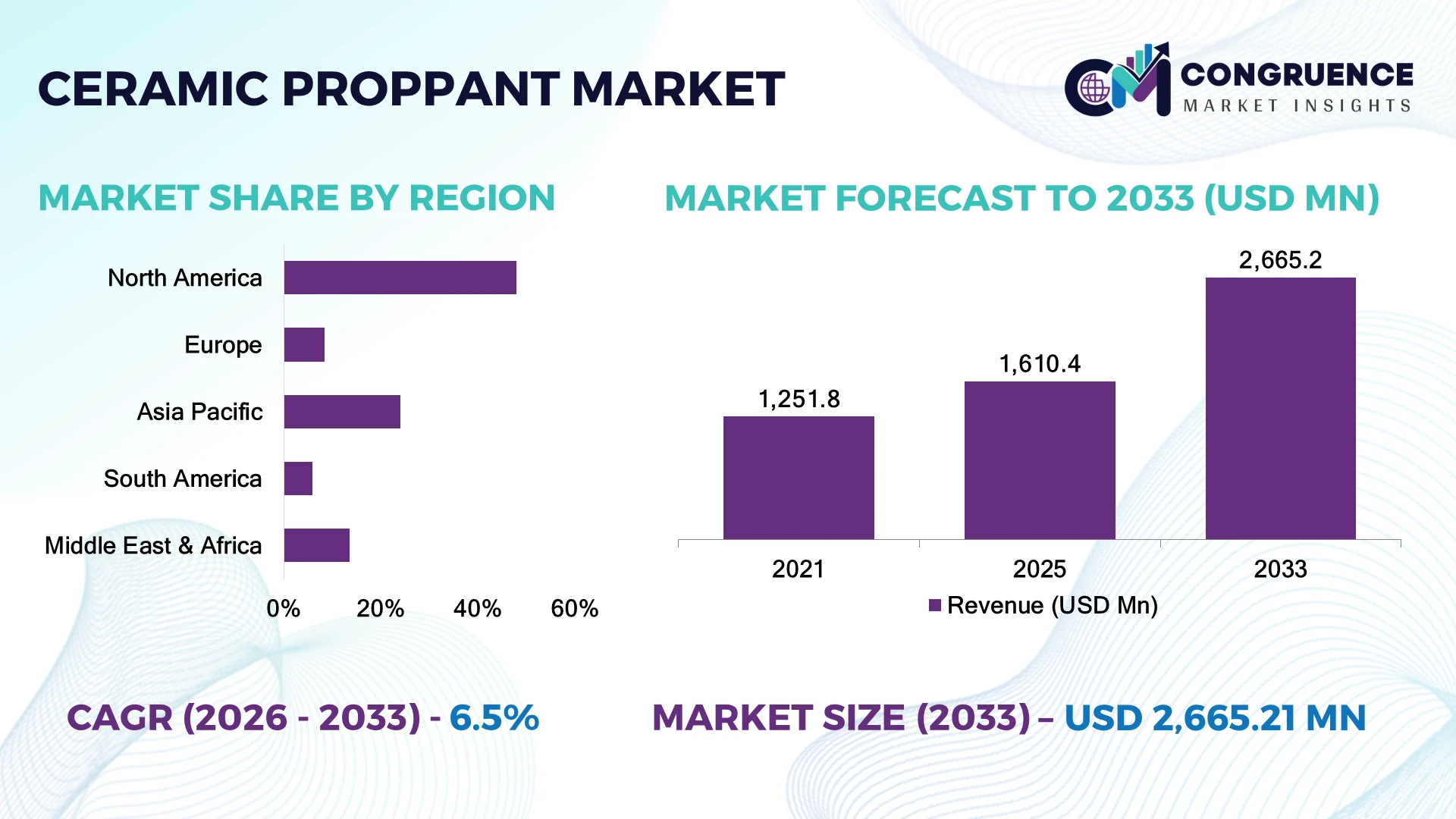
China holds more than 56% of global ceramic proppant market activity, compared with approximately 23% for the United States, supported by concentrated bauxite resources, large-scale manufacturing, and export-oriented production. China’s supply base increasingly serves international shale projects, while U.S. operators prioritize premium ceramics for high-stress Permian and deep-gas completions. The shift toward longer laterals and higher-pressure formations is strengthening demand for engineered proppant performance.
Suppliers with low-cost bauxite access, consistent API-grade quality, and export-ready logistics are best positioned to capture high-performance completion demand.
Market Size & Growth: USD 1.61 billion in 2025 to USD 2.67 billion by 2033 at 6.5% CAGR, supported by deeper shale wells and high-strength completion requirements.
Top Growth Drivers: High-pressure reservoir applications 32%; shale and tight-gas development 28%; advanced completion technologies 21%.
Short-Term Forecast: By 2028, engineered lightweight and microproppant deployment is positioned to improve fracture coverage and conductivity efficiency by approximately 10–20% in targeted completion designs.
Emerging Technologies: Lightweight ceramics, ceramic microproppants, waste-derived formulations, and AI-assisted fracture modeling are reshaping material selection and stage-level optimization.
Regional Leaders: China remains the largest production base; North America leads premium deployment; Asia-Pacific expands adoption through deep-gas and shale development.
Consumer/End-User Trends: Oil and gas operators increasingly use ceramic products selectively in high-stress zones rather than replacing sand across entire stages, strengthening value-based procurement.
Pilot/Case Example: 2025 Delaware Basin applications using ceramic microproppants reported production improvements exceeding 20% versus conventional completion approaches.
Competitive Landscape: Xinmi Wanli, Saint-Gobain, Mineracao Curimbaba, Fores, and US Ceramics collectively represent approximately 25% of the global ceramic proppant market.
Regulatory & ESG Impact: Waste-derived ceramic formulations are gaining attention; a 2026 pilot using drilling-cutting residue achieved a 3.01% breakage ratio at 52 MPa closure stress.
Investment & Funding: CARBO Ceramics secured USD 150 million in 2024 to support capacity expansion and next-generation proppant technologies, reinforcing performance-led investment.
Innovation & Future Outlook: The market is shifting from conventional high-density ceramics toward lightweight, micro-sized, waste-derived, and application-specific formulations that maximize fracture contact while controlling material and logistics costs.
Ceramic Proppant demand is concentrated in shale gas, tight oil, deep-gas, and high-pressure hydraulic fracturing applications. Lightweight ceramics and microproppants are gaining attention, with targeted formulations improving fracture coverage by more than 20% in selected field applications. China’s export-oriented supply chain remains important, while 2026 raw-material and kiln constraints are increasing procurement focus on reliable, compliant producers.
Ceramic proppant is becoming strategically important because unconventional wells are moving toward longer laterals, tighter fracture spacing, and more demanding closure stresses. Ceramic products currently represent roughly 12% of the broader proppant market but command strategic importance in deep and high-pressure reservoirs because their strength and conductivity are difficult to replicate with standard sand.
The technology gap is increasingly measurable. Engineered ceramics provide controlled particle geometry and higher crush resistance, while lightweight formulations reduce settling and improve transport. Microproppant deployment is also addressing the industry problem that only about one-third of created fracture area is typically supported by conventional proppant. Field applications in the Delaware Basin have reported production gains exceeding 20%, strengthening the business case for targeted ceramic placement rather than full-stage substitution.
Over the next 2–3 years, procurement will increasingly prioritize material consistency, logistics reliability, and reservoir-specific performance. China’s more than 56% market position creates scale advantages, while U.S. suppliers compete through premium formulations and application engineering. CARBO’s USD 150 million investment illustrates the shift toward combining capacity expansion with technology development. The winners will be suppliers that integrate advanced material science, dependable logistics, and field-level completion optimization rather than competing on ceramic price alone.
Longer horizontal wells and higher closure stresses are strengthening demand for ceramic proppants where conventional sand loses conductivity. Ceramic proppants represent approximately 12% of the broader proppant market, but their strategic use is concentrated in technically demanding formations. In the United States, Permian and other unconventional operators are increasing selective deployment of lightweight and microproppants to improve fracture coverage. A 2025 Delaware Basin deployment of ceramic microproppant delivered more than 22% production uplift after 18 months. Manufacturers are responding with lightweight grades, tighter particle-size control, and microproppant expansion. The non-obvious advantage is value per stimulated foot: operators can justify premium material when improved fracture conductivity increases well productivity without requiring major surface-equipment changes.
Ceramic proppants remain constrained by higher manufacturing and logistics costs than locally sourced frac sand, limiting their use across lower-stress formations. Ceramic sand represents roughly 12% of total proppant demand, while conventional frac sand retains the majority because transportation economics and adequate performance favor sand in many wells. Chinese intermediate-density ceramic prices increased approximately 8% year-on-year during 2026 amid higher bauxite costs, environmental enforcement, and export demand. High-temperature sintering also creates substantial energy exposure. Producers are responding through lightweight formulations, alternative aluminosilicate feedstocks, and longer-term raw-material contracts. The key operational insight is that ceramic suppliers compete on delivered well economics rather than material price; reducing density and transport intensity can protect margins more effectively than simply expanding kiln capacity.
Lightweight and ultra-lightweight ceramics offer a significant opportunity as operators pursue longer laterals and lower-viscosity fracturing fluids. North America currently accounts for roughly 50–60% of lightweight ceramic consumption, while Argentina's Vaca Muerta and China's unconventional developments are widening the application base. A 2026 materials study produced perlite-based ceramic proppants with bulk density of approximately 1.46 g/cm³ while maintaining an 8.21% breakage ratio at 35 MPa closure stress. Companies are investing in bauxite-replacement formulations, microproppants, and application-specific particle sizes. The strongest non-obvious opportunity is circular feedstock: converting industrial or drilling waste into engineered proppants can simultaneously reduce raw-material dependence and create an ESG differentiation point for suppliers serving environmentally scrutinized oilfield projects.
Scaling ceramic proppant technology requires consistent conductivity, crush resistance, density, and transport behavior across substantially different reservoir conditions. Standardized testing at 35 MPa does not fully represent ultra-deep formations where closure pressures can exceed 50 MPa, forcing suppliers to validate products across broader stress ranges. A 2026 waste-derived formulation achieved a 2.75% breakage ratio at 52 MPa, demonstrating the performance threshold required for demanding applications. Manufacturing consistency is equally important because small variations in sintering temperature or particle morphology can alter crush behavior. Companies must therefore invest in automated kiln control, laboratory characterization, and reservoir-specific qualification. The strategic challenge is scaling advanced formulations without sacrificing batch consistency, because a marginal quality deviation can undermine operator confidence across entire completion programs.
Microproppants Reach Farther Fractures: Operators are increasingly testing ultra-fine ceramic particles to access fracture networks that conventional 20/40 and 40/70 mesh materials cannot effectively support. Industry field data show that only about one-third of created fracture area is typically propped, encouraging microproppant deployment. Companies are using 325-mesh ceramic products to improve near-wellbore conductivity and extend production performance.
Lightweight Grades Gain Momentum: Lightweight and ultra-lightweight ceramics are gaining attention because lower density improves transport through slickwater systems and reduces premature settling. North America represents roughly 50–60% of lightweight ceramic consumption, while China and Argentina are expanding applications. Producers are reformulating bauxite-based products with alternative minerals to reduce density without sacrificing crush resistance.
Waste Feedstocks Enter Formulation: Ceramic manufacturing is shifting toward industrial by-products as producers address raw-material costs and environmental pressure. A 2026 formulation using perlite partially replaced bauxite while achieving 1.46 g/cm³ density and an 8.21% breakage ratio at 35 MPa. Manufacturers are evaluating fly ash, aluminum residues, and drilling-derived materials to diversify feedstock supply.
Field Economics Drive Premium Use: Ceramic adoption is becoming increasingly performance-led rather than volume-led. A Delaware Basin microproppant deployment delivered more than 22% production uplift after 18 months, strengthening the case for targeted ceramic placement. Operators are consequently evaluating proppants on incremental production per stimulated foot, while suppliers are expanding field-engineering support instead of competing solely through material pricing.
Intermediate-strength ceramic proppants account for approximately 41% of the ceramic proppant market, making them the leading product category because they balance crush resistance, conductivity, transport behavior, and delivered cost across medium- and high-pressure formations. High-strength ceramics represent roughly 35–38% and remain concentrated in deep, high-closure-stress wells where performance outweighs material premiums. Lightweight and ultra-lightweight grades account for approximately 20–24% but are gaining adoption as operators extend horizontal laterals and use lower-viscosity fracturing fluids.
Lightweight ceramics represent the fastest-growing product shift, supported by lower settling rates and improved fracture placement. North American consumption represents roughly 50–60% of lightweight ceramic demand, while Argentina, China, and Middle Eastern unconventional projects broaden the addressable market. Producers are investing in lower-density formulations, tighter particle-size control, and alternative mineral feedstocks. The business implication is a move from volume-based procurement toward reservoir-specific product selection, favoring suppliers capable of maintaining conductivity and crush performance across multiple density classes.
High-pressure and high-temperature wells represent approximately 51% of ceramic proppant application demand, reflecting the material's superior crush resistance and conductivity retention under severe closure stress. Deep and ultra-deep wells contribute roughly 35%, while shale gas and tight-oil applications account for approximately 14% within this application structure. Conventional shale deployments remain more price-sensitive because operators can substitute lower-cost sand in moderate-stress formations, whereas HPHT wells require engineered performance. This creates a clear value divide between broad-volume applications and technically critical completions.
Shale gas and tight-oil deployment is the fastest-changing application segment as longer laterals and higher-intensity fracturing increase demand for lightweight ceramics and microproppants. Operators are selectively placing premium ceramic material in high-stress stages rather than replacing sand throughout the completion. Companies are therefore expanding application-engineering teams, developing reservoir-specific particle sizes, and forming partnerships with stimulation-service providers. The strategic implication is that future demand will be determined increasingly by production uplift per tonne rather than total proppant consumption.
Oil and gas companies represent approximately 85% of ceramic proppant demand, reflecting their direct dependence on hydraulic-fracturing programs, well-completion budgets, and reservoir-development activity. Oilfield service providers form the second-largest purchasing group through stimulation and completion contracts, while mining and other specialized users remain comparatively small. Integrated producers generally prioritize conductivity consistency, technical qualification, and supply security, whereas independent operators place greater emphasis on delivered cost and well-level economics. This distinction is encouraging suppliers to offer differentiated contract structures and technical support.
Oilfield service providers represent the fastest-growing strategic buyer group as operators increasingly outsource fracture design, pumping, proppant selection, and logistics. Their procurement influence is rising as integrated completion packages become more common. Companies are responding through technical partnerships, inventory agreements, regional distribution hubs, and application-specific product portfolios. The shift creates an important competitive advantage for suppliers able to integrate material testing with fracture-design support. Rather than selling ceramic proppant solely as a commodity, leading producers are increasingly positioning it as part of a measurable well-performance solution.
North America accounted for the largest market share at 47.9% in 2025 however, Asia-Pacific is expected to register the fastest growth, expanding at a CAGR of 7.1% between 2026 and 2033.
Selective premium deployment is reshaping mature shale completions
North America remains the largest ceramic proppant market, supported by concentrated unconventional drilling in the Permian, Haynesville, Eagle Ford, and Bakken. The United States represents more than 80% of regional lightweight ceramic consumption, while the Permian alone contributes approximately 35–45% of regional demand. Ceramic deployment is increasingly selective, with operators reserving higher-value grades for intervals where closure stress makes sand substitution economically attractive. Microproppants are also gaining traction as completion designs target greater fracture coverage. Suppliers are responding with basin-level inventories, application engineering, and lightweight grades. The region's mature logistics infrastructure gives established producers an advantage, but imported bauxite exposure and trade costs continue to influence procurement strategies.
United States Market Outlook: The United States remains the principal qualification and deployment center, with demand concentrated across major shale basins. More than 90% of North American lightweight ceramic consumption is linked to oil and gas operators, while the Permian accounts for roughly 35–45% of regional demand. Suppliers increasingly compete through local inventory positioning and completion-design support.
Import dependence favors specialized, high-performance supply
Europe represents approximately 8–9% of global ceramic proppant demand, with consumption constrained by limited unconventional drilling and comparatively mature hydrocarbon infrastructure. The region nevertheless retains demand for high-strength materials in selected tight-gas, deep-well, and specialized stimulation programs. European lightweight ceramic supply remains structurally import-dependent, with domestic capacity estimated at only 20–30% of regional demand. This increases exposure to freight, qualification, and energy-cost volatility. Germany, Poland, and the Netherlands maintain specialized ceramic manufacturing capabilities, while buyers increasingly emphasize technical certification and consistent particle specifications. Suppliers with regional warehousing and compliant formulations can therefore capture opportunities despite Europe's smaller absolute market.
Norway Market Outlook: Norway offers the strongest strategic position through its large offshore petroleum infrastructure and technically advanced well-completion ecosystem. The country delivered 114.9 billion cubic meters of natural gas in 2025, supporting continued offshore activity and specialized stimulation requirements. Ceramic demand remains niche, but high-pressure applications favor technically qualified proppants where conductivity retention is prioritized.
China combines manufacturing scale with expanding gas development
Asia-Pacific holds approximately 24% of global ceramic proppant demand and represents the strongest expansion opportunity as China, India, and Southeast Asian markets develop unconventional and tight-gas resources. China accounts for roughly 55–65% of regional ceramic-proppant production capacity, giving local manufacturers significant cost and supply-chain advantages. Demand is increasingly shifting toward lightweight and intermediate-density products suited to longer laterals and higher pumping intensity. India provides an emerging demand center, while Japan and South Korea remain more dependent on specialized imports. Chinese producers are responding through export expansion, automated kiln operations, and lower-density formulations, while regional buyers are diversifying suppliers to reduce logistics and geopolitical exposure.
China Market Outlook: China combines the region's deepest manufacturing base with substantial domestic unconventional-gas activity. Its production capacity represents approximately 55–65% of Asia-Pacific output, allowing producers to serve both domestic operators and export markets. The strategic advantage lies in integrated access to mineral feedstocks, established ceramic-processing infrastructure, and large-scale kiln capacity.
Vaca Muerta is creating a new high-intensity completion market
South America accounts for approximately 5–7% of global ceramic proppant demand, with Argentina overwhelmingly shaping the region's near-term opportunity. Vaca Muerta is driving longer laterals, higher completion intensity, and greater demand for performance-oriented proppants, while Brazil provides a smaller market centered on conventional and offshore activity. Argentina's unconventional development is moving toward industrial-scale infrastructure, although transport capacity, sand logistics, and capital availability remain important execution constraints. TotalEnergies plans to invest approximately $10 billion in Argentina, including expanded gas production in Neuquén, reinforcing the upstream infrastructure pipeline. Suppliers are therefore prioritizing regional stocking, local service partnerships, and products capable of supporting high-stress unconventional completions.
Argentina Market Outlook: Argentina is the region's most strategically important ceramic-proppant market because Vaca Muerta combines large unconventional resources with rapidly expanding drilling activity. Development is expected to require unconventional drilling to rise from around 450 wells annually in 2025 toward more than 900 by 2030. This scale-up strengthens the case for dedicated proppant logistics and local completion-service ecosystems.
Deep-gas development is accelerating premium proppant adoption
Middle East & Africa contributes approximately 13–14% of global ceramic proppant demand, with Saudi Arabia and the wider Gulf increasingly important because deep unconventional-gas reservoirs impose closure stresses that can exceed conventional sand performance limits. Saudi Arabia's Jafurah development is the principal regional demand center, complemented by UAE unconventional-gas activity and tight-gas projects in Oman. A 2025 industry development plan projected GCC ceramic-proppant demand rising from approximately 182 million in 2024 to 219 million by 2027, indicating expanding procurement requirements. Suppliers are emphasizing high-strength grades, reliable import logistics, and regional inventory buffers as large-scale gas projects move through completion cycles.
Saudi Arabia Market Outlook: Saudi Arabia is the region's principal ceramic-proppant market, supported by Jafurah's unconventional-gas development and extensive high-pressure completion requirements. National drilling and completion programs are creating demand for stronger, technically qualified proppants rather than commodity-grade sand alone. The country's established oilfield-service ecosystem also enables suppliers to integrate material qualification, logistics, and completion engineering into larger procurement contracts.
CARBO Ceramics competes with Xinmi Wanli, Diamond Ceramics, Orient Ceratech, and ChangQing, pitting global suppliers against China-based cost and scale leaders. The top five are estimated to hold 25% combined share, leaving a fragmented field. Competition centers on delivered cost, crush resistance, density control, logistics, and customized mesh sizes. Lightweight formulations can reduce proppant requirement by about 20%, while CARBO’s lightweight ISP platform targets 20% higher volumetric yield. Suppliers compete through automated manufacturing, inventory, export networks, application engineering, and partnerships with completion-service companies. China-based producers benefit from integrated mineral sourcing and manufacturing scale; Western specialists compete through differentiated products, field validation, and diagnostic technologies. The competitive shift is moving from commodity ceramic supply toward engineered microproppants, lightweight grades, and data-enabled completion optimization. Entry barriers include qualification testing, consistent particle morphology, high-temperature processing expertise, and established operator relationships. Winning requires reliable supply plus demonstrable well-level productivity gains, not price leadership alone.
Automated pelletizing, kiln controls, and machine-vision quality inspection are becoming the foundation of modern ceramic-proppant production. Advanced process control can improve particle consistency and reduce dimensional variation by roughly 1–2%, while automated handling lowers labor-intensive processing requirements. Adoption is strongest among large manufacturers with high-volume production lines, giving scale players an advantage in consistent API-grade output and export qualification.
Lightweight and ultralight ceramic formulations are the most relevant technology shift. CARBOISP LITE, for example, targets 20% higher volumetric yield and 20% lower proppant requirement than conventional intermediate-strength products. Compared with traditional higher-density ceramics, lower-density formulations improve transport through low-viscosity fluids and can reduce pumping requirements by about 1–2% in optimized designs. Microproppants extend this advantage by entering fracture features inaccessible to conventional particle sizes.
The next disruptive layer is functional and traceable proppant technology. Electrically conductive iON enables far-field fracture detection, while chemical-infused and coated particles add treatment functionality. Adoption remains selective, but field validation is accelerating. During 2026–2028, suppliers combining lightweight ceramics, microproppants, sensing, digital completion models, and automated quality systems should gain differentiation. Technology leaders benefit most where operators prioritize recovery per well rather than lowest upfront material cost, in complex reservoirs requiring placement and conductivity control.
May 2025 CARBO Ceramics and a West Texas operator validated NANOMITE Express, with four Delaware Basin wells delivering more than 22% uplift after 18 months without artificial lift. The result strengthens commercial positioning for ceramic microproppants in unconventional completions. Source: carbo.tech
November 2025 CARBO Ceramics supported Mazama Energy’s enhanced geothermal system milestone, where its ceramic proppants operated in a 330°C subsurface environment. The deployment demonstrates ceramic materials’ expansion beyond oil and gas into extreme-temperature geothermal applications, broadening demand. Source: carbo.tech
June 2026 CARBO Ceramics highlighted electromagnetic proppant detection through QUANTUM and conductive iON technology, enabling far-field placement mapping. iON provides 200–2,000 S/m conductivity under downhole conditions, strengthening differentiation through measurable fracture-visibility capabilities for completion optimization today. Source: carbo.tech
January 2024 Researchers reported a recycled drilling-cuttings ceramic proppant achieving 1.48 g/cm³ bulk density and 5.25% breakage at 52 MPa. The formulation demonstrates a credible pathway toward lower-density, waste-derived proppants with improved material circularity for operators globally. Source: nature.com
The Ceramic Proppant Market Report covers intermediate-strength, high-strength, lightweight, and ultralight ceramic products across high-pressure, deep-well, shale, tight-gas, and other hydraulic-fracturing applications. End-user analysis focuses on oil and gas operators, oilfield service providers, and specialized industrial users, with regional coverage spanning North America, Europe, Asia-Pacific, South America, and Middle East & Africa. China represents more than half of regional production capacity in Asia-Pacific, while North America remains the principal premium-deployment center.
The report evaluates production technologies, automated pelletizing, kiln optimization, alternative mineral feedstocks, microproppants, lightweight formulations, and functional coated products. It assesses supply-chain positioning, manufacturing scale, qualification requirements, logistics, field deployment, and competitive differentiation across established and emerging suppliers. Strategic analysis supports investment planning, capacity expansion, sourcing decisions, partnership evaluation, product positioning, and technology prioritization through 2033, with particular attention to unconventional reservoirs, deep wells, and specialized high-stress applications.
| Report Attribute/Metric | Report Details |
|---|---|
|
Market Revenue in 2025 |
USD 1,610.4 Million |
|
Market Revenue in 2033 |
USD 2,665.2 Million |
|
CAGR (2026 - 2033) |
6.5% |
|
Base Year |
2025 |
|
Forecast Period |
2026 - 2033 |
|
Historic Period |
2021 - 2025 |
|
Segments Covered |
By Type
By Application
By End-User
|
|
Key Report Deliverable |
Revenue Forecast, Growth Trends, Market Dynamics, Segmental Overview, Regional and Country-wise Analysis, Competition Landscape |
|
Region Covered |
North America, Europe, Asia-Pacific, South America, Middle East, Africa |
|
Key Players Analyzed |
CARBO Ceramics, Xinmi Wanli Industry Development, Diamond Ceramics, Orient Ceratech, ChangQing Proppant, Mineracao Curimbaba, Saint-Gobain, Fores, SEPPE, Hebei Kaiyuan Petroleum Proppant, Luoyang Maide Ceramics, Emdad Energy, Superior Energy Services |
|
Customization & Pricing |
Available on Request (10% Customization is Free) |




