
Reports
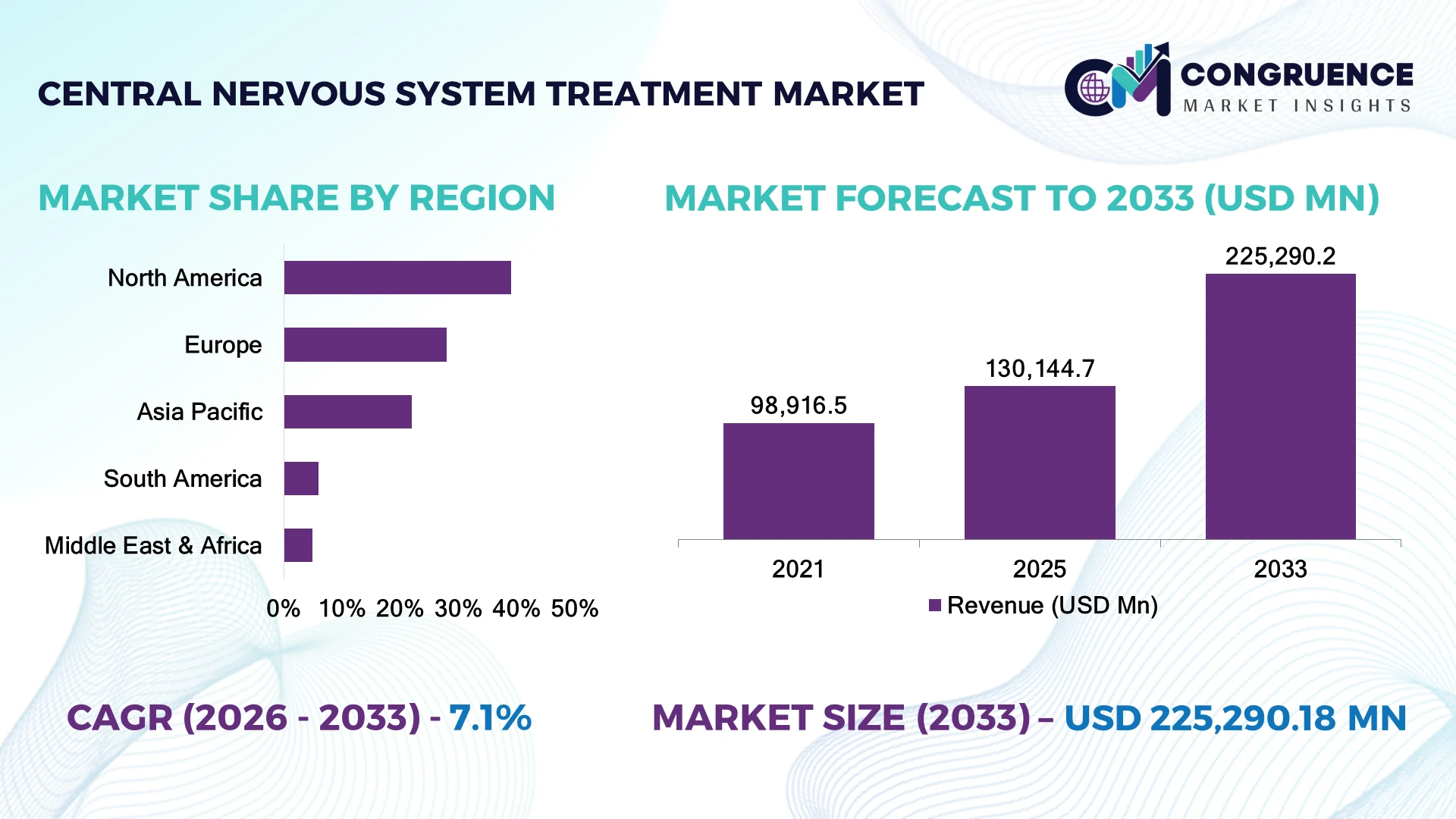
The Global Central Nervous System Treatment Market was valued at USD 130,144.7 Million in 2025 and is anticipated to reach a value of USD 225,290.2 Million by 2033 expanding at a CAGR of 7.1% between 2026 and 2033. Growth is being driven by the transition toward disease-modifying neurological therapies, biomarker-guided diagnosis, biologics, and more targeted treatment pathways for Alzheimer’s disease, Parkinson’s disease, multiple sclerosis, epilepsy, and other chronic CNS disorders.
The United States remains the dominant country market, accounting for approximately 36%–37% of global CNS treatment activity, supported by pharmaceutical R&D, specialist infrastructure, advanced diagnostics, and rapid uptake of novel therapies. In 2026, FDA clearance of additional blood-based Alzheimer’s diagnostics is expanding decentralized assessment, while India and China are strengthening pharmaceutical manufacturing and clinical-development capacity. The U.S. maintains a clear innovation advantage, with substantially higher specialty-care intensity and treatment infrastructure.
Strategically, companies that integrate CNS therapeutics with biomarker diagnostics, specialized delivery infrastructure, and evidence-generation capabilities are positioned to capture the highest-value treatment opportunities.
The Central Nervous System Treatment Market is increasingly shaped by neurodegenerative disease therapies, precision diagnostics, biologics, and digital monitoring. Blood-based Alzheimer’s testing is moving into broader clinical workflows, while blood-brain-barrier delivery platforms address a persistent limitation in CNS drug development. Approximately 18% of 2025 venture raises by therapeutic area went to neurology, reinforcing investment momentum around specialized CNS platforms and translational technologies.
The Central Nervous System Treatment Market is becoming strategically important as pharmaceutical competition shifts from symptomatic management toward disease modification, biomarker-defined populations, and measurable neurological outcomes. Alzheimer’s therapies are accelerating this transition, while regulatory acceptance of blood-based biomarkers is restructuring the diagnostic pathway. Companies increasingly compete not only on drug efficacy but also on diagnostic access, treatment administration, monitoring, and evidence generation.
Technology is producing measurable workflow advantages. Blood-based Alzheimer’s biomarkers can reduce reliance on PET imaging and invasive cerebrospinal-fluid procedures for appropriately selected patients, while digital monitoring can shift selected follow-up activities away from specialist clinics. Over the next 2–3 years, wider deployment of validated biomarkers, AI-assisted patient stratification, and remote monitoring should improve diagnostic throughput and reduce avoidable specialist workload by approximately 10–20%.
Regional strategies remain differentiated. The United States retains an advantage in high-value CNS R&D and specialty-care infrastructure, whereas China and India are expanding manufacturing, clinical-development, and treatment capacity. In 2026, companies are strengthening this transition through acquisitions, licensing agreements, diagnostic partnerships, and CNS delivery investments, including targeted blood-brain-barrier platforms. Competitive advantage increasingly depends on controlling the complete treatment pathway from patient identification to therapy delivery and longitudinal outcomes.
The shift toward biomarker-led CNS treatment is strengthening demand for targeted therapies, particularly in Alzheimer's and other neurodegenerative disorders. Approximately 35% of late-stage CNS pipelines now incorporate biomarker-based patient selection, while AI-enabled drug discovery can reduce early candidate-screening timelines by 20–30%. In the United States, regulatory acceptance of blood-based biomarkers is also accelerating diagnostic integration. This transition is pushing pharmaceutical companies to expand companion-diagnostic partnerships, invest in neuroimaging and biomarker platforms, and prioritize therapies with measurable disease-modifying outcomes. A non-obvious advantage is improved trial enrollment efficiency: better patient stratification reduces protocol-screening waste and strengthens the commercial case for precision CNS portfolios.
Advanced CNS therapies face substantial infrastructure and delivery constraints, particularly where diagnostic capacity and specialist availability remain uneven. Specialized neurological imaging and infusion-based treatment pathways can increase treatment-center operating requirements by 20–40%, while diagnostic delays in lower-capacity healthcare systems frequently exceed several weeks. The United States has stronger specialist and diagnostic infrastructure than many emerging markets, but even established systems face capacity pressure as Alzheimer's therapies expand. Pharmaceutical companies are responding through authorized treatment-center networks, regional distribution contracts, cold-chain optimization, and localized diagnostic partnerships. The key operational constraint is no longer drug availability alone; synchronized access to diagnostics, specialists, infusion capacity, and patient monitoring determines whether new CNS therapies can scale commercially.
Blood-based biomarkers are creating a high-value opportunity by moving neurological assessment toward faster and less resource-intensive diagnostic workflows. Emerging assays can deliver diagnostic information within hours rather than relying exclusively on advanced imaging or invasive procedures, while biomarker-led screening can reduce unnecessary confirmatory testing by approximately 15–25% in appropriately selected pathways. The United States is rapidly integrating these tools into Alzheimer's diagnostic development, while pharmaceutical companies are pairing therapeutic pipelines with diagnostic platforms. This creates an underdeveloped commercial layer around laboratory testing, decentralized diagnostics, and companion-diagnostic licensing. Companies investing early in assay validation, laboratory networks, and data partnerships can capture value before biomarker testing becomes a standardized component of CNS treatment pathways.
CNS treatment increasingly requires coordination among diagnostics, therapeutics, digital monitoring, specialist care, and longitudinal outcome assessment, creating execution complexity beyond conventional drug commercialization. Clinical programs involving advanced neurological therapies can require multiple diagnostic checkpoints and monitoring visits, increasing healthcare workflow requirements by roughly 15–30%. Workforce shortages further constrain consistent deployment, with specialist neurologist availability substantially lower in countries such as India than in the United States. Companies must therefore build integrated care partnerships, strengthen digital patient-monitoring infrastructure, and standardize treatment protocols across facilities. The strategic challenge is interoperability: disconnected diagnostic, clinical, and patient-data systems can undermine treatment continuity even when the underlying therapy is clinically effective.
Biomarker Testing Enters Routine Care: Blood-based neurological biomarkers are moving from specialist research into clinical workflows, with adoption accelerating across Alzheimer's assessment and clinical-trial screening. Faster testing can reduce diagnostic bottlenecks by approximately 20–30% compared with pathways dependent on advanced imaging alone. Companies are forming laboratory partnerships and integrating biomarker testing with therapeutic commercialization strategies, turning diagnostics into an important component of CNS treatment delivery.
AI Restructures Drug Development Workflows: AI-supported target identification, molecular screening, and patient stratification are becoming embedded in CNS R&D, with selected discovery workflows achieving 20–40% faster candidate evaluation. The operational shift is particularly important for disorders with historically high clinical-development failure rates. Pharmaceutical companies are combining internal AI teams with specialist technology partnerships rather than rebuilding computational capabilities independently, accelerating portfolio decisions while controlling early-stage research costs.
Specialty Treatment Centers Expand: Advanced neurological therapies are driving expansion of designated treatment centers, particularly in the United States, where infusion capacity and specialist monitoring increasingly determine patient access. Center-based administration can consolidate monitoring workflows and improve resource utilization by approximately 15–25%. Manufacturers are responding by developing certified provider networks, standardized protocols, and coordinated logistics rather than relying exclusively on conventional wholesale distribution.
Decentralized Monitoring Gains Ground: Remote neurological assessments, digital adherence tools, and connected patient-monitoring platforms are increasingly supplementing in-person consultations. Digital follow-up can reduce selected routine visits by approximately 10–20%, easing pressure on specialist capacity. Companies are integrating remote monitoring with clinical-trial and post-treatment workflows, while evolving data-governance requirements are pushing providers toward interoperable platforms rather than isolated digital applications.
Prescription drugs represent the leading type in the Central Nervous System Treatment Market, accounting for approximately 68% of demand, supported by broad use across depression, epilepsy, schizophrenia, Parkinson’s disease, and Alzheimer’s disease. Their established prescribing pathways, manufacturing scalability, reimbursement familiarity, and extensive distribution networks keep them ahead of biologics and other advanced modalities. Generic formulations account for roughly 42% of prescription volume, reinforcing their importance in cost-sensitive markets such as India and China. Companies are simultaneously protecting premium portfolios through differentiated formulations and longer-acting therapies.
Biologic and targeted therapies constitute the fastest-growing type, with adoption expanding approximately 14–17% annually within advanced CNS treatment categories as disease-modifying approaches gain clinical acceptance. Neurostimulation and other advanced therapeutic modalities remain smaller but strategically important, particularly where conventional pharmacological response is inadequate. This shift is redirecting investment toward antibody engineering, blood-brain-barrier delivery, precision biomarkers, and combination treatment platforms rather than incremental reformulation alone.
Neurodegenerative disorders represent the leading application category, accounting for approximately 31% of the Central Nervous System Treatment Market, driven by Alzheimer’s disease, Parkinson’s disease, and related cognitive and movement disorders. The segment commands disproportionate investment because treatment is shifting from symptom management toward disease modification and earlier intervention. Psychiatric disorders remain a mature high-volume application at approximately 27%, supported by established antidepressant, antipsychotic, and anxiolytic treatment pathways. Companies are increasingly differentiating portfolios through precision diagnostics and longer-duration treatment options.
Alzheimer’s disease is the fastest-changing application, with demand for disease-modifying therapies and biomarker-supported diagnosis expanding approximately 18–20% across leading treatment markets. Epilepsy and multiple sclerosis remain strategically significant, while cerebrovascular disorders continue to generate high treatment volumes through acute and preventive care. Companies are expanding specialized treatment networks and pairing therapeutics with diagnostic technologies to improve patient identification. The key business shift is toward integrated disease pathways, where diagnostic capability increasingly determines the addressable treatment population rather than drug availability alone.
Hospitals represent the dominant end-user, capturing approximately 46% of Central Nervous System Treatment Market utilization because complex neurological diagnosis, infusion-based therapies, acute care, imaging, and multidisciplinary treatment remain concentrated in hospital infrastructure. Specialty neurology and memory-care clinics account for approximately 29%, supported by increasing demand for biomarker testing and disease-specific treatment pathways. Hospitals in the United States continue to lead adoption of advanced CNS therapies, while providers in India are expanding specialist capacity and diagnostic infrastructure to improve access.
Specialty clinics are the fastest-growing end-user group, with adoption increasing approximately 15–18% as decentralized diagnosis and outpatient treatment become more practical. Home-care and ambulatory settings remain smaller but increasingly relevant for chronic medication management, digital monitoring, rehabilitation, and follow-up care. Companies are responding with provider-network partnerships, patient-support programs, decentralized diagnostic models, and therapies designed for less intensive administration. The competitive implication is clear: suppliers that build treatment ecosystems around specialist clinics can expand access without replicating the full cost structure of hospital-based delivery.
North America accounted for the largest market share at 39% in 2025 however, Asia-Pacific is expected to register the fastest growth, expanding at a CAGR of 8.3% between 2026 and 2033.
Precision neurology and specialty-care infrastructure strengthen market leadership
North America maintains the strongest position in the Central Nervous System Treatment Market, supported by high-value neurological drug development, specialist-care capacity, advanced diagnostics, and rapid commercialization of novel therapies. The United States represents more than 90% of regional demand and remains the principal launch market for disease-modifying Alzheimer’s treatments and biomarker-enabled diagnosis. FDA acceptance of blood-based Alzheimer’s biomarkers in 2025–2026 is accelerating decentralized diagnostic workflows and expanding the addressable patient pool. More than 6,000 U.S. hospitals provide neurological services, creating a dense treatment infrastructure for complex CNS conditions. Pharmaceutical companies are increasing investment in companion diagnostics, specialty pharmacies, infusion networks, and patient-monitoring platforms to support therapies requiring structured clinical supervision.
United States Market Outlook: The United States remains the global technology and commercialization center for CNS treatment, combining pharmaceutical R&D, biotechnology, specialist hospitals, clinical-trial infrastructure, and sophisticated reimbursement pathways. The country accounts for roughly 35% of global CNS treatment activity and hosts a substantial share of late-stage neurological drug development. Increasing adoption of blood-based biomarkers is improving diagnostic throughput while strengthening commercial opportunities for integrated therapeutic-diagnostic platforms.
Regulatory modernization and integrated neurological care reshape deployment
Europe holds approximately 28% of the global Central Nervous System Treatment Market, supported by established pharmaceutical manufacturing, universal or near-universal healthcare coverage, specialist neurological centers, and strong clinical research capabilities. Germany, France, Italy, and the United Kingdom account for a substantial proportion of regional treatment expenditure. European regulators are placing greater emphasis on real-world evidence, patient outcomes, and accelerated access to innovative medicines, encouraging manufacturers to build evidence-generation capabilities alongside product launches. Germany's large hospital and specialty-care network provides a major deployment base for advanced CNS therapies, while digital health adoption is improving longitudinal monitoring. Companies are prioritizing localized regulatory strategies, partnerships with neurological centers, and health-economic evidence to improve reimbursement access.
Germany Market Outlook: Germany is Europe's largest CNS treatment market, supported by approximately 2,000 hospitals, extensive specialist-care infrastructure, and strong pharmaceutical and biotechnology capabilities. Its dense network of university hospitals supports clinical trials and adoption of advanced neurological therapies. Manufacturers are increasingly targeting Germany for early commercialization and evidence generation, particularly for high-cost disease-modifying treatments requiring specialist diagnosis and structured monitoring.
Manufacturing localization and expanding specialist capacity accelerate adoption
Asia-Pacific represents approximately 22% of the global Central Nervous System Treatment Market and is the fastest-expanding major market as China, Japan, South Korea, and India strengthen pharmaceutical production, clinical research, and neurological-care infrastructure. China accounts for roughly 45% of regional demand, supported by expanding domestic drug development and hospital capacity. India is strengthening its position in affordable CNS medicines and clinical services, while Japan maintains advanced neurological diagnostics and an aging-population-driven treatment base. China's domestic pharmaceutical industry has increased investment in innovative drug discovery and biologics manufacturing, reducing dependence on imported therapies. Companies are responding through localized production, licensing agreements, clinical-trial partnerships, and differentiated pricing strategies.
China Market Outlook: China is the region's most strategically significant CNS market, combining a large patient population with rapidly expanding hospital infrastructure and domestic pharmaceutical R&D. More than 30,000 hospitals operate across the country, creating substantial treatment-distribution capacity. Increasing regulatory support for innovative medicines and stronger domestic biologics manufacturing are improving access to advanced therapies, while local companies are forming partnerships to accelerate neurological drug development.
Public-health expansion drives demand while access remains uneven
South America accounts for approximately 6% of the global Central Nervous System Treatment Market, with Brazil representing more than 55% of regional demand. The market is primarily shaped by public healthcare procurement, private hospital networks, generic medicines, and increasing diagnosis of neurological and psychiatric conditions. Brazil's extensive public healthcare system provides a large distribution channel for established CNS medicines, while private providers increasingly adopt advanced diagnostics and specialty therapies. However, specialist availability and uneven diagnostic infrastructure constrain access outside major metropolitan centers. Companies are responding through distributor partnerships, localized patient-support programs, generic manufacturing, and selective specialty-care expansion. The strongest opportunity lies in improving diagnosis and treatment continuity rather than simply expanding product availability.
Brazil Market Outlook: Brazil is the dominant South American CNS treatment market because of its population scale, extensive public healthcare network, pharmaceutical manufacturing base, and concentration of specialist hospitals in São Paulo and other major cities. The country operates more than 6,000 hospitals, providing a substantial treatment-distribution platform. Manufacturers are increasingly combining local distributors with hospital partnerships to improve access to specialty neurological therapies while maintaining cost competitiveness.
Healthcare modernization creates concentrated specialty-care opportunities
Middle East & Africa represents approximately 5% of the global Central Nervous System Treatment Market, with Saudi Arabia, the United Arab Emirates, and South Africa accounting for a significant portion of advanced-care demand. Gulf healthcare systems are investing heavily in tertiary hospitals, digital health infrastructure, neurological centers, and precision diagnostics. Saudi Arabia's healthcare transformation program is accelerating private-sector participation and hospital modernization, while the UAE is developing specialized centers capable of managing complex neurological conditions. Access remains more fragmented across African markets because specialist capacity and diagnostic infrastructure are concentrated in major cities. Companies are therefore using hub-and-spoke distribution, public-private partnerships, and regional specialty centers to improve treatment access without replicating full-scale infrastructure in every market.
Saudi Arabia Market Outlook: Saudi Arabia is the region's most strategically important CNS treatment market because healthcare modernization is creating substantial demand for advanced diagnostics, specialty hospitals, and innovative medicines. The country is targeting major expansion of private healthcare participation and digital health infrastructure under its national transformation agenda. Pharmaceutical companies are responding through hospital partnerships, local distribution agreements, and investment in specialized neurological-care capabilities, positioning the country as a Gulf hub for advanced CNS treatment.
The Central Nervous System Treatment Market pits global innovators Eli Lilly, Roche, Biogen, Novartis, and AbbVie against regional pharmaceutical producers and specialized biotechnology developers. The top five players command a 31% combined share, leaving substantial room for specialists.
Competition centers on clinical differentiation, biomarker integration, manufacturing scale, and treatment convenience. Disease-modifying therapies gain a 20–25% premium over mature symptomatic products, while biomarker-enabled pathways can improve patient-selection efficiency by 15–20%. Leaders are expanding through licensing, acquisitions, diagnostic partnerships, and vertically integrated development. Novartis’s neuroscience expansion and Roche-Lilly diagnostic collaboration illustrate the shift from standalone medicines toward integrated treatment ecosystems.
The competitive structure is consolidating around companies controlling therapeutic assets and enabling diagnostics, while regional manufacturers compete through 20–30% lower-cost generic supply. High regulatory, clinical-trial, and specialist-infrastructure requirements remain major entry barriers. Winning requires differentiated clinical evidence, scalable manufacturing, rapid regulatory execution, and partnerships that connect diagnosis, treatment, monitoring, and patient access.
Eli Lilly and Company
Roche
Biogen Inc.
Novartis AG
AbbVie Inc.
Johnson & Johnson
Bristol Myers Squibb
Merck & Co.
Sanofi
Teva Pharmaceutical Industries
Otsuka Pharmaceutical
Eisai Co., Ltd.
CNS treatment technology is shifting from conventional symptomatic pharmacology toward biomarker-guided therapeutics, AI-assisted discovery, antibody engineering, RNA therapies, and blood-brain-barrier delivery. Blood-based pTau217 testing is moving into routine diagnostic workflows, while AI-enabled screening can shorten early candidate evaluation by approximately 20–30%. Adoption is strongest in Alzheimer’s programs, where biomarker integration increasingly determines patient eligibility.
Disease-modifying antibodies are also advancing treatment precision. Modified donanemab dosing reduced ARIA-E incidence from 24% to 14% at week 24, a 41% relative reduction, while preserving comparable amyloid reduction. Compared with repeated advanced imaging and invasive CSF assessment, validated blood biomarkers provide a substantially simpler workflow and expand diagnostic access. Diagnostic companies with large installed laboratory networks therefore gain a structural commercialization advantage.
From 2026–2028, RNA delivery, digital biomarkers, AI-supported patient stratification, and minimally invasive diagnostics will increasingly converge into integrated CNS platforms. Companies combining therapeutic assets with diagnostic infrastructure can improve trial recruitment, reduce screening inefficiency, and accelerate treatment initiation. Biopharma leaders gain scale advantages, while specialized biotechnology firms gain leverage through licensing and platform partnerships. The competitive priority is shifting from drug innovation toward coordinated therapeutic, diagnostic, data, and delivery ecosystems that improve access, evidence generation, treatment personalization, and lifecycle economics across major markets.
August 2026 Roche received FDA clearance for Elecsys pTau217, extending Alzheimer’s assessment across primary and specialty care through more than 4,500 U.S. laboratory instruments. The move lowers deployment friction for biomarker testing and strengthens integrated diagnostic-treatment pathways nationally. Source: roche.com
July 2025 Biogen and Eisai reported four-year LEQEMBI data showing 56% of low-tau patients maintained improved cognitive and daily-living function. The evidence strengthens long-duration treatment positioning and supports continued investment in Alzheimer’s disease-modifying therapy worldwide and clinical differentiation. Source: biogen.com
November 2025 Novartis received FDA approval for Itvisma, a gene-replacement therapy for spinal muscular atrophy covering patients aged two years through adulthood. The approval expands neurological treatment options and strengthens Novartis’s position in advanced genetic-medicine delivery capabilities globally. Source: novartis.com
July 2024 FDA approved Kisunla for Alzheimer’s disease after a 1,736-patient trial conducted across 277 sites in eight countries. The decision established a new disease-modifying treatment option and accelerated investment in diagnostic and infusion infrastructure internationally across centers. Source: fda.gov
The Central Nervous System Treatment Market Report covers treatment types including prescription medicines, biologics, targeted therapies, and advanced therapeutic modalities, with analysis across neurodegenerative disorders, psychiatric conditions, epilepsy, multiple sclerosis, cerebrovascular disorders, and other CNS applications. End-user coverage includes hospitals, specialty neurology clinics, ambulatory settings, and home-care pathways, capturing differences in treatment intensity and diagnostic infrastructure.
The report evaluates North America, Europe, Asia Pacific, South America, and the Middle East & Africa, with country-level analysis for major pharmaceutical and healthcare markets. Technology coverage includes AI-assisted drug discovery, blood-based biomarkers, digital monitoring, RNA therapeutics, blood-brain-barrier delivery, and disease-modifying therapies. The analysis supports investment planning, market-entry decisions, partnership strategy, portfolio prioritization, manufacturing localization, competitive positioning, and expansion planning through 2033.
| Report Attribute/Metric | Report Details |
|---|---|
|
Market Revenue in 2025 |
USD 130,144.7 Million |
|
Market Revenue in 2033 |
USD 225,290.2 Million |
|
CAGR (2026 - 2033) |
7.1% |
|
Base Year |
2025 |
|
Forecast Period |
2026 - 2033 |
|
Historic Period |
2021 - 2025 |
|
Segments Covered |
By Type
By Application
By End-User
|
|
Key Report Deliverable |
Revenue Forecast, Growth Trends, Market Dynamics, Segmental Overview, Regional and Country-wise Analysis, Competition Landscape |
|
Region Covered |
North America, Europe, Asia-Pacific, South America, Middle East, Africa |
|
Key Players Analyzed |
Eli Lilly and Company, Roche, Biogen Inc., Novartis AG, AbbVie Inc., Johnson & Johnson, Bristol Myers Squibb, Merck & Co., Sanofi, Teva Pharmaceutical Industries, Otsuka Pharmaceutical, Eisai Co., Ltd. |
|
Customization & Pricing |
Available on Request (10% Customization is Free) |




