
Reports
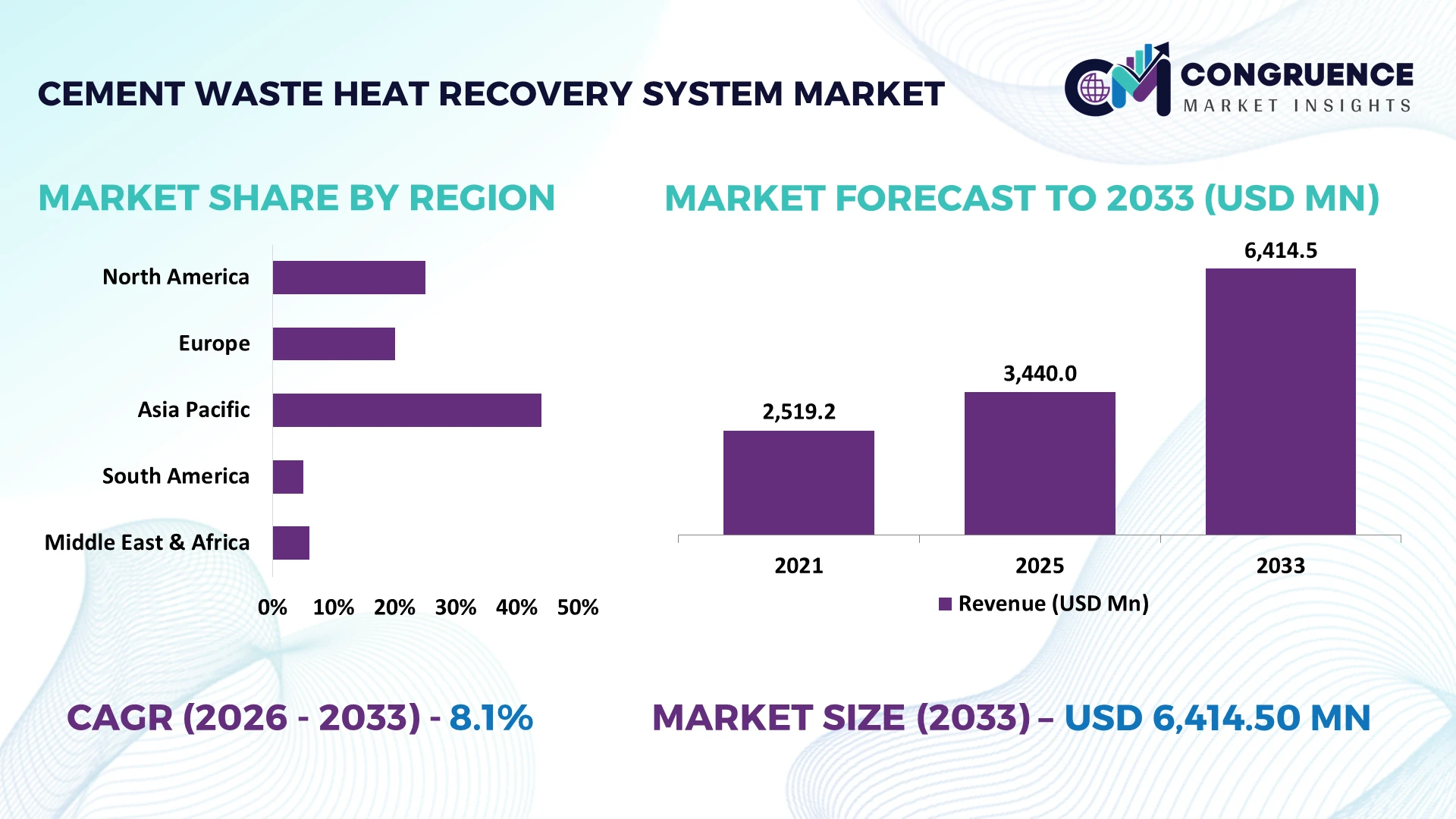
The Global Cement Waste Heat Recovery System Market was valued at USD 3440 Million in 2025 and is anticipated to reach a value of USD 6414.5 Million by 2033 expanding at a CAGR of 8.1% between 2026 and 2033. Growth is driven by rising cement plant electricity costs, suspension preheater and clinker cooler heat recovery, industrial decarbonization mandates, and investment in captive power generation.
China dominates global cement waste heat recovery deployment, supported by its integrated clinker manufacturing infrastructure and established engineering capabilities. China produces more than 50% of global cement output, compared with India's approximately 8% contribution. Modern cement waste heat recovery installations typically generate 25–45 kWh of electricity per tonne of clinker, reducing purchased electricity requirements. China's industrial energy efficiency policies and carbon market expansion strengthen incentives for heat recovery retrofits. Domestic engineering suppliers support boiler manufacturing, turbine integration, and large-scale plant modernization.
Strategically, cement manufacturers should prioritize 25–45 kWh per tonne recovery potential and China's more than 50% production concentration when evaluating retrofit investments and technology partnerships.
Market Size & Growth: USD 3,440 million in 2025, reaching USD 6,414.5 million by 2033 at 8.1% CAGR, supported by captive electricity generation and kiln heat recovery.
Top Growth Drivers: Electricity represents 15–25% of cement production costs; waste heat recovery offsets 20–30% of plant electricity demand; cement generates approximately 7–8% of global CO₂ emissions.
Short-Term Forecast: By 2027, advanced retrofit projects target 20–30% reductions in grid electricity purchases through improved thermal integration.
Emerging Technologies: Organic Rankine Cycle systems, AI-driven heat optimization, and advanced boiler coatings improve recovery from 2 major kiln exhaust streams.
Regional Leaders: Illustrative 2033 allocations: Asia-Pacific USD 3,592 million, Europe USD 1,283 million, and North America USD 834 million, reflecting retrofit, decarbonization, and efficiency investments.
Consumer/End-User Trends: Integrated cement plants deploying waste heat recovery typically offset 20–30% of electricity consumption, strengthening energy cost predictability.
Pilot/Case Example: In 2024, Dalmia Cement's WHR installations supported captive electricity generation, with modern systems delivering approximately 25–45 kWh per tonne of clinker.
Competitive Landscape: Sinoma Energy Conservation maintains a leading engineering position alongside Kawasaki Heavy Industries, Thermax, FLSmidth, and Siemens Energy; verified market shares remain unavailable.
Regulatory & ESG Impact: Cement contributes approximately 7–8% of global CO₂ emissions; waste heat recovery reduces indirect emissions by replacing grid electricity.
Investment & Funding: A 10 MW waste heat recovery installation typically requires approximately USD 15–25 million, encouraging engineering partnerships and integrated project financing.
Innovation & Future Outlook: Next-generation recovery systems target 2 principal heat sources, combining digital controls, low-temperature cycles, and modular turbine integration.
The Cement Waste Heat Recovery System Market is shifting toward integrated energy optimization across clinker production, captive power generation, and industrial emissions management. Suspension preheater exhaust and clinker cooler discharge provide recoverable thermal energy for steam turbines and advanced power cycles. Modern installations typically offset 20–30% of cement plant electricity requirements, improving operational resilience against power tariff volatility. Indian cement producers are expanding waste heat recovery capacity as renewable energy procurement and industrial decarbonization commitments reshape investment priorities. Emerging technologies include predictive boiler maintenance, improved heat exchanger materials, and automated turbine controls, strengthening the business case for integrated plant modernization.
Cement waste heat recovery systems are becoming strategically important as manufacturers seek greater electricity independence, lower clinker production costs, and stronger industrial decarbonization performance. Electricity typically accounts for 15–25% of cement manufacturing costs, making captive power generation a competitive priority. China's expansion of carbon emissions trading to cement manufacturing in 2025 reinforces the shift toward measurable energy efficiency improvements. Manufacturers are integrating waste heat recovery investments with kiln modernization, digital energy monitoring, and long-term power procurement strategies.
Modern suspension preheater and clinker cooler recovery systems can supply approximately 20–30% of integrated cement plant electricity requirements, compared with conventional installations that discharge recoverable exhaust heat without generating power. China leads deployment through established engineering capabilities and extensive clinker capacity, while India is accelerating installations across integrated cement plants. European manufacturers prioritize energy efficiency improvements alongside emissions compliance. This regional contrast creates opportunities for standardized equipment manufacturing, specialized turbine suppliers, and engineering partnerships.
Between 2026 and 2028, investment priorities will increasingly favor higher thermal conversion efficiency, predictive maintenance, and integrated energy management. Indian cement producers, including UltraTech Cement, are expanding waste heat recovery installations across manufacturing facilities. Project developers are strengthening boiler optimization, turbine integration, and performance-based maintenance contracts. Competitive advantage will depend on maximizing recoverable electricity without disrupting clinker production, improving plant economics while supporting industrial emissions reduction.
Electricity expenditure, representing approximately 15–25% of cement manufacturing costs, is strengthening investment in waste heat recovery infrastructure. Modern installations can offset 20–30% of integrated cement plant electricity requirements by converting suspension preheater and clinker cooler exhaust into usable power. Cement manufacturing contributes approximately 7–8% of global carbon dioxide emissions, increasing pressure to improve energy efficiency. India's cement manufacturers are integrating recovery systems into kiln modernization programs to reduce grid dependence and exposure to industrial electricity tariffs. Companies such as UltraTech Cement and Dalmia Cement are expanding captive power infrastructure through engineering partnerships and equipment procurement. The strategic advantage is predictable electricity generation from existing thermal losses without additional fuel combustion.
Waste heat recovery deployment faces structural constraints from substantial initial investment, plant configuration differences, and variable exhaust temperature profiles. Electricity typically represents 15–25% of cement production costs, but project economics depend on achievable recovery output and operating hours. Modern installations offset approximately 20–30% of electricity demand under suitable operating conditions, leaving substantial dependence on external power supplies. In India, smaller cement facilities face greater financing constraints because equipment costs cannot be distributed across large clinker production volumes. Retrofitting older kiln systems also requires customized ducting, boiler arrangements, and turbine integration. Manufacturers are reducing financial exposure through phased installations, equipment standardization, engineering partnerships, and performance-based contracts. Project selection increasingly depends on verified thermal availability rather than nominal plant capacity.
Organic Rankine Cycle technology, modular turbine systems, and predictive thermal optimization create opportunities to recover energy from lower-temperature exhaust streams. Conventional cement waste heat recovery systems typically offset 20–30% of plant electricity requirements, while electricity accounts for approximately 15–25% of manufacturing costs. Cement's estimated 7–8% contribution to global carbon dioxide emissions strengthens interest in technologies that reduce indirect emissions without additional fuel consumption. India's expanding integrated cement capacity provides opportunities for modular recovery installations and digital performance monitoring. Engineering suppliers are developing improved heat exchangers, automated control systems, and hybrid recovery configurations. The commercial opportunity lies in recovering previously uneconomic thermal energy while improving operating flexibility across variable clinker production conditions.
Maintaining reliable power generation while protecting clinker production stability remains a critical execution challenge. Waste heat recovery systems depend on consistent exhaust conditions, yet cement kiln operating loads and raw material characteristics influence available thermal energy. Installations designed to offset 20–30% of electricity demand require coordinated operation across preheater boilers, clinker cooler recovery units, and steam turbines. Electricity represents approximately 15–25% of cement manufacturing costs, making unexpected recovery outages commercially significant. In India, cement producers must also manage dust accumulation, boiler fouling, and maintenance scheduling around continuous kiln operations. Equipment manufacturers are investing in automated cleaning, predictive diagnostics, and integrated process controls. Long-term competitiveness requires dependable recovery performance without increasing kiln pressure losses or compromising clinker quality.
Digital Monitoring Improves Thermal Recovery Reliability: Cement manufacturers are integrating real-time temperature monitoring, vibration sensors, and predictive maintenance into waste heat recovery operations. Systems typically process 2 major exhaust streams, suspension preheater gas and clinker cooler air, producing approximately 25–45 kWh per tonne of clinker. Engineering suppliers are expanding automated boiler cleaning and turbine diagnostics, improving operational visibility and reducing unplanned interruptions during continuous kiln production.
Integrated Energy Management Gains Operational Priority: Indian cement producers are coordinating waste heat recovery generation with captive power plants and renewable electricity procurement. Recovery systems typically supply 20–30% of integrated plant electricity requirements, while grid purchases cover remaining demand. Energy management platforms increasingly synchronize generation forecasts with kiln operating schedules. Manufacturers are strengthening digital dispatch controls and centralized energy monitoring to reduce electricity procurement volatility and improve utilization of available captive generation.
Carbon Compliance Reshapes Retrofit Specifications: China's 2025 expansion of emissions trading to cement manufacturing strengthens requirements for monitoring industrial emissions. Cement contributes approximately 7–8% of global carbon dioxide emissions, increasing scrutiny of electricity-related environmental performance. Equipment suppliers are integrating metering, energy reporting, and emissions accounting capabilities into recovery projects. The operational shift favors installations with verifiable electricity generation and documented indirect emissions reductions rather than equipment capacity claims alone.
Modular Equipment Standardization Reduces Installation Complexity: Engineering contractors are increasingly standardizing boiler modules, turbine packages, and heat exchanger assemblies for cement plant retrofits. Typical installations generate 25–45 kWh per tonne of clinker using 2 primary thermal recovery locations. Standardized fabrication reduces site-specific engineering requirements and simplifies maintenance planning. Manufacturers are expanding prefabricated equipment offerings and coordinated commissioning services, supporting more predictable installation schedules across geographically dispersed cement production facilities.
Steam Rankine Cycle Systems Lead Industrial Deployment
Steam Rankine Cycle Systems represent the leading technology category, with an indicative 55–60% market share based on their established application in large integrated cement plants. This analytical estimate reflects technology positioning rather than a verified global segment allocation. These systems recover heat from suspension preheater exhaust and clinker cooler discharge to generate steam for turbine-driven electricity production. Modern installations commonly recover approximately 25–45 kWh per tonne of clinker, supporting substantial captive electricity generation. Equipment manufacturers prioritize high-efficiency boilers, turbine reliability, and integration with existing kiln infrastructure.
Organic Rankine Cycle Systems represent the potentially fastest-growing category, particularly for lower-temperature exhaust streams and smaller recovery installations. Kalina Cycle Systems use ammonia-water working fluids to improve temperature matching across selected thermal conditions. Power Generation Systems emphasize integrated electricity production packages, while Direct Heat Recovery Systems redirect available thermal energy into industrial processes without electrical conversion. Cement producers increasingly evaluate technologies according to exhaust temperature, operating continuity, and installation complexity. Suppliers are developing modular equipment, automated controls, and customized heat exchanger configurations to improve project economics and operational reliability.
Electricity Generation Dominates Thermal Recovery Investment
Electricity Generation represents the leading application, with an indicative 65–70% market share reflecting the established commercial importance of captive power production. This allocation is an analytical estimate rather than independently verified market segmentation. Integrated cement plants recover heat from preheater and clinker cooler exhaust to operate steam turbines, commonly generating approximately 25–45 kWh per tonne of clinker. Electricity represents approximately 15–25% of cement manufacturing costs, making recovery performance important for operating competitiveness. Manufacturers are expanding boiler capacity, improving turbine efficiency, and integrating generation monitoring with plant energy management systems.
Waste Heat Utilization in Cement Kilns represents a potentially faster-growing application as manufacturers pursue more comprehensive thermal integration. Raw Material Drying uses recovered heat to reduce moisture before processing, while Preheating of Combustion Air improves combustion conditions and thermal efficiency. Process Steam Generation supports facilities requiring usable steam beyond direct electricity production. Technology suppliers are developing automated heat distribution controls and application-specific recovery equipment. Investment decisions increasingly prioritize measurable energy savings, operational stability, and the ability to integrate multiple thermal requirements without disrupting clinker production.
Integrated Cement Plants Dominate Recovery System Deployment
Integrated Cement Plants represent the leading end-user category, with an indicative 60–65% market share reflecting their concentration of recoverable thermal energy and continuous clinker production operations. This estimate is analytical rather than a verified global purchasing allocation. Integrated facilities operate suspension preheaters and clinker coolers, providing the two principal heat sources required for conventional recovery systems. Modern installations typically offset approximately 20–30% of plant electricity demand, supporting stronger captive generation economics. Equipment suppliers are prioritizing integrated boiler packages, automated turbine controls, and long-term maintenance agreements for large manufacturing facilities.
Cement Producers with Captive Power Plants represent a potentially faster-growing end-user category as manufacturers coordinate waste heat recovery with existing electricity generation infrastructure. Cement Clinker Manufacturers require systems optimized for kiln operating conditions and thermal availability. Cement Grinding Units have more limited conventional recovery potential because they generally lack clinker kilns and associated high-temperature exhaust streams. Suppliers are developing customized integration packages, digital performance monitoring, and modular equipment configurations. Commercial opportunities increasingly depend on aligning recovery technology with actual thermal resources rather than nominal cement production capacity.
Asia-Pacific accounted for the largest estimated market share at 56% in 2025 however, Asia-Pacific is expected to register the fastest growth, expanding at an estimated CAGR of 9.2% between 2026 and 2033.
Industrial Energy Optimization Drives Cement Plant Modernization
North America represented an estimated 13% of the global cement waste heat recovery system market in 2025, supported by cement plant modernization, industrial energy efficiency initiatives, and established engineering capabilities. The United States dominates regional cement manufacturing, while Canada contributes through integrated cement operations and industrial decarbonization programs. American cement producers are evaluating suspension preheater and clinker cooler heat recovery to reduce dependence on purchased electricity. Conventional recovery systems can generate approximately 25–45 kWh per tonne of clinker, depending on kiln configuration and exhaust conditions. The United States Department of Energy supports industrial efficiency improvements through manufacturing modernization initiatives. Equipment suppliers are strengthening thermal engineering services, automated boiler monitoring, and retrofit integration capabilities. Investment decisions increasingly emphasize plant-specific heat balances, turbine reliability, and compatibility with existing environmental control equipment.
United States Market Outlook: The United States benefits from established cement manufacturing infrastructure, advanced industrial automation, and specialized engineering contractors. Domestic cement production has remained near 90 million tonnes annually in recent years, providing a substantial installed base for efficiency retrofits. Manufacturers are prioritizing thermal energy assessments, boiler integration, and operational monitoring. Federal industrial efficiency initiatives strengthen interest in recovering energy from existing clinker production processes without additional fuel consumption.
Carbon Compliance Accelerates Thermal Efficiency Investments
Europe accounted for an estimated 20% of the global cement waste heat recovery system market in 2025, supported by industrial decarbonization requirements, energy efficiency investment, and established cement engineering expertise. Germany, Italy, France, and Spain represent important manufacturing and technology markets. The European Union Emissions Trading System strengthens incentives for measurable reductions in cement production emissions, while industrial electricity prices influence captive generation economics. Cement manufacturing contributes approximately 7–8% of global carbon dioxide emissions, reinforcing the importance of efficiency improvements. European equipment suppliers are developing advanced heat exchangers, modular recovery packages, and integrated process controls. Waste heat recovery installations can offset approximately 20–30% of integrated plant electricity requirements under suitable operating conditions. Manufacturers increasingly prioritize projects combining electricity generation, emissions monitoring, and operational reliability.
Germany Market Outlook: Germany maintains advanced industrial engineering capabilities, established cement production facilities, and strong environmental compliance requirements. Domestic cement production has remained around 30 million tonnes annually in recent years, supporting opportunities for targeted plant modernization. German engineering companies emphasize turbine efficiency, automated thermal monitoring, and integrated energy management. The EU Emissions Trading System influences investment decisions, encouraging manufacturers to prioritize recoverable heat utilization alongside broader kiln decarbonization initiatives.
Large Clinker Capacity Supports Industrial Recovery Leadership
Asia-Pacific represented an estimated 56% of the global cement waste heat recovery system market in 2025, reflecting extensive clinker manufacturing capacity, established equipment production, and widespread industrial energy efficiency initiatives. China dominates regional deployment through large cement manufacturing operations and domestic waste heat recovery engineering capabilities. India is expanding installations as integrated cement producers strengthen captive electricity generation and operational efficiency. China accounts for more than 50% of global cement production, while India contributes approximately 8%, creating substantial differences in installed capacity and retrofit opportunities. China's 2025 expansion of emissions trading to cement manufacturing reinforces industrial efficiency priorities. Engineering suppliers are strengthening boiler manufacturing, turbine integration, and digital monitoring capabilities. Regional competition increasingly centers on standardized recovery packages, dependable generation performance, and cost-efficient deployment across large cement manufacturing networks.
China Market Outlook: China maintains the world's largest cement manufacturing infrastructure and extensive experience deploying suspension preheater and clinker cooler recovery systems. Domestic engineering companies, including Sinoma Energy Conservation, provide integrated design, equipment manufacturing, and installation services. Modern systems typically generate 25–45 kWh per tonne of clinker. China's carbon market expansion strengthens incentives for documented energy efficiency improvements, while domestic equipment supply chains support large-scale retrofit execution and maintenance.
Cement Plant Efficiency Retrofits Strengthen Energy Resilience
South America represented an estimated 5% of the global cement waste heat recovery system market in 2025, with Brazil, Argentina, Colombia, and Chile contributing to regional cement manufacturing activity. Brazil maintains the largest industrial base, supported by established clinker production facilities and diversified cement producers. Industrial electricity procurement costs influence investment in captive generation and process energy optimization. Modern recovery installations can supply approximately 20–30% of integrated cement plant electricity requirements, creating opportunities for facilities with suitable kiln configurations. However, financing constraints, variable plant utilization, and limited specialized engineering capacity affect project execution. Equipment suppliers are strengthening regional partnerships, customized feasibility assessments, and maintenance services. Commercial opportunities concentrate on large integrated facilities where recoverable thermal energy, operating continuity, and electricity procurement conditions support attractive investment economics.
Brazil Market Outlook: Brazil benefits from extensive cement manufacturing infrastructure, domestic engineering capabilities, and established industrial energy management practices. National cement production has exceeded 60 million tonnes annually in recent years, providing a substantial base for efficiency improvements. Manufacturers are evaluating kiln heat recovery, digital monitoring, and captive electricity generation. Project economics depend on local electricity tariffs, financing conditions, and plant utilization, encouraging targeted investment rather than uniform deployment across all facilities.
Industrial Diversification Strengthens Cement Energy Recovery Investment
Middle East & Africa accounted for an estimated 6% of the global cement waste heat recovery system market in 2025, supported by cement capacity expansion, industrial modernization, and growing emphasis on energy efficiency. Saudi Arabia, the United Arab Emirates, Egypt, and South Africa represent important manufacturing markets. Saudi Arabia's Vision 2030 industrial diversification agenda encourages manufacturing productivity improvements, while Egypt maintains substantial integrated clinker production infrastructure. Waste heat recovery systems can generate approximately 25–45 kWh per tonne of clinker under suitable operating conditions. Regional deployment depends on electricity pricing structures, plant operating hours, and access to specialized engineering contractors. Equipment manufacturers are expanding technical partnerships, localized maintenance support, and integrated boiler-turbine solutions. Competitive differentiation increasingly depends on equipment durability, reliable operation under demanding industrial conditions, and demonstrable reductions in purchased electricity.
Saudi Arabia Market Outlook: Saudi Arabia maintains established integrated cement manufacturing operations and industrial infrastructure supporting construction and economic diversification. National cement production has exceeded 50 million tonnes annually in recent years, creating opportunities for kiln energy efficiency improvements. Vision 2030 supports industrial modernization and resource productivity. Cement producers are evaluating waste heat recovery integration, automated plant monitoring, and equipment reliability improvements, prioritizing projects compatible with existing clinker production systems.
The cement waste heat recovery system market features competition between integrated engineering contractors, turbine manufacturers, and specialized thermal equipment suppliers. Sinoma Energy Conservation, Kawasaki Heavy Industries, Thermax, FLSmidth, and Siemens Energy compete through project execution, thermal efficiency, equipment reliability, and industrial integration capabilities. Their combined global market share remains unverified; an indicative 50–60% concentration requires project-level validation. Sinoma benefits from Chinese cement engineering integration, while Kawasaki and Thermax emphasize equipment performance and turnkey delivery. Recovery systems typically offset 20–30% of cement plant electricity requirements, making generation reliability commercially decisive. Electricity represents 15–25% of manufacturing costs, strengthening competition around lifecycle savings. Suppliers are expanding modular equipment, digital diagnostics, and engineering partnerships. Competition increasingly favors integrated performance guarantees over equipment-only procurement. Technical integration complexity, commissioning expertise, and maintenance requirements create entry barriers. Winning requires verified thermal performance, dependable project execution, localized service, and competitive lifecycle economics.
Sinoma Energy Conservation Ltd.
Kawasaki Heavy Industries, Ltd.
Thermax Limited
FLSmidth & Co. A/S
Siemens Energy AG
Mitsubishi Heavy Industries, Ltd.
ABB Ltd.
Turboden S.p.A.
CTP Team S.r.l.
Promec Engineering
Climeon AB
Enertime SA
Nanjing Kesen Kenen Environment & Energy Co., Ltd.
CITIC Heavy Industries Co., Ltd.
Steam Rankine Cycle systems dominate established cement waste heat recovery installations, converting suspension preheater and clinker cooler exhaust into electricity. Suitable integrated plants typically recover 25–45 kWh per tonne of clinker, supplying approximately 20–30% of electricity requirements. Compared with conventional kilns that discharge recoverable exhaust heat without generating power, integrated recovery installations reduce purchased electricity by the same proportion under favorable conditions. Automated boiler cleaning and turbine monitoring improve operational continuity, benefiting large clinker manufacturers with stable production schedules.
Emerging Organic Rankine Cycle systems use organic working fluids to recover lower-temperature heat that conventional steam systems cannot economically exploit. Kalina Cycle technology employs ammonia-water mixtures to improve temperature matching across variable exhaust conditions. Digital twins, predictive diagnostics, and automated heat balancing are increasingly integrated with these technologies. Operators target 5–10% improvements in recovery output through optimization, although achievable gains depend on plant configuration. Modular equipment suppliers benefit from smaller retrofit opportunities and differentiated engineering services.
Disruptive development focuses on integrated thermal networks combining electricity generation, process heating, and intelligent energy dispatch. Advanced sensors coordinate two principal exhaust streams while minimizing interference with clinker production. During 2026–2028, investment priorities will favor adaptive controls, modular turbine packages, and automated maintenance planning. Equipment manufacturers offering verified performance guarantees, dependable integration, and localized technical support will gain competitive advantages as cement producers prioritize operational efficiency.
October 2026: UltraTech Cement commissioned 10 MW of waste heat recovery capacity at Sarlanagar, lifting companywide capacity to 444 MW. Its integrated green power portfolio now supplies 48% of electricity requirements, strengthening long-term energy security and operational resilience. Source: pv-magazine-india.com
July 2026: KCP Limited commissioned a 15.80 MW waste heat recovery system at Muktyala, Andhra Pradesh, paired with a 16.58 MW turbine. The project increases captive generation and reduces exposure to purchased electricity costs across integrated cement manufacturing operations. Source: equitybulls.com
June 2026: Sagar Cements completed its 4.35 MW waste heat recovery installation at Gudipadu by commissioning the remaining 1.55 MW section. Phased commissioning enables fuller utilization of clinker process exhaust and improves plant energy efficiency and operational performance. Source: businessupturn.com
September 2025: Ramco Cements commissioned an 8 MW waste heat recovery unit at Ramasamy Raja Nagar, raising site capacity from 2 MW to 10 MW. Companywide recovery capacity reached 53.15 MW, supporting lower grid dependence and electricity procurement requirements. Source: globalcement.com
The Cement Waste Heat Recovery System Market Report evaluates technology adoption, thermal efficiency, competitive positioning, and investment opportunities between 2026 and 2033. Coverage includes five system types, five applications, and four end-user categories. Technology analysis examines Steam Rankine Cycle, Organic Rankine Cycle, Kalina Cycle, power generation, and direct heat recovery systems. Applications include electricity generation, raw material drying, combustion air preheating, kiln heat utilization, and process steam generation across North America, Europe, Asia-Pacific, South America, and Middle East & Africa.
The report assesses integrated cement plants, clinker manufacturers, grinding units, and producers operating captive power infrastructure. Quantitative benchmarks include 25–45 kWh recovery per tonne of clinker and 20–30% potential electricity substitution. Strategic analysis supports technology selection, retrofit investment planning, geographic expansion, supplier evaluation, and competitive positioning.
| Report Attribute/Metric | Report Details |
|---|---|
Market Revenue in 2025 | USD 3440 Million |
Market Revenue in 2033 | USD 6414.5 Million |
CAGR (2026 - 2033) | 8.1% |
Base Year | 2025 |
Forecast Period | 2026 - 2033 |
Historic Period | 2021 - 2025 |
Segments Covered | By Type
By Application
By End-User
|
Key Report Deliverable | Revenue Forecast, Growth Trends, Market Dynamics, Segmental Overview, Regional and Country-wise Analysis, Competition Landscape |
Region Covered | North America, Europe, Asia-Pacific, South America, Middle East, Africa |
Key Players Analyzed | Sinoma Energy Conservation Ltd., Kawasaki Heavy Industries, Ltd., Thermax Limited, FLSmidth & Co. A/S, Siemens Energy AG, Mitsubishi Heavy Industries, Ltd., ABB Ltd., Turboden S.p.A., CTP Team S.r.l., Promec Engineering, Climeon AB, Enertime SA, Nanjing Kesen Kenen Environment & Energy Co., Ltd., CITIC Heavy Industries Co., Ltd. |
Customization & Pricing | Available on Request (10% Customization is Free) |




