
Reports
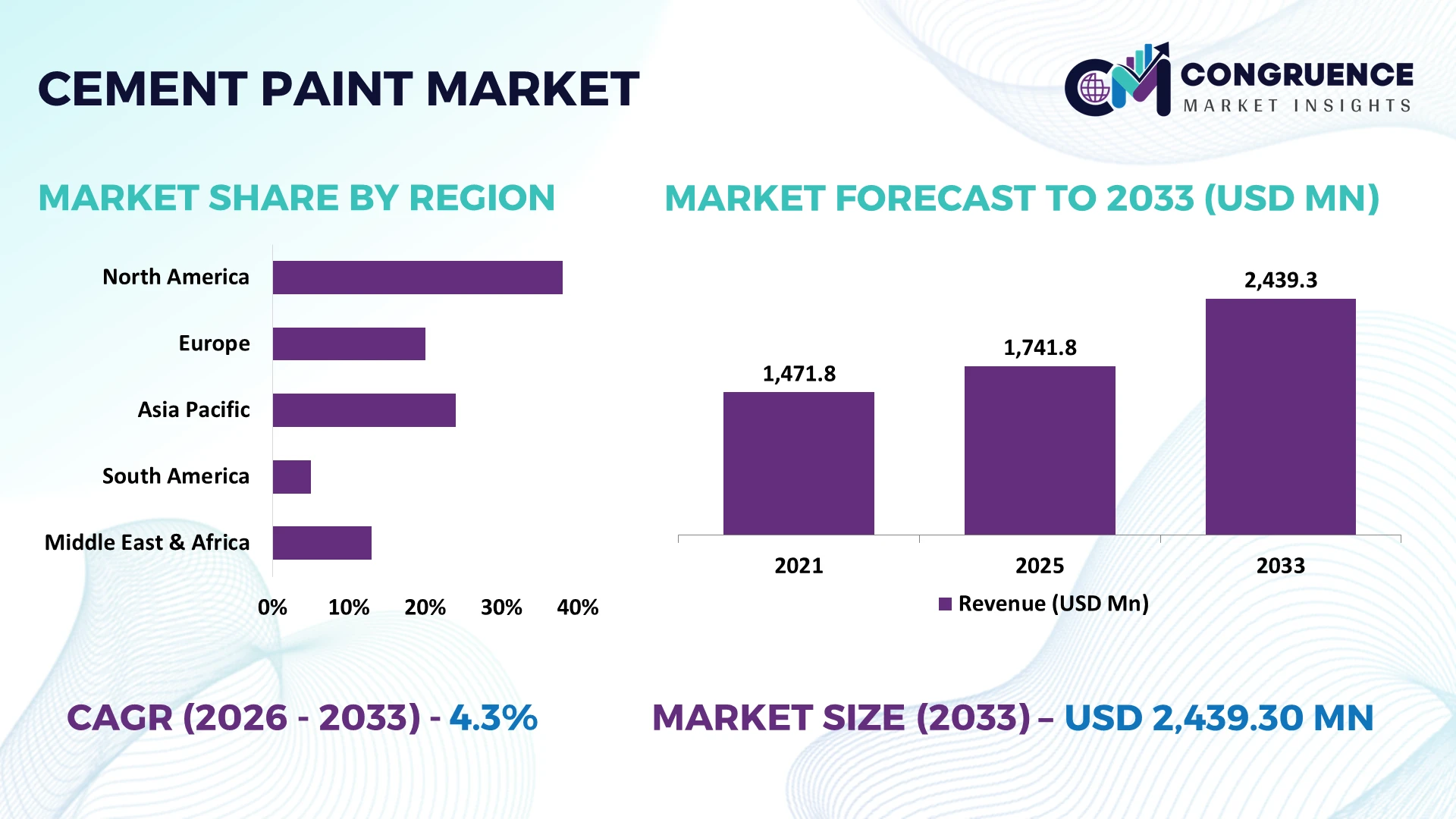
The Global Cement Paint Market was valued at USD 1741.81 Million in 2025 and is anticipated to reach a value of USD 2439.3 Million by 2033 expanding at a CAGR of 4.3% between 2026 and 2033. Growth is driven by rising adoption of waterproof, polymer-modified, weather-resistant, and low-VOC cement coatings for residential construction, infrastructure refurbishment, and moisture-prone structures.
India remains a dominant market within Asia-Pacific, supported by its large cement manufacturing base and rapid construction activity. India produced about 453 million tonnes of cement in FY2025, while China remains the world’s largest cement producer with more than 1.8 billion tonnes annually. India’s cement consumption is expanding alongside housing and infrastructure investment, strengthening demand for durable cement-based coatings and automated formulation technologies.
Strategic decisions should prioritize India and wider Asia-Pacific expansion while emphasizing waterproof performance, polymer modification, and environmentally compliant formulations.
Market Size & Growth: USD 1,741.81 million in 2025 to USD 2,439.3 million by 2033 at a 4.3% CAGR, supported by waterproofing and infrastructure refurbishment.
Top Growth Drivers: Waterproofing applications 36%, polymer-modified formulations 24%, and low-VOC coating adoption 41%.
Short-Term Forecast: By 2030, advanced cement coatings are positioned to reduce maintenance requirements by approximately 20% through improved moisture and weather resistance.
Emerging Technologies: Automated pigment dosing, AI-enabled formulation monitoring, polymer modification, and advanced mineral additives are strengthening consistency and coating performance.
Regional Leaders: Asia-Pacific holds about 46% share, Europe represents nearly 21%, while North America records the strongest high-growth adoption trend.
Consumer/End-User Trends: Waterproof cement coatings account for approximately 36% of application demand as contractors prioritize moisture protection and longer service life.
Pilot/Case Example: In 2025, polymer-modified formulations delivered approximately 24% higher adoption as construction users shifted toward crack-resistant and weather-resistant coating systems.
Competitive Landscape: Asian Paints holds an estimated 10% share, competing with Berger Paints, Kansai Nerolac, Birla White, and other regional manufacturers.
Regulatory & ESG Impact: Low-VOC formulation adoption reached approximately 41%, reflecting tighter environmental requirements and growing preference for water-based mineral coatings.
Investment & Funding: India’s cement sector is directing approximately USD 13.5 billion toward capacity expansion and efficiency improvements, strengthening downstream demand for construction coatings.
Innovation & Future Outlook: Next-generation polymer-cement, elastomeric, waterproof, and climate-resistant formulations are shifting competition toward durability, lifecycle performance, and sustainable construction.
Cement paint demand is concentrated across residential buildings, commercial structures, infrastructure, and industrial facilities requiring economical surface protection. Waterproof formulations account for approximately 36% of application demand, while polymer modification is becoming a key product-development trend. Supply-chain volatility and stricter environmental requirements are accelerating localized production, advanced formulation control, and low-VOC product development, setting the foundation for strategic market expansion.
Cement paint is becoming strategically important as construction companies shift from basic surface finishing toward durable, moisture-resistant, and lifecycle-efficient building protection. Demand is increasingly tied to infrastructure modernization, affordable housing, facade rehabilitation, and climate-resilient construction. India, China, and Southeast Asian markets are prioritizing coatings that combine low application cost with longer service intervals, making formulation performance a competitive differentiator.
A significant market shift is the restructuring of coating supply chains around localized mineral sourcing and polymer-modified formulations. Advanced cement paints can reduce application and maintenance requirements by approximately 15–20% compared with conventional cement-based systems through improved adhesion and water resistance. India is emphasizing volume-efficient construction materials, while Japan and South Korea prioritize higher-performance formulations, automated quality control, and environmentally compliant coating chemistry.
Over the next 2–3 years, manufacturers are expected to increase automated batching, digital quality monitoring, and polymer-enhanced product deployment, with advanced systems targeting 10–15% better application consistency. A practical deployment example is the use of waterproof cement coatings on public-building exteriors and concrete structures exposed to monsoon conditions. Companies are responding through localized production, distributor partnerships, formulation R&D, and expansion into infrastructure-focused channels. Competitive positioning will increasingly depend on combining cost efficiency, durability, regulatory compliance, and dependable regional supply.
Infrastructure refurbishment and moisture protection are strengthening cement paint demand, particularly in India, where cement production exceeded 450 million tonnes annually and construction activity continues to expand. Waterproof and polymer-modified formulations represent a growing portion of premium applications, with adoption increases of approximately 20–25% in infrastructure-oriented projects. Monsoon exposure and concrete deterioration are pushing contractors toward coatings with stronger adhesion and water resistance. Manufacturers are responding by expanding polymer-enhanced product portfolios, strengthening dealer networks, and forming project-based partnerships. The non-obvious advantage is reduced lifecycle maintenance: higher-performance coatings shift purchasing decisions from lowest upfront price toward total surface-protection cost, giving formulation leaders greater pricing power in institutional and infrastructure contracts.
Cement paint manufacturers remain exposed to volatility in cement, mineral fillers, pigments, polymers, and packaging inputs, creating direct pressure on production economics. Raw-material and energy movements can increase formulation costs by approximately 8–12% during supply disruptions, while imported specialty additives can face 10–15% procurement variability. India’s dependence on selected specialty chemical inputs also exposes producers to international freight and currency fluctuations. Companies are mitigating this pressure through domestic sourcing, dual-supplier contracts, inventory optimization, and reformulation using locally available mineral additives. A key operational constraint is that excessive cost substitution can weaken opacity, adhesion, or weather resistance, forcing manufacturers to protect performance specifications rather than compete solely through lower formulation cost.
Automation and advanced formulation chemistry create an underpenetrated opportunity for cement paint producers seeking higher consistency and differentiated margins. Automated dosing and digital batch monitoring can improve production consistency by approximately 10–15%, while polymer-modified systems can extend coating durability by around 15–20% in demanding applications. India offers significant opportunities in affordable housing, municipal infrastructure, and rapidly urbanizing construction corridors, while Indonesia and Vietnam are expanding modern construction-material distribution. Manufacturers are investing in R&D, localized blending facilities, and contractor partnerships to accelerate deployment. A distinctive opportunity lies in climate-specific formulations: monsoon-resistant products for South Asia and heat-reflective coatings for high-temperature markets can create specialized product categories beyond conventional cement paint.
Scaling advanced cement paint systems requires consistent surface preparation, mixing ratios, curing conditions, and applicator skills, creating execution barriers across fragmented construction markets. Poor preparation can reduce coating performance by 15–25%, while inconsistent water-to-powder ratios can produce measurable variations in adhesion and finish quality. India’s highly fragmented contractor ecosystem intensifies this challenge, particularly across smaller construction projects. Companies are addressing the issue through pre-measured packaging, application training, technical helplines, contractor certification, and simplified ready-mix formulations. The strategic challenge extends beyond product innovation: manufacturers must build an application ecosystem that protects performance after purchase, because inconsistent field execution can weaken brand reputation and limit repeat adoption even when laboratory results are superior.
Polymer Performance Takes Priority: Polymer-modified cement paints are shifting product development toward crack resistance, adhesion, permeability control, and longer service intervals. Advanced cementitious coating systems are increasingly positioned as durability solutions rather than basic surface finishes, with manufacturers expanding R&D around polymer chemistry and application-specific formulations to strengthen premium product positioning.
Low-VOC Formulation Adoption Accelerates: Water-based and low-VOC formulations are moving into mainstream construction applications as environmental requirements tighten. India’s evolving coating standards are encouraging producers to reformulate binders and additives, with low-emission systems gaining approximately 10–15% higher adoption across sustainability-focused projects. Companies are strengthening compliance testing and developing mineral-rich formulations to maintain performance.
Digital Distribution Becomes Operational: Paint manufacturers are increasingly integrating digital dealer management, demand forecasting, inventory optimization, assisted selling, and contractor platforms. Large Indian paint networks are already reaching more than 50,000 dealers, while contractor ecosystems are expanding into hundreds of thousands of users. This shift improves order visibility, replenishment speed, and product availability while reducing dependence on fragmented manual workflows.
Localized Production Cuts Logistics Pressure: Manufacturers are restructuring plant and distribution networks to reduce transportation exposure and improve regional replenishment. Indian construction-material producers are increasing localized manufacturing and warehouse coverage, while shorter supply routes can reduce product movement distances by more than 20–30% in selected operations. The non-obvious benefit is tighter inventory control alongside faster contractor and dealer replenishment.
Polymer-Modified cement paint represents the leading type, with an estimated 31% market share, supported by superior adhesion, crack resistance, moisture protection, and suitability for demanding exterior surfaces. Acrylic-Based formulations account for approximately 28%, benefiting from established production processes, broad application compatibility, and contractor familiarity. Water-Repellent products represent nearly 22%, gaining adoption in moisture-prone structures, while Textured formulations hold about 19% and remain concentrated in decorative and facade applications.
Polymer-Modified is also the fastest-growing type, with adoption expanding around 18% as buyers increasingly prioritize durability and lower maintenance requirements. Companies are increasing formulation R&D, polymer integration, and premium-channel distribution. Acrylic-Based remains the volume-oriented segment, but investment is shifting toward Polymer-Modified and Water-Repellent systems because their performance characteristics support higher-value specifications and stronger lifecycle economics.
Exterior Walls lead the application segment with an estimated 42% market share because they face continuous exposure to rainfall, ultraviolet radiation, temperature fluctuations, and surface deterioration. Concrete Surfaces account for approximately 25%, supported by structural maintenance and infrastructure construction. Interior Walls represent nearly 19%, while Masonry Surfaces contribute about 14%. Manufacturers are increasingly developing application-specific waterproof and weather-resistant cement paint systems.
Concrete Surfaces represent the fastest-growing application, with adoption increasing approximately 16% as infrastructure operators prioritize preventive protection and longer maintenance intervals. Companies are expanding technical contractor networks, improving surface-preparation guidance, and developing standardized application systems. Demand is strengthening particularly across concrete-intensive construction, where coating consistency and moisture protection increasingly influence maintenance planning and total operating costs.
Residential Construction remains the leading end-user category with an estimated 38% market share, reflecting high-volume application across housing exteriors, interiors, and masonry surfaces. Commercial Construction contributes approximately 27%, while Industrial Construction represents nearly 18%. Infrastructure Projects account for about 17% but are gaining strategic importance as institutional buyers increasingly specify durable coatings and lower-maintenance surface protection.
Infrastructure Projects are the fastest-growing end-user segment, with adoption expanding approximately 17% as public construction increasingly emphasizes weather resistance, durability, and lifecycle performance. Companies are responding through institutional contracts, project-specific formulations, bulk packaging, and construction-distributor partnerships. Residential purchasing remains volume-driven, whereas infrastructure procurement is becoming increasingly specification-led, shifting competitive advantage toward suppliers capable of delivering consistent performance at large project scale.
Asia-Pacific accounted for the largest market share at 46% in 2025 however, North America is expected to register the fastest growth, expanding at a CAGR of 5.6% between 2026 and 2033.
Renovation and High-Performance Coatings Reshape Demand
North America represents an important cement paint market, supported by concrete rehabilitation, commercial refurbishment, masonry restoration, and moisture-protection applications. The United States concentrates most regional demand, while Canada contributes through infrastructure maintenance and cold-climate construction. Adoption is shifting toward waterproof, low-VOC, and polymer-enhanced cementitious coatings that deliver stronger adhesion and improved resistance to temperature cycling. Advanced formulations are increasingly specified for performance-critical surfaces rather than basic decorative coverage. Manufacturers are strengthening contractor distribution, technical support, and product certification while expanding formulations suited to freeze-thaw exposure. Approximately 15–20% longer maintenance intervals targeted by premium systems are strengthening lifecycle-based purchasing. The strategic shift favors suppliers that combine compliant chemistry, reliable availability, and application guidance rather than competing exclusively on material price.
United States Market Outlook: The United States is the region’s principal market because of its extensive building-renovation base, established contractor ecosystem, and stringent environmental and performance requirements. Cementitious coatings are increasingly used for concrete repair, masonry protection, and moisture management. Manufacturers are emphasizing low-VOC chemistry, specialized exterior formulations, and professional-applicator partnerships to capture specification-driven demand.
Environmental Compliance Drives Formulation Upgrades
Europe is shaped by building renovation, environmental regulation, heritage restoration, and demand for durable mineral-based surface coatings. Germany, France, Italy, and the United Kingdom represent key consumption centers, with renovation activity creating sustained requirements for exterior walls, masonry, and concrete protection. Formulators are increasing the use of water-based binders, mineral additives, and low-emission chemistry as environmental standards become more influential in material selection. Approximately 10–15% better application consistency is targeted through controlled formulation and automated batching compared with basic site-mixed systems. Manufacturers are responding through certified formulations, technical partnerships, and localized distribution. The competitive advantage is increasingly linked to documented durability and regulatory compliance, particularly for renovation projects where substrate preservation and material compatibility are critical.
Germany Market Outlook: Germany holds a strategically important position through its mature construction standards, extensive building-renovation activity, and strong emphasis on sustainable materials. Cement paint demand is increasingly linked to facade refurbishment and masonry preservation. Producers with low-emission formulations, technical certification, and contractor training capabilities are well positioned as procurement becomes more performance-focused.
Manufacturing Scale Strengthens Cost and Supply Advantages
Asia-Pacific remains the dominant cement paint market, accounting for approximately 46% share, supported by large construction volumes, cement production, affordable housing, and infrastructure development. China and India provide the region’s strongest manufacturing and consumption foundations, while Southeast Asian markets are expanding through urban construction and distribution development. India produced approximately 491 million tonnes of cement in FY2026, reinforcing the raw-material ecosystem supporting cement-based coatings. Manufacturers are increasingly localizing production and inventory hubs, with selected supply-chain restructuring capable of reducing logistics exposure by 15–20%. Product portfolios are also moving toward waterproof, polymer-modified, and weather-resistant formulations. The region’s strongest strategic advantage is the combination of high-volume manufacturing, extensive distribution, and increasing formulation sophistication.
India Market Outlook: India is the region’s key strategic market because of its large construction base, extensive cement manufacturing capacity, housing requirements, and infrastructure investment. Cement production reached approximately 491 million tonnes in FY2026, supporting downstream availability of cement-based inputs. Manufacturers are expanding dealer networks, localized blending, contractor engagement, and waterproof product portfolios to capture construction-intensive markets.
Brazil-Led Construction Activity Supports Market Expansion
South America is driven primarily by Brazil’s residential construction, commercial development, infrastructure rehabilitation, and established building-material distribution network. The region represents an emerging demand center where cement paints remain attractive for economical exterior and masonry protection. Waterproof formulations are gaining approximately 12–15% stronger adoption in moisture-exposed applications as contractors prioritize surface durability and reduced maintenance. Brazil’s large urban centers provide the strongest commercial concentration, while Argentina and Colombia offer additional construction-driven opportunities. Manufacturers are responding through local distributor partnerships, regional inventory placement, and formulations adapted to humid and high-rainfall conditions. However, currency volatility and variable logistics continue to influence procurement costs. Companies with localized mineral sourcing and flexible inventory strategies are better positioned to maintain pricing competitiveness and delivery reliability.
Brazil Market Outlook: Brazil is the region’s most strategically significant country because of its construction scale, urban housing requirements, and established paint distribution infrastructure. Localized production and broad contractor networks support market penetration. Manufacturers are increasingly emphasizing waterproof, weather-resistant, and cost-efficient cement paints for exterior walls, masonry, and concrete maintenance applications.
Mega-Projects Accelerate Protective Coating Demand
Middle East & Africa demand is being shaped by urban development, infrastructure modernization, commercial construction, and large-scale project investment. Saudi Arabia, the United Arab Emirates, Egypt, and South Africa represent important consumption and distribution centers. High temperatures, intense ultraviolet exposure, dust, and moisture-management requirements are strengthening demand for weather-resistant cementitious coatings. Specialized exterior formulations are recording approximately 10–15% stronger adoption in selected project applications as developers prioritize durability under harsh climatic conditions. Manufacturers are expanding regional warehouses, project partnerships, and distributor networks to improve delivery reliability. Product adaptation is becoming a decisive competitive factor, with heat-resistant, UV-stable, and waterproof formulations outperforming generic systems in demanding applications. Companies are therefore prioritizing climate-specific R&D rather than relying solely on standardized formulations.
Saudi Arabia Market Outlook: Saudi Arabia offers the strongest strategic opportunity through large-scale urban development, infrastructure modernization, and construction programs. Cement and construction-material supply chains are expanding around major project corridors, supporting localized distribution. Manufacturers are targeting heat-resistant, waterproof, and rapid-application cement coatings for commercial, residential, and infrastructure projects where climatic durability directly influences maintenance requirements.
Asian Paints, Berger Paints, Kansai Nerolac, Birla White, and Africa Paints compete as leading established players, while Snowcem, Shalimar Paints, Nippon Paint, and specialized regional producers challenge them through localized distribution and application expertise. The top five players collectively hold approximately 43.1% of the market, indicating a moderately consolidated structure. Competition centers on price, formulation performance, distribution reach, and supply reliability, with premium waterproof and polymer-modified products achieving roughly 10–20% stronger positioning than basic systems. Large players are expanding manufacturing, dealer networks, and product portfolios, while regional suppliers compete through customization and faster local fulfillment. Vertical integration into white cement and mineral inputs is strengthening supply control. The competitive shift is moving from basic coverage toward durability, waterproofing, environmental compliance, and lifecycle performance. Entry pressure remains high around formulation consistency, brand trust, contractor acceptance, and distribution access. Winning requires localized supply, differentiated chemistry, strong channel execution, and reliable field performance.
Asian Paints Limited
Berger Paints India Limited
Kansai Nerolac Paints Limited
Snowcem Paints
Shalimar Paints Limited
Tata Pigments Limited
Nippon Paint Holdings Co., Ltd.
The Sherwin-Williams Company
PPG Industries, Inc.
Akzo Nobel N.V.
Jotun A/S
Sika AG
Hempel A/S
Indigo Paints Limited
Current cement paint technology is moving from basic white-cement formulations toward polymer-modified, acrylic-enhanced, waterproof, and controlled-dispersion systems. Polymer-modified coatings improve adhesion and crack resistance by approximately 10–15%, while automated pigment and mineral dosing can raise batch consistency by 8–12%. Adoption is strongest among organized manufacturers serving infrastructure and premium exterior applications. Companies combining formulation control with automated production gain lower rework, tighter quality specifications, and stronger contractor acceptance.
Emerging technology is integrating digital batching, automated quality monitoring, moisture-resistant additives, and low-VOC chemistry into connected production workflows. Compared with conventional site-mixed cement paint, controlled automated formulations can improve material-use efficiency by approximately 10% and reduce batch variation by 8–10%. Polymer-enhanced waterproof systems are gaining roughly 15–20% higher deployment in performance-sensitive applications. Larger manufacturers benefit most because integrated plants can standardize formulation, shorten production cycles, and support consistent specifications across multiple facilities.
Through 2026–2028, disruptive progress will center on smart formulation optimization, climate-specific coatings, advanced polymer dispersions, and digitally monitored application systems. Compared with legacy cement paint requiring repeated wet curing, advanced systems can reduce application-related labor and maintenance requirements by approximately 15–20%. Adoption is expected to broaden across infrastructure, commercial renovation, and residential construction. Companies investing now in automation, formulation R&D, and application partnerships will gain the strongest advantage through consistent quality, differentiated performance, and localized high-efficiency production.
July 2024 — Asian Paints doubled Mysuru plant capacity from 300,000 KL to 600,000 KL after a ₹1,305 crore investment, strengthening southern India supply and positioning the facility as a major water-based paint manufacturing hub. Source: economictimes.com
August 2024 — Berger Paints advanced its Panagarh, West Bengal greenfield project, with construction preparations underway and approvals progressing. The expansion supports regional capacity growth and strengthens supply coverage across eastern Indian construction markets. Source: entrepreneur.com
May 2025 — Asian Paints increased Mysuru production capacity to 600,000 KL and introduced advanced automation and real-time material-flow monitoring. The technology-led expansion improved manufacturing precision while strengthening operational efficiency and supply responsiveness. Source: asianpaints.com
May 2026 — Dalmia Bharat launched Weather 365, a super-premium water-repellent cement product in eastern India. The launch targets moisture, seepage, and weather-resilience requirements, strengthening the company’s premium construction-material portfolio and expanding performance-focused product differentiation. Source: dalmiacement.com
The Cement Paint Market Report covers Acrylic-Based, Polymer-Modified, Water-Repellent, and Textured formulations across Exterior Walls, Interior Walls, Concrete Surfaces, and Masonry Surfaces. End-user analysis includes Residential Construction, Commercial Construction, Industrial Construction, and Infrastructure Projects, enabling comparison of volume-led demand with specification-driven applications. The report evaluates established products alongside emerging waterproof, polymer-enhanced, low-VOC, and performance-oriented formulations.
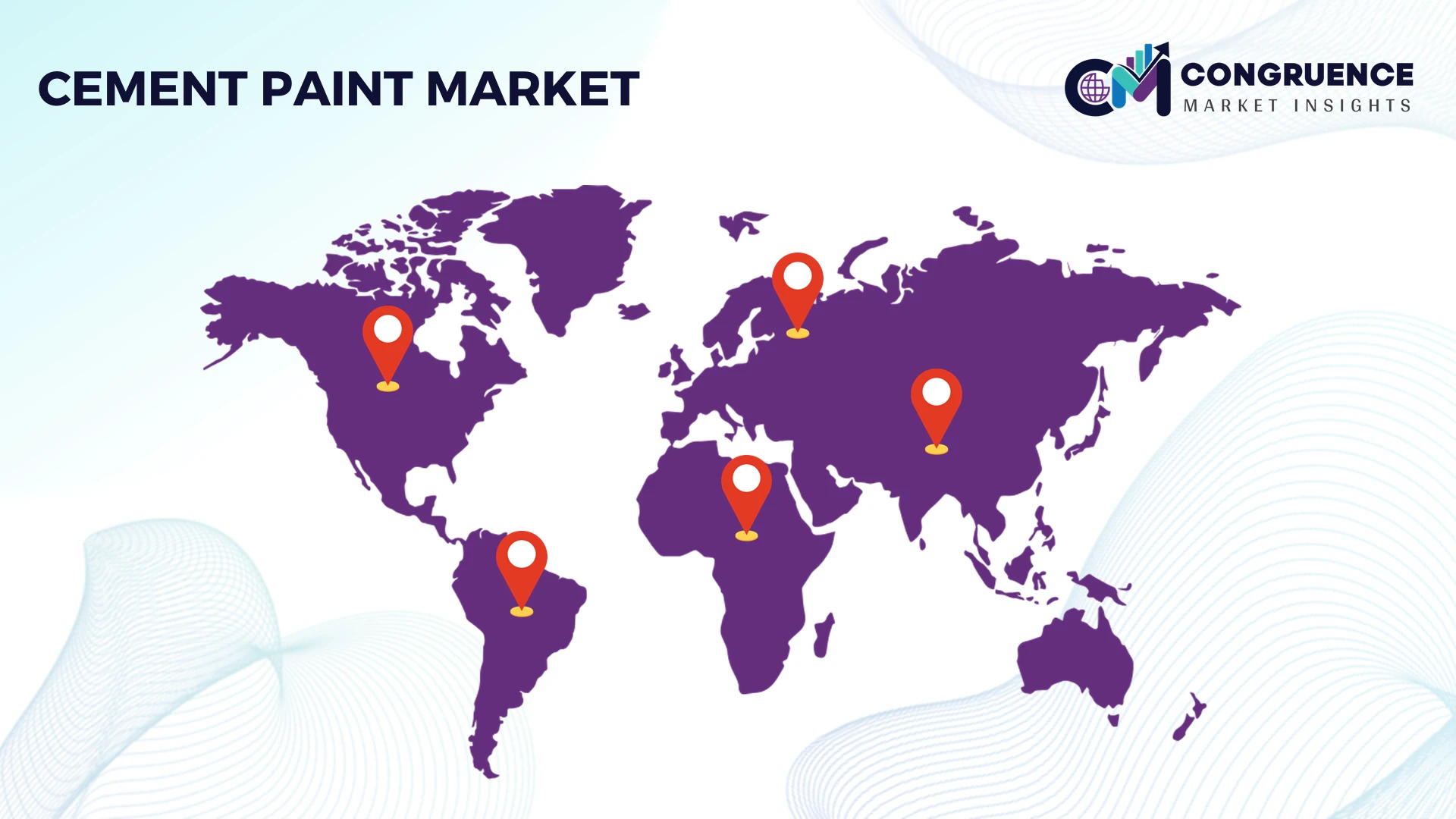
Geographic coverage spans North America, Europe, Asia-Pacific, South America, and Middle East & Africa, with country-level assessment of manufacturing capacity, construction activity, distribution infrastructure, regulatory influence, and technology adoption. Strategic analysis incorporates approximately 46% Asia-Pacific market concentration, application-level demand shifts, automation deployment, localized supply chains, and competitive positioning among major manufacturers. The report supports investment planning, regional expansion, product-development priorities, channel strategy, partnership decisions, and competitive positioning through 2026–2033.
| Report Attribute/Metric | Report Details |
|---|---|
Market Revenue in 2025 | USD 1741.81 Million |
Market Revenue in 2033 | USD 2439.3 Million |
CAGR (2026 - 2033) | 4.3% |
Base Year | 2025 |
Forecast Period | 2026 - 2033 |
Historic Period | 2021 - 2025 |
Segments Covered | By Type
By Application
By End-User
|
Key Report Deliverable | Revenue Forecast, Growth Trends, Market Dynamics, Segmental Overview, Regional and Country-wise Analysis, Competition Landscape |
Region Covered | North America, Europe, Asia-Pacific, South America, Middle East, Africa |
Key Players Analyzed | Asian Paints Limited, Berger Paints India Limited, Kansai Nerolac Paints Limited, Snowcem Paints, Shalimar Paints Limited, Tata Pigments Limited, Nippon Paint Holdings Co., Ltd., The Sherwin-Williams Company, PPG Industries, Inc., Akzo Nobel N.V., Jotun A/S, Sika AG, Hempel A/S, Indigo Paints Limited |
Customization & Pricing | Available on Request (10% Customization is Free) |




