
Reports
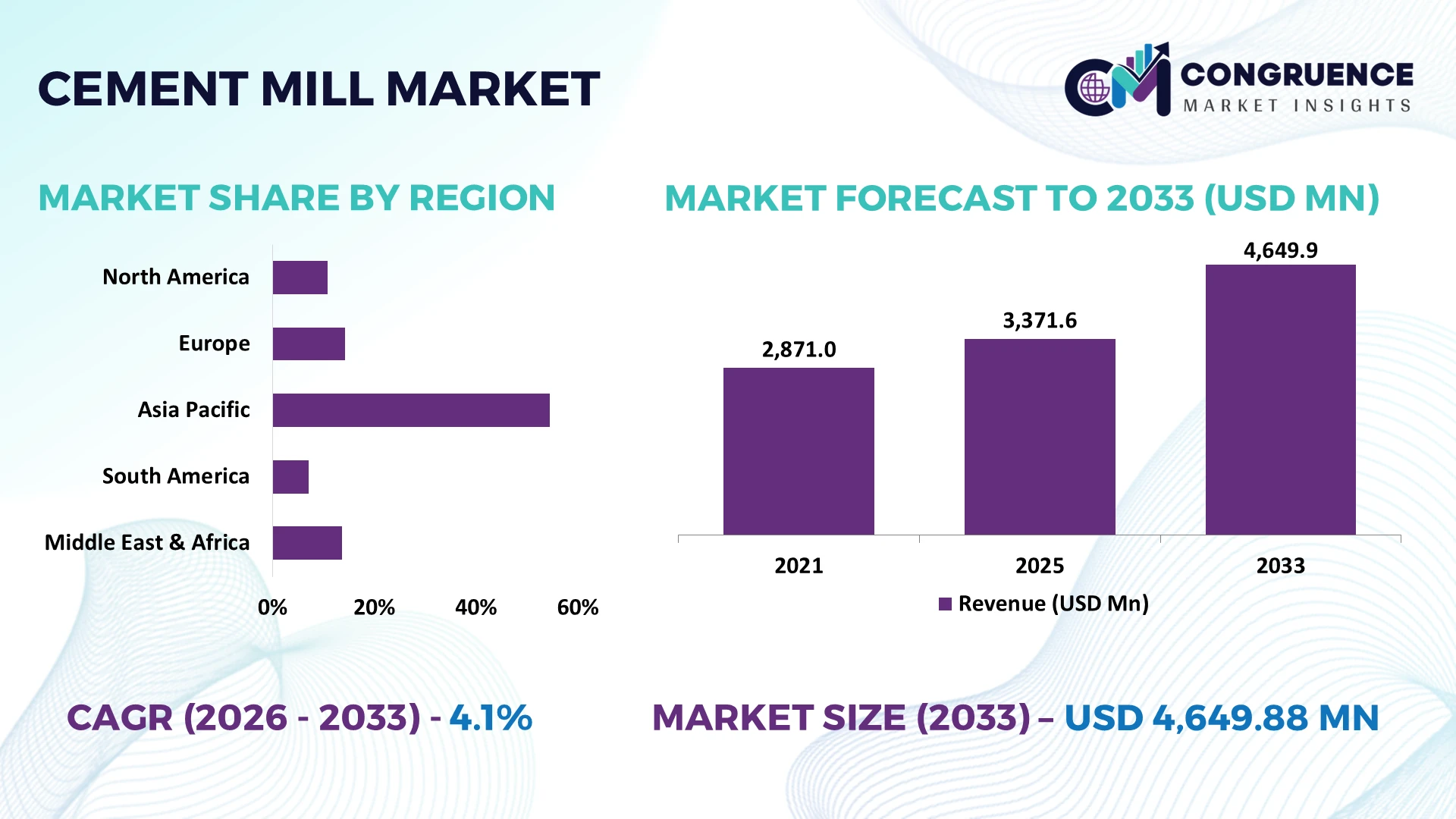
The Global Cement Mill Market was valued at USD 3,371.6 Million in 2025 and is anticipated to reach a value of USD 4,649.9 Million by 2033 expanding at a CAGR of 4.1% between 2026 and 2033. Growth is driven by rapid cement-capacity additions, energy-efficiency retrofits, and replacement of conventional grinding systems with vertical roller mills, HPGR configurations, and digitally optimized grinding circuits.
China remains the dominant cement-production hub, accounting for about 57% of global cement output, versus approximately 8% for India; its 875 cement plants in 2021 included 57 grinding plants. India is rapidly closing the capacity gap, with installed cement capacity reaching about 639 million tonnes in FY25 and planned additions accelerating through FY30.
Strategically, suppliers should prioritize high-efficiency grinding platforms, localized service networks, and retrofit-ready digital systems in Asia's expanding cement corridors.
Market Size & Growth: USD 3,371.6 million in 2025 is projected to reach USD 4,649.9 million by 2033 at 4.1% CAGR, supported by mill modernization and capacity expansion.
Top Growth Drivers: Energy-efficiency upgrades, infrastructure investment, and grinding-capacity additions are advancing at approximately 30%, 40%, and 75% respective operational-impact benchmarks across documented projects and programs.
Short-Term Forecast: By 2028, advanced grinding configurations are positioned to deliver roughly 15–30% lower specific electricity consumption than traditional ball-mill systems.
Emerging Technologies: AI process control, IIoT sensors, vertical roller mills, and HPGR systems are reshaping grinding, with modern configurations achieving up to 30–50% mill-power savings versus ball mills.
Regional Leaders: Asia Pacific represents about 54.4% of 2025 cement-mill value; Europe follows at 14.2%, while Middle East & Africa holds 13.2%, reflecting distinct capacity and retrofit cycles.
Consumer/End-User Trends: Cement producers are accelerating split-grinding adoption; India is expected to add 160–170 million tonnes of grinding capacity during FY2026–FY2028.
Pilot/Case Example: In 2025, Ozinga began its East Chicago project with a 1-million-ton annual low-carbon mill designed for up to 80% embodied-carbon reduction.
Competitive Landscape: FLSmidth leads at approximately 18.4% share, followed by Gebr. Pfeiffer, Loesche, thyssenkrupp Polysius, and KHD; the top five collectively hold about 57.4%.
Regulatory & ESG Impact: Cement represents about 7% of global CO₂ emissions, increasing pressure for low-carbon grinding, clinker optimization, and energy-efficient equipment.
Investment & Funding: India’s cement sector is targeting about USD 14.3 billion of capacity investment through FY2028, accelerating mill installations, brownfield upgrades, and split-grinding projects.
Innovation & Future Outlook: Next-generation mills are shifting toward autonomous controls, high-capacity VRMs, low-carbon binders, and lifecycle service models, making digital efficiency a core purchasing criterion.
The Cement Mill Market is being reshaped by high-efficiency grinding, blended-cement production, and localized milling capacity. VRMs can deliver up to 30% energy savings versus ball mills, while HPGR configurations offer substantially higher savings. China and India remain central to deployment, while North American projects increasingly combine low-carbon materials with domestic supply-chain resilience. This transition strengthens the strategic value of efficient, flexible milling assets.
Cement mills are becoming strategic production assets because grinding directly influences electricity consumption, throughput, product consistency, and the economics of blended cement. The shift toward brownfield expansion and split-grinding plants is particularly important: India is expected to add 160–170 million tonnes of grinding capacity during FY2026–FY2028, with two-thirds structured as split-grinding units.
Technology selection is increasingly measurable. Indian industry data shows cement-mill VRMs consuming about 21.92 kWh/t compared with 27.07 kWh/t for closed-circuit ball mills, representing roughly 19% lower electricity use. Advanced HPGR configurations can deliver even larger reductions, positioning energy performance as a procurement differentiator rather than a secondary benefit.
Regional priorities differ sharply. China emphasizes scale and modernization, India combines capacity additions with brownfield expansion, while North America is integrating low-carbon milling with domestic sourcing. Ozinga’s 2025 East Chicago project targets 1 million tonnes annually and up to 80% embodied-carbon reduction. Over the next 2–3 years, suppliers that combine automation, retrofit compatibility, local service, and low-carbon grinding solutions will strengthen competitive positioning.
Energy efficiency is accelerating mill replacement and retrofit decisions as cement producers target lower operating costs and tighter emissions performance. VRMs consume about 21.92 kWh/t compared with 27.07 kWh/t for closed-circuit ball mills, while broader studies report up to 30% VRM and 50% HPGR mill-power savings versus ball mills. India’s rapid capacity expansion reinforces this shift, with 160–170 million tonnes of new grinding capacity planned through FY2028. Companies are responding with high-efficiency VRMs, HPGR pre-grinding, advanced classifiers, and digital controls. The non-obvious advantage is reduced exposure to electricity-price volatility, allowing efficient mills to improve both cost predictability and plant competitiveness.
Advanced cement mills require significant upfront investment, while multi-stage grinding circuits increase engineering and commissioning complexity. HPGR and VRM systems can deliver 30–50% mill-power savings, but sophisticated equipment, controls, and auxiliary systems raise procurement and integration requirements. Near-zero-emission cement technologies can also carry production costs 75–150% above conventional plants in early commercial deployment, increasing financing pressure for smaller producers. China’s and India’s large-scale procurement provides greater purchasing leverage than smaller markets. Producers are reducing exposure through brownfield upgrades, staged capacity additions, long-term service agreements, and standardized equipment platforms. The key operational constraint is balancing energy savings against commissioning complexity and capital recovery.
Split-grinding units create an attractive expansion pathway because they can be installed closer to consumption centers and require shorter development cycles than integrated plants. India is expected to add 160–170 million tonnes of grinding capacity through FY2028, with two-thirds expected from split-grinding units. Low-carbon binder production adds another opportunity: Ozinga’s East Chicago mill targets 1 million tonnes annually with up to 80% embodied-carbon reduction. Companies are therefore investing in VRMs capable of processing slag and supplementary cementitious materials, supported by digital quality control. The strategic opportunity lies in locating mills around alternative-material sources and high-growth consumption corridors, reducing both logistics exposure and clinker intensity.
Modern cement mills increasingly depend on automation, sensor networks, advanced classifiers, and predictive controls, creating execution challenges beyond mechanical installation. Upgrading from conventional systems can deliver 15–30% electricity savings, but multi-stage circuits introduce additional control and maintenance requirements. Cement producers also face a broader decarbonization requirement because the sector accounts for approximately 7% of global CO₂ emissions. China’s 2025 energy-consumption classification for slag-cement vertical mills further demonstrates how performance requirements are becoming more granular. Companies must invest in operator training, interoperable control architectures, cybersecurity, and lifecycle partnerships. The critical challenge is converting advanced equipment capability into consistent plant-level performance without creating digital or maintenance bottlenecks.
Digital Grinding Control Expands: Cement producers are integrating AI-based process control, real-time sensors, and predictive maintenance into mill operations, with advanced digital systems targeting 8–12% performance improvement and lower unplanned downtime. China and India are accelerating automation as plants modernize legacy assets, shifting mill management from reactive maintenance toward continuous optimization and tighter quality control.
High-Capacity Mills Gain Preference: Vertical roller mills captured 57.6% of the 2025 market, compared with 35.3% for ball mills, as operators prioritize lower power consumption and integrated drying-grinding workflows. New installations increasingly specify high-throughput configurations, while steel and component supply volatility is encouraging standardized equipment designs and localized service inventories.
Retrofit Activity Becomes More Strategic: New construction represented 62.9% of 2025 demand, while retrofitting and upgrades accounted for 37.1%, creating a substantial modernization pipeline. Indian cement producers are expanding grinding capacity by 160–170 million tonnes through FY2028, with roughly two-thirds planned as split-grinding facilities, increasing demand for modular upgrades, classifiers, automation, and capacity debottlenecking.
Low-Carbon Grinding Reshapes Procurement: Cement producers are increasingly selecting mills capable of processing slag, fly ash, and other supplementary cementitious materials as clinker intensity falls. New low-carbon projects are targeting embodied-carbon reductions of up to 80%, while grinding configurations increasingly support multiple feedstocks. The non-obvious shift is that material flexibility is becoming a procurement criterion alongside energy efficiency, encouraging suppliers to redesign grinding circuits around variable feed composition.
Vertical Roller Mills held the leading position with approximately 57.6% market share in 2025, supported by lower energy consumption, integrated grinding and drying, compact plant layouts, and suitability for high-throughput cement production. Ball Mills followed with about 35.3%, retaining strong demand across established plants because of their operating familiarity, broad material compatibility, and extensive installed base. Horizontal Roller Mills represented roughly 7.1%, serving more specialized requirements where process configuration and throughput justify alternative grinding architectures.
Vertical Roller Mills are also becoming the central investment focus as producers modernize older grinding lines and seek higher process automation. Their ability to accommodate supplementary cementitious materials strengthens their relevance as cement formulations diversify. Ball Mills remain strategically important for replacement and selective modernization projects, while Horizontal Roller Mills occupy a narrower equipment niche.
New Construction accounted for approximately 62.9% of the global Cement Mill Market in 2025, making it the dominant application because greenfield cement plants and capacity additions allow operators to specify complete grinding systems around targeted throughput, energy consumption, and product specifications. Retrofitting and Upgrades represented about 37.1% and are gaining strategic importance as established producers extend asset life, remove production bottlenecks, and replace inefficient equipment without constructing entirely new facilities.
The retrofit segment is increasingly shaped by digital controls, high-efficiency classifiers, upgraded drives, and wear-resistant components. New construction remains concentrated around large infrastructure and cement-capacity projects, while modernization demand is becoming more distributed across mature production assets. Companies are therefore balancing greenfield expansion with brownfield investment, using modular grinding packages where speed and limited shutdown duration are critical.
Cement Manufacturing represented approximately 78.3% of end-user demand in 2025, reflecting the direct dependence of cement producers on high-capacity grinding systems for clinker processing, blended cement production, and product-fineness control. Mining accounted for about 13.6%, benefiting from technical overlap between cement grinding equipment and mineral-processing applications, while Others represented approximately 8.1%. The concentration gives large cement producers substantial purchasing influence over equipment specifications and service contracts.
Large integrated producers are increasingly prioritizing lifecycle efficiency rather than initial equipment price, with energy consumption, uptime, automation compatibility, and maintenance intervals becoming key procurement criteria. Mining buyers continue to favor robust grinding configurations capable of handling variable feed characteristics, creating different performance requirements from cement plants. Industry deployment activity in 2025–2026 shows that large-scale cement manufacturers remain the primary investment engine, while mining and specialized industrial users provide diversification opportunities.
Asia-Pacific accounted for the largest market share at 54.4% in 2025 however, Middle East & Africa is expected to register the fastest growth, expanding at a CAGR of 5.0% between 2026 and 2033.

North America represented approximately 10.8% of the global Cement Mill Market in 2025, with demand concentrated in the United States and Mexico. Producers are prioritizing modernization of existing grinding assets, automation upgrades, alternative-fuel compatibility, and equipment capable of processing supplementary cementitious materials. The United States produced approximately 84 million tonnes of cement in 2025, creating a substantial installed base requiring mill optimization and replacement. Mexico is also strategically important because of its export-oriented cement infrastructure and proximity to major U.S. construction markets. Low-carbon procurement is increasingly influencing equipment specifications, while domestic supply-chain considerations are supporting localized maintenance and component inventories. Companies are responding through phased brownfield investment, digital process controls, high-efficiency classifiers, and long-term equipment-service partnerships rather than relying exclusively on greenfield installations.
United States Market Outlook: The United States remains the principal North American demand center because of its extensive cement manufacturing base and infrastructure pipeline. Cement output reached approximately 84 million tonnes in 2025, supporting continued investment in grinding efficiency, plant modernization, and alternative-material processing. Producers are increasingly combining equipment upgrades with emissions-reduction initiatives and automated quality control.
Europe accounted for approximately 14.2% of the global Cement Mill Market in 2025, with demand centered on mature cement-producing economies such as Germany, Italy, Spain, and France. The region is shifting investment from straightforward capacity additions toward energy optimization, clinker substitution, digital monitoring, and modernization of aging grinding systems. Carbon-reduction requirements are strengthening demand for mills capable of processing higher proportions of supplementary cementitious materials. Producers are also responding to elevated electricity and raw-material costs by improving grinding efficiency and integrating automated process controls. Germany and Italy retain strong industrial equipment capabilities, while Southern European producers are increasingly focused on operational flexibility. Companies are prioritizing targeted retrofits, advanced classifiers, predictive maintenance, and partnerships with equipment suppliers to extend asset life without lengthy production interruptions.
Germany Market Outlook: Germany remains strategically significant because of its advanced industrial manufacturing base and concentration of technically sophisticated cement operations. Cement producers are emphasizing energy-efficient grinding, digital plant management, and alternative-material utilization. The country's established engineering ecosystem supports faster integration of automated controls, high-efficiency mill components, and maintenance technologies, strengthening demand for modernization-oriented Cement Mill solutions.
Asia-Pacific dominated the Cement Mill Market with approximately 54.4% share in 2025, supported by exceptionally high cement-production volumes and extensive grinding infrastructure across China, India, Vietnam, and Indonesia. China produced about 1.7 billion tonnes of cement in 2025, while India produced approximately 470 million tonnes, demonstrating the region's unmatched production concentration. India is now adding capacity at a faster structural pace, with more than 58 million tonnes of cement capacity under development. Producers are deploying high-capacity VRMs, automated classifiers, split-grinding systems, and digitally controlled production lines. China is increasingly focused on efficiency and asset rationalization, while India combines brownfield expansion with new grinding installations. Suppliers are therefore shifting toward modular equipment, localized service networks, and scalable technology platforms.
India Market Outlook: India is emerging as the most important expansion market within Asia-Pacific because cement production reached approximately 470 million tonnes in 2025 and operating capacity continues to expand. More than 58 million tonnes of additional cement capacity is under development, creating sustained requirements for grinding systems, classifiers, automation, and plant-integration services. Domestic producers are increasingly favoring energy-efficient equipment and split-grinding configurations.
South America accounted for approximately 7.0% of the global Cement Mill Market in 2025, with Brazil representing the principal equipment-demand center. Brazil produced about 67 million tonnes of cement during 2025, giving it a substantial production base for grinding equipment replacement, plant modernization, and capacity optimization. Infrastructure investment and housing activity are supporting demand for efficient cement-processing assets, while producers face logistical constraints caused by long transport distances between raw-material sources, grinding facilities, and consumption centers. This favors strategically located grinding capacity and flexible equipment configurations. Companies are increasingly prioritizing energy-efficient mills, automation, and maintenance partnerships to improve uptime. Brazil's scale also creates opportunities for suppliers offering localized technical support and components that reduce dependence on overseas equipment deliveries.
Brazil Market Outlook: Brazil remains the region's central Cement Mill market because of its large domestic cement industry, extensive industrial infrastructure, and established producer base. Cement output reached approximately 67 million tonnes in 2025, supporting continued demand for replacement equipment and process modernization. Producers are increasingly focused on grinding efficiency, operational reliability, and regional distribution capabilities to manage logistics and maintain competitive production costs.
Middle East & Africa accounted for approximately 13.6% of the global Cement Mill Market in 2025, with Saudi Arabia, Egypt, Iran, and the Gulf economies representing important deployment centers. Large infrastructure programs, housing development, industrial diversification, and cement-export activity are sustaining requirements for grinding capacity. Egypt produced approximately 64 million tonnes of cement in 2025, while Saudi Arabia produced about 54 million tonnes, demonstrating substantial installed production infrastructure. Gulf producers are increasingly investing in energy-efficient equipment, automated process control, and modern grinding configurations as industrial facilities expand. African markets are also attracting localized grinding investments because importing finished cement over long distances can increase logistics costs. Companies are responding with regional grinding facilities, modular mill installations, supplier partnerships, and localized service capabilities.
Saudi Arabia Market Outlook: Saudi Arabia holds a strategically important position because of its large cement manufacturing base and sustained infrastructure development. Cement production reached approximately 54 million tonnes in 2025, supporting demand for high-throughput grinding equipment and modernization services. Large construction programs are encouraging producers to strengthen domestic production capabilities, improve mill efficiency, and deploy automated systems that support consistent output across major industrial clusters.
FLSmidth, Gebr. Pfeiffer, Loesche, thyssenkrupp Polysius, and KHD compete directly in premium grinding systems, while Sinoma and CHAENG challenge them on integrated EPC delivery. The top five equipment suppliers command approximately 56% of the global market, creating a concentrated structure. Competition centers on technology, lifecycle cost, supply-chain reach, and customization, with systems delivering roughly 20–35% lower energy consumption than conventional ball-mill configurations. Chinese suppliers can price comparable equipment about 20–30% below European alternatives, intensifying pressure in emerging markets. FLSmidth and Polysius emphasize integrated engineering and digital optimization; Pfeiffer and Loesche focus on VRM specialization; KHD strengthens roller-press solutions and retrofit packages. Sinoma competes through turnkey EPC integration and regional project financing. The shift is toward low-carbon grinding, digital controls, and modular retrofits. High qualification requirements, installed-base references, and service networks remain entry barriers. Winning requires performance, localized support, fast delivery, and measurable lifecycle savings.
FLSmidth
Gebr. Pfeiffer
Loesche
thyssenkrupp Polysius
KHD Humboldt Wedag
Sinoma International Engineering
CHAENG
Christian Pfeiffer
CITIC Heavy Industries
UBE Machinery
Jiangsu Pengfei Group
Fives Group
Cement Mill technology is shifting from conventional ball mills toward vertical roller mills, high-pressure grinding rolls, advanced separators, and automated process control. VRMs typically reduce grinding electricity use by 20–35% versus conventional ball-mill systems, while high-efficiency classifiers improve particle separation and stabilize product quality. Adoption is strongest in new capacity and modernization projects where equipment integration can be designed around digital controls.
AI-enabled optimization, predictive maintenance, and sensor-based condition monitoring are becoming practical operating layers rather than standalone tools. Digital control systems can improve throughput and process stability by about 5–10%, while predictive maintenance can reduce unplanned downtime by roughly 10–15%. Pfeiffer, Polysius, Loesche, and KHD benefit as producers increasingly demand connected grinding assets, remote diagnostics, and retrofit-compatible automation.
The disruptive pathway is low-carbon grinding built around calcined clay, slag, fly ash, and ultra-fine cement production. Ultrafine grinding can reduce clinker requirements while preserving cement performance, creating a direct competitive advantage for suppliers offering flexible circuits. Through 2026–2028, new mills will increasingly combine advanced classifiers and automation with VRM or roller-press platforms and alternative-material processing. Producers acting now gain lower energy intensity, greater feedstock flexibility, lower maintenance exposure, and stronger compliance readiness across plants and procurement decisions.
September 2025 Gebr. Pfeiffer inaugurated a new Indian manufacturing site after one year of construction, expanding regional production capacity. The facility strengthens localized supply, shortens equipment logistics, and supports faster delivery for India’s rapidly expanding cement grinding projects. Source: GlobalCement.com
July 2024 thyssenkrupp Polysius partnered with Eqiom Lumbres on an ultrafine grinding plant featuring a booster mill and sepol UF separators. Deliveries were scheduled for 2025, enabling clinker-factor reduction and supporting finer cement production in France and supporting decarbonization goals. Source: WorldCement.com
June 2026 KHD secured an agreement with Alamo Cement for a new U.S. cement grinding facility exceeding €40 million in order value. The project expands KHD’s North American footprint and strengthens its position in high-value grinding equipment and engineering services. Source: EQS-News.com
September 2025 LOESCHE launched its C/CLAY solution for calcined-clay grinding, targeting high clinker substitution through specialized milling and process design. The initiative broadens alternative-material processing capabilities and positions LOESCHE for cement decarbonization projects requiring flexible grinding of alternative feedstocks globally. Source: Loesche.com
The Cement Mill Market Report covers the competitive and operational structure of cement grinding equipment across Vertical Roller Mills, Ball Mills, and Horizontal Roller Mills, alongside New Construction and Retrofitting and Upgrades applications. End-user coverage spans Cement Manufacturing, Mining, and Others, capturing both high-volume integrated plants and specialized grinding requirements. The analysis evaluates grinding efficiency, automation, digital controls, roller-press integration, advanced separation, and low-carbon material processing.
Regional assessment covers North America, Europe, Asia-Pacific, South America, and Middle East & Africa, with country-level analysis of production concentration, capacity expansion, modernization, and technology deployment. The report examines established OEMs, emerging Asian suppliers, retrofit specialists, and integrated EPC providers, helping decision-makers assess investment priorities, expansion opportunities, procurement risks, partnership strategies, and competitive positioning. Coverage through 2026–2033 also highlights alternative-material grinding, modular plants, ultra-fine cement, and digital optimization as emerging strategic areas.
| Report Attribute / Metric | Details |
|---|---|
| Market Revenue (2025) | USD 3,371.6 Million |
| Market Revenue (2033) | USD 4,649.9 Million |
| CAGR (2026–2033) | 4.1% |
| Base Year | 2025 |
| Forecast Period | 2026–2033 |
| Historic Period | 2021–2025 |
| Segments Covered |
By Type
By Application
By End-User
|
| Key Deliverables | Revenue Forecast; Market Trends; Growth Drivers & Restraints; Technology Insights; Segmentation Analysis; Regional Insights; Competitive Landscape; Regulatory & ESG Overview; Recent Developments |
| Regions Covered | North America; Europe; Asia Pacific; South America; Middle East & Africa |
| Companies Profiled | FLSmidth; Gebr. Pfeiffer; Loesche; thyssenkrupp Polysius; KHD Humboldt Wedag; Sinoma International Engineering; CHAENG; Christian Pfeiffer; CITIC Heavy Industries; UBE Machinery; Jiangsu Pengfei Group; Fives Group |
| Customization & Pricing | Available on Request (10% Customization Free) |




