
Reports
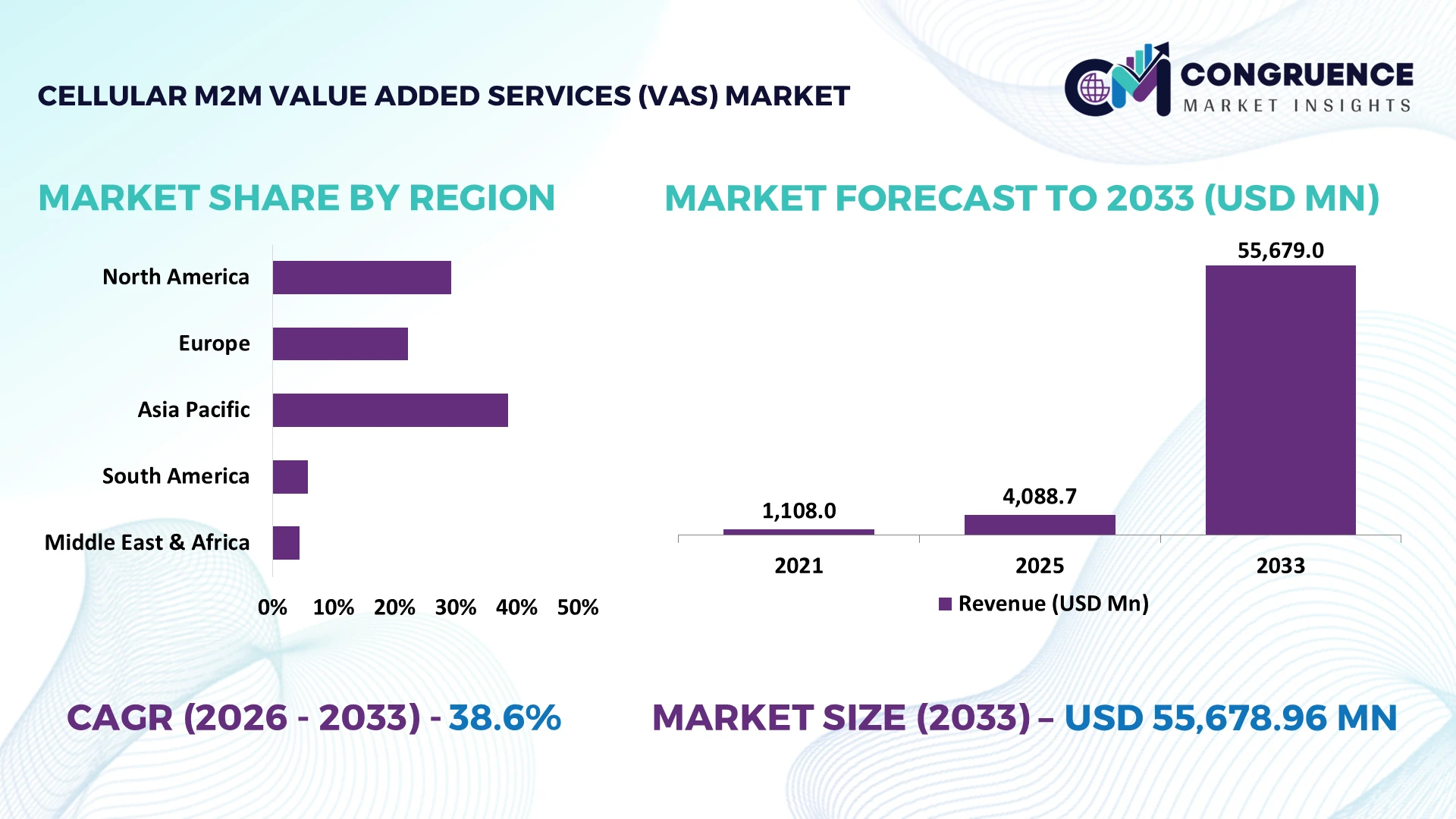
The Global Cellular M2M Value-Added Services (VAS) Market was valued at USD 4,088.7 Million in 2025 and is anticipated to reach a value of USD 55,679.0 Million by 2033 expanding at a CAGR of 38.6% between 2026 and 2033. Market growth is driven by expanding connected vehicle ecosystems, industrial IoT automation, intelligent connectivity management, remote asset monitoring, and enterprise adoption of eSIM-enabled M2M platforms.
China dominates the cellular M2M connectivity ecosystem, with over 2.6 billion cellular IoT connections recorded by the end of 2024. Its 5G infrastructure exceeded 4.25 million base stations, substantially surpassing deployment scale in the United States. Government-backed industrial digitalization, electric vehicle manufacturing, smart utilities, and technology localization amid US-China trade tensions strengthen demand for advanced connectivity management and device intelligence services.
Enterprises prioritizing scalable connectivity orchestration, localized infrastructure, and application-specific M2M services are positioned to capture recurring commercial opportunities across industrial ecosystems.
Market Size & Growth: Valued at USD 4,088.7 million in 2025, reaching USD 55,679.0 million by 2033 at 38.6% CAGR, supported by industrial IoT expansion.
Top Growth Drivers: Industrial automation (35%), connected mobility (30%), and intelligent asset management (20%), based on indicative driver weightings.
Short-Term Forecast: By 2028, automated connectivity orchestration targets 25% lower device management costs.
Emerging Technologies: Three transformative technologies include AI-powered diagnostics, eSIM orchestration, and 5G RedCap connectivity.
Regional Leaders: Indicative 2033 projections place Asia Pacific at USD 23,942.0 million, North America at USD 15,590.1 million, and Europe at USD 11,135.8 million, supported by industrial IoT, connected vehicles, and smart utilities, respectively.
Consumer/End-User Trends: Enterprises target over 90% remote device provisioning across standardized connected asset fleets.
Pilot/Case Example: In 2024, smart metering deployments demonstrated the potential to eliminate nearly 100% of routine manual meter readings.
Competitive Landscape: China Mobile leads connectivity scale, with an indicative 20% VAS market share; Vodafone, AT&T, Verizon, and Ericsson compete through integrated platforms.
Regulatory & ESG Impact: European eCall requirements mandate emergency connectivity across applicable new passenger vehicle types since 2018.
Investment & Funding: China's telecommunications infrastructure investment exceeded USD 50 billion in 2024, supporting connected industrial ecosystems.
Innovation & Future Outlook: GSMA SGP.32 architecture accelerates remote IoT provisioning, shifting competition toward intelligent lifecycle management.
The Cellular M2M Value-Added Services (VAS) Market serves connected transportation, smart manufacturing, healthcare monitoring, utilities, and logistics operations. Innovations in predictive diagnostics, cloud-native connectivity platforms, and embedded SIM management enable enterprises to target over 20% reductions in administrative workloads. Accelerating 2G and 3G network retirement further strengthens the strategic importance of adaptable, technology-independent connectivity management solutions.
Cellular M2M value-added services are becoming strategically important as enterprises transition from purchasing basic network connectivity to managing intelligent, interconnected asset ecosystems. Industrial digitalization, supply-chain modernization, and connected vehicle expansion are transforming connectivity into an operational intelligence layer. Telecommunications operators increasingly differentiate their offerings through predictive maintenance, device authentication, automated provisioning, and application-level analytics rather than conventional SIM-based subscriptions.
Compared with legacy physical SIM management, eSIM-enabled platforms eliminate manual SIM replacement during supported operator migrations, targeting administrative cost reductions of 20–30%. China benefits from billions of connected endpoints and extensive manufacturing infrastructure, while the United States emphasizes enterprise analytics, fleet intelligence, and cybersecurity. Between 2027 and 2029, large-scale deployments are expected to increasingly target automated provisioning rates exceeding 90%.
Smart utility deployments illustrate this transformation through remotely managed electricity meters that transmit consumption data and operational alerts without routine physical inspections. Companies including Vodafone, China Mobile, and Ericsson are expanding connectivity management capabilities, strengthening cloud partnerships, and integrating intelligent automation. Long-term competitive advantage increasingly depends on delivering measurable operational savings through secure, interoperable, and application-specific M2M service ecosystems.
Industrial enterprises are integrating cellular M2M services into production equipment, transportation fleets, energy infrastructure, and distributed assets to improve operational visibility. China's cellular IoT connections increased by approximately 14% during 2024, while 5G base station deployment expanded by approximately 26%, strengthening the infrastructure supporting connected industrial applications. Enterprises implementing predictive maintenance systems target maintenance expenditure reductions of 10–20% through continuous equipment diagnostics. Germany's industrial digitalization initiatives and China's smart manufacturing programs reinforce demand for managed connectivity and automated device monitoring. Telecommunications providers are responding through industrial partnerships, private network integration, and application-specific analytics platforms. The principal commercial advantage lies in monetizing operational intelligence throughout the connected asset lifecycle rather than relying exclusively on connectivity subscriptions.
Fragmented cellular infrastructure and inconsistent network availability restrict the scalability of M2M value-added services across international deployments. Global 5G population coverage remained around 51% in 2024, while coverage in low-income countries remained approximately 4%, creating substantial disparities in advanced connectivity availability. Meanwhile, 4G networks covered approximately 92% of the global population, reinforcing enterprise dependence on multiple network generations. The retirement of legacy networks in the United States and Australia has increased replacement requirements for older industrial modules and monitoring devices. These transitions introduce hardware expenditure, service interruptions, and integration costs. Providers are mitigating exposure through multi-network connectivity agreements, backward-compatible modules, and regional operator partnerships. Maintaining service continuity across heterogeneous infrastructure remains essential to protecting deployment profitability.
GSMA SGP.32 specifications and 5G RedCap technologies create opportunities for scalable, remotely managed cellular IoT ecosystems. Compared with conventional full-capability 5G configurations, RedCap reduces maximum supported channel bandwidth from 100 MHz to 20 MHz in applicable sub-6 GHz deployments, representing an 80% reduction. This simplifies device design and supports lower-power industrial applications. Enterprises adopting automated eSIM orchestration target provisioning-related administrative savings of 20–30%. India's smart metering modernization and Japan's connected manufacturing initiatives provide attractive deployment opportunities for intelligent connectivity services. Providers are investing in cloud-native orchestration, embedded security, and semiconductor partnerships. A particularly valuable opportunity involves monetizing operator-independent lifecycle management, enabling enterprises to optimize connectivity contracts without physically accessing geographically dispersed devices.
Managing millions of heterogeneous connected devices introduces substantial cybersecurity, authentication, and software lifecycle challenges. Human involvement contributed to approximately 68% of breaches examined in 2024, while third-party involvement accounted for approximately 30% of breaches examined in 2025, highlighting broader ecosystem vulnerabilities. Europe's Cyber Resilience Act introduces lifecycle security obligations for applicable connected products, increasing coordination requirements between hardware manufacturers, software developers, and connectivity providers. Inadequate firmware management and inconsistent device authentication expose industrial customers to operational disruptions and unauthorized network access. Companies must invest in zero-trust architectures, automated security monitoring, encrypted communications, and remote firmware management. Competitive sustainability depends on embedding security throughout device lifecycles without creating excessive administrative overhead or compromising deployment efficiency.
Network Migration Reshapes Service Portfolios: The retirement of 2G and 3G networks is accelerating migration toward LTE-M and NB-IoT connectivity. With 4G covering approximately 92% of the global population and 5G coverage reaching 51% in 2024, operators are restructuring service portfolios around multi-generation connectivity, automated device migration, and uninterrupted industrial operations.
Satellite Connectivity Extends Service Coverage: Telecommunications providers are integrating terrestrial and non-terrestrial networks to support remote asset monitoring. Standardized satellite IoT connectivity introduced through 3GPP Release 17 and enhanced through Release 18 reduces dependence on terrestrial infrastructure. Companies are establishing satellite partnerships to expand logistics, maritime tracking, and agricultural monitoring services beyond conventional coverage boundaries.
Automated Billing Transforms Connectivity Economics: Enterprises managing thousands of connected endpoints are replacing fixed subscription models with consumption-based pricing and centralized billing. Automated reconciliation targets administrative workload reductions of 20–30%, while intelligent usage alerts target connectivity expenditure savings of 10–15%. Providers are integrating billing analytics to improve profitability across low-data-consumption industrial devices.
Edge Processing Redefines Data Management: Distributed processing is shifting device intelligence closer to connected assets, reducing unnecessary cloud transmissions. Selective telemetry filtering targets data traffic reductions of 30–50%, while local processing supports sub-10-millisecond latency in suitable deployments. Providers are integrating edge computing partnerships and configurable analytics to improve industrial responsiveness without proportionately increasing connectivity expenditure.
Managed Services accounted for an estimated 64.5% market share in 2025, supported by enterprise dependence on continuous connectivity monitoring, device lifecycle management, network security, and centralized subscription administration. Organizations managing geographically dispersed assets prefer outsourced service models to reduce operational complexity and internal infrastructure requirements. Automated connectivity management platforms target administrative workload reductions of 20–30%, improving deployment economics across large-scale industrial networks. China Mobile, Vodafone, and AT&T are strengthening managed service portfolios through integrated dashboards, remote troubleshooting, and intelligent network optimization capabilities.
Professional Services represents the fastest-growing type in the indicative segmentation outlook, driven by increasingly complex enterprise IoT integration, application customization, regulatory compliance, and legacy infrastructure modernization requirements. Unlike managed services, professional services concentrate on consulting, system integration, deployment planning, and technical support. Enterprises implementing standardized integration frameworks target deployment time reductions of 15–25%. Providers are expanding technical consulting capabilities and establishing partnerships with cloud infrastructure developers and industrial automation specialists. Investment priorities are shifting toward specialized implementation expertise that accelerates commercialization while reducing integration risks.
Asset Tracking & Monitoring accounted for an estimated 24.5% market share in 2025, driven by continuous visibility requirements across distributed equipment, containers, industrial machinery, and commercial assets. Enterprise deployments combine cellular positioning, intelligent alerts, and centralized monitoring to improve asset utilization. Automated tracking systems target asset identification and reconciliation workload reductions of 20–30%. Fleet Management and Smart Metering represent established applications, supported by transportation optimization and automated utility consumption monitoring. POS & Retail and Security & Surveillance maintain consistent demand through connected payment terminals and remotely managed security infrastructure.
Industrial Automation represents the fastest-growing application in the indicative outlook, supported by connected production equipment, machine diagnostics, and real-time process coordination. Predictive monitoring solutions target equipment downtime reductions of 15–25%, strengthening their operational relevance. Automotive, Connected Health, Smart Home, and Smart Cities applications increasingly require secure communications, intelligent device management, and application-specific analytics. Providers are developing configurable service platforms, integrating industrial communication protocols, and expanding automation technology partnerships. Demand is shifting toward outcome-oriented services that improve asset productivity rather than simply maintaining network availability.
Consumer Electronics accounted for an estimated 31.5% market share in 2025, supported by cellular-enabled wearables, connected household devices, portable electronics, and intelligent consumer equipment. Manufacturers increasingly integrate connectivity administration, remote diagnostics, and subscription management into product ecosystems to improve customer engagement and recurring service monetization. Standardized remote support platforms target device troubleshooting workload reductions of 20–30%. Transportation & Logistics represents another established end-user segment, utilizing intelligent tracking, shipment monitoring, and fleet connectivity services to improve operational coordination and asset visibility across international distribution networks.
Automotive represents the fastest-growing end-user segment in the indicative outlook, driven by software-defined vehicles, connected infotainment, remote vehicle diagnostics, and over-the-air software distribution. Remote diagnostic programs target unnecessary service visits and associated administrative workloads, with indicative reductions of 10–20%. Healthcare adoption is strengthening through connected medical equipment and remote patient monitoring, while Other End-Users include utilities, manufacturing enterprises, and government organizations. Telecommunications providers are establishing automotive OEM partnerships, developing industry-specific connectivity packages, and introducing flexible device-based pricing. Competitive positioning increasingly depends on supporting specialized operational requirements throughout connected product lifecycles.
Asia Pacific accounted for the largest market share at 38.5% in 2025 however, North America is expected to register the fastest growth, expanding at a CAGR of 40.5% between 2026 and 2033.
North America accounted for 29.2% of the global market share in 2025, supported by advanced telecommunications infrastructure, connected transportation networks, enterprise automation, and widespread cloud computing adoption. Established telecommunications operators are expanding beyond conventional cellular connectivity into integrated device management, predictive diagnostics, and cybersecurity services. The United States and Canada demonstrate strong deployment activity across commercial fleets, healthcare monitoring systems, industrial equipment, and smart utility infrastructure. The United States Infrastructure Investment and Jobs Act allocated USD 65 billion toward broadband infrastructure, strengthening the broader digital connectivity ecosystem supporting connected enterprise operations. Fleet operators increasingly prioritize centralized connectivity management to optimize vehicle utilization and reduce administrative workloads. Telecommunications providers are strengthening partnerships with automotive manufacturers, cloud computing companies, and industrial technology developers. Regional competition increasingly centers on secure, application-specific services that deliver measurable operational improvements.
United States Market Outlook: The United States leads regional demand through its extensive connected vehicle ecosystem, advanced enterprise software capabilities, and established industrial IoT infrastructure. With more than 280 million registered motor vehicles, the country offers substantial opportunities for fleet intelligence, remote vehicle diagnostics, and subscription-based connectivity services. AT&T, Verizon, and T-Mobile are expanding enterprise IoT platforms to support automated provisioning, secure communications, and intelligent asset lifecycle management.
Europe accounted for 22.1% of the global market share in 2025, supported by automotive manufacturing, industrial automation, smart energy infrastructure, and stringent connected-device security requirements. Germany, France, and the United Kingdom demonstrate strong adoption of managed cellular connectivity across manufacturing facilities, transportation networks, and utility operations. European Union regulations mandating eCall emergency communication systems in applicable new vehicle types since March 2018 have established a structural foundation for automotive M2M services. The European Cyber Resilience Act further strengthens demand for lifecycle security management and remote software maintenance. Telecommunications providers are integrating standardized connectivity platforms, automated compliance monitoring, and cross-border device management capabilities. Industrial customers increasingly favor interoperable solutions that simplify multinational deployments. Competitive differentiation depends on combining regulatory compliance, reliable network performance, and industry-specific service customization within integrated connectivity ecosystems.
Germany Market Outlook: Germany maintains a strong regional position through its automotive manufacturing ecosystem, industrial engineering capabilities, and Industry 4.0 initiatives. The country produced approximately 4.1 million passenger vehicles in 2024, providing a substantial manufacturing base for embedded connectivity and intelligent vehicle services. Deutsche Telekom and industrial technology partners are expanding managed IoT solutions supporting production equipment diagnostics, connected supply chains, and automated manufacturing workflows.
Asia Pacific accounted for 38.5% of the global market share in 2025, supported by extensive cellular infrastructure, electronics manufacturing concentration, industrial digitalization, and expanding connected mobility ecosystems. China, Japan, South Korea, and India are accelerating deployment across smart factories, intelligent transportation systems, utility infrastructure, and consumer electronics. China's cellular IoT connections exceeded 2.6 billion by the end of 2024, demonstrating the region's substantial connected-device infrastructure. India's smart metering modernization and Japan's industrial automation initiatives further strengthen demand for centralized connectivity management and application-specific services. Telecommunications operators are collaborating with semiconductor manufacturers, industrial equipment suppliers, and cloud platform developers to deliver scalable M2M solutions. Regional manufacturing concentration enables closer integration between hardware production and value-added service deployment. This structural advantage supports cost-efficient device onboarding, localized service customization, and large-scale commercialization across industrial ecosystems.
China Market Outlook: China dominates regional cellular M2M deployment through extensive telecommunications investment, connected manufacturing capabilities, and government-supported industrial modernization. The country operated approximately 4.25 million 5G base stations by the end of 2024, providing extensive infrastructure for advanced connected applications. China Mobile, China Telecom, and China Unicom are expanding industrial connectivity platforms, intelligent device management services, and enterprise-specific IoT solutions across manufacturing, logistics, and energy infrastructure.
South America accounted for 5.8% of the global market share in 2025, supported by expanding cellular infrastructure, agricultural modernization, commercial fleet management, and digital utility services. Brazil, Argentina, and Chile represent important deployment markets for connected transportation, remote equipment monitoring, and intelligent resource management. Brazil's 5G spectrum auction in 2021 generated investment commitments valued at approximately BRL 47 billion, establishing a foundation for broader telecommunications infrastructure modernization. Agricultural enterprises increasingly integrate cellular connectivity into machinery monitoring, livestock tracking, and precision farming applications. However, inconsistent rural network coverage and fragmented infrastructure restrict deployment efficiency across geographically dispersed operations. Telecommunications providers are addressing these limitations through multi-network connectivity agreements, satellite integration, and flexible service packages. Commercial opportunities increasingly concentrate on affordable, resilient M2M solutions that deliver operational visibility without requiring extensive customer-owned infrastructure.
Brazil Market Outlook: Brazil leads regional demand through its extensive agricultural economy, commercial transportation networks, and established telecommunications sector. The country has more than 2 million kilometers of road networks, creating substantial requirements for fleet tracking, shipment monitoring, and connected logistics services. Vivo, Claro, and TIM Brasil are expanding enterprise IoT capabilities to support remote asset management, agricultural equipment connectivity, and intelligent commercial transportation operations.
Middle East & Africa accounted for 4.4% of the global market share in 2025, supported by smart infrastructure investment, energy sector digitalization, connected utilities, and telecommunications modernization. Saudi Arabia, the United Arab Emirates, and South Africa represent important deployment markets for industrial monitoring, intelligent transportation, and smart city applications. The UAE's Energy Strategy 2050 outlines investments of AED 150–200 billion by 2030, creating opportunities for connected energy management and intelligent infrastructure services. Oil and gas operators increasingly deploy cellular M2M solutions for remote equipment diagnostics, pipeline monitoring, and operational safety management. Uneven network availability across African markets encourages providers to develop low-bandwidth connectivity solutions and flexible subscription models. Telecommunications companies are strengthening partnerships with infrastructure developers, energy enterprises, and technology suppliers. Commercial differentiation depends on delivering reliable connectivity across demanding industrial environments.
Saudi Arabia Market Outlook: Saudi Arabia demonstrates strong market potential through Vision 2030, industrial diversification, and extensive smart infrastructure development. The country's National Industrial Development and Logistics Program prioritizes four strategic sectors: industry, mining, energy, and logistics. These initiatives strengthen demand for connected equipment monitoring, intelligent transportation management, and automated industrial diagnostics. STC, Mobily, and Zain Saudi Arabia are expanding enterprise IoT platforms to support infrastructure modernization and application-specific connectivity requirements.
China Mobile, Vodafone, AT&T, Verizon, and Ericsson compete across managed connectivity, device lifecycle management, and application-specific M2M services. The market exhibits moderate concentration, with the top five players collectively holding an estimated 52.5% share. Telecommunications operators leverage extensive network infrastructure, while specialized technology providers compete through operator-independent platforms, flexible pricing, and customized enterprise integration. Automated provisioning solutions target administrative cost reductions of 20–30%, while intelligent connectivity optimization targets expenditure savings of 10–15%. China Mobile prioritizes industrial ecosystem expansion, Vodafone strengthens multinational connectivity partnerships, and Ericsson advances cloud-native connectivity management platforms. AT&T and Verizon differentiate through integrated enterprise security and connected vehicle services. Competition is shifting from conventional SIM subscriptions toward intelligent, outcome-oriented service delivery. Cross-border regulatory compliance, network interoperability, and established enterprise relationships create substantial entry barriers. Winning requires scalable infrastructure, secure device orchestration, industry-specific customization, and demonstrable operational savings that strengthen customer retention across increasingly complex connected asset ecosystems.
China Mobile Limited
Vodafone Group Plc
AT&T Inc.
Verizon Communications Inc.
Telefonaktiebolaget LM Ericsson
Deutsche Telekom AG
Telefónica S.A.
Orange S.A.
China Telecom Corporation Limited
KORE Group Holdings, Inc.
Aeris Communications, Inc.
Semtech Corporation
Telit Cinterion
Wireless Logic Group
Cellular M2M value-added services increasingly integrate LTE-M, NB-IoT, cloud-native connectivity management, and automated device orchestration. Power-saving configurations target energy consumption reductions of 30–50% in suitable monitoring applications, extending battery life and reducing maintenance requirements. With billions of cellular IoT connections operating globally, enterprises prioritize centralized subscription administration, intelligent network selection, and remote diagnostics to improve operational consistency across geographically distributed connected assets.
Emerging technologies include eSIM orchestration, 5G RedCap, and artificial intelligence-driven network analytics. Compared with conventional physical SIM management, remote eSIM provisioning targets administrative cost reductions of 20–30%. RedCap reduces maximum supported sub-6 GHz channel bandwidth from 100 MHz to 20 MHz, representing an 80% reduction that simplifies device architecture. AI-enabled anomaly detection targets troubleshooting workload reductions of 15–25%, benefiting telecommunications operators managing extensive enterprise connectivity portfolios.
Between 2026 and 2028, satellite-integrated IoT connectivity, distributed edge intelligence, and automated security orchestration will reshape service differentiation. Selective edge processing targets data transmission reductions of 30–50%, improving bandwidth utilization and cloud processing economics. Operators integrating terrestrial and non-terrestrial networks gain competitive advantages across maritime, agricultural, and remote industrial deployments. Investment priorities increasingly favor interoperable platforms, intelligent automation, and embedded cybersecurity capabilities that support scalable commercialization while minimizing operational complexity and infrastructure dependency.
June 2026, Aeris announced the completion of its IoT connectivity management agreement with KDDI Corporation. Its IoT Accelerator platform manages 104 million connected devices globally, strengthening international connectivity management, automotive deployment capabilities, and streamlined enterprise billing operations. Source: aeris.com
February 2026, Vodafone and AST SpaceMobile formally launched Satellite Connect Europe, with plans to establish five European ground stations. The initiative strengthens direct-to-device satellite connectivity infrastructure, enabling mobile operators to extend network coverage beyond conventional terrestrial infrastructure. Source: vodafone.com
April 2025, Wireless Logic announced the acquisition of Arqia, a Brazilian M2M and IoT connectivity specialist managing over three million connections. The acquisition expands its Latin American presence, strengthens regional service capabilities, and supports multinational enterprise deployments. Source: wirelesslogic.com
March 2025, Telit Cinterion introduced two AI-powered 5G product series, FE990D and FN990D, incorporating Qualcomm modem technology and 3GPP Release 18 compatibility. The innovation enhances traffic prioritization, energy efficiency, positioning accuracy, and satellite-enabled connectivity for enterprises. Source: telit.com
The Cellular M2M Value-Added Services (VAS) Market Report provides comprehensive analysis across Managed Services and Professional Services, covering applications including Asset Tracking & Monitoring, Fleet Management, Smart Metering, Industrial Automation, Automotive, Connected Health, POS & Retail, Security & Surveillance, Smart Home, and Smart Cities. End-user analysis encompasses Consumer Electronics, Transportation & Logistics, Automotive, Healthcare, and Other End-Users. The report evaluates market distribution, deployment patterns, and competitive positioning across North America, Europe, Asia Pacific, South America, and Middle East & Africa.
The study examines emerging technologies, including eSIM orchestration, 5G RedCap, AI-enabled connectivity management, satellite-integrated IoT, and edge computing. Competitive analysis covers 14 prominent market participants, strategic partnerships, technology innovations, acquisitions, and service expansion initiatives. The report supports investment prioritization, geographical expansion, product development, and competitive differentiation while assessing emerging commercial opportunities and long-term industry transformation between 2026 and 2033.
| Report Attribute / Metric | Details |
|---|---|
| Market Revenue (2025) | USD 4,088.7 Million |
| Market Revenue (2033) | USD 55,679.0 Million |
| CAGR (2026–2033) | 38.6% |
| Base Year | 2025 |
| Forecast Period | 2026–2033 |
| Historic Period | 2021–2025 |
| Segments Covered |
By Type
By Application
By End-User
|
| Key Report Deliverables | Revenue Forecast; Market Trends; Growth Drivers & Restraints; Technology Insights; Segmentation Analysis; Regional Insights; Competitive Landscape; Regulatory & ESG Overview; Recent Developments |
| Regions Covered | North America; Europe; Asia-Pacific; South America; Middle East & Africa |
| Key Players Analyzed | China Mobile Limited; Vodafone Group Plc; AT&T Inc.; Verizon Communications Inc.; Telefonaktiebolaget LM Ericsson; Deutsche Telekom AG; Telefónica S.A.; Orange S.A.; China Telecom Corporation Limited; KORE Group Holdings, Inc.; Aeris Communications, Inc.; Semtech Corporation; Telit Cinterion; Wireless Logic Group |
| Customization & Pricing | Available on Request (10% Customization Free) |




