
Reports
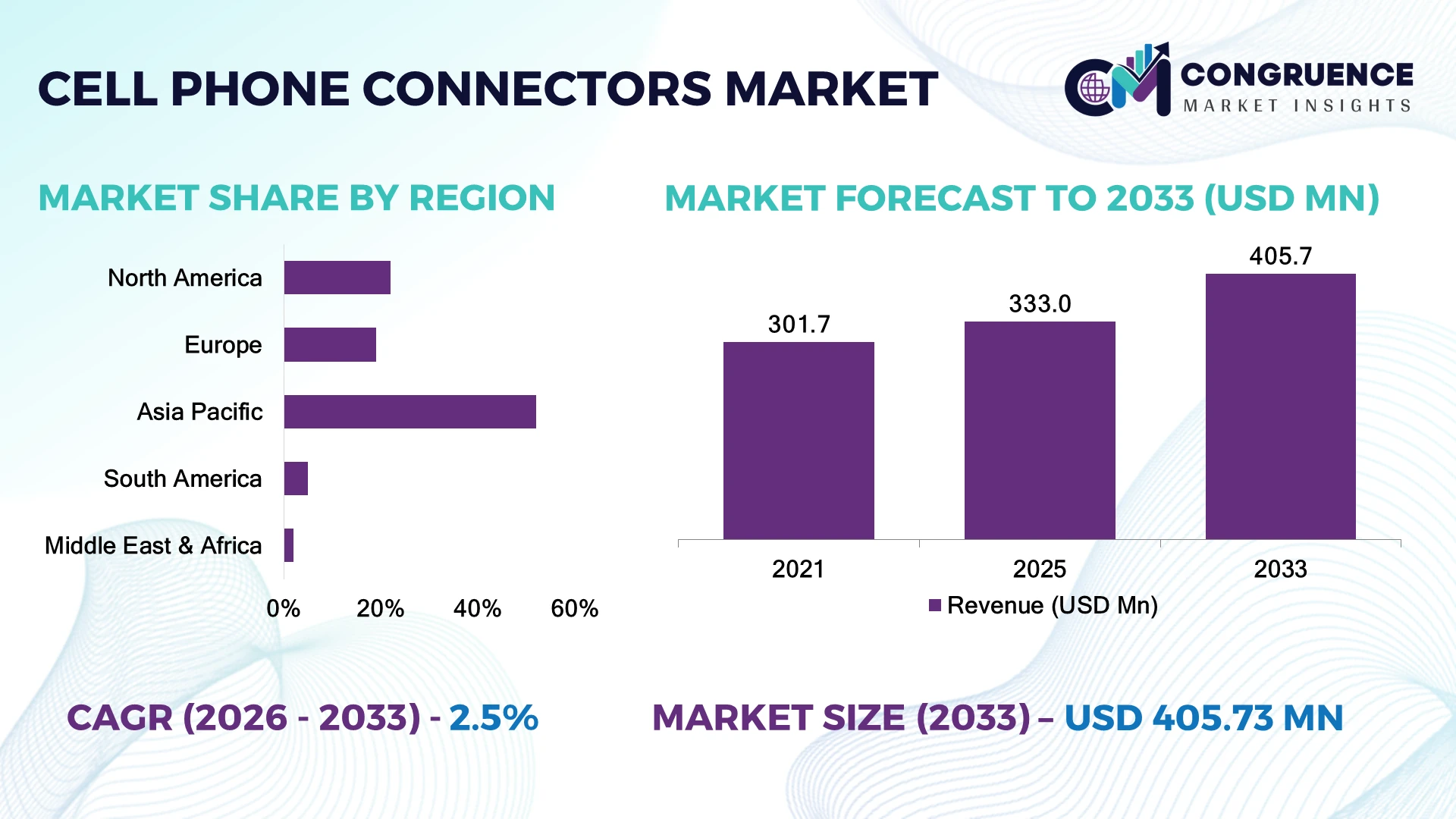
The Global Cell Phone Connectors Market was valued at USD 333.0 Million in 2025 and is anticipated to reach a value of USD 405.7 Million by 2033 expanding at a CAGR of 2.5% between 2026 and 2033. Rising adoption of USB Type-C interfaces, compact high-speed connectors, and premium smartphone designs is accelerating connector standardization and boosting replacement demand across global electronics manufacturing.
China dominates the global Cell Phone Connectors Market with approximately 46% of worldwide smartphone connector manufacturing capacity, supported by investments exceeding 1,500 advanced electronics facilities and strong supply networks serving consumer electronics and automotive sectors. India is rapidly expanding production through government-backed electronics manufacturing initiatives, while China maintains over 2.5× higher connector output. More than 82% of flagship smartphones now integrate USB Type-C interfaces, reinforcing manufacturing scale despite evolving global trade policies.
This manufacturing concentration reinforces supplier localization strategies, long-term sourcing partnerships, and technology-led product differentiation across the connector value chain.
Market Size & Growth: USD 333.0 Million in 2025 is projected to reach USD 405.7 Million by 2033 at a CAGR of 2.5%, supported by USB Type-C standardization and miniaturized connector innovation.
Top Growth Drivers: USB Type-C adoption exceeds 82%, premium smartphone penetration surpasses 38%, and automated connector assembly improves production efficiency by 20%.
Short-Term Forecast: By 2028, automated precision assembly is expected to reduce connector production defects by nearly 18%.
Emerging Technologies: AI-powered optical inspection, robotic micro-assembly, and high-durability alloy contacts are improving connector reliability and manufacturing precision.
Regional Leaders: Asia-Pacific approaches USD 220 Million with electronics manufacturing expansion, North America exceeds USD 70 Million through premium devices, and Europe nears USD 55 Million with sustainable electronics adoption.
Consumer/End-User Trends: More than 82% of newly launched smartphones feature USB Type-C connectivity, accelerating replacement demand.
Pilot/Case Example: In 2024, automated connector inspection projects improved manufacturing accuracy by approximately 15% while reducing production waste.
Competitive Landscape: Amphenol holds nearly 16% market share alongside Foxconn Interconnect Technology, Luxshare Precision, Molex, and JAE Electronics.
Regulatory & ESG Impact: Common charging regulations are expected to reduce electronic waste by nearly 11% while encouraging connector standardization.
Investment & Funding: More than USD 1.2 Billion has been invested in connector manufacturing expansion through capacity upgrades, strategic partnerships, and automation.
Innovation & Future Outlook: High-speed data connectors, compact waterproof designs, and recyclable materials are strengthening next-generation mobile connectivity strategies.
The Cell Phone Connectors Market continues to benefit from demand for fast charging, high-speed data transmission, and compact smartphone architectures. Manufacturers are introducing corrosion-resistant contact materials and precision micro-connectors to improve device durability. More than 82% of newly released smartphones now use USB Type-C interfaces, while supply-chain diversification across India and Southeast Asia is strengthening production resilience and supporting broader technology adoption, creating a strong foundation for strategic market analysis.
The Cell Phone Connectors Market has become strategically important as smartphone manufacturers compete through charging performance, data transfer capability, and device miniaturization. Connector reliability increasingly influences product quality, production efficiency, and brand competitiveness. Supply-chain restructuring beyond China and expanded electronics manufacturing in India are reshaping procurement strategies while strengthening operational resilience for global device producers.
Advanced precision connectors deliver nearly 30% faster data transmission efficiency and reduce assembly defects by approximately 18% compared with older connector generations. China remains the largest manufacturing hub because of integrated component ecosystems, whereas India is expanding production capacity through localized electronics manufacturing and supplier investments. During the next two to three years, USB Type-C penetration is expected to exceed 90% of premium smartphone launches, accelerating standardization across multiple device categories.
Leading manufacturers are deploying AI-enabled optical inspection, automated assembly systems, and collaborative supplier partnerships to improve production consistency. Connector suppliers are also investing in durable contact materials and compact waterproof designs that support thinner smartphones. Companies strengthening localized manufacturing, technology integration, and strategic customer partnerships are expected to secure stronger competitive positioning and long-term operational advantages.
The widespread transition toward USB Type-C has fundamentally changed connector manufacturing priorities across the smartphone industry. More than 82% of newly introduced smartphones now incorporate USB Type-C interfaces, while automated connector assembly improves production efficiency by nearly 20% and reduces manufacturing defects by approximately 18%. Regulatory initiatives promoting universal charging standards have accelerated product redesign across major consumer electronics brands. Connector manufacturers are expanding precision stamping facilities, investing in automated quality inspection, and collaborating with smartphone OEMs to deliver compact high-speed connectors. This transition enables greater production consistency, lower warranty claims, and stronger supplier relationships, creating measurable operational advantages throughout the electronics manufacturing ecosystem.
Connector manufacturers continue to face pressure from fluctuating prices of copper alloys, gold plating materials, and engineering polymers used in high-performance mobile connectors. Precious metal finishing accounts for nearly 18% of connector production costs, while material price fluctuations exceeding 12% affect procurement planning and production margins. Dependence on specialized component suppliers in East Asia also creates sourcing constraints during logistics disruptions. Companies are reducing exposure through supplier diversification, localized sourcing agreements, and long-term procurement contracts. Expanding regional manufacturing footprints and increasing automation help stabilize production costs while strengthening operational continuity across global connector supply chains.
Demand for thinner smartphones, foldable devices, and high-speed charging creates significant opportunities for advanced connector technologies. AI-driven optical inspection systems improve quality verification by nearly 25%, while precision robotic assembly enhances throughput by approximately 20%. India's expanding electronics manufacturing ecosystem and Japan's expertise in precision connector engineering are encouraging new investments in advanced production capabilities. Manufacturers are increasing R&D spending on waterproof connectors, high-durability contact materials, and compact multi-function interfaces supporting faster charging and data transmission. Strategic collaboration between connector suppliers and smartphone OEMs is accelerating commercialization of next-generation connector platforms while improving manufacturing flexibility.
Modern smartphones require connectors capable of supporting higher power delivery, faster data transfer, and compact internal layouts without compromising long-term durability. Connector failure rates below 0.5% have become a critical quality benchmark, while production validation cycles have increased by nearly 22% because of more demanding reliability requirements. Integrating advanced connector technologies into thinner devices also increases engineering complexity and testing requirements. Manufacturers are investing in automated validation laboratories, digital simulation tools, and advanced material engineering to improve lifecycle performance. Building scalable quality systems and maintaining engineering expertise remain essential for sustaining competitiveness in increasingly sophisticated mobile electronics manufacturing.
USB Type-C Standardization Accelerates Universal charging regulations and flagship smartphone launches have pushed USB Type-C penetration above 82%, while connector SKU standardization has reduced component complexity by nearly 18%. Chinese contract manufacturers are consolidating production lines to improve throughput, and OEMs are expanding long-term sourcing agreements with connector suppliers. The transition shortens product qualification cycles, improves inventory planning, and lowers manufacturing variation across multi-device product portfolios.
Automation Reshapes Connector Production Precision robotic assembly has increased production efficiency by approximately 20%, while AI-enabled optical inspection reduces connector defect rates by nearly 15%. Japanese and Taiwanese manufacturers are integrating automated micro-stamping and vision-based quality systems to address labor constraints and tighter dimensional tolerances. Companies are restructuring manufacturing workflows through digital production monitoring, enabling faster process validation and more consistent connector performance for premium mobile devices.
Localized Supply Networks Expand Supply-chain diversification has increased electronics component sourcing outside China by nearly 25%, with India and Vietnam strengthening localized connector ecosystems through expanded manufacturing partnerships. Inventory lead times have declined by approximately 12% as suppliers establish regional production clusters closer to smartphone assembly facilities. Connector manufacturers are responding through capacity expansion, dual-sourcing strategies, and localized engineering support to improve operational resilience against geopolitical trade disruptions.
Miniaturization Drives Material Innovation Connector thickness has declined by nearly 10% over recent product generations, while high-durability contact materials have extended connector lifecycle performance by approximately 20%. Foldable smartphones and ultra-thin devices are increasing demand for compact high-density interconnect architectures. Manufacturers are scaling precision alloy development, laser welding technologies, and advanced plating processes to deliver stronger mechanical reliability without increasing assembly complexity, creating differentiation beyond traditional price competition.
The market is segmented into USB Type-C Connectors, Micro-USB Connectors, Lightning Connectors, Board-to-Board Connectors, FPC/FFC Connectors, SIM Card Connectors, Audio Connectors, and Others. USB Type-C Connectors account for approximately 43% of total demand, supported by universal charging standards, higher power delivery capability, and faster data transfer integration across smartphones and connected devices. Micro-USB Connectors remain relevant for legacy devices and budget electronics, while Lightning Connectors continue serving selected proprietary ecosystems. Board-to-Board and SIM Card Connectors maintain stable demand because of their essential internal device architecture. FPC/FFC Connectors represent the fastest-growing segment as foldable smartphones, compact camera modules, and high-density electronic layouts require flexible interconnection systems. Their adoption has increased by nearly 19% across premium smartphone production, while advanced board-level connector integration has improved internal space utilization by approximately 14%. Connector manufacturers are expanding precision engineering capabilities, investing in thinner contact designs, and strengthening OEM partnerships to support evolving smartphone architectures and next-generation mobile electronics.
The market is segmented into Smartphones, Tablets, Wearable Devices, Laptops, Consumer Electronics Accessories, Automotive Infotainment Devices, and Others. Smartphones remain the leading application with approximately 67% of connector consumption, driven by continuous product refresh cycles, premium charging technologies, and increasing component density. Tablets continue stable demand through enterprise and education deployments, while laptops require higher-performance connectors supporting faster data transfer and advanced charging functionality. Wearable Devices represent the fastest-growing application as compact electronics, health monitoring products, and smart accessories expand global adoption. Connector integration in wearable products has increased by approximately 21%, while compact waterproof connector deployment has improved by nearly 16%. Automotive infotainment systems are also increasing demand for durable miniaturized connectors as smartphone integration becomes standard. Manufacturers are expanding automated production, customized connector platforms, and collaborative product development with device manufacturers to strengthen long-term supply relationships across multiple electronics categories.
The market is segmented into Smartphone OEMs, Consumer Electronics Manufacturers, Electronics Manufacturing Services (EMS) Providers, Aftermarket Repair & Service Providers, Telecommunications Equipment Manufacturers, and Others. Smartphone OEMs account for approximately 54% of connector procurement because of high production volumes, continuous product launches, and stringent quality requirements. Consumer Electronics Manufacturers maintain strong purchasing activity across tablets, accessories, and portable electronics, while EMS providers support scalable manufacturing through integrated component sourcing and assembly services. Electronics Manufacturing Services (EMS) Providers represent the fastest-growing end-user group as global brands continue outsourcing production to specialized manufacturing partners. EMS procurement volumes have increased by approximately 18%, while localized sourcing initiatives have improved component availability by nearly 13%. Aftermarket Repair & Service Providers continue benefiting from rising smartphone repair activity, and telecommunications equipment manufacturers require specialized high-reliability connector solutions. Connector suppliers are strengthening customized product portfolios, long-term supply agreements, and regional technical support to improve customer retention and operational responsiveness.
Asia-Pacific accounted for the largest market share at 52% in 2025 however, North America is expected to register the fastest growth, expanding at a CAGR of 3.1% between 2026 and 2033.
North America represents approximately 22% of the global Cell Phone Connectors Market, supported by premium smartphone demand, advanced semiconductor integration, and strong investment in electronics design. The region continues expanding adoption of high-speed USB Type-C connectors, compact board-level interconnects, and precision manufacturing technologies for next-generation mobile devices. More than 85% of flagship smartphones launched across the region now incorporate advanced fast-charging interfaces and higher-bandwidth connector architectures. Strategic collaborations between OEMs, semiconductor companies, and connector suppliers continue strengthening product validation, reliability testing, and advanced material development. Automation across electronics manufacturing has improved assembly consistency by approximately 17%, enabling faster product commercialization and reduced defect rates while supporting premium mobile device production.
United States Market Outlook: The United States leads the regional market through advanced consumer electronics innovation, semiconductor design capabilities, and large-scale smartphone ecosystem development. Strong collaboration between technology companies and electronics manufacturers supports continuous connector innovation for premium mobile devices. More than 88% of premium smartphones sold in the country utilize USB Type-C interfaces, while increasing investment in automated electronics manufacturing and product testing continues improving quality, production flexibility, and supply-chain resilience.
Europe accounts for nearly 19% of global demand, supported by advanced consumer electronics, sustainable manufacturing practices, and regulatory harmonization around common charging standards. Universal connector requirements have accelerated redesign activities across smartphone manufacturers while simplifying component sourcing and reducing product complexity. More than 80% of newly introduced mobile devices comply with standardized charging interfaces, enabling greater manufacturing efficiency and streamlined inventory management. Regional electronics suppliers continue investing in precision connector engineering, recyclable materials, and automated inspection technologies. Expansion of advanced electronics manufacturing and quality certification capabilities is strengthening long-term competitiveness while supporting reliable production for premium mobile electronics.
Germany Market Outlook: Germany remains the region's most strategically important market because of its precision manufacturing expertise, industrial automation capabilities, and advanced electronics engineering ecosystem. Connector manufacturers benefit from highly automated production environments and strong collaboration with industrial technology suppliers. Automated inspection systems have improved production accuracy by approximately 16%, while continued investment in advanced manufacturing infrastructure supports high-quality connector production for both domestic and export-oriented electronics industries.
Asia-Pacific contributes approximately 52% of the global Cell Phone Connectors Market and serves as the primary manufacturing center for smartphones and connector components. China, Japan, South Korea, Taiwan, and India collectively support highly integrated electronics supply chains, precision manufacturing, and large-scale exports. More than 70% of global smartphone assembly is concentrated within the region, enabling efficient connector production and rapid product commercialization. Electronics manufacturers continue expanding automated production facilities, precision stamping operations, and localized supplier ecosystems. Investments in advanced manufacturing technologies and production capacity upgrades have improved manufacturing productivity by nearly 20%, reinforcing the region's leadership in high-volume connector manufacturing.
China Market Outlook: China remains the largest country market because of its unmatched electronics manufacturing ecosystem, integrated supplier base, and extensive smartphone production capacity. The country accounts for roughly 46% of global smartphone connector manufacturing output and hosts thousands of component suppliers supporting rapid production cycles. Continuous investment in smart manufacturing, automated quality inspection, and export-oriented production strengthens China's competitive advantage while enabling efficient delivery of advanced connector solutions worldwide.
South America represents approximately 5% of the global market, with demand primarily driven by smartphone replacement cycles, expanding mobile connectivity, and growing regional electronics assembly. Brazil and neighboring markets continue increasing imports of advanced connector components while gradually strengthening localized electronics production capabilities. Smartphone penetration has exceeded 74% across major urban markets, supporting demand for replacement connectors and repair services. Regional distributors and electronics assemblers are improving inventory management and supplier partnerships to shorten procurement timelines. Although manufacturing capacity remains comparatively limited, continued investment in assembly operations and logistics infrastructure is improving market responsiveness and operational efficiency.
Brazil Market Outlook: Brazil leads the regional market through its established consumer electronics manufacturing base, domestic assembly operations, and expanding smartphone ecosystem. Electronics manufacturers continue increasing localized assembly activities to improve supply-chain flexibility and reduce import dependence. Connector demand is supported by rising mobile device production and a growing repair industry, while investments in industrial modernization and logistics infrastructure continue strengthening operational capabilities across the country's electronics sector.
The Middle East & Africa accounts for approximately 2% of the global market, supported by expanding smartphone adoption, digital infrastructure modernization, and increasing investment in consumer electronics distribution. Growing deployment of 5G networks and digital transformation initiatives is encouraging demand for advanced charging and data connectivity solutions. Smartphone adoption has exceeded 76% in several Gulf countries, strengthening demand for premium connector technologies. Regional distributors are expanding strategic partnerships with global electronics brands while improving logistics networks and after-sales support. Although large-scale manufacturing remains limited, infrastructure modernization and technology investments continue improving long-term market accessibility.
United Arab Emirates Market Outlook: The United Arab Emirates serves as the region's leading commercial hub for premium consumer electronics through its advanced logistics infrastructure, technology-focused economy, and strong international trade connectivity. Distribution centers, electronics retailers, and regional technology partners continue expanding operations to meet rising demand for premium smartphones and accessories. High digital adoption, efficient import infrastructure, and growing investment in smart logistics strengthen the country's position as a strategic gateway for advanced connector products across the Middle East and Africa.
The Cell Phone Connectors Market is led by Amphenol Corporation, TE Connectivity, Hirose Electric, JAE, and Molex, while Luxshare Precision and regional Asian manufacturers compete aggressively on manufacturing scale and pricing. Global technology leaders compete against cost-focused suppliers, whereas OEM-aligned manufacturers emphasize customization and rapid product qualification. The top five companies collectively control approximately 58% of the market, reflecting a moderately consolidated competitive structure. Competition centers on connector miniaturization, signal integrity, supply reliability, and manufacturing efficiency rather than price alone. Automated production has improved manufacturing productivity by nearly 20%, while advanced precision inspection reduces defect rates by approximately 15%, creating clear differentiation. Leading companies strengthen their positions through capacity expansion, long-term OEM partnerships, vertical integration, and next-generation USB Type-C innovation. The competitive shift increasingly favors suppliers with resilient regional manufacturing networks and advanced engineering capabilities. High qualification requirements, precision tooling investments, and strict reliability standards remain major entry barriers. Sustainable competitive success depends on technology leadership, manufacturing excellence, dependable supply chains, and close OEM collaboration.
TE Connectivity
Hirose Electric Co., Ltd.
Japan Aviation Electronics Industry (JAE)
Molex LLC
Luxshare Precision Industry Co., Ltd.
Foxconn Interconnect Technology (FIT)
JST Mfg. Co., Ltd.
Kyocera Corporation
SMK Corporation
Electric Connector Technology Co., Ltd.
Shenzhen Everwin Precision Technology Co., Ltd.
USB Type-C technology has become the dominant connector platform as smartphone manufacturers standardize charging and high-speed data interfaces. More than 82% of newly launched smartphones now integrate USB Type-C, while advanced contact materials improve connector durability by approximately 20%. AI-enabled optical inspection and precision robotic assembly are also increasing manufacturing accuracy by nearly 15%, enabling faster qualification and reducing production variability. Companies serving premium smartphone OEMs benefit most from these technology upgrades through improved quality consistency and lower operational costs.
Emerging technologies include high-density board-to-board connectors, ultra-thin FPC/FFC interconnects, laser-welded terminals, and advanced corrosion-resistant plating. Compared with conventional Micro-USB interfaces, modern USB Type-C connectors deliver approximately 30% higher data transmission efficiency and significantly greater power delivery capability. Automated inline inspection, digital process monitoring, and predictive quality analytics are becoming standard across advanced manufacturing facilities, strengthening production reliability while supporting increasingly compact smartphone architectures.
Between 2026 and 2028, broader deployment of AI-assisted manufacturing, digital factory platforms, and next-generation connector materials will accelerate operational modernization. Adoption of smart manufacturing solutions is expected to exceed 60% among leading connector suppliers, improving production flexibility and shortening development cycles. Companies investing early in automation, advanced materials, and integrated engineering partnerships will strengthen competitive positioning while meeting increasingly demanding smartphone performance, reliability, and sustainability requirements.
August 2025 – Japan Aviation Electronics (JAE) introduced a new vertical DX07 Series USB Type-C connector with a mating guide supporting USB PD EPR up to 240W and 20Gbps transmission, improving assembly efficiency and connection reliability for compact electronics. Source: www.jae.com
March 2026 – Amphenol SOCAPEX launched a rugged USB Type-C Active Optical Cable extender supporting 10Gbps transmission over distances up to 15 meters, enabling reliable high-speed connectivity for demanding industrial and defense environments while expanding advanced interconnect capabilities. Source: www.amphenol.com
January 2026 – JAE expanded its DX07 Series with compression-mount USB Type-C connectors designed to improve repairability, mechanical robustness, and manufacturing flexibility, supporting growing demand for durable high-performance mobile and embedded electronic systems. Source: www.jae.com
July 2026 – Amphenol Industrial Operations expanded its connector portfolio with the compact ePower-Lite Mini X supporting operating voltages up to 1000VDC and current ratings up to 35A, strengthening advanced interconnect technologies and manufacturing capability across electrification markets.
The report provides comprehensive analysis of the Cell Phone Connectors Market across major connector types, applications, end-user industries, and regional markets between 2026 and 2033. It evaluates USB Type-C, Micro-USB, Lightning, board-to-board, FPC/FFC, SIM card, audio, and related connector technologies while assessing deployment across smartphones, wearables, tablets, laptops, automotive infotainment, and other connected devices. Regional analysis covers North America, Europe, Asia-Pacific, South America, and the Middle East & Africa, representing more than 95% of global electronics manufacturing activity.
The study examines technology adoption, manufacturing trends, supply-chain developments, competitive positioning, automation, miniaturization, and advanced connector innovation. It highlights deployment patterns, enterprise procurement strategies, OEM partnerships, localization initiatives, and evolving production ecosystems. The report supports investment planning, product development, capacity expansion, sourcing strategies, competitive benchmarking, and long-term business decision-making by identifying operational trends, emerging opportunities, technology transitions, and strategic priorities shaping the global Cell Phone Connectors Market.
| Report Attribute / Metric | Details |
|---|---|
| Market Revenue (2025) | USD 333.0 Million |
| Market Revenue (2033) | USD 405.7 Million |
| CAGR (2026–2033) | 2.5% |
| Base Year | 2025 |
| Forecast Period | 2026–2033 |
| Historic Period | 2021–2025 |
| Segments Covered |
By Type
By Application
By End-User
|
| Key Deliverables | Revenue Forecast; Market Trends; Growth Drivers & Restraints; Technology Insights; Segmentation Analysis; Regional Insights; Competitive Landscape; Regulatory & ESG Overview; Recent Developments |
| Regions Covered | North America; Europe; Asia-Pacific; South America; Middle East & Africa |
| Companies Profiled | Amphenol Corporation; TE Connectivity; Hirose Electric Co., Ltd.; Japan Aviation Electronics Industry (JAE); Molex LLC; Luxshare Precision Industry Co., Ltd.; Foxconn Interconnect Technology (FIT); JST Mfg. Co., Ltd.; Kyocera Corporation; SMK Corporation; Electric Connector Technology Co., Ltd.; Shenzhen Everwin Precision Technology Co., Ltd. |
| Customization & Pricing | Available on Request (10% Customization Free) |




