
Reports
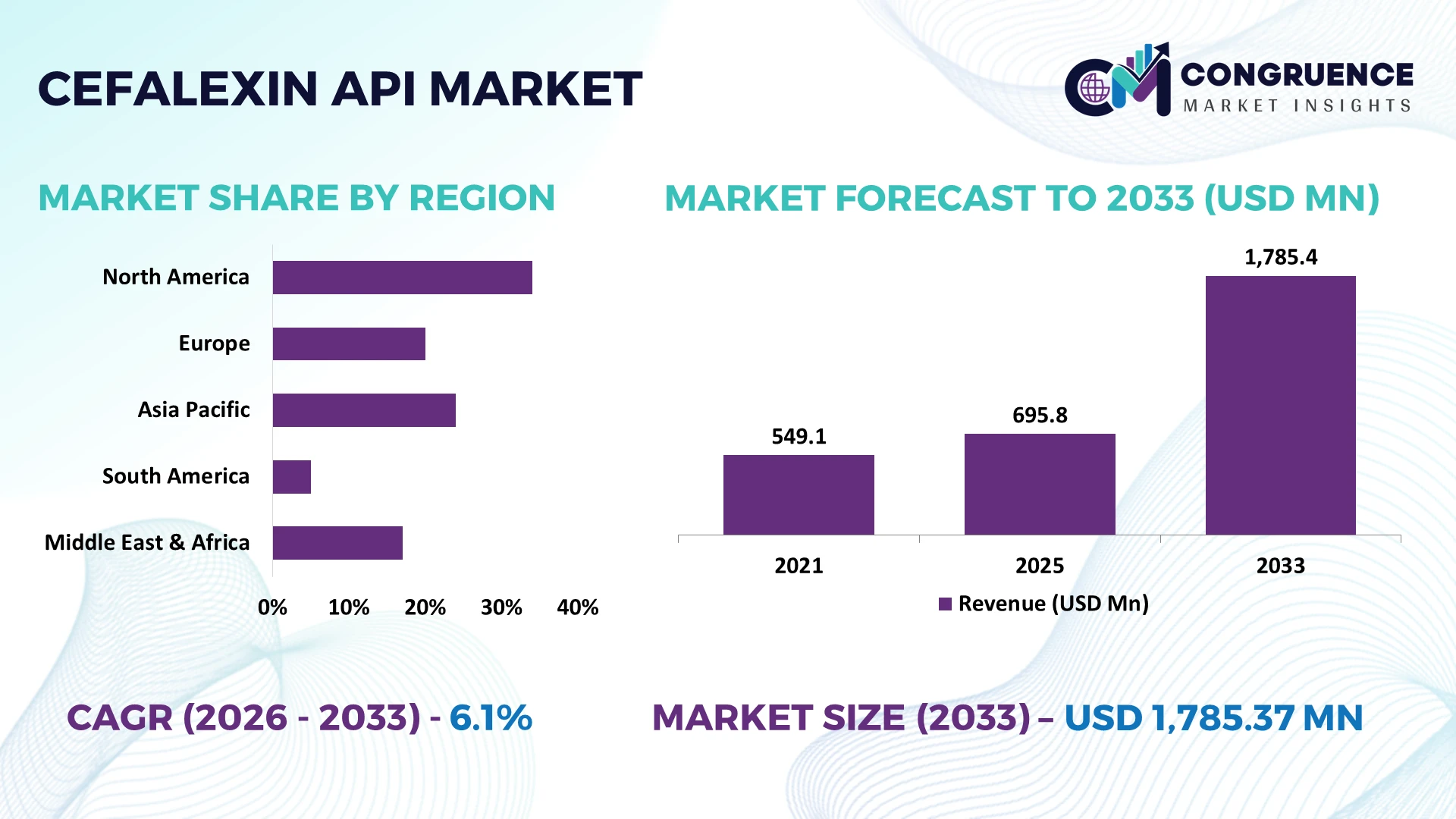
The Global Cefalexin API Market was valued at USD 695.84 Million in 2025 and is anticipated to reach a value of USD 1785.37 Million by 2033 expanding at a CAGR of 6.1% between 2026 and 2033. Growth is driven by pharmaceutical manufacturers strengthening domestic antibiotic API supply chains and expanding cefalexin production to reduce exposure to concentrated Asian raw-material networks.
India is emerging as a strategic production base, with antibiotic API manufacturing sites representing about 35% of global sites, compared with 34% in China. Indian producers are also expanding capacity; one cefalexin manufacturer reports 600+ tonnes of annual capacity, while national bulk-drug initiatives have established about 56,800 tonnes of annual capacity across 28 critical products. The COVID-19 supply shock and continuing China-linked API concentration are accelerating procurement diversification, making India’s manufacturing expansion increasingly important for global cefalexin sourcing resilience.
Strategically, buyers should prioritize qualified multi-country suppliers, scalable Indian capacity, and resilient API sourcing rather than relying on single-region procurement.
Market Size & Growth: USD 695.84 million in 2025 to USD 1,785.37 million by 2033 at 6.1% CAGR, driven by antibiotic API supply-chain localization.
Top Growth Drivers: Supply-chain localization 35%, generic-drug expansion 30%, essential-medicine procurement 25%.
Short-Term Forecast: By 2028, automated API processing is positioned to improve production efficiency by 8% while reducing batch-related costs by 5%.
Emerging Technologies: Enzymatic synthesis, continuous processing, and digital quality monitoring are advancing high-purity cefalexin production.
Regional Leaders: Asia-Pacific leads with an estimated USD 1.15 billion by 2033; Europe follows at USD 330 million and North America at USD 210 million.
Consumer/End-User Trends: Approximately 70% of global antibiotic API manufacturing sites are concentrated in India and China, reinforcing regional sourcing dominance.
Pilot/Case Example: 2022–2025 Indian capacity expansion programs established approximately 56,800 tonnes/year across 28 critical API products, strengthening domestic pharmaceutical resilience.
Competitive Landscape: India and China dominate supply infrastructure, with leading participants including Dalas Biotech, North China Pharmaceutical, Zhejiang Huahai Pharmaceutical, Aurobindo Pharma, and Zhejiang Hisun Pharmaceutical.
Regulatory & ESG Impact: WHO’s 2025 essential-medicine framework reinforces quality, availability, and antibiotic stewardship, increasing pressure for traceable API manufacturing.
Investment & Funding: India’s bulk-drug PLI ecosystem has established 56,800 tonnes/year of capacity across 28 critical products, accelerating domestic manufacturing investment.
Innovation & Future Outlook: Next-generation enzymatic routes, process automation, and dual sourcing will shift competition toward cost-efficient, compliant, and geographically resilient cefalexin API production.
The Cefalexin API Market is gaining strategic importance across generic pharmaceuticals, pediatric formulations, and essential antibacterial medicines. WHO classifies cefalexin as an Access-group antibiotic, supporting continued procurement relevance across healthcare systems. Manufacturers are increasingly adopting enzymatic processing and automated quality controls, while supply-chain diversification is accelerating as pharmaceutical buyers reassess China-linked dependencies.
Cefalexin API is becoming strategically important because antibiotic security now influences pharmaceutical competitiveness, procurement resilience, and manufacturing localization. India and China together account for roughly 70% of global antibiotic API manufacturing sites, making production concentration a critical sourcing consideration. The post-COVID supply-chain restructuring has pushed manufacturers toward qualified secondary suppliers, localized intermediates, and longer-term procurement contracts.
Technology is also reshaping production economics. Enzyme-enabled synthesis and automated process controls can reduce solvent use and batch variability, while continuous processing can improve manufacturing throughput by roughly 10–15% versus conventional batch operations. China retains scale advantages in mature API infrastructure, whereas India is strengthening process modernization and domestic capacity through pharmaceutical manufacturing incentives, creating a more diversified competitive base.
Over the next 2–3 years, manufacturers are expected to prioritize dual sourcing, digital quality monitoring, and capacity utilization improvements of around 5–10%. A practical deployment model involves Indian API producers integrating automated in-process testing with expanded fermentation and synthesis lines to improve batch consistency. Companies investing in validated capacity, supplier redundancy, and technology partnerships will secure stronger procurement positions and operational resilience.
Supply-chain localization is strengthening cefalexin API production strategies as pharmaceutical companies reduce exposure to concentrated sourcing. India and China account for approximately 70% of antibiotic API manufacturing sites, while Indian manufacturers are expanding domestic critical-drug capacity. Government-backed production incentives are shifting investment toward integrated API facilities, reducing dependence on imported intermediates. Companies are responding through capacity additions, long-term supplier agreements, and process modernization. The non-obvious advantage is procurement continuity: vertically integrated producers can control intermediate availability and quality release more effectively than fragmented sourcing models. This structural shift is increasing the value of validated Indian manufacturing hubs and strengthening their position in global generic-drug supply chains.
Cefalexin API production remains exposed to concentrated intermediate and precursor supply chains, creating procurement and margin pressure. India and China collectively represent about 70% of antibiotic API manufacturing sites, leaving buyers vulnerable to regional disruptions, while imported intermediates can represent 30–40% of selected API input costs. Environmental compliance and pharmaceutical-quality requirements further increase operating expenditure by approximately 5–8% for modernized facilities. Companies are mitigating this constraint through supplier diversification, inventory buffers, multi-year contracts, and backward integration. The key operational issue is not production capability alone but consistent access to qualified starting materials; manufacturers with localized intermediate capacity gain stronger cost visibility and faster response to supply interruptions.
Advanced biocatalysis, continuous processing, and automated quality analytics create opportunities to improve cefalexin API economics beyond conventional batch manufacturing. Continuous production can deliver roughly 10–15% higher throughput, while automated process monitoring can reduce batch-related deviations by 5–8%. India offers a particularly attractive platform as pharmaceutical producers combine established generic-drug infrastructure with newer digital manufacturing systems. Companies are positioning through enzyme-technology partnerships, process R&D, and integrated production lines. A less obvious opportunity lies in reducing quality-release delays: real-time monitoring can shorten decision cycles and improve asset utilization, allowing producers to compete on reliability and delivery performance rather than API price alone.
Scaling advanced cefalexin API processes requires stringent validation, skilled technical teams, and consistent infrastructure across production sites. Automated manufacturing environments can require 15–20% higher initial technology investment than conventional lines, while workforce shortages in specialized pharmaceutical process engineering can constrain deployment by roughly 5–10%. India’s expanding manufacturing base therefore faces pressure to standardize digital quality systems across facilities rather than simply add capacity. Companies must invest in validated automation, workforce training, analytical infrastructure, and technology partnerships to maintain consistent output. The strategic challenge is achieving repeatable quality at higher utilization: facilities that cannot synchronize process control, analytical release, and compliance workflows risk losing the operational advantage created by modernization.
Domestic API Capacity Expansion: Indian manufacturers are expanding antibiotic API capacity and qualifying secondary suppliers as supply-chain resilience becomes a procurement priority. About 70% of antibiotic API manufacturing sites remain concentrated in India and China, encouraging localized sourcing and longer-term contracts.
Quality-System Digitization: Digital batch records, automated analytical testing, and real-time process monitoring are moving into API facilities, targeting 5–8% fewer deviations and faster release cycles. Companies are integrating electronic quality systems as regulatory expectations for traceability intensify.
Formulation Flexibility Rising: Pharmaceutical producers are increasingly balancing capsules, tablets, and liquid-ready API specifications to serve varied dosage requirements. Formulation flexibility can improve production responsiveness by 5–10%, with manufacturers adjusting particle-size control and packaging compatibility.
Stewardship Reshapes Procurement: WHO's 2025 antibiotic stewardship framework is strengthening emphasis on appropriate antibiotic use, while GLASS data covers 60 countries. The non-obvious shift is tighter procurement qualification, prompting suppliers to prioritize consistent quality, traceability, and responsible manufacturing alongside price.
Pharmaceutical Grade is estimated to lead the Cefalexin API Market with approximately 72% share, supported by stringent pharmacopoeial specifications, large-scale generic-drug manufacturing, and established regulatory pathways. Its quality consistency and compatibility with standardized formulation processes make it the preferred input for mainstream human medicines. Standard Grade remains relevant in cost-sensitive production, representing roughly 18% of demand, while Veterinary Grade accounts for about 10% and serves specialized animal-health formulations. Companies are prioritizing validated Pharmaceutical Grade capacity because production interruptions directly affect finished-dose availability.
Veterinary Grade is the fastest-growing type, with adoption expanding around 6–8% as animal-health manufacturers strengthen antimicrobial quality controls and diversify formulations. Standard Grade remains comparatively mature, with companies competing primarily through process yield and input-cost optimization. Manufacturers are therefore directing approximately 10% more development attention toward differentiated specifications and veterinary supply partnerships, while maintaining Pharmaceutical Grade as the core capacity investment.
Capsules are estimated to represent approximately 42% of Cefalexin API consumption, supported by standardized manufacturing, dosing convenience, and established generic-drug production lines. Tablets follow at roughly 34%, benefiting from automated compression and high-throughput packaging. Capsules remain operationally attractive because manufacturers can scale filling systems with relatively predictable API specifications, while tablets provide stronger automation opportunities. Companies are optimizing particle-size consistency and batch uniformity to minimize formulation variability.
Oral Suspensions are the fastest-growing application, expanding adoption by approximately 7–9% as pediatric and patient-specific dosing requirements increase. Veterinary Medicines account for nearly 12% of application demand and are becoming more specification-sensitive as animal-health producers strengthen stewardship practices. Manufacturers are responding through flexible formulation partnerships, dedicated liquid-ready API specifications, and automated quality testing. The strategic shift is toward API characteristics that support multiple finished-dose formats without extensive process requalification.
Pharmaceutical Companies account for an estimated 68% of Cefalexin API demand, reflecting their extensive generic-drug portfolios, validated production infrastructure, and recurring procurement requirements. Contract Manufacturers follow at approximately 19%, gaining importance as pharmaceutical companies outsource selected production stages to improve asset utilization and reduce fixed manufacturing commitments. Veterinary Drug Manufacturers represent around 9%, while Research Institutions account for approximately 4% and remain strategically relevant for process development and analytical validation.
Contract Manufacturers are the fastest-growing end-user group, with demand expanding about 7–9% as pharmaceutical producers pursue flexible capacity and regional supply diversification. Their procurement model increasingly favors multi-product API facilities and long-term supply agreements. Pharmaceutical companies are responding through strategic partnerships, dual-source qualification, and supplier audits, while veterinary manufacturers emphasize tailored specifications. The competitive advantage is shifting toward suppliers capable of serving multiple validated production environments without compromising batch consistency.
Asia-Pacific accounted for the largest market share at 61% in 2025 however, South America is expected to register the fastest growth, expanding at a CAGR of 7.4% between 2026 and 2033.

Domestic Supply Resilience Reshapes API Procurement
North America represents approximately 14% of global Cefalexin API demand, supported by established generic-drug manufacturing, stringent quality controls, and hospital procurement networks. The United States dominates regional consumption, while domestic API production remains comparatively limited, increasing reliance on qualified international suppliers. Pharmaceutical companies are responding by expanding dual-source qualification and maintaining larger strategic inventories, with procurement programs increasingly targeting 5–10% greater supply continuity. Digital batch documentation and automated analytical release are also gaining traction across modern pharmaceutical facilities. The region's strategic position rests less on manufacturing scale and more on regulatory sophistication, high-value pharmaceutical integration, and purchasing power. Supply-chain restructuring is pushing buyers toward Indian and European suppliers capable of meeting U.S. quality requirements.
United States Market Outlook: The United States remains the region's most strategically important market because of its extensive generic-drug distribution infrastructure and regulatory requirements. More than 90% of prescriptions are filled with generic medicines, supporting recurring demand for cost-efficient antibiotic APIs. Manufacturers are strengthening supplier qualification, inventory planning, and compliant sourcing to protect finished-dose availability.
Regulatory Discipline Drives Qualified Sourcing
Europe accounts for roughly 17% of global Cefalexin API demand, with Germany, Italy, France, and Spain representing major pharmaceutical manufacturing and procurement centers. European buyers increasingly prioritize GMP compliance, traceability, environmental controls, and supplier redundancy rather than lowest-cost sourcing alone. API qualification programs can involve multi-stage technical and regulatory assessments, encouraging established suppliers to maintain validated documentation and consistent batch performance. Manufacturers are integrating electronic quality-management systems and improving process monitoring to reduce deviations by approximately 5–8%. Sustainability requirements are also influencing supplier selection as pharmaceutical companies evaluate solvent intensity, waste generation, and manufacturing transparency. Companies are consequently strengthening partnerships with qualified Asian producers while retaining European quality-control and formulation capabilities.
Germany Market Outlook: Germany provides Europe with a strong pharmaceutical manufacturing and quality-assurance base, supported by advanced analytical infrastructure and highly regulated production environments. Its pharmaceutical industry employs more than 100,000 people, creating strong technical capabilities for API qualification, formulation, and quality management. Buyers increasingly favor suppliers demonstrating dependable documentation and environmental compliance.
Manufacturing Scale Reinforces Supply Leadership
Asia-Pacific commands approximately 61% of the Cefalexin API Market, with China and India forming the core manufacturing and export base. The region benefits from established antibiotic intermediate networks, integrated chemical infrastructure, skilled pharmaceutical labor, and large-scale generic-drug production. India and China together account for about 70% of global antibiotic API manufacturing sites, reinforcing their procurement importance. Chinese producers retain scale and integrated upstream capabilities, while Indian manufacturers are expanding capacity and strengthening regulated-market exports. Companies are investing in backward integration, automated quality testing, and multi-product facilities to improve utilization and supply resilience. Regional producers are also diversifying export destinations as buyers in Europe and North America seek alternatives to concentrated procurement. The competitive advantage increasingly combines manufacturing scale with regulatory qualification.
India Market Outlook: India is the region's most strategically significant diversification hub, combining extensive generic-drug manufacturing with expanding API infrastructure. Government production-linked initiatives have supported domestic capacity development for critical pharmaceutical ingredients. Indian manufacturers are strengthening integrated API facilities, process automation, and regulated-market certifications, positioning the country as a preferred secondary source for global antibiotic procurement.
Import Diversification Strengthens Pharmaceutical Security
South America represents approximately 5% of global Cefalexin API demand, with Brazil accounting for the largest share because of its pharmaceutical manufacturing base, extensive public-health procurement, and established generic-drug sector. Regional API production remains limited compared with consumption, leaving manufacturers dependent on imports from India, China, and other qualified suppliers. Brazilian pharmaceutical companies are increasingly using multi-country sourcing and inventory buffers to reduce exposure to shipping disruptions and currency volatility. Procurement diversification is improving supply resilience, while local formulation facilities support downstream value creation. Approximately 60% of regional API requirements are estimated to depend on imported supply chains, creating both an execution constraint and localization opportunity. Companies are prioritizing long-term supply agreements and local formulation partnerships rather than attempting immediate upstream replication.
Brazil Market Outlook: Brazil is the region's principal pharmaceutical manufacturing hub, supported by a large domestic medicine market and extensive generic-drug production. Its national healthcare procurement system creates recurring demand for essential antibiotics, while local manufacturers increasingly combine imported APIs with domestic formulation and packaging. Strategic partnerships can improve delivery reliability and reduce exposure to international logistics volatility.
Localization Accelerates Strategic Pharmaceutical Investment
Middle East & Africa contributes approximately 3% of global Cefalexin API demand, with pharmaceutical localization, healthcare infrastructure investment, and essential-medicine procurement shaping purchasing decisions. Saudi Arabia, the United Arab Emirates, South Africa, and Egypt are developing stronger pharmaceutical manufacturing capabilities, although API production remains less integrated than in India or China. Saudi Arabia's Vision 2030 industrial agenda is encouraging local pharmaceutical manufacturing and technology partnerships, while regional producers increasingly seek contract manufacturing and supply agreements with established API companies. Import dependence remains significant, creating opportunities for localized formulation and selected API processing. Companies are responding through technology-transfer partnerships, regional manufacturing alliances, and inventory hubs. The strategic shift is toward pharmaceutical supply security rather than immediate full-scale upstream localization.
Saudi Arabia Market Outlook: Saudi Arabia offers the strongest regional investment platform through pharmaceutical industrialization initiatives, modern healthcare infrastructure, and government-backed localization priorities. The country's pharmaceutical localization strategy targets stronger domestic production capabilities and partnerships with international manufacturers. Cefalexin suppliers can leverage this environment through technology transfer, contract manufacturing, and compliant regional distribution arrangements.
Cefalexin API competition centers on Asian cost leaders, regulated-market suppliers, and integrated pharmaceutical manufacturers, with major pressure among Aurobindo Pharma, North China Pharmaceutical, Zhejiang Huahai Pharmaceutical, Zhejiang Hisun Pharmaceutical, and Antibioticos. The top five players collectively hold an estimated 35–40% share, leaving substantial room for regional specialists. Competition is driven primarily by price, GMP compliance, supply reliability, and batch consistency. Vertically integrated producers can achieve 8–12% lower input costs, while automated quality systems can reduce batch deviations by 5–8%. Indian companies are expanding regulated-market capacity, Chinese producers leverage upstream integration, and European buyers increasingly pursue dual-source partnerships. Supply-chain diversification is shifting competitive power toward qualified secondary suppliers. High regulatory qualification requirements and validated manufacturing processes remain major entry barriers. Winning requires competitive cost structures, dependable API availability, strong compliance records, and geographically diversified production.
Aurobindo Pharma Limited
North China Pharmaceutical Group Corporation
Zhejiang Huahai Pharmaceutical Co., Ltd.
Zhejiang Hisun Pharmaceutical Co., Ltd.
Lupin Limited
Cipla Limited
Sun Pharmaceutical Industries Ltd.
Dr. Reddy's Laboratories Ltd.
Alkem Laboratories Ltd.
Viatris Inc.
Sandoz Group AG
Teva Pharmaceutical Industries Ltd.
Enzymatic synthesis is becoming the most important process innovation, with active Type II filings showing commercial deployment rather than laboratory experimentation. Compared with conventional chemical routes, enzymatic processing can improve reaction efficiency by 5–8% and reduce process-related waste by 3–5%. Adoption remains concentrated among advanced Indian API manufacturers, giving vertically integrated suppliers a cost and quality advantage.
Continuous manufacturing, automated in-process controls, and real-time analytical monitoring are emerging alongside established batch production. Automated quality systems can improve batch-release efficiency by 4–6%, while continuous processing can raise throughput by 8–12%. Adoption across modern API facilities remains selective, generally below 30%, but integration with electronic batch records is accelerating as manufacturers seek stronger traceability and fewer deviations.
From 2026–2028, enzymatic routes, process analytical technology, and AI-assisted quality monitoring will increasingly determine manufacturing competitiveness. Newer digitally integrated lines can deliver approximately 10% higher operational efficiency than legacy batch workflows. Indian producers with validated automation benefit most, while global buyers gain shorter qualification cycles, stronger supply consistency, and improved manufacturing resilience.
October 2024, Aurobindo Pharma received USFDA approval for Cephalexin Tablets USP 250 mg and 500 mg, gaining 180-day shared generic exclusivity. The approval expands regulated-market access and strengthens the company’s vertically integrated cephalosporin portfolio for U.S. commercial supply and partnerships. Source: aurobindo.com
July 2025, Lupin received TGA GMP certification for its Dabhasa API facility in Gujarat. The certification strengthens Australian market access and CDMO credibility, supporting expansion of compliant API manufacturing and improving qualification prospects for international customers seeking reliable regulated-market suppliers. Source: lupin.com
August 2025, Lupin’s Cephalexin USP enzymatic API DMF received an updated revision, with submission dated March 2025. The active Type II filing signals commercialization of an enzymatic route and strengthens Lupin’s differentiated API platform for regulated international customers and manufacturing scale. Source: pharmacompass.com
January 2026, researchers reported a multicentre Phase IV study of cephalexin extended release with clavulanate in India, covering outpatient bacterial infections. The study expands clinical evidence and supports formulation innovation around differentiated cephalexin-based therapies for broader therapeutic applications and development. Source: Springer Nature
The Cefalexin API Market Report covers Pharmaceutical Grade, Veterinary Grade, and Standard Grade types across Capsules, Tablets, Oral Suspensions, and Veterinary Medicines. End-user analysis includes Pharmaceutical Companies, Contract Manufacturers, Veterinary Drug Manufacturers, and Research Institutions, with regional assessment spanning North America, Europe, Asia-Pacific, South America, and Middle East & Africa.
The scope evaluates manufacturing technologies, enzymatic processing, automated quality control, supply-chain diversification, regulatory qualification, and formulation integration. Asia-Pacific receives particular attention because India and China account for approximately 70% of antibiotic API manufacturing sites, while regulated markets emphasize supplier qualification and traceability. The analysis supports investment planning, capacity expansion, sourcing decisions, partnership strategies, competitive positioning, and technology priorities through 2026–2033.
| Report Attribute/Metric | Report Details |
|---|---|
Market Revenue in 2025 | USD 695.84 Million |
Market Revenue in 2033 | USD 1785.37 Million |
CAGR (2026 - 2033) | 6.1% |
Base Year | 2025 |
Forecast Period | 2026 - 2033 |
Historic Period | 2021 - 2025 |
Segments Covered | By Type
By Application
By End-User
|
Key Report Deliverable | Revenue Forecast, Growth Trends, Market Dynamics, Segmental Overview, Regional and Country-wise Analysis, Competition Landscape |
Region Covered | North America, Europe, Asia-Pacific, South America, Middle East, Africa |
Key Players Analyzed | Aurobindo Pharma Limited, North China Pharmaceutical Group Corporation, Zhejiang Huahai Pharmaceutical Co., Ltd., Zhejiang Hisun Pharmaceutical Co., Ltd., Lupin Limited, Cipla Limited, Sun Pharmaceutical Industries Ltd., Dr. Reddy's Laboratories Ltd., Alkem Laboratories Ltd., Viatris Inc., Sandoz Group AG, Teva Pharmaceutical Industries Ltd. |
Customization & Pricing | Available on Request (10% Customization is Free) |




