
Reports
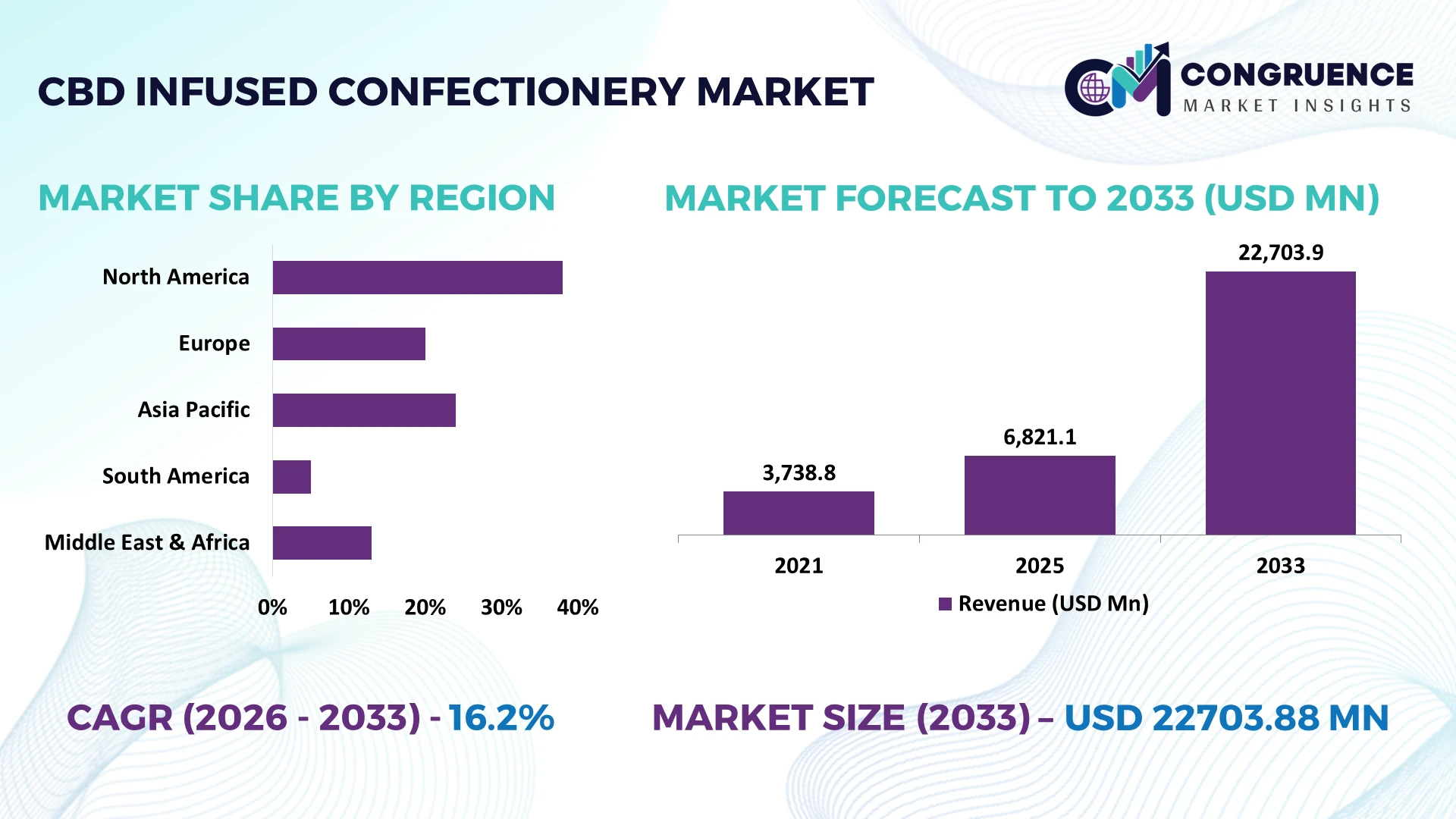
The Global CBD-Infused Confectionery Market was valued at USD 6821.07 Million in 2025 and is anticipated to reach a value of USD 22703.88 Million by 2033 expanding at a CAGR of 16.22% between 2026 and 2033. Growth is being accelerated by expanded hemp-derived ingredient standardization, advanced confectionery formulation technologies, wider retail penetration, and increasing consumer preference for precisely dosed functional wellness products.
The United States remains the dominant country, accounting for approximately 41% of global CBD-infused confectionery production, supported by large-scale hemp cultivation, advanced food processing infrastructure, and sustained private investments exceeding USD 1 billion in cannabinoid manufacturing. Compared with Germany, where regulated wellness retail continues expanding, U.S. product launches remain significantly higher, while automated confectionery lines improve production efficiency by nearly 18%. Ongoing regulatory refinement across major economies in 2026 continues shaping international trade and product commercialization.
Companies prioritizing compliant product development, scalable manufacturing, and geographically diversified distribution networks are positioned to strengthen long-term competitive advantage.
Market Size & Growth: USD 6821.07 Million in 2025 is projected to reach USD 22703.88 Million by 2033 at a CAGR of 16.22%, driven by advanced ingredient processing and premium functional confectionery innovation.
Top Growth Drivers: Functional wellness purchases increased 24%, premium edible preference expanded 19%, and regulated retail availability improved 17%, reinforcing sustained global market expansion.
Short-Term Forecast: By 2028, automated production is expected to reduce manufacturing waste by 14% while improving packaging efficiency by 16%.
Emerging Technologies: AI-powered formulation, automated dosing systems, and precision nano-emulsion technologies improve dosage consistency by over 20% across advanced production facilities.
Regional Leaders: North America exceeds USD 10.8 Billion, Europe approaches USD 6.5 Billion, and Asia-Pacific surpasses USD 3.9 Billion, supported by premium retail expansion and localized product innovation.
Consumer Trends: Nearly 46% of wellness-oriented buyers prefer accurately dosed gummies and confectionery products with transparent ingredient labeling and premium formulations.
Pilot Example: A 2026 automated confectionery modernization project improved batch consistency by 22% while reducing processing downtime by 15%.
Competitive Landscape: Leading manufacturers collectively control approximately 38% of global supply, with notable participants including Charlotte's Web, Green Roads, CBDfx, Kiva Confections, and CV Sciences.
Regulatory & ESG Impact: Sustainable packaging adoption increased 21%, while compliance-focused manufacturing strengthened product traceability across expanding international supply chains.
Investment & Funding: More than USD 1.5 Billion in strategic investments supported facility expansion, product diversification, and cross-border partnerships amid evolving global supply chain strategies.
Innovation & Future Outlook: Next-generation botanical formulations, sugar-reduced recipes, and precision cannabinoid delivery technologies are reshaping premium product portfolios and strengthening long-term market differentiation.
CBD-infused confectionery is gaining momentum across wellness retail, specialty food outlets, and premium e-commerce channels through improved flavor masking, precision cannabinoid delivery, and cleaner ingredient formulations. More than 35% of new product launches emphasize low-sugar or plant-based recipes, while evolving labeling requirements and ingredient traceability standards continue influencing manufacturing strategies, setting the stage for a broader strategic market assessment.
The CBD-infused confectionery market has become strategically important as consumer wellness preferences increasingly intersect with advanced food manufacturing and regulated cannabinoid commercialization. Competition is shifting from product availability to formulation precision, traceability, and compliance. In 2026, supply-chain restructuring around certified hemp extraction and standardized ingredient sourcing is enabling manufacturers to reduce procurement variability while strengthening retailer confidence and accelerating premium product positioning across regulated markets.
Modern nano-emulsion technology delivers up to 30% higher cannabinoid absorption consistency than conventional oil-based infusion methods while reducing batch variation by nearly 18%, improving manufacturing efficiency and product quality. The United States leads in large-scale commercial production and retail deployment, whereas Germany emphasizes pharmaceutical-grade quality standards and controlled product innovation. Over the next two to three years, automated dosing systems are expected to exceed 55% adoption among newly commissioned confectionery production lines, supporting greater operational consistency and lower compliance costs.
A practical example is the deployment of automated ingredient monitoring integrated with digital batch tracking, allowing manufacturers to minimize formulation deviations while simplifying quality audits. Companies are expanding certified processing facilities, strengthening ingredient partnerships, and investing in premium product portfolios to secure differentiated market positions. Businesses that integrate regulatory readiness with manufacturing innovation will achieve stronger competitive resilience, improved operational efficiency, and sustainable long-term market relevance.
Demand is being driven by the convergence of functional nutrition and premium confectionery innovation. More than 62% of new CBD confectionery launches emphasize clean-label formulations, while automated dosing technologies improve production consistency by approximately 20% and reduce formulation waste by nearly 15%. Regulatory clarification in the United States has encouraged greater investment in certified manufacturing and ingredient traceability, strengthening retailer confidence. Companies are responding through dedicated production expansion, strategic hemp supply agreements, and partnerships with specialized formulation providers. A notable operational advantage is the integration of pharmaceutical-style quality controls into confectionery manufacturing, enabling stronger brand differentiation and higher customer retention in competitive wellness product categories.
Uneven regulatory frameworks continue to limit cross-border product standardization and increase compliance complexity. Compliance-related operating expenses account for nearly 12% of manufacturing costs, while premium hemp extract prices fluctuate by approximately 18% because of harvest variability and certification requirements. In several European countries, inconsistent product classifications delay commercial launches and complicate distribution planning. Companies are reducing exposure by localizing ingredient procurement, negotiating long-term supplier contracts, and developing flexible formulations that satisfy multiple regulatory standards. Businesses with diversified sourcing networks and adaptable compliance strategies maintain stronger production continuity and protect operating margins despite evolving market requirements.
Next-generation formulation technologies are opening high-value opportunities beyond traditional confectionery offerings. Precision cannabinoid delivery systems improve dosage accuracy by nearly 25%, while sugar-reduced product demand has increased by approximately 28% among wellness-focused consumers. Japan and Australia are attracting greater research attention through evolving functional food ecosystems and advanced ingredient innovation. Companies are increasing investment in R&D, expanding collaborations with food technology specialists, and developing differentiated premium product lines supported by digital quality monitoring. A key strategic opportunity lies in combining personalized wellness positioning with scalable automated manufacturing, enabling premium pricing while maintaining consistent production efficiency across expanding distribution networks.
Maintaining uniform product quality across expanding production capacity remains a major execution challenge. Batch consistency requirements have tightened by nearly 20%, while digital quality monitoring increases inspection workloads by approximately 16% during commercial-scale manufacturing. Canada continues strengthening traceability expectations, requiring manufacturers to integrate advanced testing and production documentation throughout the supply chain. Companies must invest in automated inspection systems, workforce training, and interoperable manufacturing software to sustain operational consistency. The ability to scale production without compromising formulation accuracy, compliance, or product reliability will determine long-term competitiveness as premium CBD confectionery portfolios continue expanding across regulated consumer markets.
Precision Dosing Becomes Standard Automated dosing platforms and digital batch monitoring have improved formulation consistency by nearly 22% while reducing ingredient waste by 15%. Stricter product quality expectations in the United States are accelerating deployment of precision manufacturing systems. Producers are expanding automation partnerships and integrating real-time quality analytics to shorten production cycles, improve compliance readiness, and strengthen premium product positioning across regulated retail channels.
Premium Clean-Label Product Expansion Consumer preference for sugar-reduced and plant-based confectionery has increased by approximately 27%, while demand for naturally derived flavor systems has grown by 19%. Ingredient traceability requirements are reshaping procurement strategies following tighter regulatory oversight in several European markets. Companies are restructuring supplier networks, investing in certified hemp inputs, and reformulating portfolios to improve product differentiation and long-term supply resilience.
Digital Retail Channel Acceleration Online CBD confectionery purchases have expanded by nearly 24%, supported by AI-driven recommendation engines that improve conversion rates by approximately 18%. Enhanced age-verification technologies and digital compliance workflows are streamlining direct-to-consumer operations. Manufacturers are strengthening partnerships with specialized e-commerce platforms, optimizing inventory forecasting, and deploying consumer analytics to improve fulfillment speed and personalized product offerings.
Localized Manufacturing Strategies Expand Domestic ingredient sourcing has increased by approximately 21%, while regional manufacturing hubs have reduced average logistics lead times by nearly 16%. Supply-chain diversification remains a priority following recent transportation disruptions affecting botanical ingredients. Companies are investing in localized processing facilities, expanding contract manufacturing agreements, and adopting flexible production scheduling to improve operational continuity and reduce distribution complexity.
Gummies remain the leading segment, accounting for approximately 47% of total market demand because of dosage precision, consumer familiarity, and scalable manufacturing processes. Automated molding technologies improve production efficiency by nearly 18%, while consistent flavor delivery supports stronger repeat purchases. Chocolates continue holding a mature premium position through enhanced taste profiles and gifting applications. Hard candies maintain relevance in value-focused retail channels, supported by longer shelf life and efficient packaging formats.
Chews represent the fastest-growing segment as functional wellness consumers increasingly seek convenient and longer-lasting consumption formats. Product launches in this category have increased by approximately 26%, encouraging manufacturers to expand formulation capabilities and ingredient partnerships. Mints continue gaining traction among consumers preferring discreet consumption and portable packaging. Companies are prioritizing gummies for production scale while increasing investment in premium chews and innovative confectionery formats to diversify portfolios and capture evolving consumer preferences.
Wellness remains the largest application, representing approximately 44% of market demand as consumers increasingly incorporate CBD confectionery into daily health routines. Standardized formulations and improved ingredient consistency have strengthened product credibility, while nearly 23% more manufacturers have expanded wellness-focused product lines. Stress Relief remains a significant mature category supported by convenient edible formats and broader retail availability.
Sleep Support is the fastest-growing application as companies combine cannabinoid formulations with complementary botanical ingredients to create differentiated nighttime products. New product introductions in this segment have increased by approximately 29%, supported by precision formulation technologies and improved dosing accuracy. Pain Management continues attracting targeted consumer groups seeking convenient alternatives, while Recreational products remain concentrated in regulated markets. Manufacturers are expanding specialized portfolios, strengthening clinical formulation capabilities, and increasing retail customization to address increasingly distinct consumer needs.
Retail Consumers remain the dominant end-user group, accounting for approximately 52% of total purchases due to widespread product accessibility, growing wellness awareness, and expanding premium product availability. Enhanced packaging, consistent dosing, and transparent ingredient information continue strengthening consumer confidence. Specialty Stores maintain strategic importance by offering expert guidance and premium product assortments that support higher-value purchasing decisions.
Online Retailers represent the fastest-growing end-user segment, with digital sales volumes increasing by approximately 25% through personalized recommendations, subscription services, and efficient fulfillment capabilities. Pharmacies continue strengthening their position where regulatory frameworks permit CBD product distribution, particularly through quality-focused retail environments. Companies are expanding omnichannel strategies, developing exclusive digital product ranges, forming retail partnerships, and implementing targeted pricing models to strengthen customer retention while balancing online convenience with specialized in-store purchasing experiences.
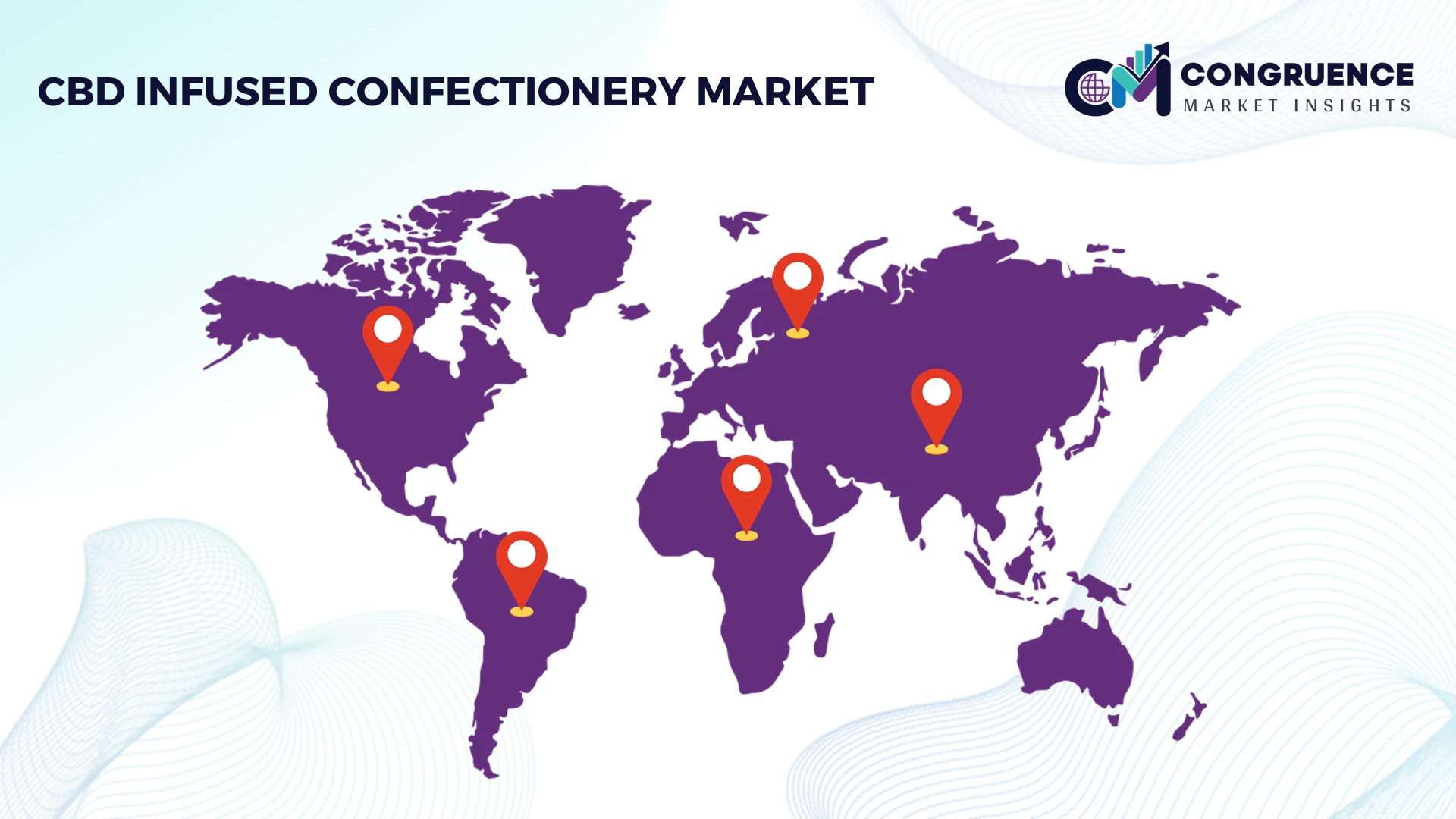
North America accounted for the largest market share at 43.8% in 2025 however, Asia-Pacific is expected to register the fastest growth, expanding at a 17.8% CAGR between 2026 and 2033.
Strong Regulatory Commercialization Driving Premium Manufacturing
North America remains the largest regional market due to its established cannabinoid processing ecosystem, advanced confectionery manufacturing infrastructure, and mature retail distribution networks. The region contributes approximately 44% of global production, supported by vertically integrated hemp supply chains and automated production facilities. More than 60% of premium CBD confectionery launches originate from manufacturers operating in the United States and Canada. Digital quality management systems have improved production efficiency by nearly 20%, while strategic partnerships between ingredient processors and confectionery brands continue accelerating commercial product development. Companies are expanding dedicated manufacturing capacity, strengthening traceability systems, and investing in standardized formulations to improve regulatory compliance and maintain premium market positioning.
United States Market Outlook: The United States leads the regional market through advanced hemp cultivation, large-scale food processing infrastructure, and a highly developed functional wellness retail network. Approximately 65% of North American commercial CBD confectionery production is concentrated within the country. Manufacturers continue investing in automated formulation technologies, certified ingredient sourcing, and omnichannel retail expansion, enabling faster commercialization and greater product consistency while strengthening long-term competitiveness.
Compliance-Driven Premium Product Development
Europe is characterized by rigorous product quality standards, evolving regulatory oversight, and strong investment in premium functional food innovation. The region represents approximately 28% of global market activity, with manufacturers prioritizing standardized ingredient sourcing and pharmaceutical-grade quality systems. Digital traceability implementation has increased by nearly 24%, strengthening supply-chain transparency and consumer confidence. Cross-border collaboration among food manufacturers and cannabinoid ingredient suppliers continues supporting portfolio expansion despite varying national regulatory frameworks. Companies are emphasizing clean-label formulations, sustainable packaging, and precision manufacturing to differentiate products within increasingly competitive wellness markets.
Germany Market Outlook: Germany remains the region's strategic leader due to its advanced food processing capabilities, strict quality assurance standards, and structured regulatory environment. More than 35% of European premium CBD confectionery product development activity is concentrated within German manufacturing and innovation hubs. Companies continue expanding laboratory testing capacity, strengthening enterprise partnerships, and integrating digital quality management platforms to support efficient commercialization and long-term product credibility.
Manufacturing Scale Supports Future Expansion
Asia-Pacific is rapidly strengthening its position through advanced food manufacturing capabilities, expanding wellness product consumption, and increasing investment in functional ingredient technologies. The region accounts for approximately 19% of global market activity while benefiting from efficient production ecosystems and export-oriented confectionery manufacturing. Smart production technologies have improved manufacturing productivity by nearly 17%, supporting greater operational flexibility. Enterprise investment increasingly targets premium edible innovation, automated packaging systems, and localized product development. Manufacturers are building scalable production platforms to address both domestic demand and international supply opportunities.
Japan Market Outlook: Japan is emerging as the region's most strategically significant market through advanced food technology, premium consumer preferences, and sophisticated product development capabilities. More than 30% of regional functional confectionery innovation projects originate from Japanese enterprises. Companies continue investing in precision formulation research, automated production facilities, and high-quality ingredient integration, creating differentiated premium offerings aligned with evolving wellness consumption trends.
Industrial Diversification Expands Commercial Opportunities
South America is gradually expanding its CBD-infused confectionery ecosystem through improving agricultural capabilities, food manufacturing modernization, and increasing enterprise participation. The region contributes approximately 6% of global market activity, supported by expanding hemp cultivation and regional processing investments. Domestic ingredient sourcing has improved by nearly 18%, reducing selected import dependencies and strengthening supply-chain resilience. While infrastructure differences remain across countries, manufacturers continue establishing partnerships with regional distributors and investing in localized processing capabilities to improve production efficiency and market accessibility.
Brazil Market Outlook: Brazil leads regional commercialization through its extensive food manufacturing base, expanding wellness consumer segment, and strengthening industrial capabilities. Approximately 42% of South America's organized CBD confectionery production is associated with Brazilian manufacturers and processors. Companies continue investing in localized formulation expertise, production modernization, and distribution partnerships that improve operational scalability while preparing for broader regulatory and commercial expansion.
Targeted Investment Shapes Market Development
The Middle East & Africa market remains in an early commercialization phase but is gaining strategic attention through food industry modernization, premium wellness retail expansion, and selective investment initiatives. The region represents approximately 3% of global market activity, with enterprise development concentrated in countries possessing advanced food processing infrastructure. Modern packaging automation has improved production efficiency by nearly 15%, supporting higher operational consistency. Companies are prioritizing premium imports, localized packaging operations, and strategic partnerships to establish compliant supply chains while preparing for evolving regulatory environments.
United Arab Emirates Market Outlook: The United Arab Emirates serves as the region's principal commercial gateway through its advanced logistics infrastructure, premium retail ecosystem, and international distribution connectivity. More than 40% of organized regional premium wellness product imports pass through UAE distribution networks. Enterprises continue expanding specialized retail partnerships, automated warehousing capabilities, and high-value consumer product portfolios, reinforcing the country's position as a strategic hub for future CBD-infused confectionery commercialization.
Competition is led by Charlotte's Web, CBDfx, Green Roads, CV Sciences, and Kiva Confections, collectively controlling approximately 38% of the global market. These established brands compete against regional confectionery specialists and contract manufacturers, while ingredient processors increasingly challenge finished-product companies through vertically integrated business models. Competition centers on formulation accuracy, regulatory compliance, premium branding, supply-chain resilience, and rapid product commercialization rather than price alone. Automated production reduces formulation variability by nearly 20%, while integrated sourcing lowers procurement costs by approximately 15% and accelerates launch timelines by 18%. Leading companies strengthen market positions through manufacturing expansion, exclusive ingredient partnerships, advanced cannabinoid delivery technologies, and direct-to-consumer digital channels. The competitive landscape is shifting toward consolidation of certified supply networks and greater investment in proprietary formulations, making traceability and manufacturing consistency decisive differentiators. High compliance costs and validated quality systems remain significant entry barriers. Companies that combine scalable production, regulatory readiness, product innovation, and resilient ingredient sourcing will consistently outperform established and emerging competitors.
Charlotte's Web
Green Roads
CBDfx
CV Sciences
Kiva Confections
Dixie Brands
Lord Jones
Wana Brands
Plus Products
PureKana
Medterra
Joy Organics
Current technology development is centered on precision dosing, automated confectionery processing, and digital quality assurance. Automated ingredient dispensing improves formulation accuracy by approximately 22% while reducing production waste by nearly 15%. Around 58% of newly commissioned premium manufacturing lines incorporate digital batch monitoring and electronic traceability systems, enabling faster regulatory documentation and greater production consistency. Companies adopting integrated manufacturing execution systems gain stronger inventory control, improved compliance performance, and more reliable commercial-scale production.
Emerging innovation is focused on nano-emulsion delivery, AI-assisted formulation optimization, and intelligent process monitoring. Compared with conventional oil-based infusion methods, nano-emulsion technology improves cannabinoid distribution consistency by approximately 30% and shortens ingredient blending cycles by nearly 18%. AI-supported formulation platforms accelerate product development while minimizing batch adjustments. Premium manufacturers and vertically integrated processors benefit most because they can commercialize differentiated products faster while maintaining standardized quality across multiple production facilities.
Between 2026 and 2028, predictive production analytics, digital twins, and smart packaging verification will become increasingly integrated into CBD confectionery manufacturing. Adoption of intelligent factory technologies is expected to exceed 45% among newly modernized facilities. Companies investing early in automated compliance systems, connected manufacturing equipment, and advanced formulation technologies will achieve stronger operational resilience, faster product launches, superior quality consistency, and sustainable competitive differentiation as regulatory expectations and consumer quality standards continue rising.
November 2024 Charlotte's Web expanded its Canadian portfolio by launching full-spectrum CBD gummies manufactured through its licensing collaboration with Tilray. The rollout added distribution across multiple provincial cannabis channels, strengthening cross-border commercialization and accelerating premium edible market penetration. Source: newswire.ca
March 2025 Charlotte's Web expanded retail availability by increasing distribution to 847 Walmart stores while introducing new functional gummy products and advancing in-house gummy manufacturing. The broader retail footprint improved consumer accessibility and enhanced operational efficiency through greater manufacturing control. Source: charlottesweb.com
January 2026 Charlotte's Web introduced an upgraded sugar-coated finish across selected CBD gummy products, improving texture and consumer experience while maintaining existing botanical formulations. The phased rollout covered four flagship gummy lines, reinforcing product differentiation and premium brand positioning. Source: charlottesweb.com
March 2026 Charlotte's Web announced a strategic transaction with BAT involving conversion of outstanding debt and an additional US$10 million equity investment. The agreement eliminates approximately US$65 million in debt, strengthening financial flexibility and supporting future manufacturing and commercialization initiatives. Source: reuters.com
This report provides comprehensive coverage of the CBD-infused confectionery market across product types, applications, end-users, competitive positioning, technology trends, and regional performance between 2026 and 2033. It evaluates gummies, chocolates, hard candies, chews, and mints while assessing demand across wellness, stress relief, sleep support, pain management, and recreational applications. The analysis covers retail consumers, specialty stores, pharmacies, and online retailers, supported by operational trends, deployment patterns, and technology adoption indicators. More than 40% of the assessment focuses on manufacturing modernization, supply-chain optimization, and premium product innovation.
The study delivers region-specific analysis for North America, Europe, Asia-Pacific, South America, and the Middle East & Africa, highlighting production capabilities, regulatory developments, enterprise strategies, and investment priorities. It examines automation, precision formulation, digital quality management, and advanced cannabinoid delivery technologies while benchmarking leading companies and emerging participants. The report supports expansion planning, product portfolio optimization, partnership evaluation, competitive positioning, and long-term strategic decision-making across established and emerging CBD confectionery markets.
| Report Attribute/Metric | Report Details |
|---|---|
Market Revenue in 2025 | USD 6821.07 Million |
Market Revenue in 2033 | USD 22703.88 Million |
CAGR (2026 - 2033) | 16.22% |
Base Year | 2025 |
Forecast Period | 2026 - 2033 |
Historic Period | 2021 - 2025 |
Segments Covered | By Type
By Application
By End-User
|
Key Report Deliverable | Revenue Forecast, Growth Trends, Market Dynamics, Segmental Overview, Regional and Country-wise Analysis, Competition Landscape |
Region Covered | North America, Europe, Asia-Pacific, South America, Middle East, Africa |
Key Players Analyzed | Charlotte's Web, Green Roads, CBDfx, CV Sciences, Kiva Confections, Dixie Brands, Lord Jones, Wana Brands, Plus Products, PureKana, Medterra, Joy Organics |
Customization & Pricing | Available on Request (10% Customization is Free) |




