
Reports
The Global Catalog Management Software Market was valued at USD 2,160.0 Million in 2025 and is anticipated to reach a value of USD 4,484.0 Million by 2033 expanding at a CAGR of 9.56% between 2026 and 2033. Growth is propelled by AI-driven product data automation and omnichannel syndication mandates across retail and B2B distribution networks.
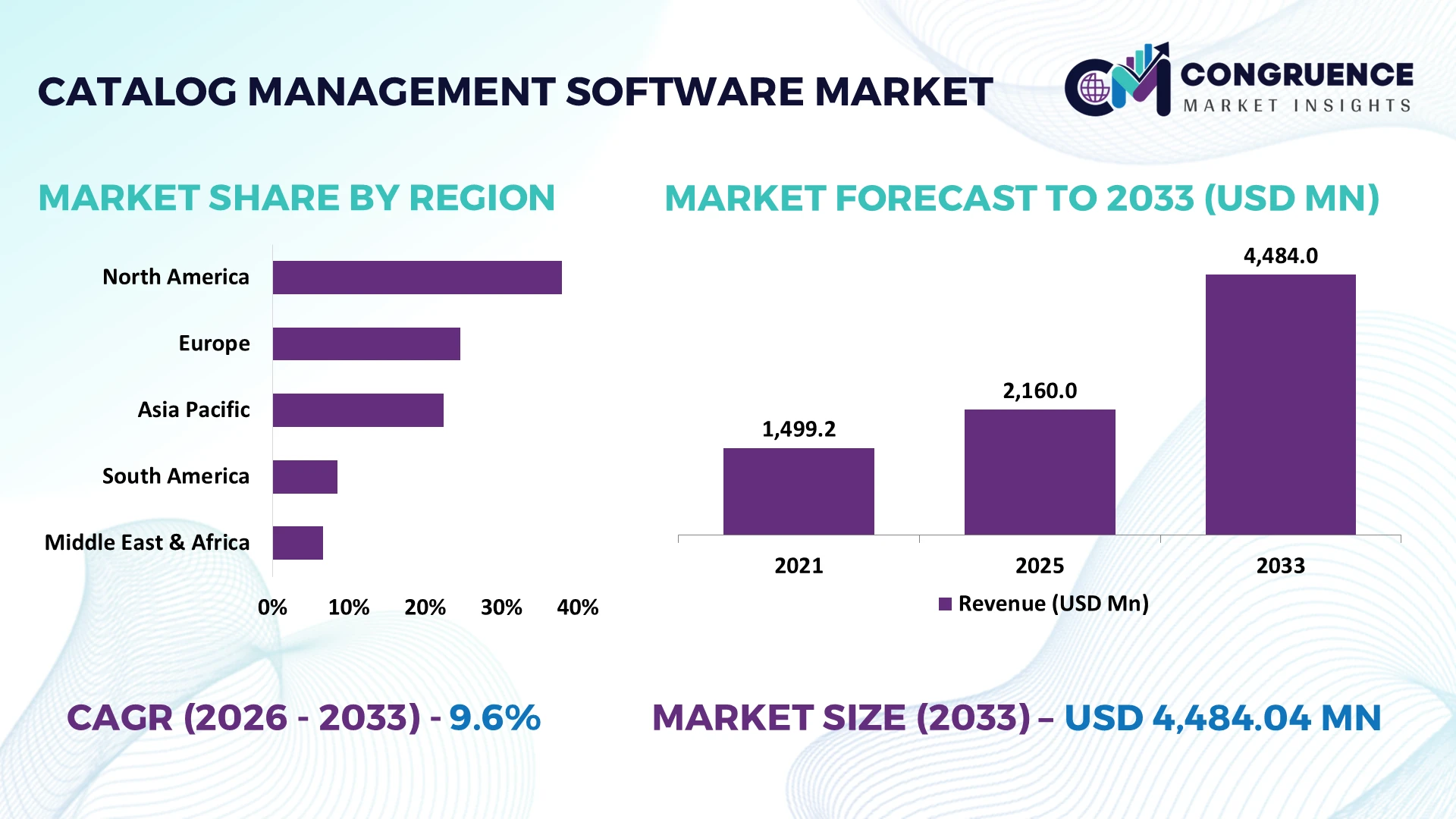
North America commands 34.2% of global revenue through 2034, anchored by concentrated retail chains and high digital-adoption rates. The United Kingdom alone holds approximately 22% of its regional catalog system market, driven by retail and telecom adoption. Germany's EU Data Act enforcement from September 2025 imposes cloud portability and interoperability obligations, reshaping vendor selection across European deployments.
Strategic implication, vendors prioritizing AI-native catalog enrichment and Data Act-ready portability architecture will capture disproportionate share as enterprises consolidate fragmented product information stacks.
Market Size & Growth: Valued at USD 2,160.0 Million in 2025, forecast to reach USD 4,484.0 Million by 2033, expanding at 9.56% CAGR through 2033, driven by AI-driven catalog enrichment and real-time omnichannel syndication requirements.
Top Growth Drivers: AI-powered product data automation (68% enterprise priority), omnichannel retail expansion (54% adoption uplift), and supply chain localization (47% of firms restructuring product data workflows).
Short-Term Forecast: By 2028, automated catalog syndication reduces listing errors by 35% and accelerates time-to-market by 28% across retail and B2B distribution operations.
Emerging Technologies: Generative AI for product descriptions, low-code workflow builders for catalog mapping, and GS1-compliant data models enabling supplier integration at scale.
Regional Leaders: North America at 34.2% revenue share (USD 738 Million in 2025); Europe driven by Data Act compliance adoption; Asia-Pacific led by e-commerce expansion in China and India.
Consumer/End-User Trends: 63.5% of catalog deployments now cloud-based, with enterprises prioritizing subscription economics and 24-hour global syndication availability.
Pilot/Case Example: 2025 European retail pilot integrating AI catalog enrichment achieved 41% reduction in manual data correction time and 33% faster marketplace onboarding.
Competitive Landscape: North America leaders hold approximately 28% combined share; key players include Salsify, Stibo Systems, Syndigo, Akeneo, and Informatica.
Regulatory & ESG Impact: EU Data Act mandates cloud portability by 2027, with non-compliance penalties reaching 4% of global turnover; 61% of vendors now offer regional hosting options.
Investment & Funding: CommerceClarity raised €2.7M for AI-driven catalog automation in November 2025; Emfas secured €600K for fashion catalog AI; sector funding concentrates on AI-native enrichment.
Innovation & Future Outlook: Next-generation catalogs embed generative AI for multilingual product content and predictive attribute mapping, shifting vendor strategies from data storage to intelligence orchestration.
The Catalog Management Software Market concentrates demand in retail, e-commerce, and B2B distribution, where SKU proliferation and marketplace fragmentation drive adoption. AI-native enrichment tools now automate 62% of routine attribute mapping, reducing manual governance overhead. Germany's EU Data Act enforcement introduces portability obligations that reshape vendor evaluation criteria across European deployments. Vendors embedding compliance-ready data export architecture alongside AI-driven catalog intelligence position themselves for enterprise consolidation cycles.
Catalog management has shifted from back-office utility to competitive infrastructure as enterprises confront SKU proliferation across fragmented marketplaces and regulatory pressure on data portability. The EU Data Act's September 2025 enforcement introduces mandatory cloud switching and interoperability requirements, forcing vendors to redesign export architecture or risk exclusion from European procurement cycles. Digital-first retail expansion across Southeast Asia and the Middle East amplifies demand for localized, machine-readable product data at scale.
Cloud-native catalog platforms deliver 35% lower total cost of ownership over legacy on-premise systems, with deployment cycles compressed from 9 months to under 12 weeks. North American enterprises lead AI-native catalog adoption at 44% penetration, while European deployments prioritize Data Act-compliant portability features. A 2025 European retail deployment integrating automated catalog syndication achieved 41% reduction in manual correction time and 33% faster marketplace onboarding across six channels. Vendors are responding by embedding compliance export tools and regional hosting options into standard product tiers.
Strategic positioning now hinges on catalog intelligence rather than storage capacity. Enterprises evaluating platforms prioritize vendors demonstrating measurable syndication accuracy gains and regulatory readiness across jurisdictions. The next 24 months will separate vendors offering AI-driven enrichment with portability compliance from those delivering static data management, with procurement cycles favoring platforms that reduce integration friction across supplier and marketplace ecosystems.
Enterprise catalog complexity has outpaced manual governance capacity, with 68% of retail organizations reporting SKU proliferation across five or more marketplace channels. AI-native enrichment tools now automate 62% of routine attribute mapping and product description generation, reducing catalog operations headcount requirements by 28% in early adopters. The EU Data Act's portability mandates compel vendors to embed structured export architecture, creating differentiation for platforms designed for interoperability rather than lock-in. Companies are responding by prioritizing AI catalog modules in procurement evaluations and demanding contractual portability guarantees. Vendors that combine automation depth with compliance-ready architecture secure disproportionate share as enterprises consolidate fragmented product information stacks across North American and European operations.
Catalog deployment failures trace to integration complexity, with 54% of enterprises reporting ERP and PIM interoperability gaps extending implementation timelines by 40%. Legacy on-premise systems demand custom middleware for marketplace syndication, inflating total cost of ownership by 35% versus cloud-native alternatives. European data residency requirements compound constraints, with 47% of vendors requiring regional hosting infrastructure investments that smaller providers cannot absorb. Retailers in Germany and France face particular friction integrating supplier catalogs across GS1-compliant and proprietary formats. Companies are mitigating risk through phased cloud migration, standardized data model adoption, and vendor contracts specifying integration milestones. The operational insight: integration readiness, not feature breadth, determines catalog platform viability in multi-system enterprise environments.
B2B distribution represents the largest underserved catalog segment, with only 31% of wholesale distributors deploying automated syndication versus 67% of retail counterparts. AI-driven catalog platforms reduce distributor onboarding time by 44% and enable real-time pricing synchronization across dealer networks. India and Southeast Asia present high-growth opportunities, with e-commerce catalog volumes expanding at 29% annually and local vendors lacking AI-native enrichment capabilities. Generative AI modules for multilingual product descriptions address a critical gap in cross-border B2B commerce. Companies are positioning through partnerships with regional systems integrators and R&D investment in low-resource language catalog automation. The non-obvious insight: B2B catalog modernization delivers higher margin retention than retail, as distributor switching costs rise with catalog integration depth.
Catalog platforms aggregate supplier, pricing, and product data across organizational boundaries, creating attack surfaces that 58% of enterprises identify as unmanaged. The EU Data Act's government access safeguards require vendors to implement judicial authorization workflows for non-EU data requests, adding compliance overhead that strains smaller platform providers. Workforce gaps compound execution risk, with 42% of catalog implementations delayed by insufficient data governance expertise. Enterprises in financial services and healthcare face heightened regulatory scrutiny, where catalog errors trigger compliance violations with penalties reaching 4% of global turnover. Companies must invest in zero-trust data access architecture, automated governance controls, and specialized catalog operations teams. The strategic imperative: governance scalability determines whether catalog platforms support enterprise expansion or become compliance liabilities.
AI Enrichment Moves to Production Scale Catalog teams are shifting from AI pilots to production-grade enrichment workflows, with 62% of routine attribute mapping now automated in mature deployments. Salsify customers automated over 768 million workflow tasks in 2025, a 50% year-over-year increase, while product publication volumes exceeded 5 billion records. The operational impact is measured in time reclaimed: Kerry reduced product validation cycles from 20–30 minutes per SKU to five minutes, redirecting merchandiser capacity toward assortment strategy rather than data cleanup. Enterprises are responding by embedding AI validation directly into PIM pipelines rather than treating enrichment as a post-hoc correction layer.
Regulatory Data Quality Mandates Reshape Supplier Workflows Germany's GS1 DQX standards, mandatory since May 2023, now govern product master data exchange across 1,350+ companies representing nearly four-fifths of FMCG revenue in the market. Over 250,000 GTINs have been quality-verified through the Global Data Synchronisation Network, with bread and bakery categories achieving 94% revenue-level penetration. The non-obvious insight: compliance is becoming a competitive filter rather than a cost center, as retailers prioritize suppliers with verified data quality for shelf placement and promotional inclusion. Manufacturers are restructuring master data teams to meet DQX thresholds before category reviews.
Cloud Migration Accelerates on Tariff and Infrastructure Pressure Cloud-based catalog deployments now represent the majority of new implementations, driven by both scalability requirements and rising on-premise hardware costs from US-China tariff structures affecting server and middleware procurement. North American retailers facing import cost inflation are prioritizing subscription-based catalog platforms that shift capital expenditure to operating budgets. Vendors are responding by expanding regional data center capacity to address latency and data residency concerns in European and Asia-Pacific deployments.
B2B Distributor Onboarding Becomes the Next Automation Frontier Only 31% of wholesale distributors have deployed automated catalog syndication, versus 67% of retail counterparts, creating a structural efficiency gap across B2B supply chains. AI-driven platforms are reducing distributor onboarding cycles by 44% and enabling real-time pricing synchronization across dealer networks. Companies are targeting this gap through industry-specific catalog templates and ERP-native connectors that lower integration friction for mid-market distributors lacking dedicated PIM teams.
Cloud-based catalog management represents approximately 64% of global deployments, driven by scalability advantages, lower upfront infrastructure costs, and continuous feature delivery cycles that on-premise systems cannot match. The segment's dominance is reinforced by enterprise preference for subscription economics and vendor-managed security updates, particularly among retail and e-commerce organizations managing thousands of SKUs across marketplace channels.
On-premise deployments persist in regulated sectors—notably healthcare and government—where data residency requirements and legacy ERP integration depth justify the higher total cost of ownership. The fastest-growing type is cloud-based catalog platforms configured for B2B distribution, where real-time pricing and inventory synchronization demand continuous connectivity that on-premise architectures struggle to deliver. Companies are responding by retiring customized on-premise instances in favor of multi-tenant cloud platforms with configurable governance controls, redirecting internal IT resources from maintenance to integration and analytics.
Retail and e-commerce applications account for approximately 58% of catalog management demand, concentrated in organizations managing multi-marketplace product listings where inconsistent attributes directly erode conversion and increase return rates. The operational intensity is highest among omnichannel retailers operating five or more sales channels, where manual catalog maintenance becomes economically unviable beyond a few thousand SKUs.
The fastest-growing application segment is B2B distribution, where catalog platforms are being deployed to synchronize dealer networks, contract pricing, and technical specifications across fragmented partner ecosystems. Media and entertainment applications remain niche but show steady adoption for digital asset cataloging and rights metadata management. Manufacturing and telecom applications prioritize integration with ERP and CPQ systems, where catalog accuracy directly affects quote-to-cash cycle times.
Large enterprises represent approximately 67% of catalog management spending, reflecting their operational complexity: multi-brand portfolios, global supplier networks, and compliance obligations across jurisdictions that demand enterprise-grade governance, workflow, and integration capabilities. These organizations prioritize platform depth over price, evaluating vendors on ERP interoperability, data model flexibility, and audit trail completeness.
The fastest-growing end-user segment is small and medium enterprises, where affordable cloud-based catalog solutions have removed the infrastructure barrier that previously restricted adoption to organizations with dedicated IT resources. SME adoption is concentrated in retail, e-commerce, and professional services, where marketplace selling requires structured product data but internal catalog expertise is limited. Companies are targeting SMEs through pre-configured templates, guided onboarding, and usage-based pricing that aligns cost with catalog volume rather than user seats.
North America accounted for the largest market share at 37.9% in 2025 however, Asia-Pacific is expected to register the fastest growth, expanding at a CAGR of 11.09% between 2026 and 2033.
North America retains 37.9% of global catalog management deployments, concentrated among US retail, technology, and financial services enterprises embedding AI-driven data enrichment and real-time pricing into catalog workflows. Oracle's Fusion Cloud AI Vector Search has gained rapid traction among US enterprises requiring sub-second semantic query performance across SKU libraries exceeding one million records. Canada's ServiceNow Now Assist pilot achieved 53% self-service resolution rates, confirming regional appetite for AI-automated catalog operations. Deployment density is highest in omnichannel retail, where catalog accuracy directly governs marketplace conversion and return rates.
United States Market Outlook: US enterprises lead global adoption of AI-native catalog platforms, with 44% of large retailers integrating semantic search and automated attribute mapping into production workflows. The country's concentrated retail chains and mature cloud infrastructure support rapid deployment cycles, with catalog governance increasingly treated as a board-level data integrity function rather than operational overhead.
Europe commands 24.6% of global catalog management deployment value, with Germany's GS1 DQX standards and the EU Data Act driving structural adoption across FMCG, manufacturing, and retail supply chains. Over 1,350 companies now submit product master data through GS1 DQX verification, covering nearly four-fifths of German FMCG revenue. The region's catalog priorities center on data portability, supplier interoperability, and compliance-ready export architecture, differentiating European procurement criteria from North American feature-driven evaluations. Cloud adoption is accelerating as vendors embed regional hosting and judicial-access safeguards into platform contracts.
Germany Market Outlook: Germany's industrial base and GS1 DQX enforcement create the most structured catalog data quality regime globally, with 250,000+ GTINs verified through GDSN synchronization. Manufacturers prioritize configurable catalogs and supplier data standardization, positioning Germany as the regulatory benchmark for European catalog governance.
Asia-Pacific holds 22.4% of global catalog management deployments, anchored by China's manufacturing-linked product data infrastructure and India's rapidly expanding e-commerce ecosystem. India recorded nearly 58 billion e-commerce website visits over the past year, the highest globally, with 28% year-on-year traffic growth outpacing every major market. This scale generates catalog volume requirements that legacy manual systems cannot absorb, accelerating cloud-native adoption among Indian retailers and B2B distributors. Japan's precision manufacturing and South Korea's digital-first consumer sectors prioritize attribute accuracy and rapid channel syndication.
India Market Outlook: India's e-retail GMV reached USD 65–66 billion in 2025, growing 19–21%, with 290–300 million online shoppers generating catalog complexity across marketplace, quick commerce, and D2C channels. Multilingual product content and seller onboarding at scale represent the country's most pressing catalog infrastructure requirement.
South America accounts for 8.5% of global catalog management deployments, with Brazil's marketplace ecosystem and Mexico's nearshoring-driven cross-border trade creating localized demand for structured product data governance. VTEX customers, including Magazine Luiza, integrated 4.5 million SKUs and recorded 30% month-over-month sales growth following Mexico expansion, demonstrating catalog scale as a revenue lever. Infrastructure limitations and fragmented supplier data standards constrain deployment velocity outside Brazil's mature digital commerce hubs, though cloud-based SaaS models are lowering adoption barriers for mid-market retailers.
Brazil Market Outlook: Brazil's large digital consumer base and expanding marketplace ecosystem are driving investment in localized content and catalog governance, with structured product data becoming essential for cross-border trade accuracy and supplier synchronization across Mercosur markets.
Middle East & Africa represents 6.6% of global catalog management deployments, with Gulf Cooperation Council countries—particularly the UAE and Saudi Arabia—leading adoption through government-backed digital commerce infrastructure and sovereign cloud investments. Retail and government procurement sectors prioritize catalog platforms that support Arabic-language product content, regulatory compliance, and integration with national e-invoicing and customs systems. Deployment concentration remains urban-centric, with scalability beyond Tier-1 markets constrained by supplier data maturity and integration complexity across fragmented distributor networks.
Saudi Arabia Market Outlook: Saudi Arabia's Vision 2030 digital infrastructure investments and expanding e-commerce regulatory framework position the Kingdom as the region's most active catalog modernization market, with government procurement and retail sector deployments driving structured product data adoption.
The catalog management software market is structured around two competing camps: enterprise-grade PIM incumbents (Stibo Systems, Informatica, Akeneo, Syndigo) contesting governance depth and AI enrichment, versus ERP-native catalog modules and regional specialists competing on integration cost and deployment speed. The top five players hold approximately 28% combined share, leaving a fragmented mid-market open to vertical challengers. Competition pivots on AI automation depth—Akeneo's Data Architect Agent and Syndigo's GoPilots reduce manual mapping effort by 60% in reference deployments—and network scale, where Syndigo's 15,000-brand recipient network locks in syndication advantages. Vendors are expanding through acquisitions (Syndigo–1WorldSync), SAP integration depth, and MCP protocol adoption for AI-agent interoperability. The decisive competitive shift is from data storage to intelligence orchestration: entry barriers now hinge on compliance-ready portability architecture and supplier onboarding automation, not feature breadth. Winning requires demonstrable syndication accuracy gains and regulatory readiness across jurisdictions.
Akeneo
Stibo Systems
Syndigo
Informatica
Salsify
Pimcore
Cenit AG
Contentserv
Riversand (a Syndigo company)
Vinculum
Plytix
eSellerHub
AI agents now automate 62% of routine attribute mapping and product description generation, compressing catalog enrichment cycles from weeks to hours. Akeneo's Data Architect Agent and Syndigo's GoPilots represent production-grade deployment, not pilots—enterprises report 60% data quality improvement and time-to-market reductions measured in days rather than quarters. The competitive advantage accrues to platforms embedding AI directly into PIM workflows rather than bolting on external tools.
Model Context Protocol (MCP) adoption marks the next integration frontier. Akeneo and Pimcore have both shipped MCP server support, enabling external AI agents and LLMs to read catalog data directly—a 40% reduction in integration engineering effort compared to custom API development. This shifts vendor value from data storage to intelligence orchestration.
Between 2026 and 2028, platforms without native AI-agent interoperability will face procurement exclusion. Enterprises should prioritize vendors demonstrating measurable enrichment automation and MCP-ready architecture now, as switching costs rise with catalog integration depth.
November 2025 — Akeneo launched its Autumn release introducing AI Auto-Mapping of product catalogs to retail and marketplace channels, reducing manual mapping effort and accelerating time-to-market. The release also added MCP protocol support for AI-model interoperability and unified PIM-DAM asset tagging, targeting 60% faster product setup across enterprise deployments. Source: akeneo.com
March 2025 — Syndigo unveiled its AI-native Product Experience Cloud for Brands at Shoptalk, featuring embedded GoPilots for copy generation, attribute mapping, and image analysis. Stanley Black & Decker reported 60% data quality improvement and reduced product information retrieval from days to minutes following adoption. Source: syndigo.com
September 2025 — Syndigo completed its acquisition of 1WorldSync, creating a combined network of 15,000+ consumer brands and 3,500+ retailer connections. The integration unifies two GDSN data pools and adds PowerReviews into the Syndigo ecosystem, expanding syndication reach and vendor onboarding capacity for multinational enterprises. Source: syndigo.com
October 2025 — Informatica released its Fall 2025 IDMC update introducing Agentic PIM for Product 360 in private preview, enabling conversational product data stewardship. The release also expanded MDM enrichment orchestration and CLAIRE Copilot capabilities, targeting reduced manual governance overhead for enterprise catalog teams. Source: tahawultech.com
This report delivers a structured assessment of the global catalog management software market across deployment types (cloud and on-premise), applications (retail and e-commerce, B2B distribution, manufacturing, media), and end-user segments (large enterprises and SMEs). Regional coverage spans North America, Europe, Asia-Pacific, South America, and Middle East & Africa, with country-level analysis of adoption drivers, regulatory influence, and infrastructure readiness. Cloud deployments represent approximately 64% of installations, while B2B distribution remains the fastest-growing application segment at 31% penetration versus 67% in retail.
The report integrates technology assessment covering AI-native enrichment, MCP-enabled agent interoperability, and GS1-compliant data governance—factors reshaping vendor selection criteria through 2033. Strategic insights address competitive positioning, investment prioritization, and expansion pathways for enterprises evaluating catalog platform consolidation. Coverage of 12 profiled vendors and regional regulatory developments, including EU Data Act portability mandates and GS1 DQX enforcement, supports decision-makers in aligning platform investments with compliance trajectories and operational scalability requirements between 2026 and 2033.
| Report Attribute / Metric | Details |
|---|---|
| Market Revenue (2025) | USD 2,160.0 Million |
| Market Revenue (2033) | USD 4,484.0 Million |
| CAGR (2026–2033) | 9.56% |
| Base Year | 2025 |
| Forecast Period | 2026–2033 |
| Historic Period | 2021–2025 |
| Segments Covered |
By Type
By Application
By End-User
|
| Key Report Deliverables | Revenue Forecast; Market Trends; Growth Drivers & Restraints; Technology Insights; Segmentation Analysis; Regional Insights; Competitive Landscape; Regulatory & ESG Overview; Recent Developments |
| Regions Covered | North America; Europe; Asia-Pacific; South America; Middle East & Africa |
| Key Players Analyzed | Akeneo; Stibo Systems; Syndigo; Informatica; Salsify; Pimcore; Cenit AG; Contentserv; Riversand (a Syndigo company); Vinculum; Plytix; eSellerHub |
| Customization & Pricing | Available on Request (10% Customization Free) |




