
Reports
The Global Cashew Nutshell Liquid Market was valued at USD 3489.48 Million in 2025 and is anticipated to reach a value of USD 6316.64 Million by 2033 expanding at a CAGR of 7.7% between 2026 and 2033. Growth is driven by rising conversion of cashew-shell waste into cardanol-based resins, friction materials, coatings, adhesives, and bio-based chemical intermediates, accelerating industrial utilization of CNSL.
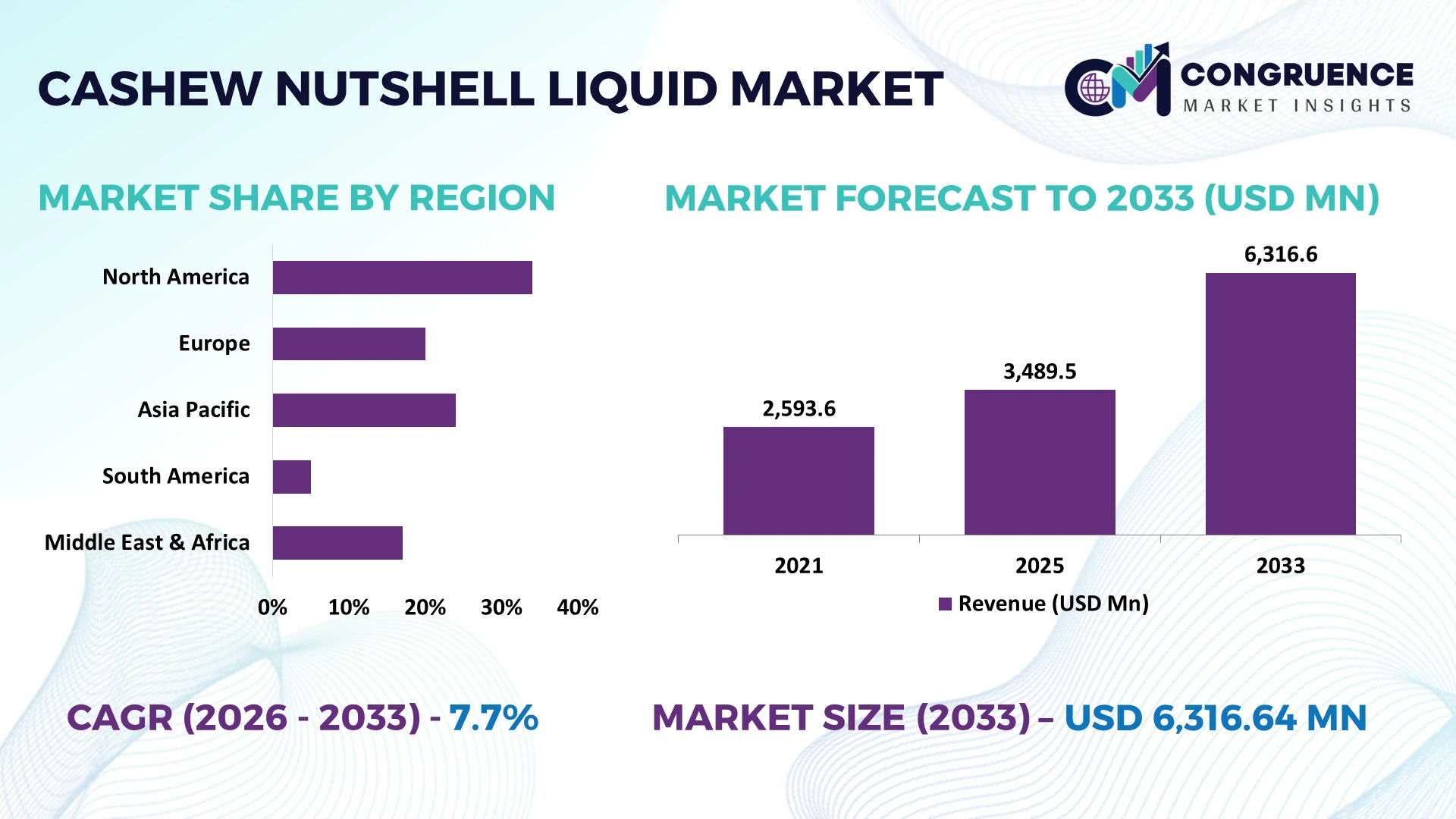
India remains the dominant CNSL processing hub, accounting for an estimated 30%–35% of global processing capacity, supported by cashew-processing clusters and downstream resin, coating, automotive, and friction-material industries. India processes a larger share of CNSL than most individual producing countries, while Vietnam is expanding industrial extraction and value-added processing. Recent supply-chain shifts toward local shell valorization are strengthening adoption.
Strategically, suppliers prioritizing high-purity cardanol extraction, automated recovery, and integrated downstream production will capture the strongest margin and application opportunities.
Market Size & Growth: USD 3,489.48 million in 2025 to USD 6,316.64 million by 2033, supported by cardanol-based resin and coating substitution.
Top Growth Drivers: Bio-based materials 32%, industrial coatings 27%, friction materials 21%.
Short-Term Forecast: By 2028, automated extraction is projected to reduce processing costs 8% and improve recovery efficiency 10%.
Emerging Technologies: AI process monitoring, automated shell extraction, and advanced cardanol purification are reaching 20%–30% deployment in modern facilities.
Regional Leaders: Asia-Pacific leads; North America is projected near USD 1.1 billion and Europe near USD 0.9 billion as bio-based material adoption expands.
Consumer/End-User Trends: Industrial users increasingly favor renewable phenolic inputs, with adoption estimated at 18%–22% across targeted specialty-material applications.
Pilot/Case Example: A 2025 CNSL extraction study reduced effective insecticidal concentration from 12.56 g/kg to 0.62 g/kg after 120 hours, demonstrating 95% lower required concentration.
Competitive Landscape: India leads processing capacity at roughly 30%–35%, alongside major producers and processors across India, Vietnam, Côte d’Ivoire, Brazil, and West Africa.
Regulatory & ESG Impact: Shell valorization can divert approximately 100% of processed shell material from low-value disposal while supporting lower fossil-feedstock dependence.
Investment & Funding: An estimated USD 300+ million is moving toward cashew processing, extraction, downstream chemicals, and capacity expansion across major producing regions.
Innovation & Future Outlook: Next-generation CNSL purification, bio-based polymers, specialty cardanol derivatives, and integrated zero-waste plants will shift competition from raw-liquid supply toward higher-value chemical applications.
The Cashew Nutshell Liquid Market is increasingly centered on high-purity cardanol, anacardic-acid derivatives, bio-based coatings, friction materials, adhesives, and specialty polymers. Advanced extraction and purification can improve recovery efficiency by around 10%, while new analytical methods are enabling more consistent constituent profiling. Supply-chain localization and tighter industrial sustainability targets are pushing processors toward integrated shell-to-chemical models, strengthening the strategic case for higher-value CNSL applications.
The Cashew Nutshell Liquid Market is becoming strategically important as processors convert a low-value shell residue into cardanol, anacardic acid, resins, coatings, adhesives, and friction-material inputs. This shift strengthens feedstock security while improving waste economics. India and Vietnam are restructuring processing networks around higher-value extraction, with integrated plants increasingly linking shell recovery to downstream chemical manufacturing and reducing dependence on conventional phenolic inputs.
Technology is accelerating this transformation. Modern solvent-assisted and controlled thermal extraction systems can deliver roughly 8%–12% higher recovery efficiency than basic roasting and mechanical methods, while automated temperature monitoring reduces process variability by about 10%. India maintains greater processing scale, whereas Vietnam is advancing export-oriented processing and value-added manufacturing. Over the next 2–3 years, automated extraction, purification, and quality-control deployment is expected to expand by approximately 15%–20% across larger facilities.
Operationally, processors are investing in integrated shell collection, purification units, and partnerships with resin, coating, and automotive-material manufacturers. Companies that secure consistent shell feedstock and upgrade from bulk CNSL toward standardized cardanol derivatives will gain stronger margins, supply resilience, and customer retention. Competitive positioning will increasingly depend on conversion efficiency and downstream integration rather than extraction volume alone.
The strongest growth driver is the industrial conversion of cashew shells into higher-value chemical intermediates. Integrated extraction can improve CNSL recovery efficiency by 8%–12%, while cardanol purification can reduce downstream formulation variability by roughly 10%. India’s established cashew-processing clusters provide concentrated feedstock, supporting economies of scale for resin, coating, adhesive, and friction-material producers. Supply-chain restructuring is also pushing processors toward direct shell collection and captive extraction. Companies are responding through plant modernization, long-term processor contracts, and partnerships with downstream chemical manufacturers. The non-obvious advantage is feedstock monetization: facilities that previously treated shells as residual waste can now create an additional chemical-input stream, improving plant utilization and strengthening cost control.
CNSL production remains exposed to seasonal shell availability, inconsistent feedstock quality, and variations in extraction yield. Smaller processors can experience 10%–15% fluctuations in recovery efficiency, while moisture and shell composition differences can increase purification requirements by approximately 8%–12%. India’s fragmented processing base creates additional collection and standardization challenges, particularly outside major cashew clusters. These conditions directly affect batch consistency, operating costs, and supply commitments to specialty-material customers. Companies are reducing exposure through centralized shell aggregation, supplier qualification, inventory buffers, and multi-year procurement contracts. A critical operational insight is that securing standardized feedstock is becoming as important as installing advanced extraction equipment because inconsistent input quality can erase much of the efficiency advantage.
The strongest emerging opportunity lies in moving beyond bulk CNSL toward high-purity cardanol and specialty derivatives for coatings, adhesives, friction materials, and bio-based polymers. Advanced purification can improve usable product consistency by roughly 10%, while automated process controls can raise extraction productivity by 8%–12%. Vietnam is positioned to expand export-oriented value-added processing, while Indian producers can leverage established shell-collection networks for integrated chemical production. Growing substitution of petroleum-derived phenolics creates an additional opening for bio-based formulations. Companies are increasing R&D spending, forming resin-manufacturer partnerships, and developing application-specific grades. The strategic opportunity is to capture value downstream: purified derivatives command greater differentiation than standardized liquid CNSL and create stronger customer lock-in.
Scaling CNSL production from decentralized extraction units to industrial chemical platforms remains an execution challenge. Differences in shell composition can produce 5%–10% variation in product characteristics, while insufficient automation can increase manual quality-control requirements by approximately 15%. Indian processors expanding into specialty chemicals must also integrate extraction, purification, storage, and downstream formulation without disrupting established cashew operations. These integration pressures affect consistency, certification readiness, production planning, and customer qualification cycles. Companies must invest in sensor-based monitoring, standardized operating procedures, laboratory analytics, and technical partnerships. The long-term competitive divide will emerge between processors capable of maintaining specification-level consistency at scale and those remaining dependent on variable commodity-grade CNSL production.
Extraction Process Modernization: Processors are shifting from basic mechanical recovery toward controlled thermal, solvent, and supercritical-CO₂ extraction. Reported CNSL yields can reach up to 30%, while advanced purification improves compositional control. Indian and Vietnamese processors are upgrading equipment to reduce variability and support higher-value cardanol production.
Purification Workflow Intensifies: Producers are increasingly separating cardanol fractions rather than selling undifferentiated CNSL. Research demonstrates recovery and reuse of purification solvents up to 82%, reducing process-material consumption. Companies are integrating chromatography, vacuum processing, and analytical characterization to improve consistency for specialty chemical customers.
Supply Chains Move Downstream: India exported 971.69 metric tons of CNSL and 7,525.92 metric tons of cardanol in FY2025, indicating a stronger emphasis on refined derivatives. Processors are developing direct relationships with resin, coating, and specialty-chemical manufacturers, reducing dependence on commodity-grade liquid sales.
Bio-Based Substitution Accelerates: CNSL-derived materials are gaining attention as renewable alternatives to petroleum-based phenolic inputs, particularly in coatings, polymers, adhesives, and plasticizers. Recent research has identified CNSL-derived plasticizers as potential sustainable alternatives to phthalates, while companies are increasing formulation R&D and downstream partnerships to commercialize bio-based grades.
Refined Grade is estimated to lead the type segment at approximately 35% share because its controlled composition, improved purity, and compatibility with downstream polymer and coating formulations support larger industrial contracts. Technical Grade follows at about 30%, retaining strong demand where cost efficiency and basic processing performance remain priorities. Cardanol-Rich Grade accounts for nearly 21% and is gaining adoption as manufacturers seek more consistent reactive phenolic content for specialized formulations.
Cardanol-Derived Grade represents the fastest-expanding type, with adoption estimated to rise 13%–16% as chemical manufacturers move from bulk CNSL toward engineered intermediates. Its higher formulation flexibility strengthens margins and creates greater differentiation than commodity-grade material. Companies are therefore directing investment toward distillation, fractionation, hydrogenation, and application-specific product development. The strategic shift is clear: mature grades protect volume, while purified and derived grades increasingly determine downstream value capture.
Adhesives & Resins lead the application segment with an estimated 34% share because CNSL-derived phenolic structures provide adhesion, chemical resistance, and formulation flexibility. Coatings account for approximately 25%, supported by corrosion-resistant and durable formulations, while Friction Materials represent nearly 20% through automotive brake and clutch applications. These established uses provide stable industrial consumption and favor suppliers capable of maintaining specification consistency.
Specialty Chemicals is the fastest-growing application, with adoption estimated at 14%–17% as producers develop surfactants, reactive diluents, plasticizers, polyurethane intermediates, and other tailored derivatives. Laminates retain a specialized position at around 9%, where flexibility and resistance characteristics remain relevant. Companies are shifting investment from bulk extraction toward purification and application-specific chemistry, with downstream partnerships becoming increasingly important. The non-obvious opportunity is that customized molecular fractions can address performance requirements that standard CNSL cannot consistently meet.
Automotive is estimated to lead end-user demand at approximately 31% share, supported by friction materials, coatings, adhesives, and polymer components requiring heat and chemical resistance. Chemical Manufacturers follow at around 28%, benefiting from CNSL’s role as a feedstock for cardanol and specialty intermediates. Industrial Manufacturers account for roughly 19%, while Construction and Electrical & Electronics represent smaller but strategically relevant consumption bases.
Chemical Manufacturers are the fastest-growing end-user group, with adoption estimated at 14%–17% as producers expand bio-based polymers, specialty chemicals, and engineered cardanol derivatives. Automotive buyers emphasize consistent quality and supply reliability, whereas chemical manufacturers increasingly demand customized purity and molecular profiles. Companies are responding through technical partnerships, dedicated purification capacity, application-specific contracts, and integrated supply arrangements. India retains a processing advantage through established cashew infrastructure, while Vietnam is strengthening export-oriented downstream capabilities. Competitive differentiation is therefore shifting from raw CNSL availability toward formulation expertise and specification control.
Asia-Pacific accounted for the largest market share at 48% in 2025 however, Middle East & Africa is expected to register the fastest growth, expanding at a CAGR of 9.1% between 2026 and 2033.
Bio-Based Chemical Integration Is Reshaping Demand
North America remains an application-led CNSL market, with demand concentrated in specialty chemicals, coatings, adhesives, friction materials, and renewable-material formulations rather than primary cashew processing. The region contributes an estimated 13% of global market activity, with purchasing concentrated among chemical formulators and industrial-material suppliers. U.S. manufacturers are increasingly evaluating cardanol as a renewable phenolic feedstock, while distributors prioritize traceability and consistent specifications. Adoption of bio-based formulation inputs is estimated at 15%–20% across targeted specialty applications. Companies are responding through supplier qualification, technical partnerships, and customized cardanol grades. The key operational shift is from commodity CNSL procurement toward specification-driven derivative sourcing, reducing formulation variability and strengthening supply-chain resilience.
United States Market Outlook: The United States leads regional consumption because of its advanced coatings, adhesives, composites, automotive-material, and specialty-chemical industries. Demand is increasingly concentrated in high-performance formulations where cardanol-based chemistry can provide renewable feedstock characteristics without requiring major equipment redesign. U.S. buyers increasingly prioritize documented specifications and reliable multi-country supply.
Sustainability Compliance Is Driving Higher-Value Chemistry
Europe represents an estimated 16% of global market activity, with demand centered on specialty chemicals, coatings, adhesives, and bio-based materials. Regulatory pressure on fossil-derived and hazardous chemical inputs is strengthening interest in renewable phenolic alternatives, while manufacturers increasingly require traceable agricultural feedstocks. Germany, Italy, France, and the Netherlands form important downstream demand centers. Bio-based material adoption across targeted formulation categories is estimated at 15%–20%, encouraging suppliers to provide refined cardanol rather than only crude CNSL. Companies are investing in formulation testing, certification readiness, and long-term supply partnerships. The competitive shift is toward lifecycle performance and traceability: European buyers increasingly value documented origin and consistent chemistry alongside price, giving technically capable exporters an advantage over low-cost bulk suppliers.
Germany Market Outlook: Germany provides a strong downstream platform through its automotive, coatings, adhesives, polymers, and specialty-chemical industries. Industrial buyers emphasize consistent specifications, technical documentation, and sustainable feedstock credentials. The country’s sophisticated chemical manufacturing base supports higher-value cardanol derivatives, making Germany strategically important for suppliers seeking qualification in demanding European formulations.
Processing Scale Is Moving Toward Integrated Value Capture
Asia-Pacific leads the market with an estimated 48% share, supported by India and Vietnam’s large cashew-processing ecosystems. India produced approximately 795,000 tonnes of cashews in 2023–24, while Vietnam combines large raw-nut imports with extensive processing and export infrastructure. India exported 971.69 tonnes of CNSL and 7,525.92 tonnes of cardanol in FY2025, demonstrating stronger downstream conversion into purified products. Companies are expanding shell collection, automated extraction, vacuum distillation, and cardanol refining. The major operational advantage is feedstock proximity: integrated processors can capture shell value immediately instead of paying for external collection and transportation, improving utilization and supply reliability.
India Market Outlook: India remains the strategically significant country because its cashew-processing network spans Maharashtra, Karnataka, Kerala, Goa, Andhra Pradesh, Odisha, Tamil Nadu, and other producing states. Production reached about 795,000 tonnes in 2023–24, providing a substantial shell feedstock base. Indian manufacturers are increasingly targeting cardanol, resins, and specialty derivatives rather than relying exclusively on crude CNSL exports.
Brazil Combines Feedstock Access With Export Capability
South America represents an estimated 9% of global market activity, with Brazil accounting for most regional CNSL production and downstream activity. Ceará remains a critical cashew-processing hub, providing direct access to shell feedstock and established industrial infrastructure. Brazilian producer Resibras operates a dedicated CNSL derivatives business and exports to more than 40 destinations, demonstrating the region’s international positioning. Regional processors are increasingly integrating shell extraction with cashew-kernel operations to improve material utilization by approximately 10%–15%. Companies are also targeting coatings, friction materials, adhesives, and renewable chemical applications. Infrastructure concentration remains advantageous, but logistics and scale limitations outside established processing clusters continue to constrain broader deployment.
Brazil Market Outlook: Brazil has the strongest regional manufacturing platform through established cashew-processing facilities, chemical expertise, and export infrastructure. Resibras’ Cashol operation demonstrates long-standing CNSL specialization and international distribution, with products reaching more than 25 countries. Brazilian producers are positioned to expand higher-value derivatives by combining local shell availability with downstream formulation capabilities.
Origin Processing Is Creating a New CNSL Supply Base
Middle East & Africa is emerging as the fastest-transforming market, supported primarily by West Africa’s shift from raw-cashew exports toward domestic processing. Côte d’Ivoire increased domestic cashew-processing capacity from 68,515 tonnes in 2015 to 350,000 tonnes in 2024, while three agro-industrial zones are strengthening infrastructure. Cashew shells represent roughly 70% of processing waste, creating substantial feedstock for CNSL extraction. Companies are investing in localized extraction units, collection networks, waste-processing technology, and export partnerships. This creates a non-obvious competitive advantage: proximity to shell generation can lower feedstock logistics requirements and enable producers to monetize waste before it becomes a disposal cost.
Côte d’Ivoire Market Outlook: Côte d’Ivoire is the strongest country opportunity because it combines substantial cashew production with rapidly expanding processing infrastructure. Domestic processing capacity reached 350,000 tonnes in 2024, while agro-industrial zones and improved logistics are supporting further industrialization. New CNSL projects are positioning shell recovery as a commercial industrial activity rather than a secondary waste-management function.
The Cashew Nutshell Liquid Market pits integrated Indian and Vietnamese processors against Brazilian specialists and emerging West African origin-processing companies. Resibras Cashol, Cat Loi, Kumarasamy Industries, KGA Enterprises, and CardoChem represent distinct competitive models spanning large-scale processing, export supply, refining, and derivative chemistry. The top five players are estimated to hold about 25%–30% collectively, reflecting a fragmented supplier structure. Competition centers on feedstock security, purity, customization, and delivery reliability, with integrated producers gaining roughly 8%–12% efficiency advantages through controlled shell sourcing. Refined grades can command 10%–15% greater value than basic technical material because of tighter specification control. Companies are expanding extraction capacity, building direct processor relationships, and integrating cardanol refining to defend margins. Côte d’Ivoire’s processing expansion is increasing supply-side competition, while Asian suppliers retain scale advantages. The key entry barrier is reliable shell aggregation combined with chemical-processing expertise. Winning requires vertical integration, consistent quality, and dependable downstream partnerships.
Cardolite Corporation
Resibras Cashol
Cat Loi Cashew Oil Production and Export Joint Stock Company
Kumarasamy Industries
KGA Enterprises
CardoChem Industries
Industrial Resins & Chemicals (CASKYD)
Cashew Chem India
CNSL Industrial
DP Biomaterials
Zantye Agro Industries
Kavita Dyes
Modern CNSL plants are shifting from basic mechanical pressing toward automated pressing, filtration, controlled heating, and vacuum distillation. Commercial systems now reach 1,000–5,000 kg/hour, while centralized controls improve temperature and timing consistency by roughly 5%–10%. Adoption is concentrated among larger processors, giving integrated operators stronger throughput, lower labor dependence, and tighter product specifications than fragmented producers.
Emerging technology centers on precision distillation, hydrogenation, and high-purity cardanol production. Cardolite’s NX-2026 achieves Gardner color of ≤2, compared with higher-color conventional grades, improving formulation flexibility and performance in coatings and epoxy systems. Hydrogenation enhances moisture and UV resistance, while advanced purification can reduce batch variability by approximately 8%–12%. Roughly 20%–30% of sophisticated downstream processors are moving toward value-added CNSL derivatives.
Disruptive integration is combining automated extraction, digital quality monitoring, derivative synthesis, and closed-loop shell utilization. Compared with legacy batch-only processing, integrated systems can improve throughput efficiency by about 10%–15% and reduce manual intervention by 15%–20%. From 2026–2028, technology leaders will benefit most as processors expand high-purity cardanol, bio-based polymers, and specialty chemicals. Acting now secures feedstock control, technical differentiation, and downstream customer qualification before advanced capacity becomes more widespread.
| Report Attribute/Metric | Report Details |
|---|---|
Market Revenue in 2025 | USD 3489.48 Million |
Market Revenue in 2033 | USD 6316.64 Million |
CAGR (2026 - 2033) | 7.7% |
Base Year | 2025 |
Forecast Period | 2026 - 2033 |
Historic Period | 2021 - 2025 |
Segments Covered | By Type
By Application
By End-User
|
Key Report Deliverable | Revenue Forecast, Growth Trends, Market Dynamics, Segmental Overview, Regional and Country-wise Analysis, Competition Landscape |
Region Covered | North America, Europe, Asia-Pacific, South America, Middle East, Africa |
Key Players Analyzed | Cardolite Corporation, Resibras Cashol, Cat Loi Cashew Oil Production and Export Joint Stock Company, Kumarasamy Industries, KGA Enterprises, CardoChem Industries, Industrial Resins & Chemicals (CASKYD), Cashew Chem India, CNSL Industrial, DP Biomaterials, Zantye Agro Industries, Kavita Dyes |
Customization & Pricing | Available on Request (10% Customization is Free) |




