
Reports
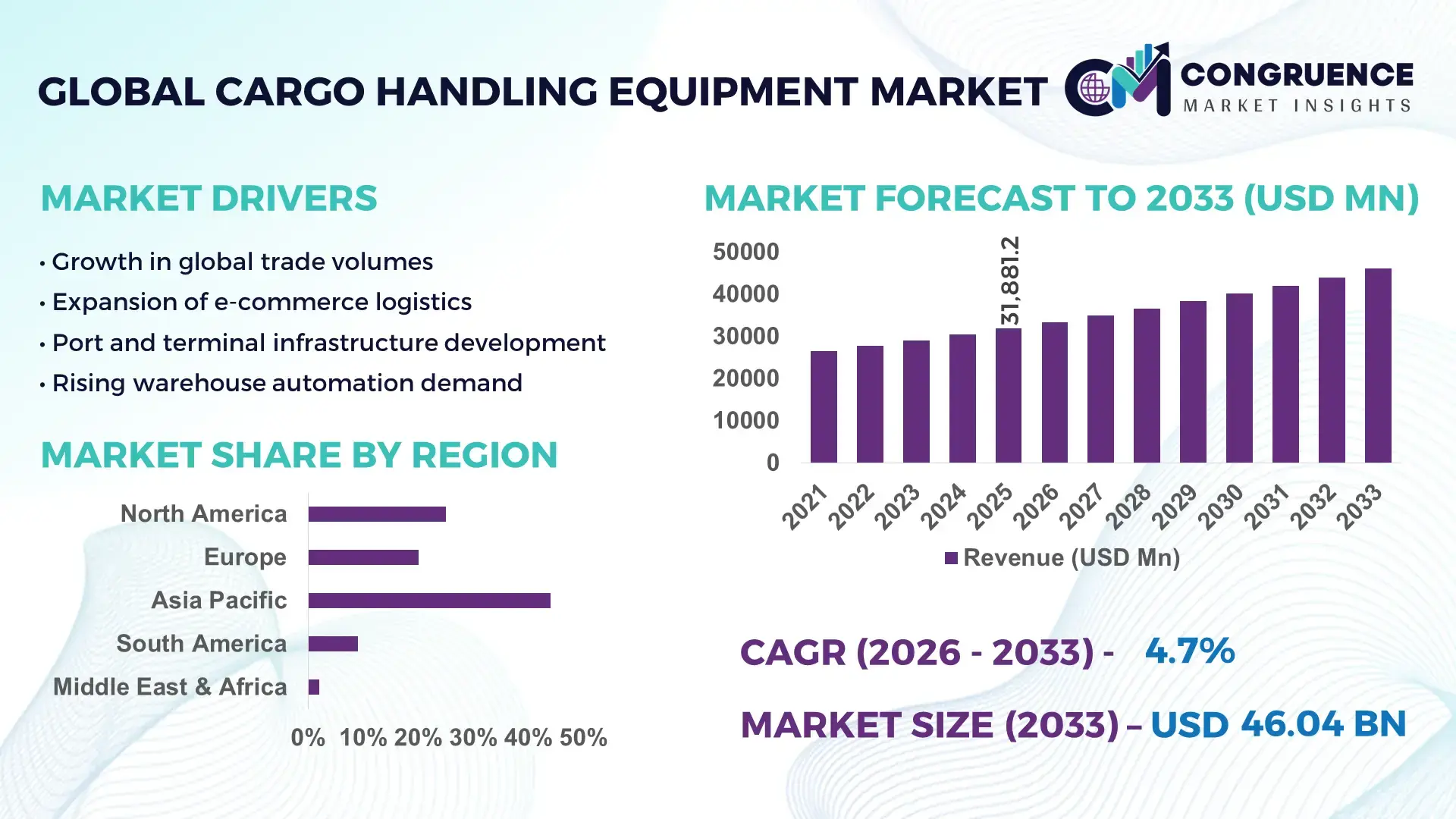
The Global Cargo Handling Equipment Market was valued at USD 31881.15 Million in 2025 and is anticipated to reach a value of USD 46037.04 Million by 2033 expanding at a CAGR of 4.7% between 2026 and 2033. This growth is primarily driven by the rapid expansion of global trade volumes and increasing port automation initiatives.
China continues to lead in the cargo handling equipment landscape with extensive manufacturing capacity and large-scale infrastructure investments. The country operates over 34 major ports, with automated terminals handling more than 30% of container throughput. Chinese manufacturers produce a significant portion of global cranes, forklifts, and conveyor systems, supported by domestic demand exceeding 250 million tons of port cargo annually. Advanced electrified container handling equipment adoption in key ports such as Shanghai and Ningbo has reached above 40%, reflecting a strong push toward energy-efficient operations and smart port technologies.
Market Size & Growth: USD 31881.15 Million (2025) to USD 46037.04 Million (2033), CAGR of 4.7%, driven by increasing global container traffic and port modernization.
Top Growth Drivers: Automation adoption (35%), logistics efficiency improvement (28%), e-commerce cargo expansion (25%).
Short-Term Forecast: By 2028, automated cargo systems are expected to improve operational efficiency by 22% and reduce handling time by 18%.
Emerging Technologies: AI-powered cargo tracking, electric and hybrid handling equipment, IoT-enabled predictive maintenance systems.
Regional Leaders: Asia-Pacific projected at USD 19000 Million by 2033 with strong port expansion; Europe at USD 12000 Million driven by green port initiatives; North America at USD 9000 Million with automation-led upgrades.
Consumer/End-User Trends: High adoption among port operators, logistics hubs, and airport cargo terminals focusing on throughput optimization and cost efficiency.
Pilot or Case Example: In 2024, a smart port project achieved 30% reduction in cargo dwell time using automated guided vehicles.
Competitive Landscape: Market leader holds approximately 18% share, followed by major global equipment manufacturers and regional suppliers.
Regulatory & ESG Impact: Emission reduction mandates and electrification targets are accelerating adoption of low-emission equipment.
Investment & Funding Patterns: Over USD 8 billion invested in smart port infrastructure and automated cargo systems in recent years.
Innovation & Future Outlook: Integration of robotics, AI, and digital twin technologies is reshaping cargo handling efficiency and scalability.
The cargo handling equipment market spans multiple industry sectors, including maritime ports, airports, warehousing, and intermodal logistics hubs, with ports contributing nearly 55% of equipment demand. Recent innovations such as automated stacking cranes, electric forklifts, and AI-enabled fleet management systems are improving throughput and reducing downtime. Regulatory pressure to reduce carbon emissions has accelerated the shift toward electrified and hybrid equipment, particularly in Europe and Asia. Regional consumption patterns show strong growth in Asia-Pacific due to expanding trade corridors, while North America emphasizes modernization of aging infrastructure. Emerging trends include autonomous cargo systems, digital logistics integration, and predictive maintenance technologies, positioning the market for long-term operational efficiency and sustainability.
The cargo handling equipment market holds strategic importance as global supply chains become increasingly complex and time-sensitive. Advanced automation technologies are redefining operational benchmarks, with automated guided vehicles delivering up to 35% improvement compared to conventional manual handling systems. Similarly, AI-driven predictive maintenance reduces equipment downtime by nearly 25% compared to traditional reactive maintenance models, enhancing asset utilization across logistics networks.
Asia-Pacific dominates in cargo volume due to high trade throughput and large-scale port infrastructure, while Europe leads in adoption, with over 45% of logistics operators integrating smart and electrified cargo handling solutions. This regional divergence highlights the dual focus on scale and sustainability shaping the market’s trajectory. By 2028, AI-integrated cargo optimization systems are expected to improve handling efficiency by approximately 20%, while reducing operational costs by 15%, particularly in high-traffic ports and logistics hubs.
From a compliance and ESG perspective, firms are committing to measurable sustainability targets, including a 30% reduction in carbon emissions from cargo handling operations by 2030. Electrification of equipment and integration of renewable energy sources into port operations are becoming standard practices. In 2025, a major port operator achieved a 28% reduction in fuel consumption through the deployment of electric cranes and automated systems, demonstrating tangible performance gains. The cargo handling equipment market is evolving as a critical enabler of resilient supply chains, aligning operational efficiency with sustainability goals while supporting global trade expansion under dynamic geopolitical and economic conditions.
The steady increase in global trade volumes and containerized shipping is a primary driver of the cargo handling equipment market. Global container throughput has exceeded 850 million TEUs annually, creating significant demand for high-capacity cranes, automated guided vehicles, and conveyor systems. Ports are investing heavily in advanced handling infrastructure to manage growing cargo volumes efficiently. For instance, automated container terminals can improve throughput by up to 30% compared to conventional operations. The expansion of e-commerce has further intensified the need for rapid cargo handling, particularly in air freight and warehouse logistics. Additionally, intermodal transportation systems are gaining traction, requiring versatile equipment capable of seamless cargo transfer across multiple transport modes. This sustained demand is pushing operators to adopt advanced, high-performance equipment to enhance operational productivity.
One of the key restraints in the cargo handling equipment market is the substantial capital investment required for procurement and installation of advanced systems. Automated cranes, electric forklifts, and smart handling solutions involve high upfront costs, often exceeding millions per installation. Maintenance and operational expenses also remain significant, particularly for technologically advanced equipment requiring specialized expertise. Small and medium-sized port operators and logistics firms often face financial constraints, limiting their ability to adopt modern solutions. Additionally, equipment lifecycle management, including replacement and upgrades, adds to long-term costs. Fluctuations in raw material prices, particularly steel and electronic components, further increase manufacturing expenses, making equipment less accessible for cost-sensitive markets.
Automation and digital transformation present significant growth opportunities in the cargo handling equipment market. The integration of AI, IoT, and robotics enables real-time monitoring, predictive maintenance, and optimized cargo movement. Automated systems can reduce labor dependency by up to 40% while increasing operational efficiency by over 25%. Smart ports and logistics hubs are investing in digital twin technologies to simulate and optimize cargo flows, improving decision-making and reducing bottlenecks. The growing emphasis on sustainability is also driving demand for electric and hybrid equipment, creating opportunities for manufacturers to innovate and expand their product portfolios. Emerging markets are increasingly adopting digital logistics solutions, further expanding the addressable market for advanced cargo handling equipment.
The cargo handling equipment market faces significant challenges from supply chain disruptions and complex regulatory frameworks. Global events, including geopolitical conflicts and trade restrictions, have led to delays in equipment manufacturing and delivery, affecting project timelines. The reliance on critical components such as semiconductors and specialized machinery parts makes the supply chain vulnerable to shortages. Additionally, stringent environmental and safety regulations require continuous compliance, increasing operational complexity for manufacturers and operators. Certification processes and regional regulatory differences can delay equipment deployment and increase costs. Furthermore, the transition to sustainable equipment requires substantial investment and technological adaptation, posing challenges for companies operating in cost-sensitive environments.
• Rapid Electrification of Cargo Handling Fleets: Electrification is transforming cargo handling operations, with over 38% of newly deployed equipment in major ports now powered by electric or hybrid systems. Electric forklifts and cranes reduce fuel consumption by nearly 45% and cut emissions by up to 50% compared to diesel-powered alternatives. In Asia-Pacific, more than 60% of newly commissioned automated terminals have integrated electric rubber-tired gantry cranes, while European ports report a 35% increase in battery-powered equipment adoption between 2023 and 2025. This shift is driven by stringent emission regulations and operational cost savings.
• Accelerated Adoption of Automation and Robotics: Automation continues to redefine efficiency benchmarks, with automated guided vehicles and robotic cranes improving cargo throughput by up to 30% and reducing labor dependency by 25%. Over 70% of newly developed container terminals are partially automated, while fully automated terminals account for approximately 18% of global port infrastructure. Smart warehouses are deploying robotic palletizers and autonomous forklifts, reducing handling errors by 20% and improving operational speed by 28%, particularly in high-volume logistics hubs.
• Integration of AI and Predictive Analytics Systems: AI-powered cargo handling systems are gaining traction, with predictive maintenance reducing equipment downtime by 22% and increasing asset utilization by 18%. Around 40% of large-scale logistics operators have implemented IoT-enabled sensors to monitor equipment performance in real time. Digital twin technology is being adopted in nearly 25% of major ports, enabling simulation-based planning and improving operational efficiency by 15%. These intelligent systems enhance decision-making and optimize cargo flow across complex logistics networks.
• Expansion of Smart Port Infrastructure: Smart port development is accelerating globally, with over 120 ports implementing advanced digital infrastructure by 2025. These ports report a 35% improvement in cargo handling efficiency and a 25% reduction in turnaround time. Investment in smart port projects has increased by approximately 42% over the past three years, driven by the need for integrated logistics ecosystems. Advanced technologies such as blockchain for cargo tracking and automated gate systems are reducing documentation processing time by 30%, enhancing transparency and operational reliability.
The cargo handling equipment market is segmented based on type, application, and end-user, each contributing uniquely to overall industry performance. Equipment types such as cranes, forklifts, conveyor systems, and automated guided vehicles serve diverse operational needs across ports, warehouses, and airports. In terms of applications, port operations dominate due to high cargo volumes, followed by warehousing and air cargo logistics, reflecting the expansion of global trade and e-commerce. End-user segmentation highlights port authorities, logistics companies, and industrial manufacturers as primary adopters. Approximately 55% of demand originates from maritime port operations, while warehouse automation accounts for nearly 30%, driven by rising e-commerce fulfillment requirements. These segments are further influenced by technological integration, regulatory pressures, and regional trade dynamics.
The cargo handling equipment market by type includes cranes, forklifts, conveyor systems, automated guided vehicles (AGVs), and other specialized handling equipment. Cranes represent the leading segment, accounting for approximately 40% of total equipment deployment due to their critical role in container handling and heavy cargo lifting in ports. Forklifts follow with around 28% share, widely used in warehouses and distribution centers for material movement. Conveyor systems contribute nearly 18%, supporting continuous cargo flow in logistics hubs.
Automated guided vehicles are the fastest-growing segment, expanding at an estimated growth rate of 6.5% annually, driven by increasing demand for automation and labor cost optimization. AGVs enhance operational efficiency by reducing manual intervention and improving accuracy in cargo movement. Other equipment, including reach stackers and pallet handlers, collectively account for about 14% of the market, serving niche and specialized applications.
By application, the cargo handling equipment market is segmented into ports, warehouses, and airports. Port operations dominate the segment with approximately 55% share, driven by high container throughput and continuous expansion of maritime trade. Warehousing accounts for around 30% of the market, fueled by rapid growth in e-commerce and demand for efficient order fulfillment systems. Airport cargo handling contributes approximately 15%, supported by increasing air freight volumes and time-sensitive logistics requirements.
Warehousing is the fastest-growing application segment, with an estimated growth rate of 6.2%, as companies invest in automated storage and retrieval systems to improve efficiency and reduce delivery timelines. The adoption of robotics and AI-driven inventory management is further accelerating growth in this segment.
End-user segmentation in the cargo handling equipment market includes port operators, logistics and transportation companies, manufacturing industries, and airport authorities. Port operators represent the leading end-user segment, accounting for approximately 50% of total demand due to large-scale cargo handling requirements and infrastructure investments. Logistics companies follow with around 30% share, driven by the need for efficient supply chain management and rapid delivery services.
Logistics and e-commerce companies are the fastest-growing end-user segment, expanding at an estimated rate of 6.8%, supported by increasing online retail penetration and demand for automated fulfillment solutions. Manufacturing industries and airport authorities collectively account for about 20% of the market, utilizing specialized equipment for internal logistics and air cargo operations.
Region Asia-Pacific accounted for the largest market share at 48% in 2025 however, Europe is expected to register the fastest growth, expanding at a CAGR of 5.6% between 2026 and 2033.
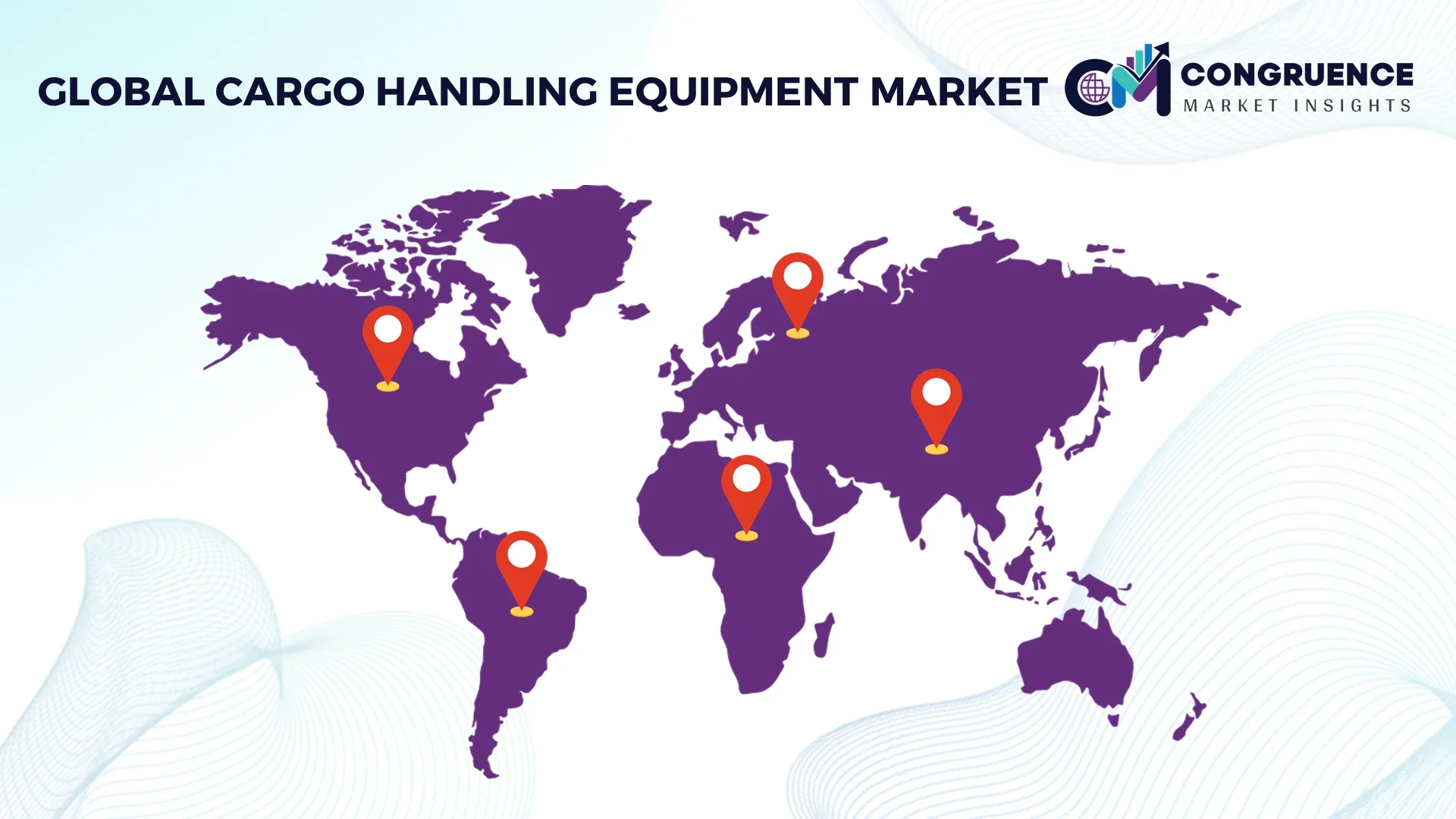
Asia-Pacific dominates due to its extensive port infrastructure, handling over 60% of global container throughput, with China alone processing more than 280 million TEUs annually. North America holds approximately 22% share, supported by over 360 major logistics hubs and advanced warehouse automation systems. Europe contributes nearly 18%, driven by sustainability-focused port upgrades and electrification initiatives, with over 35% of port equipment already electrified. South America accounts for around 7%, led by Brazil and Argentina with increasing agricultural exports exceeding 150 million tons annually. The Middle East & Africa region holds close to 5%, supported by strategic trade corridors and investments exceeding USD 25 billion in port infrastructure projects. Rising geopolitical tensions and shipping route disruptions have increased equipment demand by nearly 12% in critical logistics hubs, further influencing regional investment strategies.
How are automation-driven logistics ecosystems reshaping operational efficiency and equipment demand?
North America accounts for approximately 22% of the cargo handling equipment market, driven by strong demand from logistics, e-commerce, and manufacturing sectors. The region operates over 25 of the world’s busiest ports and more than 18,000 warehouses exceeding 50,000 square feet each. Government initiatives supporting infrastructure modernization and port digitization have accelerated adoption of automated systems. Regulations targeting emission reduction have increased the adoption of electric forklifts by nearly 40% across large distribution centers. Technological advancements such as AI-enabled warehouse management systems and autonomous mobile robots are improving operational efficiency by up to 28%. A key player in the region has deployed over 2,500 automated guided vehicles across logistics facilities, enhancing throughput and reducing labor costs significantly. Regional consumer behavior reflects high enterprise adoption, particularly in retail and e-commerce sectors, where over 65% of companies prioritize automation to manage high-volume cargo flows efficiently.
What role do sustainability mandates and smart port innovations play in transforming operational performance?
Europe holds approximately 18% of the cargo handling equipment market, with major contributions from Germany, the UK, and France. The region is characterized by strong regulatory frameworks promoting sustainability, with over 50% of ports implementing carbon reduction initiatives. Electrified cargo handling equipment accounts for nearly 35% of total installations, reflecting strict emission standards. The adoption of advanced technologies such as automated stacking cranes and IoT-enabled monitoring systems has improved port efficiency by approximately 25%. European logistics operators are increasingly investing in green technologies, including hydrogen-powered equipment and renewable energy integration. A leading regional manufacturer has introduced electric container handlers capable of reducing energy consumption by 30%, supporting sustainability goals. Consumer behavior in this region emphasizes regulatory compliance and environmental responsibility, with over 70% of operators prioritizing low-emission equipment solutions to meet stringent environmental standards.
How is large-scale infrastructure expansion and digital transformation accelerating equipment deployment across high-volume trade corridors?
Asia-Pacific leads the cargo handling equipment market in volume, accounting for nearly 48% of global demand. China, India, and Japan are the top consuming countries, with China alone contributing more than 35% of regional equipment deployment. The region’s ports handle over 60% of global container traffic, supported by continuous infrastructure expansion and government-backed investments exceeding USD 100 billion in logistics development projects. Manufacturing hubs and export-oriented industries are driving demand for high-capacity cranes, conveyor systems, and automated vehicles. Technological innovation is rapidly advancing, with over 40% of new port projects incorporating smart technologies such as AI-driven cargo tracking and automated systems. A prominent regional equipment manufacturer has delivered more than 1,200 automated cranes to major ports, improving handling efficiency by over 30%. Consumer behavior reflects strong growth driven by e-commerce and industrial production, with over 50% of logistics operators investing in automation to manage increasing cargo volumes.
How are trade expansion and infrastructure upgrades influencing equipment demand across key logistics corridors?
South America represents approximately 7% of the cargo handling equipment market, with Brazil and Argentina serving as the primary contributors. The region’s growth is closely linked to agricultural exports, which exceed 150 million tons annually, requiring efficient cargo handling solutions. Infrastructure development projects, including port expansions and logistics network improvements, are increasing equipment demand by nearly 15% in key regions. Government policies promoting trade and foreign investment have supported modernization initiatives across major ports. Technological adoption remains moderate, with approximately 20% of logistics facilities implementing automated systems, though this figure is steadily increasing. A regional equipment provider has recently introduced cost-efficient conveyor systems tailored for bulk cargo handling, improving operational efficiency by 18%. Consumer behavior in the region is influenced by cost sensitivity, with companies prioritizing durable and low-maintenance equipment to support high-volume export operations.
What impact do strategic trade hubs and energy sector investments have on cargo handling modernization?
The Middle East & Africa region accounts for approximately 5% of the cargo handling equipment market, driven by demand from oil & gas, construction, and logistics sectors. Key growth countries include the UAE and South Africa, with the UAE handling over 20 million TEUs annually through its advanced port infrastructure. Investments in smart logistics hubs and free trade zones have increased demand for automated and high-capacity equipment. Technological modernization is accelerating, with nearly 25% of new port projects integrating digital systems and automation technologies. Trade partnerships and regional connectivity initiatives are further boosting equipment demand. A major logistics operator in the region has implemented automated cargo handling systems that improved operational efficiency by 22%. Consumer behavior reflects a growing preference for technologically advanced equipment, particularly in high-value trade and energy-driven economies.
China – 35% share: Cargo Handling Equipment market leadership driven by massive port infrastructure, high container throughput, and large-scale domestic manufacturing capacity.
United States – 18% share: Cargo Handling Equipment market dominance supported by advanced logistics networks, high automation adoption, and strong e-commerce-driven demand.
The cargo handling equipment market exhibits a moderately fragmented structure, with over 120 active global and regional competitors. The top five companies collectively account for approximately 42% of the market, indicating a balanced competitive environment with opportunities for both established players and emerging entrants. Leading companies focus on product innovation, automation, and sustainability to strengthen their market positions. Strategic initiatives such as mergers, acquisitions, and partnerships have increased by nearly 20% over the past three years, aimed at expanding technological capabilities and geographic reach.
Manufacturers are investing heavily in research and development, with approximately 6–8% of annual budgets allocated to innovation, particularly in automation and electrification technologies. Product launches featuring AI-enabled systems, electric equipment, and advanced safety features are becoming more frequent. Additionally, companies are forming collaborations with logistics providers and port authorities to implement large-scale automation projects. Competitive differentiation is increasingly based on technology integration, energy efficiency, and lifecycle cost optimization. Regional players are focusing on cost-effective solutions to compete with global manufacturers, further intensifying market competition.
Konecranes
Cargotec Corporation
Liebherr Group
Toyota Industries Corporation
Hyster-Yale Materials Handling
Kalmar Global
Mitsubishi Logisnext Co., Ltd.
Anhui Heli Co., Ltd.
Hangcha Group Co., Ltd.
SANY Group
Clark Material Handling Company
Jungheinrich AG
Crown Equipment Corporation
Doosan Industrial Vehicle
Hyundai Construction Equipment
Technological advancements are significantly reshaping the cargo handling equipment market, with automation, electrification, and digital integration at the forefront. Automated guided vehicles (AGVs) and autonomous mobile robots (AMRs) are increasingly deployed across ports and warehouses, improving operational efficiency by up to 30% and reducing manual labor dependency by nearly 25%. These systems are equipped with advanced navigation technologies such as LiDAR and machine vision, enabling precise and collision-free operations even in high-density cargo environments.
Electrification is another critical technological trend, with over 38% of newly deployed cargo handling equipment powered by electric or hybrid systems. Electric rubber-tired gantry cranes and battery-operated forklifts reduce fuel consumption by approximately 40% and significantly lower emissions, aligning with global sustainability goals. Fast-charging lithium-ion battery systems now enable continuous operations with charging times reduced by nearly 50% compared to earlier technologies.
The integration of Internet of Things (IoT) and predictive analytics is enhancing equipment reliability and lifecycle management. IoT-enabled sensors are embedded in over 45% of modern cargo handling systems, providing real-time data on equipment performance, usage patterns, and maintenance requirements. Predictive maintenance solutions can reduce unexpected equipment downtime by up to 22% and extend asset lifespan by nearly 15%.
Artificial intelligence is also playing a transformative role, particularly in optimizing cargo flow and yard management. AI-driven software platforms can analyze large datasets to improve scheduling efficiency by approximately 20% and reduce congestion in logistics hubs. Digital twin technology is gaining traction, with nearly 25% of major ports implementing simulation models to test operational scenarios and improve planning accuracy. Additionally, blockchain-based cargo tracking systems are being adopted to enhance transparency and reduce documentation processing time by up to 30%, further streamlining global trade operations.
• In March 2026, Konecranes introduced a new generation of electric rubber-tired gantry cranes equipped with advanced energy storage systems, enabling up to 35% reduction in energy consumption and improved operational efficiency in high-throughput container terminals. Source: www.konecranes.com
• In November 2025, Cargotec’s Kalmar division deployed automated straddle carriers at a major European port, achieving a 25% increase in container handling productivity and reducing operational emissions through electrified drivetrain systems. Source: www.cargotec.com
• In July 2025, Liebherr expanded its portfolio of automated ship-to-shore cranes with enhanced remote-control capabilities, allowing operators to manage multiple cranes simultaneously and improving handling efficiency by nearly 20% in large-scale port operations. Source: www.liebherr.com
• In January 2026, Toyota Industries Corporation launched an advanced lithium-ion powered forklift series designed for high-capacity warehouse operations, reducing charging time by 40% and increasing operational uptime in logistics facilities. Source: www.toyota-industries.com
The cargo handling equipment market report provides a comprehensive analysis of the global industry, covering a wide spectrum of equipment types, applications, technologies, and regional markets. The report includes detailed segmentation across product categories such as cranes, forklifts, conveyor systems, automated guided vehicles, and specialized handling equipment, collectively addressing over 95% of cargo handling requirements across ports, warehouses, and airports. It evaluates operational capacities, with container terminals handling more than 850 million TEUs annually and warehouse facilities exceeding 150,000 large-scale distribution centers globally.
Geographically, the report covers five major regions, including Asia-Pacific, North America, Europe, South America, and the Middle East & Africa, representing diverse market dynamics and infrastructure maturity levels. Asia-Pacific leads in volume with over 60% of global cargo throughput, while Europe and North America focus on sustainability and automation, with more than 35% of equipment electrified in advanced markets. Emerging regions are analyzed for their infrastructure development and trade expansion potential.
The report also examines key application areas, including maritime ports, air cargo terminals, intermodal logistics hubs, and industrial material handling, with ports contributing approximately 55% of total equipment demand. It highlights technological advancements such as AI-driven automation, IoT-enabled monitoring systems, and digital twin applications, which are implemented in nearly 40% of modern logistics facilities. Additionally, the scope includes analysis of regulatory frameworks, sustainability initiatives, and evolving supply chain strategies, offering decision-makers actionable insights into operational efficiency, investment planning, and long-term market positioning.
| Report Attribute/Metric | Report Details |
|---|---|
|
Market Revenue in 2025 |
USD V2025 Million |
|
Market Revenue in 2033 |
USD V2033 Million |
|
CAGR (2026 - 2033) |
4.7% |
|
Base Year |
2025 |
|
Forecast Period |
2026 - 2033 |
|
Historic Period |
2021 - 2025 |
|
Segments Covered |
By Types
By Application
By End-User
|
|
Key Report Deliverable |
Revenue Forecast, Growth Trends, Market Dynamics, Segmental Overview, Regional and Country-wise Analysis, Competition Landscape |
|
Region Covered |
North America, Europe, Asia-Pacific, South America, Middle East, Africa |
|
Key Players Analyzed |
Konecranes, Cargotec Corporation, Liebherr Group, Toyota Industries Corporation, Hyster-Yale Materials Handling, Kalmar Global, Mitsubishi Logisnext Co., Ltd., Anhui Heli Co., Ltd., Hangcha Group Co., Ltd., SANY Group, Clark Material Handling Company, Jungheinrich AG, Crown Equipment Corporation, Doosan Industrial Vehicle, Hyundai Construction Equipment |
|
Customization & Pricing |
Available on Request (10% Customization is Free) |




