
Reports
The Global Carbon Fiber and CFRP Market was valued at USD 3,002.0 Million in 2025 and is anticipated to reach a value of USD 7,171.5 Million by 2033 expanding at a CAGR of 11.5% between 2026 and 2033. Growth is anchored in aerospace program ramp-ups, wind blade spar cap demand, and hydrogen pressure vessel adoption across Asian and European supply chains.
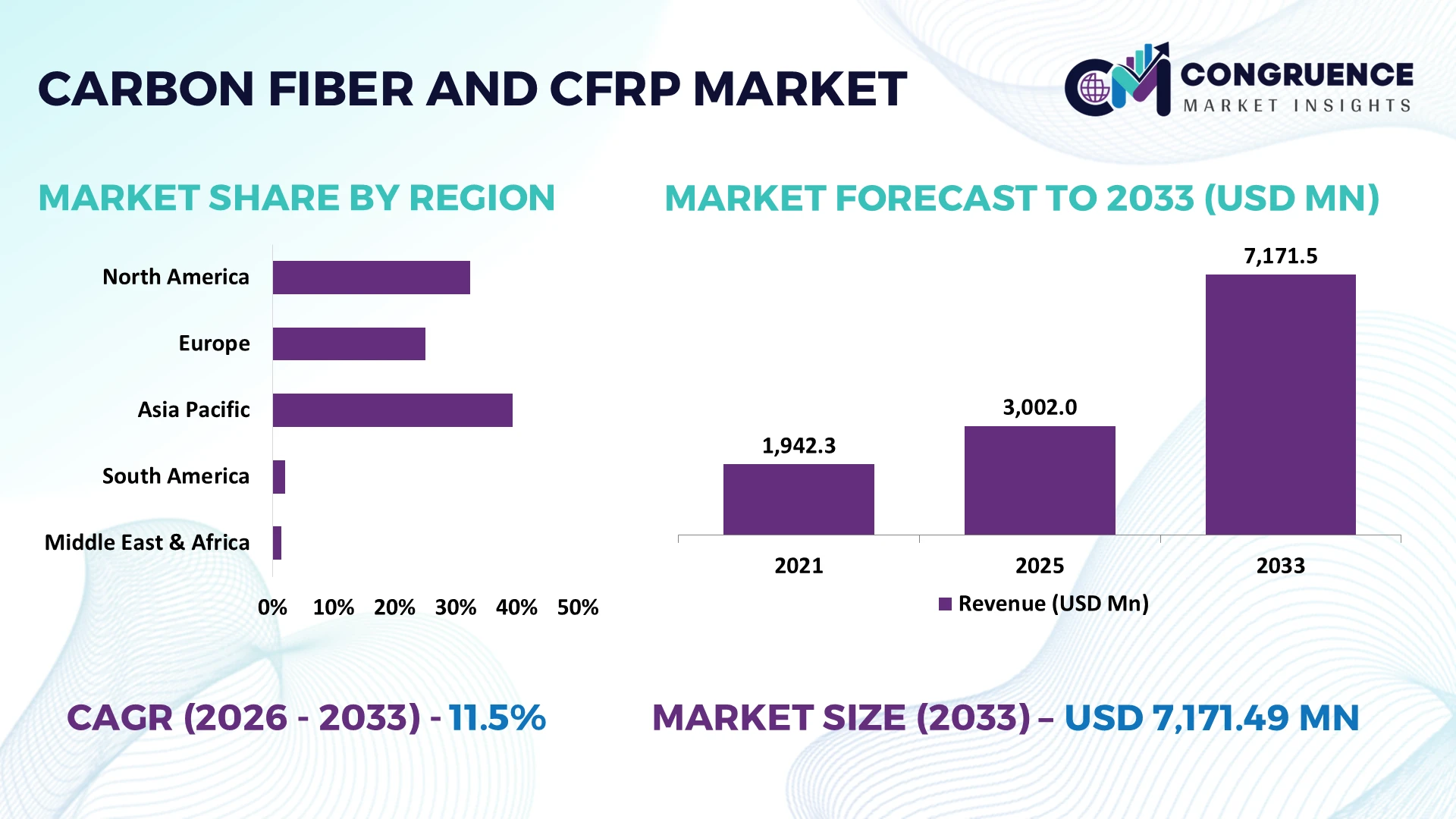
China commands the dominant position, with CFRP demand projected at USD 5.38 billion in 2026, supported by vertically integrated precursor-to-fiber capacity and national wind energy deployment exceeding 4.5 GW offshore installations. Japan follows at USD 1.03 billion, reflecting its aerospace-grade specialty fiber concentration. China’s capacity utilization advantage over Western peers—estimated at 15–20 percentage points higher in large-tow grades—translates directly into cost leadership.
Strategic implication, procurement and localization decisions must now weight Chinese supply reliability against EU regulatory friction on automotive carbon fiber restrictions.
Market Size & Growth: Valued at USD 3,002.0 Million in 2025, reaching USD 7,171.5 Million by 2033 at 11.5% CAGR; wind blade spar cap conversion to pultruded carbon planks drives industrial volume growth.
Top Growth Drivers: Aerospace composite penetration at 50% of structural weight (Boeing 787/Airbus A350), wind blade lengths exceeding 100 meters requiring carbon spar caps, and hydrogen pressure vessel demand rising 28% annually in China and Europe.
Short-Term Forecast: By 2028, microwave-assisted oxidation adoption targets 25–30% faster cycle times and 15–20% lower energy use per kilogram, compressing conversion costs for large-tow fiber.
Emerging Technologies: Thermoplastic CFRP grid-structure forming eliminates layup labor, recycled fiber recovery achieves 90–95% virgin strength retention for non-primary structures, and automated fiber placement reduces scrap rates by 12–18%.
Regional Leaders: China at USD 5.38 billion (wind and pressure vessels), Japan at USD 1.03 billion (aerospace-grade small tow), Germany at USD 1.4 billion (automotive and industrial).
Consumer/End-User Trends: Pressure vessel applications represent the fastest-growing end-use segment, with natural gas truck and hydrogen bus fleets in China absorbing 2,000+ units annually per major converter.
Pilot/Case Example: 2025—Aksa Akrilik acquired Dow’s 50% stake in DowAksa for USD 125 million, consolidating Turkish carbon fiber capacity under Aksa Carbon and targeting defense and wind energy supply independence.
Competitive Landscape: Toray leads with approximately 18–22% global share; key players include Hexcel, Mitsubishi Chemical, Solvay (Syensqo), and Chinese challengers Zhongfu Shenying and Guangwei Composites.
Regulatory & ESG Impact: EU ELV Regulation proposal adding carbon fiber to restricted automotive substances threatens 89.55% thermoset CFRP share in European automotive applications; industry lobbying targets exemption for structural composites.
Investment & Funding: Jinggong Technology committed USD 59 million (RMB 426 million) to a Wuhan composites smart manufacturing base, adding 28,000 carbon-ceramic brake discs and 2,000 pressure vessels annual capacity.
Innovation & Future Outlook: Recycled carbon fiber volumes growing at 19.87% CAGR through 2031, with wind blade decommissioning after 2027 providing stable feedstock; certification for primary aerospace structures remains outside 2026 planning horizons.
The Carbon Fiber and CFRP Market is pivoting toward industrial-grade large-tow dominance, with pressure vessels and wind energy absorbing over 45% of new capacity additions. Thermoplastic forming technologies are cutting cycle times by 25–30% versus legacy thermoset layup, enabling automotive and drone applications to move from prototyping to series production. A critical operational constraint: China’s precursor integration buffers cost shocks, while European converters face 12–18% higher PAN procurement premiums amid EU carbon fiber regulatory uncertainty. These dynamics frame the strategic choices examined below.
Carbon fiber has shifted from a niche aerospace material to a strategic industrial input, with supply chain control now determining competitive advantage in wind energy, defense drones, and hydrogen infrastructure. China’s vertically integrated precursor-to-fiber chains and Turkey’s Aksa Carbon consolidation signal a restructuring away from Western-dominated specialty supply toward regional self-sufficiency. Thermoplastic CFRP grid-structure forming, validated in battery cover prototypes, delivers 25–30% faster cycle times than thermoset layup and enables reusability—a decisive operational advantage for automotive and eVTOL production lines. Regionally, China’s capacity utilization runs 15–20 percentage points above European converters, while Japan retains aerospace-grade small-tow specialization that China’s C919 program still imports. Over the next 24–36 months, pressure vessel converters in China and Germany will absorb the majority of new large-tow capacity, with hydrogen refueling station buildouts targeting 15–20% annual unit growth. Jinggong Technology’s RMB 426 million Wuhan base exemplifies the response: co-locating prepreg lines with pressure vessel and drone blade production to shorten qualification cycles. Competitive positioning now hinges on precursor security and downstream application integration, not fiber volume alone.
Commercial aircraft backlogs at Boeing and Airbus exceed 12,000 units, with carbon composites comprising approximately 50% of structural weight on widebody platforms. Wind turbine blades now exceed 100 meters offshore, forcing spar cap conversion from glass to pultruded carbon planks to prevent tower strikes. Chinese turbine OEMs—Goldwind, Envision, Mingyang—have accelerated carbon spar cap adoption, absorbing large-tow fiber at scale. Hexcel’s 2025 defense and space sales growth confirms aerospace demand durability. Companies are responding through capacity localization: Toray’s 5,000-ton South Carolina line targets automotive grades, while Hexcel’s Salt Lake City expansion supports 787 and A350 wing spar production. The strategic insight: wind blade manufacturers that secure pultrusion-grade large-tow contracts through 2027 will lock in cost positions 12–15% below spot-exposed competitors.
Global carbon fiber operating capacity reached 309,000 tons in 2024 with utilization below 70%, yet PAN precursor spot prices spiked to USD 8–10 per kilogram, forcing converters to invoke force-majeure clauses on automotive contracts. Europe’s capacity share collapsed from 35% in 2015 to under 15% in 2024, with SGL Carbon closing its Portuguese plant. The direct business impact: European automotive Tier 1 suppliers face 12–18% higher fiber procurement costs than Chinese counterparts, eroding margins on EV battery enclosure programs. Companies are mitigating through diversification—Aksa Carbon’s full ownership of DowAksa reduces reliance on Western joint venture governance, while Chinese converters lock in domestic acrylonitrile supply from Shandong and Jiangsu clusters. The non-obvious constraint: precursor outages in China ripple through global value chains within nine months, making single-source qualification a balance-sheet risk, not merely an operational one.
Recycled carbon fiber volumes are growing at 19.87% CAGR through 2031, with ELG Carbon Fibre recovering 90–95% of virgin strength from aerospace scrap at 30–50% lower cost. Wind blade decommissioning after 2027 will provide a stable feedstock base, transforming a waste liability into a supply asset. Automotive seat frames and overhead bins represent immediate qualification pathways, while drone airframes and industrial rollers offer volume upside without primary-structure certification burdens. Companies are positioning through ecosystem partnerships: composite recyclers are co-locating with aerospace scrap generators in the US and Europe, while Chinese wind OEMs pilot blade-to-blade recycling loops. The unique strategic insight: recycled fiber’s 30–50% cost advantage makes it viable for pressure vessel overwrap in non-hydrogen service, opening natural gas vehicle and industrial gas storage segments that virgin fiber economics cannot reach.
The European Commission’s ELV Regulation proposal adds carbon fiber to restricted substances in automotive components, aligning it with lead, mercury, and hexavalent chromium despite absent toxicity evidence. This threatens the 89.55% thermoset CFRP share deployed in European automotive applications and could force reformulation or material substitution on battery enclosures and structural parts. The execution barrier extends beyond compliance: automotive qualification cycles for alternative materials run 24–36 months, creating deployment uncertainty for 2027–2028 model year programs. Companies must invest in lobbying through composites associations and simultaneously develop thermoplastic CFRP variants that may qualify under circularity exemptions. The operational imperative: European converters should pre-qualify recycled-content CFRP for non-structural automotive parts now, hedging against a regulatory outcome that restricts virgin carbon fiber while rewarding recyclability.
Pressure Vessel Capacity Localization Accelerates Chinese and German converters are co-locating filament winding with hydrogen refueling station deployment, with Jinggong Technology adding 2,000 pressure vessels annual capacity in Wuhan. Natural gas truck fleets in China absorb 28% more large-tow fiber than 2024 levels, while European hydrogen bus programs target 15–20% unit growth. Companies are responding by securing long-term PAN contracts and integrating winding cells into existing prepreg facilities to cut logistics costs by 8–12%.
Thermoplastic Forming Moves to Series Production Thermoplastic CFRP grid-structure forming, validated in battery cover prototypes, achieves 25–30% faster cycle times than thermoset layup and enables reusability. Japanese and German Tier 1 suppliers are piloting servo-press and insert injection molding lines for automotive and eVTOL applications. The non-obvious shift: thermoplastic scrap can be remelted and re-formed, reducing material waste by 15–20% and changing the cost calculus for high-volume industrial parts.
Aerospace Supply Chain Diversification Intensifies Boeing and Airbus qualification teams are adding non-traditional carbon fiber sources, with C919 program suppliers Guangwei and Zhongfu Shenying pursuing aerospace-grade certifications. Japan’s Toray retains 18–22% global share but faces pressure from Chinese small-tow entrants targeting 15% cost reduction through domestic precursor integration. Companies are responding through bilateral qualification agreements and dual-sourcing strategies that reduce single-region exposure.
EU Regulatory Lobbying Reshapes Material Strategy The ELV Regulation proposal’s carbon fiber restriction has triggered coordinated industry lobbying through composites associations, with Japanese and European manufacturers challenging the scientific basis. Simultaneously, converters are accelerating recycled-content and thermoplastic CFRP development to pre-empt circularity-based exemptions. The operational response: automotive material engineers now include regulatory risk scoring in CFRP selection matrices, weighting recyclability and thermoplastic compatibility alongside mechanical performance.
PAN-based carbon fiber commands the overwhelming majority of the market, with a 97.98% share projected for 2026, anchored by its cost-effectiveness, high tensile strength, and established aerospace qualification pathways . This dominance is reinforced by mature precursor supply chains in Japan and China, where integrated acrylonitrile production buffers cost volatility. Pitch-based fiber represents the fastest-emerging type, advancing at 11.14% growth driven by ultra-high-modulus requirements in satellite structures and thermal management systems.
Rayon-based fiber retains a residual niche in ablative rocket nozzles and missile heat shields, though its strategic relevance is confined to defense-specific procurement. Companies are responding through precursor diversification: Mitsubishi Chemical maintains pitch capacity exceeding 10,000 tonnes, while Chinese producers concentrate large-tow PAN expansion on wind and pressure vessel grades . Investment priorities are bifurcating between scale-driven PAN capacity in Asia and specialty pitch qualification for Western defense programs.
Aerospace applications represent the highest-value segment, holding a 55.29% share of CFRP demand in 2026, sustained by commercial aircraft backlogs and defense composite structures that mandate qualified small-tow fiber . Wind turbine blades constitute the fastest-expanding volume application, with China alone accounting for a 12.7% share of domestic CFRP demand in 2024 as spar cap conversion from glass to carbon accelerates. Automotive applications are transitioning from premium niche to mainstream platform integration, led by European luxury brands and Chinese EV manufacturers incorporating battery enclosures and structural components.
Pressure vessels for hydrogen and natural gas storage represent the operational inflection point, absorbing large-tow fiber at scale in China and Germany. Companies are adapting through application-specific capacity: Hexcel and Toray prioritize aerospace prepreg lines, while Zhongfu Shenying and Guangwei concentrate industrial large-tow output on wind and pressure vessel customers. Demand is strengthening most rapidly where fiber performance directly enables system-level efficiency gains—longer blades, lighter vehicles, and higher-pressure storage.
Aerospace and defense end-users represent the leading demand concentration, commanding approximately 32.7% of market value through stringent material qualification requirements and long program lifecycles that lock in supplier relationships . Alternative energy—principally wind energy and pressure vessel storage—is the fastest-growing end-user group, with Chinese turbine OEMs and hydrogen infrastructure developers absorbing large-tow capacity at accelerating rates. Industrial end-users, including construction reinforcement and sporting goods, maintain steady baseline demand but face substitution pressure from lower-cost glass and recycled fiber alternatives.
Automotive end-users exhibit divergent behavior: European OEMs prioritize thermoplastic CFRP for recyclability compliance, while Chinese manufacturers scale thermoset solutions for cost-sensitive EV platforms. Companies are targeting these segments through differentiated engagement models—Toray and Hexcel maintain embedded engineering teams with Boeing and Airbus, while Chinese producers offer volume pricing and shorter lead times to wind and pressure vessel customers. Future demand is shifting toward end-users where carbon fiber’s performance premium is non-substitutable: defense hypersonics, hydrogen infrastructure, and next-generation offshore wind.
Asia-Pacific accounted for the largest market share at 39.30% in 2025 however, North America is expected to register the fastest growth, expanding at a CAGR of 16.74% between 2026 and 2033.
North America holds a 32.3% value share, with the United States accounting for USD 1.01 billion in 2025 as aerospace recovery and defense hypersonic programs absorb qualified small-tow fiber . Regional demand is concentrated in aerospace and defense end-users, where traceability requirements exclude recycled and non-certified imports. Collins Aerospace’s USD 200 million Spokane expansion and GE Aerospace’s near-USD 1 billion composite part allocation signal defense-driven capacity commitments . Automotive electrification adds incremental demand through battery enclosure pilots, though volume remains below aerospace thresholds. The region’s strategic posture favors supply chain security over cost optimization, with PAN precursor import scrutiny elevating domestic sourcing priorities.
United States Market Outlook: The U.S. commands the region’s dominant position, supported by Boeing and Airbus U.S. final assembly operations, NASA HiCAM fast-build composite wing research, and Department of Energy funding for ductile carbon-fiber battery housings . Defense hypersonic and missile programs require high-modulus pitch and small-tow PAN grades unavailable from Chinese suppliers, creating a protected premium segment.
Europe holds a 25.0% value share, with Germany anchoring regional demand at USD 200 million in 2025 through Airbus final assembly, automotive lightweighting, and wind energy manufacturing . The region leads in aerospace-grade composite qualification, with German and French suppliers embedded in Airbus wing and fuselage programs. However, European capacity utilization trails Chinese competitors by 15–20 percentage points, and the EU ELV Regulation proposal’s carbon fiber restriction threatens automotive demand continuity. SGL Carbon’s Portuguese plant closure underscores the cost pressure facing European converters. Regional investment is pivoting toward thermoplastic CFRP and recycled fiber qualification as circularity compliance becomes a procurement criterion.
Germany Market Outlook: Germany’s aerospace and automotive manufacturing base supports approximately one in six globally assembled commercial aircraft, with Airbus and tier suppliers driving qualified composite consumption . The German automotive industry’s EUR 220 billion investment commitment through 2026 includes lightweighting programs that position CFRP for EV structural components, though regulatory uncertainty on carbon fiber restriction tempers near-term volume commitments.
Asia-Pacific commands 39.3% of global market value, with China’s USD 1.23 billion regional position underpinned by an annual production capacity of 160,300 metric tons . The region’s competitive advantage rests on vertical integration from acrylonitrile precursor through fiber and downstream composite fabrication, enabling cost positions 12–18% below Western peers. China’s wind energy deployment absorbs large-tow output at scale, while Japan retains aerospace-grade small-tow leadership through Toray and Teijin. South Korea contributes industrial-grade capacity through Hyosung. The region’s structural challenge is domestic overcapacity in industrial grades, with utilization at 40–45%, even as aerospace-grade supply remains import-dependent .
China Market Outlook: China’s dominance is built on precursor integration through Sinopec and domestic acrylonitrile supply, supporting large-tow fiber for wind spar caps and pressure vessels at scale . The C919 program is driving aerospace-grade qualification efforts by Guangwei and Zhongfu Shenying, though Western certification remains pending. Offshore wind installations exceeding 4.5 GW annually provide a captive demand base that sustains capacity expansion despite industrial-grade margin compression.
South America represents a minor share of 2% of global CFRP consumption, with demand concentrated in Brazil’s aerospace and defense maintenance operations, Chilean and Argentine wind energy installations, and Brazilian automotive lightweighting for premium vehicle exports. Regional infrastructure limitations and import dependency constrain large-scale adoption, with most carbon fiber arriving through European and North American distributors. Investment activity remains limited, though wind energy project pipelines in Brazil’s northeast and Chile’s Atacama region create incremental demand for blade materials. The region’s strategic relevance lies in its role as a downstream market for global suppliers rather than a production base.
Brazil Market Outlook: Brazil accounts for the region’s dominant demand position, supported by Embraer’s aerospace supply chain, wind energy expansion exceeding 30 GW installed capacity, and automotive sector lightweighting for export-oriented premium vehicles. The country’s industrial base absorbs prepreg and fabric imports primarily from the United States and Europe, with no domestic carbon fiber production capacity. Trade agreements and distributor relationships determine supply access.
The Middle East and Africa represent a small but strategically relevant share of 1.4% of global CFRP consumption, with demand concentrated in UAE and Saudi Arabian aerospace maintenance, Turkish defense programs, and South African industrial applications. Turkey’s Aksa Carbon consolidation through the USD 125 million DowAksa stake acquisition creates a regional production node targeting defense and wind energy supply independence. Gulf states’ infrastructure modernization programs incorporate CFRP for bridge reinforcement and architectural applications, though volumes remain modest. The region’s growth trajectory is tied to defense procurement cycles and sovereign industrial diversification initiatives rather than commercial aerospace or automotive scale.
Turkey Market Outlook: Turkey’s strategic position bridges European and Middle Eastern demand, with Aksa Carbon’s consolidated capacity supporting domestic defense drone programs, wind blade manufacturing, and export-oriented composite fabrication . The country’s aerospace ambitions under Turkish Aerospace Industries create qualified demand for structural composites, while proximity to European markets offers supply chain flexibility amid EU regulatory uncertainty.
Toray, Hexcel, Mitsubishi Chemical, and China’s Zhongfu Shenying and Guangwei Composites define the competitive hierarchy, with Toray and Hexcel contesting qualified aerospace small-tow while Chinese producers weaponize large-tow cost leadership against Zoltek and SGL Carbon. The top five hold roughly 45–50% combined share, leaving a fragmented industrial-grade tail. Competition pivots on precursor integration: Chinese players achieve 12–18% lower conversion costs through domestic acrylonitrile access, while Western leaders defend certification moats and charge 20–25% premiums for aerospace-qualified fiber. Hexcel’s overbraiding collaboration with A&P Technology and NIAR targets 57% cost reduction and 67% touch-time savings for defense programs, directly challenging conventional prepreg-autoclave economics . Mitsubishi Chemical is doubling high-performance capacity across Japan and Sacramento by 2027, prioritizing hypercar and aerospace niches over volume . Consolidation is accelerating—Aksa’s full DowAksa ownership and Zhongfu Shenying’s path to profitability signal scale-driven survival. The entry barrier is qualification time: aerospace certification runs 24–36 months, locking new entrants out of premium demand. Winning requires either certified aerospace positioning or irreversible large-tow cost dominance—mid-tier undifferentiated capacity faces extinction.
Toray Industries
Hexcel Corporation
Mitsubishi Chemical Corporation
Teijin Limited
SGL Carbon SE
Solvay (Syensqo)
Zhongfu Shenying Carbon Fiber
Guangwei Composites
Hyosung Advanced Materials
Aksa Carbon
Formosa Plastics
Jilin Carbon
Kureha Corporation
Nippon Graphite Fiber
Overbraiding and resin infusion are displacing conventional prepreg-autoclave layup for defense airframe structures, with AFRL validation confirming 57% cost savings and 67% touch-time reduction . Adoption remains concentrated in uncrewed platforms—Kratos XQ-58A inlet ducts now use the process—while commercial aerospace qualification lags. Hexcel and A&P Technology capture near-term advantage by embedding certification pathways through NIAR, creating a template competitors must replicate or cede.
Microwave-assisted oxidation and thermoplastic grid-structure forming target the cost floor of industrial-grade fiber, promising 25–30% faster conversion cycles and 15–20% energy reduction per kilogram. Chinese producers are piloting these processes to defend large-tow margins against Toray’s lower-pricing strategy in 2025 . Equipment suppliers and converters with existing PAN integration benefit most; standalone fiber producers without downstream application access face margin compression.
By 2028, recycled fiber recovery at 90–95% virgin strength will qualify for non-primary automotive and wind applications, challenging virgin fiber’s 30–50% cost premium. Companies that pair recycling infrastructure with application engineering—rather than treating recycling as a compliance cost—will unlock pressure vessel and industrial roller demand inaccessible to premium virgin grades.
December 2025 — Mitsubishi Chemical Announced capacity doubling for high-performance carbon fiber at Tokai, Japan and Sacramento, U.S., phasing from 2025 to 2027 to serve aerospace, hypercar, and sports demand . Business impact: locks in high-value niche supply before Chinese aerospace-grade entrants achieve qualification. Source: mcgc.com
September 2025 — Guangwei Composites Subsidiary formed an 80 million yuan joint venture with Shangong Feiren, holding 25%, to manufacture civil aircraft composite structural components for light aircraft . Business impact: embeds Guangwei in domestic aviation supply chains beyond wind energy exposure. Source: longbridge.com
June 2025 — Hexcel and Kongsberg Signed a five-year partnership for HexWeb cores and HexPly carbon fiber materials across Kongsberg’s defense production programs . Business impact: secures long-cycle defense demand and reinforces Hexcel’s European defense positioning amid regulatory uncertainty. Source: kongsberg.com
March 2026 — Zhongfu Shenying Reported 2025 revenue exceeding RMB 2.1 billion with a production-sales ratio above 110%, achieving profitability on 29,000 tonnes operational capacity and 31,000 tonnes under construction . Business impact: validates Chinese large-tow scale economics despite industrial-grade margin pressure. Source: english.sse.com.cn
The report covers the full value chain from PAN precursor through carbon fiber and CFRP conversion, segmented by fiber type, resin system, manufacturing process, form, application, and end-user. Application coverage spans aerospace and defense, automotive, wind energy, pressure vessels, sporting goods, construction, and marine, with end-user demand tracked across aerospace, automotive, energy, construction, and industrial manufacturing. Regional analysis addresses North America, Europe, Asia-Pacific, South America, and Middle East & Africa, with country-level deployment indicators for the United States, Germany, China, Japan, Turkey, and Brazil. Quantitative coverage includes segment distribution shares, adoption rates, capacity utilization, and qualification timelines, without aggregating revenue or growth-rate figures.
Strategic business insights prioritize investment planning, expansion sequencing, and competitive positioning through 2033. The report examines precursor integration economics, aerospace certification pathways, thermoplastic adoption readiness, and recycled fiber qualification trajectories. Company participation levels are mapped across 14 profiled players, with capacity commitments, partnership structures, and application focus areas detailed to support sourcing decisions, localization strategy, and partnership evaluation in an increasingly bifurcated competitive landscape.
| Report Attribute / Metric | Details |
|---|---|
| Market Revenue (2025) | USD 3,002.0 Million |
| Market Revenue (2033) | USD 7,171.5 Million |
| CAGR (2026–2033) | 11.5% |
| Base Year | 2025 |
| Forecast Period | 2026–2033 |
| Historic Period | 2021–2025 |
| Segments Covered |
By Type
By Application
By End-User
|
| Key Report Deliverables | Revenue Forecast; Market Trends; Growth Drivers & Restraints; Technology Insights; Segmentation Analysis; Regional Insights; Competitive Landscape; Regulatory & ESG Overview; Recent Developments |
| Regions Covered | North America; Europe; Asia-Pacific; South America; Middle East & Africa |
| Key Players Analyzed | Toray Industries; Hexcel Corporation; Mitsubishi Chemical Corporation; Teijin Limited; SGL Carbon SE; Solvay (Syensqo); Zhongfu Shenying Carbon Fiber; Guangwei Composites; Hyosung Advanced Materials; Aksa Carbon; Formosa Plastics; Jilin Carbon; Kureha Corporation; Nippon Graphite Fiber |
| Customization & Pricing | Available on Request (10% Customization Free) |




