
Reports
The Global Carbon Cleaning Machine Market was valued at USD 570.4 Million in 2025 and is anticipated to reach a value of USD 1,144.9 Million by 2033 expanding at a CAGR of 9.1% between 2026 and 2033. Growth is being driven by stricter vehicle-emission standards, increasing use of non-invasive engine decarbonization, and workshops seeking shorter maintenance cycles without extensive engine-component dismantling.
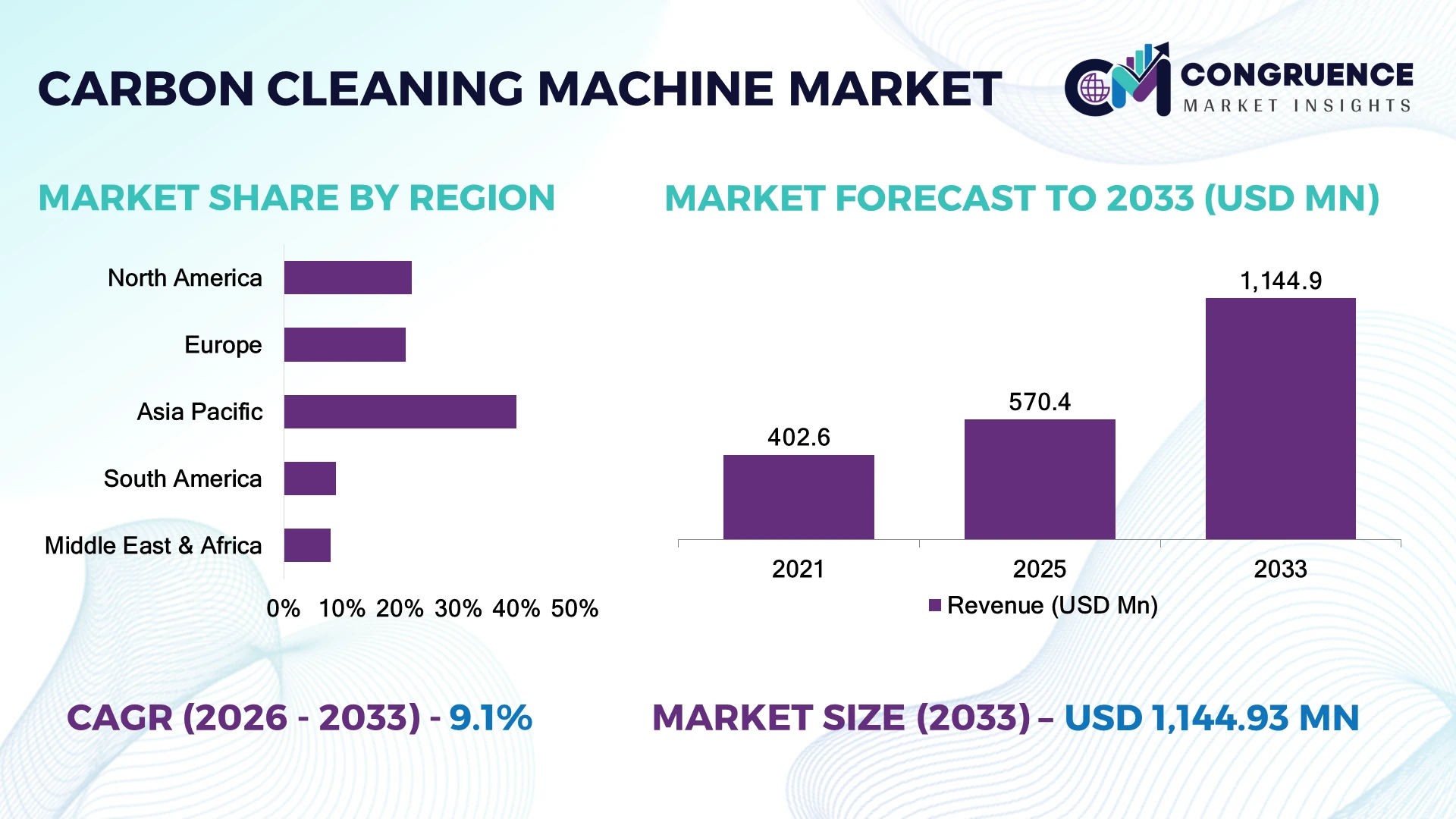
Asia Pacific accounts for approximately 40% of global demand, supported by high vehicle parc volumes, expanding automotive workshops, and growing adoption of hydrogen-based cleaning equipment. India is emerging as a major deployment market, with more than 1,500 carbon-cleaning service centers, while Europe places greater emphasis on emission compliance and advanced diagnostic integration. India’s workshop expansion contrasts with Europe’s technology-led adoption, where regulatory requirements strongly influence equipment selection.
The strategic priority is to target high-throughput workshops and fleet-service networks with automated, energy-efficient machines that improve service productivity rather than compete primarily on equipment price.
Market Size & Growth: USD 570.4 Million in 2025 to USD 1,144.9 Million by 2033 at 9.1% CAGR, driven by non-invasive engine maintenance and emission-control requirements.
Top Growth Drivers: Approximately 40% Asia Pacific demand, 30%+ workshop adoption momentum, and tightening vehicle-emission requirements are strengthening market expansion.
Short-Term Forecast: By 2028, automated carbon cleaning systems are positioned to reduce service-cycle time by 20–30% and increase workshop throughput.
Emerging Technologies: AI-assisted diagnostics, automated hydrogen flow control, and high-efficiency electrolysis are advancing machine accuracy and operating efficiency.
Regional Leaders: Asia Pacific is projected near USD 460 Million, Europe near USD 300 Million, and North America near USD 275 Million by 2033, with mobile deployment expanding.
Consumer/End-User Trends: More than 50% of commercial workshop demand is shifting toward preventive maintenance packages combining carbon cleaning with diagnostics and exhaust-system servicing.
Pilot/Case Example: A 2026 vehicle-level evaluation involving a 230,000-km vehicle demonstrated continued industry focus on measurable outcomes from hydrogen-based engine decarbonization.
Competitive Landscape: Leading competition includes DAYEL, Shenzhen AUTOOL, Okay Energy Equipment, Hunan Shichun New Energy, and specialized HHO equipment manufacturers.
Regulatory & ESG Impact: BS-VI and National VI requirements are strengthening preventive engine-maintenance practices, while hydrogen-based processes reduce reliance on solvent-intensive cleaning methods.
Investment & Funding: Manufacturers are prioritizing automated equipment, regional distribution partnerships, and workshop-network expansion as recurring service models gain traction.
Innovation & Future Outlook: Next-generation machines are integrating programmable gas generation, remote monitoring, automated diagnostics, and multi-service capabilities covering engines, DPFs, injectors, and EGR systems.
The Carbon Cleaning Machine Market is increasingly centered on workshop productivity rather than standalone cleaning capability. Hydrogen-based systems commonly target 30–60-minute treatment cycles, while integrated diagnostics and automated gas control improve process consistency. Asia Pacific remains a major deployment zone as BS-VI and comparable emission standards strengthen maintenance practices, accelerating the transition toward technology-enabled engine decarbonization.
Carbon cleaning machines are becoming strategically important as automotive service providers face increasing pressure to restore engine performance while limiting vehicle downtime and avoiding labor-intensive component removal. The market is shifting from standalone cleaning equipment toward integrated maintenance platforms combining hydrogen-based cleaning, DPF servicing, diagnostics, and automated operating controls. This transition aligns closely with stricter emission standards and the modernization of automotive workshop infrastructure.
Technology differentiation is increasingly measurable. Advanced electrolysis configurations can reduce electricity requirements for oxyhydrogen generation from approximately 5.8 kWh/m³ to around 3 kWh/m³, representing nearly 48% lower electricity consumption than conventional configurations. Europe is prioritizing sophisticated emissions-oriented servicing, while Asia Pacific is scaling deployment through large workshop networks, cost-efficient equipment, and mobile service models.
Over the next 2–3 years, competitive workshops are expected to prioritize machines capable of 30–60-minute treatment cycles, automated flow management, and multi-component servicing. Fleet operators are incorporating preventive carbon cleaning into scheduled maintenance to limit unplanned downtime. Equipment suppliers that combine machines with diagnostics, technician training, and service partnerships will strengthen recurring revenue and customer retention, making integrated deployment capability a decisive competitive advantage.
Stricter emission-control requirements are increasing the need for preventive engine decarbonization, particularly in India, Germany, and the United States. More than 40% of modern diesel vehicles rely on exhaust-treatment systems such as EGR and DPF, making carbon accumulation a measurable maintenance concern, while hydrogen-based cleaning can complete treatment cycles in roughly 30–60 minutes. The operational advantage is reduced dismantling and shorter workshop downtime compared with conventional mechanical cleaning. Indian automotive service networks are expanding carbon-cleaning capacity alongside BS-VI compliance requirements, while European workshops are prioritizing diagnostic-linked servicing. Manufacturers are responding with automated gas-flow controls, OBD integration, and bundled cleaning-diagnostic packages, improving equipment utilization and strengthening recurring service opportunities.
Electricity remains a material operating constraint because it represents more than 60% of levelized hydrogen-production cost, while installed electrolyzer systems can range from USD 750–2,450/kWe depending on technology and supplier geography. PEM systems remain about 20% more expensive than alkaline alternatives, increasing equipment-payback sensitivity for smaller workshops. In India, imported electrolysis components and specialized power electronics expose operators to currency and logistics volatility. Manufacturers are reducing exposure through localized assembly, multi-vendor component sourcing, longer-term procurement contracts, and greater use of lower-cost alkaline configurations. The key business implication is that machine suppliers with predictable energy consumption and localized service inventories can scale faster without compressing workshop-level margins.
The strongest opportunity is shifting carbon cleaning from a standalone service into a digitally monitored maintenance workflow. Advanced electrolyzer designs are reporting efficiencies approaching 80–84%, while critical-material innovations have reduced iridium and platinum requirements by up to 90% in some designs. India offers a particularly attractive expansion pathway as BS-VI emissions testing moves toward WLTP from April 2027, increasing the value of measurable engine-condition diagnostics. Manufacturers are developing automated gas-flow controls, OBD-linked diagnostics, remote service monitoring, and subscription-based maintenance packages. The non-obvious opportunity is fleet servicing: bundling carbon cleaning with preventive diagnostics can increase machine utilization and generate recurring service revenue rather than relying on infrequent equipment sales.
Long-term scalability depends on integrating carbon-cleaning equipment with increasingly complex vehicle electronics, diagnostic protocols, and emissions-control systems. Modern electrolyzer architectures still face durability and technology-specific integration constraints, while SOEC systems require operating temperatures above 650°C, limiting their suitability for decentralized automotive workshops. In India, the transition toward WLTP-based BS-VI testing from 2027 will increase the importance of repeatable measurement and standardized service procedures. Companies therefore need to invest in technician certification, machine telemetry, OBD interoperability, automated operating parameters, and standardized treatment records. The strategic risk is not machine availability but inconsistent outcomes across decentralized workshops; manufacturers that control the equipment–software–training ecosystem will be better positioned to maintain service quality at scale.
Hydrogen Systems Become Smarter: Carbon cleaning equipment is shifting toward automated hydrogen generation and digitally controlled treatment cycles, with advanced electrolyzers reporting 80–84% efficiency. Workshops are integrating automated gas-flow management to improve repeatability, reduce operator intervention, and support higher daily machine utilization.
Emission Testing Drives Diagnostics: India’s move to WLTP-based BS-VI emissions testing from April 2027 is pushing workshops toward measurable engine-condition assessment. Diagnostic integration is becoming more important as operators seek to connect carbon cleaning with emissions readings, fault codes, and post-service verification rather than selling cleaning as an isolated procedure.
Localized Equipment Supply Expands: Indian manufacturers are increasingly assembling carbon-cleaning systems domestically while building local technician and spare-parts networks. This reduces exposure to imported components and logistics disruption, while localized servicing can shorten equipment downtime by days compared with overseas parts procurement.
Fleet Maintenance Becomes Strategic: Commercial fleets are moving toward preventive engine and exhaust-system maintenance as downtime directly affects asset utilization. Carbon-cleaning providers are responding with mobile systems, scheduled service contracts, and bundled DPF/EGR diagnostics, creating higher machine utilization and more predictable recurring revenue than workshop-by-workshop equipment sales.
Hydrogen-based carbon cleaning machines represent the leading type, estimated at approximately 62% of global demand, supported by non-invasive operation, compatibility with petrol and diesel engines, and straightforward workshop integration. Their compact configurations also support mobile servicing, giving suppliers an advantage in fragmented markets such as India. Oxy-hydrogen systems account for roughly 38% and represent the faster-growing technology category as electronically controlled HHO generation improves treatment precision and supports shorter service cycles. The shift is particularly relevant for independent garages seeking higher bay utilization without engine dismantling.
The mature hydrogen-based segment remains the volume anchor, while oxy-hydrogen equipment is attracting a larger share of new product development. Manufacturers are emphasizing adjustable gas production, touchscreen controls, and automated treatment parameters, with approximately 15–20% of product-development activity increasingly directed toward control-system upgrades and compact architectures. Companies are shifting investment from basic generators toward digitally controlled platforms that improve repeatability, simplify technician operation, and support premium service positioning.
In 2025, Roland Berger's Automotive Aftermarket Pulse surveyed 600 workshops across 13 major automotive markets, highlighting technology and cost pressures facing independent repair businesses and strengthening the commercial case for productivity-enhancing workshop equipment.
Passenger cars account for approximately 68% of carbon cleaning machine demand, reflecting their substantially larger installed base and frequent exposure to urban stop-start driving, where deposit accumulation and exhaust-system maintenance remain relevant. Commercial vehicles represent about 32% but are the faster-growing application as fleet operators place greater emphasis on preventive maintenance, fuel utilization, and minimizing vehicle downtime. In India, passenger-car workshops prioritize affordable, rapid-turnaround services, whereas commercial fleets increasingly favor scheduled treatments linked to operating performance.
Commercial-vehicle adoption is estimated to expand at roughly 10–12% annually across high-utilization fleet channels, compared with approximately 6–8% growth in passenger-car service deployment. Manufacturers are responding with higher-capacity machines, mobile configurations, and service contracts aligned with fleet maintenance schedules. Marine and industrial-engine applications remain smaller niches but provide opportunities for specialized high-capacity systems. The strategic implication is that suppliers can increase machine utilization and recurring revenue by shifting from individual workshop sales toward fleet-oriented deployment models.
Roland Berger's 2025 Automotive Aftermarket Pulse found that vehicle owners in 11 of 13 surveyed markets spent less in real terms on maintenance and repair than in 2024, increasing pressure on workshops to demonstrate measurable value from additional services.
Independent garages represent the dominant end-user group, estimated at approximately 55% of global equipment deployment, because their large installed base, flexible service offerings, and lower procurement barriers support faster adoption. Authorized service centers account for around 30%, benefiting from OEM-aligned diagnostic infrastructure and standardized maintenance procedures, while fleet and industrial users comprise roughly 15%. Independent workshops in India, Southeast Asia, and Latin America increasingly use compact machines to introduce specialized decarbonization services without major facility expansion.
Fleet operators are the fastest-growing end-user group, with adoption expected to rise by approximately 12–14% annually as preventive maintenance becomes more closely linked to asset utilization and operating-cost control. Around 25% of new commercial-oriented equipment demand is shifting toward higher-capacity or mobile configurations designed for repeated fleet servicing. Manufacturers are responding through leasing models, technician-training packages, distributor partnerships, and customized service contracts. Authorized centers remain important for premium equipment, but the strategic opportunity is increasingly concentrated in independent and fleet ecosystems where suppliers can build recurring service relationships and improve equipment utilization.
In 2025, Roland Berger's Automotive Aftermarket Pulse surveyed 6,000 vehicle owners and 600 workshops across 13 markets, highlighting rising pressure on independent repair businesses to manage costs while keeping pace with increasingly complex vehicle technology.
Asia-Pacific accounted for the largest market share at 40% in 2025 however, South America is expected to register the fastest growth, expanding at a CAGR of 10.2% between 2026 and 2033.
Fleet Maintenance and Diagnostic Integration Reshape Demand
North America represents approximately 22% of global carbon cleaning machine demand, with deployment concentrated across independent automotive repair networks, diesel fleet workshops, and specialized service centers in the U.S. and Canada. The region's mature aftermarket favors equipment that integrates carbon cleaning with OBD diagnostics, DPF servicing, and preventive maintenance workflows rather than standalone cleaning. More than 35% of commercial-oriented installations are increasingly positioned around fleet or high-mileage vehicle servicing. U.S. operators are also adopting mobile equipment to service distributed fleet depots, reducing vehicle transfer requirements and improving bay utilization. Manufacturers are responding with higher-capacity systems, automated treatment cycles, and distributor-led technician training. The strategic opportunity lies in integrating carbon cleaning into scheduled fleet maintenance contracts rather than relying primarily on retail workshop transactions.
United States Market Outlook: The United States is the regional technology and deployment center, supported by a large light-vehicle parc, extensive commercial trucking activity, and sophisticated independent repair infrastructure. More than 60% of North American carbon-cleaning equipment demand is concentrated in U.S. workshops and fleet-service channels. Suppliers are prioritizing portable systems, diagnostic connectivity, and service partnerships that allow equipment to operate across multi-location maintenance networks.
Emission Compliance Accelerates Diagnostic-Led Servicing
Europe accounts for approximately 21% of global carbon cleaning machine demand, with Germany, the United Kingdom, France, and Italy representing the principal deployment markets. Regulatory pressure on particulate and NOx emissions is encouraging workshops to connect carbon cleaning with DPF, EGR, and engine-diagnostic services. Germany represents nearly 30% of European demand, supported by its large automotive manufacturing ecosystem and technically advanced aftermarket. Around 40% of new professional installations increasingly emphasize automated controls or diagnostic integration. Suppliers are shifting product development toward lower-energy hydrogen generation, standardized treatment protocols, and equipment capable of supporting multiple engine platforms. The strategic focus is moving from basic cleaning capability toward compliance-oriented maintenance packages that provide measurable service outcomes.
Germany Market Outlook: Germany remains Europe's most strategically significant market because of its automotive manufacturing base, dense workshop infrastructure, and high concentration of commercial and passenger vehicles. The country's large network of independent repair businesses creates a substantial installed-equipment opportunity, while premium workshops increasingly favor machines with automated process controls and diagnostic compatibility. Suppliers are strengthening distributor partnerships and technical training to support deployment across specialized aftermarket channels.
Workshop Scale and Local Manufacturing Drive Deployment
Asia-Pacific holds the largest position at approximately 40% of global carbon cleaning machine demand, led by China, India, Japan, and South Korea. China provides substantial equipment manufacturing capacity, while India is emerging as a major deployment market because of its expanding vehicle parc and independent workshop ecosystem. More than 45% of regional installations are concentrated in China and India combined. Domestic manufacturers are increasingly producing compact hydrogen-based systems for price-sensitive workshops, while larger operators are adopting automated equipment with higher gas-generation capacity. India’s BS-VI framework is strengthening demand for emission-focused maintenance, while Chinese manufacturers benefit from established component supply chains. Companies are expanding through local assembly, distributor networks, technician training, and fleet-service partnerships, creating a strong volume advantage for suppliers with scalable equipment platforms.
India Market Outlook: India is the region's strongest expansion market, supported by a rapidly expanding automotive service network and increasing emphasis on BS-VI-compliant vehicle maintenance. More than 1,500 carbon-cleaning service centers and workshops are estimated to operate across domestic and export-oriented channels, creating a broad installed-equipment base. Manufacturers are emphasizing compact machines, localized components, mobile servicing, and affordable financing to penetrate independent garages and multi-brand workshop networks.
Fleet Modernization Creates Untapped Service Demand
South America represents approximately 9% of global carbon cleaning machine demand, with Brazil and Argentina accounting for the majority of regional deployment. Brazil contributes more than 55% of South American demand because of its large vehicle population, extensive commercial transport activity, and established independent workshop network. Adoption remains concentrated in urban automotive-service clusters where equipment utilization can justify investment. Commercial fleets are increasingly evaluating preventive engine maintenance to reduce downtime and improve vehicle operating efficiency, while imported equipment remains exposed to currency and logistics costs. Manufacturers are responding through regional distributors, localized technician training, and lower-capacity machines suited to smaller workshops. The non-obvious opportunity is mobile servicing for distributed agricultural and logistics fleets, where centralized workshop infrastructure is limited and equipment portability directly improves utilization.
Brazil Market Outlook: Brazil dominates South American deployment because of its large automotive aftermarket, extensive road-freight activity, and concentration of independent repair businesses in São Paulo, Minas Gerais, and Paraná. The country represents more than half of regional carbon-cleaning machine demand. Suppliers are increasingly targeting fleet operators and high-volume workshops with mobile systems and bundled maintenance services, while local distribution partnerships help reduce import-related service delays and improve spare-parts availability.
Fleet Expansion and Workshop Modernization Support Adoption
The Middle East & Africa accounts for approximately 8% of global carbon cleaning machine demand, with the United Arab Emirates, Saudi Arabia, South Africa, and Egypt representing the principal deployment centers. Gulf markets are benefiting from large commercial vehicle fleets, premium automotive workshops, and rapid modernization of automotive-service infrastructure. The UAE and Saudi Arabia together represent approximately 45% of regional demand, while South Africa provides a strong independent-workshop base. More than 30% of new installations in major urban markets are increasingly targeted at professional workshops offering multi-service maintenance. Suppliers are expanding through dealership partnerships, mobile-service models, and localized technical support. The strategic priority is building reliable after-sales infrastructure because equipment downtime and imported spare-parts delays can materially reduce utilization in geographically dispersed markets.
Saudi Arabia Market Outlook: Saudi Arabia is the region's most strategically significant market due to large vehicle fleets, expanding automotive-service infrastructure, and sustained investment in modern workshop facilities. Riyadh, Jeddah, and Dammam are emerging as major deployment centers, with fleet-oriented service providers increasingly adopting automated maintenance equipment. Suppliers are positioning through local distributors, technician training, and fleet partnerships, while compact mobile systems provide an effective route into decentralized commercial and industrial vehicle servicing.
The competitive landscape pits established hydrogen-cleaning brands such as HydroTech, Kingkar and Okay Energy against regional manufacturers including Uniko India and technology-led specialists such as H2E. The top five players collectively hold an estimated 28% share, indicating a fragmented structure with strong regional competition. Competition centers on equipment price, gas-generation efficiency, automation, after-sales support and distributor reach; leading systems target 15–30-minute cleaning cycles, while premium platforms emphasize automated treatment controls. Chinese suppliers compete aggressively on manufacturing cost and export availability, whereas Indian companies differentiate through localization and workshop networks. European specialists compete through process consistency, mobile servicing and diagnostic integration. Current competition is shifting toward software-enabled machines, fleet partnerships and vertically integrated service ecosystems. Entry barriers remain moderate for hardware but rise sharply around patents, safety certification, technician training and distribution. Winning requires reliable output, localized support, scalable production and measurable workshop productivity. Uptime is becoming a decisive purchasing criterion.
DAYEL
Hy-Carbon Connect
Decaabo
BG Products
Carbon Clean
Kingkar Eco-Technologies
Oxyhtech
Hydrogen Carbon Clean
NOS2
HydroTech Clean Energy
H2E
Okay Energy Equipment
Hydrogen electrolysis remains the core technology, with advanced HHO systems increasingly using automated gas-flow regulation and digital treatment controls. Current machines typically complete passenger-vehicle treatments within 20–40 minutes, versus substantially longer dismantling-based cleaning workflows. Automated platforms can improve workshop throughput by approximately 20–30% through shorter intervention and repeatable settings. App-linked systems are emerging, allowing engine parameters to determine gas quantity and treatment duration, reducing operator variability. Around 30% of premium-oriented equipment now emphasizes automation, remote monitoring or digital controls.
Next-generation designs are also targeting higher-capacity engines, extending coverage from passenger cars toward trucks, buses, generators and industrial engines. H2E benefits from precision automation, while cost-focused manufacturers gain through scalable electrolyzer architectures. Between 2026 and 2028, diagnostic integration will become more important as workshops connect carbon cleaning with OBD data, DPF servicing and emissions verification. Suppliers investing now in software, sensor integration, safety controls and modular electrolyzer design can capture higher-value fleet contracts and differentiate beyond hardware pricing.
The competitive shift is therefore from standalone HHO generation toward integrated, data-enabled maintenance platforms that reduce service variability, improve technician productivity and support recurring service models. This transition also strengthens equipment utilization, service standardization, warranty control, and customer retention across multi-location workshop networks.
April 2025 HydroTech listed upgraded HHO carbon-cleaning equipment for engines up to 10,000cc, with models priced at INR 399,999 and INR 499,999. The expansion broadens localized equipment availability in India and supports workshops serving multiple passenger and commercial vehicle categories. Source: hydrotech.co.in
October 2025 Oxyhtech was featured in SAFIA’s second 2025 industry bulletin for decarbonization equipment, while its Ultra platform delivers 4,600 L/h oxyhydrogen output. The development strengthens European workshop distribution and supports higher-capacity fleet servicing deployments for fleets and industrial engines. Source: safia.ch
December 2025 Energy journal research tested oxyhydrogen across multiple fuel blends, finding gasoline CO reductions up to 59% and methane power gains near 17%. The evidence strengthens technical validation while highlighting NOx-control requirements for commercial carbon-cleaning technology developers and suppliers. Source: sciencedirect.com
July 2026 Scientific Reports evaluated hydrogen-oxygen mixture addition under real driving conditions, extending validation beyond controlled workshop demonstrations. The study strengthens measurement-based development of hydrogen-assisted engine treatment and provides equipment developers with operational evidence for optimizing protocols and performance verification. (Nature) Source: nature.com
The Carbon Cleaning Machine Market Report covers hydrogen-based and oxy-hydrogen machine types, passenger and commercial vehicle applications, and independent workshops, authorized service centers, fleets, and industrial users. The analysis evaluates capacity classes, automation levels, distribution models, and equipment configurations, capturing both established workshop deployment and emerging mobile servicing models. Geographic coverage spans North America, Europe, Asia-Pacific, South America, and Middle East & Africa, with detailed country-level assessment of India, China, the United States, Germany, Brazil, Saudi Arabia, and other strategically relevant markets.
The report assesses hydrogen electrolysis, automated gas-flow control, OBD connectivity, remote monitoring, DPF/EGR integration, and high-capacity systems for commercial engines. It quantifies deployment patterns, regional concentration, technology adoption, and competitive positioning across key suppliers. These insights support investment screening, market-entry planning, distributor selection, product prioritization, capacity expansion, partnership strategy, and competitive positioning through 2026–2033.
| Report Attribute/Metric | Report Details |
|---|---|
|
Market Revenue in 2025 |
USD 570.4 Million |
|
Market Revenue in 2033 |
USD 1,144.9 Million |
|
CAGR (2026 - 2033) |
9.1% |
|
Base Year |
2025 |
|
Forecast Period |
2026 - 2033 |
|
Historic Period |
2021 - 2025 |
|
Segments Covered |
By Type
By Application
By End-User
|
|
Key Report Deliverable |
Revenue Forecast, Growth Trends, Market Dynamics, Segmental Overview, Regional and Country-wise Analysis, Competition Landscape |
|
Region Covered |
North America, Europe, Asia-Pacific, South America, Middle East, Africa |
|
Key Players Analyzed |
DAYEL, Hy-Carbon Connect, Decaabo, BG Products, Carbon Clean, Kingkar Eco-Technologies, Oxyhtech, Hydrogen Carbon Clean, NOS2, HydroTech Clean Energy, H2E, Okay Energy Equipment |
|
Customization & Pricing |
Available on Request (10% Customization is Free) |




