
Reports
The Global Carbon Capture and Sequestration (CCS) Market was valued at USD 7940.78 Million in 2025 and is anticipated to reach a value of USD 25499.41 Million by 2033 expanding at a CAGR of 15.7% between 2026 and 2033. Growth is accelerating through large-scale industrial decarbonization, expanding carbon transport infrastructure, direct air capture innovation, and stricter emissions compliance across power generation, cement, steel, chemicals, and hydrogen production.
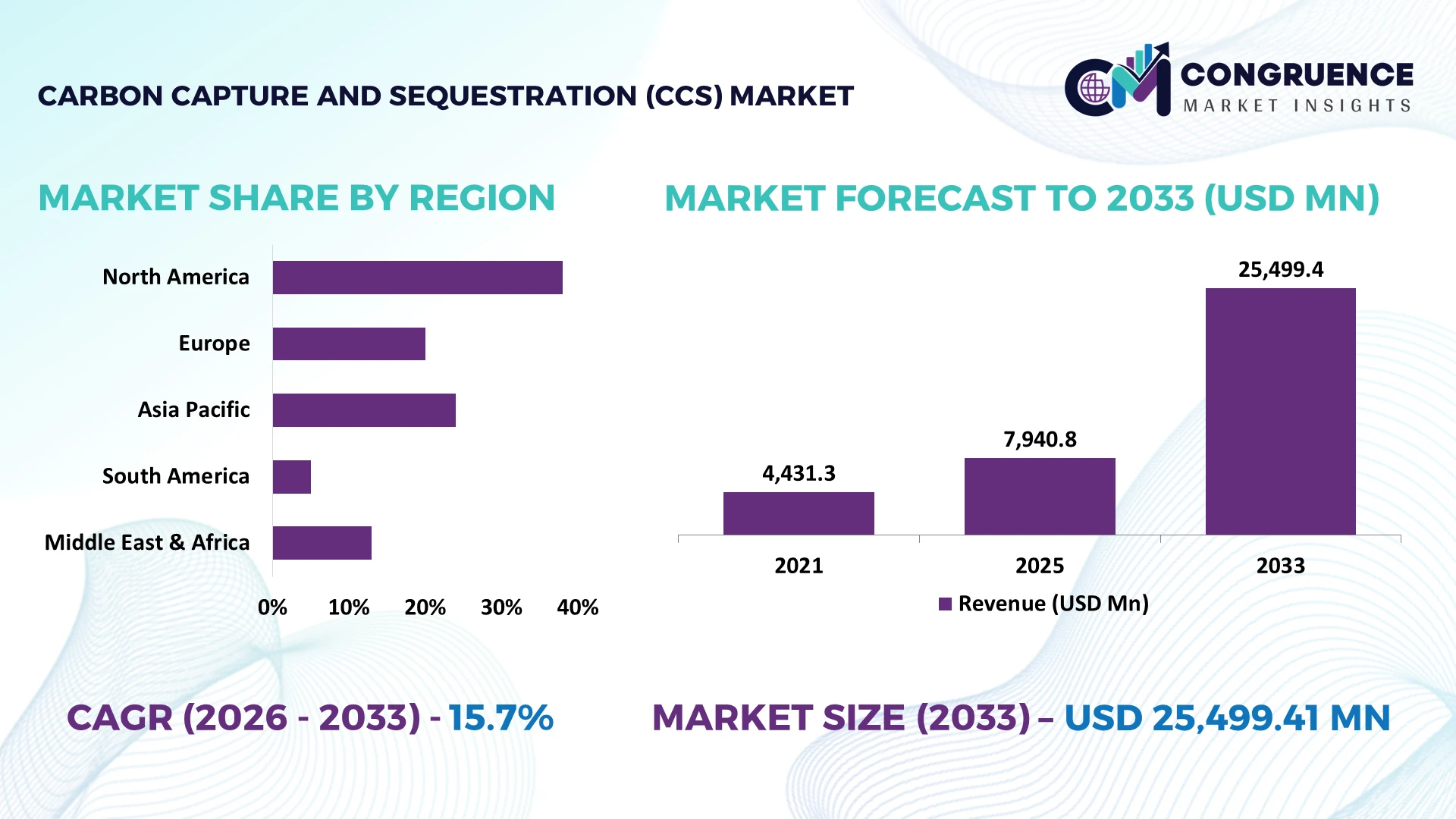
The United States leads the global Carbon Capture and Sequestration (CCS) Market with approximately 38% of operational capture capacity, supported by multi-billion-dollar federal incentives and deployment across refining, natural gas processing, ethanol, and power facilities. Norway maintains higher offshore CO₂ storage maturity, while the U.S. operates more commercial-scale projects, strengthening industrial leadership amid evolving energy security priorities and cross-border climate commitments.
Strategic implication: Companies investing in integrated capture, transport, and storage ecosystems secure stronger long-term positioning as industrial decarbonization shifts from pilot deployment to commercial-scale execution.
Market Size & Growth: USD 7940.78 Million in 2025, reaching USD 25499.41 Million by 2033 at 15.7% CAGR, driven by advanced industrial decarbonization technologies and expanding carbon transport infrastructure.
Top Growth Drivers: Industrial emissions reduction contributes over 45%, government incentive programs exceed 30%, and low-carbon hydrogen integration accounts for nearly 25% of deployment momentum.
Short-Term Forecast: By 2028, capture efficiency improves by over 15% while operating costs decline approximately 12% through automation and process optimization.
Emerging Technologies: AI-enabled monitoring, advanced solvent systems, and digital reservoir modeling improve operational reliability and storage verification across large-scale projects.
Regional Leaders: North America exceeds USD 10 billion, Europe approaches USD 7 billion, and Asia-Pacific surpasses USD 6 billion, supported by industrial cluster expansion and cross-border infrastructure development.
Consumer/End-User Trends: More than 60% of new heavy-industry decarbonization projects integrate carbon capture into long-term emissions management strategies.
Pilot/Case Example: In 2026, commercial CCS expansion improved capture performance by approximately 20% while enhancing long-term storage verification across integrated industrial facilities.
Competitive Landscape: The leading participant holds roughly 12% market presence, with major competition from SLB, Shell, ExxonMobil, Aker Carbon Capture, and Mitsubishi Heavy Industries.
Regulatory & ESG Impact: Carbon reduction mandates support over 40% of announced industrial CCS investments, accelerating compliance and sustainability targets across manufacturing sectors.
Investment & Funding: More than USD 20 billion in project commitments supports regional expansion, strategic partnerships, shared transport networks, and commercial storage hubs.
Innovation & Future Outlook: Next-generation modular capture systems, digital optimization, and integrated carbon management platforms strengthen scalable deployment across high-growth industrial value chains.
Carbon Capture and Sequestration (CCS) Market demand is expanding across cement, steel, refining, chemicals, and low-carbon hydrogen production as operators prioritize permanent emissions reduction. Advanced solvent technologies, AI-based process optimization, and continuous monitoring systems improve operational performance, with capture efficiency increasing by around 15% in advanced installations. Expanding cross-border CO₂ transport infrastructure and evolving regulatory frameworks are reinforcing commercial deployment, setting the stage for broader strategic market evaluation.
Carbon Capture and Sequestration (CCS) has become a strategic industrial capability as governments and manufacturers prioritize emissions reduction without compromising heavy industrial output. Competition increasingly centers on integrated carbon management rather than standalone capture technologies, while regulatory reforms and carbon transport infrastructure modernization are reshaping investment priorities. Industrial clusters are replacing isolated projects, enabling shared pipelines and storage networks that lower operating costs and accelerate commercial deployment across steel, cement, refining, and low-carbon hydrogen value chains.
Advanced solvent-based capture systems now achieve nearly 15% higher capture efficiency and reduce energy consumption by around 10% compared with conventional amine-based configurations, improving project economics for continuous industrial operations. The United States leads commercial deployment through large-scale industrial hubs, while Norway maintains leadership in offshore geological storage innovation with mature monitoring capabilities. Over the next two to three years, more than 30% of newly announced industrial decarbonization projects are expected to incorporate integrated carbon transport and storage infrastructure instead of standalone capture facilities.
A practical example is the development of shared CCS hubs where multiple industrial emitters utilize common transport pipelines and storage reservoirs, significantly improving asset utilization and reducing infrastructure duplication. Companies are expanding strategic partnerships between technology providers, pipeline operators, and energy companies while increasing investment in digital monitoring platforms and storage verification systems. Organizations establishing scalable, integrated CCS ecosystems will strengthen competitive positioning through lower operating costs, stronger regulatory alignment, and long-term industrial resilience.
Industrial decarbonization commitments are accelerating commercial CCS deployment as heavy industries seek permanent emissions management solutions. More than 65% of announced industrial carbon reduction projects now evaluate capture integration during facility modernization, while shared transport infrastructure lowers project costs by approximately 20%. The United States continues expanding carbon pipeline networks alongside federal policy support, encouraging faster commercialization across ethanol, cement, and refining industries. This structural shift improves project bankability and operational efficiency. Companies are responding through joint ventures, long-term storage agreements, and technology partnerships that combine capture equipment, transport systems, and geological storage, creating integrated carbon management platforms with stronger competitive differentiation.
Limited transport infrastructure and uneven storage availability remain major structural constraints despite increasing industrial demand. Transport and storage activities can account for nearly 35% of total project expenditure, while permitting timelines extend project development by over 25% in several industrial jurisdictions. Germany and other European markets continue facing infrastructure coordination challenges that delay commercial-scale deployment. These limitations reduce investment certainty and restrict project scalability for industrial operators. Companies are mitigating exposure through localized storage partnerships, long-term transport contracts, modular capture deployment, and diversified project portfolios that reduce dependence on single infrastructure corridors while improving operational flexibility.
Digital optimization and integrated carbon ecosystems are creating high-value commercial opportunities beyond conventional capture projects. AI-enabled process optimization improves operational efficiency by approximately 12%, while advanced monitoring systems reduce storage verification time by nearly 30%. Japan is strengthening next-generation carbon utilization and storage initiatives through coordinated industrial collaboration and advanced engineering capabilities. Companies are investing in digital twins, automated monitoring, and integrated carbon accounting platforms alongside research partnerships focused on lower-energy solvents and modular capture technologies. The strongest competitive advantage will emerge from organizations delivering end-to-end carbon management services rather than standalone capture equipment.
Commercial success increasingly depends on coordinating capture facilities, transport infrastructure, storage reservoirs, and digital verification within a unified operational framework. More than 40% of large-scale CCS developments involve multiple industrial stakeholders, increasing contractual complexity and project coordination requirements, while skilled technical workforce demand has risen by over 20%. Australia and other resource-intensive markets continue expanding geological storage capability, but workforce availability and cross-sector integration remain operational pressures. Companies must strengthen digital asset management, workforce development, standardized monitoring protocols, and cross-industry partnerships to maintain deployment consistency, improve operational reliability, and secure durable competitive advantage in large-scale carbon management.
Integrated Carbon Hub Expansion: Industrial clusters are replacing standalone CCS facilities, with shared transport and storage infrastructure reducing project development costs by nearly 20% and increasing storage utilization above 30%. The United States is accelerating multi-user hub deployment following infrastructure modernization, while operators are forming long-term partnerships to maximize pipeline efficiency, standardize CO₂ logistics, and shorten commercial commissioning timelines.
Digital Monitoring Standardization: AI-enabled reservoir monitoring, fiber-optic sensing, and automated verification platforms have improved storage surveillance accuracy by approximately 25% while reducing manual inspection requirements by over 30%. Growing regulatory verification requirements are accelerating digital adoption, prompting technology providers and energy companies to integrate cloud-based analytics, predictive maintenance, and continuous emissions reporting into commercial CCS operations.
Industrial Retrofit Acceleration: Existing cement, refining, and chemical facilities are increasingly adopting modular retrofit solutions that reduce installation downtime by around 18% and improve capture efficiency by nearly 15%. Labor shortages and extended construction schedules are encouraging phased deployment strategies, leading equipment suppliers to expand modular manufacturing capacity and strengthen engineering partnerships for faster industrial integration.
Cross-Sector Partnership Models: Energy producers, pipeline operators, technology developers, and heavy manufacturers are shifting toward integrated commercial ecosystems, reducing duplicated infrastructure investment by approximately 22% while improving project execution speed by over 15%. Norway and the United Kingdom continue advancing collaborative storage networks, encouraging companies to prioritize long-term capacity agreements, digital coordination platforms, and shared operational governance.
Post-Combustion remains the leading segment, accounting for approximately 47% of the Carbon Capture and Sequestration (CCS) Market because it integrates efficiently with existing industrial assets, particularly power plants, refineries, and cement facilities. Its retrofit compatibility minimizes production disruption while reducing capital replacement requirements, making it the preferred option for industrial modernization. Oxy-Fuel Combustion continues gaining traction in specialized industrial processes where higher CO₂ concentration improves separation efficiency, while Pre-Combustion maintains strategic importance for hydrogen production and integrated gasification projects.
Direct Air Capture represents the fastest-growing segment as technological improvements reduce energy intensity and expand commercial viability. Capture efficiency has improved by nearly 15%, while modular system deployment has shortened installation schedules by approximately 20%. Companies are increasing investment in next-generation sorbent materials, automation platforms, and strategic partnerships to commercialize scalable Direct Air Capture solutions while strengthening Post-Combustion portfolios through process optimization and digital monitoring. Investment priorities increasingly balance mature retrofit technologies with emerging atmospheric carbon removal capabilities.
Power Generation remains the dominant application, representing roughly 36% of deployment due to high emission intensity, established infrastructure, and continuous operational requirements. Utilities are integrating carbon capture into existing generating assets to comply with emissions targets while extending plant operating life. Oil & Gas continues as a mature application through gas processing and enhanced operational carbon management. Chemical Processing supports stable demand because concentrated CO₂ streams improve capture efficiency compared with dispersed industrial emissions.
Cement Production is emerging as the fastest-growing application because process emissions cannot be eliminated through electrification alone. Capture integration within cement facilities has increased by approximately 18%, while digital process optimization has improved operational efficiency by nearly 12%. Steel Manufacturing is also accelerating deployment through integrated decarbonization programs linked with low-carbon production pathways. Equipment suppliers are expanding modular solutions, automation capabilities, and engineering partnerships to serve increasingly complex industrial applications requiring continuous production reliability.
Power Utilities remain the largest end-user group, accounting for approximately 39% of commercial deployment due to extensive emissions profiles, existing infrastructure, and long operating lifecycles. Large utility operators continue integrating carbon capture into thermal generation assets while modernizing facilities for lower-emission operation. Oil & Gas Companies remain major adopters because existing subsurface expertise, transport infrastructure, and operational experience accelerate commercial implementation across carbon management projects.
The Cement Industry represents the fastest-growing end-user segment as manufacturers pursue permanent process-emission reduction strategies. Industrial adoption has expanded by nearly 20%, while digital plant optimization improves capture integration efficiency by approximately 14%. Steel Industry demand continues strengthening through low-carbon production initiatives, and the Chemical Industry benefits from relatively concentrated emission streams that simplify capture operations. Technology providers are responding through sector-specific engineering solutions, long-term service agreements, ecosystem partnerships, and customized deployment models that improve operational performance across diverse industrial environments.
North America accounted for the largest market share at 41% in 2025 however, Asia-Pacific is expected to register the fastest growth, expanding at a CAGR of 17.2% between 2026 and 2033.
Industrial Carbon Hub Leadership Strengthens
North America remains the global center for commercial Carbon Capture and Sequestration deployment, supported by mature pipeline infrastructure, favorable policy frameworks, and extensive industrial emissions clusters. The region contributes approximately 41% of global deployment activity, with the United States and Canada leading large-scale carbon transport and geological storage initiatives. More than 70% of announced regional projects are concentrated around integrated industrial hubs serving refining, ethanol, natural gas processing, and cement manufacturing. Multi-user transport infrastructure continues reducing operational duplication while improving asset utilization. Technology providers are expanding long-term engineering partnerships and digital monitoring capabilities to improve storage verification, operational reliability, and regulatory compliance across commercial-scale carbon management projects.
United States Market Outlook: The United States remains the strategic foundation of the regional market through extensive geological storage resources, advanced engineering capabilities, and expanding carbon transport networks. More than 200 carbon capture and storage projects are in various development stages, supporting deployment across power generation, refining, hydrogen, and industrial manufacturing. Companies continue strengthening integrated project partnerships, digital monitoring systems, and long-term storage agreements to accelerate commercial implementation and improve operational efficiency.
Cross-Border Storage Networks Drive Commercial Scale
Europe is accelerating CCS commercialization through coordinated transport infrastructure, offshore storage development, and industrial decarbonization policies. The region accounts for approximately 29% of global market activity, with deployment increasingly centered on shared storage networks serving multiple industrial sectors. Carbon transport corridors connecting manufacturing clusters with offshore storage reservoirs are reducing infrastructure duplication and improving long-term project viability. More than 40 large-scale projects continue progressing through coordinated public-private collaboration. Industrial operators are expanding engineering alliances, digital monitoring platforms, and standardized storage verification systems while integrating CCS into broader energy transition strategies.
Norway Market Outlook: Norway maintains technology leadership through advanced offshore geological storage expertise and established carbon transport infrastructure. Commercial storage developments continue supporting multiple European industrial emitters, while continuous investment in reservoir monitoring enhances operational confidence. Offshore storage capacity expansion and integrated shipping solutions strengthen Norway's position as a strategic carbon storage destination supporting regional industrial decarbonization.
Heavy Industry Deployment Accelerates
Asia-Pacific is emerging as the fastest-expanding CCS market due to large industrial emissions, manufacturing modernization, and growing investment in low-carbon technologies. The region represents nearly 22% of current deployment activity, with steel, cement, chemicals, and power generation driving commercial implementation. Industrial operators are integrating modular capture systems during plant modernization, reducing installation complexity while improving operational efficiency. Several governments continue supporting demonstration projects and industrial carbon management infrastructure, encouraging enterprise collaboration. Equipment manufacturers are strengthening domestic supply chains and technology partnerships to improve deployment speed and expand commercial manufacturing capacity.
China Market Outlook: China is rapidly strengthening its position through large-scale industrial deployment, strong manufacturing capabilities, and expanding low-carbon industrial programs. Steel, cement, coal chemicals, and power generation remain primary deployment sectors, while integrated industrial parks increasingly evaluate shared carbon transport infrastructure. Continuous investment in domestic capture technologies and engineering capabilities supports faster commercialization and enhances the country's long-term competitiveness in industrial carbon management.
Energy Sector Integration Expands
South America is gradually advancing CCS deployment by leveraging existing oil and gas infrastructure alongside industrial emissions management initiatives. The region contributes approximately 4% of global market activity, with Brazil leading commercial evaluation across offshore energy operations and industrial manufacturing. Existing pipeline infrastructure provides opportunities for future carbon transport integration, although storage development remains at an earlier stage compared with mature markets. Strategic partnerships between energy companies and engineering providers are improving technical readiness while supporting pilot-scale implementation. Infrastructure development and regulatory alignment remain essential for broader commercial deployment.
Brazil Market Outlook: Brazil possesses strong long-term potential through offshore expertise, established energy infrastructure, and expanding industrial decarbonization initiatives. National oil and gas operators continue evaluating carbon storage opportunities associated with offshore production systems while industrial companies examine capture integration within refining and manufacturing operations. Growing collaboration between energy producers and technology suppliers is strengthening technical capabilities and preparing the country for larger commercial-scale deployment.
Energy Diversification Supports Carbon Management
The Middle East & Africa market is advancing through large-scale industrial diversification, expanding carbon management investments, and integration with hydrogen development strategies. The region contributes approximately 4% of global deployment, with hydrocarbon producers utilizing existing subsurface expertise and industrial infrastructure to accelerate commercial implementation. National energy companies continue investing in carbon capture linked to refining, petrochemicals, and natural gas processing. Several large industrial facilities are increasing capture capacity while integrating digital monitoring technologies to strengthen operational performance. Enterprise collaboration and long-term infrastructure planning continue improving project execution and commercial readiness.
Saudi Arabia Market Outlook: Saudi Arabia leads regional development through integrated industrial expansion, large hydrocarbon operations, and national energy transition initiatives. Carbon capture projects are increasingly linked with blue hydrogen production, refining, and petrochemical operations, strengthening industrial competitiveness. Strategic investments in storage infrastructure, engineering capabilities, and technology partnerships continue expanding commercial deployment while positioning the country as a regional leader in large-scale carbon management solutions.
The Carbon Capture and Sequestration (CCS) Market is led by technology developers such as SLB, Aker Carbon Capture, Mitsubishi Heavy Industries, Shell, and ExxonMobil competing against regional engineering contractors and specialized carbon management providers. The top five participants collectively control approximately 46% of commercial market activity through integrated technology portfolios, storage expertise, and project execution capability. Competition increasingly centers on capture efficiency, lifecycle operating costs, and integrated infrastructure rather than equipment pricing alone. Advanced solvent technologies improve energy efficiency by nearly 15%, while AI-enabled monitoring reduces storage verification time by approximately 25% and modular systems shorten installation schedules by around 18%. Companies are strengthening competitive positions through cross-sector partnerships, transport infrastructure investments, digital platform integration, and vertical collaboration across capture, transport, and storage operations. Market dynamics are shifting toward full-service carbon management ecosystems, making standalone equipment suppliers less competitive. High capital intensity, geological expertise, permitting complexity, and infrastructure access remain major entry barriers. Winning requires integrated execution capability, scalable technology, digital optimization, and long-term industrial partnerships.
SLB
Aker Carbon Capture
Mitsubishi Heavy Industries
Shell
ExxonMobil
Fluor Corporation
Linde plc
Honeywell
Carbon Clean
Climeworks
Svante
Air Liquide
Baker Hughes
Halliburton
Current technology development is centered on improving capture efficiency while lowering operational energy demand across heavy industries. Advanced solvent formulations, membrane separation technologies, and modular capture systems are replacing conventional amine-based processes in new installations. Modern solvent systems deliver nearly 15% higher capture efficiency while reducing regeneration energy requirements by approximately 12% compared with legacy configurations. More than 45% of newly announced commercial projects now integrate digital process optimization during the engineering stage, enabling improved operational reliability and lower maintenance requirements across continuous industrial facilities.
Emerging technologies are expanding beyond capture into intelligent carbon management. AI-driven process optimization, digital twins, fiber-optic reservoir monitoring, and autonomous inspection platforms improve storage verification accuracy by approximately 25% while reducing manual monitoring requirements by nearly 30%. Technology providers offering integrated software, monitoring, and engineering capabilities gain stronger competitive positioning because industrial customers increasingly prefer unified carbon management platforms instead of disconnected equipment solutions. Automated workflow integration also accelerates commissioning and improves long-term asset performance across multi-site industrial operations.
Between 2026 and 2028, modular Direct Air Capture systems, advanced solid sorbents, and continuous subsurface monitoring will reshape commercial deployment strategies. Early adoption is expected across more than 35% of new industrial carbon management initiatives where scalability, standardized deployment, and digital verification become procurement priorities. Companies investing now in integrated capture technologies, intelligent monitoring platforms, and interoperable infrastructure will achieve stronger operational resilience, faster deployment cycles, and superior competitive differentiation as commercial carbon management ecosystems continue expanding.
October 2024 Global CCS Institute reported accelerated CCS infrastructure expansion, highlighting 628 projects across development stages and global capture capacity projected to exceed 100 million tonnes annually after construction completion. The update strengthened investor confidence in large-scale carbon hubs and industrial decarbonization planning. Source: https://www.globalccsinstitute.com
September 2024 Aker Solutions advanced Northern Lights CCS infrastructure in Norway, supporting liquefied CO₂ transport and offshore storage operations with planned capacity of 1.5 million tonnes annually. The expansion improved Europe’s cross-border carbon management capabilities and strengthened integrated storage network development. Source: https://www.akersolutions.com
January 2026 ExxonMobil commenced commercial CCS operations with CF Industries in Louisiana, capturing up to 2 million tonnes of CO₂ annually from ammonia production. The partnership expanded industrial carbon storage services and reinforced ExxonMobil’s position in large-scale CCS project execution. Source: https://www.exxonmobil.com
June 2026 Global Cement and Concrete Association partnered with Global CCS Institute to accelerate cement-sector CCS adoption through technical collaboration and industry engagement. The agreement supports deployment scaling across cement facilities, improving sector readiness for carbon capture integration and emissions reduction strategies. Source: https://www.globalcement.com
The Carbon Capture and Sequestration (CCS) Market Report covers detailed analysis across capture technologies including Pre-Combustion, Post-Combustion, Oxy-Fuel Combustion, and Direct Air Capture. The study evaluates applications across Power Generation, Oil & Gas, Cement Production, Steel Manufacturing, and Chemical Processing, while assessing adoption patterns among utilities, industrial manufacturers, and energy companies.
The report provides regional analysis across North America, Europe, Asia-Pacific, South America, and Middle East & Africa, highlighting infrastructure development, storage capacity expansion, technology adoption, and competitive positioning. It examines emerging areas such as digital monitoring, modular capture systems, carbon transport networks, and integrated storage platforms. The analysis supports investment planning, partnership strategies, expansion decisions, and competitive positioning by identifying deployment trends and strategic priorities shaping the market between 2026 and 2033.
| Report Attribute/Metric | Report Details |
|---|---|
Market Revenue in 2025 | USD 7940.78 Million |
Market Revenue in 2033 | USD 25499.41 Million |
CAGR (2026 - 2033) | 15.7% |
Base Year | 2025 |
Forecast Period | 2026 - 2033 |
Historic Period | 2021 - 2025 |
Segments Covered | By Type
By Application
By End-User
|
Key Report Deliverable | Revenue Forecast, Growth Trends, Market Dynamics, Segmental Overview, Regional and Country-wise Analysis, Competition Landscape |
Region Covered | North America, Europe, Asia-Pacific, South America, Middle East, Africa |
Key Players Analyzed | SLB, Aker Carbon Capture, Mitsubishi Heavy Industries, Shell, ExxonMobil, Fluor Corporation, Linde plc, Honeywell, Carbon Clean, Climeworks, Svante, Air Liquide, Baker Hughes, Halliburton |
Customization & Pricing | Available on Request (10% Customization is Free) |




