
Reports
The Global Carbomer Market was valued at USD 690 Million in 2025 and is anticipated to reach a value of USD 1099.75 Million by 2033 expanding at a CAGR of 6% between 2026 and 2033. Growth is being driven by the shift toward high-viscosity, low-use-level formulation systems in pharmaceutical gels, advanced skincare, and multifunctional personal-care products, alongside regional manufacturing expansion.
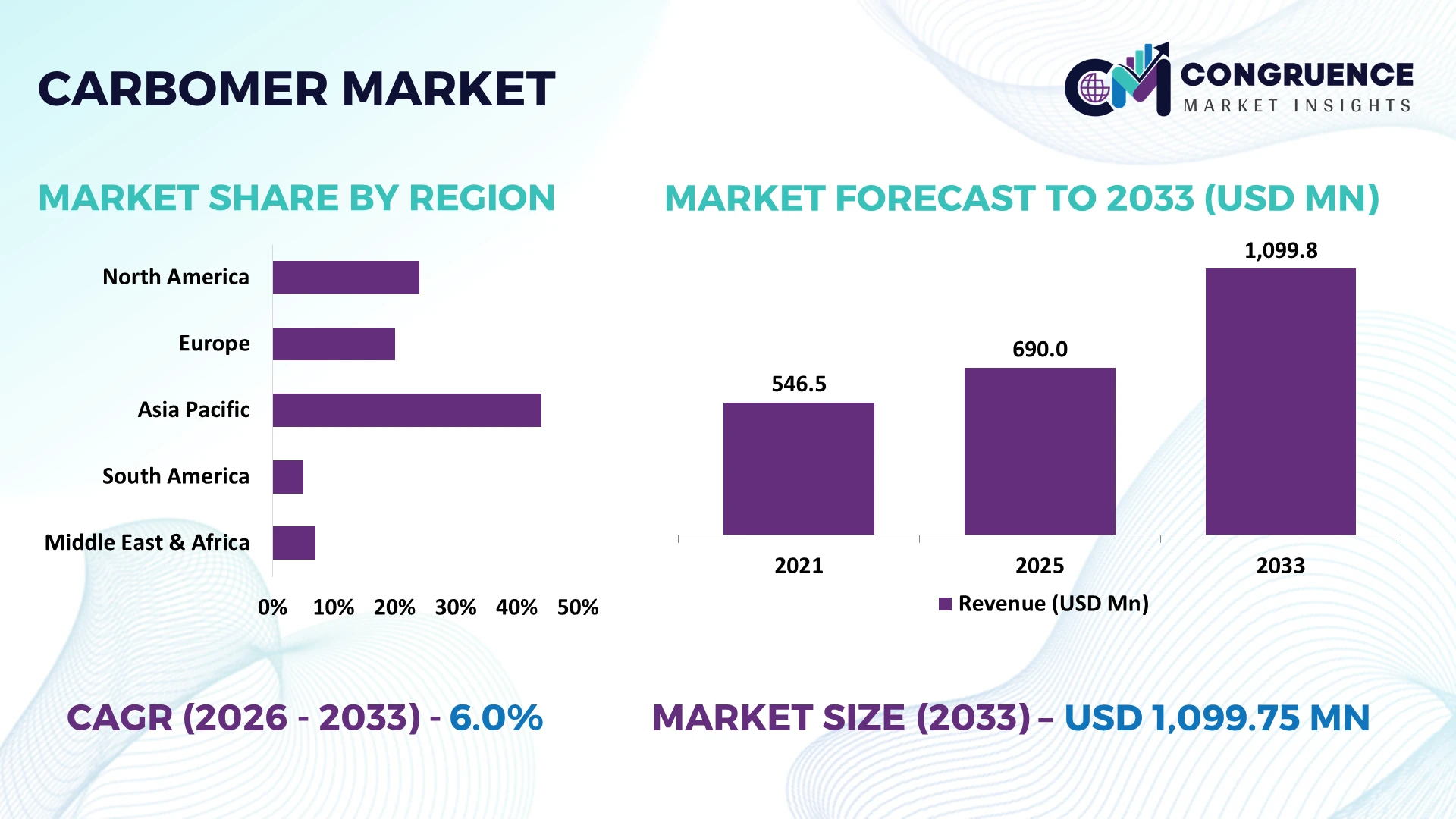
Asia Pacific dominates the global carbomer landscape with a 40.5% share, led by China, which accounts for about 34% of regional demand; Chinese suppliers are scaling GMP-grade production, while pharmaceutical, skincare, and cosmetics manufacturing continues to expand. North America holds about 25.3%, giving Asia Pacific a clear 15.2-percentage-point lead. Lubrizol’s USD 350 million India investment reinforces regional localization.
Strategically, suppliers should prioritize Asia-Pacific capacity, pharmaceutical-grade approvals, and sustainable polymer innovation to defend margins and capture formulation-led growth.
Market Size & Growth: USD 690 million in 2025 to USD 1099.75 million by 2033 at 6% CAGR, supported by pharmaceutical-grade formulations and localized supply chains.
Top Growth Driver 1: 40.5% Asia Pacific share reflects concentrated cosmetics, personal-care, and pharmaceutical manufacturing demand.
Top Growth Driver 2: 55%+ skincare application share highlights carbomer’s central role in gel, cream, serum, and emulsion formulations.
Top Growth Driver 3: 34% of Asia Pacific demand attributed to China reinforces its manufacturing and formulation advantage.
Short-Term Forecast: By 2030, formulation automation and rheology optimization target 5–10% lower processing variability across high-volume gel production.
Emerging Technologies: Bio-based rheology modifiers, AI-assisted formulation, and advanced cross-linked polymers are reshaping performance and sustainability specifications.
Regional Leaders: Asia Pacific reaches about USD 445 million by 2033 on the supplied market trajectory; North America and Europe remain strategic high-value formulation hubs.
Consumer/End-User Trends: More than 55% of cosmetic carbomer demand is linked to skincare, strengthening demand for clear, lightweight, multifunctional formulations.
Pilot/Case Example: 2024 Carbopol Fusion S-20 demonstrated commercial sustainability traction, securing 8 innovation awards and accelerating biodegradable-polymer positioning.
Competitive Landscape: Lubrizol leads with approximately 22.3% share, followed by Ashland, BASF, Evonik, and Sumitomo Seika; China-based suppliers are intensifying regional competition.
Regulatory & ESG Impact: EU REACH requirements and biodegradable-polymer development are accelerating qualification of lower-impact grades, while Lubrizol’s Carbopol BioSense advances bio-based formulation options.
Investment & Funding: Lubrizol committed USD 350 million to localized India manufacturing and regional investment, signaling a broader shift toward resilient, near-market specialty-polymer supply chains.
Innovation & Future Outlook: Next-generation carbomers are shifting competition from basic thickening toward biodegradable rheology control, pharmaceutical excipient qualification, formulation precision, and regionalized production.
Carbomer demand is increasingly concentrated in skincare, pharmaceutical gels, oral care, and high-performance personal-care formulations, where viscosity control, suspension stability, and sensory performance remain critical. More than 55% of cosmetic-oriented demand is associated with skincare applications, while biodegradable and bio-based polymer development is accelerating product differentiation. Regional manufacturing expansion, including new Indian capacity, is reinforcing supply-chain localization and setting the stage for the market’s strategic evolution.
The Carbomer Market is becoming strategically important because formulation performance is increasingly influencing product differentiation across pharmaceuticals, skincare, oral care, and specialty cosmetics. Carbomers deliver viscosity, suspension, and gel stability at relatively low concentrations, allowing manufacturers to optimize texture and active-ingredient delivery. Asia Pacific represents about 40.5% of market demand, with China contributing nearly 34% of regional consumption, creating a powerful manufacturing and formulation center.
Supply-chain restructuring is now shifting procurement toward localized specialty-polymer production. Lubrizol’s USD 350 million India investment illustrates this move toward regional capacity and shorter supply routes. Technology is also improving operating economics: optimized high-efficiency carbomer systems can reduce polymer loading by roughly 10–20% versus conventional grades while maintaining comparable rheological performance. China emphasizes production scale, while India is strengthening pharmaceutical and personal-care formulation capabilities and North America remains more focused on premium specialty grades.
Over the next 2–3 years, adoption of multifunctional, bio-based, and pharmaceutical-grade carbomers is expected to accelerate, with automated formulation and tighter rheology control reducing batch variability by an estimated 5–10%. Companies are prioritizing local manufacturing, application laboratories, and formulation partnerships to secure qualification-driven demand. Competitive advantage will increasingly depend on polymer performance, regulatory readiness, supply resilience, and the ability to provide application-specific grades rather than commodity volume alone.
The strongest growth driver is the increasing use of carbomers in high-performance formulations requiring precise viscosity and suspension control. Skincare applications account for more than 55% of cosmetic-oriented demand, while China represents about 34% of Asia Pacific consumption. Advanced grades can deliver comparable rheological performance with roughly 10–20% lower polymer loading than conventional systems, improving formulation economics and reducing material intensity. Pharmaceutical manufacturers are also moving toward higher-purity excipient grades as regulatory scrutiny increases. Companies are responding through application-specific polymer development, localized technical centers, and expanded GMP-oriented production. The non-obvious advantage is that lower-use-level grades improve both formulation cost control and logistics efficiency, strengthening supplier positioning beyond simple price competition.
Cost volatility and qualification requirements remain structural restraints, particularly for manufacturers dependent on specialized acrylic-based polymer inputs and imported grades. China accounts for approximately 34% of Asia Pacific demand, creating concentration exposure when regional logistics or chemical-feedstock conditions tighten. Qualification cycles for pharmaceutical applications can also extend commercialization timelines by 10–20% compared with less regulated cosmetic formulations. Regulatory compliance adds further testing, documentation, and reformulation costs. These pressures directly affect inventory planning, margins, and customer-switching flexibility. Companies are reducing exposure through dual sourcing, regional contracts, safety-stock strategies, and localized production. The key operational insight is that supply resilience increasingly carries the same commercial value as polymer price, particularly for customers requiring uninterrupted pharmaceutical manufacturing.
The largest emerging opportunity lies in next-generation carbomers that combine high rheological efficiency with lower environmental impact. Skincare already represents more than 55% of cosmetic-oriented demand, creating a large addressable base for biodegradable and bio-based formulation technologies. Optimized polymers delivering 10–20% lower dosage requirements can reduce material consumption while preserving viscosity and suspension performance. India offers a particularly attractive expansion pathway because pharmaceutical manufacturing and domestic personal-care formulation are developing simultaneously. Companies are increasing R&D spending, establishing application partnerships, and developing specialty grades for sensitive-skin, pharmaceutical, and sustainable formulations. The strategic opportunity is to monetize performance per gram rather than polymer volume, enabling suppliers to protect margins while meeting increasingly demanding ESG specifications.
Long-term competitiveness depends on maintaining consistent rheology across large-scale production, particularly when formulations transition from laboratory batches to automated commercial lines. Batch-to-batch viscosity variation of even 5–10% can trigger filling, dispensing, texture, or stability problems in sensitive formulations. Pharmaceutical-grade products face substantially higher documentation and validation requirements than conventional cosmetic grades, while evolving sustainability expectations are adding material-screening complexity. India and China offer strong manufacturing scale but require continued investment in quality systems, technical workforce capabilities, and process automation. Companies must therefore strengthen statistical process control, application testing, supplier qualification, and technical partnerships. The critical challenge is not simply producing more carbomer; it is maintaining reproducible polymer performance across geographies, formulations, and increasingly stringent regulatory specifications.
Low-Dosage Formulation Optimization: Formulators are increasingly using high-efficiency carbomer grades at 0.2–2.0 wt% use levels, reducing polymer loading while preserving viscosity and suspension performance. Automated dispersion and neutralization workflows are shortening batch-adjustment cycles by an estimated 10–15%. Suppliers are responding with faster-dispersing grades and application-lab support, particularly for hair-care and transparent gel systems.
Pharma-Grade Qualification Tightens: Pharmaceutical buyers are placing greater emphasis on validated excipient quality, impurity control, and regulatory documentation. Carbomer 940 remains specifically recognized for aqueous and hydroalcoholic gel applications, while qualification-intensive procurement is increasing supplier switching costs. Companies are expanding GMP-oriented production and documentation capabilities as U.S. and international regulatory expectations tighten.
Supply Chains Become Regionalized: Acrylic-acid availability, freight volatility, and geopolitical supply-chain pressure are pushing buyers toward dual sourcing across China, India, and North America. Supplier diversification is increasing procurement resilience while reducing exposure to single-country disruptions. Manufacturers are responding through regional inventory buffers, local partnerships, and capacity expansion closer to formulation hubs.
Premium Grades Gain Share: Carbomer 980 is gaining traction in leave-on skincare and pharmaceutical formulations requiring clarity and tighter impurity control, while Carbomer 940 retains broad-volume use. Premium-grade procurement is increasingly tied to performance specifications rather than lowest unit cost, prompting suppliers to expand customized polymers and technical partnerships.
Carbomer 940 remains the leading type, representing approximately 35% of cosmetic-grade carbomer demand in 2025, supported by high viscosity, clarity, suspension capability, and broad compatibility across gels and creams. Its established formulation base gives manufacturers strong scalability and lower qualification friction. Carbomer 934 and 941 remain strategically relevant in pharmaceutical and personal-care formulations where established regulatory familiarity and controlled rheology matter. Companies continue to prioritize 940 production for high-volume applications while maintaining diversified grade portfolios.
Carbomer 980 is the fastest-growing type, driven by demand for higher-purity, clear, and premium leave-on formulations. Adoption is strengthening in South Korea, Japan, and France as formulators tighten impurity and ingredient specifications. Carbomer 981 occupies a complementary position where lower-viscosity rheology is preferred. The strategic shift is toward performance-specific grade selection rather than universal polymer substitution, encouraging suppliers to expand specialty capacity and application testing.
Cosmetics & Skincare is the leading application, accounting for approximately 55% of cosmetic-grade carbomer demand in 2025, supported by extensive use in creams, gels, serums, and emulsions. The category benefits from carbomer’s clarity, texture control, and low-use-level efficiency. Hair Care represents about 20%, providing a substantial secondary market through styling gels, conditioners, and treatment products. Companies are expanding transparent-gel and multifunctional formulations while optimizing polymer dosage to control material costs.
Topical Pharmaceuticals are the fastest-strengthening application within the specified portfolio as manufacturers increasingly use carbomer for topical gels, suspensions, and controlled-release systems. Oral Care remains a smaller but stable application, where rheology and suspension control support product consistency. The operational divide is clear: cosmetics prioritize sensory performance and speed-to-market, while pharmaceuticals prioritize validated quality and reproducibility. Suppliers are therefore separating application-specific technical support and qualification strategies.
Pharmaceutical Companies represent the most strategically intensive end-user group, with pharmaceutical applications estimated at about 41% of overall carbomer application demand in 2025 in one market assessment. Their purchasing decisions emphasize validated excipient quality, batch consistency, regulatory documentation, and supply continuity rather than price alone. Cosmetics Manufacturers remain a major volume buyer, while Personal Care Manufacturers increasingly differentiate through texture, clarity, and low-residue formulations.
Healthcare Products Manufacturers represent an important emerging buyer group as carbomer use expands across topical and hygiene-oriented formulations. Personal Care Manufacturers are also increasing adoption of application-specific grades, particularly where formulation efficiency and premium sensory attributes matter. Companies are responding with customized technical specifications, long-term supply agreements, and application partnerships. The competitive shift is from selling standardized polymer grades toward co-developing formulations that reduce qualification time and improve production consistency.
Asia Pacific accounted for the largest market share at 40.5% in 2025 however, Asia Pacific is expected to register the fastest growth, expanding at a CAGR of 6.4% between 2026 and 2033.

Premium Pharmaceutical Grades Reshape Regional Procurement
North America holds approximately 25.3% of global carbomer demand, with the United States accounting for nearly 85% of regional consumption. Pharmaceutical gels, dermatological products, premium skincare, and oral-care formulations remain the principal demand centers. Buyers increasingly prioritize high-purity grades, validated specifications, and supply continuity, shifting procurement away from lowest-cost sourcing. Automated formulation and tighter rheology control are improving batch consistency, while domestic inventory strategies reduce replenishment exposure. U.S. pharmaceutical manufacturers are expanding specialty formulation capacity, encouraging suppliers to strengthen application laboratories and technical partnerships. The region’s competitive advantage increasingly rests on pharmaceutical-grade qualification, customization, and rapid technical support rather than production scale alone.
United States Market Outlook: The United States is the dominant North American market, supported by advanced pharmaceutical manufacturing, established cosmetics production, and stringent quality systems. Approximately 85% of regional demand is concentrated in the country, creating strong supplier incentives for domestic inventory, formulation support, and specialized carbomer grades.
Regulatory Compliance Accelerates Specialty-Grade Adoption
Europe represents approximately 24.7% of global carbomer demand, with Germany, France, Italy, and the United Kingdom forming the principal formulation centers. Pharmaceutical and premium cosmetics manufacturers increasingly require controlled viscosity, purity documentation, traceability, and consistent batch performance. EU chemical-management requirements are pushing suppliers toward more transparent ingredient qualification and efficient formulation systems. Germany contributes roughly 30% of European demand, while France maintains strong positioning through cosmetics and skincare production. Manufacturers are responding with application-specific grades, regional warehousing, and technical partnerships. The strategic shift is toward polymers that deliver stronger formulation performance at lower use levels, allowing customers to manage material efficiency while meeting increasingly demanding regulatory and sustainability specifications.
Germany Market Outlook: Germany remains Europe’s most important carbomer market because of its pharmaceutical manufacturing depth, specialty-chemical infrastructure, and advanced quality-control systems. The country accounts for approximately 30% of European demand, encouraging suppliers to emphasize validated grades, consistent rheology, regulatory documentation, and dependable industrial supply.
Manufacturing Scale Drives Supply-Chain Localization
Asia Pacific commands approximately 40.5% of global carbomer demand, supported by extensive pharmaceutical, cosmetics, personal-care, and chemical manufacturing. China contributes nearly 34% of regional consumption, while Japan and India provide important high-value formulation and manufacturing bases. China’s large-scale production ecosystem enables cost-efficient supply, whereas Japan emphasizes high-purity and precision formulations. India is strengthening its strategic position through pharmaceutical manufacturing expansion and localized specialty-chemical infrastructure. Lubrizol’s more than USD 350 million India investment demonstrates the move toward regional production and application support. Suppliers are expanding capacity, technical centers, and local partnerships to shorten lead times and reduce dependence on long-distance supply chains.
China Market Outlook: China is the leading country within Asia Pacific, supported by large-scale cosmetics manufacturing, pharmaceutical production, and established specialty-chemical infrastructure. Its approximately 34% share of regional demand gives domestic suppliers significant scale advantages, while multinational companies are strengthening localized technical support and application-specific product portfolios.
Brazil Strengthens Localized Formulation Demand
South America remains a developing carbomer market, with Brazil serving as the principal demand and manufacturing center. Cosmetics, skincare, pharmaceuticals, oral care, and hygiene products account for the majority of regional consumption, while domestic contract manufacturing supports recurring polymer requirements. Brazil represents more than 50% of South American demand, giving suppliers a clear entry point for regional expansion. Import dependence remains an operational constraint because freight costs, currency movements, and lead times influence procurement decisions. Companies are responding through distributor partnerships, regional inventory, and application support rather than immediately establishing large-scale polymer facilities. The most relevant strategic shift is closer supplier integration with Brazilian formulators to accelerate grade qualification and reduce replenishment delays.
Brazil Market Outlook: Brazil is the strongest South American market because of its extensive cosmetics and pharmaceutical manufacturing ecosystem. More than half of regional carbomer demand is concentrated in the country, encouraging suppliers to strengthen distributor networks, maintain local inventory, and provide formulation support for domestic manufacturers.
Pharmaceutical Localization Supports Regional Expansion
Middle East & Africa accounts for approximately 4.0% of global carbomer demand, with Saudi Arabia, the UAE, South Africa, and Egypt representing the most commercially relevant markets. Pharmaceutical localization, personal-care manufacturing, and healthcare-product modernization are strengthening demand for specialty rheology modifiers. Saudi Arabia and the UAE are emerging as important pharmaceutical and distribution hubs, while South Africa provides an established consumer-health manufacturing base. Regional procurement remains heavily dependent on imports, making inventory availability and lead-time management critical. Suppliers are responding through regional distributors, warehousing partnerships, regulatory assistance, and localized technical services. The strategic opportunity lies in connecting imported specialty grades with growing domestic formulation capacity while reducing supply interruptions through regional stocking models.
Saudi Arabia Market Outlook: Saudi Arabia holds the strongest strategic position in the Middle East & Africa market through pharmaceutical localization and industrial diversification. Expanding domestic manufacturing under Vision 2030 is encouraging suppliers to develop regional distribution, technical partnerships, and application support for pharmaceutical and personal-care manufacturers.
Lubrizol, Ashland, BASF, Evonik, and Sumitomo Seika compete directly as global specialty-polymer leaders, while Chinese and Indian producers challenge them through cost efficiency and shorter regional supply chains. The top five players collectively control approximately 85% of the market, creating high qualification and technology barriers. Competition centers on polymer purity, rheological performance, customization, price, and supply reliability. Premium grades can reduce polymer loading by approximately 10–20%, strengthening the technology-led pricing advantage of established suppliers. Asian manufacturers are expanding localized production and distributor networks, while global players are investing in application laboratories, regional inventory, and pharmaceutical-grade capacity. The competitive shift is moving from commodity-volume competition toward application-specific performance and supply resilience. Entry pressure remains high because validated manufacturing processes, regulatory documentation, and customer qualification require significant technical investment. Companies that combine consistent quality, responsive regional supply, formulation expertise, and differentiated polymer performance will secure the strongest competitive position.
Lubrizol Corporation
Ashland Inc.
BASF SE
Evonik Industries AG
Sumitomo Seika Chemicals Co., Ltd.
Guangzhou Tinci Materials Technology Co., Ltd.
SNF Group
Anhui Newman Fine Chemical Co., Ltd.
Corel Pharma Chem
DX Chemical Co., Ltd.
Maruti Chemicals
Nanjing COSMOS Chemical Co., Ltd.
Hangzhou Lingeba Technology Co., Ltd.
Guangdong Richest Chemical Co., Ltd.
Current carbomer technology is shifting toward high-efficiency rheology control, low-dosage dispersion, and automated neutralization. Advanced grades can deliver target viscosity with roughly 10–20% lower polymer loading than conventional systems, while process automation cuts batch adjustment time by 10–15%. Adoption is strongest in pharmaceutical gels and premium skincare, where reproducibility directly affects filling, stability, sensory quality, and qualification speed.
Emerging platforms combine bio-based polymers, precision molecular engineering, and cold-process formulation. Lubrizol’s Carbopol BioSense contains more than 98% natural-origin content and demonstrated 2–7x viscosity improvement in selected emulsion systems. By 2026–2028, biodegradable rheology modifiers and digital formulation screening will gain traction, benefiting suppliers able to validate performance, sustainability, and regulatory compatibility simultaneously. This shift also reduces material intensity and supports cleaner product claims.
Disruptive integration is moving carbomer selection from catalog purchasing toward application-specific formulation engineering. AI-assisted screening, inline viscosity monitoring, and automated dosing can improve formulation consistency by 5–10% while reducing rework. Established suppliers benefit from technical laboratories and qualification databases, whereas regional producers gain through faster customization. Companies acting now can lock in validated grades, shorten scale-up cycles, and strengthen supply resilience through 2028. This favors suppliers combining validated excipients, technical service, regional inventory, and documented performance data across applications.
March 2025 Lubrizol and Suzano pre-launched Carbopol BioSense in Brazil, a readily biodegradable polymer with more than 98% natural-origin content. The partnership expands sustainable rheology options and strengthens premium beauty formulation differentiation through sourced cellulosic materials, supporting resilience. Source: Lubrizol
May 2025 Pioma Chemicals introduced Biopol carbomers positioned as alternatives to conventional grades, eliminating benzene residual-solvent concerns. The development targets pharmaceutical and personal-care formulations, strengthening safety-focused differentiation and supporting qualification-driven substitution in regulated applications and faster qualification cycles. Source: PharmaBiz
March 2025 FDA updated its compounding guidance listing Carbomer 940 and carbomer gels among recognized substances. The update reinforces pharmaceutical-grade relevance while increasing pressure on manufacturers to verify ingredient quality, documentation, and formulation compliance during procurement for manufacturers. Source: FDA
April 2026 Anhui Newman promoted NM-Carbomer 1 amid higher U.S.-China tariffs, positioning domestic substitution as a supply-chain response. The company highlighted the polymer’s multifunctional thickening, suspension, and emulsification capabilities, supporting lower ingredient complexity for formulators across Asian markets. Source: Newman
The Carbomer Market Report covers the five types—Carbomer 934, 940, 941, 980, and 981—across Topical Pharmaceuticals, Cosmetics & Skincare, Hair Care, and Oral Care. End-user analysis evaluates Pharmaceutical Companies, Cosmetics Manufacturers, Personal Care Manufacturers, and Healthcare Products Manufacturers, with emphasis on formulation intensity, grade selection, procurement behavior, and application-specific performance. The report also assesses advanced rheology systems, low-dosage formulation, bio-based polymers, automated processing, and sustainable alternatives.
Geographic coverage spans North America, Europe, Asia-Pacific, South America, and Middle East & Africa, with country-level analysis centered on manufacturing and consumption hubs. Asia-Pacific’s approximately 40.5% share establishes a benchmark for regional comparison, while pharmaceutical and skincare applications remain important demand anchors. The analysis supports 2026–2033 investment planning through competitive benchmarking, capacity priorities, supply-chain localization, technology adoption, partnership opportunities, market-entry decisions, and identification of emerging niche applications where performance-driven carbomer grades can strengthen positioning.
| Report Attribute/Metric | Report Details |
|---|---|
Market Revenue in 2025 | USD 690 Million |
Market Revenue in 2033 | USD 1099.75 Million |
CAGR (2026 - 2033) | 6% |
Base Year | 2025 |
Forecast Period | 2026 - 2033 |
Historic Period | 2021 - 2025 |
Segments Covered | By Type
By Application
By End-User
|
Key Report Deliverable | Revenue Forecast, Growth Trends, Market Dynamics, Segmental Overview, Regional and Country-wise Analysis, Competition Landscape |
Region Covered | North America, Europe, Asia-Pacific, South America, Middle East, Africa |
Key Players Analyzed | Lubrizol Corporation, Ashland Inc., BASF SE, Evonik Industries AG, Sumitomo Seika Chemicals Co., Ltd., Guangzhou Tinci Materials Technology Co., Ltd., SNF Group, Anhui Newman Fine Chemical Co., Ltd., Corel Pharma Chem, DX Chemical Co., Ltd., Maruti Chemicals, Nanjing COSMOS Chemical Co., Ltd., Hangzhou Lingeba Technology Co., Ltd., Guangdong Richest Chemical Co., Ltd. |
Customization & Pricing | Available on Request (10% Customization is Free) |




