
Reports
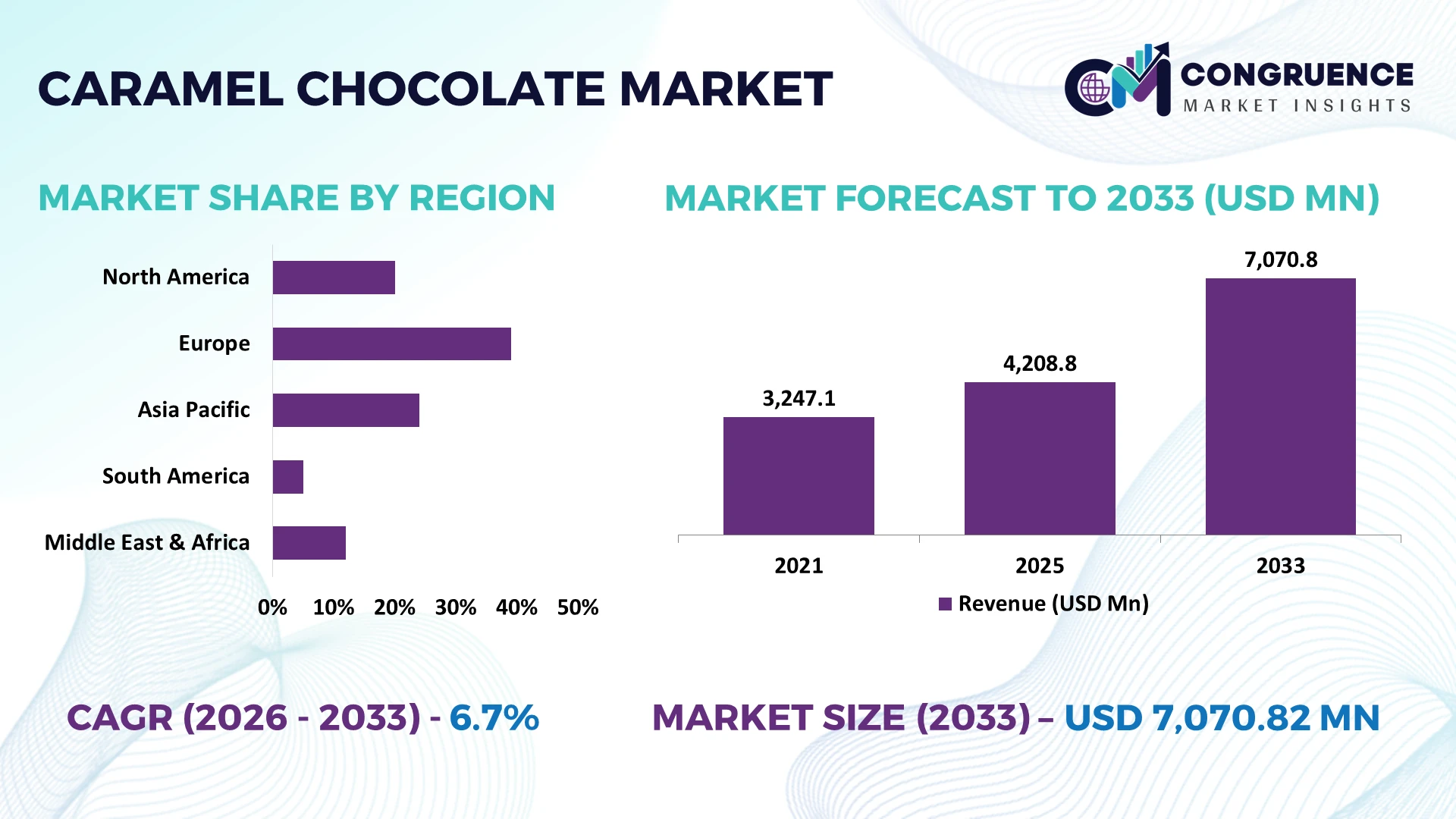
The Global Caramel Chocolate Market was valued at USD 4208.76 Million in 2025 and is anticipated to reach a value of USD 7070.82 Million by 2033 expanding at a CAGR of 6.7% between 2026 and 2033. Growth is driven by premium caramel inclusions, filled-bar innovation, portion-controlled formats, and expanding seasonal gifting portfolios across modern retail and e-commerce.
The United States remains the dominant country market, supported by its large chocolate confectionery base, advanced manufacturing capacity, and high household penetration; chocolate represented about 52% of U.S. confectionery sales in 2025, while nearly 100% of households purchased confectionery at least once. The U.S. therefore holds a stronger consumption platform than emerging markets such as India, where premium chocolate adoption is expanding from a smaller base.
Strategic decisions should prioritize premiumization, automated filling and coating capacity, and resilient cocoa-sourcing strategies aligned with evolving EU deforestation-traceability requirements.
Market Size & Growth: USD 4.21 billion in 2025 to USD 7.07 billion by 2033 at 6.7% CAGR, driven by premium fillings and product-format innovation.
Top Growth Drivers: Premiumization 32%, seasonal gifting 24%, e-commerce expansion 19%.
Short-Term Forecast: By 2028, automated production is positioned to reduce processing costs 8% and improve line efficiency 10%.
Emerging Technologies: AI-assisted flavor development, robotic depositing, and precision tempering are reshaping high-growth caramel chocolate production.
Regional Leaders: Europe targets approximately USD 2.3 billion, North America USD 2.1 billion, and Asia-Pacific USD 1.8 billion, supported by premium and digital retail adoption.
Consumer/End-User Trends: Nearly 52% of U.S. confectionery sales came from chocolate in 2025, reinforcing caramel chocolate's strong indulgence positioning.
Pilot/Case Example: In 2025, AI-supported confectionery development programs cut product-development timelines by approximately 3 months while expanding innovation pipelines.
Competitive Landscape: Hershey, Mars, Ferrero, Mondelez, and Nestlé anchor the competitive field, with leading players benefiting from extensive retail distribution and manufacturing scale.
Regulatory & ESG Impact: Cocoa traceability requirements are pushing suppliers toward farm-level digital records, increasing compliance readiness across sourcing networks.
Investment & Funding: More than USD 5 billion in recent U.S. confectionery expansion and acquisitions demonstrates aggressive capacity building, portfolio diversification, and regional manufacturing investment.
Innovation & Future Outlook: Next-generation products will emphasize reduced-sugar caramel, premium inclusions, AI-led flavor personalization, recyclable packaging, and resilient cocoa supply chains.
The caramel chocolate market is increasingly concentrated around premium bars, filled formats, and convenient single-serve products, with supermarkets, convenience channels, and digital commerce capturing distinct consumption occasions. Approximately 49% of caramel chocolate application demand is concentrated in supermarkets and hypermarkets, while product innovation increasingly combines caramel with nuts, sea salt, biscuit inclusions, and reduced-sugar formulations. Cocoa traceability and supply-chain resilience are becoming central strategic priorities as global manufacturers adapt to regulatory changes and input-cost volatility, setting the stage for deeper competitive and investment analysis.
The Caramel Chocolate Market is becoming strategically important as confectionery leaders compete through premiumization, differentiated textures, and faster product innovation rather than volume alone. Caramel inclusions, sea-salt combinations, filled centers, and reduced-sugar formulations are expanding portfolio value while digital retail is reshaping product discovery. Supply-chain restructuring is also accelerating as manufacturers strengthen cocoa traceability and diversify sourcing.
Automation is creating measurable operational advantages. Robotic depositing and precision tempering can improve production-line efficiency by approximately 8–12% versus labor-intensive legacy processes while reducing material inconsistencies by about 5%. The United States remains the largest innovation and manufacturing platform, whereas India is moving faster in premium chocolate adoption and modern retail penetration from a smaller installed base. Over the next 2–3 years, automated lines and digitally monitored quality systems are positioned to reach broader deployment across large confectionery plants.
A practical deployment model combines automated caramel filling, inline inspection, and recyclable packaging within integrated production cells. Major manufacturers are directing capital toward flexible equipment, regional manufacturing, supplier partnerships, and traceable cocoa procurement. Companies that combine formulation innovation with resilient sourcing and production automation will secure stronger margins, faster launches, and more defensible competitive positioning.
Premium confectionery positioning is accelerating demand for caramel chocolate formats featuring sea salt, nuts, biscuit inclusions, and layered fillings. Approximately 32% of category growth initiatives emphasize premium formulations, while limited-edition products can command 15–20% higher price points than standard offerings. In the United States, premium chocolate innovation is increasingly supported by automated depositing and precision tempering. Cocoa traceability requirements are simultaneously pushing manufacturers toward more controlled procurement. Companies are responding through flexible production-line investments, specialty ingredient partnerships, and faster seasonal product development. The non-obvious advantage is portfolio elasticity: manufacturers can use one automated platform to produce multiple caramel textures and formats, reducing changeover constraints while strengthening premium shelf positioning.
Input-cost volatility remains a structural restraint because caramel chocolate depends on cocoa, sugar, dairy ingredients, nuts, and specialty inclusions with different supply exposures. Cocoa price shocks have increased procurement pressure, while specialty ingredients can represent 10–15% of formulation costs in premium products. European manufacturers also face additional traceability requirements under evolving deforestation regulations, increasing documentation and supplier-management workloads. These pressures directly affect gross margins, inventory planning, and smaller producers' ability to scale premium SKUs. Companies are responding through multi-origin sourcing, longer-term procurement contracts, formulation optimization, and selective localization. A key operational insight is that procurement resilience increasingly determines product profitability before manufacturing efficiency is considered.
Advanced manufacturing creates an opportunity to combine AI-assisted formulation, robotic depositing, machine-vision inspection, and digitally controlled tempering. Automated confectionery lines can deliver approximately 8–12% higher throughput and 5–7% lower process waste than comparable manual operations. India offers an especially attractive expansion pathway as premium chocolate penetration develops alongside organized retail and e-commerce. Manufacturers are investing in flexible equipment capable of supporting smaller batches, rapid flavor changes, and personalized packaging. Partnerships between ingredient developers, automation vendors, and confectionery producers are becoming strategically valuable. The strongest opportunity lies in using modular production systems to serve premium and mass-market products from the same manufacturing footprint.
Maintaining consistent caramel viscosity, chocolate temper, filling ratios, and shelf stability becomes difficult as manufacturers expand product variety. Process deviations of only 2–4% in filling weight can create measurable material losses across high-volume lines, while frequent SKU changes increase changeover complexity. European plants face additional operational pressure from traceability and packaging-sustainability requirements. Companies must integrate machine vision, inline sensors, automated dosing, and digital quality-control platforms rather than adding isolated equipment. Workforce capability is equally important, with advanced lines requiring stronger automation and process-engineering skills. The strategic challenge is not automation alone; it is building interoperable production cells that preserve texture and flavor consistency while supporting rapid commercialization and sustainable packaging transitions.
Multisensory Caramel Formats: Texture-led innovation is accelerating as 44% of consumers are highly attracted to unexpected textures and 42% find sweet-savory chocolate combinations highly relevant. Manufacturers are scaling layered caramel, crunchy inclusions, and contrasting fillings, using advanced enrobing and depositing processes to differentiate premium SKUs.
Shorter Ingredient Formulations: Clean-label reformulation is becoming operationally important, with 83% of consumers looking for shorter ingredient lists when buying chocolate confectionery. Brands are reducing formulation complexity, testing alternative fats and sweeteners, and restructuring recipes to maintain caramel creaminess while addressing changing health expectations and ingredient-cost pressure.
Cocoa Supply Restructuring: Cocoa procurement is shifting toward diversification, traceability, and alternative ingredients as global stocks fell from more than 2 million tonnes in 2021 to about 1.3 million tonnes in 2024–25. Manufacturers are strengthening supplier networks, evaluating cocoa alternatives, and redesigning formulations to protect margins without compromising flavor consistency.
AI-Enabled Chocolate Development: AI is moving beyond marketing analytics into cocoa sourcing, flavor development, quality control, and manufacturing optimization. Machine-learning systems are increasingly used to model weather and supply risks and refine roasting and ingredient ratios, while manufacturers combine automation with R&D workflows to improve consistency and accelerate product development.
Milk Chocolate remains the leading type, accounting for approximately 48% of caramel chocolate demand, supported by broad consumer acceptance, scalable molding, and strong compatibility with caramel inclusions. Dark Chocolate holds nearly 28%, benefiting from premium and reduced-sugar positioning, while White Chocolate maintains a specialized role in seasonal and filled products. Filled Chocolate is the fastest-growing type, with adoption increasing around 10% as layered centers and multi-texture formats gain traction. Caramelized Chocolate remains niche because of higher process complexity but strengthens premium differentiation.
Manufacturers are shifting investment toward flexible filling, molding, and enrobing systems that support multiple formats through shared infrastructure, reducing production changeovers by approximately 8%. The strategic shift favors Filled Chocolate for premium-margin expansion while Milk Chocolate retains scale advantages. Companies are increasingly balancing mature volume platforms with specialized formulations that improve texture, differentiation, and shelf positioning.
Confectionery is the leading application, representing approximately 58% of caramel chocolate usage because bars, pralines, filled pieces, and seasonal products provide highly scalable caramel integration. Bakery Products account for roughly 17%, while Ice Cream & Desserts contribute approximately 13%. Snacks and Beverages remain smaller applications but are gaining formulation attention. Ice Cream & Desserts represent the fastest-growing application, with adoption rising around 9% as manufacturers expand caramel swirls, chocolate inclusions, coatings, and layered textures.
Companies are deploying standardized inclusions and temperature-stable formulations, reducing process variability by nearly 5% while improving production consistency. Bakery Products remain strategically important for fillings and toppings, while Snacks are gaining through portable indulgence formats. Manufacturers are therefore prioritizing application-specific product development rather than one-size-fits-all caramel chocolate systems, creating stronger opportunities for customized ingredients and cross-category partnerships.
Confectionery Manufacturers lead end-user demand at approximately 61%, reflecting extensive infrastructure for molding, filling, enrobing, and seasonal production. Bakery Manufacturers represent around 15%, followed by Dairy & Dessert Companies at approximately 11%. Foodservice Operators remain smaller but increasingly deploy caramel chocolate in premium desserts and beverages, while Retailers influence private-label formulations and seasonal assortments. Dairy & Dessert Companies are the fastest-growing end-user group, with adoption expanding approximately 8% as premium frozen desserts and layered products gain traction.
Companies are responding through customized inclusions, co-development partnerships, application engineering, and flexible production agreements. Retailers are strengthening private-label caramel chocolate portfolios, while Foodservice Operators emphasize portion control and premium presentation. The competitive advantage is shifting toward suppliers capable of providing consistent ingredients alongside application-specific technical support, allowing manufacturers to address multiple end-user requirements without duplicating formulation infrastructure.
North America accounted for the largest market share at 36% in 2025 however, Asia-Pacific is expected to register the fastest growth, expanding at a CAGR of 7.4% between 2026 and 2033.

Premiumization and Automated Manufacturing Scale
North America holds the leading position in the Caramel Chocolate Market, supported by high chocolate consumption, established confectionery manufacturing infrastructure, and extensive retail distribution. The United States represents the primary demand and production hub, with large manufacturers operating high-capacity molding, filling, enrobing, and packaging facilities. Premium caramel combinations, seasonal formats, and portion-controlled products are strengthening production utilization. Automated depositing and robotic handling are improving line productivity by approximately 8–12%, while digital quality-control systems support consistent filling and coating. Companies are diversifying cocoa procurement and strengthening long-term supplier agreements to manage commodity volatility. Investment is increasingly shifting toward flexible production platforms capable of producing filled, layered, and multi-texture caramel chocolate formats without extensive equipment duplication.
United States Market Outlook: The United States remains the region's strongest consumption and manufacturing base, supported by advanced confectionery infrastructure and nationwide retail penetration. Chocolate represents more than half of U.S. confectionery sales, providing manufacturers with strong distribution opportunities across mass retail, premium stores, seasonal channels, and e-commerce.
Traceability-Driven Premiumization and Sustainable Processing
Europe maintains a highly developed caramel chocolate ecosystem built around premium confectionery manufacturing, specialty chocolate processing, and sophisticated retail networks. Germany, Switzerland, Belgium, France, and the United Kingdom represent important production and consumption centers. Manufacturers are strengthening cocoa traceability, recyclable packaging, and responsible sourcing as European regulatory requirements increasingly influence procurement and product development. Automated molding, filling, and enrobing technologies are improving manufacturing efficiency by approximately 7–10%, while premium filled and dark chocolate products strengthen portfolio differentiation. Companies are responding through supplier partnerships, localized procurement, production modernization, and packaging redesign. The European Union's evolving cocoa traceability requirements are also accelerating digital supplier-data integration, making compliance infrastructure an increasingly important competitive capability for manufacturers.
Germany Market Outlook: Germany represents a strategically important European market because of its large confectionery manufacturing base, sophisticated food-processing infrastructure, and strong private-label ecosystem. Manufacturers are increasingly integrating automated production and digital quality-control systems, enabling higher SKU flexibility and supporting premium caramel chocolate innovation across retail and industrial applications.
Manufacturing Expansion and Premium Consumption Shift
Asia-Pacific is emerging as the fastest-expanding Caramel Chocolate Market, driven by rising premium confectionery adoption, modern retail development, e-commerce penetration, and expanding domestic manufacturing. China, India, Japan, South Korea, and Australia represent important demand centers, while manufacturers are increasingly localizing formulations around regional taste preferences. Premium chocolate adoption in India is encouraging investments in filled bars, caramel inclusions, and smaller indulgence formats. Automated production systems can improve processing efficiency by approximately 8–12%, supporting higher-volume manufacturing while controlling quality variation. Companies are expanding through local partnerships, contract manufacturing, and flexible production facilities. The region's key strategic advantage is the ability to combine lower-cost manufacturing ecosystems with rapidly developing premium consumer segments and digitally enabled retail distribution.
India Market Outlook: India is becoming a significant strategic market as premium chocolate consumption expands alongside organized retail and e-commerce. Manufacturers are increasing localized production and introducing caramel, nut, biscuit, and reduced-sugar combinations. Smaller pack formats and affordable premium products are strengthening penetration beyond major metropolitan markets.
Cocoa Integration and Regional Manufacturing Development
South America benefits from strong cocoa-producing capabilities, established confectionery industries, and growing domestic demand for premium chocolate products. Brazil represents the principal commercial hub, supported by large-scale food manufacturing, extensive retail networks, and expanding premium confectionery portfolios. Regional manufacturers are increasingly integrating locally sourced cocoa with caramel, nuts, and other inclusions to strengthen product differentiation and reduce selected import dependencies. Automated molding and packaging systems are gaining adoption, improving throughput by approximately 6–9% in modern facilities. Supply-chain localization is becoming more important as manufacturers seek greater control over cocoa availability and ingredient costs. Companies are strengthening domestic supplier relationships, upgrading processing equipment, and developing region-specific products. The strategic opportunity lies in combining cocoa availability with value-added downstream confectionery production.
Brazil Market Outlook: Brazil dominates South America's confectionery manufacturing landscape, supported by extensive food-processing infrastructure, a large domestic consumer base, and established cocoa-processing capabilities. Manufacturers are investing in automation, premium formulations, and localized ingredient sourcing, strengthening Brazil's role as both a consumption center and an important regional production platform.
Premium Retail Expansion and Manufacturing Modernization
The Middle East & Africa market is developing through premium retail expansion, tourism-linked foodservice demand, modern trade development, and gradual confectionery manufacturing modernization. The United Arab Emirates and Saudi Arabia are important commercial centers because of strong premium food retail, hospitality infrastructure, and international brand presence. Manufacturers and distributors are expanding premium caramel chocolate assortments through supermarkets, specialty stores, hotels, and gifting channels. Automated packaging and temperature-controlled logistics are becoming increasingly important, particularly in hot-climate markets where product integrity requires tighter operational controls. Companies are strengthening regional distribution partnerships, localized packaging, and warehousing capabilities. Investment is increasingly directed toward cold-chain reliability and premium presentation rather than only production capacity, creating a differentiated competitive pathway for suppliers serving luxury retail and hospitality customers.
United Arab Emirates Market Outlook: The United Arab Emirates offers a strategically important market supported by premium retail infrastructure, international tourism, luxury hospitality, and sophisticated food distribution. Chocolate products are increasingly positioned around gifting and premium experiences, while temperature-controlled logistics and specialized warehousing strengthen product-quality consistency across the market.
The Caramel Chocolate Market is contested by global confectionery leaders including Mars, Mondelez International, Ferrero, Nestlé, and Hershey, alongside premium specialists and regional manufacturers. The top five players collectively control approximately 30–35% of the broader chocolate confectionery landscape, creating a moderately concentrated structure. Competition centers on premiumization, ingredient sourcing, manufacturing efficiency, retail reach, and product innovation. Automated production can improve throughput by 8–12%, while flexible filling systems reduce changeover requirements by roughly 10%. Leading companies are expanding premium portfolios, forming ingredient partnerships, strengthening cocoa procurement, and investing in recyclable packaging. The competitive shift is moving toward supply-chain control and faster commercialization as cocoa volatility and traceability requirements intensify. Entry barriers include brand recognition, manufacturing scale, retailer access, and cocoa procurement capabilities. Winning requires differentiated formulations, resilient sourcing, flexible automation, and strong multi-channel distribution.
Mars, Incorporated
Mondelez International, Inc.
Ferrero Group
Nestlé S.A.
The Hershey Company
Lindt & Sprüngli AG
Barry Callebaut AG
Chocoladefabriken Lindt & Sprüngli
Meiji Holdings Co., Ltd.
LOTTE Corporation
Ghirardelli Chocolate Company
Guylian
Hotel Chocolat
Tony's Chocolonely
Current caramel chocolate production is shifting from conventional batch processing toward automated depositing, precision tempering, machine vision, and digitally monitored filling. These systems improve line efficiency by approximately 8–12% and reduce filling variation by 3–5%. Large confectionery manufacturers increasingly deploy integrated automation across molding, enrobing, inspection, and packaging, giving scaled producers stronger throughput and consistency advantages.
Emerging technologies are centered on AI-assisted formulation, digital sensory analysis, and advanced ingredient processing. Barry Callebaut’s AI collaboration demonstrates this transition, combining chocolate expertise with data-driven recipe development to accelerate innovation workflows. AI-supported development can reduce formulation cycles by approximately 10–15%, while advanced caramelized ingredients improve sensory consistency by 2–4%. Compared with manual formulation and legacy batch controls, integrated digital systems deliver roughly 10% faster production workflows.
Disruptive technologies are moving toward cocoa-fruit utilization, predictive sourcing, and end-to-end traceability. Nestlé’s 2025 patented process uses up to 30% more of the cocoa fruit, strengthening material efficiency and waste reduction. By 2028, integrated AI, automation, and traceability platforms will increasingly become standard among major manufacturers. Companies adopting these systems now gain faster launches, tighter costs, resilient sourcing, and stronger premium-product differentiation.
November 2025 — Barry Callebaut partnered with NotCo AI to explore AI-powered chocolate recipe development, integrating a decade of food data with chocolate expertise. The platform targets faster formulation and scalable innovation, strengthening digital R&D capabilities across chocolate manufacturing. Source: barry-callebaut.com
September 2025 — Ferrero launched Ferrero Rocher Chocolate Squares in five varieties, including Caramel Hazelnut, combining creamy fillings, roasted hazelnuts, and crispies. The launch expanded the brand into a multi-texture format and strengthened premium innovation across U.S. retail distribution. Source: ferrero.com
August 2025 — Nestlé developed a patented cocoa-processing technique using up to 30% more of the cocoa fruit to create chocolate flakes. The pilot improves raw-material utilization and creates a pathway for greater cocoa value extraction amid supply-chain pressure. Source: nestle.com
February 2025 — Nestlé invested EUR 44.2 million in its Sofia, Bulgaria KitKat factory, enabling an additional 10,000–20,000 tonnes of chocolate production for export to 29 countries. The expansion strengthens European manufacturing capacity and supports filled and salted-caramel tablet innovation. Source: nestle.com
The Caramel Chocolate Market Report covers Milk Chocolate, Dark Chocolate, White Chocolate, Filled Chocolate, and Caramelized Chocolate across Confectionery, Bakery Products, Ice Cream & Desserts, Snacks, and Beverages. End-user analysis includes Confectionery Manufacturers, Bakery Manufacturers, Dairy & Dessert Companies, Foodservice Operators, and Retailers, enabling comparison of demand concentration, formulation requirements, production intensity, and adoption patterns.
Geographic coverage spans North America, Europe, Asia-Pacific, South America, and the Middle East & Africa, with country-level analysis emphasizing major manufacturing and consumption hubs. The report evaluates automation, AI-assisted formulation, precision processing, digital traceability, sustainable cocoa utilization, and advanced filling technologies. Competitive analysis covers 10–14 major participants, while strategic indicators assess segment positioning, technology deployment, supply-chain resilience, product innovation, and expansion priorities. The analysis supports investment planning, capacity decisions, market entry, partnerships, competitive positioning, and strategic planning through 2033.
| Report Attribute/Metric | Report Details |
|---|---|
Market Revenue in 2025 | USD 4208.76 Million |
Market Revenue in 2033 | USD 7070.82 Million |
CAGR (2026 - 2033) | 6.7% |
Base Year | 2025 |
Forecast Period | 2026 - 2033 |
Historic Period | 2021 - 2025 |
Segments Covered | By Type
By Application
By End-User
|
Key Report Deliverable | Revenue Forecast, Growth Trends, Market Dynamics, Segmental Overview, Regional and Country-wise Analysis, Competition Landscape |
Region Covered | North America, Europe, Asia-Pacific, South America, Middle East, Africa |
Key Players Analyzed | Mars, Incorporated, Mondelez International, Inc., Ferrero Group, Nestlé S.A., The Hershey Company, Lindt & Sprüngli AG, Barry Callebaut AG, Chocoladefabriken Lindt & Sprüngli, Meiji Holdings Co., Ltd., LOTTE Corporation, Ghirardelli Chocolate Company, Guylian, Hotel Chocolat, Tony's Chocolonely |
Customization & Pricing | Available on Request (10% Customization is Free) |




