
Reports
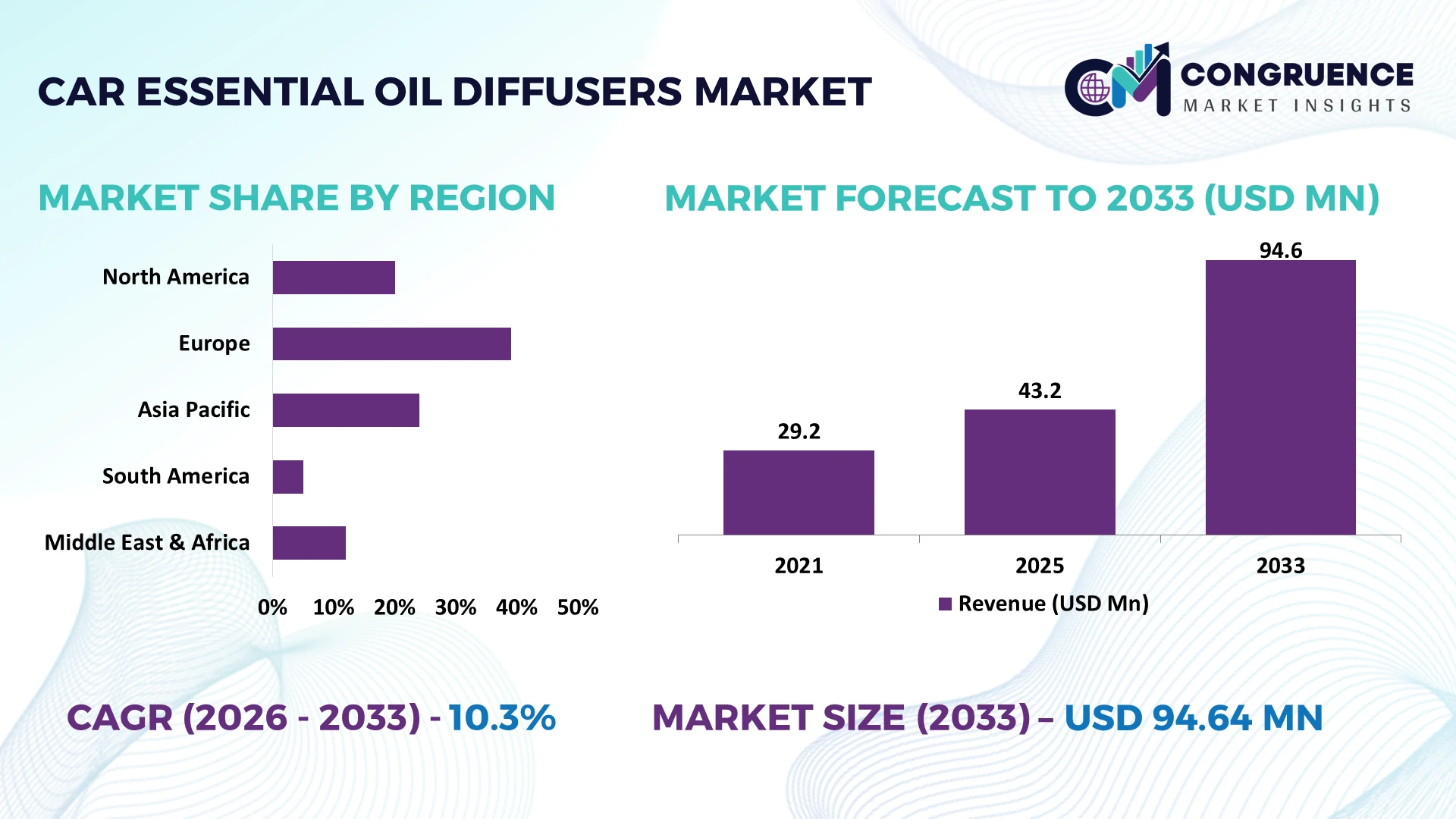
The Global Car Essential Oil Diffusers Market was valued at USD 43.2 Million in 2025 and is anticipated to reach a value of USD 94.64 Million by 2033 expanding at a CAGR of 10.3% between 2026 and 2033. Growth is driven by USB-powered ultrasonic diffusion, rechargeable waterless atomization, increasing vehicle personalization, and rising integration of compact fragrance systems into EV-focused cabin wellness ecosystems.
China represents the strongest manufacturing and adoption hub, supported by 34.53 million vehicles produced in 2025 and new-energy vehicles representing 47.9% of new-vehicle sales. Its electronics, automotive-accessory, fragrance, and essential-oil supply chains accelerate low-cost diffuser commercialization. China sold 34.4 million vehicles versus 16.2 million U.S. light vehicles, creating an addressable new-vehicle base approximately 112% larger amid tariff-driven global sourcing adjustments.
Manufacturers prioritizing China-linked electronics sourcing, EV-compatible diffuser formats, and differentiated refill ecosystems gain the strongest scale and product-development advantages.
Market Size & Growth: USD 43.2 million in 2025 advances to USD 94.64 million by 2033 at 10.3%, supported by rechargeable waterless diffusion and vehicle-interior wellness upgrades.
Top Growth Drivers: EV cabin personalization contributes an estimated 36% growth influence, portable USB/rechargeable formats 31%, and essential-oil wellness positioning approximately 24%.
Short-Term Forecast: By 2027, improved atomization electronics and optimized reservoirs are positioned to reduce essential-oil consumption per operating hour by approximately 15%.
Emerging Technologies: Smart intensity control, waterless nebulization, USB-C charging, and motion-activated operation are shifting advanced car aromatherapy devices toward lower-maintenance connected accessories.
Regional Leaders: Modeled 2033 values place Asia-Pacific near USD 39 million, North America USD 27 million, and Europe USD 21 million, led respectively by EV scale, premium accessories, and wellness-oriented interiors.
Consumer/End-User Trends: Rechargeable and cordless designs are estimated to capture more than 45% of premium-category purchases as drivers prioritize portability and cable-free dashboards.
Pilot/Case Example: 2026 waterless atomization configurations can lower oil usage approximately 20% versus continuously heated diffusion by delivering controlled micro-dosing directly into cabin airflow.
Competitive Landscape: The fragmented market keeps the modeled leading-player share below 10%; Baseus, InnoGear, doTERRA, Young Living, and AromaTech compete through design, fragrance ecosystems, portability, and refill economics.
Regulatory & ESG Impact: Refillable reservoirs can reduce single-use fragrance-container consumption by approximately 30%, strengthening positioning as European packaging and waste-reduction requirements tighten.
Investment & Funding: An estimated USD 15–20 million annual global product-development and capacity allocation increasingly targets rechargeable electronics, precision atomizers, OEM partnerships, and Asia-based manufacturing expansion.
Innovation & Future Outlook: By 2030, smart sensing, app-linked intensity control, interchangeable fragrance cartridges, and EV-native cabin wellness positioning will move high-growth car essential oil diffusers beyond basic fragrance accessories.
The Car Essential Oil Diffusers Market is increasingly concentrated around EV cabins, premium vehicle accessories, ride-hailing fleets, and wellness-focused personal mobility. Waterless nebulizers, USB-C rechargeable units, motion sensing, and adjustable mist control are replacing basic heat-driven designs, with rechargeable formats estimated to represent over 45% of premium purchases. China’s large electronics and automotive-accessory manufacturing ecosystem strengthens component availability, while tariff-related sourcing diversification is encouraging dual-supplier strategies. These shifts make technology differentiation, refill economics, and regional sourcing central to strategic positioning.
Car essential oil diffusers are becoming strategically relevant as vehicle interiors shift from purely functional spaces toward personalized wellness, connected accessories, and premium cabin experiences. Electric cars represented 25% of global new-car sales in 2025, while nearly 1,000 electric models were available worldwide, expanding the addressable base for compact electronic scent systems. Supply-chain restructuring is also pushing brands toward multi-country sourcing for batteries, atomizers, housings, and refill components.
Technology is shifting from heated or water-based units toward cordless waterless atomization. Current USB-C nebulizing models deliver 30–60 hours of intermittent operation per charge, eliminate water reservoirs, and remove heating elements, reducing maintenance steps while improving portability. China remains the largest scaling platform, producing roughly 75% of global electric cars in 2025, while EU battery-electric penetration reached 20.7% in H1 2026, creating stronger opportunities for premium, design-led accessories.
A practical deployment model uses motion-activated cup-holder diffusers that operate only while the vehicle is occupied, extending refill and battery life. Over 2026–2028, manufacturers are prioritizing 2,000 mAh batteries, standardized 5–20 ml refill compatibility, private-label partnerships, and localized distribution. Competitive advantage will increasingly depend on controlled atomization, refill economics, heat-resistant design, and access to high-volume automotive accessory channels.
Electrification is increasing the commercial relevance of compact cabin-wellness accessories because EV buyers interact more intensively with digitally controlled interior environments. Electric cars accounted for 25% of global vehicle sales in 2025, while China exceeded 50% EV penetration and supplied nearly 60% of electric cars sold worldwide. This shift supports rechargeable diffusers that integrate USB-C power, motion sensing, and adjustable mist delivery rather than passive vent clips. China’s rapidly expanding EV ecosystem also enables manufacturers to source batteries, atomizers, aluminum housings, and control boards within concentrated industrial clusters. Suppliers are responding with 2,000 mAh rechargeable units, three-stage diffusion control, and OEM/private-label programs. The key operational advantage is attachment to the broader vehicle-electronics ecosystem rather than dependence on traditional fragrance-only retail.
The market remains constrained by dependence on concentrated electronics and accessory manufacturing supply chains, particularly for lithium batteries, miniature pumps, control boards, and aluminum casings. China produced close to 75% of global electric cars in 2025 and accounted for approximately 40% of EV trade, illustrating how strongly automotive-adjacent component ecosystems remain geographically concentrated. At the same time, imported premium waterless diffusers can cost several times more than passive vent-based alternatives, weakening mass-market conversion. Tariff changes and freight volatility further affect low-volume accessory brands with limited purchasing leverage. Companies are reducing exposure through dual-sourcing, standardized 5–20 ml bottle interfaces, modular component design, and local packaging assembly. The strongest profitability gains come from lowering component complexity and refill costs rather than competing solely through fragrance variety.
Waterless cold-air atomization creates a higher-value opportunity by combining fragrance delivery with electronics, sensing, portability, and recurring refill consumption. Commercial models now offer 30–60 hours of intermittent battery operation, USB-C charging, three or more mist modes, and direct compatibility with 5 ml, 10 ml, 15 ml, and 20 ml essential-oil bottles. India represents a particularly attractive expansion market as vehicle ownership, premium accessories, and mobile commerce increase simultaneously, while China provides scalable OEM manufacturing capacity. Motion-triggered operation, occupancy sensing, and programmable dosing can extend operating intervals by limiting unnecessary diffusion when vehicles are parked. Brands are investing in private-label development, refill subscriptions, digital storefronts, and heat-resistant enclosures. The non-obvious opportunity lies in converting a one-time accessory sale into a controlled refill ecosystem with stronger repeat-purchase economics.
Long-term execution depends on maintaining consistent atomization, battery safety, and fragrance stability inside vehicles exposed to heat, vibration, and repeated temperature cycling. Premium car diffusers increasingly use 2,000 mAh batteries and aluminum housings, while certain products are engineered for cabin temperatures approaching 50°C. However, electronic pumps, seals, nozzles, and essential-oil viscosity must perform consistently across repeated charging and seasonal temperature changes. EU battery-electric penetration reached 20.7% in H1 2026, intensifying expectations for accessories that match increasingly sophisticated vehicle interiors. Poor leakage control or inconsistent mist output can damage brand credibility faster than cosmetic differentiation can recover it. Manufacturers therefore need thermal validation, clog-resistant nozzle engineering, vibration testing, battery protection circuitry, and standardized refill formulations. Durable engineering, not feature proliferation, will determine sustainable competitive positioning.
Waterless Atomization Moves Mainstream: Premium product portfolios are shifting from water-based misting toward direct essential-oil nebulization, eliminating reservoirs and shortening cleaning cycles. Rechargeable models increasingly provide 30–60 operating hours, 2,000 mAh batteries, and 3-level intensity control. Brands are redesigning refill interfaces and scaling compact atomizer sourcing to improve portability and repeat-use economics.
Cabin Design Becomes More Integrated: Diffusers are moving from dashboard-mounted accessories toward cup-holder, vent-integrated, and low-profile console formats. Electric cars represented 25% of global new-car sales in 2025, while nearly 700 EV models were available. Manufacturers are responding with cable-free housings, USB-C charging, vibration-resistant mounting, and interiors-compatible finishes targeting increasingly digital vehicle cabins.
Natural Fragrance Positioning Strengthens: Product positioning is moving away from conventional synthetic air-freshening toward essential-oil-based functional fragrance. A 2025 consumer study recorded 68.7% essential-oil usage, with 59.1% using oils for aromatherapy and 55.1% for aromatization. Suppliers are expanding lavender, peppermint, citrus, and blended refill portfolios while emphasizing controlled dosing and reusable containers.
Distribution Models Become More Flexible: Digital marketplaces, private-label production, and direct-to-consumer refill programs are shortening product-launch cycles. Chinese manufacturers produced nearly 75% of electric cars in 2025, while Chinese EV exports exceeded 2.5 million units, reinforcing accessory supply-chain scale. Diffuser brands are diversifying assembly locations, standardizing 5–20 ml refill compatibility, and building recurring-consumable models.
Vent-Mounted Diffusers account for an estimated 32% of the Car Essential Oil Diffusers Market by type, supported by low installation complexity, compact form factors, and direct utilization of existing HVAC airflow. Their established retail presence keeps deployment costs below electronically controlled alternatives. Clip-On Diffusers represent approximately 24%, benefiting from similarly simple installation but offering less consistent fragrance dispersion across larger cabins. Plug-In Diffusers retain relevance where continuous powered operation is preferred, particularly in vehicles with accessible 12-V sockets.
Portable Diffusers are the fastest-growing type, supported by rechargeable batteries, waterless atomization, and use across cars, offices, and personal spaces. USB Diffusers are also gaining share as USB-C becomes standard across newer vehicle interiors. Together, USB and Portable Diffusers represent roughly 30% of current category demand, with their share strengthening as consumers shift toward cable-managed and rechargeable accessories. Manufacturers are therefore prioritizing compact nebulizers, 2,000 mAh batteries, adjustable output, standardized refill bottles, and premium metal housings, redirecting investment from passive fragrance hardware toward reusable electronic platforms.
Personal Aromatherapy holds an estimated 34% share of Car Essential Oil Diffusers Market applications as consumers increasingly use vehicle cabins for individualized fragrance and wellness routines rather than basic odor masking. Air Freshening remains a mature application at approximately 27%, benefiting from habitual use but facing substitution from essential-oil formulations offering broader sensory positioning. Odor Elimination retains importance for vehicles exposed to food, pets, smoking residues, and intensive passenger turnover, particularly where controlled diffusion replaces disposable fragrance products.
Stress Relief is the fastest-growing application as commuting, congested urban driving, and ride-intensive lifestyles increase interest in lavender, peppermint, citrus, and blended aromatic formulations. Relaxation is developing alongside this shift, especially in premium vehicles and longer-distance travel. A 2025 nationwide essential-oil study found 59.1% of users employed oils for aromatherapy, while 39.5% specifically pursued stress reduction. Brands are responding with selectable mist intensity, timed diffusion cycles, functional blend labeling, and refill subscriptions, shifting competition from fragrance strength toward controlled sensory experiences and repeat-use engagement.
Private Car Owners represent approximately 68% of Car Essential Oil Diffusers Market demand, reflecting their control over vehicle personalization, fragrance selection, installation, and refill purchasing. Automotive Retailers form the principal institutional distribution channel, using bundled accessories and aftermarket displays to convert vehicle purchases into higher-margin interior customization sales. Car Rental Companies remain comparatively selective because centralized cleaning protocols and rapid vehicle turnover favor standardized, easily removable fragrance solutions.
Ride-Hailing Drivers are the fastest-growing end-user segment as cabin presentation increasingly influences passenger experience, driver ratings, and perceived service quality. Uber recorded 13.57 billion global trips in 2025, up 20%, demonstrating the operational intensity of shared vehicles. Fleet Operators are similarly evaluating controlled fragrance systems where standardized cabin presentation supports premium transport services. Manufacturers are targeting these professional users through bulk refill packs, leak-resistant units, adjustable output, and fleet pricing. The strategic demand shift is therefore toward products that reduce servicing frequency while maintaining consistent scent delivery across high-utilization vehicles.
Asia-Pacific accounted for the largest market share at 41% in 2025 however, Asia-Pacific is expected to register the fastest growth, expanding at a CAGR of 12.2% between 2026 and 2033.
Premium Cabin Accessories Shift Toward Rechargeable Formats
North America accounted for approximately 27% of 2025 demand, supported by high private-vehicle ownership, established automotive aftermarket channels, and consumer spending on cabin personalization. The operating shift is toward rechargeable waterless diffusers, USB-C interfaces, cup-holder installation, and controlled atomization rather than disposable vent fragrances. U.S. automotive accessory distribution through e-commerce and specialist retailers gives brands rapid access to a large installed vehicle base. Electrification further supports electronically powered accessories as new interiors add USB-C ports and configurable cabin functions. Product differentiation is concentrating around 2,000 mAh batteries, 30–60-hour intermittent operation, and standardized 5–20 ml refill compatibility. Suppliers are responding through direct-to-consumer distribution, refill bundles, private-label partnerships, and compact metal-housing designs that command stronger positioning than conventional passive air fresheners.
United States Market Outlook: The United States remains North America’s primary addressable market because its vehicle fleet exceeds 280 million registered vehicles and consumers have extensive aftermarket purchasing access. Premium EV adoption is strengthening demand for cable-free, low-profile accessories, while tariff exposure is encouraging diffuser brands to diversify final assembly and packaging beyond China. U.S. retailers increasingly emphasize reusable reservoirs, adjustable scent intensity, and replacement-oil ecosystems.
Electrified Interiors Reinforce Premium Product Design
Europe represents approximately 21% of 2025 market demand, with Germany, the United Kingdom, France, Italy, and the Netherlands supporting premium automotive-accessory consumption. Electrification is reshaping cabin architecture: battery-electric vehicles captured 17.4% of EU registrations in 2025, while hybrids reached 34.5%. This transition supports compact USB-C and rechargeable diffusers designed around digitally equipped consoles rather than legacy 12-V sockets. Sustainability requirements also influence packaging, refillability, material selection, and product durability, increasing pressure on disposable fragrance formats. Suppliers are responding with reusable aluminum reservoirs, recyclable packaging, replaceable essential-oil bottles, and lower-consumption intermittent atomization. Germany is particularly important because its battery-electric registrations increased 43.2% during 2025. The commercial advantage increasingly belongs to suppliers combining premium industrial design with regulatory-ready packaging and controlled refill consumption.
Germany Market Outlook: Germany provides the strongest combination of automotive scale, premium-car ownership, accessory purchasing power, and electrification momentum. Battery-electric registrations increased 43.2% in 2025, while plug-in hybrids advanced 62.3%. Diffuser suppliers can therefore position electronically controlled aromatherapy accessories alongside increasingly sophisticated Mercedes-Benz, BMW, Volkswagen, and Audi cabin ecosystems, particularly through dealership, aftermarket, and online accessory channels.
China Anchors Manufacturing and Deployment Scale
Asia-Pacific holds approximately 41% of 2025 demand and the strongest manufacturing advantage for atomizers, miniature pumps, rechargeable batteries, electronic control boards, essential-oil containers, and molded housings. China produced 34.531 million vehicles in 2025, increasing output 10.4%, while new-energy vehicle production reached 16.626 million units. This concentration enables rapid diffuser product iteration, competitive component procurement, and private-label production at scales difficult to replicate elsewhere. Japan and South Korea provide premium electronics and automotive design opportunities, while India contributes a rapidly expanding passenger-vehicle aftermarket and digital-commerce channel. Manufacturers are moving beyond low-cost vent clips toward rechargeable nebulizers, intelligent sensing, adjustable mist cycles, and standardized refill architectures. Asia-Pacific's structural advantage therefore combines end-market expansion with upstream component density, allowing suppliers to compress development cycles and serve overseas brands through OEM and ODM arrangements.
China Market Outlook: China is the market’s most strategically important production center. Automobile sales reached 34.4 million units in 2025, while new-energy vehicle sales reached 16.49 million, rising 28.2%. Shenzhen, Dongguan, Guangzhou, and surrounding electronics clusters provide access to batteries, PCBs, miniature motors, atomization components, tooling, packaging, and cross-border e-commerce infrastructure, supporting faster commercialization of smart diffuser designs.
Brazilian Aftermarket Expands Addressable Demand
South America accounts for approximately 6% of 2025 demand, with Brazil providing the strongest automotive aftermarket, domestic manufacturing base, and digital retail ecosystem. Brazil produced 2.644 million vehicles during 2025, up 3.5%, while vehicle registrations reached 2.690 million. Rising circulation of newer passenger vehicles supports demand for portable cabin accessories, but price sensitivity and imported electronic-component exposure constrain premium waterless diffuser penetration. Consequently, vent-mounted, clip-on, and lower-priced USB formats remain important alongside emerging rechargeable products. Suppliers are adapting through local marketplace distribution, smaller refill packs, localized packaging, and broader compatibility with standard essential-oil bottles. Importers also face currency and freight exposure, making inventory discipline critical. The strongest commercial model combines affordable hardware with locally sourced or packaged refill oils rather than relying entirely on imported premium fragrance ecosystems.
Brazil Market Outlook: Brazil dominates the regional opportunity through automotive scale and an unusually active new-and-used vehicle ecosystem. Vehicle exports increased 32.1% in 2025, while domestic registrations advanced 2.1%. For 2026, vehicle registrations are positioned to exceed 3 million units, strengthening accessory-channel traffic and creating additional opportunities for locally packaged refills, affordable rechargeable diffusers, and automotive-retailer partnerships.
Premium Mobility Drives Cabin Personalization
Middle East & Africa represents approximately 5% of 2025 market demand, but purchasing patterns are highly concentrated in Gulf automotive hubs and major African cities. The UAE and Saudi Arabia provide the strongest premium opportunity because high-value passenger vehicles, ride-hailing activity, luxury retail, and extreme climatic conditions encourage investment in cabin comfort and fragrance products. Waterless diffusers are gaining strategic relevance because sealed atomization systems avoid open water reservoirs and fit premium cup-holder or console environments. Suppliers are emphasizing aluminum housings, heat-resistant components, rechargeable operation, and concentrated fragrance formulations suited to intensive air-conditioning use. Dubai's role as a re-export and e-commerce hub also supports distribution into neighboring Gulf and African markets. Companies are therefore prioritizing distributor partnerships, premium gifting formats, localized fragrance profiles, and thermal durability rather than competing purely on low hardware prices.
United Arab Emirates Market Outlook: The UAE offers the strongest premium positioning through high vehicle ownership, luxury-car concentration, tourism mobility, and rapid EV infrastructure development. Dubai's logistics ecosystem gives suppliers access to Gulf re-export channels, while the country's expanding charging network supports broader electrified-mobility adoption. Diffuser brands benefit particularly from premium oud, citrus, floral, and essential-oil formulations tailored to local fragrance preferences.
The Car Essential Oil Diffusers Market is fragmented, with Baseus, InnoGear, AromaTech, doTERRA, Young Living, and specialist Chinese OEM suppliers competing across distinct positions. The top five brands collectively account for approximately 28% of sales, leaving substantial share with private-label and marketplace sellers. Baseus and electronics-led suppliers compete through USB-C integration, compact engineering, and price, while aromatherapy brands differentiate through oil quality and refill ecosystems. Waterless nebulizing products command approximately 20–35% price premiums over basic electronic diffusers, while standardized refill compatibility can reduce recurring consumable costs by 15–25%. Competition is shifting toward motion sensing, adjustable atomization, rechargeable batteries, and reusable reservoirs. Brands are expanding through Amazon-led distribution, OEM manufacturing partnerships, direct-to-consumer refill programs, and vertically integrated fragrance portfolios. Low-cost hardware imitation remains a major pressure point, while battery reliability and nozzle durability create meaningful quality barriers. Winning requires controlled atomization, defensible design, efficient sourcing, recurring refills, and diversified distribution.
Baseus
InnoGear
AromaTech
doTERRA
Young Living Essential Oils
GreenAir
ZAQ
Saje Natural Wellness
Organic Aromas
Aera
NEOM Wellbeing
Stadler Form
Millefiori Milano
Moodo
Current car essential-oil diffusers are shifting from passive vent clips and water-filled ultrasonic units toward rechargeable waterless systems using cold-air atomization, USB-C power, sealed reservoirs, and programmable intensity. Intermittent duty cycles can reduce active diffusion time by 50% versus continuous operation, improving refill efficiency and battery endurance. Waterless designs also remove one water-filling step, lowering maintenance frequency and strengthening suitability for high-use vehicles, ride-hailing, and cars.
Emerging platforms add tilt shut-off, motion sensing, Bluetooth control, and selectable car modes. NEOM’s waterless Mini+ demonstrates up to 125 hours of battery operation, while smart nebulizing systems support 30-second diffusion intervals and multi-hour schedules. Compared with legacy 6-hour intermittent portable ultrasonic models, next-generation battery platforms deliver more than 20-times longer operating endurance. Adoption is strongest in portable formats, where cordless products, reusable oil bottles, and app-based dosing improve convenience and reduce overscenting.
Disruptive development is moving toward vehicle-aware scenting integrated with occupancy sensing, infotainment, and personalized wellness profiles. Between 2026 and 2028, suppliers that combine compact atomizers, standardized 5–20 ml bottles, thermal protection, and software-controlled dosing will gain an operational edge. Electronics-led brands benefit from faster hardware scaling, while aromatherapy specialists defend margins through proprietary blends, refill ecosystems, and differentiated scent libraries globally.
June 2024 Simply Earth introduced its Car Diffuser Vent Clip for continuous essential-oil diffusion through airflow. The passive design requires no electricity and supports refillable use, reducing hardware complexity and strengthening the company’s natural-alternative positioning in automotive fragrance. Source: simplyearth.com
May 2025 NEOM Wellbeing launched its waterless Wellbeing Pod Mini+, adding dedicated car and home modes, customizable intensity, tilt shut-off, and up to 125 hours of battery operation, strengthening portable premium aromatherapy and reducing refill-handling requirements globally today. Source: neomwellbeing.com
September 2025 Maserati partnered with Acqua di Parma on the Andiamo Car Diffuser, distributed through Maserati showrooms and selected boutiques. A limited Art of Travel Coffret run of 100 units elevated in-car fragrance into a luxury automotive accessory. Source: stellantis.com
February 2026 Organic Aromas unveiled Bluetooth-enabled Smart Nebulizing Diffusers after two years of development; the Smart Mobile Mini targets car cup holders, offers 16–20 hours per charge, and enables 30-second programmable diffusion, advancing connected, precision-controlled mobile aromatherapy systems. Source: natlawreview.com
The report evaluates Car Essential Oil Diffusers across Clip-On Diffusers, Vent-Mounted Diffusers, USB Diffusers, Plug-In Diffusers, and Portable Diffusers, alongside Personal Aromatherapy, Odor Elimination, Relaxation, Air Freshening, and Stress Relief applications. End-user coverage includes Private Car Owners, Fleet Operators, Ride-Hailing Drivers, Car Rental Companies, and Automotive Retailers. Asia-Pacific contributes approximately 41% of current demand, while rechargeable and portable formats are gaining strategic importance.
Regional analysis covers North America, Europe, Asia-Pacific, South America, and Middle East & Africa, with country-level assessment of manufacturing, automotive aftermarket activity, electrification, distribution, and premium accessory adoption. Technology coverage includes waterless atomization, USB-C charging, motion sensing, Bluetooth controls, programmable dosing, and refillable bottle systems. The 2026–2033 assessment supports investment screening, product prioritization, sourcing decisions, geographic expansion, partnership strategy, and competitive positioning across emerging connected-cabin and mobility-focused applications.
| Report Attribute/Metric | Report Details |
|---|---|
Market Revenue in 2025 | USD 43.2 Million |
Market Revenue in 2033 | USD 94.64 Million |
CAGR (2026 - 2033) | 10.3% |
Base Year | 2025 |
Forecast Period | 2026 - 2033 |
Historic Period | 2021 - 2025 |
Segments Covered | By Type
By Application
By End-User
|
Key Report Deliverable | Revenue Forecast, Growth Trends, Market Dynamics, Segmental Overview, Regional and Country-wise Analysis, Competition Landscape |
Region Covered | North America, Europe, Asia-Pacific, South America, Middle East, Africa |
Key Players Analyzed | Baseus, InnoGear, AromaTech, doTERRA, Young Living Essential Oils, GreenAir, ZAQ, Saje Natural Wellness, Organic Aromas, Aera, NEOM Wellbeing, Stadler Form, Millefiori Milano, Moodo |
Customization & Pricing | Available on Request (10% Customization is Free) |




