
Reports
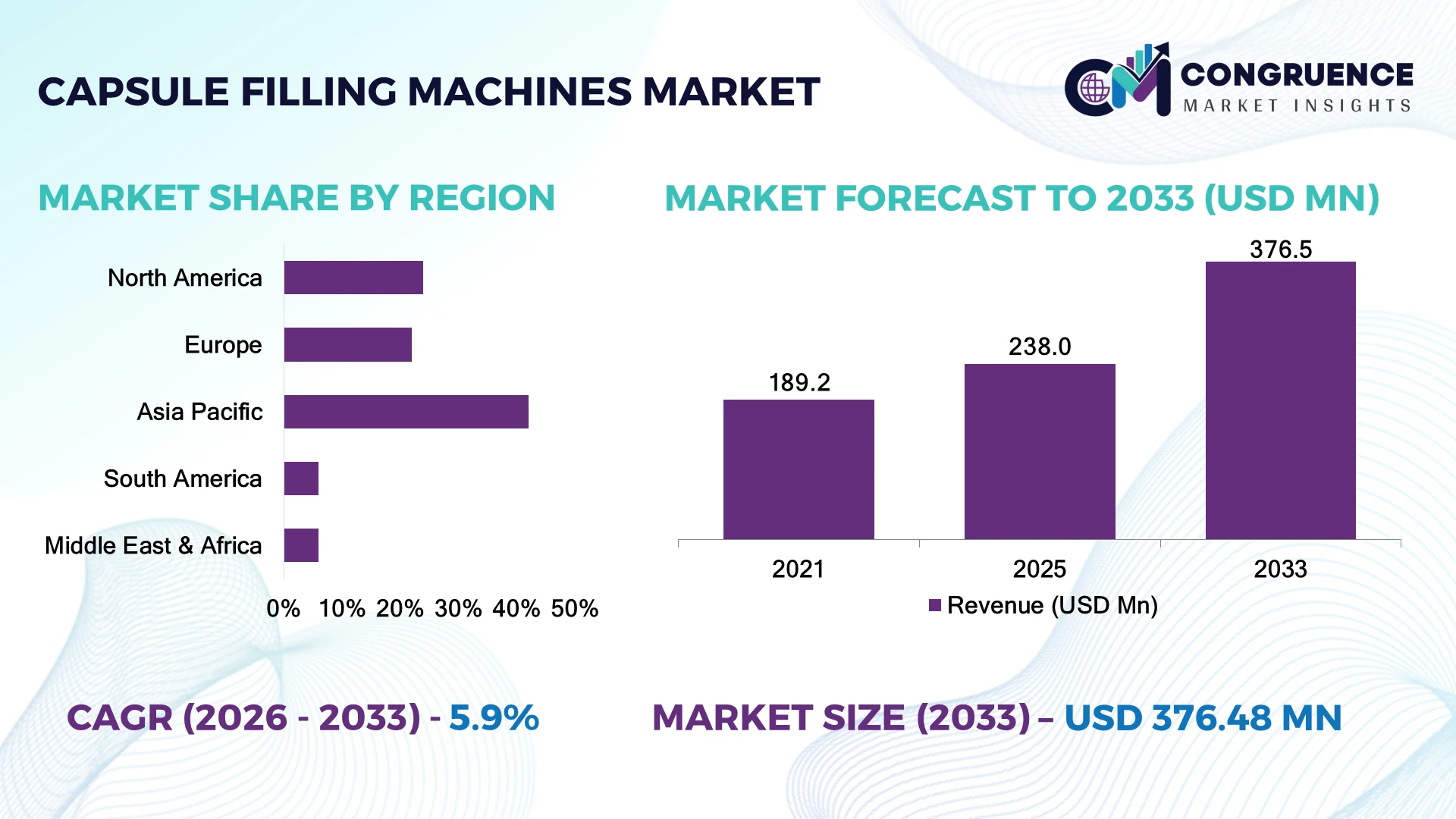
The Global Capsule Filling Machines Market was valued at USD 238.0 Million in 2025 and is anticipated to reach a value of USD 376.5 Million by 2033 expanding at a CAGR of 5.9% between 2026 and 2033. Growth is driven by the shift from semi-automatic to high-speed automated filling lines, tighter GMP requirements, and pharmaceutical manufacturers’ investment in precision dosing, electronic inspection, and integrated production controls.
China holds about 20% of global capsule filling machine demand, while India accounts for approximately 9.7%, supported by pharmaceutical and nutraceutical manufacturing expansion. Europe represents nearly 44% of global manufacturing capacity, with established machinery producers and high automation adoption. Geopolitical supply-chain diversification is encouraging manufacturers to localize equipment and component sourcing across Asian production hubs.
Strategically, equipment suppliers should prioritize automation, regional service networks, and localized component ecosystems to capture pharmaceutical capacity expansion.
Market Size & Growth: USD 238.0 million in 2025 is projected to reach USD 376.5 million by 2033 at a 5.9% CAGR, driven by automated high-throughput filling systems.
Top Growth Drivers: Automated production adoption 47%; pharmaceutical capsule production 52%; high-speed system adoption 44%.
Short-Term Forecast: By 2028, automated inspection and monitoring can reduce filling defects by about 20% and improve line efficiency by approximately 25%.
Emerging Technologies: AI monitoring increased 39%, while advanced electronic dosing and real-time inspection are accelerating precision manufacturing.
Regional Leaders: Asia-Pacific could reach about USD 158.1 million by 2033 with automation-led expansion; Europe about USD 113.0 million through replacement upgrades; North America about USD 75.3 million through advanced equipment adoption.
Consumer/End-User Trends: Pharmaceutical companies account for approximately 74% of machine utilization, reinforcing demand for high-volume, GMP-compliant production platforms.
Pilot/Case Example: 2025 automated production deployments recorded approximately 14% higher dosage accuracy through electronic verification and integrated control systems.
Competitive Landscape: IMA leads with approximately 19% share, followed by ACG Worldwide at about 15%, alongside Bosch Packaging Technology, MG2, and Qualicaps.
Regulatory & ESG Impact: GMP-driven automation is increasing equipment modernization, while integrated monitoring can lower material and process losses by approximately 15%.
Investment & Funding: Automation-focused equipment investment increased approximately 41%, with manufacturers emphasizing capacity expansion, technology partnerships, and regional service infrastructure.
Innovation & Future Outlook: AI-enabled monitoring, predictive maintenance, modular filling platforms, and higher-speed rotary systems are shifting competition toward digitally integrated and resource-efficient manufacturing.
The Capsule Filling Machines Market is increasingly concentrated around pharmaceutical, nutraceutical, and contract manufacturing facilities seeking higher precision, shorter changeover cycles, and automated quality control. Automatic systems represent approximately 61% of equipment demand, while Asia-Pacific accounts for nearly 42% of global production. Supply-chain restructuring and stricter GMP expectations are accelerating investment in localized servicing, advanced controls, and flexible production platforms, setting the stage for deeper strategic competition.
Capsule filling machines are becoming strategically important as pharmaceutical manufacturers compete on throughput, dosage consistency, batch flexibility, and compliance rather than equipment capacity alone. Approximately 61% of equipment demand is concentrated in automatic systems, reflecting the industry’s transition toward digitally controlled production. Supply-chain restructuring following pandemic disruptions and geopolitical tensions is also pushing manufacturers toward regional equipment support and diversified component sourcing.
Advanced automatic platforms provide measurable advantages over legacy semi-automatic systems, with integrated inspection and electronic dosing capable of improving operational efficiency by around 25% while reducing process defects by roughly 20%. China combines approximately 20% global market participation with a large equipment-manufacturing base, while India’s approximately 9.7% share is increasingly linked to generic-drug and nutraceutical production. Europe retains a strong manufacturing position through premium, high-precision machinery.
Over the next 2–3 years, automated monitoring, predictive maintenance, and modular tooling will become key deployment priorities. A pharmaceutical plant replacing semi-automatic equipment with an integrated rotary system can consolidate filling, inspection, and counting into a controlled workflow. Companies are therefore increasing automation budgets, forming technology partnerships, and expanding regional service networks. Competitive advantage will increasingly depend on uptime, validation readiness, and lifecycle support rather than machine speed alone.
Automation is the principal structural driver as pharmaceutical facilities replace labor-intensive filling processes with electronically controlled systems. Automatic machines represent approximately 61% of global equipment demand, while automated manufacturing adoption has expanded about 47%. AI-enabled production monitoring has also increased approximately 39%, improving process visibility and reducing manual intervention. India’s expanding generic-drug manufacturing base and China’s large pharmaceutical equipment ecosystem are strengthening equipment replacement and capacity investment. Stricter GMP expectations further accelerate modernization because electronic controls simplify batch monitoring and quality documentation. Manufacturers are responding by investing in high-speed rotary platforms, integrated inspection, and predictive maintenance. The non-obvious advantage is greater production consistency across multiple capsule formats, allowing pharmaceutical plants to improve asset utilization without proportionally increasing workforce requirements.
Capital intensity remains a structural limitation, particularly for smaller pharmaceutical and nutraceutical producers. Approximately 34% of small manufacturers report high equipment installation costs, while about 27% face maintenance and calibration challenges. Advanced systems also require specialized technicians, validated software, controlled utilities, and periodic tooling replacement, increasing the total cost of ownership beyond the initial machine purchase. Smaller manufacturers in price-sensitive markets such as India therefore continue using semi-automatic equipment for lower-volume production. Global component shortages and logistics disruptions can further extend replacement-part lead times. Suppliers are reducing exposure through localized service centers, preventive-maintenance contracts, modular machine architecture, and regional spare-parts inventories. The strategic implication is clear: equipment suppliers offering predictable lifecycle costs gain an advantage over vendors competing primarily on upfront machine pricing.
The strongest opportunity lies in combining automated filling with AI monitoring, electronic dosing, and predictive maintenance. AI-enabled monitoring adoption has risen approximately 39%, while automatic high-speed system deployment has increased about 44%. India offers particularly strong expansion potential as pharmaceutical and nutraceutical manufacturers upgrade production for regulated export markets. Indonesia, Brazil, and other emerging manufacturing hubs also present opportunities for modular systems that bridge semi-automatic and fully automated production. Future platforms integrating real-time weight verification and machine-learning process controls can reduce defects by roughly 20% while improving equipment efficiency by approximately 25%. Manufacturers are positioning through localized engineering, distributor partnerships, and application-specific R&D. A less obvious opportunity is retrofit technology, allowing existing filling lines to gain digital monitoring without complete equipment replacement.
Long-term competitiveness increasingly depends on integrating filling machines with broader pharmaceutical manufacturing systems. Approximately 27% of manufacturers report maintenance and calibration difficulties, while automated production adoption approaching 50% is increasing demand for specialized controls and technical skills. Legacy facilities often lack standardized data infrastructure, creating integration challenges between filling equipment, inspection systems, serialization platforms, and enterprise manufacturing software. Cybersecurity exposure also rises as machines become connected and remotely monitored. In China and India, rapid capacity expansion can intensify technician shortages and commissioning requirements. Manufacturers must therefore invest in standardized communication protocols, operator training, cybersecurity controls, and regional technical support. The critical strategic challenge is maintaining consistent validated performance across multiple plants, because equipment speed provides limited competitive value when integration failures cause downtime, requalification, or inconsistent batch execution.
Automation Is Reshaping Production: Fully automatic capsule fillers now represent about 61% of equipment utilization, while semi-automatic systems account for roughly 27%. Pharmaceutical plants are replacing labor-intensive workflows with rotary filling, automated dosing, and inline inspection to improve throughput and consistency. Labor shortages and stricter GMP expectations are accelerating this shift, prompting manufacturers to expand automated lines and prioritize equipment with lower operator dependency.
Digital Quality Controls Expand: AI-assisted monitoring and electronic process controls are gaining traction, with digital monitoring adoption rising approximately 39% and automated inspection deployment increasing about 25%. Manufacturers are connecting filling, weight verification, rejection, and batch-record functions to strengthen traceability. The non-obvious shift is that digital controls are increasingly being purchased for audit readiness and faster deviation investigation rather than speed alone.
India Gains Manufacturing Pull: India is strengthening its position as a pharmaceutical production hub, with approximately 60% of WHO-prequalified medicines originating from the country. Capsule equipment buyers are increasingly favoring flexible machines capable of handling multiple formulations and capsule sizes. Supply-chain diversification and local-production initiatives are encouraging equipment suppliers to build domestic service partnerships, shorten spare-parts lead times, and establish localized technical support.
Modular Systems Improve Flexibility: Modular tooling and quick-change configurations are gaining adoption, reducing format-change requirements by approximately 20% and improving equipment utilization by nearly 15%. Contract manufacturers and nutraceutical producers are particularly focused on flexible production because shorter campaigns and varied formulations require rapid changeovers. Equipment companies are responding with tool-free adjustments, recipe-driven controls, and configurable dosing systems that support smaller production batches without sacrificing precision.
Automatic capsule filling machines dominate the market with approximately 61% share, supported by high-speed production, consistent dosing, reduced manual intervention, and compatibility with integrated inspection systems. Semi-automatic machines hold around 27%, retaining strong relevance among medium-scale pharmaceutical and nutraceutical producers seeking lower capital intensity and flexible batch production. Manual systems account for roughly 12% and remain concentrated in laboratories, pilot operations, small manufacturers, and formulation trials. Automatic platforms can operate at substantially higher production rates than manual equipment, making them the preferred investment for large-volume facilities.
Semi-automatic systems represent the fastest-shifting category as smaller manufacturers move toward automation without committing to fully integrated production lines. Their approximately 27% share reflects demand for intermediate capacity, operator flexibility, and manageable installation costs. Companies are expanding automatic portfolios while introducing modular semi-automatic platforms to capture upgrading manufacturers. The strategic implication is that suppliers offering scalable migration paths from manual to semi-automatic and ultimately automatic systems can capture customers across multiple investment cycles.
Pharmaceutical applications account for approximately 74% of capsule filling machine utilization, reflecting the concentration of high-volume production, strict dosage requirements, and GMP-controlled manufacturing within drug production. Nutraceutical applications represent about 16%, supported by expanding supplement portfolios and increasing demand for flexible powder, granule, and pellet handling. Cosmetics account for approximately 6%, while other applications contribute around 4%. Pharmaceutical manufacturers prioritize automated equipment because consistent fill weights, controlled contamination risk, and validated production records directly influence batch acceptance.
Nutraceutical production is the fastest-growing application category, with adoption rising as manufacturers introduce more complex botanical blends, vitamins, minerals, and specialty formulations. Approximately 35% of nutraceutical-oriented production lines increasingly emphasize flexible tooling and rapid changeovers, compared with more standardized pharmaceutical workflows. Companies are responding through modular fillers, multi-format dosing systems, and integrated cleaning configurations. The business implication is a gradual shift from equipment optimized solely for maximum output toward platforms balancing throughput, formulation flexibility, and rapid product changeovers.
Pharmaceutical companies represent approximately 68% of end-user demand, reflecting their larger production volumes, extensive GMP infrastructure, and greater dependence on automated encapsulation equipment. Nutraceutical companies account for around 14%, while contract manufacturing organizations contribute approximately 10% and research laboratories about 8%. Pharmaceutical buyers typically favor high-speed rotary systems integrated with inspection and process-monitoring platforms, whereas smaller nutraceutical and laboratory users prioritize affordability, flexibility, and shorter changeovers.
Contract manufacturing organizations are the fastest-growing end-user group, supported by increasing outsourcing of specialized formulation and encapsulation operations. Their equipment requirements increasingly emphasize multi-product capability, with approximately 30% of CMO-oriented installations prioritizing rapid format changes and flexible dosing configurations. Nutraceutical companies are also expanding through partnerships and contract production models, creating demand for scalable semi-automatic systems. Suppliers are responding with configurable equipment, service agreements, application engineering, and financing structures. The strategic opportunity lies in serving CMOs with machines that maximize utilization across multiple customer batches rather than optimizing exclusively for a single high-volume product.
Asia Pacific accounted for the largest market share at 42% in 2025 however, Asia Pacific is expected to register the fastest growth, expanding at a CAGR of 6.7% between 2026 and 2033.
North America represented approximately 24% of the global market in 2025, equivalent to about USD 57.1 million, supported by established pharmaceutical manufacturing, nutraceutical production, and contract development infrastructure. The United States concentrates most regional demand, particularly across New Jersey, Pennsylvania, California, and North Carolina pharmaceutical clusters. Automatic systems account for nearly 70% of regional installations as manufacturers prioritize validated dosing, electronic batch records, and integrated inspection. Approximately 35% of new equipment projects emphasize digital monitoring or predictive maintenance. Companies are responding through equipment upgrades, technology partnerships, and expanded technical-service coverage. High regulatory expectations and mature manufacturing infrastructure make North America particularly attractive for premium capsule filling platforms rather than entry-level machinery.
United States Market Outlook: The United States remains the principal North American demand center because of its large pharmaceutical manufacturing base and extensive contract manufacturing network. More than 40% of regional high-end equipment deployments are concentrated in U.S. pharmaceutical production clusters, where manufacturers prioritize validated automation, containment, electronic documentation, and rapid format changeovers. Investment is increasingly directed toward integrated systems capable of supporting multiple products within regulated facilities.
Europe held approximately 22% of the global market in 2025, representing about USD 52.4 million. Germany, Italy, Switzerland, and the United Kingdom form the principal manufacturing and deployment centers, with European equipment producers maintaining a strong position in high-precision machinery. Approximately 65% of regional installations are automatic systems, reflecting demand for controlled dosing, inspection, and high repeatability. EU GMP requirements and sustainability pressures are accelerating equipment modernization, particularly through energy-efficient drives and reduced material waste. Around 30% of replacement projects increasingly specify digital connectivity and automated quality controls. Manufacturers are strengthening partnerships with pharmaceutical producers and expanding modular platforms to support smaller batches, faster changeovers, and increasingly complex formulations.
Germany Market Outlook: Germany remains a critical European manufacturing and engineering center, supported by sophisticated pharmaceutical facilities, automation expertise, and a dense machinery supplier ecosystem. Approximately 28% of European premium capsule filling equipment production is associated with German manufacturers and engineering networks. Buyers emphasize high-speed rotary platforms, electronic process control, validation support, and lifecycle service, reinforcing Germany’s role in technology-intensive equipment deployment.
Asia Pacific led the global market with approximately 42% share in 2025, equivalent to about USD 100.0 million, supported by pharmaceutical manufacturing scale across China, India, Japan, and South Korea. China and India together account for roughly 65% of regional production capacity, while automatic machines represent approximately 59% of regional equipment utilization. Pharmaceutical expansion, contract manufacturing, nutraceutical production, and government-backed manufacturing localization are strengthening demand. Imported high-end continuous-motion systems still account for approximately 60–75% of premium equipment requirements, creating opportunities for regional suppliers to localize precision components. Companies are responding through domestic assembly, automation partnerships, service expansion, and modular machine development. The region’s scale advantage increasingly supports both equipment consumption and machinery manufacturing.
China Market Outlook: China is the leading national market in Asia Pacific, accounting for approximately 46% of regional capsule filling machine production. Its manufacturing clusters across Zhejiang, Guangdong, and Jiangsu provide integrated access to mechanical components, automation systems, and pharmaceutical machinery engineering. Around 53% of Chinese pharmaceutical equipment manufacturers have expanded automated production capabilities, strengthening domestic supply while improving export competitiveness across Southeast Asia and other emerging markets.
South America accounted for approximately 6% of the global market in 2025, equivalent to about USD 14.3 million. Brazil represents the dominant demand center because of its pharmaceutical manufacturing base, extensive nutraceutical industry, and comparatively developed production infrastructure. Automatic and semi-automatic systems together account for nearly 75% of regional installations, reflecting a gradual transition from labor-intensive operations toward controlled production. Approximately 30% of new installations are associated with pharmaceutical contract manufacturing and formulation expansion. Currency volatility, imported component exposure, and uneven technical-service coverage continue to influence procurement decisions. Equipment suppliers are responding through distributor partnerships, localized maintenance capabilities, and configurable systems that reduce dependence on highly specialized imported machinery.
Brazil Market Outlook: Brazil represents the principal South American market, supported by its large pharmaceutical and supplement manufacturing ecosystem. Approximately 45% of regional capsule filling equipment demand is concentrated in Brazilian production facilities. Manufacturers increasingly favor machines offering multiple capsule-size compatibility, simplified cleaning, and local technical support. Domestic production expansion is also encouraging suppliers to strengthen distributor networks and maintain regional spare-parts inventories.
The Middle East & Africa accounted for approximately 6% of the global market in 2025, representing about USD 14.3 million. Demand is concentrated in Saudi Arabia, the United Arab Emirates, South Africa, Egypt, and selected pharmaceutical manufacturing hubs. Approximately 40% of regional equipment purchases are linked to pharmaceutical capacity modernization, while nutraceutical and herbal-product manufacturers increasingly adopt semi-automatic systems. Saudi Arabia and the UAE are investing in localized healthcare and pharmaceutical production, creating demand for GMP-oriented machinery and technical services. Around 25% of new installations incorporate enhanced electronic monitoring or automated quality checks. Suppliers are responding through regional partnerships, distributor expansion, localized servicing, and compact automated platforms suited to emerging production facilities.
Saudi Arabia Market Outlook: Saudi Arabia is the region’s strongest strategic market because pharmaceutical localization initiatives are encouraging domestic manufacturing and technology modernization. Approximately 30% of Middle East pharmaceutical equipment investment is concentrated in Saudi production projects. Manufacturers increasingly prioritize GMP-compliant filling systems, automated dosing, and scalable equipment that can support expanding domestic formulations while reducing dependence on imported finished medicines.
The competitive field is led by IMA, ACG, MG2, Syntegon, and Harro Höfliger, with established European OEMs competing against regional manufacturers and cost-focused suppliers. The top five players together control 55% of the market, leaving room for specialized Asian producers. Competition centers on automation, containment, throughput, customization, and lifecycle support: premium systems command roughly 15–25% higher pricing, while high-speed platforms can deliver 20–30% greater productivity than conventional equipment. IMA and Syntegon compete through integrated pharmaceutical lines and global service networks; ACG emphasizes vertical integration and high-speed equipment; MG2 differentiates through flexible dosing and human-centered design; Harro Höfliger targets advanced containment and specialized applications. Recent competitive activity is shifting toward digital controls, modular architecture, and supply-chain localization, while ACG’s U.S. investment reinforces regional supply resilience. High validation requirements, engineering expertise, and service infrastructure remain key entry barriers. Winning requires proven GMP performance, rapid customization, reliable components, and strong regional technical support.
IMA Group
ACG
MG2
Syntegon Technology
Harro Höfliger
Capsugel
Qualicaps
Dott. Bonapace
Fette Compacting
Fabtech Technologies
Anchor Mark
Shanghai Tianjiu Machinery Manufacturing
Zhejiang Furis Machinery
Shanghai Hanyi Engineering Equipment
Modern capsule filling technology is moving from mechanically controlled dosing toward automated, digitally monitored platforms. AI-assisted monitoring, electronic weight verification, and predictive maintenance are increasingly integrated with filling equipment, improving process efficiency by approximately 15–20%. Automatic systems account for about 61% of equipment utilization, establishing automation as the dominant technology pathway. These systems reduce operator dependency while strengthening batch consistency and production visibility.
High-speed rotary fillers are replacing conventional semi-automatic platforms in large pharmaceutical facilities. Advanced systems operating at up to 200,000 capsules per hour provide substantially higher throughput than smaller legacy machines, while modular dosing systems support powders, pellets, tablets, and combination fills. Digital controls can reduce changeover and troubleshooting time by approximately 20%, giving integrated OEM platforms a competitive advantage in high-volume production.
From 2026 to 2028, containment technology, AI-enabled process analytics, robotic handling, and machine-to-manufacturing-system connectivity will become increasingly important. High-containment platforms addressing potent APIs are gaining relevance alongside low-dose precision systems. Manufacturers benefit through improved operator protection, reduced material waste, and higher equipment utilization. Suppliers with integrated automation, scalable software, and remote service capabilities are best positioned as pharmaceutical plants prioritize connected production rather than standalone machinery.
October 2025 — Harro Höfliger introduced Modu-C LS Advanced, adding advanced containment for potent products. The launch strengthens its high-containment portfolio and positioning in regulated pharmaceutical manufacturing, where safer handling and flexible production are increasingly critical for customers. Source: hoefliger.com
October 2025 — ACG announced a $200 million U.S. investment, including $100 million for a new Atlanta facility and more than 200 jobs. The expansion strengthens localized capsule supply, shortens lead times, and improves supply-chain resilience for customers. Source: acg-world.com
February 2025 — Syntegon showcased GKF 60 at Interphex, featuring vibration dosing for quantities starting at 0.1 milligrams. The R&D machine supports standard and containment configurations, improving development flexibility and enabling smoother scale-up from laboratory batches toward production. Source: syntegon.com
May 2024 — MG2 presented Electa, its top-range E Series capsule filler, at ACHEMA with output reaching 200,000 capsules per hour. The platform supports multiple dosing units and 100% net-weight control, strengthening precision and production competitiveness across lines. Source: mg2.it
The report covers the global Capsule Filling Machines Market across type, application, end-user, and geographic dimensions. Type analysis includes automatic, semi-automatic, and manual systems, while applications cover pharmaceutical, nutraceutical, cosmetics, and other uses. End-user coverage includes pharmaceutical companies, nutraceutical companies, contract manufacturing organizations, and research laboratories. Regional assessment spans North America, Europe, Asia Pacific, South America, and Middle East & Africa.
The study evaluates high-speed rotary platforms, modular dosing, containment systems, electronic weight control, AI-enabled monitoring, predictive maintenance, and integrated inspection technologies. It examines deployment concentration, automation penetration, production-scale requirements, and emerging demand from contract manufacturing and nutraceutical facilities. The analysis supports equipment investment planning, regional expansion, technology selection, supplier benchmarking, partnership strategy, and competitive positioning through 2026–2033, with particular attention to Asia Pacific manufacturing expansion and supply-chain localization.
| Report Attribute / Metric | Details |
|---|---|
| Market Revenue (2025) | USD 238.0 Million |
| Market Revenue (2033) | USD 376.5 Million |
| CAGR (2026–2033) | 5.9% |
| Base Year | 2025 |
| Forecast Period | 2026–2033 |
| Historic Period | 2021–2025 |
| Segments Covered |
By Type
By Application
By End-User
|
| Key Deliverables | Revenue Forecast; Market Trends; Growth Drivers & Restraints; Technology Insights; Segmentation Analysis; Regional Insights; Competitive Landscape; Regulatory & ESG Overview; Recent Developments |
| Regions Covered | North America; Europe; Asia-Pacific; South America; Middle East & Africa |
| Companies Profiled | IMA Group; ACG; MG2; Syntegon Technology; Harro Höfliger; Capsugel; Qualicaps; Dott. Bonapace; Fette Compacting; Fabtech Technologies; Anchor Mark; Shanghai Tianjiu Machinery Manufacturing; Zhejiang Furis Machinery; Shanghai Hanyi Engineering Equipment |
| Customization & Pricing | Available on Request (10% Customization Free) |




