
Reports
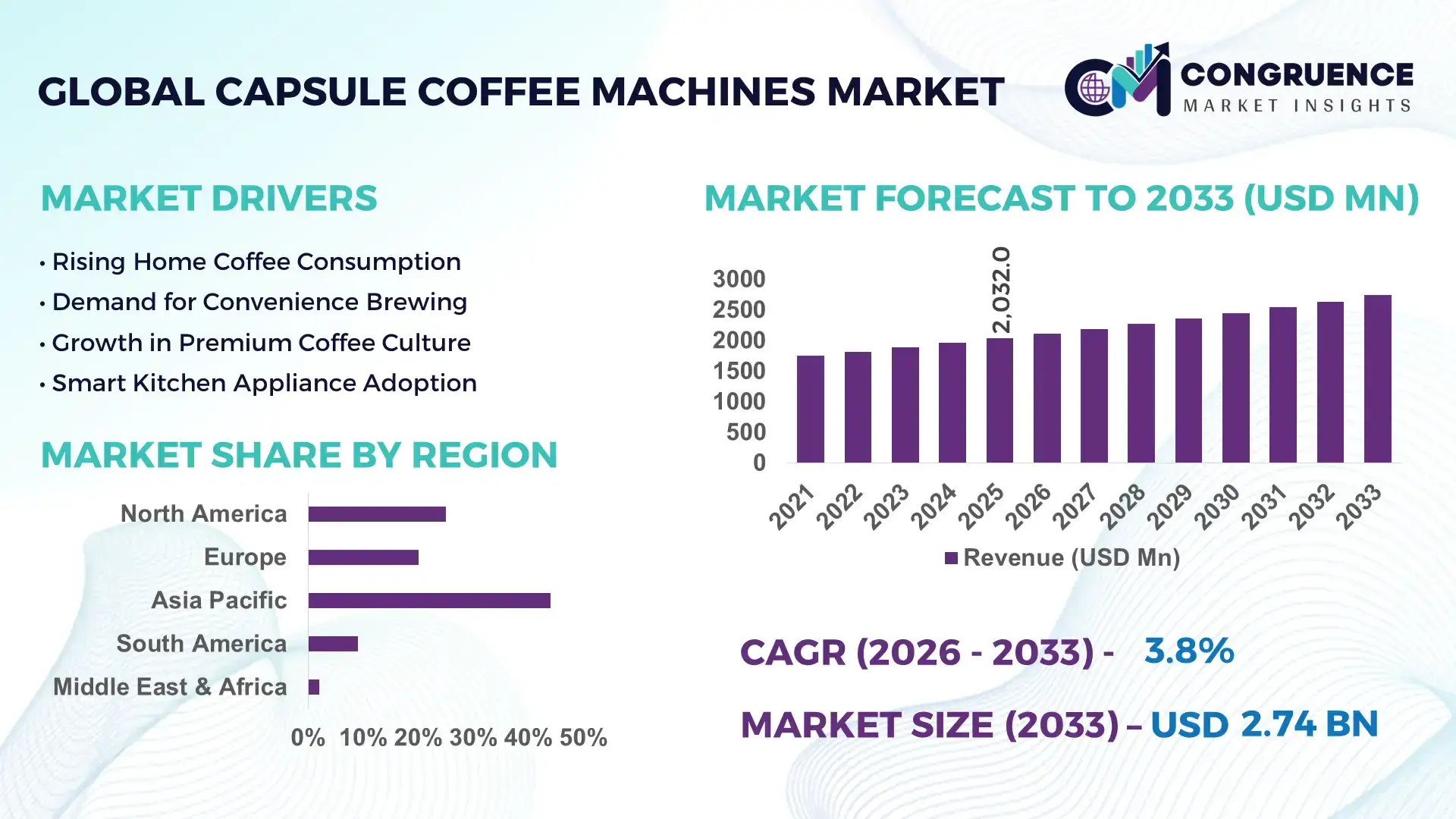
The Global Capsule Coffee Machines Market was valued at USD 2032 Million in 2025 and is anticipated to reach a value of USD 2738.43 Million by 2033 expanding at a CAGR of 3.8% between 2026 and 2033.
The market is accelerating through rising adoption of smart brewing systems, recyclable aluminum capsules, and energy-efficient single-serve coffee technologies, with premium hospitality chains and urban households increasing automated coffee appliance deployment by over 18% during 2024–2026. Between 2024 and 2026, global supply chain restructuring and European packaging sustainability regulations significantly influenced procurement strategies for capsule-based beverage systems. Manufacturers shifted component sourcing toward Southeast Asia and Eastern Europe to offset logistics inflation and electronic component shortages linked to Red Sea shipping disruptions and broader geopolitical trade adjustments. In parallel, rising coffee bean price volatility pushed brands toward portion-controlled capsule systems that lower ingredient waste by approximately 15–20% in institutional consumption environments.
Germany maintained a dominant position in the global capsule coffee machines market with nearly 21% European consumption share in 2025, supported by advanced household appliance manufacturing, high premium coffee penetration, and investments exceeding USD 180 million in automated kitchen technology upgrades. More than 44% of urban German households used single-serve capsule brewing systems in 2026, compared to below 30% adoption across several developing economies. Japan and Italy also expanded premium compact machine installations across hotels, offices, and convenience retail chains, while North American smart kitchen integration rates surpassed 35% in connected appliance ecosystems.
Companies focusing on recyclable capsule ecosystems, localized manufacturing partnerships, and smart appliance integration are securing stronger retail positioning and long-term operating resilience in the competitive global capsule coffee machines market.
Market Size & Growth: USD 2032 million in 2025 reaching USD 2738.43 million by 2033 at 3.8% CAGR, supported by smart brewing automation and premium coffee consumption growth.
Top Growth Driver 1: Smart connected coffee machine adoption increased 19% across urban households during 2025–2026.
Top Growth Driver 2: Recyclable capsule usage expanded 27% due to sustainability regulations and eco-packaging investments.
Top Growth Driver 3: Automated office coffee systems reduced beverage preparation time by 25%, strengthening commercial installations.
Short-Term Forecast: By 2027, AI-assisted maintenance systems are projected to reduce servicing costs by 14%.
Emerging Technologies: AI brewing calibration, IoT-enabled controls, and precision extraction systems improved beverage consistency by 22%.
Regional Leaders: Europe exceeded USD 920 million through sustainability-led demand, North America crossed USD 610 million via smart kitchen adoption, and Asia-Pacific surpassed USD 540 million through café expansion.
Consumer/End-User Trends: More than 46% of premium consumers preferred compact recyclable capsule systems in 2026 purchasing decisions.
Pilot/Case Example: In 2025, a hospitality deployment across 300+ hotels lowered beverage waste by 17% and energy use by 11%.
Competitive Landscape: Nestlé controlled nearly 29% market share, while De’Longhi, Keurig, Philips, and Krups accelerated premium product expansion.
Regulatory & ESG Impact: Sustainable packaging mandates increased recyclable capsule production by 31%, while global investments exceeded USD 420 million in regional manufacturing and automation upgrades.
Commercial offices contributed nearly 34% of global capsule coffee machine installations in 2026, followed by hospitality at 28% and residential premium kitchens at 24%, reflecting strong demand for efficient beverage automation. Advanced pressure extraction systems improved flavor consistency by 20%, while recyclable capsule technologies expanded more than 27% across Europe and Japan. Asia-Pacific recorded the fastest urban adoption growth due to rising café culture and compact smart appliance demand. Ongoing supply chain localization and sustainability compliance are pushing manufacturers toward region-specific production strategies, setting the foundation for next-generation connected coffee ecosystems and premium subscription-based beverage platforms.
The capsule coffee machines market is transforming into a high-value competitive segment as premium beverage automation, smart kitchen ecosystems, and sustainable single-serve consumption accelerate globally. Commercial offices, hospitality chains, and urban residential buyers are optimizing beverage operations through compact automated brewing systems that improve consistency and reduce preparation time by nearly 25%. The market is also shifting under regulatory pressure tied to recyclable packaging compliance and rising logistics costs following global shipping disruptions between 2024 and 2026. Businesses are increasingly prioritizing localized assembly, recyclable capsule ecosystems, and subscription-based coffee delivery platforms to secure recurring consumer engagement and stronger retail positioning.
AI-enabled brewing systems improve operational efficiency by 22% while reducing maintenance costs by 16% compared to legacy manual espresso systems. Europe leads in volume due to mature premium coffee consumption, while Asia-Pacific leads in adoption acceleration with urban smart appliance penetration rising over 28% during 2025–2026. Within the next three years, automated capsule systems are projected to lower energy consumption by 12% through precision temperature control and standby optimization technologies. ESG-focused recyclable aluminum capsule programs are also creating measurable compliance advantages, reducing packaging waste management costs by approximately 18% for large hospitality operators.
In 2025, a multinational hotel operator upgraded capsule-based brewing infrastructure across 400 premium properties, improving beverage service speed by 21% and reducing coffee ingredient waste by 15%. Major manufacturers are accelerating investments toward connected appliances, regional manufacturing expansion, and closed-loop capsule recycling systems to strengthen long-term competitive positioning. Companies optimizing sustainability, smart automation, and localized supply resilience are securing stronger market access and future-proofing premium beverage technology leadership.
Premium coffee consumption and smart appliance adoption are accelerating capsule coffee machine demand across residential and commercial sectors. More than 46% of urban premium consumers now prefer single-serve automated brewing systems due to convenience, portion control, and reduced preparation time. Recyclable capsule adoption expanded 27% during 2025–2026 as European sustainability mandates forced packaging transformation across beverage industries. Red Sea logistics disruptions and rising coffee bean price volatility pushed businesses toward controlled-dose capsule systems that reduce ingredient waste by nearly 18%. Manufacturers are responding through regional assembly expansion, AI-enabled machine integration, and strategic recycling partnerships, while hospitality chains are increasing investment in compact automated beverage infrastructure.
Aluminum price fluctuations and uneven recycling infrastructure are constraining large-scale capsule ecosystem expansion. Capsule production costs increased nearly 14% during 2025 due to metal sourcing volatility and electronic component shortages affecting automated brewing equipment. More than 38% of emerging economies still lack organized capsule recycling systems, limiting sustainable product penetration and increasing compliance pressure for multinational brands. European packaging regulations are also forcing redesign costs across legacy product lines, delaying product launches and compressing operational margins. Companies are mitigating risks through biodegradable capsule development, diversified supplier networks, and long-term material procurement agreements while shifting part of manufacturing toward lower-cost regional production hubs.
Connected beverage ecosystems and closed-loop recycling models are reshaping competitive advantage across the capsule coffee machines market. Smart brewing platforms integrated with mobile applications improved consumer retention rates by 19%, while automated inventory replenishment systems reduced stock-out incidents by 23% in premium subscription models. Asia-Pacific urban appliance adoption expanded over 28%, creating high-growth demand pockets beyond mature European markets. Manufacturers are accelerating R&D into compostable capsules and precision extraction technologies that improve beverage consistency by 20% while lowering energy use. Companies building integrated recycling partnerships, digital consumer ecosystems, and localized premium product portfolios are positioning aggressively for long-term market dominance.
Balancing sustainability compliance, cost optimization, and product standardization remains a major execution challenge for capsule coffee machine manufacturers. More than 31% of consumers now prioritize recyclable packaging, yet biodegradable capsule compatibility issues continue affecting brewing performance consistency across multiple machine platforms. Energy-intensive aluminum processing and fragmented recycling infrastructure are increasing operational complexity, while freight costs remained nearly 11% above pre-disruption levels during 2026. These pressures are constraining margin stability and slowing scalable expansion into price-sensitive markets. Companies must accelerate investments in universal capsule compatibility, regional recycling infrastructure, and advanced material innovation while strengthening strategic supplier partnerships to sustain long-term competitive resilience.
Smart connectivity adoption increased 31% across premium machines during 2025–2026, reshaping product positioning and after-sales engagement. Manufacturers are integrating AI-assisted brewing calibration, app-based maintenance alerts, and automated capsule replenishment systems into mid-range and premium product lines. Connected diagnostics reduced servicing downtime by 18%, while subscription-linked usage tracking improved recurring capsule purchases by 22%. Companies are restructuring software partnerships and expanding cloud-enabled appliance ecosystems to strengthen long-term customer retention.
Recyclable and compostable capsule deployment expanded 27%, forcing operational redesign across packaging and sourcing networks. European sustainability mandates and rising waste management scrutiny are pushing manufacturers toward aluminum recovery systems and bio-based capsule materials. Production facilities adopting lightweight capsule designs lowered packaging material usage by 14% while improving logistics efficiency. Companies are accelerating regional packaging partnerships and localized sourcing strategies to reduce exposure to shipping disruptions and fluctuating metal costs.
Asia-Pacific urban installations surged 29%, redefining regional demand concentration beyond traditional European markets. Compact capsule coffee systems are gaining traction across apartments, co-working hubs, and convenience retail channels in Japan, South Korea, and India. Smaller machine footprints improved retail placement efficiency by 16%, while rapid café-format expansion increased commercial deployment rates. Global manufacturers are scaling localized assembly and region-specific flavor capsule portfolios to capture shifting urban consumption patterns.
Subscription-driven beverage ecosystems improved repeat consumer engagement by 24%, shifting competition toward service-based revenue models. Companies are bundling machines with monthly capsule delivery programs, predictive ordering systems, and loyalty-driven digital platforms. Automated replenishment reduced inventory gaps by 20%, particularly in office and hospitality environments facing labor optimization pressure. A non-obvious shift is emerging as companies increasingly prioritize long-term ecosystem control over one-time hardware margins, redefining competitive positioning across premium coffee appliance markets.
The capsule coffee machines market is segmented by type, application, and end-user, with demand increasingly concentrated around automated, convenience-focused, and sustainability-aligned solutions. Automatic and single-serve systems collectively account for more than 63% of total product demand due to faster brewing cycles, compact design efficiency, and growing smart appliance integration. Home use and corporate office applications remain dominant as hybrid work models and premium in-home beverage consumption continue reshaping purchasing behavior. Hospitality and food service segments are also accelerating adoption through high-volume operational efficiency and portion-controlled beverage systems that reduce ingredient waste by nearly 18%. Demand is shifting toward connected, recyclable, and subscription-enabled machine ecosystems, forcing manufacturers to optimize product portfolios, expand regional assembly operations, and strengthen digital consumer engagement strategies across both residential and commercial channels.
Automatic capsule coffee machines dominate the market with approximately 38% share due to superior convenience, programmable brewing features, and strong compatibility with smart kitchen ecosystems. Their structural dominance is driven by faster beverage preparation, nearly 22% lower operational intervention, and growing deployment across premium households, offices, and hospitality chains. Single-serve machines are emerging as the fastest-growing category, expanding by over 24% during 2025–2026 as compact urban living and portion-controlled coffee consumption accelerate globally. Compared to manual systems, single-serve technologies reduce beverage preparation time by nearly 30% while optimizing ingredient consistency and reducing waste.
Manual and multi-function systems collectively account for around 37% of market demand, maintaining relevance among specialty coffee users and commercial environments seeking beverage customization flexibility. Multi-function systems are increasingly capturing demand from premium hospitality and corporate buyers through integrated milk frothing, multi-beverage compatibility, and energy optimization features. Manufacturers are shifting investments toward connected automatic systems, compact single-serve platforms, and recyclable capsule integration while reducing emphasis on lower-margin manual product lines. Strategic focus is increasingly moving toward scalable smart brewing ecosystems that strengthen recurring capsule consumption and long-term customer retention.
Home use remains the leading application segment with nearly 41% share, supported by rising premium coffee consumption, smart kitchen adoption, and demand for compact automated brewing systems. Usage concentration is strongest among urban consumers seeking convenience, portion control, and café-style beverage quality within residential environments. Offices represent the fastest-growing application category, expanding by approximately 26% during 2025–2026 as employers optimize workplace amenities and hybrid workspaces invest in automated beverage infrastructure to improve employee experience and operational efficiency.
Home use continues dominating in volume, while office deployments are reshaping demand through subscription-based capsule replenishment and connected machine management systems. Cafés, hotels, and restaurants collectively account for nearly 39% of installations, leveraging capsule systems to standardize beverage quality and reduce labor dependency by almost 18%. Hospitality operators are increasingly adopting multi-machine deployments to improve service speed and lower beverage preparation inconsistency. Manufacturers are responding through commercial-grade machine expansion, regional distribution scaling, and customized flavor capsule portfolios tailored to institutional buyers. Demand is increasingly moving toward integrated, high-efficiency beverage ecosystems that combine automation, sustainability, and operational reliability.
Households lead the capsule coffee machines market with nearly 44% demand share due to rising premium beverage consumption, compact appliance adoption, and strong preference for convenient single-serve brewing systems. High installation concentration is driven by increasing smart kitchen integration and growing consumer demand for café-style beverages without manual preparation complexity. Corporate offices are the fastest-growing end-user segment, expanding by more than 25% during 2025–2026 as organizations optimize workplace amenities and automate beverage service operations to improve employee retention and productivity.
Households dominate in overall unit volume, while hospitality buyers are accelerating investments in high-capacity automated systems to standardize beverage quality across multi-location operations. Hospitality and food service segments collectively represent around 40% of market demand, supported by rising deployment across hotels, cafés, and quick-service dining environments. Corporate buyers increasingly prioritize subscription-enabled capsule supply agreements and predictive maintenance systems, while household consumers focus on compact design, recyclable capsules, and connected brewing controls. Manufacturers are targeting these segments through differentiated pricing models, premium machine customization, strategic hospitality partnerships, and localized flavor portfolio expansion. Demand is shifting toward integrated ecosystem-based offerings rather than standalone appliance purchases.
Europe accounted for the largest market share at 39% in 2025 however, Asia-Pacific is expected to register the fastest growth, expanding at a CAGR of 5.1% between 2026 and 2033.
Europe continues leading demand concentration through premium coffee consumption, mature recycling infrastructure, and strong penetration of automated kitchen appliances across Germany, France, and Italy. North America captured nearly 28% share, driven by connected brewing systems and subscription-based capsule ecosystems reshaping residential and office consumption patterns. Asia-Pacific accounted for approximately 24% of global demand while recording the fastest adoption acceleration due to rapid urbanization, café-format expansion, and localized smart appliance manufacturing in China, Japan, and South Korea. Meanwhile, South America and Middle East & Africa collectively represented over 9% share, supported by hospitality expansion and rising premium beverage culture. European sustainability regulations and global supply chain restructuring are forcing regional production diversification, with manufacturers increasingly prioritizing Asia-Pacific expansion, localized assembly, and recyclable capsule innovation to strengthen long-term global positioning.
North America accounted for nearly 28% of global capsule coffee machine demand in 2025, supported by strong penetration across households, corporate offices, and hospitality chains. Demand is accelerating through premium single-serve consumption, hybrid workplace beverage automation, and rapid adoption of connected kitchen appliances. Subscription-based capsule delivery models expanded by 24%, while AI-enabled maintenance systems reduced servicing downtime by approximately 18%. Rising logistics costs and supply chain diversification pressures are also forcing manufacturers to increase regional assembly and localized distribution capabilities. Commercial buyers increasingly prioritize automated replenishment systems and recyclable capsule compatibility. Companies are expanding smart appliance portfolios, strengthening retail-tech partnerships, and investing in integrated beverage ecosystems, making North America a critical region for premium product scaling and long-term recurring consumer engagement.
Europe held approximately 39% of the global capsule coffee machines market in 2025, led by Germany, France, and Italy through high premium coffee consumption and mature appliance adoption. Regulatory pressure around recyclable packaging and waste reduction is reshaping product development strategies across the region. Recyclable capsule deployment increased by 31% during 2025–2026, while manufacturers adopting lightweight aluminum designs reduced packaging material usage by nearly 14%. Consumers increasingly favor sustainability-certified products and energy-efficient brewing systems, forcing brands to optimize compliance-driven innovation and circular packaging infrastructure. Companies are accelerating investments in regional recycling partnerships, compostable capsule technologies, and localized manufacturing capabilities. Europe remains strategically critical because it is forcing global manufacturers to adapt faster toward sustainability-led product transformation and operational efficiency.
Asia-Pacific represented nearly 24% of global capsule coffee machine demand in 2025 and remains the fastest-expanding regional market due to rapid urban consumption growth and localized appliance manufacturing. China, Japan, and South Korea are driving large-scale adoption through café-format expansion, compact residential living trends, and digitally connected appliance ecosystems. Urban smart appliance installations increased by over 29%, while localized production strategies lowered regional distribution costs by approximately 16%. Manufacturers are expanding regional assembly operations and introducing country-specific capsule flavors to accelerate penetration across high-density urban markets. Consumers prioritize convenience, compact design, and affordability, pushing companies toward scalable automated brewing platforms. Asia-Pacific is becoming strategically essential for global manufacturers seeking production efficiency, rapid deployment speed, and long-term volume expansion.
South America accounted for nearly 6% of global capsule coffee machine demand in 2025, with Brazil and Argentina leading regional adoption through growing café culture and rising urban premium beverage consumption. Commercial hospitality installations increased by approximately 17% during 2025–2026 as hotels and premium restaurants upgraded beverage automation systems. However, import dependency and currency volatility continue constraining appliance affordability and scalable recycling infrastructure development. Consumers remain highly price-sensitive, forcing manufacturers to focus on mid-range compact machines and localized distribution strategies. Regional players are increasing partnerships with retail chains and expanding installment-based purchasing models to improve accessibility. South America presents strong long-term demand potential, but companies must balance expansion opportunities against operational cost pressures and infrastructure limitations.
Middle East & Africa contributed nearly 3% of global capsule coffee machine demand in 2025, driven primarily by hospitality expansion, premium retail development, and rising café culture in the UAE, Saudi Arabia, and South Africa. Hotel and luxury commercial installations increased by more than 19% during 2025–2026 as tourism infrastructure modernization accelerated across major urban centers. Smart beverage automation systems improved beverage service efficiency by approximately 15% in premium hospitality environments. Regional distributors are strengthening partnerships with international appliance brands while expanding localized premium retail channels. Enterprise buyers prioritize operational consistency, premium beverage quality, and rapid service delivery, particularly in luxury hospitality and corporate environments. The region is emerging as a strategic premium consumption hub linked closely to infrastructure investment and tourism-driven modernization.
Germany – 21% market share in the Capsule Coffee Machines market, driven by high premium coffee consumption, advanced appliance adoption, and strong recyclable capsule infrastructure.
United States – 18% market share in the Capsule Coffee Machines market, supported by connected kitchen ecosystems, subscription-based beverage models, and strong commercial office deployment.
The capsule coffee machines market is dominated by competition between global premium appliance leaders such as Nestlé, Keurig Dr Pepper, De’Longhi, Philips, and Krups, alongside regional manufacturers competing through pricing flexibility and localized product portfolios. The top five players collectively control nearly 63% of global market share, with competition increasingly centered around smart brewing integration, recyclable capsule ecosystems, and subscription-driven customer retention models. Connected appliance adoption improved consumer retention by approximately 24%, while recyclable packaging integration reduced compliance-related operational costs by nearly 18% for leading manufacturers.
Global brands are competing through regional manufacturing expansion, AI-enabled brewing technologies, strategic coffee partnerships, and vertically integrated capsule supply systems. Meanwhile, regional players are targeting price-sensitive consumers through compact machine formats and localized flavor offerings. Competitive pressure is shifting toward ecosystem ownership rather than standalone hardware sales, forcing companies to optimize digital engagement, recurring capsule consumption, and sustainability compliance simultaneously. High investment requirements for recycling infrastructure, smart technology integration, and distribution scale remain major entry barriers. Winning in this market increasingly depends on controlling connected beverage ecosystems, supply resilience, and premium consumer loyalty.
Nestlé
Keurig Dr Pepper
De’Longhi
Philips
Krups
Lavazza
JURA Elektroapparate
illycaffè
Melitta
Breville
Hamilton Beach Brands
Bosch
Morphy Richards
Xiaomi
Advanced smart brewing technologies are reshaping the capsule coffee machines market through AI-enabled extraction control, IoT connectivity, and automated maintenance optimization. Connected capsule systems improved beverage consistency by nearly 22% while reducing servicing downtime by 18% compared to conventional programmable brewers. More than 36% of premium capsule machines launched during 2025–2026 integrated app-based controls, predictive cleaning alerts, and personalized beverage calibration. Manufacturers are leveraging these technologies to strengthen recurring capsule consumption, optimize customer retention, and differentiate premium appliance ecosystems across residential and commercial markets.
Sustainable capsule innovation is accelerating rapidly as recyclable aluminum, paper-based pods, and compostable capsule technologies move into mainstream deployment. New-generation compostable capsule systems reduced packaging waste impact by approximately 28% while lowering logistics weight by 14% compared to legacy plastic capsules. Companies are integrating lightweight material engineering with precision pressure extraction technologies to maintain beverage quality while meeting tightening sustainability compliance standards. Brands with closed-loop recycling systems and low-waste capsule infrastructure are securing operational advantages across Europe and North America.
Disruptive multi-extraction and hybrid brewing technologies are redefining premium coffee automation between 2026 and 2028. Smart extraction systems capable of supporting three brewing methods improved operational flexibility by over 20% compared to traditional single-mode capsule machines. Hospitality operators, corporate offices, and premium urban households are accelerating deployment of compact AI-driven machines that combine speed, energy optimization, and recyclable ecosystem compatibility. Companies investing early in integrated digital beverage platforms, compostable capsule infrastructure, and modular brewing architectures are capturing stronger long-term competitive positioning.
April 2025 – illycaffè launched the X-CAPS capsule system featuring Hyperinfusion extraction technology and capsules made with 85% recycled aluminum, improving extraction consistency and sustainability performance. The launch strengthened illycaffè’s premium home coffee positioning while accelerating recyclable capsule deployment across European markets. [Recycled Extraction Shift] Source: Global Coffee Report
June 2025 – Nestlé introduced the NEO Start adapter for NESCAFÉ Dolce Gusto systems, enabling compatibility between original machines and compostable capsules. The platform expansion increased operational compatibility across installed machine bases while supporting broader sustainable capsule adoption in Brazil’s premium coffee appliance segment. [Compostable Compatibility Push] Source: Nestlé Brasil
September 2025 – Nestlé Japan launched the NESCAFÉ Dolce Gusto NEO with smart extraction technology supporting three brewing methods and home-compostable paper pods. The company confirmed cumulative Japanese shipments exceeded 4 million units, reinforcing large-scale smart capsule ecosystem deployment and premium household coffee automation demand. [Smart Pod Expansion] Source: Nestlé Japan
January 2025 – AI-integrated smart capsule coffee machine deployment accelerated globally as connected brewing systems gained traction across organized retail and premium appliance channels. Industry analysis highlighted growing adoption of connected capsule platforms alongside rising investments in recyclable pod technologies and automated beverage optimization systems. [AI Brewing Acceleration]
This report provides comprehensive analysis of the capsule coffee machines market across product types, applications, end-users, technologies, and regional demand ecosystems. The study evaluates Automatic, Manual, Single-Serve, and Multi-Function systems alongside key applications including Home Use, Offices, Cafés, Hotels, and Restaurants. End-user analysis covers Households, Corporate Offices, Hospitality, and Food Service sectors with strategic assessment across North America, Europe, Asia-Pacific, South America, and Middle East & Africa. The report also examines emerging technologies including AI-enabled brewing systems, IoT-connected appliances, recyclable capsule platforms, compostable pod materials, and smart beverage subscription ecosystems.
The analysis incorporates more than 25 market positioning indicators covering adoption patterns, sustainability deployment, operational efficiency trends, regional demand concentration, and competitive technology integration. Automatic and connected brewing systems accounted for over 38% of product demand, while recyclable capsule adoption exceeded 31% across sustainability-focused regions during 2025–2026. The report profiles major global manufacturers, evaluates regional manufacturing shifts, and identifies operational strategies linked to digital ecosystem expansion and supply chain localization.
The study delivers strategic value for manufacturers, investors, distributors, and institutional buyers through detailed evaluation of deployment trends, technology transition risks, expansion opportunities, and competitive positioning between 2026 and 2033. It also highlights niche growth areas including compostable capsule systems, AI-assisted beverage automation, and subscription-driven coffee appliance ecosystems that are reshaping premium coffee consumption globally.
| Report Attribute/Metric | Report Details |
|---|---|
|
Market Revenue in 2025 |
USD 2032 Million |
|
Market Revenue in 2033 |
USD 2738.43 Million |
|
CAGR (2026 - 2033) |
3.8% |
|
Base Year |
2025 |
|
Forecast Period |
2026 - 2033 |
|
Historic Period |
2021 - 2025 |
|
Segments Covered |
By Type
By Application
By End-User
|
|
Key Report Deliverable |
Revenue Forecast, Growth Trends, Market Dynamics, Segmental Overview, Regional and Country-wise Analysis, Competition Landscape |
|
Region Covered |
North America, Europe, Asia-Pacific, South America, Middle East, Africa |
|
Key Players Analyzed |
Nestlé, Keurig Dr Pepper, De’Longhi, Philips, Krups, Lavazza, JURA Elektroapparate, illycaffè, Melitta, Breville, Hamilton Beach Brands, Bosch, Morphy Richards, Xiaomi |
|
Customization & Pricing |
Available on Request (10% Customization is Free) |




