
Reports
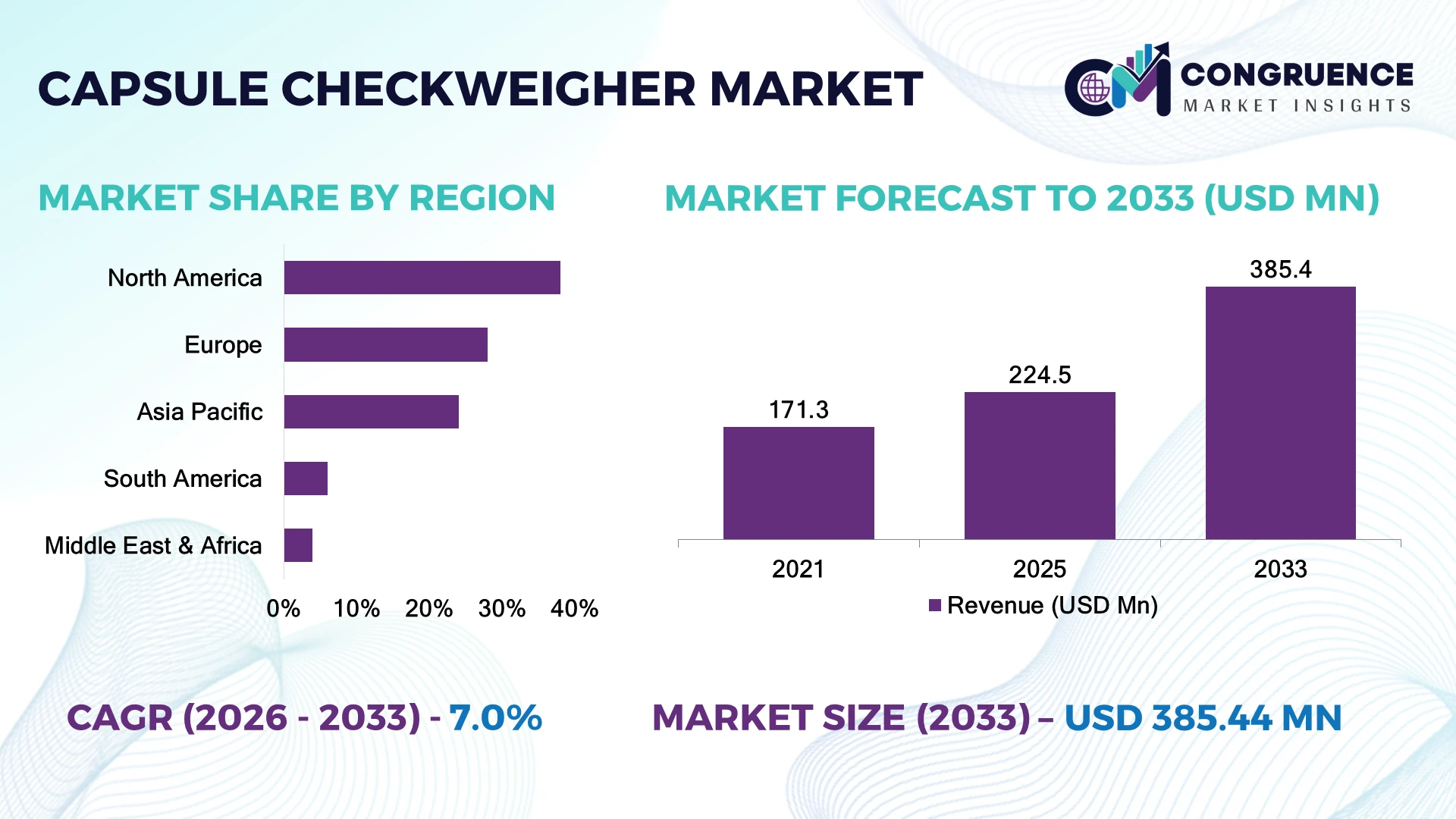
The Global Capsule Checkweigher Market was valued at USD 224.5 Million in 2025 and is anticipated to reach a value of USD 385.4 Million by 2033 expanding at a CAGR of 6.99% between 2026 and 2033. Growth is driven by pharmaceutical manufacturers adopting high-speed automated inspection systems to improve capsule weight accuracy, reduce batch deviations, and comply with stringent quality-control standards.
The United States dominates the market with approximately 34% share, supported by advanced pharmaceutical manufacturing capacity, FDA-driven quality systems, and investments in automated production lines exceeding USD 2 billion annually across drug manufacturing infrastructure. Germany follows with nearly 18% share due to strong pharmaceutical engineering capabilities and Industry 4.0 adoption, while China is expanding rapidly through localized equipment production and automation upgrades, with over 40% of large-scale pharmaceutical facilities integrating smart inspection technologies.
The strategic implication is that companies prioritizing digital weighing solutions and regional manufacturing partnerships will strengthen competitive positioning.
Market Size & Growth: USD 224.5 Million in 2025 reaching USD 385.4 Million by 2033 at 6.99% CAGR, driven by automated pharmaceutical quality inspection.
Top Growth Drivers: Automation adoption 42%, pharmaceutical compliance upgrades 36%, smart manufacturing integration 31%.
Short-Term Forecast: By 2028, automated checkweighing systems improve production efficiency by 25% and reduce manual inspection dependency by 30%.
Emerging Technologies: AI-based defect detection, IoT-enabled monitoring, and robotic capsule handling systems are reshaping high-speed inspection.
Regional Leaders: North America projected at USD 145 Million with automation adoption; Europe at USD 110 Million with Industry 4.0 deployment; Asia-Pacific at USD 95 Million with pharmaceutical expansion.
Consumer/End-User Trends: Over 60% of pharmaceutical producers prioritize real-time weight monitoring for quality assurance improvements.
Pilot/Case Example: A 2024 pharmaceutical automation project achieved 28% reduction in inspection errors after deploying intelligent capsule verification systems.
Competitive Landscape: Leading players include METTLER TOLEDO, Syntegon, ACG Worldwide, IMA Group, and Loma Systems, with top manufacturers holding significant global presence.
Regulatory & ESG Impact: Digital inspection systems reduce material waste by nearly 20% through improved filling accuracy and process control.
Investment & Funding: Pharmaceutical automation investments exceeded USD 5 billion globally, focusing on smart manufacturing partnerships and production upgrades.
Innovation & Future Outlook: Next-generation systems emphasize AI analytics, predictive maintenance, and connected pharmaceutical manufacturing ecosystems.
The Global Capsule Checkweigher Market is witnessing increasing adoption across pharmaceutical production facilities due to demand for precision dosing, faster inspection cycles, and regulatory compliance. Advanced systems now integrate AI algorithms, automated rejection mechanisms, and cloud-based monitoring, with nearly 35% of new pharmaceutical packaging lines incorporating intelligent inspection capabilities. Supply-chain localization and stricter quality regulations are accelerating investments in automated capsule verification solutions.
The Capsule Checkweigher Market is becoming strategically important as pharmaceutical companies shift toward automated quality assurance, precision manufacturing, and digitally connected production environments. Increasing regulatory scrutiny after global pharmaceutical supply-chain disruptions has accelerated investments in reliable inspection technologies, particularly across the United States, Germany, and China.
Modern AI-enabled capsule checkweighers deliver approximately 30% higher inspection accuracy and reduce manual verification costs by nearly 20% compared with conventional systems. North America maintains leadership through advanced pharmaceutical infrastructure, while Asia-Pacific gains momentum through manufacturing expansion and localized automation development. Japan and South Korea are also increasing adoption through smart factory initiatives.
Companies are deploying connected checkweighing systems in high-volume production facilities to improve traceability and reduce batch rejection risks. Pharmaceutical manufacturers are forming technology partnerships to integrate automation, analytics, and predictive maintenance capabilities into production lines.
Over the next 2–3 years, competitive advantage will depend on scalable automation, regional supply-chain resilience, and the ability to deliver intelligent inspection platforms that support efficient, compliant, and sustainable pharmaceutical operations.
Pharmaceutical manufacturers are accelerating automation adoption as precision requirements increase across capsule production. Automated checkweighers improve weight verification accuracy by 35% and reduce inspection-related production losses by nearly 25%. Regulatory frameworks from agencies such as the FDA are encouraging advanced monitoring systems in drug manufacturing facilities. Companies including equipment manufacturers and pharmaceutical producers are investing in AI-enabled inspection platforms, robotics integration, and real-time analytics. The key strategic shift is moving from end-line quality checks toward continuous process monitoring, enabling manufacturers to improve compliance, reduce downtime, and optimize high-volume capsule production.
High initial installation costs remain a challenge for small and medium pharmaceutical manufacturers adopting advanced capsule inspection systems. Automated solutions can increase equipment investment requirements by 20–35% compared with traditional weighing methods. Supply-chain dependency for precision sensors and electronic components also creates cost pressure, particularly in emerging manufacturing hubs. Companies are addressing these constraints through modular equipment designs, localized sourcing strategies, and long-term supplier agreements. The operational impact remains significant as manufacturers balance automation benefits with capital allocation priorities and maintenance requirements.
Digital pharmaceutical transformation creates opportunities for intelligent capsule checkweighing technologies integrated with IoT and AI platforms. Smart inspection systems improve production monitoring efficiency by 30% and support predictive maintenance capabilities that reduce unplanned downtime by approximately 15%. India and China are emerging as high-potential markets due to expanding pharmaceutical manufacturing capacity and government-backed production initiatives. Companies are strengthening positions through R&D investments, automation partnerships, and cloud-based analytics development. The major opportunity lies in transforming checkweighers from standalone machines into connected quality-control platforms supporting future pharmaceutical ecosystems.
Integration challenges remain significant as pharmaceutical facilities modernize existing production environments with advanced inspection technologies. Nearly 40% of manufacturers report difficulties related to equipment compatibility, software integration, and workforce training requirements. Cybersecurity concerns are increasing as connected manufacturing systems become more common across pharmaceutical plants. Companies must invest in standardized communication protocols, employee training programs, and secure digital infrastructure. Long-term competitiveness will depend on creating flexible systems that integrate with diverse production lines while maintaining regulatory compliance, operational reliability, and consistent quality performance.
AI Inspection Integration Pharmaceutical manufacturers are rapidly integrating AI-powered capsule inspection systems, with adoption increasing by nearly 30% across advanced production facilities. These systems improve defect identification accuracy by 25–35% and reduce manual verification workloads by over 20%. Companies in the United States and Germany are deploying machine-learning platforms with real-time analytics to improve batch monitoring and reduce quality deviations. The shift is driven by stricter regulatory expectations and the need for continuous manufacturing visibility.
Smart Factory Deployment Connected checkweighers are becoming part of Industry 4.0 pharmaceutical workflows, with nearly 40% of new automated production lines incorporating IoT-enabled monitoring. Real-time data exchange improves production tracking by 20% and reduces unplanned downtime by approximately 15%. Manufacturers are partnering with automation providers to integrate checkweighers into digital manufacturing ecosystems, especially in high-volume facilities across China and India.
Compact System Adoption Pharmaceutical companies are increasing demand for modular and compact checkweighing equipment as production flexibility becomes critical. Around 35% of small and medium facilities are prioritizing space-efficient systems that support multiple capsule formats. Equipment suppliers are redesigning platforms with faster changeover capabilities, reducing setup time by nearly 25% and improving operational efficiency.
Sustainable Production Focus Sustainability initiatives are influencing equipment upgrades, with automated weighing systems helping manufacturers reduce material waste by approximately 18–22%. European pharmaceutical plants are adopting energy-efficient inspection technologies following stricter environmental compliance targets. Companies are restructuring production processes through resource optimization, predictive maintenance, and supplier collaborations to improve long-term operational efficiency.
Automated capsule checkweighers represent the leading type segment, accounting for approximately 62% of market adoption due to superior speed, accuracy, and integration with pharmaceutical production lines. These systems support continuous inspection, reduce human error, and improve compliance with strict quality standards. Semi-automated systems maintain relevance among smaller manufacturers because of lower installation complexity and flexible deployment requirements, while manual solutions continue serving low-volume operations. Automated platforms are expanding as pharmaceutical companies prioritize high-throughput manufacturing and digital quality control.
The fastest-growing shift is toward AI-enabled automated checkweighers, supported by increasing demand for predictive analytics and real-time monitoring. Adoption of intelligent systems is rising by nearly 30%, while facilities implementing connected inspection technologies report approximately 20% improvement in workflow efficiency. Companies are responding through software upgrades, automation partnerships, and modular equipment development.
Pharmaceutical capsule manufacturing is the dominant application segment, contributing nearly 70% of demand due to strict dosage accuracy requirements and large-scale production volumes. Drug manufacturers rely on capsule checkweighers to maintain compliance, prevent batch rejection, and improve operational consistency. Nutraceutical and contract manufacturing applications are expanding as private-label production increases and manufacturers seek flexible inspection capabilities.
The fastest-growing application area is contract pharmaceutical manufacturing, where demand for scalable quality-control systems is increasing by approximately 35%. These facilities require adaptable checkweighers capable of handling multiple capsule formats and shorter production cycles. Companies are expanding equipment partnerships and integrating automated inspection into outsourced manufacturing networks. Other applications, including research laboratories and specialty production units, continue adopting compact systems for precision testing and limited-volume operations.
Pharmaceutical manufacturers represent the largest end-user segment with approximately 65% market share, driven by extensive capsule production volumes, regulatory compliance requirements, and investment in automated quality systems. Large pharmaceutical enterprises deploy advanced checkweighers across multiple production facilities to improve consistency and reduce inspection-related losses. Contract manufacturing organizations are emerging as the fastest-growing user group as outsourcing models expand globally.
Contract manufacturers are increasing adoption by nearly 35% due to rising demand for flexible production capacity and rapid product changeovers. Hospitals, research institutions, and specialty laboratories represent smaller segments but are adopting compact systems for controlled production environments. Companies are targeting these segments through customized equipment configurations, service partnerships, and scalable pricing models.
North America accounted for the largest market share at 38% in 2025 however, Asia-Pacific is expected to register the fastest growth, expanding at a CAGR of 8.1% between 2026 and 2033.

North America remains the leading market for capsule checkweighers due to advanced pharmaceutical manufacturing infrastructure, strict quality-control frameworks, and high adoption of automated inspection systems. The region contributes approximately 38% of global demand, supported by large-scale drug manufacturers and contract development organizations in the United States. More than 65% of major pharmaceutical production facilities have integrated automated inspection technologies to improve batch accuracy and compliance. Increasing investments in smart manufacturing, digital traceability, and AI-enabled quality monitoring are accelerating deployment. Companies are expanding partnerships with automation providers to enhance production efficiency and strengthen regulatory readiness across high-volume facilities.
United States Market Outlook: The United States dominates regional adoption through its extensive pharmaceutical manufacturing base and FDA-driven quality requirements. Nearly 70% of large pharmaceutical plants utilize automated weight inspection solutions as part of quality assurance workflows. Investments in advanced manufacturing technologies, robotics integration, and domestic pharmaceutical capacity expansion continue strengthening market demand.
Europe maintains a strong position due to established pharmaceutical engineering capabilities, advanced automation adoption, and strict manufacturing standards. The region represents nearly 28% of global market demand, with Germany, Switzerland, and the United Kingdom leading deployment. European pharmaceutical companies are upgrading production lines with connected inspection systems to improve efficiency and reduce process variability. Around 55% of newly modernized pharmaceutical facilities incorporate Industry 4.0 technologies, including automated weighing and digital monitoring platforms. Sustainability regulations and energy-efficiency initiatives are influencing equipment replacement strategies, encouraging suppliers to develop optimized and lower-maintenance solutions.
Germany Market Outlook: Germany leads European adoption through its pharmaceutical machinery expertise, industrial automation ecosystem, and strong manufacturing base. More than 60% of advanced pharmaceutical production facilities incorporate automated inspection systems. Investments in smart factories, precision engineering, and digital production infrastructure continue supporting demand for high-performance capsule checkweighers.
Asia-Pacific is becoming the fastest-expanding market due to rising pharmaceutical production capacity, export-oriented manufacturing, and automation upgrades across emerging economies. The region contributes approximately 24% of current demand, with China, India, and Japan representing key deployment centers. Over 45% of large pharmaceutical manufacturers in China and India are upgrading production facilities with automated inspection technologies to improve quality consistency. Government-backed pharmaceutical manufacturing initiatives and supply-chain diversification are increasing investments in advanced equipment. Companies are developing localized solutions, expanding service networks, and forming technology partnerships to support growing manufacturing requirements.
China Market Outlook: China remains a major growth center due to its large pharmaceutical manufacturing ecosystem and increasing automation adoption. More than 50% of leading pharmaceutical production facilities are integrating digital quality-control systems. Domestic equipment manufacturers are expanding capabilities through automation research, component localization, and partnerships with pharmaceutical producers.
South America is gradually expanding adoption as pharmaceutical manufacturers modernize production facilities and improve quality-control processes. The region accounts for nearly 6% of global demand, with Brazil and Argentina representing the primary deployment markets. Pharmaceutical companies are investing in automated inspection equipment to improve compliance and reduce production inconsistencies. Around 30% of large-scale pharmaceutical facilities in Brazil have introduced automated quality monitoring technologies. However, equipment import dependency and infrastructure limitations influence deployment speed. Companies are addressing these challenges through regional partnerships, service expansion, and customized equipment solutions suited to local manufacturing environments.
Brazil Market Outlook: Brazil represents the largest South American market due to its pharmaceutical production scale and expanding healthcare manufacturing sector. Over 35% of major pharmaceutical facilities are adopting automated inspection solutions to improve production reliability. Investments in domestic manufacturing capabilities and regulatory compliance upgrades continue supporting market development.
The Middle East & Africa market is developing through pharmaceutical localization programs, healthcare infrastructure investments, and manufacturing modernization initiatives. The region contributes approximately 4% of global demand, with the United Arab Emirates, Saudi Arabia, and South Africa leading adoption. Pharmaceutical investment programs have increased demand for automated production equipment, with more than 25% of new manufacturing facilities incorporating advanced inspection technologies. Supply-chain localization strategies and healthcare sector expansion are encouraging companies to establish regional production capabilities. Equipment suppliers are strengthening partnerships and providing scalable automation solutions to address evolving manufacturing requirements.
Saudi Arabia Market Outlook: Saudi Arabia is emerging as a strategic market through pharmaceutical localization initiatives and healthcare manufacturing investments. More than 20% of newly developed pharmaceutical facilities are adopting automated production technologies. Government-backed industrial development programs are encouraging advanced manufacturing adoption and improving the country’s pharmaceutical supply-chain capabilities.
The Capsule Checkweigher Market features competition between global automation leaders such as METTLER TOLEDO, Syntegon, and IMA Group, regional pharmaceutical equipment manufacturers, and specialized inspection technology providers. The top five players collectively account for approximately 45% of market presence, creating a moderately consolidated structure. Competition is based on precision technology, integration capability, service networks, and customization, with advanced systems improving inspection accuracy by 25–35% and reducing manual quality checks by nearly 20%. Global leaders compete through AI integration, digital monitoring platforms, and pharmaceutical partnerships, while regional players compete through cost efficiency and localized support. Companies are expanding through automation alliances, product upgrades, and direct industry collaborations. The competitive landscape is shifting toward intelligent inspection platforms, predictive analytics, and supply-chain localization. High engineering expertise, regulatory compliance capability, and after-sales infrastructure remain major entry barriers. Winning players will need scalable automation solutions, strong service ecosystems, and continuous technology innovation.
Syntegon Technology
IMA Group
ACG Worldwide
Loma Systems
Anritsu Corporation
WIPOTEC-OCS GmbH
Thermo Fisher Scientific
Ishida Co., Ltd.
Minebea Intec
Bizerba
Sartorius AG
Artificial intelligence and machine-learning inspection systems are transforming capsule checkweighing by enabling real-time defect detection, predictive monitoring, and automated decision-making. AI-enabled platforms improve inspection accuracy by approximately 30% and reduce quality-related interruptions by nearly 20%. Around 35% of advanced pharmaceutical facilities are adopting intelligent inspection technologies to strengthen compliance and operational visibility.
IoT-connected checkweighers are becoming critical components of smart pharmaceutical factories by linking equipment data with manufacturing execution systems. Compared with traditional standalone systems, connected platforms improve workflow efficiency by 25% and reduce maintenance delays by nearly 15%. Leading pharmaceutical manufacturers benefit through faster troubleshooting, improved traceability, and centralized production control.
Between 2026 and 2028, automation integration, robotics compatibility, and cloud-based analytics will define competitive advantage. New-generation systems outperform legacy equipment through faster changeovers, approximately 20% lower operational waste, and improved multi-format capsule handling. Technology-focused suppliers and pharmaceutical enterprises investing in digital inspection ecosystems will gain stronger positioning as production environments become increasingly automated and data-driven.
October 2025 ACG announced a USD 200 million phased investment to establish hard-shell capsule manufacturing operations in the United States, including a new Atlanta facility expected to create 200+ jobs. The expansion strengthens regional capsule supply resilience and supports integrated capsule production capabilities. Source: ACG official media release
February 2026 Syntegon launched its AIM9 high-speed inspection platform, advancing automated pharmaceutical inspection capabilities with next-generation technology integration. The platform strengthens production efficiency and supports pharmaceutical manufacturers seeking higher inspection performance, compliance readiness, and scalable automation solutions. Source: Syntegon press releases
June 2025 Minebea Intec deployed its Flexus checkweigher and SPC@Enterprise software solution for Vital Products’ capsule and tablet production operations. The implementation improved fill quantity control and process monitoring, strengthening quality assurance for contract supplement manufacturing workflows. Source: Minebea Intec press releases
February 2025 Syntegon showcased advanced pharmaceutical automation solutions at Interphex, highlighting inspection, robotics, and integrated production technologies. The company demonstrated 100% in-process control capabilities for pharmaceutical applications, supporting manufacturers focused on faster production cycles and improved quality consistency. Source: Syntegon Interphex announcement
The Capsule Checkweigher Market Report covers detailed analysis across equipment types, applications, end-users, regional markets, technology trends, competitive positioning, and strategic developments. The study evaluates automated and semi-automated systems used across pharmaceutical manufacturing, contract production, nutraceutical facilities, and specialized healthcare applications. It analyzes adoption patterns across North America, Europe, Asia-Pacific, South America, and Middle East & Africa.
The report provides insights into automation integration, AI-enabled inspection, digital monitoring, manufacturing modernization, and emerging deployment opportunities. With analysis of major industry participants, technology shifts, and segment-level demand patterns, the report supports investment planning, expansion strategies, partnership decisions, and competitive positioning from 2026 to 2033. It highlights operational trends influencing future manufacturing efficiency and quality-control transformation.
| Report Attribute / Metric | Details |
|---|---|
| Market Revenue (2025) | USD 224.5 Million |
| Market Revenue (2033) | USD 385.4 Million |
| CAGR (2026–2033) | 6.99% |
| Base Year | 2025 |
| Forecast Period | 2026–2033 |
| Historic Period | 2021–2025 |
| Segments Covered |
By Type
By Application
By End-User
|
| Key Deliverables | Revenue Forecast; Market Trends; Growth Drivers & Restraints; Technology Insights; Segmentation Analysis; Regional Insights; Competitive Landscape; Regulatory & ESG Overview; Recent Developments |
| Regions Covered | North America; Europe; Asia-Pacific; South America; Middle East & Africa |
| Companies Profiled | METTLER TOLEDO; Syntegon Technology; IMA Group; ACG Worldwide; Loma Systems; Anritsu Corporation; WIPOTEC-OCS GmbH; Thermo Fisher Scientific; Ishida Co., Ltd.; Minebea Intec; Bizerba; Sartorius AG |
| Customization & Pricing | Available on Request (10% Customization Free) |




