
Reports
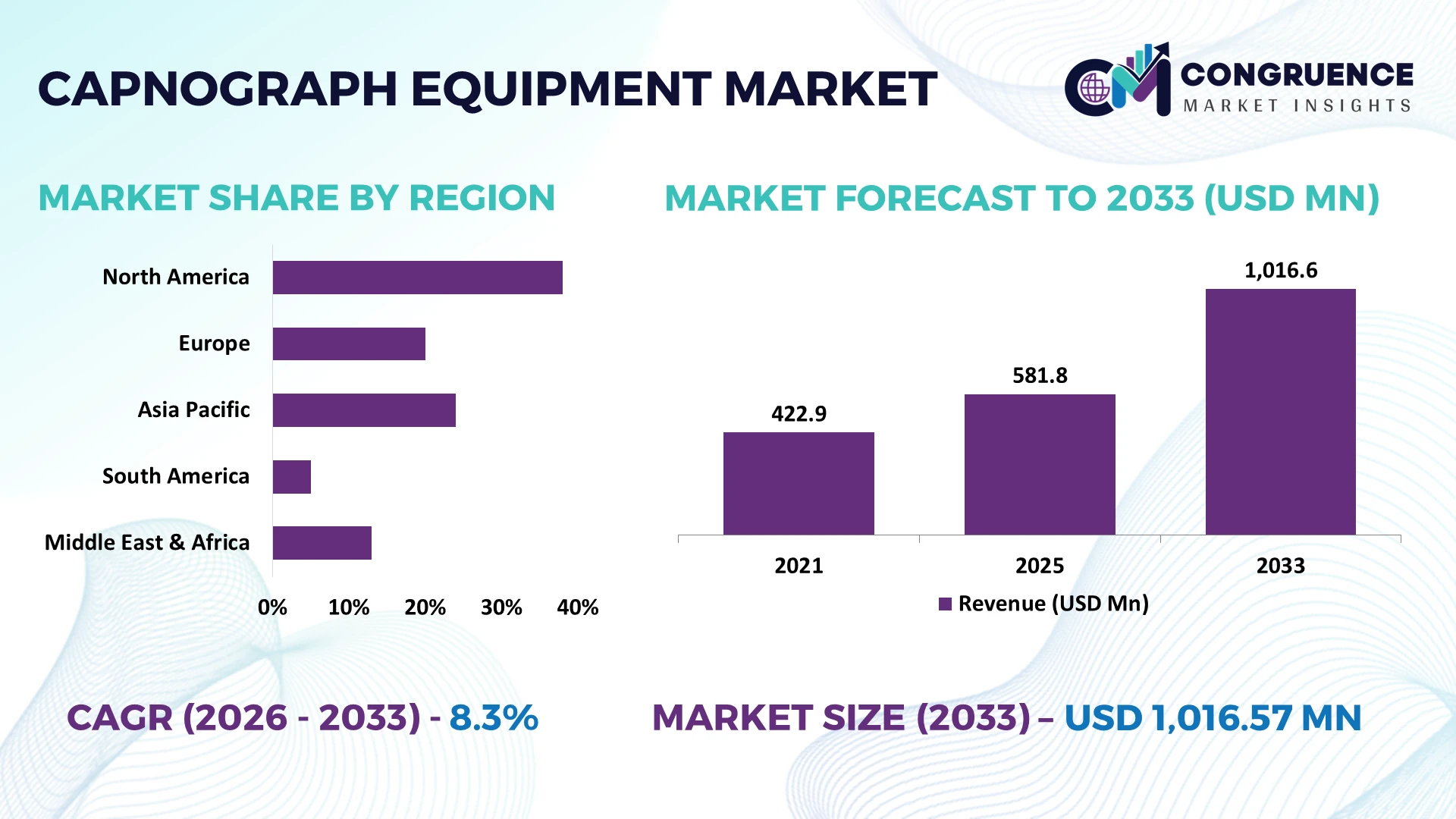
The Global Capnograph Equipment Market was valued at USD 581.75 Million in 2025 and is anticipated to reach a value of USD 1016.57 Million by 2033 expanding at a CAGR of 8.3% between 2026 and 2033. Growth is being accelerated by wider procedural sedation monitoring, expanding ICU capacity, and integration of advanced capnography into multi-parameter patient monitoring systems across acute care and emergency settings.
The United States leads the global capnograph equipment market with approximately 34% share, supported by over 6,000 hospitals, sustained medical technology investments, and capnography adoption exceeding 78% across critical care and surgical environments. Compared with Japan, where adoption in advanced hospital networks is above 62%, the U.S. benefits from larger procurement volumes and faster AI-enabled monitoring deployment. Ongoing healthcare supply-chain localization following post-pandemic resilience initiatives continues to strengthen domestic manufacturing and procurement strategies.
For manufacturers and investors, prioritizing high-performance portable systems, integrated monitoring platforms, and strategic expansion across established healthcare infrastructure offers the strongest long-term competitive advantage.
Market Size & Growth: USD 581.75 Million in 2025, reaching USD 1016.57 Million by 2033 at 8.3% CAGR, driven by integrated respiratory monitoring and digital critical care expansion.
Top Growth Drivers: Procedural monitoring adoption +18%, emergency care equipment procurement +15%, outpatient surgical volumes +12% supporting sustained market expansion.
Short-Term Forecast: By 2028, workflow efficiency improves by 20% while monitoring-related intervention time declines by 15% through advanced integrated systems.
Emerging Technologies: AI-assisted waveform interpretation, wireless connectivity, and compact sidestream monitoring increase clinical workflow efficiency by nearly 22%.
Regional Leaders: North America exceeds USD 360 Million, Europe approaches USD 255 Million, and Asia-Pacific surpasses USD 240 Million, driven by expanding hospital modernization and regional manufacturing.
Consumer/End-User Trends: More than 72% of tertiary hospitals prioritize continuous capnography for critical care and procedural sedation monitoring.
Pilot/Case Example: A 2026 hospital digital monitoring deployment reduced respiratory event response time by 19% through continuous capnography integration.
Competitive Landscape: Leading manufacturers collectively account for nearly 48% market share, with competition centered on portable, connected, and multi-parameter monitoring platforms.
Regulatory & ESG Impact: Energy-efficient medical device programs lower equipment power consumption by approximately 14% while supporting updated patient safety compliance.
Investment & Funding: More than USD 900 Million supports manufacturing expansion, strategic partnerships, and regional supply-chain diversification across advanced healthcare markets.
Innovation & Future Outlook: Next-generation wearable respiratory monitoring, cloud-enabled analytics, and predictive clinical decision support strengthen long-term competitive positioning.
The Capnograph Equipment Market is advancing through rising demand from emergency medicine, ambulatory surgery centers, and intensive care facilities requiring continuous respiratory assessment. Compact wireless devices, AI-assisted waveform analytics, and integrated patient monitoring platforms are improving clinical efficiency, with smart monitoring deployments increasing by approximately 24%. Regional manufacturing expansion and stricter patient safety standards are reshaping procurement priorities, setting the foundation for the following strategic market assessment.
Capnograph equipment is becoming strategically important as healthcare providers prioritize continuous respiratory monitoring, digital clinical workflows, and patient safety across operating rooms, emergency departments, and ambulatory care. Infrastructure modernization and stricter monitoring protocols are accelerating replacement cycles, while supply-chain diversification since the post-pandemic period is encouraging localized manufacturing and dual-sourcing strategies. These structural shifts are reshaping competition, with manufacturers differentiating through connected monitoring ecosystems instead of standalone devices.
AI-assisted waveform analysis and integrated multi-parameter monitoring reduce clinician response time by approximately 20% compared with conventional standalone capnographs while lowering workflow interruptions by nearly 15%. The United States maintains leadership through extensive deployment across hospital networks, whereas South Korea is expanding faster through digitally connected healthcare infrastructure and smart hospital initiatives. Over the next two to three years, connected capnography installations are expected to exceed 40% of new hospital monitoring procurements, supported by broader interoperability standards and cloud-enabled clinical monitoring.
A leading deployment trend involves integrating portable capnographs into emergency medical services, enabling faster respiratory assessment during patient transport and improving clinical handover efficiency by around 18%. Companies are expanding software partnerships, strengthening domestic production capacity, and investing in interoperable monitoring platforms to secure procurement contracts. Competitive advantage will increasingly depend on integrated digital capabilities, deployment flexibility, and lifecycle service offerings rather than hardware performance alone.
The strongest market driver is the rapid integration of continuous respiratory monitoring across surgical, emergency, and critical care settings, where patient safety protocols have become more stringent. Approximately 78% of tertiary hospitals now prioritize continuous capnography during moderate and deep sedation, while connected monitoring platforms improve clinical workflow efficiency by nearly 21%. Japan and the United States continue expanding digital operating room infrastructure, supporting wider deployment of integrated monitoring solutions. In response, manufacturers are increasing investment in portable systems, software-enabled analytics, and strategic partnerships with hospital technology providers. A key operational advantage is the transition from isolated monitoring devices to networked clinical ecosystems that improve alarm accuracy and reduce intervention delays.
Device interoperability remains a structural limitation, particularly where hospitals operate mixed monitoring platforms from multiple manufacturers. Nearly 35% of healthcare facilities report integration challenges with legacy patient monitoring infrastructure, while specialized sensor components account for approximately 28% of production costs. Periodic semiconductor and precision sensor supply fluctuations continue extending procurement lead times in several manufacturing hubs. These constraints increase deployment costs and complicate large-scale modernization projects. Companies are mitigating risks through localized component sourcing, long-term supplier agreements, and standardized communication protocols that improve compatibility across existing clinical systems. Strengthening interoperability has become a strategic requirement rather than simply a technical enhancement.
Growing adoption of AI-assisted respiratory analytics and remote patient monitoring is creating new commercial opportunities beyond traditional hospital environments. Connected monitoring platforms can reduce manual observation requirements by approximately 22%, while portable capnography demand in home-based respiratory care is expanding by nearly 18% annually in technologically advanced healthcare systems. Australia and Germany are accelerating digital health initiatives that encourage connected monitoring outside acute care facilities. Companies are responding through cloud-enabled software development, strategic collaborations with telehealth providers, and expanded R&D focused on predictive respiratory analytics. An emerging competitive opportunity lies in subscription-based monitoring ecosystems that combine devices, analytics, and clinical support services.
The primary long-term challenge is achieving consistent deployment across fragmented healthcare infrastructures while maintaining cybersecurity, interoperability, and workforce readiness. Around 31% of healthcare providers require substantial IT upgrades before implementing advanced connected monitoring, and nearly 24% report shortages of personnel trained to interpret advanced respiratory analytics. As hospitals increase cloud-connected medical devices, cybersecurity compliance requirements continue becoming more rigorous, particularly in technologically advanced healthcare systems. Companies must invest in secure software architectures, standardized data integration, workforce training, and long-term service partnerships. Organizations that successfully combine secure connectivity with scalable deployment capabilities will establish stronger competitive positioning and operational resilience.
Integrated Monitoring Platforms Expand: Hospitals are accelerating the transition from standalone capnographs to integrated patient monitoring systems combining capnography, pulse oximetry, and ECG. Integrated deployments have increased by approximately 26%, while clinical response efficiency has improved by nearly 18% and false alarm rates have declined by around 14%. Updated patient safety protocols and hospital digitalization programs are driving procurement. Manufacturers are strengthening interoperability through software partnerships and modular monitoring architectures that simplify enterprise-wide deployment.
Portable Devices Drive Mobility: Lightweight handheld and transport-ready capnographs are becoming standard across ambulatory surgical centers and emergency medical services. Portable equipment adoption has risen by approximately 23%, while newer battery technologies extend operating time by nearly 28%. Workforce shortages and faster patient turnover are encouraging compact respiratory monitoring solutions. Companies are expanding portable product portfolios, improving wireless connectivity, and optimizing rugged designs for continuous operation in high-mobility clinical environments.
AI-Enabled Respiratory Analytics: Artificial intelligence is enhancing waveform interpretation, reducing unnecessary clinical alerts by approximately 19% while improving early respiratory event detection by nearly 16%. Healthcare providers in the United States and South Korea are integrating cloud-based monitoring into centralized clinical command centers. Manufacturers are scaling software capabilities, expanding cybersecurity investments, and forming digital health partnerships to strengthen connected respiratory monitoring ecosystems.
Supply Chain Localization Accelerates: Healthcare organizations are prioritizing resilient procurement models following recent electronic component supply disruptions. Regional sourcing of precision sensors has increased by approximately 21%, reducing procurement lead times by nearly 17% while improving inventory stability. Companies are expanding domestic manufacturing partnerships, diversifying supplier networks, and increasing strategic component inventories to strengthen operational continuity and maintain reliable delivery across critical healthcare facilities.
Mainstream capnograph equipment holds the largest share of approximately 41% due to its real-time measurement capability, high waveform accuracy, and seamless compatibility with anesthesia workstations and intensive care monitoring systems. Its widespread deployment across operating rooms and critical care units supports consistent demand from large hospitals where continuous respiratory monitoring is mandatory. Manufacturers continue improving sensor durability and digital connectivity, helping reduce maintenance requirements by nearly 15%. Sidestream systems remain strategically important because they provide flexible monitoring for both intubated and non-intubated patients, making them suitable for diverse clinical environments.
Microstream capnography is the fastest-growing type, with adoption increasing by approximately 20% as healthcare providers seek lower sampling flow rates, improved neonatal monitoring, and greater moisture resistance. Handheld devices continue expanding in emergency transport and outpatient care because of their compact design and operational flexibility. Companies are increasing investment in miniaturized sensors, portable monitoring platforms, and integrated software capabilities, shifting product development toward mobility, interoperability, and specialized respiratory care applications while maintaining support for established mainstream technologies.
Anesthesia Monitoring accounts for approximately 45% of total market demand, supported by standardized respiratory monitoring protocols during surgical procedures and expanding operating room modernization. Continuous end-tidal carbon dioxide monitoring remains essential for improving patient safety and ventilation management. Critical Care represents the second-largest application as intensive care units increasingly deploy integrated respiratory monitoring systems. Manufacturers are expanding compatibility with anesthesia workstations and centralized monitoring platforms, improving workflow efficiency by approximately 17%.
Procedural Sedation is the fastest-growing application, with adoption rising by nearly 22% as outpatient procedures, endoscopy services, and minimally invasive interventions continue expanding. Emergency Care is also strengthening through broader deployment of portable capnographs in ambulances and trauma response systems, enabling faster respiratory assessment during patient transport. Companies are introducing specialized portable solutions, cloud-connected monitoring platforms, and workflow-focused software to address growing demand across both acute and ambulatory healthcare environments.
Hospitals represent the dominant end-user segment with approximately 58% market share due to extensive deployment across operating rooms, intensive care units, emergency departments, and post-anesthesia recovery areas. Their advanced infrastructure and centralized procurement processes support large-scale installation of integrated respiratory monitoring systems. Specialty Clinics continue increasing adoption for procedural monitoring and outpatient respiratory assessment. Manufacturers are strengthening long-term service agreements, integrated software offerings, and equipment lifecycle management to improve customer retention and operational performance.
Ambulatory Surgical Centers are the fastest-growing end-user category, with adoption expanding by approximately 24% as minimally invasive procedures increasingly shift toward outpatient settings. Emergency Medical Services are also becoming an important growth area through wider deployment of portable capnographs for prehospital respiratory assessment and patient transport. Companies are responding through customized product portfolios, flexible pricing strategies, distribution partnerships, and transport-ready monitoring solutions designed for mobile healthcare environments, strengthening competitive positioning across emerging clinical settings.
North America accounted for the largest market share at 38.6% in 2025 however, Asia-Pacific is expected to register the fastest growth, expanding at a 9.8% CAGR between 2026 and 2033.

Advanced Hospital Digitalization Sustains Market Leadership
North America maintains the leading position through extensive deployment of capnography across operating rooms, emergency departments, and intensive care units. Approximately 38.6% of global demand originates from the region, supported by mature healthcare infrastructure, high adoption of integrated patient monitoring systems, and continuous replacement of legacy equipment. More than 76% of tertiary hospitals have incorporated capnography into standard respiratory monitoring workflows, while increasing investments in connected healthcare platforms continue strengthening procurement activity. Strategic partnerships between medical device manufacturers and hospital networks are accelerating deployment of cloud-enabled monitoring solutions and improving interoperability across enterprise healthcare systems. Companies are also expanding domestic manufacturing capabilities to improve supply resilience and shorten equipment delivery timelines.
United States Market Outlook: The United States remains the regional growth engine due to advanced hospital infrastructure, strong clinical standardization, and rapid adoption of AI-assisted monitoring technologies. More than 6,000 hospitals support extensive deployment of capnography across surgical and critical care environments, while integrated monitoring installations continue increasing as healthcare providers prioritize digital patient safety initiatives. Manufacturers are strengthening software partnerships and localized production to support long-term procurement programs.
Regulatory Modernization Accelerates Clinical Standardization
Europe continues strengthening its position through harmonized patient safety standards, hospital modernization, and widespread deployment of advanced respiratory monitoring systems. The region represents approximately 27% of global market demand, with high adoption across anesthesia, intensive care, and procedural sedation applications. Digital healthcare transformation has increased integrated monitoring deployments by nearly 18%, while procurement increasingly favors interoperable medical devices capable of centralized data management. Medical technology companies are expanding manufacturing partnerships and investing in connected monitoring platforms to comply with evolving regulatory expectations while improving operational efficiency across healthcare networks.
Germany Market Outlook: Germany leads the European market through its advanced hospital infrastructure, strong medical technology manufacturing ecosystem, and consistent investment in digital healthcare modernization. More than 70% of large tertiary hospitals utilize integrated respiratory monitoring platforms during critical care and surgical procedures. Domestic manufacturers continue expanding innovation programs and enterprise partnerships focused on intelligent patient monitoring and interoperability.
Healthcare Infrastructure Expansion Drives Rapid Deployment
Asia-Pacific is experiencing the fastest operational expansion through hospital construction, healthcare digitalization, and growing domestic medical device manufacturing. The region accounts for approximately 24% of global demand while recording the strongest deployment momentum across emerging healthcare systems. Government-backed healthcare infrastructure projects and increasing procedural volumes have expanded advanced respiratory monitoring installations by nearly 24%. Manufacturers are strengthening regional production facilities, expanding distribution partnerships, and increasing localized component sourcing to improve delivery efficiency and cost competitiveness while supporting rapidly expanding healthcare networks.
China Market Outlook: China dominates the regional landscape through large-scale hospital expansion, increasing domestic medical device manufacturing, and strong public healthcare investment. Smart hospital initiatives continue accelerating deployment of connected patient monitoring systems, while local manufacturers expand production capacity to reduce import dependency. Integrated respiratory monitoring adoption continues rising across tertiary hospitals, strengthening China's strategic role in both manufacturing and healthcare deployment.
Hospital Modernization Supports Equipment Upgrades
South America is steadily expanding through healthcare infrastructure improvements, greater procedural monitoring adoption, and increasing investment in emergency medical services. The region contributes approximately 6% of global demand, with Brazil and neighboring markets driving equipment procurement for public and private hospitals. Digital monitoring deployments have increased by nearly 16%, supported by modernization programs and expanded surgical capacity. Companies are strengthening distributor partnerships, regional service networks, and localized technical support to improve equipment availability while addressing infrastructure variability across healthcare systems.
Brazil Market Outlook: Brazil represents the largest national market due to its extensive hospital network, growing surgical volumes, and continued modernization of public healthcare facilities. Deployment of integrated patient monitoring systems is expanding across tertiary hospitals, supported by investment in digital clinical infrastructure. Manufacturers are increasing regional partnerships and technical support capabilities to strengthen long-term customer engagement and operational reliability.
Healthcare Investment Reshapes Clinical Monitoring
The Middle East & Africa market is advancing through sustained healthcare investment, hospital expansion, and modernization of critical care infrastructure. The region contributes approximately 4.4% of global demand while increasing procurement of advanced respiratory monitoring technologies across major healthcare centers. Hospital modernization projects have increased integrated monitoring deployments by nearly 19%, supported by national healthcare transformation initiatives. Manufacturers are expanding regional distribution partnerships, technical training programs, and localized service operations to improve deployment consistency and equipment lifecycle management across developing healthcare systems.
Saudi Arabia Market Outlook: Saudi Arabia leads regional development through significant investment in hospital infrastructure, digital healthcare transformation, and modernization of critical care facilities. National healthcare expansion programs continue increasing adoption of advanced respiratory monitoring technologies across public and private hospitals. Companies are strengthening local partnerships, clinical training initiatives, and after-sales service capabilities to support sustained deployment and operational excellence.
Global leaders including Medtronic, Masimo, Smiths Medical, Dräger, and Nihon Kohden compete directly against specialized respiratory monitoring manufacturers and cost-focused regional suppliers. The top five players collectively control approximately 57% of the market, with competition centered on technology integration, monitoring accuracy, software interoperability, and clinical workflow optimization rather than pricing alone. AI-enabled monitoring platforms improve operational efficiency by nearly 18%, while connected device ecosystems reduce hospital integration time by approximately 15%, creating measurable competitive differentiation. Leading manufacturers are expanding production capacity, strengthening hospital partnerships, investing in cloud-enabled monitoring platforms, and increasing vertical integration of sensors and software. Regional manufacturers compete aggressively through localized production, faster customization, and shorter procurement cycles. Regulatory compliance, clinical validation requirements, and interoperability with existing hospital infrastructure remain significant entry barriers. Sustainable competitive success depends on delivering integrated digital monitoring ecosystems, dependable supply chains, advanced analytics, and comprehensive lifecycle support rather than standalone hardware performance.
Medtronic
Masimo Corporation
Dräger
Nihon Kohden Corporation
Smiths Medical
Philips Healthcare
GE HealthCare
Mindray Medical International
Nonin Medical
Edan Instruments
Infinium Medical
Schiller AG
Spacelabs Healthcare
BPL Medical Technologies
Current capnograph equipment technology is centered on mainstream, sidestream, and microstream sensing platforms integrated with multi-parameter patient monitors. Advanced infrared sensing and intelligent signal processing improve measurement accuracy by approximately 16% while reducing false respiratory alarms by nearly 14% compared with previous-generation systems. Around 74% of tertiary hospitals now deploy capnography as part of integrated monitoring environments rather than standalone devices, enabling faster clinical intervention and streamlined patient data management. Healthcare providers benefit through improved workflow efficiency, lower maintenance requirements, and enhanced interoperability with electronic medical records.
Emerging technologies between 2026 and 2028 include AI-assisted waveform interpretation, cloud-connected respiratory monitoring, Bluetooth-enabled portable capnographs, and predictive respiratory analytics. AI-supported analysis improves abnormal event recognition by approximately 19%, while cloud integration reduces clinical data retrieval time by nearly 18%. Connected monitoring deployment is expected to exceed 45% of new hospital installations by 2028. Compared with conventional standalone capnographs, integrated AI-enabled platforms improve clinical workflow efficiency by approximately 22%, giving large healthcare systems stronger operational visibility and faster decision-making.
Disruptive innovation is shifting competition toward software-enabled respiratory monitoring ecosystems rather than hardware differentiation alone. Global technology leaders benefit through integrated monitoring platforms, while specialized manufacturers compete through compact portable devices and advanced sensor technologies. Companies investing in predictive analytics, cybersecurity, and interoperable digital architectures are expected to secure stronger procurement positions between 2026 and 2028, making technology integration the primary competitive differentiator across the capnograph equipment market.
June 2026 Medtronic received U.S. FDA 510(k) clearance for the Nellcor™ pulse oximetry system with the Nell-EQ™ intelligent processor, strengthening integrated respiratory monitoring capabilities across diverse patient populations and supporting broader acute-care deployment. Business impact: enhanced connected monitoring portfolio.
May 2026 Medtronic obtained FDA substantial-equivalence clearance for the Capnostream™ 35 Portable Respiratory Monitor, expanding real-time multiparameter respiratory monitoring beyond intensive care environments. Business impact: broader point-of-care adoption and stronger product competitiveness.
September 2025 Masimo and Philips expanded their strategic partnership to accelerate integration of advanced monitoring technologies into Philips patient monitoring platforms, supporting wider deployment of AI-enabled respiratory monitoring solutions. Business impact: improved enterprise interoperability and streamlined hospital procurement.
March 2026 Medtronic expanded its global strategic alliance with GE HealthCare to accelerate innovation across bedside monitoring, telemetry, and perioperative monitoring platforms, strengthening integrated clinical workflows. Business impact: faster deployment of connected monitoring ecosystems across healthcare networks. Source: Medtronic News
This report provides comprehensive analysis of the Capnograph Equipment Market across mainstream, sidestream, microstream, and handheld technologies, together with detailed evaluation of anesthesia monitoring, critical care, emergency care, and procedural sedation applications. It assesses demand across hospitals, ambulatory surgical centers, emergency medical services, and specialty clinics while examining deployment trends across North America, Europe, Asia-Pacific, South America, and the Middle East & Africa. More than 55% of market assessment focuses on hospital-based respiratory monitoring and integrated digital healthcare deployments.
The study evaluates technology adoption, competitive positioning, regional infrastructure development, procurement strategies, product innovation, and emerging digital monitoring ecosystems expected to shape the market between 2026 and 2033. It further examines company strategies, deployment patterns, interoperability trends, supply-chain developments, and investment priorities, enabling stakeholders to identify expansion opportunities, optimize product portfolios, strengthen competitive positioning, and support informed strategic planning across established and emerging healthcare markets.
| Report Attribute/Metric | Report Details |
|---|---|
Market Revenue in 2025 | USD 581.75 Million |
Market Revenue in 2033 | USD 1016.57 Million |
CAGR (2026 - 2033) | 8.3% |
Base Year | 2025 |
Forecast Period | 2026 - 2033 |
Historic Period | 2021 - 2025 |
Segments Covered | By Type
By Application
By End-User
|
Key Report Deliverable | Revenue Forecast, Growth Trends, Market Dynamics, Segmental Overview, Regional and Country-wise Analysis, Competition Landscape |
Region Covered | North America, Europe, Asia-Pacific, South America, Middle East, Africa |
Key Players Analyzed | Medtronic, Masimo Corporation, Dräger, Nihon Kohden Corporation, Smiths Medical, Philips Healthcare, GE HealthCare, Mindray Medical International, Nonin Medical, Edan Instruments, Infinium Medical, Schiller AG, Spacelabs Healthcare, BPL Medical Technologies |
Customization & Pricing | Available on Request (10% Customization is Free) |




