
Reports
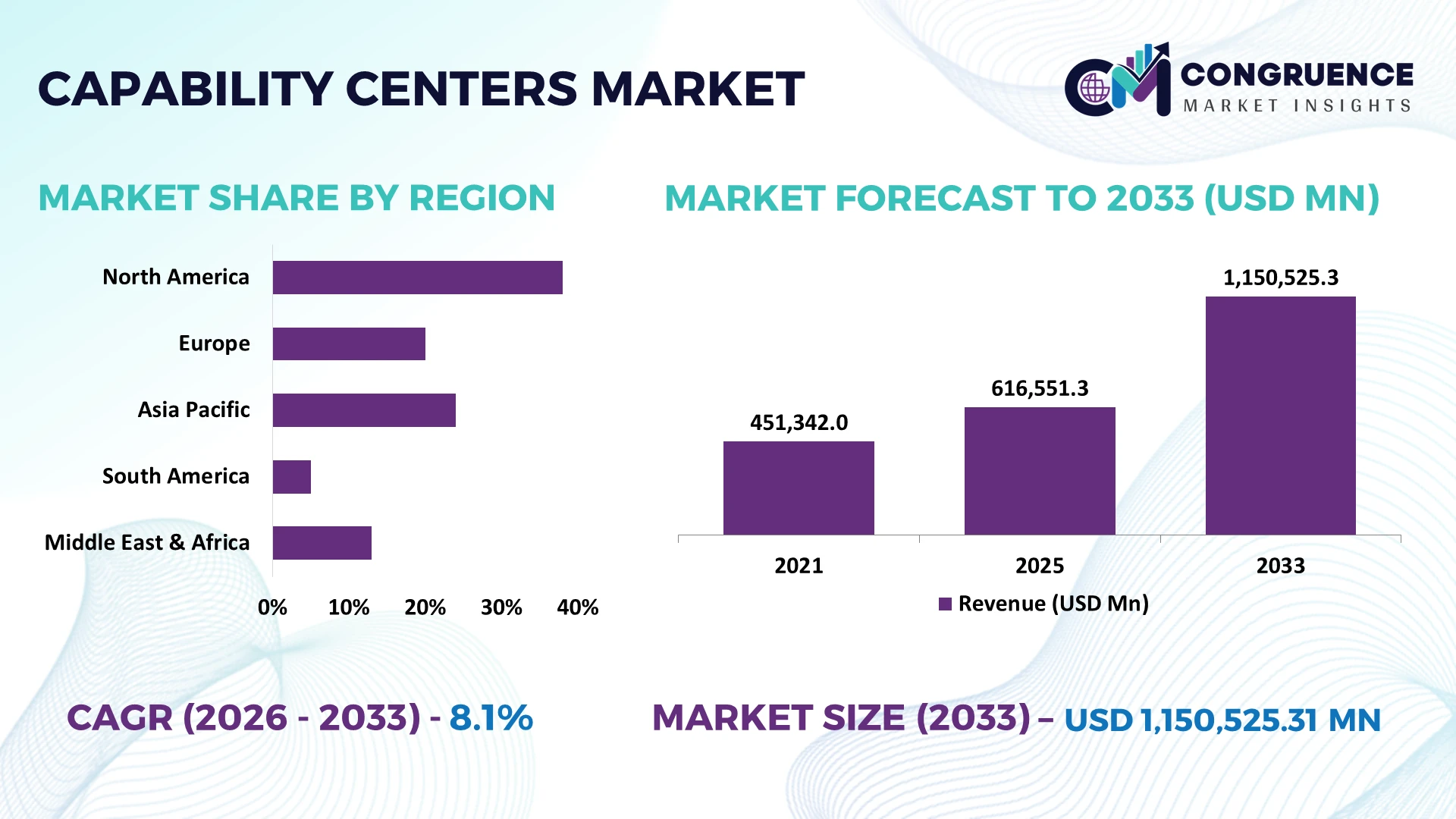
The Global Capability Centers Market was valued at USD 616551.33 Million in 2025 and is anticipated to reach a value of USD 1150525.31 Million by 2033 expanding at a CAGR of 8.11% between 2026 and 2033. Growth is being propelled by enterprise AI deployment, semiconductor and engineering R&D expansion, cloud-native product development, and the relocation of mission-critical operations into specialized offshore capability hubs.
India dominates the global capability center landscape, accounting for approximately 55% of global centers, with more than 1,800 GCCs and 1.9 million professionals as of 2025. The country generates USD 64.6 billion in annual export revenue, supported by BFSI, software, engineering, healthcare, and semiconductor operations. Bengaluru, Hyderabad, Pune, and Chennai anchor technology-intensive capacity, while tier-2 cities expand talent access. Compared with established North American centers, India offers a deeper concentration of offshore digital talent, strengthening its position amid geopolitical supply-chain diversification and enterprise resilience strategies.
Strategic implication: Prioritize AI-led engineering, cybersecurity, and product ownership in India while retaining geographically diversified centers for regulatory control, customer proximity, and operational resilience.
Market Size & Growth: USD 616.55 billion in 2025 to USD 1,150.53 billion by 2033, at 8.11% CAGR; AI-native operations and engineering specialization accelerate expansion.
Top Growth Drivers: 62.58% Asia-Pacific market share, 54.28% IT and digital services share, and 57.74% captive-center share underscore geographic concentration, digital capability, and ownership preferences.
Short-Term Forecast: By 2028, enterprise GCCs targeting AI-enabled workflows prioritize 20% productivity improvement and 15% lower process costs as internal performance benchmarks.
Emerging Technologies: Agentic AI, generative AI, and cloud-native engineering reshape GCC delivery; 58% of Indian GCCs invest in agentic AI and 83% invest in GenAI.
Regional Leaders: Asia-Pacific reaches USD 207.23 billion, North America USD 116.39 billion, and Central and Eastern Europe USD 41.97 billion by 2031; APAC expands through AI hubs, North America through nearshoring, and CEE through engineering talent.
Consumer/End-User Trends: 65% of GCCs apply GenAI to customer service, 53% to finance, and 49% to operations, signaling measurable enterprise-wide adoption.
Pilot/Case Example: A 2025 insurance GCC transformation cleared 5,000+ backlogs within a month, improved productivity by 22%, and reduced total costs by more than 60%.
Competitive Landscape: Accenture, EY, and IBM each hold above 8% of GCC transformation services share; Capgemini, Cognizant, Deloitte, HCLTech, Infosys, and TCS form the next competitive tier.
Regulatory & ESG Impact: 42% report rising data privacy and compliance concerns, while 60% monitor third-party data access; governance readiness directly influences GCC location and operating-model selection.
Investment & Funding: 58% of Indian GCCs invest in agentic AI, while 29% plan to scale investment within a year; capital deployment shifts toward AI infrastructure, innovation teams, and workforce reskilling.
Innovation & Future Outlook: 67% of Indian GCCs establish dedicated innovation teams, strengthening the shift from transactional delivery toward enterprise product ownership and global decision-making.
The global capability centers market increasingly prioritizes AI-led product engineering, financial analytics, cybersecurity, healthcare technology, and enterprise data management. Demand is strongest among multinational enterprises consolidating specialized functions into integrated innovation hubs. Generative AI platforms, autonomous workflow orchestration, and cloud-native engineering are accelerating the transition from support operations to strategic business ownership. Notably, 43% of Indian GCCs reported GenAI pilots in 2025, compared with 37% in 2024, reflecting faster implementation. Meanwhile, geopolitical supply-chain diversification and stricter data-residency requirements are reshaping location strategies, making technology governance and talent specialization central to future investment decisions.
Global Capability Centers (GCCs) are becoming strategic assets for multinational enterprises as competition shifts from labor-cost optimization toward proprietary technology development, operational resilience, and enterprise-wide innovation. Supply-chain restructuring and geopolitical uncertainty are accelerating the relocation of critical engineering, analytics, and digital operations into controlled global hubs. India hosted approximately 1,700 GCCs employing 1.9 million professionals in FY2024, establishing a substantial platform for advanced capability development.
The technology transition is redefining operating economics. AI-enabled automation reduces manual processing and accelerates decision cycles compared with legacy rule-based workflows, while cloud-native architectures improve deployment flexibility. By 2025, 83% of Indian GCCs were investing in generative AI, and 58% were investing in agentic AI. Bengaluru and Hyderabad lead large-scale technology deployment, while emerging Indian hubs attract specialized operations through lower operating costs and expanding talent pools.
Over the next 2–3 years, investment priorities will center on AI infrastructure, cybersecurity, domain-specific engineering, and workforce transformation. Companies are expanding innovation teams, forming technology partnerships, and shifting selected functions from outsourced delivery to captive ownership. A practical example is the deployment of AI-assisted finance operations for automated reconciliation, exception handling, and compliance monitoring. GCCs that combine specialized talent with enterprise decision authority will secure stronger competitive positioning, greater operational control, and more durable strategic relevance.
The transition from labor arbitrage to technology-led value creation is the principal driver of capability center expansion. In India, 83% of GCCs are investing in generative AI, while 58% are investing in agentic AI, reflecting accelerating enterprise automation. AI adoption across customer service, finance, and operations is expanding the functional mandate of GCCs beyond conventional back-office delivery. The European Union’s AI Act and evolving data-governance requirements are also increasing demand for specialized compliance engineering and secure technology development. Companies are responding by establishing AI centers of excellence, expanding engineering teams, and building partnerships with cloud and AI providers. The strategic advantage lies in embedding innovation directly into enterprise workflows rather than treating GCCs as external support units.
Rising compensation, infrastructure expenses, and regulatory complexity constrain GCC scalability, particularly in established Indian technology hubs. In 2025, 54% of Indian GCCs reported rising compensation costs, while 42% identified increasing compliance and data-privacy concerns. Transfer pricing remained a major regulatory concern for 63% of surveyed centers, complicating cross-border cost allocation and operating-model design. Bengaluru and Hyderabad face intense competition for specialized AI and cybersecurity professionals, increasing recruitment and retention expenses. Companies are mitigating these pressures through tier-2 expansion, multi-location operating models, structured workforce planning, and long-term technology contracts. A key operational insight is that location selection must optimize total delivery cost and talent availability rather than salary benchmarks alone.
The shift toward AI-native enterprises creates opportunities for GCCs to own product engineering, intelligent automation, cybersecurity research, and advanced analytics. In India, 67% of GCCs have established dedicated innovation teams, while 71% are pursuing workforce reskilling and 81% are upskilling employees for GenAI. These investments support expansion into specialized capabilities rather than conventional transaction processing. Hyderabad and Pune are strengthening technology and engineering capacity, while Coimbatore and Ahmedabad are emerging as cost-efficient alternatives for selected functions. Companies are positioning through AI research partnerships, startup collaboration, and domain-specific product development. A non-obvious opportunity lies in building reusable enterprise AI platforms within GCCs, enabling one innovation investment to support multiple global business units.
Scaling GCCs into enterprise-critical functions introduces complex execution requirements involving legacy integration, cybersecurity architecture, talent readiness, and governance consistency. In India, 66% of GCCs report difficulty attracting niche technology talent, while only 7% have fully embedded cybersecurity centers of excellence. Third-party data-access monitoring has increased to 60%, reflecting heightened exposure as centers integrate external AI platforms and enterprise systems. These pressures affect deployment speed, operational continuity, and the reliability of globally distributed functions. Companies must invest in secure cloud infrastructure, interoperable data platforms, AI governance, and specialized workforce development. The decisive challenge is maintaining consistent control across multiple locations while enabling innovation at enterprise scale.
AI Pilots Shift Toward Production: Indian GCCs are moving from controlled AI experimentation into operational deployment, with GenAI investment reaching 83% and agentic AI investment reaching 58% in 2025. Pilot adoption increased from 37% to 43% year over year. Enterprises are embedding AI into service workflows, knowledge retrieval, and internal decision systems rather than treating it as a standalone technology initiative. Companies are expanding implementation teams, strengthening governance, and prioritizing production-ready use cases to improve process consistency and reduce manual intervention. The emerging distinction is between AI adoption and measurable enterprise-wide impact.
Enterprise Decision Ownership Expands: GCCs are assuming greater responsibility for global business decisions, with 52% of Indian centers sharing decision accountability and 26% formally consulted in 2025. Meanwhile, 45% are contributing to global strategy leadership. This shift reflects organizational restructuring in which centers move closer to business-unit leadership instead of remaining execution-only units. Enterprises are expanding senior leadership roles, product ownership, and end-to-end process accountability within established hubs. The operational benefit is faster decision-making across time zones, although effective governance requires clear boundaries between local execution and global authority.
Talent Strategies Prioritize Specialization: Workforce strategies are shifting toward capability depth, with 71% of Indian GCCs prioritizing reskilling and 63% emphasizing niche-skill hiring. Attrition declined from 13% in 2023 to 9% in 2025, strengthening workforce continuity. As AI, cybersecurity, and data engineering reshape role requirements, companies are replacing broad recruitment strategies with domain-specific talent pipelines, internal academies, and targeted hiring partnerships. Bengaluru and Pune continue attracting advanced technology talent, while emerging cities provide alternatives for expanding delivery capacity. The non-obvious shift is that talent retention increasingly protects institutional knowledge, not simply recruitment expenditure.
Flexible Operating Models Gain Traction: Indian GCCs are retaining in-house control over 84% of operations, while outsourcing increased from 8% in 2024 to 12% in 2025. This indicates selective externalization of transactional and non-core activities rather than wholesale outsourcing. Companies are combining captive ownership with managed services, specialist vendors, and Build-Operate-Transfer arrangements to accelerate setup and preserve control over intellectual property. Regulatory complexity and cross-border data requirements are influencing partner selection. The model enables enterprises to concentrate internal teams on product engineering, analytics, and strategic workflows while using external providers for standardized delivery.
Integrated GCCs Lead; R&D Centers Deepen Strategic Mandates
Global Capability Centers remain the dominant operating type, accounting for an estimated 55% of the worldwide center footprint. Their leadership reflects enterprise preference for integrated delivery models that combine technology, finance, analytics, and business operations under centralized governance. Shared Services Centers retain strategic relevance through standardized finance, HR, procurement, and transaction processing, with 84% of Indian GCCs maintaining in-house operations in 2025. However, the operating model is becoming more selective, as outsourcing of non-core functions increased from 8% to 12%. Enterprises are consolidating high-value activities internally while using external partners for standardized workloads, improving cost control without diluting ownership of critical capabilities.
R&D Centers and Centers of Excellence represent the higher-value segment shift. Engineering-focused centers are increasingly responsible for product architecture, semiconductor design, AI development, and advanced testing. India's engineering R&D GCC setup rate grew 1.3 times faster than the overall GCC setup rate over the preceding five years. Centers of Excellence are gaining importance as enterprises centralize specialized knowledge, AI governance, and reusable technology platforms. Companies are directing investment toward innovation-led mandates, domain-specific engineering, and cross-functional integration rather than simply expanding headcount. This shift strengthens intellectual property ownership and accelerates product development.
IT and Digital Services Anchor Enterprise Demand
IT and Digital Services represent the leading application, accounting for approximately 54.28% of global capability center market share in 2025. Demand concentration reflects enterprise reliance on software engineering, cloud migration, cybersecurity, application modernization, and digital product development. The segment's scale is reinforced by recurring technology maintenance and continuous platform upgrades. Finance and Accounting remain mature applications, with 79% of Indian GCCs supporting finance functions in 2025. Customer Support continues to provide a substantial operational base, while companies are increasingly integrating automation, multilingual service delivery, and knowledge management into existing workflows. Enterprises are consolidating technology and business operations to improve service consistency and reduce duplicated infrastructure.
Data Analytics and Research and Development are gaining strategic weight as enterprises prioritize predictive intelligence, product innovation, and evidence-based decision-making. Data Management and Analytics were supported by 69% of Indian GCCs, while Engineering R&D functions reached 41% in 2025. These applications increasingly connect operational data with product engineering and business planning. Companies are expanding analytics teams, deploying AI-enabled platforms, and strengthening data governance to convert distributed information into enterprise-level intelligence. The shift is moving demand toward integrated applications that combine digital delivery, analytical capability, and domain expertise, making advanced data functions increasingly critical to operational competitiveness.
IT and Telecom Lead; BFSI Strengthens Technology Investment
IT and Telecom represent the leading end-user segment, accounting for approximately 35.88% of global capability center market share in 2025. Demand is concentrated around software development, network engineering, cloud infrastructure, cybersecurity, and continuous digital platform modernization. Established technology enterprises operate large-scale centers to support global product portfolios and distributed engineering teams. BFSI remains a major buyer group, with demand shaped by regulatory technology, digital banking, fraud analytics, and secure financial infrastructure. Companies are expanding specialized delivery teams and integrating advanced analytics into enterprise operations. The strategic distinction is that IT and Telecom centers increasingly develop proprietary platforms, while BFSI centers prioritize operational resilience, regulatory compliance, and secure transaction processing.
Healthcare, Manufacturing, and Retail are strengthening their adoption as digital transformation extends beyond traditional technology buyers. Healthcare centers are expanding clinical data management, pharmaceutical research, and medical technology development, while manufacturing enterprises prioritize industrial automation, digital twins, and engineering analytics. Retail centers increasingly support omnichannel platforms, customer intelligence, and supply-chain optimization. In India's 2025 new GCC setup mix, BFSI accounted for 11%, engineering and manufacturing for 7%, healthcare for 4%, and retail and FMCG for 1%. Companies are responding through sector-specific talent acquisition, technology partnerships, and customized operating models. Future demand is shifting toward specialized industry capabilities rather than broad, standardized delivery structures.
Asia-Pacific accounted for the largest market share at 62.58% in 2025 however, Middle East & Africa is expected to register the fastest growth through 2033, supported by digital infrastructure investment and enterprise capability expansion.
Nearshore Innovation and Enterprise Technology Ownership Reshape Deployment
North America remains a strategically important capability center market, supported by multinational headquarters, advanced technology infrastructure, and concentrated demand for high-value digital operations. The United States accounts for approximately 84.10% of the regional market, reflecting its dominant enterprise base and concentration of technology-intensive functions. Deployment priorities are shifting from conventional offshore cost arbitrage toward nearshore engineering, cybersecurity, AI development, and regulatory-sensitive operations. Mexico benefits from bilingual talent and time-zone alignment, while Canada attracts specialized financial and technology functions. In 2025, IT and Digital Services represented 53.22% of North American GCC activity. Companies are expanding hybrid operating models and Build-Operate-Transfer partnerships to accelerate setup while preserving intellectual property control. Rising labor and real-estate costs are encouraging investment in secondary cities, where enterprises can balance technical talent, operating expenses, and proximity to customers.
United States Market Outlook: The United States remains the region's primary capability center anchor, supported by enterprise headquarters, intellectual property protection, deep research ecosystems, and advanced digital infrastructure. Austin, Chicago, Phoenix, and the Bay Area support technology-intensive operations across AI, cloud computing, financial technology, and cybersecurity. The country accounted for 84.10% of the North American market in 2025. Companies are increasingly establishing specialized domestic centers for product ownership, regulated workloads, and customer-facing innovation. Secondary-city expansion provides access to university talent and lower operating costs, allowing enterprises to preserve strategic functions without concentrating all investment in high-cost coastal technology hubs.
Regulatory Alignment and Specialized Engineering Drive Hub Selection
Europe's capability center landscape is shaped by specialized talent, cross-border operating models, and regulatory alignment. The United Kingdom remains a major financial and technology hub, while Poland, Romania, and the Czech Republic attract engineering, analytics, and shared-services operations. The United Kingdom held approximately 17.52% of the European market in 2025, reflecting its concentration of multinational headquarters and financial services capabilities. The EU's GDPR and AI Act are influencing deployment architecture, particularly for data-intensive and AI-enabled workloads. Companies are adopting multi-country operating structures to balance access to talent with data governance and customer proximity. Poland's expanding engineering ecosystem and fiscal incentives are strengthening its role in advanced technology delivery, while higher labor costs in mature hubs are prompting enterprises to distribute selected functions across Central and Eastern Europe.
United Kingdom Market Outlook: The United Kingdom retains strategic relevance through its financial services ecosystem, technology research base, English-language talent, and access to enterprise decision-makers. London remains a key center for financial technology, risk analytics, cybersecurity, and digital banking operations. The country accounted for approximately 17.52% of Europe's capability center market in 2025. Post-Brexit operating requirements have encouraged some multinational enterprises to pair UK centers with EU-based affiliates, preserving access to continental markets while maintaining specialized domestic functions. Investment priorities increasingly favor regulated technology, AI-enabled financial operations, and enterprise data management.
Scale, Talent Depth, and AI Deployment Reinforce Regional Leadership
Asia-Pacific accounted for 62.58% of the global capability centers market in 2025, supported by India's extensive enterprise delivery ecosystem and China's engineering infrastructure. India remains the principal hub for technology services, financial operations, analytics, and product engineering, while China retains relevance in hardware engineering and domestic technology development. India held approximately 70.32% of the Asia-Pacific capability centers market in 2025. Enterprises are expanding beyond Bengaluru and Hyderabad into Pune, Chennai, and emerging tier-2 cities to access specialized talent and improve cost efficiency. AI adoption is reshaping delivery structures, with companies investing in agentic workflows, GenAI platforms, and domain-specific engineering. Japan, Singapore, Malaysia, and the Philippines provide complementary capabilities in regional headquarters, advanced manufacturing, financial operations, and customer service. Companies increasingly use multi-country models to balance scale, talent specialization, and regulatory exposure.
India Market Outlook: India remains the region's dominant capability center destination, supported by a deep technology workforce, established enterprise ecosystems, and expanding engineering capabilities. The country hosted more than 1,700 GCCs employing approximately 1.9 million professionals in FY2024. Bengaluru leads advanced technology operations, while Hyderabad, Pune, Chennai, and Mumbai support diversified engineering, financial, and analytics mandates. India's engineering R&D GCC setup rate has grown 1.3 times faster than the overall setup rate over the preceding five years. Enterprises are expanding AI, semiconductor, aerospace, and product engineering functions, strengthening India's position as a global innovation and decision-support hub.
Nearshore Delivery and Cloud Infrastructure Strengthen Regional Relevance
South America's capability center market is increasingly shaped by nearshore delivery requirements, multilingual talent, and improving cloud infrastructure. Brazil accounted for approximately 59.31% of the regional market in 2025, supported by its large enterprise base, skilled workforce, and established financial and technology ecosystems. Argentina, Chile, Colombia, and Uruguay provide complementary talent and operating advantages for software engineering, analytics, and customer-facing functions. Regional cloud infrastructure investment is improving latency and enabling more complex workloads, while US enterprises value time-zone alignment and operational collaboration. However, currency volatility, infrastructure inconsistencies, and country-specific regulatory requirements influence investment decisions. Companies are adopting hybrid Build-Operate-Transfer models, local partnerships, and diversified delivery footprints to reduce setup risk. The strategic opportunity lies in specialized nearshore capabilities rather than replicating India's scale-led delivery model.
Brazil Market Outlook: Brazil is South America's leading capability center market, supported by its extensive domestic economy, advanced banking ecosystem, and growing digital infrastructure. São Paulo anchors financial technology, enterprise analytics, software development, and regional business operations, while other cities provide access to engineering and multilingual talent. Brazil accounted for approximately 59.31% of South America's capability center market in 2025. Enterprises are investing in cloud-based delivery, data localization, and specialized technology teams to serve Latin American markets. Companies targeting Brazil must integrate local regulatory expertise and currency-risk management into operating plans while leveraging the country's scale to support regional expansion.
Sovereign Digital Infrastructure and Enterprise Modernization Accelerate Investment
Middle East & Africa is emerging as a strategic capability center destination through sovereign technology investment, digital transformation programs, and infrastructure modernization. The United Arab Emirates and Saudi Arabia are attracting multinational enterprises seeking regional headquarters, financial technology operations, AI development, and advanced business services. The UAE accounted for approximately 27.62% of the regional market in 2025, supported by established free zones, enterprise infrastructure, and international connectivity. Saudi Arabia's Vision 2030 is accelerating investment in digital infrastructure, smart-city technology, and enterprise modernization. Egypt and South Africa provide complementary delivery capabilities through engineering talent, business services, and regional access. Companies are expanding through government partnerships, local technology ecosystems, and specialized hiring. Infrastructure investment is strengthening deployment potential, although talent specialization, regulatory alignment, and operational maturity remain essential selection criteria.
United Arab Emirates Market Outlook: The UAE is a strategically important capability center location, supported by advanced connectivity, international business infrastructure, and investor-friendly operating environments. Dubai and Abu Dhabi attract regional headquarters, financial technology operations, cybersecurity teams, and enterprise digital functions. The UAE held approximately 27.62% of the Middle East and Africa capability centers market in 2025. Companies are establishing regional coordination centers to serve Middle Eastern, African, and South Asian markets. Investment in cloud infrastructure, AI applications, and sovereign digital capabilities is strengthening the country's role in enterprise transformation. Its principal advantage is regional access and infrastructure readiness rather than labor-cost arbitrage.
The capability centers market is shaped by global consulting firms, technology service providers, and specialist GCC setup operators competing for enterprise transformation mandates. Accenture, Deloitte, EY, and PwC compete through strategy, operating-model design, and transformation execution, while TCS, Infosys, HCLTech, and Cognizant compete through technology delivery, talent scale, and engineering capabilities. ANSR and specialized regional operators target enterprises seeking faster center establishment. The market remains fragmented, with the top five providers estimated to account for approximately 20–25% of the service-provider landscape. Competition centers on deployment speed, technology depth, talent access, customization, and operating-cost efficiency. India's 84% in-house operating share and 12% outsourced share demonstrate the importance of ownership flexibility. Providers are expanding through AI partnerships, city-level ecosystem development, and Build-Operate-Transfer models. The competitive shift favors firms capable of combining rapid setup with long-term capability ownership. High-value differentiation requires domain expertise, secure infrastructure, and measurable enterprise outcomes rather than price-led delivery alone.
Accenture
Deloitte
EY
PwC
KPMG
IBM
Tata Consultancy Services (TCS)
Infosys
Wipro
HCLTech
Cognizant
Capgemini
Genpact
Tech Mahindra
Generative AI and coding assistants are entering software engineering, finance, and customer service. EY reported 83% of Indian GCCs investing in GenAI in 2025, with 58% investing in agentic AI. Field experiments across 4,867 developers found 26.08% more completed tasks with AI assistance; Capgemini reported 7–18% engineering productivity gains. Compared with manual coding, AI-assisted development improves throughput and frees specialists for innovation.
Cloud-native platforms, data engineering, and cybersecurity provide the operating foundation. Hybrid-cloud architectures, APIs, and unified data platforms connect legacy systems with AI applications, improving portability and resilience. Accenture reported 75% of GCCs had moved beyond isolated AI pilots to scaling use cases across functions. Integrated cloud architectures can improve deployment speed by 15–20% through standardized environments, subject to governance.
Agentic AI, digital twins, and intelligent automation are the disruptive frontier for 2026–2028. Agents execute workflows with human approval, while digital twins simulate manufacturing and supply-chain decisions. Early adopters gain shorter service cycles and scenario testing. Advantage will favor GCCs integrating agents with data, security, and domain expertise. Act now on reusable platforms, model governance, process redesign, and reskilling to move beyond task execution toward product ownership and enterprise decision support.
December 2024: Infosys opened its Kolkata development centre after investing ₹426 crore; the 320,000-square-foot facility can accommodate more than 4,000 employees in cloud, AI, and digital roles, expanding eastern India delivery capacity for global enterprise technology programmes worldwide. Source: Infosys
June 2025: Cognizant announced a ₹1,583-crore Visakhapatnam campus across 22 acres, planned to create over 8,000 jobs in three phases. The expansion broadens AI and digital delivery capacity beyond established metros, while supporting supplier and infrastructure development locally. Source: Cognizant
November 2025: EY's GCC Pulse survey found 58% of India-based centres investing in agentic AI, while 83% were investing in generative AI. The adoption shift raises demand for AI engineering, governance, and enterprise-wide workflow redesign across core functions. Source: EY
May 2026: Reuters reported India had more than 2,100 GCCs employing 2.36 million people, as centres shifted from low-cost support toward product, analytics, and R&D mandates. This signals rising competition for specialist talent and greater geographic diversification globally. Source: Reuters
The report evaluates capability centers across ownership and operating types, including captive, hybrid, and outsourced models, and applications spanning IT services, engineering, research and development, finance, analytics, cybersecurity, customer operations, and supply-chain management. End-user coverage includes BFSI, IT and telecommunications, healthcare, manufacturing, retail, energy, and other sectors. Technology analysis addresses cloud, AI and generative AI, automation, data platforms, cybersecurity, and emerging agentic systems.
Geographic assessment covers North America, Europe, Asia-Pacific, South America, and the Middle East and Africa, with evaluation of established and emerging hubs. It examines niche mandates including product engineering, digital operations, and industry-specific innovation centres. Segment distribution, adoption signals, talent concentration, and expansion patterns inform investment planning, location selection, operating-model design, and competitive positioning, while identifying capability shifts likely to shape market direction from 2026 to 2033.
| Report Attribute/Metric | Report Details |
|---|---|
Market Revenue in 2025 | USD 616551.33 Million |
Market Revenue in 2033 | USD 1150525.31 Million |
CAGR (2026 - 2033) | 8.11% |
Base Year | 2025 |
Forecast Period | 2026 - 2033 |
Historic Period | 2021 - 2025 |
Segments Covered | By Type
By Application
By End-User
|
Key Report Deliverable | Revenue Forecast, Growth Trends, Market Dynamics, Segmental Overview, Regional and Country-wise Analysis, Competition Landscape |
Region Covered | North America, Europe, Asia-Pacific, South America, Middle East, Africa |
Key Players Analyzed | Accenture, Deloitte, EY, PwC, KPMG, IBM, Tata Consultancy Services (TCS), Infosys, Wipro, HCLTech, Cognizant, Capgemini, Genpact, Tech Mahindra |
Customization & Pricing | Available on Request (10% Customization is Free) |




