
Reports
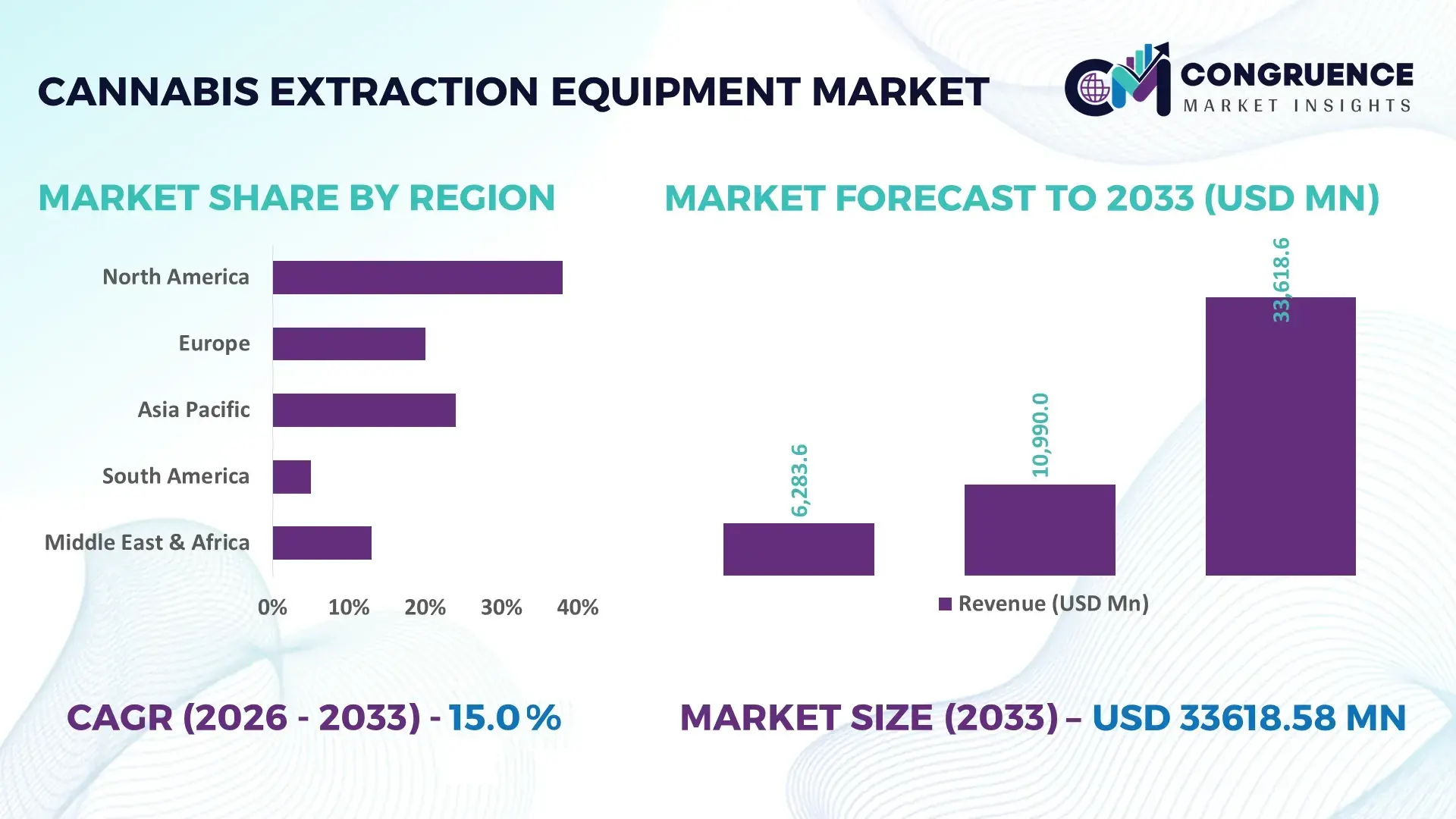
The Global Cannabis Extraction Equipment Market was valued at USD 10989.97 Million in 2025 and is anticipated to reach a value of USD 33618.58 Million by 2033 expanding at a CAGR of 15% between 2026 and 2033. Growth is driven by expanding licensed cannabis processing facilities, rapid adoption of automated supercritical CO₂ and ethanol extraction systems, pharmaceutical-grade production standards, and increasing investment in high-throughput extraction infrastructure.
The United States dominates the global Cannabis Extraction Equipment Market with approximately 43% of installed industrial extraction capacity, supported by multi-state cannabis operators, pharmaceutical manufacturing, and continuous automation investments exceeding USD 1 billion across processing infrastructure. Compared with Canada, where advanced GMP-compliant extraction adoption exceeds 75% of licensed facilities, the U.S. benefits from broader commercial processing despite evolving federal regulatory discussions in 2026. Businesses prioritizing scalable, compliant, and energy-efficient extraction platforms are positioned to strengthen long-term operational competitiveness.
Market Size & Growth: USD 10,989.97 Million (2025) to USD 33,618.58 Million (2033) at 15% CAGR, driven by automated pharmaceutical-grade extraction systems.
Top Growth Drivers: Licensed processing capacity +22%, automation adoption +31%, solvent recovery efficiency +28%.
Short-Term Forecast: By 2028, extraction cycle time declines 20% while production efficiency improves 26% through intelligent process control.
Emerging Technologies: AI process optimization, robotic material handling, and advanced supercritical CO₂ platforms improve consistency by over 25%.
Regional Leaders: North America exceeds USD 15 billion, Europe surpasses USD 7 billion, Asia-Pacific approaches USD 5 billion with expanding regulated processing.
Consumer/End-User Trends: More than 68% of commercial processors prioritize high-purity extract production using automated extraction equipment.
Pilot/Case Example: 2026 facility modernization increased extraction throughput by 30% while reducing solvent consumption by 18%.
Competitive Landscape: Top five manufacturers collectively control approximately 48%, led by Precision Extraction, Eden Labs, Apeks Supercritical, Root Sciences, and Delta Separations.
Regulatory & ESG Impact: Energy-efficient solvent recovery systems reduce operating emissions by nearly 20% while strengthening compliance standards.
Investment & Funding: Over USD 2.3 billion supports facility expansion, strategic partnerships, and advanced processing equipment as regional manufacturing expands.
Innovation & Future Outlook: Continuous extraction, digital monitoring, and modular processing platforms accelerate productivity while strengthening resilient global supply chains.
Advanced Cannabis Extraction Equipment Market demand is accelerating across pharmaceutical formulations, cannabis concentrates, wellness products, and industrial hemp processing. Automated solvent recovery, continuous extraction platforms, and digital monitoring systems are improving processing consistency, with operational efficiency increasing by nearly 25%. Strengthening regulatory compliance requirements and localized equipment manufacturing initiatives are reshaping procurement strategies, setting the foundation for the strategic market analysis that follows.
Cannabis extraction equipment has become a strategic investment area as licensed producers shift from volume expansion to high-efficiency processing, standardized product quality, and pharmaceutical-grade manufacturing. Regulatory harmonization across selected cannabis markets and continued modernization of processing infrastructure are accelerating replacement of legacy extraction assets with automated, digitally monitored systems. This transition is strengthening competitive differentiation through lower operating costs, improved traceability, and scalable production capabilities.
Modern supercritical CO₂ extraction platforms deliver up to 24% higher extraction efficiency while reducing solvent losses by nearly 30% compared with conventional batch solvent systems, improving both operational consistency and sustainability. The United States leads in commercial-scale deployment through integrated processing facilities, while Germany emphasizes GMP-compliant extraction technologies for medical cannabis applications, prioritizing precision over production scale. Over the next two to three years, automated process control adoption is expected to exceed 65% among newly commissioned industrial extraction facilities, reflecting an industry-wide shift toward intelligent manufacturing.
Commercial processors are expanding modular extraction lines and partnering with automation specialists to increase throughput without significant facility expansion. A practical example includes multi-line extraction installations that integrate real-time monitoring and automated solvent recovery, reducing downtime by approximately 18%. Companies prioritizing digital integration, flexible production capacity, and compliance-ready equipment will strengthen competitive positioning while improving long-term operational resilience.
Growing demand for pharmaceutical-grade cannabis extracts is accelerating investment in automated extraction infrastructure capable of delivering consistent purity, traceability, and production efficiency. More than 70% of newly commissioned industrial extraction facilities now incorporate automated process monitoring, while advanced solvent recovery systems reduce operational losses by nearly 25% and improve equipment utilization by approximately 20%. Regulatory expansion of medical cannabis programs in Germany, Australia, and selected U.S. states is reinforcing demand for validated processing technologies. Equipment manufacturers are responding through modular platform development, strategic automation partnerships, and expanded engineering services. A notable strategic shift is the integration of digital quality assurance directly into extraction systems, enabling processors to satisfy increasingly stringent compliance requirements while reducing manual intervention and improving production economics.
High capital expenditure and complex regulatory validation continue to restrict deployment among small and mid-sized cannabis processors. Complete industrial extraction installations frequently require compliance investments exceeding 35% of total project costs, while equipment qualification timelines have extended by nearly 20% due to evolving quality standards. Dependence on specialized pressure vessels, instrumentation, and imported components also exposes manufacturers to procurement delays and cost volatility. Canadian and European operators are increasingly addressing these challenges through localized sourcing, long-term supplier agreements, and standardized equipment platforms that simplify regulatory validation. Companies reducing engineering complexity and shortening installation cycles gain measurable advantages in project execution, customer acquisition, and production scalability.
Next-generation modular extraction systems equipped with AI-enabled process optimization, predictive maintenance, and digital twins are creating significant operational opportunities. Intelligent control platforms improve extraction consistency by approximately 22%, while predictive maintenance reduces unplanned downtime by nearly 18%. Thailand and Germany continue expanding regulated medical cannabis processing capacity, encouraging investment in flexible manufacturing infrastructure capable of serving multiple product formulations. Equipment suppliers are increasing R&D spending, forming software partnerships, and developing interoperable processing ecosystems rather than standalone machinery. An emerging competitive advantage lies in offering scalable extraction modules that allow processors to expand production incrementally without major facility redesign, reducing investment risk while improving long-term asset utilization.
Successful deployment increasingly depends on integrating sophisticated extraction equipment with manufacturing execution systems, laboratory analytics, and enterprise quality platforms. Nearly 40% of industrial operators report shortages of qualified technical personnel capable of managing automated extraction processes, while integration activities can account for approximately 15% of total commissioning time. As facilities become more digitally connected, cybersecurity protection for operational technology environments has become an additional priority. U.S. manufacturers are expanding workforce training programs and collaborating with industrial automation providers to accelerate implementation. Companies that standardize digital architecture, strengthen engineering expertise, and invest in secure connected operations will achieve more reliable production performance and sustain long-term competitive differentiation.
Automated Modular Processing Expansion: Cannabis processors are replacing fixed extraction lines with modular production platforms, reducing installation time by nearly 28% while increasing production flexibility by approximately 24%. Labor shortages across the United States and Canada are accelerating automation investments, with over 60% of new industrial projects integrating centralized process controls. Equipment manufacturers are responding through modular product portfolios, turnkey engineering partnerships, and standardized installation packages that shorten commissioning schedules and improve plant utilization.
Digital Quality Assurance Integration: Real-time analytics, inline sensors, and digital batch documentation are becoming standard across pharmaceutical-grade extraction facilities. Automated quality verification reduces manual inspection workloads by about 35% while improving batch consistency by 22%. Germany's expanding GMP-focused processing requirements are encouraging greater deployment of connected monitoring platforms. Equipment suppliers are embedding software, cloud-based diagnostics, and predictive maintenance capabilities to strengthen compliance while minimizing production interruptions.
Energy Recovery System Adoption: Energy optimization has become an operational priority as processors target lower utility costs and improved sustainability performance. Advanced solvent recovery and heat-recapture technologies reduce energy consumption by approximately 20% and solvent losses by nearly 27%, while shortening cleaning cycles by 15%. Manufacturers are redesigning extraction platforms with integrated recovery modules and collaborating with industrial engineering partners to improve lifecycle efficiency and operational resilience.
Precision Multi-Product Manufacturing: Extraction facilities increasingly require flexible equipment capable of processing medical cannabis, CBD products, and industrial hemp on shared production lines. Multi-recipe automation increases equipment utilization by around 25% while reducing changeover time by 18%. Regulatory diversification and evolving product portfolios are encouraging investment in configurable extraction platforms. Companies are expanding software-driven process customization and strategic technology collaborations to deliver higher-value manufacturing capabilities without major facility expansion.
CO₂ Extraction remains the leading segment because it combines pharmaceutical-grade purity, solvent-free processing, high scalability, and compatibility with automated production environments. More than 48% of industrial extraction installations utilize supercritical CO₂ systems due to their ability to deliver consistent cannabinoid recovery while supporting strict regulatory compliance. Ethanol Extraction follows as the preferred option for high-volume commercial processing, particularly where throughput and operating costs are prioritized. Hydrocarbon Extraction continues serving premium concentrate manufacturers requiring high terpene preservation, while Steam Distillation retains strategic relevance for niche botanical applications.
Solventless Extraction represents the fastest-growing type as demand for premium chemical-free extracts continues expanding. Industry adoption has increased by nearly 26% over the past two years, supported by consumer preference for minimally processed products and improvements in automated rosin technology. Equipment suppliers are expanding modular CO₂ platforms, enhancing ethanol recovery systems, and developing hybrid extraction solutions that improve operational flexibility while reducing processing complexity. Investment priorities increasingly favor equipment capable of supporting multiple extraction techniques within a single manufacturing environment.
Medical Cannabis remains the dominant application because pharmaceutical-grade production requires highly controlled extraction, purification, and quality validation processes. Approximately 46% of industrial extraction capacity supports medical formulations, particularly in Germany, Australia, and Canada, where regulated production standards emphasize consistency and traceability. Recreational Cannabis continues generating substantial equipment demand through high-volume concentrate manufacturing, while Cannabis Oils remain an important downstream application supporting multiple product categories.
CBD Products represent the fastest-growing application as wellness manufacturers diversify product portfolios and expand exports. Automated extraction adoption within CBD processing has increased by roughly 29%, supported by improved production efficiency and standardized formulations. Hemp Processing is also gaining momentum through industrial diversification and broader cannabinoid utilization strategies. Equipment manufacturers are introducing configurable extraction systems, expanding application-specific engineering services, and strengthening integration capabilities to support evolving customer requirements across multiple production formats.
Cannabis Processors represent the largest end-user segment because they operate high-capacity extraction facilities requiring continuous production, solvent recovery, and automated quality control. Nearly 55% of industrial equipment purchases originate from commercial processors expanding multi-product manufacturing capabilities. Pharmaceutical Companies constitute the fastest-growing end-user group as regulated cannabinoid therapies require GMP-compliant extraction infrastructure and highly standardized manufacturing workflows. Research Laboratories continue investing in precision-scale systems supporting formulation development and analytical validation.
CBD Manufacturers and Hemp Producers are increasing procurement of flexible extraction platforms capable of handling multiple feedstocks while minimizing operating costs. Automated extraction deployment among pharmaceutical buyers has expanded by approximately 24%, reflecting stronger emphasis on validated manufacturing and digital process monitoring. Equipment suppliers are responding through customized system configurations, long-term service agreements, integrated automation packages, and collaborative technology partnerships designed to improve customer retention while supporting specialized production requirements across diverse operating environments.
North America accounted for the largest market share at 41.8% in 2025 however, Asia-Pacific is expected to register the fastest growth, expanding at a 17.3% between 2026 and 2033.
Industrial Automation and High-Capacity Processing Leadership
North America maintains the highest concentration of commercial cannabis extraction infrastructure, supported by mature processing networks, advanced automation adoption, and established equipment manufacturers. The region contributes nearly 42% of global installed extraction capacity, with large-scale processors increasingly deploying continuous extraction systems integrated with digital quality management platforms. More than 68% of new industrial installations incorporate automated solvent recovery and process analytics, improving production consistency and reducing operating costs. Strategic partnerships between equipment suppliers and licensed processors continue accelerating deployment of modular extraction facilities capable of supporting pharmaceutical, recreational, and wellness product manufacturing while strengthening operational resilience.
United States Market Outlook: The United States remains the operational center of the regional market through extensive multi-state processing networks, engineering expertise, and equipment innovation. More than 60% of licensed industrial cannabis processing facilities utilize automated extraction technologies, supported by investments in digital manufacturing and compliance-ready production infrastructure. Domestic equipment manufacturers continue expanding modular product portfolios, automation capabilities, and long-term service agreements to improve plant efficiency and strengthen competitive positioning.
Medical Cannabis Compliance Drives Equipment Modernization
Europe is strengthening its position through pharmaceutical-grade cannabis production, strict GMP manufacturing standards, and investments in precision extraction technologies. Approximately 24% of global industrial medical cannabis extraction capacity is located within the region, where advanced compliance requirements encourage adoption of validated automated processing systems. Companies continue modernizing extraction facilities with digital batch documentation, integrated monitoring platforms, and energy-efficient solvent recovery technologies. Cross-border collaboration among engineering firms and licensed manufacturers is supporting standardized production while improving operational efficiency across regulated cannabis processing facilities.
Germany Market Outlook: Germany leads the European market through its highly regulated medical cannabis framework and expanding pharmaceutical manufacturing infrastructure. Automated extraction deployment has increased by more than 30% across newly commissioned facilities, reflecting strong emphasis on validated production and quality assurance. Equipment suppliers continue investing in GMP-focused engineering, software integration, and precision processing technologies to support long-term manufacturing scalability and evolving healthcare requirements.
Manufacturing Expansion and Regulatory Evolution
Asia-Pacific is emerging as the fastest-expanding operational market due to growing industrial hemp processing, evolving medical cannabis regulations, and expanding manufacturing capabilities. The region accounts for approximately 18% of global equipment deployment, with increasing investment in modular extraction systems and automated production technologies. New processing facilities are emphasizing flexible equipment capable of handling multiple botanical feedstocks while reducing energy consumption by nearly 20%. Local equipment manufacturers are strengthening production capacity through technology licensing, engineering collaboration, and localized component sourcing to improve supply-chain stability.
Thailand Market Outlook: Thailand has established itself as the regional leader through supportive medical cannabis policies, expanding processing infrastructure, and active investment in cannabinoid manufacturing. Licensed processors continue upgrading extraction facilities with automated solvent recovery and digital process control technologies, while industrial deployments have increased by approximately 27% over recent expansion cycles. Domestic and international equipment suppliers are prioritizing strategic partnerships to strengthen production capabilities and technical support services.
Industrial Hemp Processing Gains Momentum
South America is steadily expanding extraction equipment deployment through regulated medical cannabis production and growing industrial hemp processing initiatives. The region contributes approximately 9% of global commercial extraction installations, supported by increasing investment in standardized processing infrastructure. New facilities increasingly adopt modular extraction technologies that improve production flexibility while reducing commissioning time by nearly 18%. Infrastructure development remains uneven across markets, encouraging companies to prioritize scalable equipment platforms, localized technical support, and phased expansion strategies that reduce operational risk while improving processing efficiency.
Colombia Market Outlook: Colombia remains the strongest market within the region due to favorable cultivation conditions, export-oriented processing capacity, and an established regulatory framework for medical cannabis production. Industrial operators continue investing in advanced extraction equipment supporting pharmaceutical-grade exports, while automated processing installations have expanded by more than 22%. Equipment suppliers are strengthening local engineering partnerships and maintenance networks to improve equipment utilization and long-term operational performance.
Targeted Infrastructure Investment Supports Market Development
The Middle East & Africa market is progressing through selective investments in medical cannabis processing, industrial hemp applications, and modern extraction infrastructure. Although representing approximately 7% of global deployment, the region is emphasizing high-efficiency equipment capable of supporting export-oriented manufacturing. Recent facility developments increasingly integrate automated control systems and energy-efficient extraction technologies that reduce solvent consumption by nearly 19%. Companies continue aligning investments with specialized production hubs, localized engineering services, and strategic technology partnerships to strengthen operational reliability under evolving regulatory frameworks.
South Africa Market Outlook: South Africa leads regional market activity through established cultivation capabilities, expanding licensed processing infrastructure, and increasing private-sector investment in cannabinoid manufacturing. Commercial processors are adopting advanced extraction technologies to improve export competitiveness and manufacturing consistency, while automated equipment utilization has increased by approximately 25% across newer facilities. Equipment manufacturers are expanding technical service capabilities and localized training programs to improve operational efficiency and support long-term industrial development.
The Cannabis Extraction Equipment Market is led by Precision Extraction Solutions, Eden Labs, Root Sciences, Apeks Supercritical, and Delta Separations, competing against regional engineering firms, contract system integrators, and lower-cost equipment manufacturers. Global technology leaders compete through automation, validation, and turnkey processing platforms, while regional suppliers emphasize faster delivery and customized configurations. The top five players collectively account for approximately 49% of market activity, creating a moderately consolidated structure. Competition increasingly depends on extraction efficiency, digital process control, lifecycle service, and localized manufacturing rather than equipment pricing alone. Automated extraction platforms improve operational productivity by nearly 24%, integrated solvent recovery reduces operating costs by about 20%, and modular systems shorten installation time by approximately 28%. Companies are expanding engineering centers, forming automation partnerships, strengthening aftermarket support, and integrating software with extraction hardware. Competitive momentum is shifting toward intelligent connected platforms and vertically integrated processing solutions. High compliance requirements and specialized engineering expertise remain key entry barriers. Winning requires scalable automation, regulatory-ready systems, responsive technical support, and continuous product innovation.
Precision Extraction Solutions
Eden Labs LLC
Apeks Supercritical
Root Sciences
Delta Separations
Green Mill Supercritical
extraktLAB
Pure Extraction Ltd.
Isolate Extraction Systems Inc.
Cedarstone Industry
Luna Technologies
Vitalis Extraction Technology
Pope Scientific Inc.
Advanced automation, intelligent process control, and pharmaceutical-grade extraction platforms are redefining industrial cannabis processing. Modern supercritical CO₂ systems integrated with automated pressure regulation improve extraction efficiency by approximately 24% while reducing solvent consumption by nearly 20% compared with conventional manually controlled batch systems. More than 60% of newly installed commercial extraction lines now incorporate digital monitoring, automated recipe management, and inline quality verification, enabling higher production consistency and reducing operator intervention across regulated manufacturing environments.
Emerging technologies include AI-assisted process optimization, predictive maintenance, digital twins, and advanced solvent recovery systems. Predictive maintenance reduces unexpected equipment downtime by around 18%, while digital optimization improves batch repeatability by approximately 22%. Companies operating large multi-product facilities gain the greatest competitive advantage because connected extraction platforms simplify regulatory documentation, accelerate production changeovers, and improve asset utilization. Equipment manufacturers increasingly integrate industrial software, remote diagnostics, and cloud-enabled performance analytics into complete extraction ecosystems.
Between 2026 and 2028, modular continuous extraction technologies, robotics-assisted material handling, and machine-learning process optimization will become mainstream across industrial cannabis manufacturing. Early adopters will strengthen production flexibility, lower operating costs, shorten commissioning periods, and improve compliance readiness. Companies investing now in scalable digital extraction infrastructure will establish stronger operational resilience, higher product consistency, and a sustainable competitive advantage as manufacturing standards continue advancing.
April 2024 – Prodigy Processing Solutions partnered with Solvent Direct to integrate pharmaceutical-grade extraction solvents with GMP-compliant processing equipment, strengthening compliance-focused manufacturing workflows. The collaboration targeted 100% GMP-compatible extraction operations, improving readiness for regulated cannabis production.
January 2025 – Prodigy Processing Solutions became the exclusive extraction equipment provider for ProXtracts' hydrocarbon processing laboratory in New York City after the facility secured the city's only Tier 1 Processor License. The deployment strengthened compliant urban cannabis manufacturing infrastructure. Source: Cannabis Equipment News
January 2026 – Spring Sciences Australia entered a strategic partnership with Union Cannabis Group to establish pharmaceutical-grade cannabis extraction infrastructure, commissioning high-throughput extraction lines for regulated medical production. The initiative expanded advanced manufacturing capabilities for domestic and export markets. Source: Spring Sciences Australia
2026 – Root Sciences expanded its technology portfolio through strategic manufacturing partnerships supporting more than 400 processing systems operating worldwide, strengthening access to hydrocarbon, ethanol, CO₂, solventless extraction, and downstream processing technologies. The move broadened integrated end-to-end equipment offerings for commercial processors. Source: Root Sciences
The report delivers comprehensive analysis of the Cannabis Extraction Equipment Market across extraction technologies, operational applications, end-user industries, and major geographic markets. It evaluates CO₂, ethanol, hydrocarbon, solventless extraction, and steam distillation systems while assessing deployment across medical cannabis, recreational cannabis, CBD products, hemp processing, and cannabis oils. Coverage includes cannabis processors, pharmaceutical companies, research laboratories, CBD manufacturers, and hemp producers, representing more than five primary commercial demand segments and multiple technology adoption pathways.
The study provides strategic evaluation of North America, Europe, Asia-Pacific, South America, and the Middle East & Africa, highlighting regional deployment patterns, automation adoption, manufacturing infrastructure, and competitive positioning between 2026 and 2033. It examines technology integration, equipment modernization, digital process control, and emerging niche opportunities while benchmarking leading manufacturers, operational trends, and investment priorities. The report supports expansion planning, product portfolio optimization, partnership strategies, competitive assessment, and long-term decision-making through data-driven market intelligence and actionable business insights.
| Report Attribute/Metric | Report Details |
|---|---|
Market Revenue in 2025 | USD 10989.97 Million |
Market Revenue in 2033 | USD 33618.58 Million |
CAGR (2026 - 2033) | 15% |
Base Year | 2025 |
Forecast Period | 2026 - 2033 |
Historic Period | 2021 - 2025 |
Segments Covered | By Type
By Application
By End-User
|
Key Report Deliverable | Revenue Forecast, Growth Trends, Market Dynamics, Segmental Overview, Regional and Country-wise Analysis, Competition Landscape |
Region Covered | North America, Europe, Asia-Pacific, South America, Middle East, Africa |
Key Players Analyzed | Precision Extraction Solutions, Eden Labs LLC, Apeks Supercritical, Root Sciences, Delta Separations, Green Mill Supercritical, extraktLAB, Pure Extraction Ltd., Isolate Extraction Systems Inc., Cedarstone Industry, Luna Technologies, Vitalis Extraction Technology, Pope Scientific Inc. |
Customization & Pricing | Available on Request (10% Customization is Free) |




