
Reports
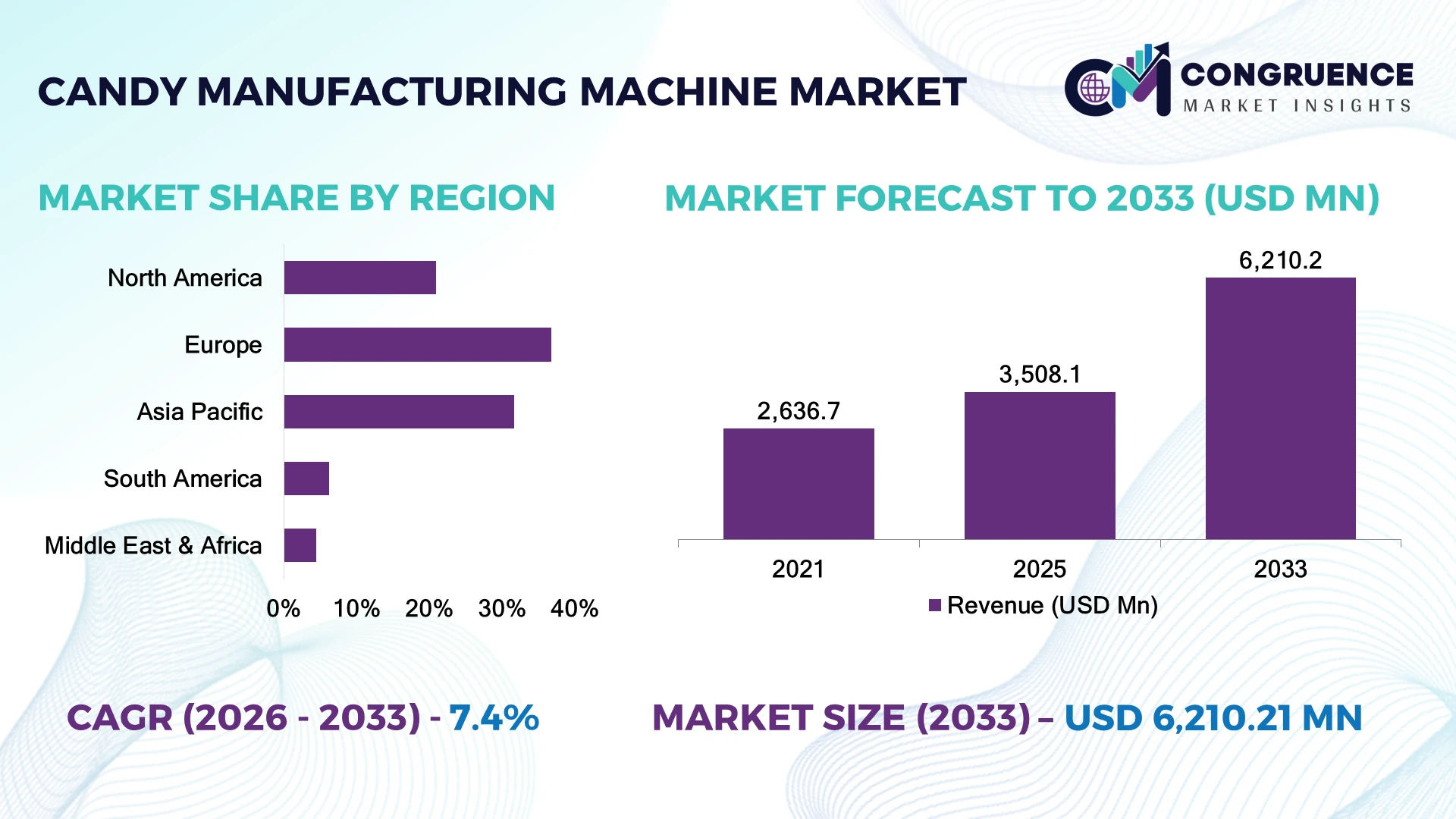
The Global Candy Manufacturing Machine Market was valued at USD 3,508.1 Million in 2025 and is anticipated to reach a value of USD 6,210.2 Million by 2033 expanding at a CAGR of 7.4% between 2026 and 2033. Growth is driven by rising investment in fully automated confectionery production lines, high-speed packaging integration, and increasing demand for flexible equipment capable of producing premium, sugar-free, and functional candies.
Germany remains the dominant manufacturing hub, accounting for approximately 24% of global high-end confectionery equipment exports, supported by advanced engineering capabilities, over 80% automation adoption across premium production facilities, and sustained investment in precision food-processing machinery. Italy follows with strong specialization in molding and wrapping systems, while China is expanding production capacity through cost-efficient manufacturing and smart factory deployment. Ongoing European industrial modernization, reinforced by supply-chain diversification following geopolitical disruptions in Eastern Europe, continues accelerating technology upgrades.
Manufacturers prioritizing modular automation, digital process control, and energy-efficient machinery are strengthening long-term competitiveness across global confectionery production.
Market Size & Growth: USD 3,508.1 Million in 2025 reaching USD 6,210.2 Million by 2033 at 7.4% CAGR, driven by automated confectionery production.
Top Growth Drivers: Automation 46%, premium confectionery demand 34%, labor optimization 29% accelerate equipment upgrades.
Short-Term Forecast: By 2028, production efficiency improves 18% while changeover time declines 25% through intelligent manufacturing.
Emerging Technologies: AI inspection, robotic handling, and digital twin monitoring increase process accuracy by nearly 22%.
Regional Leaders: Europe, Asia-Pacific, and North America lead with expanding smart factory adoption and advanced food-processing investments.
Consumer/End-User Trends: Nearly 52% of manufacturers prioritize flexible machinery supporting multiple candy formats.
Pilot/Case Example: 2026 automated gummy production projects improved output consistency by 20% while reducing waste.
Competitive Landscape: Top suppliers collectively control nearly 43% market share through automation and turnkey solutions.
Regulatory & ESG Impact: Energy-efficient equipment lowers electricity consumption by approximately 16% while supporting cleaner manufacturing.
Investment & Funding: More than USD 900 Million supports digital food-processing expansion amid global supply-chain restructuring.
Innovation & Future Outlook: Servo-driven modular systems and predictive maintenance redefine high-speed confectionery manufacturing.
The Candy Manufacturing Machine Market is advancing through demand for multifunctional production systems capable of processing gummies, chocolates, hard candies, and nutraceutical confectionery on shared production lines. AI-based quality inspection and servo-controlled depositing systems improve product consistency by nearly 20%, while modular equipment supports faster product launches. Growing investment in localized manufacturing following global supply-chain adjustments is strengthening equipment modernization, setting the stage for broader strategic transformation.
The candy manufacturing machine market has become strategically important as confectionery producers compete through production flexibility, automation, and rapid product innovation rather than manufacturing scale alone. Manufacturers are restructuring production networks to reduce supply-chain risks while investing in smart factories capable of handling seasonal demand fluctuations and smaller batch production with greater operational efficiency.
Modern servo-driven depositing, robotic packaging, and AI-enabled inspection systems improve production accuracy by approximately 22% while reducing product waste by nearly 18% compared with conventional mechanical production lines. Germany continues leading premium machinery innovation through advanced automation, whereas China focuses on large-scale manufacturing capacity with increasingly sophisticated digital production capabilities. Over the next two to three years, digital process monitoring and predictive maintenance are expected to become standard across new confectionery installations.
A leading operational trend involves integrating molding, cooling, wrapping, and inspection into unified automated production cells that minimize manual intervention and shorten product changeovers. Equipment manufacturers are expanding regional service networks, investing in modular platforms, and collaborating with industrial automation providers to strengthen lifecycle support. Companies combining intelligent automation, energy efficiency, and flexible manufacturing architectures will secure stronger competitive positioning as confectionery production becomes increasingly digital and demand-responsive.
Confectionery manufacturers are accelerating investment in fully automated processing and packaging lines to improve throughput, consistency, and labor efficiency. More than 58% of new equipment installations incorporate robotic handling, while servo-controlled systems reduce product changeover time by nearly 28% and improve production efficiency by approximately 20%. Germany continues expanding advanced food-processing equipment manufacturing, while India's packaged confectionery sector is encouraging new plant investments to serve rising domestic demand. This structural shift increases demand for integrated depositing, cooling, wrapping, and inspection systems. Equipment suppliers are responding through modular machine platforms, digital monitoring capabilities, and strategic partnerships with industrial automation providers, enabling faster commissioning and greater manufacturing flexibility across multiple candy formats.
High capital expenditure and dependence on specialized automation components continue limiting rapid equipment adoption, particularly among mid-sized confectionery manufacturers. Motion-control systems and precision servo assemblies account for nearly 32% of advanced machine costs, while electronic component lead times remain 18–25% above pre-disruption levels for selected industrial parts. Italy and Germany continue facing periodic sourcing pressure for specialized precision components used in high-speed production equipment. These constraints delay factory modernization, reduce deployment flexibility, and increase project costs. Manufacturers are mitigating operational risk through supplier diversification, localized component sourcing, long-term procurement agreements, and standardized machine architectures that simplify maintenance while reducing dependence on proprietary replacement parts.
Demand is shifting toward intelligent modular production lines capable of supporting multiple confectionery products without extensive mechanical modification. AI-enabled process optimization improves production yield by approximately 15%, while predictive maintenance reduces unexpected downtime by nearly 22%. Japan is advancing digital manufacturing technologies that integrate machine vision, automated quality inspection, and industrial IoT into confectionery equipment. Manufacturers are increasing R&D investment in configurable processing modules and software-driven production control that enable rapid product diversification. A significant emerging opportunity lies in supplying flexible machinery to producers entering functional confectionery and nutraceutical candy categories, where shorter production runs and frequent formulation changes require adaptable manufacturing platforms rather than dedicated equipment.
Integrating intelligent machinery with existing factory infrastructure remains a major execution challenge for confectionery manufacturers pursuing digital transformation. Nearly 37% of modernization projects require significant software customization, while commissioning periods increase by approximately 24% when legacy production equipment lacks standardized communication protocols. United States manufacturers upgrading established facilities frequently encounter interoperability challenges between new automation platforms and older processing assets. These issues affect production continuity, maintenance efficiency, and long-term operational scalability. Equipment suppliers must strengthen cybersecurity, digital integration expertise, workforce training, and lifecycle engineering support while expanding partnerships with industrial software providers to ensure reliable deployment across increasingly connected confectionery manufacturing environments.
AI-powered quality inspection Machine vision systems now inspect product dimensions, color consistency, and surface defects with approximately 98% detection accuracy while reducing manual inspection by nearly 45%. Food manufacturers are integrating AI with automated rejection systems to improve product uniformity, reduce waste, and strengthen production consistency as labor shortages accelerate factory automation.
Flexible multi-product production Manufacturers increasingly deploy modular production lines capable of processing gummies, hard candies, chocolates, and functional confectionery on shared equipment. Product changeover times have declined nearly 30%, while equipment utilization has improved by approximately 18%. Companies are expanding configurable machine portfolios to support faster product launches and smaller production batches.
Energy-efficient processing systems Rising industrial electricity costs are accelerating adoption of high-efficiency heating, cooling, and servo-drive technologies that reduce energy consumption by nearly 16% while lowering maintenance requirements by approximately 14%. European sustainability initiatives are encouraging manufacturers to modernize legacy production assets through equipment upgrades rather than complete factory replacement.
Digital lifecycle service expansion Equipment suppliers increasingly bundle predictive maintenance, remote diagnostics, and cloud-based production analytics into machinery offerings. Remote service interventions now resolve approximately 40% of operational issues without onsite visits, reducing maintenance delays and improving equipment availability. Companies are strengthening long-term customer relationships through digital service agreements, software upgrades, and performance optimization programs.
Fully automatic candy manufacturing machines dominate the market with an estimated 49% share, supported by superior production speed, integrated process control, reduced labor dependence, and consistent product quality. These systems are widely adopted by large confectionery manufacturers operating high-volume production facilities. Semi-automatic machines remain relevant among regional producers due to lower investment requirements and operational flexibility, while manual equipment continues serving niche artisan confectionery businesses with limited production capacity.
Robotic and AI-enabled fully automatic systems represent the fastest-growing segment as manufacturers prioritize smart factories and digital process optimization. Demand for modular production lines capable of manufacturing multiple confectionery formats has increased by approximately 24%, while intelligent quality inspection improves production accuracy by nearly 20%. Equipment suppliers continue expanding modular automation portfolios, investing in servo-controlled technologies, and partnering with industrial automation firms to strengthen product competitiveness and reduce factory commissioning time.
According to findings published by the Association for Packaging and Processing Technologies (PMMI) during 2025, more than 60% of food manufacturers identified automation investment as their primary strategy for improving production efficiency and addressing workforce shortages.
Chocolate manufacturing accounts for approximately 38% of total equipment demand, driven by continuous investment in automated molding, tempering, cooling, and packaging systems. Large-scale chocolate manufacturers prioritize integrated production lines capable of maintaining product consistency while supporting premium and seasonal product launches. Sugar confectionery remains a mature application supported by stable global demand, while chewing gum processing continues emphasizing precision mixing and forming technologies.
Gummy and functional confectionery production is emerging as the fastest-growing application, supported by increasing consumer preference for nutraceutical and vitamin-infused products. Demand for flexible depositing equipment has expanded by approximately 26%, while automated inspection systems reduce production waste by nearly 18%. Equipment manufacturers are strengthening digital integration, expanding high-speed depositing technologies, and developing configurable production platforms that allow rapid transitions between different confectionery products without extensive mechanical modifications.
Industry analysis released by the German Engineering Federation (VDMA) during 2026 indicated that investments in flexible food-processing machinery increasingly favor modular production systems capable of supporting multiple confectionery product categories from a single manufacturing platform.
Large confectionery manufacturers represent the leading end-user segment with an estimated 56% market share because of extensive production capacity, continuous factory modernization, and strong investment in intelligent automation. Their large-scale operations justify deployment of integrated processing, cooling, inspection, and packaging systems that maximize throughput while maintaining consistent product quality. Medium-sized confectionery producers continue upgrading semi-automated facilities, whereas contract manufacturers increasingly adopt flexible equipment capable of serving multiple consumer brands.
Contract manufacturing organizations are projected to record the fastest adoption as private-label confectionery production expands across Europe and Asia. Equipment utilization within outsourced production facilities has improved by approximately 21%, while demand for modular machinery has increased nearly 25%. Equipment suppliers are responding through customized production lines, lifecycle service contracts, digital maintenance platforms, and flexible financing programs that reduce capital barriers and strengthen long-term customer relationships.
A 2025 enterprise survey conducted by PMMI reported that food manufacturers increasingly prioritize flexible automation investments capable of supporting shorter production runs, faster product changeovers, and greater operational resilience.
Europe accounted for the largest market share at 36.8% in 2025 however, Asia-Pacific is expected to register the fastest growth, expanding at a CAGR of 8.3% between 2026 and 2033.

Smart factory upgrades strengthen confectionery automation
North America remains a technologically advanced market supported by modernization of confectionery manufacturing facilities and widespread deployment of intelligent processing equipment. The region accounts for approximately 27% of global demand, driven by high labor costs and continuous investment in automated depositing, wrapping, and inspection systems. Manufacturers increasingly integrate robotics, AI-enabled quality control, and predictive maintenance into production environments. More than 55% of newly commissioned confectionery lines now incorporate digital monitoring platforms that improve equipment utilization and reduce production interruptions. Equipment suppliers are strengthening regional engineering support, expanding aftermarket services, and developing modular machinery tailored for premium and functional confectionery production.
United States Market Outlook: The United States leads regional demand through its large confectionery manufacturing base, strong industrial automation ecosystem, and continuous investment in production modernization. Major food manufacturers increasingly replace conventional equipment with integrated smart production lines capable of supporting multiple product formats. More than 60% of large confectionery facilities have accelerated automation upgrades focused on improving throughput, labor productivity, and operational consistency.
Precision engineering sustains global equipment leadership
Europe remains the leading production hub for advanced candy manufacturing machinery due to its strong engineering expertise, mature food-processing equipment industry, and continuous innovation in automation technologies. Regional manufacturers emphasize energy-efficient processing, servo-controlled production systems, and hygienic machine design aligned with evolving food manufacturing standards. Approximately 48% of premium confectionery equipment exports originate from European manufacturers, reflecting their strong technological position. Companies continue investing in digital engineering, modular production platforms, and collaborative automation partnerships to strengthen export competitiveness.
Germany Market Outlook: Germany serves as the region's primary machinery manufacturing center through advanced industrial automation capabilities, precision engineering, and extensive export networks. Domestic equipment producers specialize in integrated confectionery processing systems with high-speed automation and digital monitoring. Strong collaboration between machinery builders and industrial software providers enables rapid commercialization of intelligent production technologies for global confectionery manufacturers.
Manufacturing expansion accelerates equipment deployment
Asia-Pacific represents the fastest-growing regional market as expanding confectionery production capacity drives investment in automated manufacturing equipment. China, India, and Southeast Asian economies continue increasing factory construction to serve domestic consumption and export demand. Nearly 44% of new confectionery production facilities announced globally are concentrated across Asia-Pacific manufacturing hubs. Equipment suppliers are expanding localized production, engineering services, and technical support while introducing scalable machinery designed for cost-efficient high-volume manufacturing and flexible product diversification.
China Market Outlook: China dominates regional equipment demand through its extensive confectionery manufacturing capacity, integrated machinery supply chain, and expanding smart manufacturing initiatives. Domestic manufacturers increasingly adopt automated depositing, packaging, and inspection systems to improve production efficiency and international competitiveness. Large industrial clusters support rapid equipment deployment while encouraging continuous innovation in digital manufacturing technologies and modular production architectures.
Industrial modernization supports confectionery investment
South America is experiencing steady demand for confectionery processing equipment as manufacturers modernize aging production facilities and improve operational efficiency. Brazil and neighboring markets continue investing in automated packaging, molding, and cooling technologies to strengthen domestic manufacturing competitiveness. Approximately 35% of recent equipment purchases focus on replacing legacy production systems with energy-efficient alternatives. Equipment suppliers increasingly offer localized technical support, flexible financing, and modular machinery suited to regional production requirements while balancing investment constraints and infrastructure limitations.
Brazil Market Outlook: Brazil represents the largest confectionery manufacturing economy in South America, supported by a broad domestic consumer market and established food-processing infrastructure. Local manufacturers continue upgrading production facilities through automated processing equipment capable of improving product consistency and reducing operating costs. Growing investment in flexible manufacturing enables producers to respond more efficiently to changing product portfolios and seasonal demand.
Food manufacturing investment reshapes regional capacity
The Middle East & Africa market is expanding through rising investment in domestic food manufacturing, industrial diversification programs, and modern processing infrastructure. Gulf countries increasingly support localized food production to strengthen supply resilience and reduce import dependence. Approximately 30% of newly established confectionery facilities across major Gulf manufacturing zones incorporate automated production technologies from the initial installation stage. Equipment manufacturers are expanding regional partnerships, technical service capabilities, and turnkey production solutions for industrial food manufacturers.
Saudi Arabia Market Outlook: Saudi Arabia leads regional investment through industrial diversification initiatives, expanding food manufacturing zones, and strong support for advanced processing technologies. Confectionery producers are installing automated production equipment to improve manufacturing efficiency, product quality, and local production capacity. Continued investment in industrial infrastructure and technology partnerships is strengthening the country's position as a regional manufacturing center for processed food products.
Global machinery specialists including Bühler, Syntegon, Baker Perkins, Tanis, Sollich, and Theegarten-Pactec compete directly against regional equipment manufacturers offering lower-cost customized production lines. The top five companies collectively account for approximately 44% of global market share, with competition centered on automation capability, processing precision, lifecycle support, and turnkey integration rather than equipment pricing alone. Servo-driven systems improve production efficiency by nearly 20%, while AI-enabled inspection reduces product defects by approximately 18% and predictive maintenance lowers unplanned downtime by around 22%. Global leaders are expanding through application-specific innovation, digital service platforms, strategic partnerships, and localized engineering centers, whereas regional suppliers compete through rapid customization and shorter delivery cycles. Competition is shifting toward modular smart factories integrating processing, inspection, and packaging within unified production cells. High engineering expertise, food safety compliance, and software integration create substantial entry barriers. Winning requires scalable automation, flexible machine architecture, responsive technical support, and continuous digital innovation.
Bühler Group
Baker Perkins
Tanis Confectionery
Sollich KG
Syntegon Technology
Theegarten-Pactec
Chocotech GmbH
Aasted ApS
Heat and Control
GEA Group
TNA Solutions
Hänsel Processing
Loynds
SAMP S.p.A.
Servo-driven automation, AI-based vision inspection, and industrial IoT platforms are becoming the technological foundation of modern candy manufacturing equipment. Approximately 62% of newly commissioned premium production lines incorporate centralized PLC control with recipe management, while AI inspection improves defect detection by nearly 18%. Cloud-connected monitoring enables predictive maintenance and real-time production analytics, helping manufacturers increase equipment availability and reduce maintenance interventions.
Modular digital production systems are replacing conventional fixed-process machinery because they support multiple confectionery products on a single platform. Compared with legacy mechanical equipment, intelligent servo-controlled lines improve production flexibility by approximately 30% while reducing product changeover time by nearly 28%. Machine builders integrating robotics, automated quality inspection, and digital twins gain a competitive advantage by delivering faster commissioning, lower operating costs, and greater production consistency. Adoption of connected manufacturing platforms has exceeded 45% among newly installed large-scale confectionery facilities.
Between 2026 and 2028, autonomous process optimization, collaborative robotics, and machine-learning-driven production scheduling will reshape factory operations. Digital simulation before installation shortens engineering cycles, while smart energy management reduces utility consumption by approximately 15%. Companies investing today in modular, software-defined production architectures, cybersecurity, and remote lifecycle services will secure stronger operational resilience, faster product launches, and higher long-term manufacturing competitiveness.
January 2024 Baker Perkins introduced its latest ServoForm Mini depositing technology for confectionery applications, improving depositing precision while supporting flexible product development and smaller production batches. The platform enhances production consistency for manufacturers targeting premium confectionery innovation. Source: International Confectionery Magazine.
January 2024 Syntegon showcased turnkey confectionery production and packaging solutions at ProSweets, including the fully automated Makat BC96 oiling drum designed to stabilize gummy finishing and improve line reliability through greater automation. Source: syntegon.com (Syntegon)
November 2025 Bühler launched CompactMix for chocolate and confectionery processing, delivering particle sizes below 20 microns while reducing energy consumption by up to 30% compared with conventional systems, strengthening efficient premium confectionery production. Source: buhlergroup.com (Bühler Group)
May 2026 Tanis received the Automation Innovation of the Decade Award for its Compact Lines with Gantry Robots, replacing chain transport to improve production uptime and reduce mechanical wear in gummy manufacturing. Source: tanis.com (Tanis)
This report delivers comprehensive analysis across equipment types, applications, end-users, and major geographic markets, covering developments between 2026 and 2033. It evaluates fully automatic, semi-automatic, and specialized confectionery machinery used for chocolate, gummies, hard candy, toffee, chewing gum, and functional confectionery production. The assessment examines deployment trends, automation adoption exceeding 60% in advanced manufacturing facilities, regional production patterns, technology integration, and competitive positioning across established and emerging manufacturing economies.
The study further evaluates intelligent automation, robotics, AI-enabled inspection, predictive maintenance, digital manufacturing platforms, and energy-efficient processing technologies influencing equipment purchasing decisions. It provides strategic insights into investment priorities, factory modernization, supply-chain evolution, product innovation, regional expansion opportunities, company benchmarking, and operational differentiation. The report supports manufacturers, equipment suppliers, investors, and industry stakeholders in identifying growth opportunities, strengthening competitive positioning, optimizing production strategies, and evaluating future market direction through detailed segmentation and technology-focused business intelligence.
| Report Attribute/Metric | Report Details |
|---|---|
|
Market Revenue in 2025 |
USD 3,508.1 Million |
|
Market Revenue in 2033 |
USD 6,210.2 Million |
|
CAGR (2026 - 2033) |
7.4% |
|
Base Year |
2025 |
|
Forecast Period |
2026 - 2033 |
|
Historic Period |
2021 - 2025 |
|
Segments Covered |
By Type
By Application
By End-User
|
|
Key Report Deliverable |
Revenue Forecast, Growth Trends, Market Dynamics, Segmental Overview, Regional and Country-wise Analysis, Competition Landscape |
|
Region Covered |
North America, Europe, Asia-Pacific, South America, Middle East, Africa |
|
Key Players Analyzed |
Bühler Group, Baker Perkins, Tanis Confectionery, Sollich KG, Syntegon Technology, Theegarten-Pactec, Chocotech GmbH, Aasted ApS, Heat and Control, GEA Group, TNA Solutions, Hänsel Processing, Loynds, SAMP S.p.A. |
|
Customization & Pricing |
Available on Request (10% Customization is Free) |




