
Reports
The Global Camping Furniture Market was valued at USD 540.0 Million in 2025 and is anticipated to reach a value of USD 867.2 Million by 2033 expanding at a CAGR of 6.1% between 2026 and 2033. Growth is driven by rising glamping and weekend camping participation, lightweight foldable designs, premium ergonomic seating, and expanding e-commerce access for portable outdoor equipment.
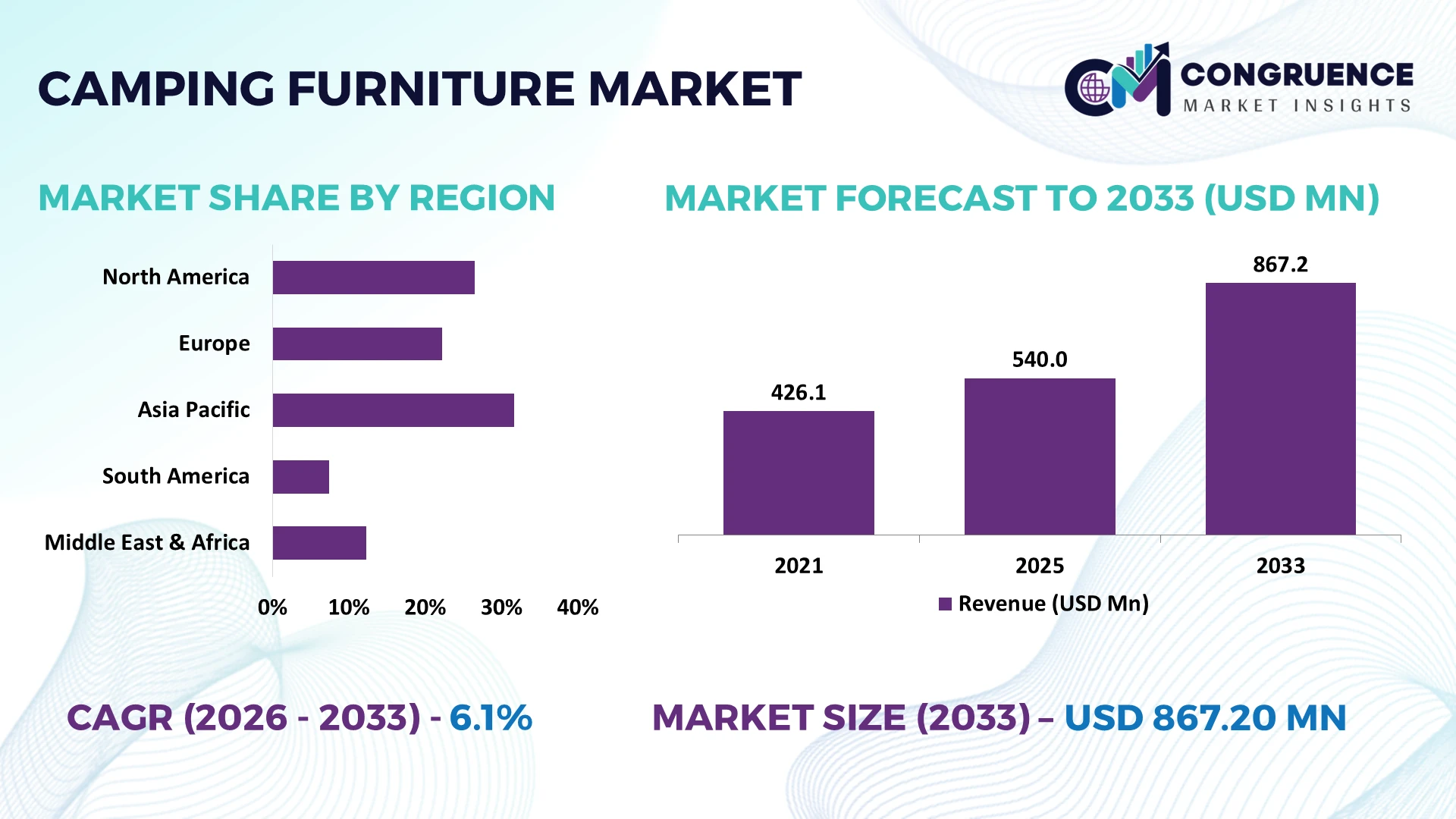
China holds a strong manufacturing position through large-scale metal fabrication and textile production, while the U.S. represents a substantially larger consumer market supported by established outdoor recreation and RV travel. Asia Pacific accounted for 31.6% of the broader market in 2025, with demand increasingly shifting toward lightweight aluminum chairs, compact tables, and modular furniture.
Strategically, manufacturers should prioritize lightweight product engineering, localized supply chains, and premium modular formats to capture expanding outdoor-lifestyle spending.
Market Size & Growth: The market reaches USD 867.2 Million by 2033, supported by a 6.1% CAGR and increasing adoption of lightweight, foldable furniture.
Top Growth Drivers: Glamping adoption, e-commerce penetration, and compact-product innovation each strengthen demand, with online sales already exceeding 30% in leading estimates.
Short-Term Forecast: By 2028, manufacturers are targeting 10–15% lower packed volume through collapsible frames and modular construction.
Emerging Technologies: Aluminum alloys, advanced textiles, modular joints, and ergonomic engineering are improving portability without sacrificing load-bearing performance.
Regional Leaders: Asia Pacific reached USD 1.7 billion, North America USD 1.4 billion, while European demand remains concentrated around premium camping and glamping products.
Consumer/End-User Trends: Chairs and stools represent approximately 48.6% of product demand, reflecting the priority placed on portable comfort.
Pilot/Case Example: In 2024, outdoor-lifestyle expansion in Japan included a new integrated retail complex designed to strengthen engagement with premium camping products.
Competitive Landscape: Coleman led with more than 14% share, followed by GCI Outdoor, Helinox, ALPS Mountaineering, and Camp Chef; the leading five collectively held about 35%.
Regulatory & ESG Impact: Recycled aluminum, durable textiles, repairable components, and longer product lifecycles are becoming important design priorities as sustainability requirements tighten across consumer goods.
Investment & Funding: Manufacturers are increasing investment in lightweight manufacturing, direct-to-consumer channels, and Asia-based distribution partnerships as outdoor recreation expands.
Innovation & Future Outlook: Next-generation products are shifting toward modular seating, integrated storage, ultralight frames, and multi-use furniture serving camping, festivals, RV travel, and outdoor hospitality.
Camping furniture demand is increasingly concentrated around lightweight seating, compact tables, portable beds, and modular storage, with chairs and stools commanding nearly half of product demand. Foldable aluminum structures and weather-resistant textiles are becoming standard design features, while online purchasing already represents about 30.5% of sales in one major market assessment. Supply-chain diversification and regional outdoor-tourism expansion are now shaping product portfolios and channel strategies.
Camping furniture is becoming strategically important as outdoor recreation evolves from occasional expedition use into a broader lifestyle category covering glamping, RV travel, festivals, family recreation, and outdoor hospitality. This shift is changing purchasing criteria from basic durability toward portability, ergonomics, aesthetics, and multi-use functionality. Chairs and stools represented 50.5% of the market in 2025 in one market assessment, while tables are gaining traction through improved portability and utility.
Supply-chain restructuring is also influencing competitive positioning. Manufacturers are moving toward aluminum frames, modular components, and localized assembly to reduce packed volume and transportation requirements. Compared with conventional fixed-frame furniture, collapsible designs can reduce storage requirements by approximately 30–40%, improving logistics efficiency and retailer inventory utilization.
Regional strategies are diverging. North America benefits from mature camping and RV ecosystems, while Asia Pacific is expanding through domestic tourism and rising outdoor participation. Over the next 2–3 years, manufacturers are expected to emphasize 10–15% improvements in portability, durability, and material efficiency. Companies deploying modular product ecosystems, regional partnerships, and direct digital channels will strengthen operational flexibility and customer retention.
Lightweight modular engineering is reshaping camping furniture purchasing, particularly for road trips, backpacking, and glamping. Chairs and stools account for approximately 48.6% of demand in one market assessment, while tables represent 14.8%, highlighting the importance of compact seating and coordinated furniture sets. Aluminum frames, folding joints, and high-strength textiles reduce packed dimensions while maintaining structural performance. In Japan and South Korea, premium outdoor users increasingly prioritize ultralight construction and compact storage. Manufacturers are responding through modular collections, material optimization, and integrated accessories. The non-obvious advantage is logistics efficiency: products that occupy less warehouse and vehicle space allow retailers and outdoor operators to increase assortment density without proportional expansion of storage capacity.
Camping furniture manufacturers face exposure to aluminum, steel, textile, plastics, and international freight costs, creating pressure on margins across value-oriented product ranges. Offline distribution still represents roughly 69.5% of sales in one assessment, increasing dependence on physical inventory, warehousing, and retail handling. Cross-border sourcing from Asian manufacturing hubs also exposes companies to tariff changes and shipping disruptions. U.S. import-policy changes affecting furniture categories have increased the importance of procurement planning and supplier diversification. Manufacturers are responding through multi-country sourcing, longer-term component contracts, localized assembly, and greater use of standardized parts. The key operational constraint is not product availability alone but maintaining competitive landed cost while preserving durability and perceived quality.
Glamping and premium outdoor hospitality are creating an opportunity beyond conventional camping chairs and tables. Demand is shifting toward coordinated furniture ecosystems combining seating, tables, cots, storage, and accessories, while premium buyers increasingly value ergonomics, weather resistance, and design aesthetics. Tables are projected to be among the faster-expanding product categories, supported by portable cooking and dining requirements. India, Indonesia, and Australia offer attractive expansion opportunities as outdoor recreation and domestic tourism broaden. Manufacturers can capture higher margins by developing modular collections for resorts, festivals, RV operators, and campsite networks rather than relying solely on individual consumer products. The strategic opportunity lies in selling complete outdoor-use systems, enabling recurring B2B orders and stronger accessory attachment rates.
Long-term competitiveness depends on maintaining consistent structural quality across increasingly diverse camping furniture configurations. Modular products introduce additional requirements for hinges, locking mechanisms, joints, textiles, and load-bearing connections, while customization increases manufacturing complexity. Premium outdoor users expect products to withstand repeated assembly, weather exposure, and transportation cycles. Companies therefore face pressure to maintain quality while controlling SKU proliferation and production complexity. Digital product engineering, automated testing, and standardized components can improve manufacturing consistency by approximately 10–15% in targeted production workflows. Manufacturers must also strengthen supplier qualification and component traceability as product portfolios expand. The strategic challenge is balancing customization with manufacturing standardization so that innovation does not create excessive inventory complexity, warranty exposure, or inconsistent field performance.
Offline Retail Meets Digital Discovery: Physical stores still represented 73.1% of 2025 sales, while online purchasing reached 30.5% in another market assessment, creating a hybrid buying workflow. Retailers are adding digital product reviews, comparison tools, and click-and-collect services while manufacturers strengthen direct-to-consumer partnerships. The non-obvious shift is that physical demonstrations remain important for chairs and tables even as digital channels accelerate product discovery.
Lightweight Structures Gain Priority: Aluminum, compact folding mechanisms, and weather-resistant materials are moving from premium features toward mainstream specifications. Tables are projected to expand 5.4% annually in one established market analysis, while chairs and stools retain the largest product position. Companies are redesigning frames, reducing packed dimensions, and consolidating components to lower freight exposure and improve setup speed.
Outdoor Hospitality Reshapes Procurement: More than 52 million North American households camped in 2025, pushing campground and outdoor-hospitality operators toward durable, repeat-use furniture rather than purely consumer-oriented products. Operators are increasingly standardizing seating, tables, and sleeping equipment across sites, improving replacement planning and procurement consistency. Manufacturers are responding with commercial-grade materials, bulk-order programs, and operator partnerships.
Tables Shift Toward Multi-Functionality: Portable tables are gaining functionality through adjustable legs, integrated storage, compact folding, and cooking-oriented configurations. Tables remain a smaller segment than chairs and stools but are identified as the fastest-growing product category, with adoption supported by family camping and glamping. Companies are therefore shifting engineering resources toward multifunctional platforms that improve utility without increasing packed volume.
Chairs & Stools represent the leading product type, accounting for approximately 50.5% of the global market in 2025. Their dominance reflects high utilization frequency, compact storage, straightforward deployment, and broad suitability across individual camping, family trips, RV travel, and glamping. Cots & Hammocks and Others retain specialized demand, particularly where sleeping comfort or supplemental campsite functionality is required. Companies are prioritizing ergonomic seating, lighter frames, weather-resistant textiles, and integrated accessories to protect the segment's scale advantage.
Tables represent the fastest-growing type, supported by increasing demand for dedicated cooking, dining, storage, and gear-organization surfaces. The segment is expanding from basic folding products toward adjustable and multifunctional designs, while chairs increasingly compete through comfort differentiation. In India, chairs & stools represented 51.67% of the product market in 2025, while tables were identified as the fastest-growing product category. This indicates a broader shift from essential seating toward higher-utility campsite systems.
Car Camping represents the leading application because vehicle access allows consumers to carry larger, heavier, and more multifunctional furniture than backpacking users. Its demand concentration supports folding tables, chairs, storage units, and cots that prioritize comfort over minimum weight. Backpacking/Trekking remains a specialized segment where compact dimensions and low packed weight dominate purchasing decisions, while Backyard/Garden Camping maintains demand for furniture that overlaps with casual outdoor living. Companies are responding with differentiated weight classes, compact packaging, and application-specific product architectures.
Backyard/Garden Camping benefits from repeat seasonal use, while Car Camping is strengthening through family-oriented outdoor travel and RV activity. More than 52 million North American households camped in 2025, creating a substantial base for furniture designed around vehicle-supported trips. In contrast, backpacking products face tighter portability constraints, encouraging manufacturers to use lightweight alloys and collapsible structures. The business implication is clear: product portfolios are increasingly segmented by transport mode rather than by furniture category alone.
Individual Consumers represent the leading end-user group, accounting for approximately 44.1% of camping-furniture demand in one market assessment. Their purchasing behavior favors portable chairs, compact tables, easy-fold mechanisms, and products that balance price with durability. Commercial Operators and Hospitality & Glamping users purchase at greater deployment scale and place stronger emphasis on weather resistance, replacement cycles, standardized specifications, and bulk procurement. Manufacturers are consequently separating consumer-focused product lines from commercial-grade configurations.
Hospitality & Glamping is emerging as a strategically important end-user group, accounting for approximately 19.6% in the same assessment, while Event Organizers represented 14.6%. Commercial buyers increasingly evaluate furniture through lifecycle cost rather than initial purchase price, creating opportunities for manufacturers offering replacement programs, standardized components, and service partnerships. Individual consumers remain volume-driven, whereas hospitality operators increasingly prioritize consistency across multiple locations. Companies are responding through B2B contracts, customized product packages, and durable material specifications.
Asia Pacific accounted for the largest market share at 31.6% in 2025 however, Asia Pacific is expected to register the fastest growth, expanding at a CAGR of 6.8% between 2026 and 2033.
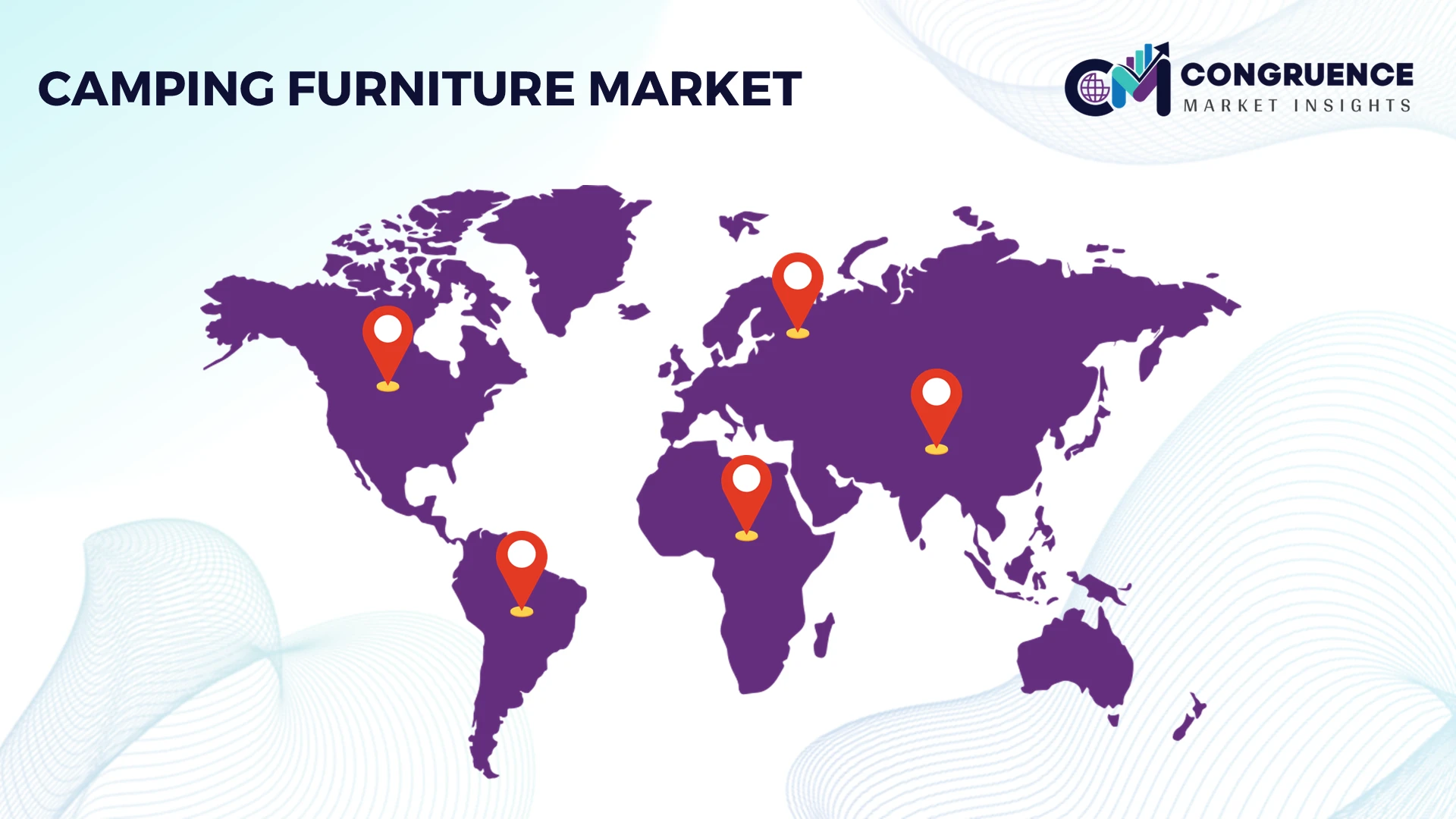
North America represented approximately 26.5% of the global camping furniture market in 2025, supported by mature camping participation, RV travel, specialty outdoor retail, and established e-commerce infrastructure. The U.S. contributes nearly 89% of regional demand, creating a highly concentrated commercial base for manufacturers. Chairs and stools account for more than half of regional product demand, reflecting strong preference for comfort-oriented portable furniture. Manufacturers are increasingly combining camping functionality with backyard, tailgating, festival, and recreational-vehicle applications, extending utilization beyond seasonal trips. Retailers are also expanding compact displays and coordinated furniture collections to improve cross-selling. The strategic opportunity lies in premium lightweight products that justify higher selling prices through ergonomic design, faster setup, and durable materials rather than basic portability alone.
U.S. Market Outlook: The U.S. remains the principal North American demand center because of its extensive camping, RV, national-park, and outdoor recreation ecosystem. More than 175 million Americans participated in outdoor recreation in 2023, supporting a broad consumer base for portable furniture. Manufacturers are emphasizing high-back seating, reinforced frames, compact folding systems, and furniture compatible with RV storage constraints. Direct-to-consumer channels are also helping premium brands introduce specialized products without relying entirely on physical retail expansion.
Europe accounted for approximately 22.2% of the global camping furniture market in 2025, supported by established camping, caravanning, festival, and nature-tourism activity. Germany, the U.K., France, Italy, and Spain form the principal demand corridor, with consumers placing greater emphasis on durability, packability, material quality, and product longevity. Limited urban storage space is strengthening demand for folding tables, stackable chairs, compact cots, and modular storage systems. Sustainability is also influencing product development as manufacturers increase recycled textiles, repairable components, and longer-life aluminum structures. Online distribution is expanding category access while specialty outdoor stores retain an important role for products where consumers need to assess comfort and folding mechanisms. Companies are therefore balancing digital reach with physical demonstration to support premium positioning.
U.K. Market Outlook: The U.K. represents a strategically significant European market because camping culture is closely connected with caravanning, festivals, staycations, and family outdoor travel. Retailers benefit from a dense specialty-store and garden-center network alongside strong e-commerce penetration. Premium consumers increasingly favor weather-resistant textiles, lightweight frames, and multi-functional furniture that can move between campsites, gardens, and festivals. Manufacturers are responding with coordinated furniture collections rather than isolated chairs or tables, improving accessory attachment and increasing average basket value.
Asia Pacific held the largest regional position at 31.6% in 2025 and is becoming the key manufacturing and consumption corridor for camping furniture. China provides substantial advantages in aluminum fabrication, textile processing, plastics, folding hardware, and contract manufacturing, while Japan, South Korea, and Australia support higher-value demand for lightweight and design-focused products. Rising domestic travel and outdoor recreation are broadening the customer base beyond specialist campers. E-commerce is particularly important for reaching emerging consumers in China, India, Southeast Asia, and Australia. Manufacturers are increasingly using standardized frames and modular components to reduce production complexity across multiple product variants. The strongest competitive model combines China's manufacturing scale with localized product adaptation, allowing brands to offer accessible entry-level furniture while maintaining premium ranges for experienced outdoor users.
China Market Outlook: China is the region's most strategically important manufacturing and consumption hub, supported by extensive furniture-component supply chains and rapidly expanding domestic outdoor recreation. Manufacturers benefit from established aluminum, steel, textile, and plastic processing capabilities that enable high-volume production across multiple price tiers. Domestic brands are increasingly developing lightweight chairs, compact tables, cots, and storage products for short-duration camping. Online retail also enables rapid product testing, customer feedback collection, and portfolio adjustments, shortening the cycle between design development and commercial rollout.
South America represents approximately 7.4% of the global camping furniture market, with Brazil serving as the primary commercial center. Demand is connected to beach travel, nature tourism, festivals, family recreation, and informal outdoor gatherings rather than only organized camping facilities. Brazil's large consumer base provides manufacturers with opportunities across entry-level chairs, folding tables, portable storage, and basic sleeping furniture. However, currency movements, import costs, and uneven specialty-retail coverage constrain premium product penetration. Regional distributors are therefore prioritizing products with simple construction, lower packed volume, and broad use cases. Companies entering the market are increasingly combining imported components with local distribution partnerships to improve inventory availability. The strongest opportunity is mid-priced furniture that delivers durability and portability without the logistics burden associated with oversized premium products.
Brazil Market Outlook: Brazil provides the strongest demand platform in South America because of its population scale, extensive coastline, outdoor tourism, and established sporting-goods distribution. Manufacturers can address multiple use occasions, including camping, beaches, fishing, festivals, and recreational events. Local distributors increasingly favor lightweight folding furniture because compact products reduce warehouse requirements and simplify transportation across long domestic distances. Product ranges using standardized components also allow suppliers to control replacement parts and manage inventory more efficiently across different retail channels.
Middle East & Africa accounted for approximately 12.3% of the global camping furniture market in 2025, with demand concentrated in the UAE, Saudi Arabia, and South Africa. Luxury camping, desert tourism, safari operations, resorts, and outdoor hospitality are creating commercial demand beyond individual campers. Saudi Arabia's tourism and leisure infrastructure expansion is supporting procurement opportunities for durable seating, tables, cots, and outdoor storage, while the UAE provides a strong premium-retail and hospitality distribution base. South Africa adds established safari and nature-tourism demand. The region remains import-dependent for many specialized products, making freight efficiency and supplier reliability important purchasing criteria. Manufacturers are increasingly developing weather-resistant materials, reinforced frames, and modular furniture sets suitable for repeated commercial deployment rather than single-use consumer camping.
Saudi Arabia Market Outlook: Saudi Arabia is emerging as a strategically important market because tourism development is expanding the requirement for outdoor hospitality equipment across desert destinations, resorts, camps, and recreational facilities. Large-scale tourism projects are creating demand for furniture capable of repeated deployment under high-temperature and dusty conditions. Suppliers are increasingly emphasizing UV-resistant fabrics, corrosion-resistant metal frames, compact storage, and easy-maintenance surfaces. Commercial buyers are also favoring coordinated furniture packages, enabling manufacturers to secure larger procurement contracts rather than relying exclusively on individual consumer sales.
Coleman competes with GCI Outdoor, ALPS Mountaineering, Helinox, and Camp Chef across value, comfort, portability, and premium design. Coleman leads at 14%, while the top five collectively hold 35%, leaving a large fragmented field for specialized brands. Competition centers on distribution scale, product engineering, price, and supply-chain responsiveness: Helinox differentiates through lightweight aluminum structures, while GCI emphasizes ergonomic seating and Coleman competes through broad availability. Online channels are gaining importance, while offline distribution still represents more than 73% in market assessments. Players are expanding portfolios, strengthening retailer partnerships, and integrating multifunctional features to raise product value. The competitive shift is moving from basic folding furniture toward lighter, modular, weather-resistant products with stronger lifestyle positioning. Entry barriers include established retail relationships, seasonal inventory requirements, tooling capabilities, and brand credibility. Winning requires supply, differentiated engineering, broad channel coverage, and rapid product refreshes converting portability and comfort into value.
The Coleman Company, Inc.
ALPS Mountaineering
Oase Outdoors ApS
Johnson Outdoors Inc.
GCI Outdoor
Kamp-Rite
Helinox
Recreational Equipment, Inc. (REI Co-op)
TREKOLOGY
Thule Group
CampTime
Big Agnes
NEMO Equipment
Kelty
Current technology is centered on lightweight aluminum alloys, shock-corded frames, high-strength textiles, and modular folding mechanisms. Advanced frame engineering can deliver roughly 20–30% lower weight than conventional steel furniture, improving portability and reducing transport burden. Premium manufacturers increasingly integrate ergonomic tension systems, reinforced joints, and compact packing architectures to strengthen durability without adding substantial mass.
Emerging products increasingly integrate recycled materials, weather-resistant coatings, adjustable joints, and multifunctional components. Dual-function furniture combining seating, storage, tables, and accessories can reduce equipment requirements by approximately 10–20% for selected camping setups. Recycled-material integration also reduces virgin-material dependence, while modular parts improve serviceability and replacement efficiency. Adoption is strongest in premium outdoor furniture, where lightweight construction differentiates brands and supports higher-value positioning.
Disruptive innovation is shifting toward ultralight engineering, collapsible systems, and furniture designed for multiple environments. New-generation products increasingly target backpacking, RV travel, festivals, glamping, and outdoor hospitality simultaneously. Between 2026 and 2028, advanced alloys, circular materials, and modular ecosystems will strengthen logistics efficiency, durability, product differentiation, and premium positioning. Early investment protects margins as retailers prioritize compact, durable products across channels.
March 2024 Helinox launched Table Four, a collapsible four-person camping table using bluesign-certified polyester and aluminum framing. Its 28.5-inch by 8.5-inch by 3-inch packed case improves transport efficiency and expands Helinox’s dining portfolio for group camping applications. Source: outdoorsportswire.com
September 2024 Crazy Creek introduced its Pack Table, manufactured entirely in Montana. The table compresses to a 6 x 6 x 2-inch cube and expands to a 12 x 12-inch surface, strengthening domestic production while addressing compact campsite storage needs. Source: outdoorindustry.org
May 2025 Hankook Tire and Helinox introduced Ball-Feet, a camping-chair accessory using racing-grade tire compounds. The product repurposes leftover racing compounds and improves grip on soft ground, creating an ESG-led collaboration extending tire technology into premium outdoor furniture markets. Source: helinox-hcc.com
March 2026 HEST entered camp furniture with its Foamy Camp Chair, extending its sleep-system expertise into seating. The product uses signature memory-foam comfort and packable construction, diversifying HEST’s portfolio and targeting camping, tailgating, and backyard relaxation segments globally. Source: outdoorsportswire.com
The Camping Furniture Market Report covers chairs and stools, tables, cots and hammocks, and other portable furniture across online and offline distribution channels. Geographic coverage spans North America, Europe, Asia Pacific, South America, and Middle East & Africa, with country-level analysis across major camping and outdoor-recreation markets. The scope also addresses premium, ultralight, modular, multifunctional, and sustainable furniture niches.
The analysis evaluates approximately 48–51% concentration around chairs and stools in major market assessments, alongside expanding table adoption and digital purchasing channels. It examines lightweight aluminum engineering, recycled materials, ergonomic structures, foldable mechanisms, and modular product ecosystems. The report supports investment planning, product portfolio expansion, regional entry, channel optimization, competitive positioning, and partnership decisions while identifying operational priorities shaping market direction between 2026 and 2033.
| Report Attribute / Metric | Details |
|---|---|
| Market Revenue (2025) | USD 540.0 Million |
| Market Revenue (2033) | USD 867.2 Million |
| CAGR (2026–2033) | 6.1% |
| Base Year | 2025 |
| Forecast Period | 2026–2033 |
| Historic Period | 2021–2025 |
| Segments Covered |
By Type
By Application
By End-User
|
| Key Deliverables | Revenue Forecast; Market Trends; Growth Drivers & Restraints; Technology Insights; Segmentation Analysis; Regional Insights; Competitive Landscape; Regulatory & ESG Overview; Recent Developments |
| Regions Covered | North America; Europe; Asia Pacific; South America; Middle East & Africa |
| Companies Profiled | The Coleman Company, Inc.; ALPS Mountaineering; Oase Outdoors ApS; Johnson Outdoors Inc.; GCI Outdoor; Kamp-Rite; Helinox; Recreational Equipment, Inc. (REI Co-op); TREKOLOGY; Thule Group; CampTime; Big Agnes; NEMO Equipment; Kelty |
| Customization & Pricing | Available on Request (10% Customization Free) |




